
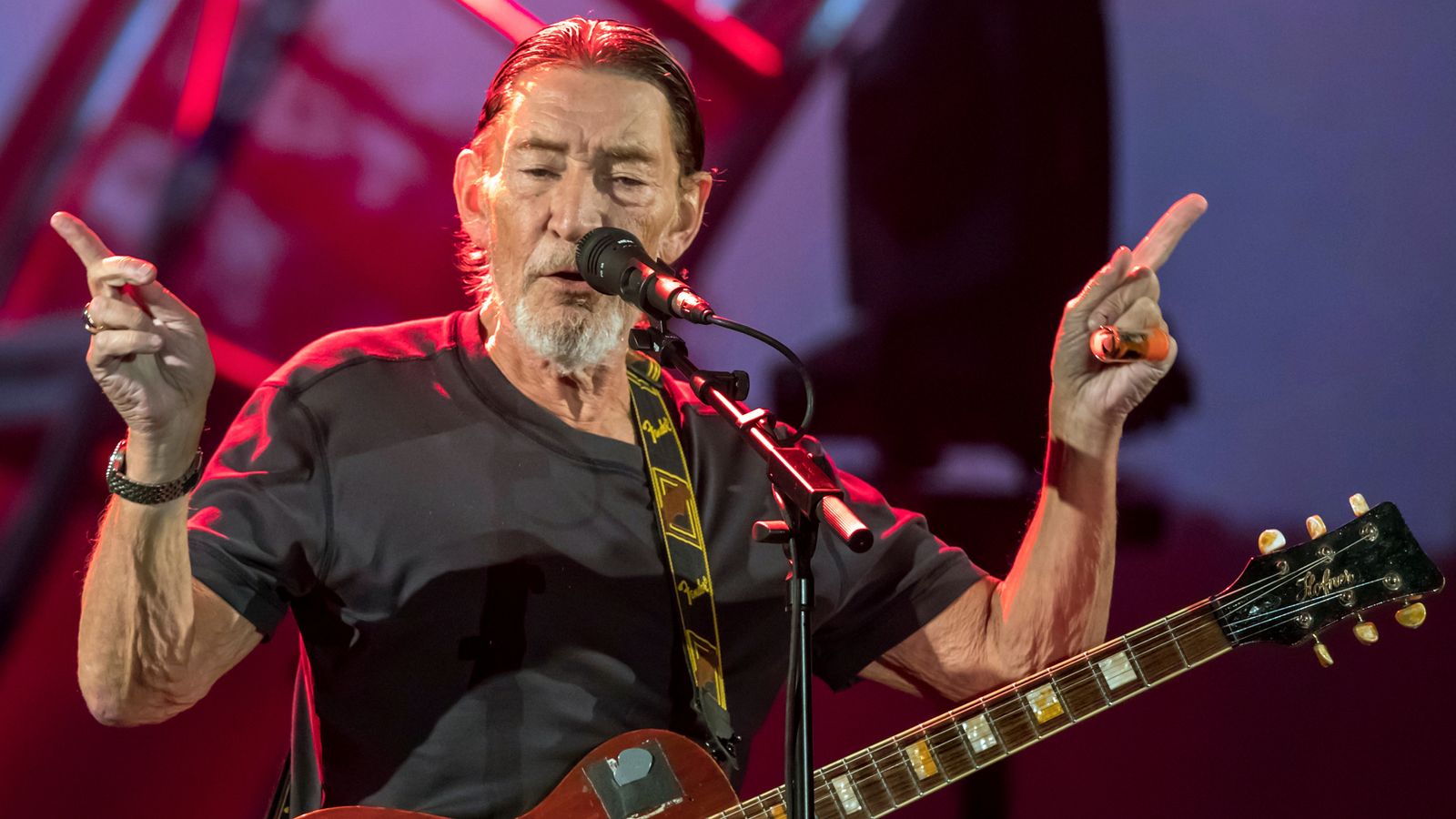
Chris Rea, known for hits including Driving Home For Christmas and The Road To Hell, has died after a short illness, according to a family spokesperson.
A statement on behalf of his wife and two children stated: “It is with immense sadness that we announce the death of our beloved Chris.
“He passed away peacefully in hospital earlier today following a short illness, surrounded by his family.”
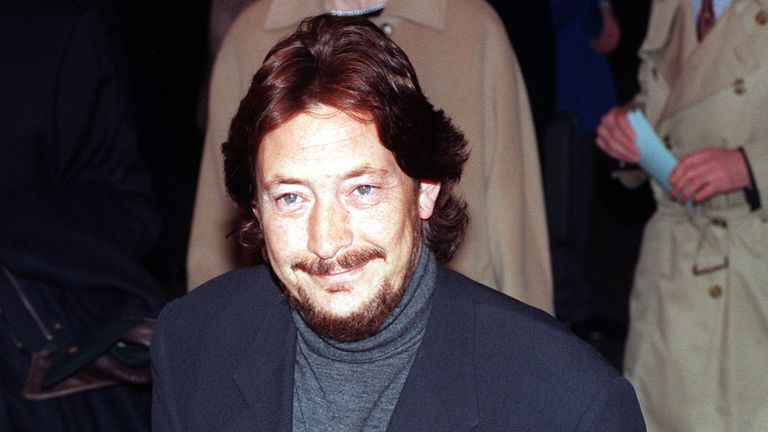
Chris Rea arrives at the Odeon Leicester Square for the opening of the London Film Festival in 1996. Pic: PA
The Middlesbrough-born musician was diagnosed with pancreatic cancer and had his pancreas removed in 2001, and in 2016 he suffered a stroke.
Follow our blog for the latest reactions to Chris Rea’s death
Rea found fame in the late seventies and eighties with hits such as Fool (If You Think It’s Over), Let’s Dance and The Road To Hell.
Known for his gravelly voice and latterly for his slide guitar playing, he was nominated for a slew of top awards, including Brit Awards, at the height of his success and sold millions of records.
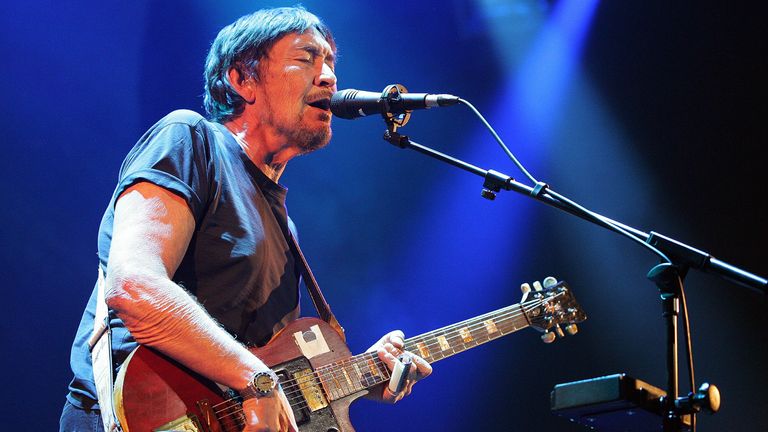
File pic: Glenn Ashley/ZUMA Press Wire/Shutterstock
Rea’s debut album, titled Whatever Happened To Benny Santini?, a reference to the stage name his record label wanted him to adopt, was released in 1978.
His track Fool (If You Think It’s Over), from the album, went on to be nominated for a Grammy.
He did not find such success again for a few years, but by the time his eighth album On The Beach was released, he was a star in the UK and around Europe, with sporadic hits in the US.
When Road To Hell was released in 1989, he became one of the biggest solo stars in the UK. Two of his studio albums – The Road To Hell (1989) and Auberge (1991) – went to number one in the country.
Read more from Sky News:
Trump’s new Greenland envoy intends to make territory “a part of the US”
Puppy farming and trail hunting to be banned
His famous song Driving Home For Christmas, first released in 1986, features in this year’s M&S Food Christmas advert – which sees comedian Dawn French sing along to the single in her car.
Speaking about the song during the 2020 Mortimer And Whitehouse Gone Fishing Christmas special, he told comedian Bob Mortimer: “I was on the dole when I wrote that.
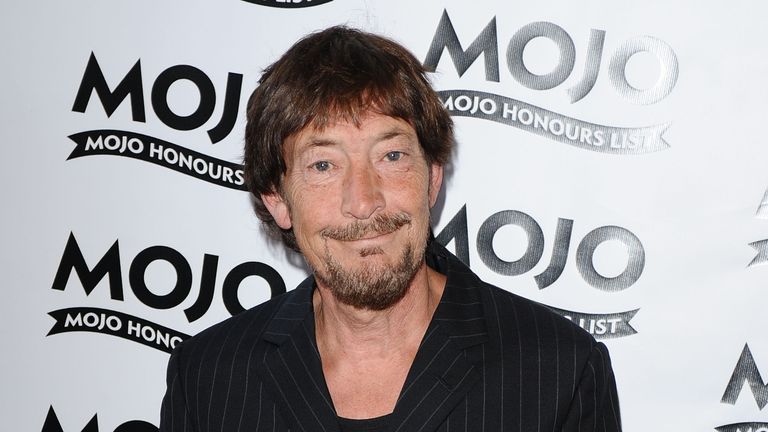
Chris Rea arrives at the Mojo Awards in 2009. Pic: PA
“My manager had just left me. I’d just been banned from driving, right. My now wife, Joan, she had to drive down to London, picked me up in the Mini, and take me home, and that’s when I wrote it.”
The singer returned to his blues roots after a string of health problems.
“I wasn’t frightened of dying,” he once said in an interview.
“It did look like the end, but what got me through was the thought of leaving a record that my two teenage daughters could say, ‘That’s what Papa did – not the pop stuff, but the blues music. That’s what he was about’.”
Chris Rea arrives at the Odeon Leicester Square for the opening of the London Film Festival in 1996. Pic: PA
Entertainment
Stars and fans including Liam Gallagher, Paul Weller and David Beckham gather for Gary ‘Mani’ Mounfield’s funeral

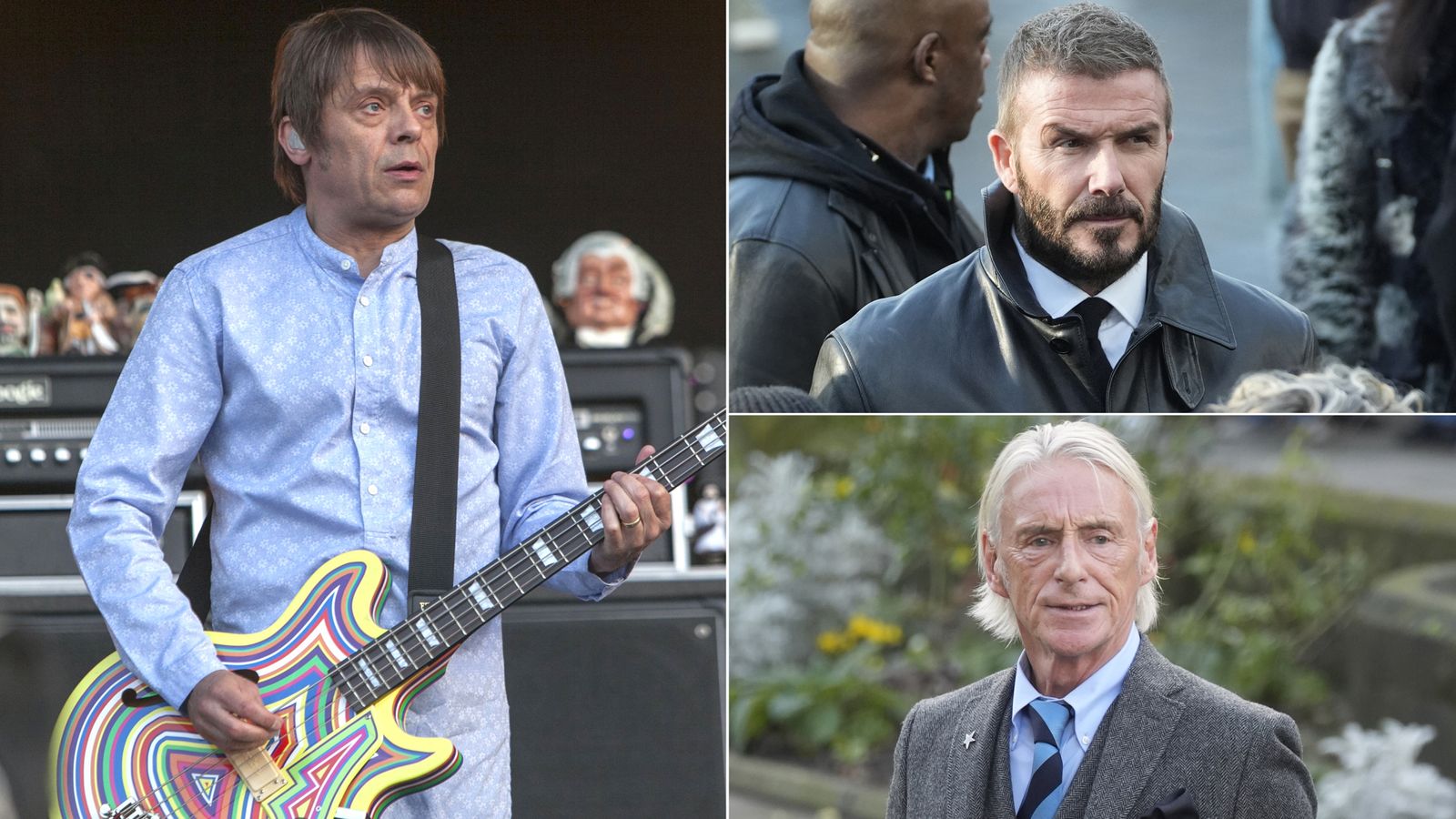
Stars including Liam Gallagher, David Beckham and Paul Weller have gathered to pay tribute to The Stone Roses star Gary “Mani” Mounfield.
The Stone Roses and Primal Scream bassist died last month at the age of 63.
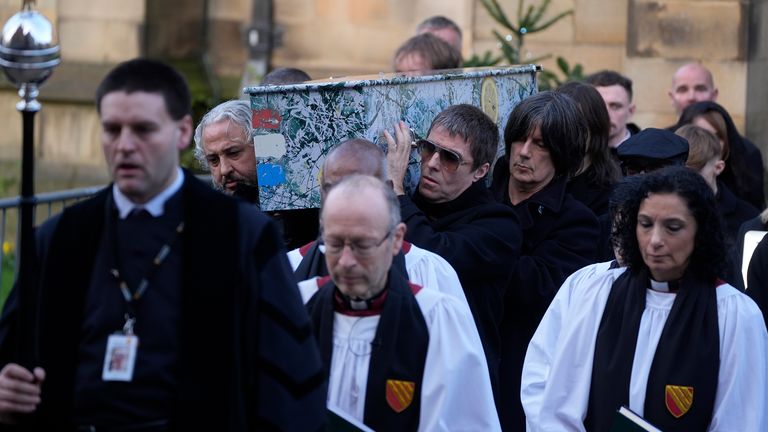
The coffin is carried from the ceremony by Alan Wren (L), Liam Gallagher (R) and John Squire (2nd R). Pic: PA
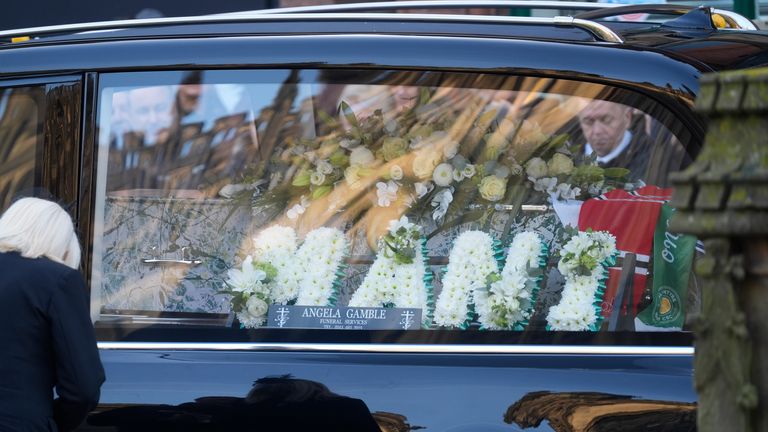
Pic: PA
His death came two years after that of his wife, Imelda Mounfield, who was diagnosed with stage 4 bowel cancer in November 2020. The couple welcomed twin boys in 2012.
He had been due to travel the UK later this year for an in-conversation tour sharing memories of his rock experiences.
Liveblog: Famous faces say final goodbye to Stone Roses bass player
The funeral, which was held at Manchester Cathedral, drew hundreds of fans, including a guard of scooter riders with black bands and a photo of Mani on their bikes.
Arriving at the service, The Stone Roses frontman Ian Brown said Mani was “a brother to me”, calling him a “beautiful human being”.
Some of the biggest names of British 1990s music were at the ceremony, including Oasis star Liam Gallagher, singer-songwriter Paul Weller, Primal Scream frontman Bobbie Gillespie and Bez, from the Happy Mondays.
Tim Burgess, lead singer of The Charlatans, Elbow frontman Guy Garvey, Ian McCulloch of Echo & The Bunnymen, Mike Joyce, drummer from The Smiths, Inspiral Carpets keyboardist Clint Boon, and former Joy Division and New Order bassist Peter Hook also came to pay tribute.
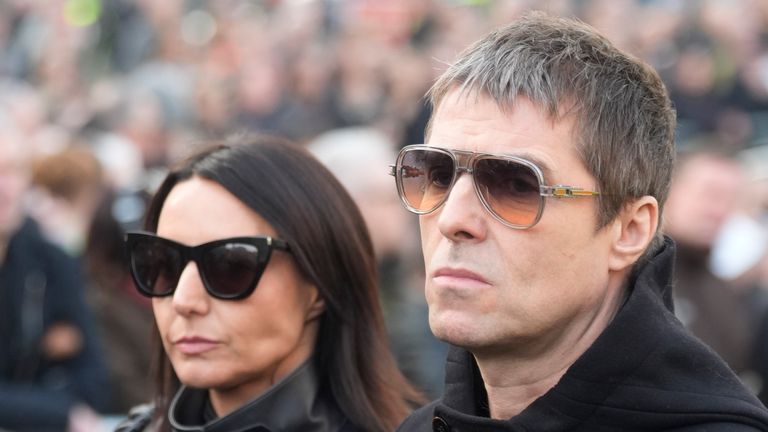
Liam Gallagher. Pic: PA
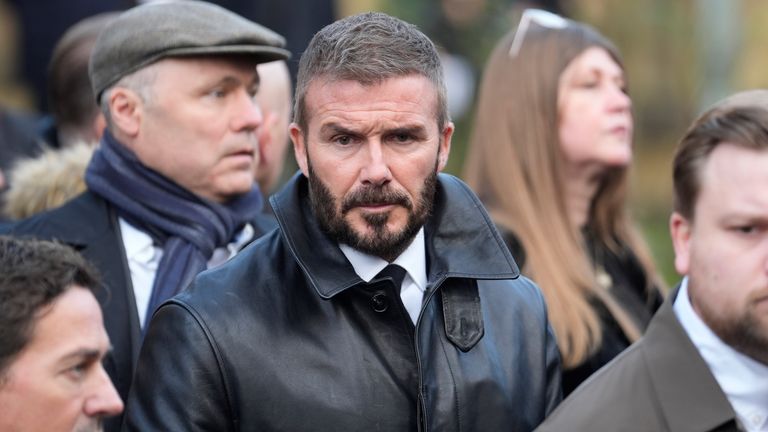
David Beckham. Pic: PA
Former Manchester United players David Beckham and Gary Neville were also among hundreds of mourners arriving for the service.
Manchester mayor Andy Burnham and Coronation Street star Sally Lindsay were also in attendance.
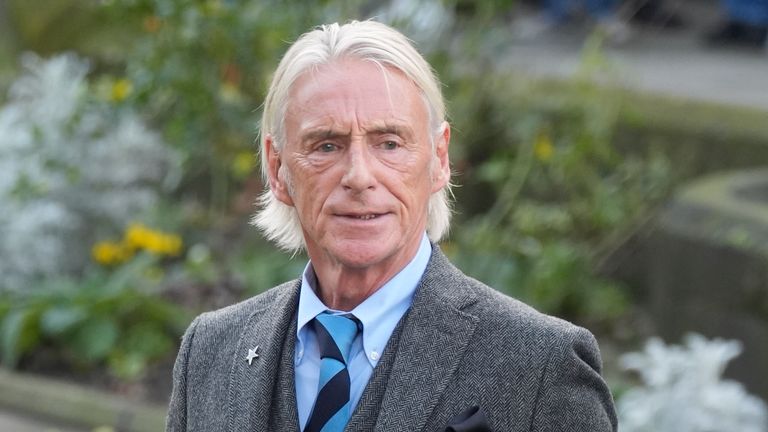
Paul Weller. Pic: PA
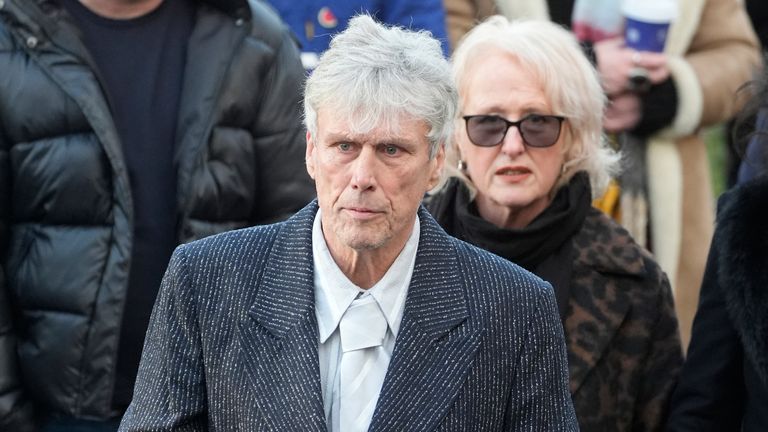
Bez from the Happy Mondays. Pic: PA
Hundreds more fans gathered outside the cathedral and applauded as the cortege arrived, and as I Wanna Be Adored – one of The Stone Roses’ biggest hits – blared from the speakers.
The coffin, which was decorated with artwork from the cover of The Stone Roses – the band’s self-titled debut album – had travelled around eight miles from Heaton Moor in Stockport to the cathedral.
Gallagher, along with The Stone Roses drummer Alan Wren – also known as Reni – and bandmate John Squire carried the coffin from the ceremony after the service.
Mani was part of the Stone Roses’ classic line-up alongside Brown, Squire and Wren.
Pausing briefly as he went into church, Brown said he was there to celebrate “what a beautiful human being that he was”.
Asked what his bandmate meant to him, the singer said: “Everything. He’s a brother to me.”
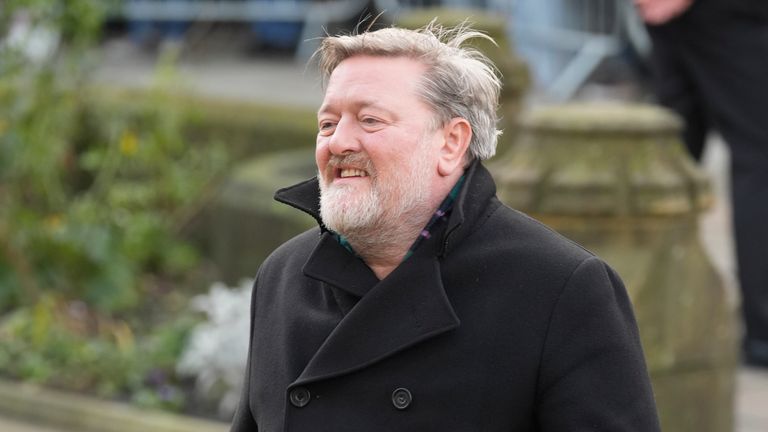
Guy Garvey, from Elbow, arriving for the funeral service of former The Stone Roses and Primal Scream bass player Gary Mounfield, who was known as Mani
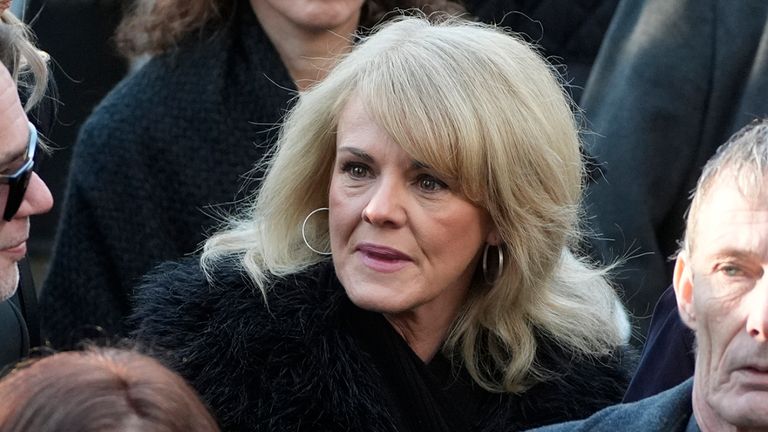
Actress Sally Lindsay. Pic: PA
Forming in 1983, Mani was part of The Stone Roses until they split in 1996, playing on both the eponymous debut album, released in 1989, and their 1995 follow-up, Second Coming.
The “Madchester” band was known for blending indie with acid house, psychedelia and pop.
Mani went on to play with Scottish band Primal Scream for 15 years, leaving in 2011 to rejoin the reuniting Roses.

The average person now has £38 less to spend each month after tax than they did at the end of 2024, following three consecutive quarters of falling UK living standards.
The government made “improving living standards across all every part of the UK” one of their most high profile targets to achieve before the next election.
The previous parliament, between December 2019 and July 2024, was the first in recorded British history to oversee a fall in disposable income in real terms.
But disposable income is now £1 lower per month than it was in summer 2019 after adjusting for inflation, according to Monday’s updated figures from the Office for National Statistics, and more than £20 lower than in December 2019.
Disposable income is the money people have left over after paying taxes and receiving benefits (including pensions).
Essential expenses like rent or mortgage payments, council tax, food and energy bills all need to be paid from disposable income.
Before 2022 there had been only one five-year period where living standards fell. That was between 2008 and 2013, following the financial crisis and austerity policies that followed.
There have been just five other occasions since the 1950s where disposable income fell for three consecutive quarters. Three of those were in the 2010s, with the others during the early 1960s and late 1970s.
The longest sustained fall was five consecutive quarters between December 2015 and March 2017, coinciding with the UK voting to leave the EU.
Simon Pittaway, Senior Economist at living standards think tank the Resolution Foundation, told Sky News:
“Today’s ONS data confirms that Britain’s mini living standards bounce in 2024 is well and truly over. Growth has been poor this year and prospects for 2026 aren’t looking great either.
“Stepping back, Britain’s big problem is that the country experienced three once-in-a-generation economic shocks in less than two decades [the 2008 financial crash, Brexit, and the cost of living crisis/COVID], with people in their mid-late 30s having spent their entire working lives lurching from one national crisis to another.
“We need to avoid further shocks so that we can focus instead on boosting economic growth and lifting living standards.”
Sky News has been tracking the government’s performance against some of their key economic targets, including living standards, inflation and growth.
Despite the now three quarters of decline, living standards are up overall since Labour took office, after rapid growth in their first six months continued the trend of the final few months of the outgoing government.
Inflation has risen however, and Britain is now the fourth-fastest growing G7 country behind the US, Japan and Canada. Use our tool to explore the country’s performance on other important metrics:
Responding to today’s figures, a spokesperson for the prime minister told reporters:
“Living standards dropped last parliament, but we’re working to improve them. Real wages have risen more in the last year than in the first 10 years of the previous government. This budget included help with energy bills, prescription fees, fuel duty and rail fares. It’s expected to help lower inflation next year, inflation fell to 3.2% in November.
“Lower interest rates, six of them so far since the election, will help people and businesses borrow and spend. And we’ve also raised the national living wage, giving full-time low earners £900 more a year, and those on the national minimum wage at £1,500 more a year.
“We are, of course, always seeking to do more on growth, the economy has grown faster than expected this year, and most forecasts have been upgraded.”
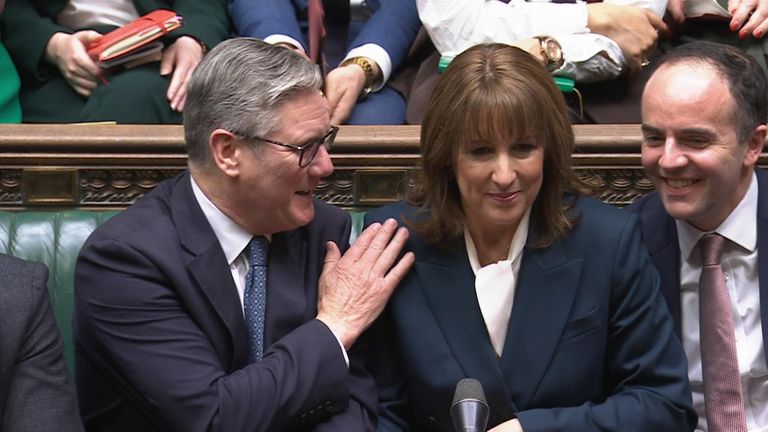
Rachel Reeves delivered her second budget in November, including a promise to end the two-child benefit cap and an extension to the tax threshold freeze
Following the budget in November, anti-poverty think tank the Joseph Rowntree Foundation projected that living standards would fall by £850 a year over the course of this parliament.
They also said that some actions at the budget, for example lifting the two-child benefit cap, would make the decline in living standards “less painful” for low-income households.
Frozen tax thresholds mean that many people will be paying thousands of pounds a year more tax in real terms by the end of this parliament than they do currently, however, including low earners.
Read more:
Budget tax threshold freeze: Use our calculator to see how much more you will pay
Sky News has also been tracking Labour’s performance against their key policy targets, like small boat Channel crossings, housebuilding and renewable energy.
Explore their performance towards those below:
Click here to read more information about why we picked these targets and how we’re measuring them.
The Data and Forensics team is a multi-skilled unit dedicated to providing transparent journalism from Sky News. We gather, analyse and visualise data to tell data-driven stories. We combine traditional reporting skills with advanced analysis of satellite images, social media and other open source information. Through multimedia storytelling we aim to better explain the world while also showing how our journalism is done.
-
 Sports2 years ago
Story injured on diving stop, exits Red Sox game
-
 Sports3 years ago
‘Storybook stuff’: Inside the night Bryce Harper sent the Phillies to the World Series
-
 Sports2 years ago
Game 1 of WS least-watched in recorded history
-
 Sports3 years ago
Button battles heat exhaustion in NASCAR debut
-
 Sports3 years ago
MLB Rank 2023: Ranking baseball’s top 100 players
-
Sports4 years ago
Team Europe easily wins 4th straight Laver Cup
-
 Environment3 years ago
Japan and South Korea have a lot at stake in a free and open South China Sea
-
 Environment1 year ago
Here are the best electric bikes you can buy at every price level in October 2024