

Top GCSE grades fall as hundreds of thousands of teenagers receive their results


Hundreds of thousands of teenagers have received their GCSE results with a slight drop in the proportion of top grades awarded from last year.
The approach to grading in England returned to pre-pandemic levels last year and this year exam regulators in Wales and Northern Ireland have also made the transition.
The Joint Council for Qualifications (JCQ) said the results are the biggest ever across the three nations with more than 6.5 million issued across GCSEs as well as Level 1 and 2 vocational and technical qualifications (VTQs).
Follow politics live updates: Starmer’s son among students getting GCSE results
The GCSE results are similar to last year, with more than a fifth of entries, or 21.8%, awarded the top grades – at least a 7 or A grade – slightly down on the 22% in 2023, but higher than the 20.8% in 2019 before the pandemic.
Nihal Shah receiving his GCSE results at Ark Pioneer in Barnet
Pic: PA
Some 67.6% of grades were awarded at 4 or C and above, which is considered the standard pass grade, compared with 68.2% in 2023 and 67.3% in 2019.
The overall rate for grades 1 or G or above is 97.9%, down from 98% in 2023 and 98.3% in 2019.
While traditional A* to G grades are used in Northern Ireland and Wales, in England these have been replaced with a 9-1 system, where 9 is the highest.
A 4 is broadly equivalent to a C grade, and a 7 is broadly equivalent to an A.
Prime Minister Sir Keir Starmer said in a post on X: “Congratulations to those receiving their GCSE results today – you’ve done an incredible job.
“I know the power of education and opportunity. My government will make sure everyone’s path is determined by their talent, skills and ambition, not where you come from.”

Pupils at Brighton College receiving their GCSE results. Hundreds of thousands of pupils in England, Wales and Northern Ireland are receiving grades to help them progress to sixth form, college or training. Picture date: Thursday August 22, 2024. PA
Education disruption due to COVID-19 led to an increase in top GCSE and A-level grades in 2020 and 2021, with results based on teacher assessments instead of exams.
Last week, the proportion of A-level entries awarded top grades rose on last year and surpassed pre-pandemic highs.
Many of the pupils who are receiving their GCSE results were in Year 7 when schools closed due to the pandemic.
Leaders in the education sector have warned that the cohort has had to overcome a series of challenges in their secondary schooling in recent years.

Keep up with all the latest news from the UK and around the world by following Sky News
GCSE entries increased by 4.8% to more than 6.1 million, resulting in just over 50,000 more top grades being awarded than last year.
Results remain higher for girls than boys, but the gap narrowed slightly, while the top ten most popular subjects remain the same as last year, with science double award staying top with a total of 980,786 entries.


A nine-year-old girl found dead in Weston-super-Mare has been named on the day police revealed a teenager had been charged with her murder.
Emergency services were called to Lime Close in the Somerset town at 6.09pm on Monday but Aria Thorpe was pronounced dead at the scene.
Police said a 15-year-old boy had been charged with her murder and that a preliminary post-mortem found she died from a single stab wound.
The teenage boy – who can’t be named due to his age – will appear at Bristol Magistrates’ Court later today.
A police cordon remains in place as forensics officers continue their work.
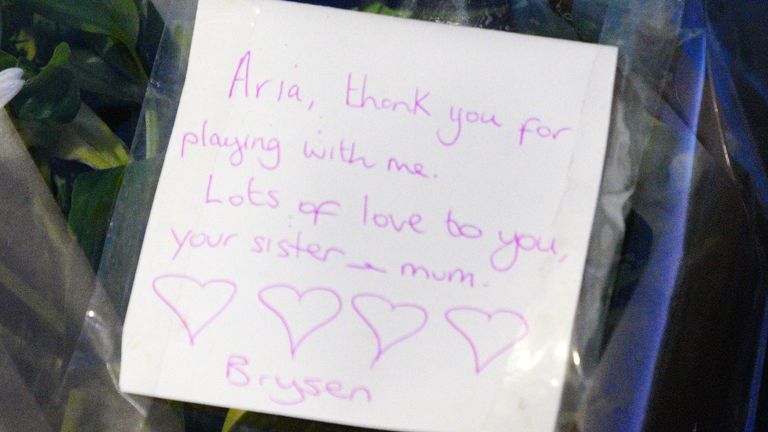
Flowers and tributes have been left at the scene. Pic: PA
Read more from Sky News:
NHS facing ‘worst-case scenario’ as doctors strike
Arrests over plot to steal ‘tonnes’ of charity clothes to fund crime
Superintendent Jen Appleford, from Avon and Somerset Police, said the community was in shock and Aria’s family were being supported by police.
“It is impossible to adequately describe how traumatic the past 36 hours have been for them and we’d like to reiterate in the strongest possible terms their request for privacy,” she said.
Supt Appleford said police were working with local schools and other agencies to make sure support is available.



Britain loves chocolate.
We’re estimated to consume 8.2kg each every year, a good chunk of it at Christmas, but the cost of that everyday luxury habit has been rising fast.
Whitakers have been making chocolate in Skipton in North Yorkshire for 135 years, but they have never experienced price pressures as extreme as those in the last five.
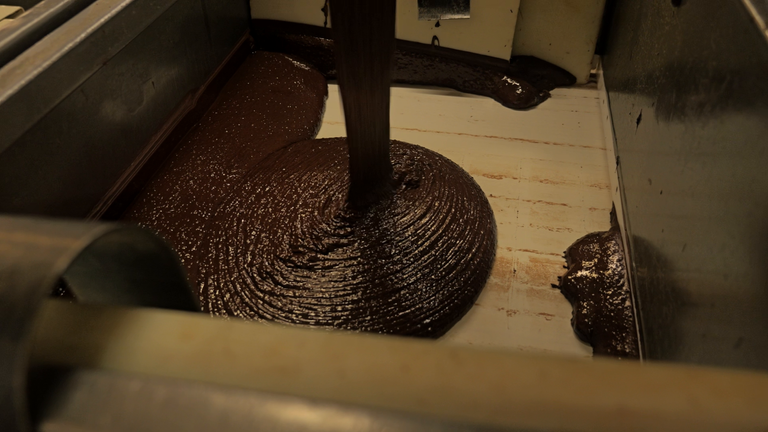
“We buy liquid chocolate and since 2023, the price of our chocolate has doubled,” explains William Whitaker, the real-life Willy Wonka and the fourth generation of the family to run the business.
William Whitaker, managing director of the company
“It could have been worse. If we hadn’t been contracted [with a supplier], it would have trebled.
“That represents a £5,000 per-tonne increase, and we use a thousand tonnes a year. And we only sell £12-£13m of product, so it’s a massive effect.”
Whitakers makes 10 million pieces of chocolate a week in a factory on the much-expanded site of the original bakery where the business began.
Automated production lines snake through the site moulding, cutting, cooling, coating and wrapping a relentless procession of fondants, cremes, crisps and pure chocolate products for customers, including own-brand retail, supermarkets, and the catering trade.

Steepest inflation in the business
All of them have faced price increases as Whitakers has grappled with some of the steepest inflation in the food business.
Cocoa prices have soared in the last two years, largely because of a succession of poor cocoa harvests in West Africa, where Ghana and the Ivory Coast produce around two-thirds of global supply.
A combination of drought and crop disease cut global output by around 14% last year, pushing consumer prices in the other direction, with chocolate inflation passing 17% in the UK in October.

Skimpflation and shrinkflation
Some major brands have responded by cutting the chocolate content of products – “skimpflation” – or charging more for less – “shrinkflation”.
Household-name brands including Penguin and Club have cut the cocoa and milk solid content so far they can no longer be classified as chocolate, and are marketed instead as “chocolate-flavour”.
Whitakers have stuck to their recipes and product sizes, choosing to pass price increases on to customers while adapting products to the new market conditions.
“Not only are major brands putting up prices over 20%, sometimes 40%, they’ve also reduced the size of their pieces and sometimes the ingredients,” says William Whitaker.
“We haven’t done any of that. We knew that long-term, the market will fall again, and that happier days will return.
“We’ve introduced new products where we’ve used chocolate as a coating rather than a solid chocolate because the centre, which is sugar-based, is cheaper than the chocolate.
“We’ve got a big product range of fondant creams, and others like gingers and Brazil nuts, where we’re using that chocolate as a coating.”

The costs are adding up
A deluge of price rises
Brazil nuts have enjoyed their own spike in price, more than doubling to £15,000 a tonne at one stage.
On top of commodity prices determined by markets beyond their control, Whitakers face the same inflationary pressures as other UK businesses.
“We’ve had the minimum wage increasing every year, we had the national insurance rise last year, and sort of hidden a little bit in this budget is a business rate increase.
“This is a small business, we turn over £12m, but our rates will go up nearly £100,000 next year before any other costs.
“If you add up all the cocoa and all the other cost increases in 2024 and 2025, it’s nearly £3m of cost increases we’ve had to bear. Some of that is returning to a little normality. It does test the relevance of what you do.”
-
 Sports2 years ago
Story injured on diving stop, exits Red Sox game
-
 Sports3 years ago
‘Storybook stuff’: Inside the night Bryce Harper sent the Phillies to the World Series
-
 Sports2 years ago
Game 1 of WS least-watched in recorded history
-
 Sports3 years ago
Button battles heat exhaustion in NASCAR debut
-
 Sports3 years ago
MLB Rank 2023: Ranking baseball’s top 100 players
-
Sports4 years ago
Team Europe easily wins 4th straight Laver Cup
-
 Environment3 years ago
Japan and South Korea have a lot at stake in a free and open South China Sea
-
 Environment1 year ago
Here are the best electric bikes you can buy at every price level in October 2024