
College Football Power Rankings: How did the top 25 look in Week 7?


Week 7 has wrapped up as this week’s matchups gave us some exciting endings along with Arizona State’s upset of No. 16 Utah on Friday. Four of the 17 games with top-25 teams went into overtime as the unranked looked to make it another chaotic weekend.
After a lopsided loss to No. 1 Texas, Oklahoma drops out of this week’s top 25 as the Sooners were held out of the end zone in this year’s Red River Rivalry matchup. Longhorns quarterback Quinn Ewers made his return after being out for 2½ games as Texas secured its second Red River Rivalry victory in six years.
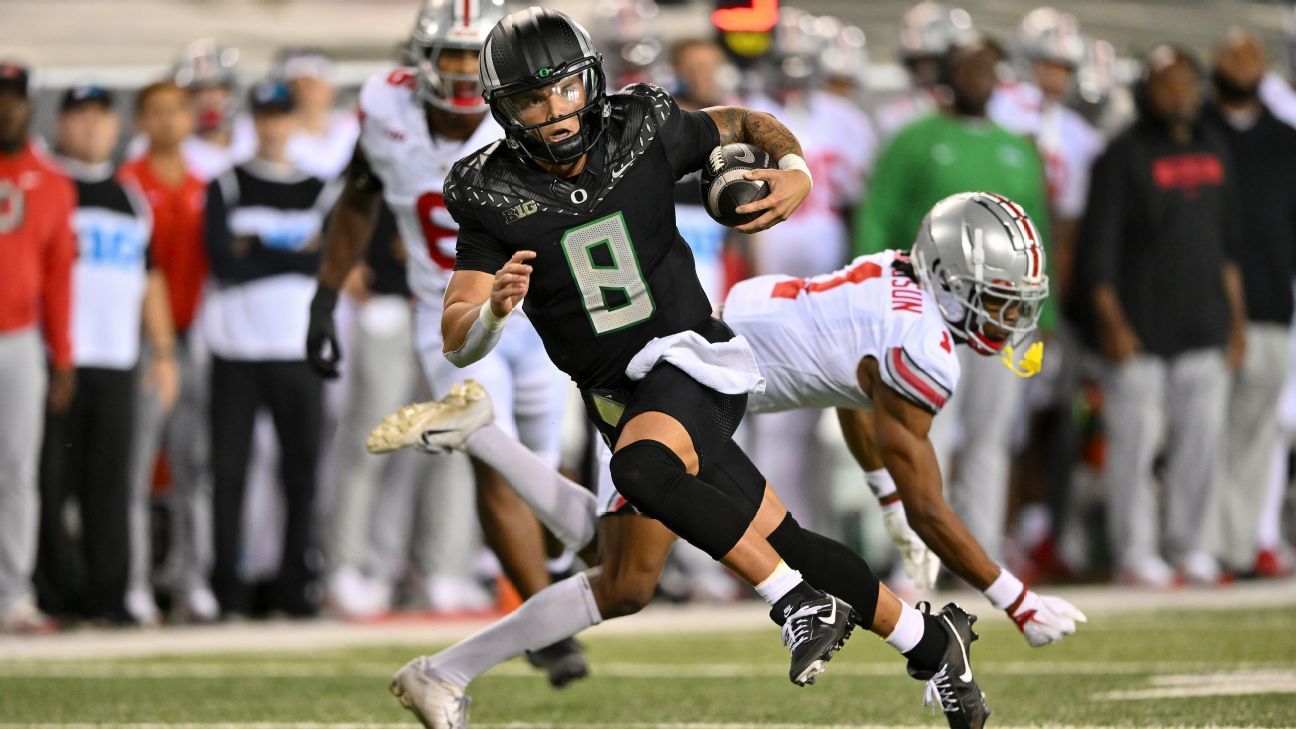
It was an exciting Saturday evening in Eugene, Oregon, as No. 3 Oregon took down No. 2 Ohio State in a matchup you didn’t want to miss. Dillon Gabriel and the Ducks’ offense showed they’re contenders for the Big Ten title even in their first year in the league.
After a 6-0 start, Army jumps four spots in our top-25 power ratings and is joined in the rankings by Navy, which remains undefeated as well, at the No. 24 spot. This is the first time since 1960 that both Army and Navy have been in the AP poll.
Here’s the latest top 25 from our college football experts, who provide their insight on each team’s Week 7 performance.
Previous ranking: 3
The Longhorns are 6-0 for the first time since 2009, and they’ve trailed for only 3½ minutes this year (after Oklahoma’s first-quarter field goal on Saturday). They’ve lost multiple running backs, including leading returning rusher from last year CJ Baxter, to season-ending injuries. And of course, starting quarterback Quinn Ewers missed 2½ games with an oblique injury only to see backup Arch Manning star in his place, yet there has been no hint of a quarterback controversy. ESPN’s FPI gives Texas a 61% chance of winning the SEC and a 32.8% chance to win the national championship, by far the best odds in the country.
The Longhorns have survived injuries, adversity, a road trip to Michigan and the annual test in Dallas against Oklahoma. At this point, their biggest obstacle is handling the expectations and the pressure, beginning with Saturday’s game against No. 5 Georgia, one of the most anticipated games of the season before a very manageable stretch at Vanderbilt, home against Florida, at Arkansas and home against Kentucky. If the Longhorns can walk the tightrope to get there, the Nov. 30 game at Texas A&M will be one of the most heated in the history of the rivalry, returning after 13 seasons with what would appear right now to be a lot on the line for both teams. — Dave Wilson
Previous ranking: 2
The Ducks took a major step toward advancing to the playoff and, potentially, the Big Ten championship in their first year in the league. Quarterback Dillon Gabriel and the Oregon offense were spectacular in the 32-31 victory over second-ranked Ohio State. Wideouts Evan Stewart and Tez Johnson showed they can make plays downfield against anyone.
Jordan James ran tough between the tackles to keep the Oregon running game rolling. And Gabriel underscored why he should be on the short list of Heisman Trophy contenders. The Ducks still have to travel to Michigan on Nov. 2. But otherwise, Oregon should be heavy favorites to win its other five remaining games. With a talented offense finding its groove, the Ducks are looking like legitimate national title contenders. — Jake Trotter
Previous ranking: 1
The controversial offensive pass interference penalty on receiver Jeremiah Smith and quarterback Will Howard‘s inexplicable decision to slide on the final play consumed the oxygen in Ohio State’s postgame news conference.
Yet the biggest reason the Buckeyes ultimately lost 32-31 at Oregon? Their defense got torched. The Ducks could’ve easily scored 20 more points.
Oregon missed a 43-yard field goal, came up with only three points off two drives that reached the 2-yard line, missed a pair of point-after tries and then had a spitting penalty that caused it to settle for a field goal. The Buckeyes didn’t force a turnover, didn’t record a sack and couldn’t slow Oregon’s running game. All-America cornerback Denzel Burke had a particularly rough night in man coverage. Ohio State’s season is far from over. But the Buckeyes will have to be much better defensively moving forward after failing their first big test. — Trotter
Previous ranking: 6
The Canes were off in Week 7, and that was probably a good thing. After back-to-back nail-biters that came down to the final play, Miami had a chance to regroup, recoup and refocus. A road trip to Louisville in Week 8 is likely the biggest obstacle still standing between the Canes and the ACC title game — and possibly an undefeated regular season — so the extra prep time helps.
More than anything, though, there’s a feeling that Cam Ward has turned this into a team of destiny. After come-from-behind wins against Virginia Tech and Cal, the latter in utterly improbable fashion, it’s hard to argue with the premise. — David Hale
Previous ranking: 4
It hasn’t been pretty or particularly flashy, but Penn State just keeps winning. The Nittany Lions are one of only three undefeated teams in the Big Ten after coming back from a 20-6 halftime deficit to USC and pulling off an overtime win. Despite a slow start, Penn State’s offense woke up from its slumber in the second half and utilized its tight end, Tyler Warren, to reignite quarterback Drew Allar.
There’s no doubt Allar is skilled — he finished with 391 yards on Saturday — but Penn State’s hopes in the second half of the season and beyond are banking on him being not just productive but consistent. The passing game is by far the part of PSU’s offense that needs the most work — it’s currently ranked 58th in the country in passing production. Yet after outlasting USC, the Nittany Lions should be favored in every game in the rest of their schedule but one: Ohio State at home on Nov. 2. — Paolo Uggetti
Previous ranking: 5
The good news for Georgia is that quarterback Carson Beck has found his groove. He passed for 459 yards and three touchdowns Saturday in a 41-31 win at home over Mississippi State, but Georgia also gave up 306 passing yards and three touchdowns to true freshman quarterback Michael Van Buren Jr., who was making just his second collegiate start. Moreover, Georgia (5-1, 3-1 SEC) could never completely put away Mississippi State, which has now lost five straight games. Beck did throw two interceptions, but in his past 10 quarters, he has thrown for 1,038 yards and eight touchdowns.
Georgia has bounced back (at least in the win column) from an abysmal first half against Alabama on Sept. 28, but the most important stretch of the season awaits, starting with a trip to No. 1 Texas this Saturday. After a bye week, Georgia then faces Florida on Nov. 2 in Jacksonville, travels to Ole Miss the following week and returns home to face Tennessee on Nov. 16. Getting through that gauntlet unscathed will be difficult unless the Dawgs clean it up across the board and play more consistently. — Chris Low
Previous ranking: 7
It has been a shaky past two weeks for Alabama and dangerously close to being disastrous. Coming off a 40-35 loss to Vanderbilt, Alabama held off determined South Carolina in the final seconds Saturday at home to squeak out a 27-25 victory. The Crimson Tide again had trouble getting off the field on defense, as the Gamecocks were 7-of-15 on third down and 1-of-2 on fourth down. Alabama (5-1, 2-1 SEC) built an early 14-0 lead, but the Gamecocks scored 19 unanswered points to take a 19-14 lead going into the fourth quarter.
Alabama quarterback Jalen Milroe made some big plays late to give the lead back to Alabama but also threw two interceptions. South Carolina had a chance in the final seconds to win it after recovering an onside kick, but Alabama’s Domani Jackson intercepted LaNorris Sellers in the end zone. There’s no taking away the win over Georgia last month, but Alabama hasn’t looked like a playoff team the past two weeks and has a trip to Tennessee next Saturday. — Low
Previous ranking: 8
The Tigers rolled through another opponent this past weekend, beating Wake Forest 49-14, the fourth time they scored 40 or more points this season. The offense has found a nice balance with Cade Klubnik (No. 5 in the nation in total QBR) and Phil Mafah (6.9 yards per rush), and the defense has held its past three opponents to two touchdowns or less.
Suddenly, Clemson looks like a favorite to make it back to the ACC championship game. There are some obstacles ahead — including Louisville and back-to-back road trips at Virginia Tech and Pitt. But if Clemson keeps playing consistently, the Tigers will control their destiny. — Andrea Adelson
Previous ranking: 10
The Cyclones quietly are 6-0 for the first time since 1938, following the 28-16 victory at West Virginia. Iowa State quarterback Rocco Becht continues to play efficiently, throwing for 265 yards and a touchdown. Becht has posted a QBR of 64 or above in every game this season, and now ranks 25th nationally in QBR (76.3).
With running back Carson Hansen adding three touchdowns, more than he had all of last season, and Jayden Higgins producing back-to-back 100-yard receiving games for the first time in his career, Iowa State’s offense is coming together. With Kansas State beginning to roll as well, Farmageddon in Ames on Nov. 30 could be for a berth in the Big 12 title game, and potentially a spot in the playoff, as well. — Trotter
Previous ranking: 12
With a 6-0 record at the halfway point of the regular season, BYU looks like a team destined for the playoff. The Cougars might not play a ranked team the rest of the regular season and, as things sit, would be favored against every team left on their schedule. Against Arizona on Saturday, BYU might have played its best game of the season.
It tied its season high with 41 points and forced four turnovers, running away with the game in the third quarter. The offense hasn’t exactly been explosive, but with the way BYU has played with control thanks to its stout defense, it has been necessarily effective. As quarterback Jake Retzlaff continues to improve, so should the Cougars. — Kyle Bonagura
Previous ranking: 16
The Tigers’ growth on defense under first-year coordinator Blake Baker is obvious and remarkable, and showed up in huge ways during Saturday night’s come-from-behind overtime win against Ole Miss. Baker’s bunch bought a struggling Garrett Nussmeier and the offense enough time to rally and eventually win, but even if LSU had fallen short, the progress showed. Consider that LSU allowed 55 points and 706 yards — by far the highest total the Tigers had allowed — to Ole Miss in 2023, and already lost top defender Harold Perkins Jr. to a season-ending knee injury.
Continued excellence from players like Bradyn Swinson, Greg Penn III and Whit Weeks has given the defense a new streak of confidence. Nussmeier admitted Saturday was one of his worst performances, and he will need to be more efficient during a second-half schedule that includes Alabama, Texas A&M and others. But coach Brian Kelly is finally seeing his team’s performance match its preparation, which keeps the College Football Playoff very much in play. — Adam Rittenberg
Previous ranking: 13
The Irish have managed to get themselves back into playoff contention after a tough loss to Northern Illinois in Week 2. A 49-7 win over Stanford has given the Irish four wins in a row. Riley Leonard threw for 229 yards and three touchdowns in the win, while the Irish racked up 229 yards rushing and four TDs on the ground. But the road ahead looks a lot more difficult now than it did when the season began.
Georgia Tech has proved to be resilient and excellent running the ball; meanwhile Army and Navy are both undefeated. Virginia is also a vastly improved team. Still, if Notre Dame can win out, the Irish would be in great position to earn an at-large playoff spot. — Adelson
Previous ranking: 14
After a historic first half, Indiana had a chance to exhale and reflect on a 6-0 start with so many statistical ties to 1967, the last time the Hoosiers shared a Big Ten title. But to actually end the streak without a championship, IU must navigate a second-half schedule that begins with Nebraska and also features Ohio State, Michigan and Washington.
Nebraska’s 3-3-5 defense will pose the biggest challenge to date for an Indiana offense that has eclipsed 40 points in five consecutive games for the first time in team history, and boasts nine scoring drives of 10 plays or more, which matches the team’s total from 2023. Quarterback Kurtis Rourke, the first IU player since 1967 to record three or more touchdown passes in three Big Ten games, faces a Huskers defense with seven interceptions. Mikail Kamara (five sacks, 7.5 tackles for loss) and the IU defense will try to fluster Dylan Raiola in the most anticipated Hoosiers home game in many years. — Rittenberg
Previous ranking: 9
Josh Heupel said it more than once Saturday night. It hasn’t been perfect for his Vols, especially on offense, but they managed to squeeze past Florida 23-17 in overtime after being held scoreless in the first half for the second straight week. They weren’t able to overcome that drought a week ago in a 19-14 loss to Arkansas, but survived at home thanks to a defense that stood its ground in key moments. Florida led 3-0 at the half, but it could have easily been 21-0.
The Gators managed just one field goal in four trips inside the 20-yard line in the first half, and Tennessee defensive end James Pearce Jr. forced a fumble inside the 1 when he stripped the ball away from quarterback Graham Mertz. The Vols (5-1, 2-1 SEC) still have some serious polishing to do in their passing game, but they are leaning on a defense right now that has yet to give up more than 19 points in all six games this season. — Low
Previous ranking: 15
The Aggies’ passing game faltered in their only loss, a 23-13 defeat to Notre Dame, with Conner Weigman going 12-of-30 for 100 yards and two interceptions. Weigman suffered an AC joint injury in the game and reaggravated it the following week against McNeese, with redshirt freshman Marcel Reed stepping in. Reed polished off that win, then started three games in place of Weigman and accounted for eight scores with no interceptions, including six TD passes. But he never topped 178 yards in the three games and completed 54.4% of his passes on the season.
The Aggies saw the potential of their offense when Weigman returned, going 18-of-22 for 276 yards in a 41-10 blowout of No. 9 Missouri, with Weigman delivering precision back-shoulder throws and fitting passes into tight windows. The Aggies rank 112th nationally in passing at 181 yards per game, but Weigman’s efficiency could be a game changer. — Wilson
Previous ranking: 17
The Heisman Trophy résumé for Ashton Jeanty gets better every week. This time, college football’s leading rusher put up 217 rushing yards, 20 receiving yards and two total touchdowns on 34 touches in the Broncos’ 28-7 road win at Hawai’i.
Jeanty has set the bar so impossibly high that a 217-yard rushing performance against the No. 1 scoring defense in the Mountain West actually dropped his season average down to 208 yards per game. Boise State’s defense pitched a shutout in the second half and sacked Hawai’i quarterback Brayden Schager eight times. The Broncos have an idle week up next before their much-anticipated showdown with UNLV in Las Vegas on Oct. 25. — Max Olson
Previous ranking: 19
The Panthers are 6-0 for the first time since 1982 after a 17-15 win over Cal and had to rely on their defense to stay undefeated after an uncharacteristically off day from quarterback Eli Holstein. Pitt racked up a season-high six sacks and held Cal to under 100 yards rushing.
After an open date, Pitt faces six opponents that all have winning records — including SMU and Clemson (both undefeated in league play). Holstein threw two interceptions and Pitt had only 277 yards of offense, so that is one area that is sure to be emphasized on the open date this week. — Adelson
Previous ranking: 18
K-State proved its toughness late Saturday night in a thrilling 31-28 win at Colorado. The Wildcats could’ve fallen apart in a last-minute meltdown after the Buffaloes grabbed the lead with 3:12 left thanks to a fourth-down interception by Avery Johnson. The young QB rallied in the clutch, responding with a three-play touchdown drive capped by a 50-yard strike to Jayce Brown.
Running back DJ Giddens (220 total yards) was impressive all night long and now leads the Big 12 in rushing yards, and the Wildcats succeeded in applying consistent pressure to Shedeur Sanders and getting stops when they needed them. Up next is another tough road test at 3-3 West Virginia. — Olson
Previous ranking: 22
The Mustangs took the week off, but with BYU chugging along to 6-0, SMU’s lone loss looks better and better. It was a game in which the Mustangs probably outplayed BYU, too, and it’s impossible to argue the notion that the Mustangs have taken a big step forward since turning the offense over to Kevin Jennings.
The rest of the slate is manageable, too — though a Week 10 date with Pitt looms large — and the once long-shot odds for an ACC title game appearance now seem entirely reasonable. — Hale
Previous ranking: 11
Lane Kiffin has a CFP-caliber roster but likely will not get the Rebels their first CFP appearance. The team’s margin for error is gone after its second loss in three games. Undoubtedly most frustrating for Kiffin is that his offense, led by quarterback Jaxson Dart and a host of dynamic wide receivers and backs, looked shockingly ordinary in both setbacks. Ole Miss could have put away LSU with one touchdown drive in the second half but could not reach the end zone despite four consecutive possessions that went inside the LSU 30-yard line.
Sacks allowed and penalties really hurt the Rebels. Dart, Tre Harris and others continue to put up numbers, but they feel empty without the touchdowns and wins in the biggest games. Ole Miss still can gain CFP consideration by winning out, which would include a Nov. 9 home clash against Georgia. But the Rebels could easily be undefeated with a team that made clear upgrades on defense and retained most of its top pieces. — Rittenberg
Previous ranking: 25
Army just keeps rolling. The Black Knights moved to 6-0 for the season with a 44-10 romp over UAB on Saturday in West Point. They rolled to 515 total yards, with quarterback Bryson Daily throwing for 102 yards and one touchdown (on just three completions, naturally) and rushing for 136 yards and four scores.
Against an admittedly weak (to date) schedule, they’ve won by an average score of 40-10, and they’re one of just two teams (along with Indiana) who have yet to trail in 2024. They will be solid favorites in each game between now and Week 13, when they face Notre Dame at Yankee Stadium. Then they could look to either one or two games against Navy late in the year. What a story this is becoming. — Bill Connelly
Previous ranking: 23
Mizzou made an odd, mid-October trip to Amherst, Massachusetts, in search of confidence after a blowout loss to Texas A&M. The Tigers certainly didn’t find much resistance from host UMass: Brady Cook completed 14 of 19 passes for 219 yards and two scores, and Mizzou rolled to a 45-3 win. The Tigers’ offense, disappointing thus far, gained 461 yards while mostly taking the fourth quarter off.
Star Luther Burden III caught five balls for 59 yards and rushed for a 61-yard touchdown; he left the game in the third quarter with a shoulder injury that coach Eliah Drinkwitz downplayed after the game. The Tigers were preseason CFP contenders because of that offense, and it must now show up against a pair of opponents far more stout than UMass: Auburn in Week 8 and Alabama in Week 9. — Connelly
Previous ranking: 24
The Illini improved to 5-1, but their defense, which had risen to No. 12 in points allowed, cratered for the first time against a new-look Purdue offense. Illinois saw a 27-3 third-quarter lead disappear as the Boilers piled up 40 points in the final 22:43 of regulation and scored on their lone overtime possession before linebacker Dylan Rosiek stifled the decisive 2-point conversion attempt. Coordinator Aaron Henry must figure out how such a strong defense surrendered 382 yards and 14 first downs to a left-for-dead Purdue team after halftime.
Illinois can still contend in the Big Ten and for a CFP spot, but the next two weeks will be pivotal as it hosts Michigan and then travels to Oregon. The good news is the Illini continue to get strong play from quarterback Luke Altmyer (379 passing yards, three touchdowns, no interceptions against Purdue), and they sparked their run game with 177 yards and three touchdowns Saturday. — Rittenberg
Previous ranking: NR
Navy had a bye week to bask in the glow of an unbeaten start. The Midshipmen have won five games by an average score of 44-20, and that includes a potentially vital conference win over Memphis in Week 4. Quarterback Blake Horvath leads the nation in Total QBR, with 771 passing yards and 565 rushing yards.
The Midshipmen won their past two games on the road, and any hopes of an unbeaten finish will require continuing the road warrior mentality: They’ve got only two games left in Annapolis. They’ll face Notre Dame in East Rutherford, New Jersey, in Week 9, and they have only one home game between now and a potentially huge visit from Tulane in Week 12. So far, so good. — Connelly
Previous ranking: NR
After an idle week, Nebraska hits the road to face No. 16 Indiana in a showdown that will validate whichever team wins as a legitimate factor in the Big Ten race. Just as important, the 5-1 Huskers have a chance to finally break an ignominious streak. A sixth win would mean bowl eligibility in Year 2 under Matt Rhule, ending the longest active bowl game drought among all Power 4 programs. How long has it been? Nebraska’s last holiday road trip was the 2016 TransPerfect Music City Bowl, a 38-24 loss to a Tennessee squad led by Butch Davis that featured Josh Dobbs and Alvin Kamara. — Olson

-
Dan Wetzel
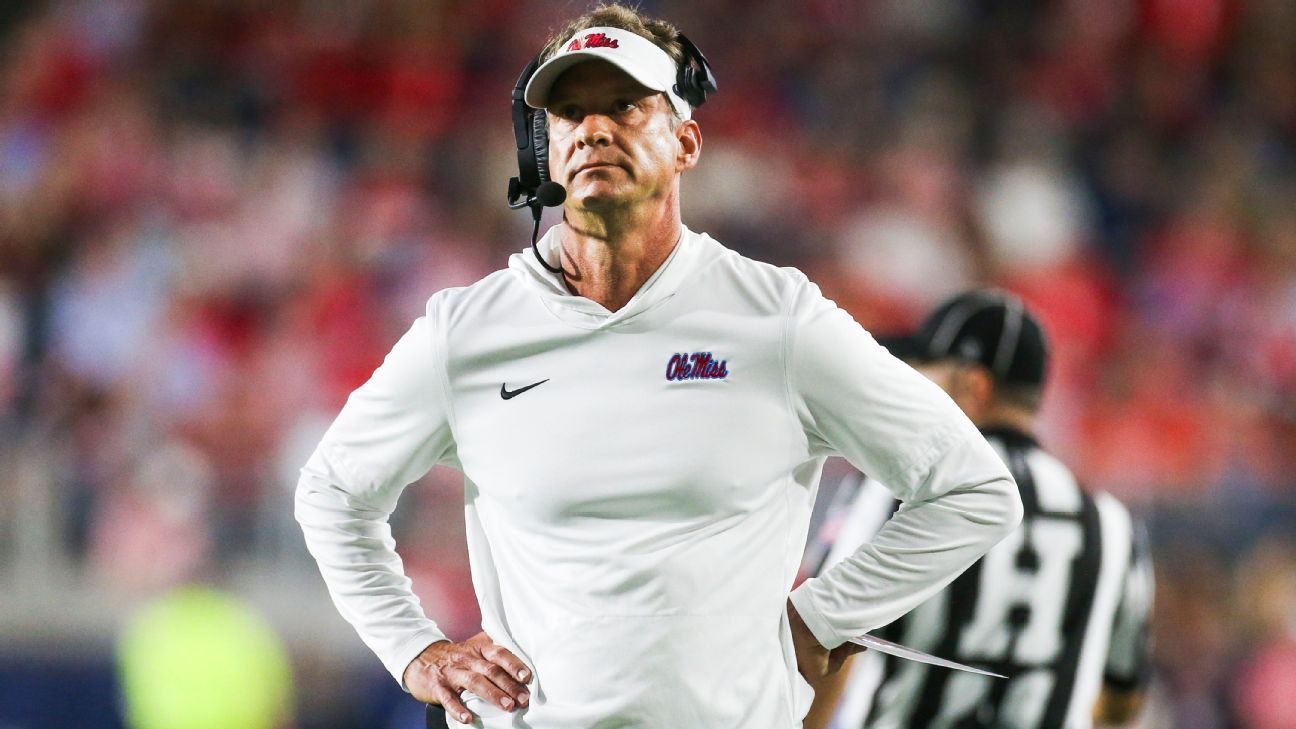
As victims go, Lane Kiffin doesn’t seem like one.
He could have stayed at Ole Miss, made over $10 million a year, led his 11-1 team into a home playoff game and become an icon at a place he supposedly found personal tranquility. Or he could’ve left for LSU to make over $10 million a year leading a program that has won three national titles this century.
Fortunate would be one description of such a fork in life’s road. The result of endless work and talent would be another.
But apparently no one knows a man’s burdens until they’ve walked a mile in his hot yoga pants.
Per his resignation statement on social media, it was spiritual, familial and mentor guidance that led Kiffin to go to LSU, not all those five-star recruits in New Orleans.
“After a lot of prayer and time spent with family, I made the difficult decision to accept the head coaching position at LSU,” he wrote.
In an interview with ESPN’s Marty Smith, Kiffin noted “my heart was [at Ole Miss] but I talked to some mentors, Coach [Pete] Carroll, Coach [Nick] Saban. Especially when Coach Carroll said, ‘Your dad would tell you to go. Take the shot.'” Kiffin later added: “I talked to God, and he told me it’s time to take a new step.”
After following everyone else’s advice, Kiffin discovered those mean folks at Ole Miss wouldn’t let him keep coaching the Rebels through the College Football Playoff on account of the fact Kiffin was now, you know, the coach of rival LSU.
Apparently quitting means different things to different people. Shame on Ole Miss for having some self-esteem.
“I was hoping to complete a historic six-season run … ,” Kiffin said. “My request to do so was denied by [Rebels athletic director] Keith Carter despite the team also asking him to allow me to keep coaching them so they could better maintain their high level of performance.”
Well, if he hoped enough, Kiffin could have just stayed and done it. He didn’t. Trying to paint this as an Ole Miss decision, not a Lane Kiffin decision, is absurd. You are either in or you are out.
Leaving was Kiffin’s right, of course. He chose what he believes are greener pastures. It might work out; LSU, despite its political dysfunction, is a great place to coach ball.
Kiffin should have just put out a statement saying his dream is to win a national title, and as good as Ole Miss has become, he thinks his chance to do it is so much better at LSU that it was worth giving up on his current players, who formed his best and, really, first nationally relevant team.
At least it would be his honest opinion.
Lately, the 50-year-old Kiffin has done all he can to paint himself as a more mature version of a once immature person. In the end, though, he is who he is. That includes traits that make him a very talented football coach. He is unique.
He might never live down being known as the coach who bailed on a title contender. It’s his life, though. It’s his reputation.
One of college sports’ original sins was turning playcallers into life-changers. Yeah, that can happen, boys can become men. A coach’s job is to win, though.
A great coach doesn’t have to be loyal or thoughtful or an example of how life should be lived.
This is the dichotomy of what you get when you hire Kiffin. He was on a heater in Oxford, winning in a way he never did with USC or Tennessee or the Oakland Raiders.
That seemingly should continue at resource-rich LSU. Along the way, you get a colorful circus, a wrestling character with a whistle, a high-wire act that could always break bad. It rarely ends well — from airport firings to near-riot-inducing resignations to an exasperated Nick Saban.
LSU should just embrace it — the good and the not so good. What’s more fun than being the villain? Kiffin might be a problem child, but he’s your problem child. It will probably get you a few more victories on Saturdays. He will certainly get you a few more laughs on social media.
It worked for Ole Miss, at least until it didn’t. Then the Rebels had to finally push him aside. This is Lane Kiffin. You can hardly trust him in the good times.
If anything, Carter had been too nice. He probably should have demanded Kiffin pledge his allegiance weeks back, after Kiffin’s family visited Gainesville, Florida, and Baton Rouge.
Instead, Kiffin hemmed and hawed and extended the soap opera, gaining leverage along the way.
Blame was thrown on the “calendar,” even though it was coaches such as Kiffin who created it. And leaving a championship contender is an individual choice that no one else is making.
Blame was put on Ole Miss, like it should just accept desperate second-class hostage status. Better to promote defensive coordinator Pete Golding and try to win with the people who want to be there.
To Kiffin, the idea of winning is seemingly all that matters. Not necessarily winning, but the idea of winning. Potential playoff teams count for more than current ones. Tomorrow means more than today. Next is better than now.
Maybe that mindset is what got him here, got him all these incredible opportunities, including his new one at LSU, where he must believe he is going to win national title after national title.
So go do that, unapologetically. Own it. Own the decision. Own the quitting. Own the fallout. Everything is possible in Baton Rouge, just not the Victim Lane act.

Closer Ryan Helsley and the Baltimore Orioles are in agreement on a two-year, $28 million contract that includes an opt-out after the first season, sources told ESPN, continuing the remaking of Baltimore’s beleaguered pitching staff with one of the most sought-after relievers on the free agent market.
While multiple teams sought to sign Helsley as a starter, the 31-year-old right-hander chose to remain in the role that made him a two-time All-Star and will hand him the ninth inning for the Orioles while retaining the ability to reach the open market after 2026.
Helsley, whose deal is pending a physical, is the second bullpen addition of the winter for Baltimore, which reacquired right-hander Andrew Kittredge from the Cubs after dealing him to Chicago at the trade deadline. With a moribund pitching staff, the Orioles went 75-87 and finished in last place in the American League East after consecutive postseason berths.
Orioles president of baseball operations Mike Elias trawled the free agent market for a late-inning option and landed on Helsley, who over his seven-year career has a 2.96 ERA in 319⅔ innings with 377 strikeouts, 133 walks and 105 saves.
Among the lowest points were the final two months of Helsley’s 2025 season, when, following a deadline deal from St. Louis to the New York Mets, he posted a 7.20 ERA and allowed 36 baserunners in 20 innings. Coming off an All-Star showing for St. Louis in 2024, which included a National League-leading 49 saves and a 2.04 ERA, Helsley saved 21 games with a solid 3.00 ERA for the Cardinals before the deadline, when he was sent to the Mets for three prospects.
Acquired to deepen a New York bullpen anchored by closer and fellow free agent Edwin Diaz, Helsley struggled badly during his time with the Mets. He blew saves in three straight appearances in mid-August and spent most of the past month working in low-leverage situations as New York collapsed down the stretch and missed the postseason.
Baltimore saw more noise than signal in Helsley’s downturn and is banking on Helsley’s stuff — which pitch-quality metrics rate as some of the best in the game — returning him to dominance. Helsley deploys one of baseball’s hardest fastballs, which averaged 99.3 mph in 2025, according to Statcast, ranking in the 99th percentile of all pitchers.
With incumbent closer Felix Bautista expected to miss the 2026 seasons following rotator cuff and labrum surgeries in August, the Orioles entered the winter with only right-hander Yennier Cano and left-hander Keegan Akin as veteran bullpen options. Beyond Helsley and Kittredge, Baltimore could add another reliever, sources said. The Orioles’ need for pitching help isn’t limited to their bullpen, either. Following the trade of Grayson Rodriguez to the Los Angeles Angels for left fielder Taylor Ward, Baltimore continues to pursue starting-pitching options to join left-hander Trevor Rogers and right-hander Kyle Bradish at the top of their rotation, sources said.
A fifth-round pick out of Northeastern State in Oklahoma, Helsley was a full-time starter throughout the minor leagues until he joined the Cardinals’ big league roster. From 2022 to ’24, he was arguably the most valuable reliever in the NL, alongside right-hander Devin Williams, a free agent with whom the Orioles spoke as well.
ESPN’s Bradford Doolittle contributed to this report.
Sports
Will there be baseball in 2027? Is a salary cap coming? What you need to know about MLB’s looming labor battle

Is Major League Baseball headed for disaster?
One year from today — on Dec. 1, 2026, at 11:59 p.m. ET, to be exact — the league’s current labor agreement expires.
As the owners and players look to agree on a new collective bargaining agreement, there are major hurdles to clear and some key areas of disagreement.
Will we see a work stoppage in 2027? Is a salary cap coming? ESPN MLB experts Jeff Passan, Jesse Rogers and Alden Gonzalez field some of the biggest questions looming over the sport.
Is there any chance that the two sides could come to an agreement before next December’s deadline — and what happens if they don’t?
Sure. There’s always a chance. It’s akin to the chance that Lloyd Christmas had with Mary Swanson, but it’s a chance nonetheless.
The greater likelihood, if past is indeed prologue, points toward the league locking out the players Dec. 1, 2026. A lockout would shut down free agency and trades, as it did in 2021, and set an even more important, though informal, deadline: early to mid-March 2027, the drop-dead date for potentially losing regular-season games.
What happens between today and a year from today could have significant bearing on avoiding the doomsday scenario: that not only are the players locked out, but the sides cannot find common ground thereafter. The greatest threat of an extended work stoppage — baseball’s last was in 1994-95 — would come if owners insist on an overhaul of the game’s economic system to include a salary cap. Player leadership has indicated it won’t even entertain the notion of a capped system.
At the same time, the union and executive director Tony Clark are in the middle of a federal investigation into MLBPA finances that launched around May 2025. Any pursuit of a prosecution by the government could have a demonstrable effect on union leadership and, potentially, its positions in bargaining. — Jeff Passan
What is the timeline for negotiations between now and Dec. 1, 2026?
While the sides held a preliminary meeting this fall and could have more informal sessions over the coming months, bargaining typically cranks up during spring training.
At that point, the sides will begin to make their priorities clear to each other, and it will offer a better sense of the issues that are expected to be central to the negotiations. The most pertinent will be just how firm the league is on its desire for a cap.
The initial offers are important to outline the broad strokes of the negotiations to come. The most important meetings, however, will take place closer to the Dec. 1, 2026, deadline, with November the most vital month to establish where the sides stand before the expected lockout. — Passan
Who are the primary names fans should know on both sides of the negotiations?
For the players: Deputy executive director Bruce Meyer is the lead negotiator, Clark the ultimate authority. There is a 38-member executive board of players, made up of eight elected, high-ranking subcommittee members (Cy Young winners Paul Skenes and Tarik Skubal, plus veterans Chris Bassitt, Jake Cronenworth, Pete Fairbanks, Cedric Mullins, Marcus Semien and Brent Suter) and one representative from each team — the delegates for the rank-and-file.
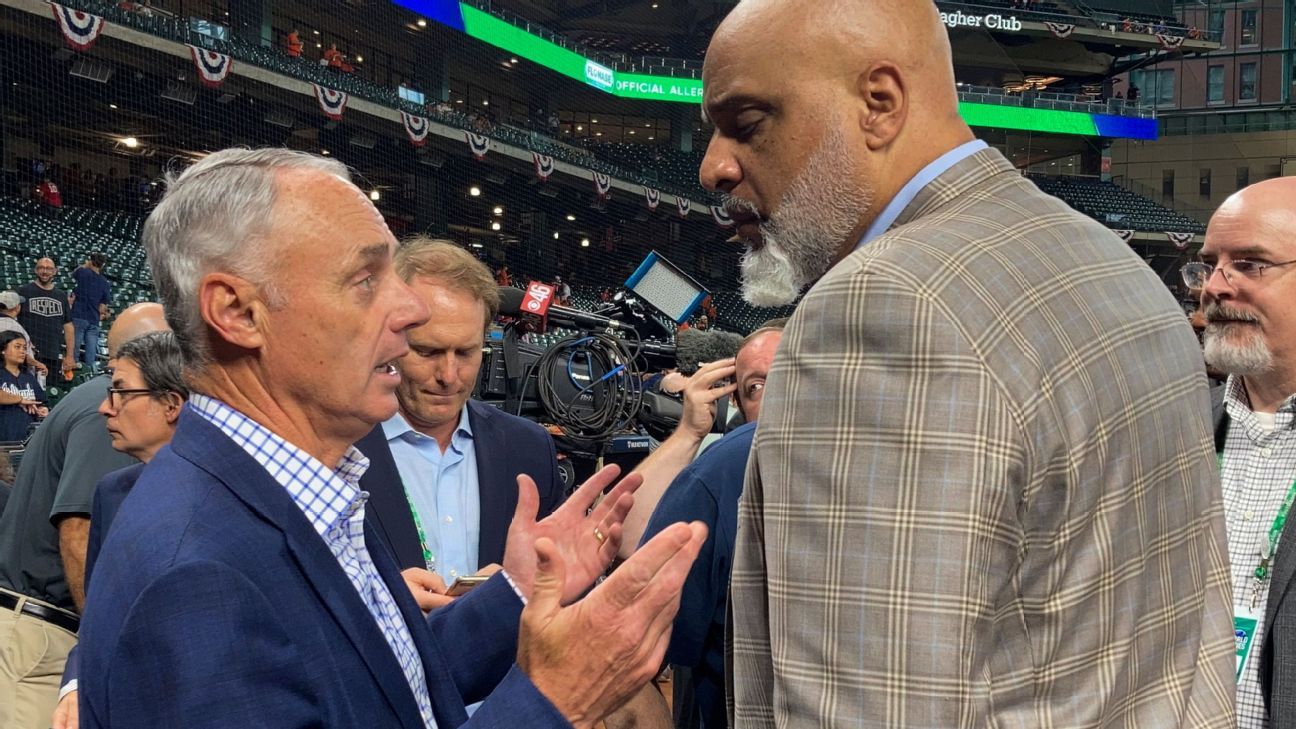
For the league: Deputy commissioner Dan Halem is the lead negotiator, commissioner Rob Manfred the ultimate authority. The league’s labor policy committee — headed by Colorado Rockies owner Dick Monfort, who is joined by Hal Steinbrenner (New York Yankees), John Sherman (Kansas City Royals), Jerry Reinsdorf (Chicago White Sox), Ray Davis (Texas Rangers) and Jim Pohlad (Minnesota Twins) — is the proxy for the 30 owners. — Passan
How will the looming potential of a prolonged labor stoppage impact free agency this offseason?
Executives, league officials and agents are in agreement on one thing at this moment in the offseason: They’re simply not sure how things will shake out just yet in terms of spending. There are no grand predictions about the theme of the offseason, and the few early signings haven’t foreshadowed much, either.
Having said that, two emerging narratives seem to be prevalent. It’s business as usual for the annual World Series contenders like the Yankees, the Philadelphia Phillies and the Los Angeles Dodgers — and now we can include the Toronto Blue Jays in that category.
Phillies president Dave Dombrowski didn’t even hesitate when asked how the final year of labor might impact their winter.
“That is not something we talk about,” he said. “We’re going to proceed normally.”
You can expect the same from the Dodgers, who are attempting a rare three-peat in 2026.
Other organizations are waiting for more certainty, potentially in the form of a new economic system, before they jump back into serious spending. That might not come until after the next CBA is signed, which means that the looming end of the CBA will have some say in the offseason, even if it’s a small impact.
Chicago Cubs president Jed Hoyer admitted at the end of last season that many of his player contracts were designed to be up after 2026 — in other words when the CBA expires — in order to have relatively clean books heading into 2027 and beyond. Several agents and teams believe that cost certainty in the form of a new CBA — and, if MLB gets its way, a first-ever salary cap — will return spending back to higher levels simply because teams will understand their yearly costs more intimately after a new deal.
In the meantime, there’s a postseason and World Series to be played in 2026. And it’s just not the major markets that want to get a playoff run under their belts before things change, according to insiders. So look for free agents to do well in the market even with labor concerns percolating this winter. Yes, a few might take one-year deals, hoping the next economic system benefits them when they go back into the market — but there is certain to be plenty of momentum.
Agent Scott Boras summed it up when asked if spending would be depressed this winter, knowing what’s to come after next season.
“Historically we haven’t seen that, because teams always want to be their best,” he said. “The bottom line is teams understand they don’t have to pay players when there are strikes [or lockouts].” — Jesse Rogers
Will the battle over a potential salary cap be the primary topic discussed between owners and players in the year ahead?
There doesn’t appear to be much doubt about that. Economic disparity has been a hot-button issue for decades. The crumbling of the regional sports network (RSN) television model, which led to several teams losing out on local media revenue, has brought that topic to the forefront in recent years. And the unmitigated spending of teams like the Dodgers and New York Mets has only exacerbated the anger from owners throughout the industry, who continue to claim they don’t have the revenues to keep up.
Even Yankees owner Hal Steinbrenner recently downplayed his franchise’s profit margins and spoke out in favor of a salary cap. If Steinbrenner, who presides over one of the most powerful sports franchises in the world, sounds open to one, imagine how strongly his counterparts in markets such as Pittsburgh, Milwaukee and Tampa feel.
But the prevalence of free markets has been a tentpole issue throughout the MLB Players Association’s existence. Remember that, and you’ll start to understand how ugly this could get. — Alden Gonzalez
Which other issues will fans hear most from each side in the year ahead before the CBA expires?
A central issue for the union during the last round of talks was on how to get players paid sooner, a counter to the middle class of free agency continuing to dry up. As a result of the current CBA, minimum salaries went up, the prospect promotion incentive was introduced, and pre-arbitration bonus pools were established. Expect more talk around that subject in general. In all likelihood, MLB will once again argue that higher compensation for younger players needs to be coupled with a lower luxury tax threshold and will try once again to pair that with a salary floor. The MLBPA probably will say that steers too close to a traditional salary cap system, and on and on we’ll go again.
So, yes, economics will dominate — particularly with changes to the revenue-sharing model desired by both parties and potentially providing a path to an agreement. But two other topics figure to be front and center. One is how MLB implements rule changes. In the last basic agreement, the league secured full autonomy over the implementation of new rules. The union desires more control. And then there’s the subject of an international draft. The league wants one.
During the last round of talks, the union entertained the possibility. After a new CBA was ratified, the two sides gave themselves an additional four months to agree on a trade: The league gets an international draft, the union does away with the qualifying offer. They couldn’t agree by the deadline, but this will come up again. — Gonzalez
-
 Sports2 years ago
Story injured on diving stop, exits Red Sox game
-
 Sports3 years ago
‘Storybook stuff’: Inside the night Bryce Harper sent the Phillies to the World Series
-
 Sports2 years ago
Game 1 of WS least-watched in recorded history
-
 Sports3 years ago
Button battles heat exhaustion in NASCAR debut
-
 Sports3 years ago
MLB Rank 2023: Ranking baseball’s top 100 players
-
Sports4 years ago
Team Europe easily wins 4th straight Laver Cup
-
 Environment3 years ago
Japan and South Korea have a lot at stake in a free and open South China Sea
-
 Environment1 year ago
Here are the best electric bikes you can buy at every price level in October 2024