
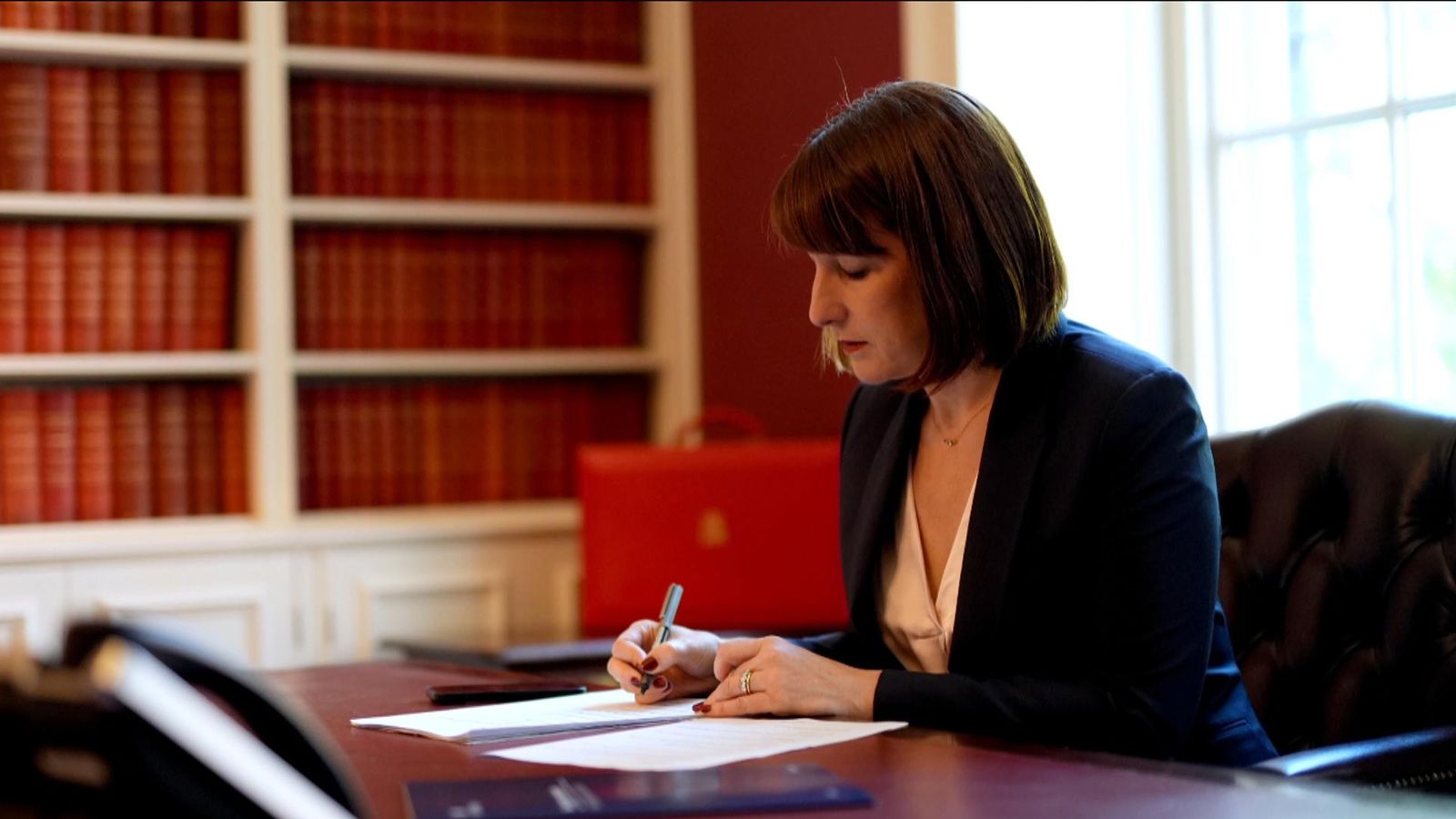
Chancellor Rachel Reeves to change public finance rules to borrow more for investment


Rachel Reeves will rewrite the government’s fiscal rules in next week’s budget to allow her to increase borrowing for public investment by around £50bn.
Speaking to Sky News in Washington DC, the chancellor said that the self-imposed rule under which borrowing must be falling by the fifth year of economic forecasts will be redefined from the current measure of public sector net debt.
Ms Reeves would not be drawn on what measure will replace the current rule but there is speculation that she will favour using public sector debt net of financial liabilities (PSNFL).
Under this definition, investments such as the government’s student loans book are defined as assets rather than liabilities, which on current measures would allow a further £53bn of borrowing.
Charge motorists for every mile they drive, chancellor urged – Money latest
The chancellor said the second fiscal rule, under which day-to-day spending must be funded from government revenue rather than borrowing, would be unchanged.
Growing consensus
Ms Reeves cited support for increasing the debt threshold from leading British economists, as well as the International Monetary Fund, which this week said public investment should be protected and was “badly needed” in the UK.
She insisted the change was necessary to end years of declining public investment and deliver on Labour‘s promise to deliver growth.
“Under the plans that I have inherited from the previous Conservative government, public sector net investment as a share of our economy was due to decline steeply during the course of this parliament,” she said.
“I don’t want that path for Britain when there are so many opportunities in industries from life sciences to carbon capture, storage and clean energy to AI and technology, as well as the need to repair our crumbling schools and hospitals.”
Read more on the budget:
What could Chancellor Rachel Reeves announce?
Chancellor Rachel Reeves looking to ‘find £40bn’ in budget
Ms Reeves denied that she was effectively fiddling the rules to get around her manifesto pledge not to increase income tax, VAT or national insurance.
“The rule that really bites is the first rule, the stability rule, to get day-to-day spending funded by tax receipts. That’s something that the previous government weren’t even trying to achieve and we will show in the budget next week how we will deliver on that promise.
“The second role is about being responsible. By seizing the opportunities, but doing it in a way where we are making sure we’re getting value for money for every pound of taxpayer’s money spent.
“Of course we’ll put guardrails in place to ensure that every pound of taxpayers’ money that is spent is spent wisely, and will involve the National Audit Office and the Office of Budget Responsibility in that.”
The first test of the change in the debt rule will be the reaction of bond markets, which rose slightly on Thursday following reports of Ms Reeves’ plans.
Taken together, the redefined fiscal rules set the terms of a budget that is likely to see tax rises and public spending cuts balanced by more freedom to borrow.
Keep up with all the latest news from the UK and around the world by following Sky News
Tax rises not ruled out
Ms Reeves did not rule out a raft of tax rises, including adding national insurance to employers’ pension contributions, from which public sector employers may be exempt.
“I was clear in the statement I made to the House of Commons in July that there will be difficult decisions in this budget around spending, welfare and taxation. But the precise details I will set out to the House of Commons next week.
“I will be a responsible chancellor. I will be honest and transparent about the challenges we face, but also how we’ll fix them to wipe the slate clean after the mismanagement we’ve seen in the last few years under the Conservatives.”
Gareth Davies, shadow exchequer secretary, said: “Before the election Rachel Reeves promised that she would not ‘fiddle’ the fiscal rules, and now it seems she is going to do exactly that. Remarkably she is announcing this not to Parliament, but to the IMF in advance of the budget.
“This is already having real world effects, with borrowing costs rising. This uncertainty over additional borrowing risks interest rates staying higher and for longer. It’s families up and down the country who would pay the price.”



The first-ever Capture case has been delayed at the Court of Appeal as the Post Office asks for an extension to respond, Sky News has learned.
Pat Owen, a former sub postmistress who has since passed away, was convicted of stealing in 1998 based on evidence from computer software.
The system, known as Capture, was used in up to 2,500 branches in the 1990s, before the infamous Horizon system was introduced.
Hundreds of sub-postmasters were wrongfully convicted between 1999 and 2015 as part of the Horizon scandal.
Earlier this year, Sky News unearthed a 1998 report showing the Capture software was also faulty.
That report, commissioned by the solicitors acting for Mrs Owen in 1998, was served on the Post Office and may never have been seen by the jury in her case.
‘All we want is her name cleared’
Ms Owen was given a suspended prison sentence and fought to clear her name subsequently – but died in 2003.
Her case was referred by the Criminal Cases Review Commission (CCRC) to the Court of Appeal in October.
The Post Office had until 5 December to respond to papers put forward by Mrs Owen’s defence team but they have now asked for an extension until 30 January.
Ms Owen’s daughter, Juliet Shardlow, described the family’s suffering at the lengthening wait.
“I need to emphasise the profound impact the ongoing delay is having on our family,” she said.
“The continuous uncertainty only compounds our heartache, stress, and anxiety.
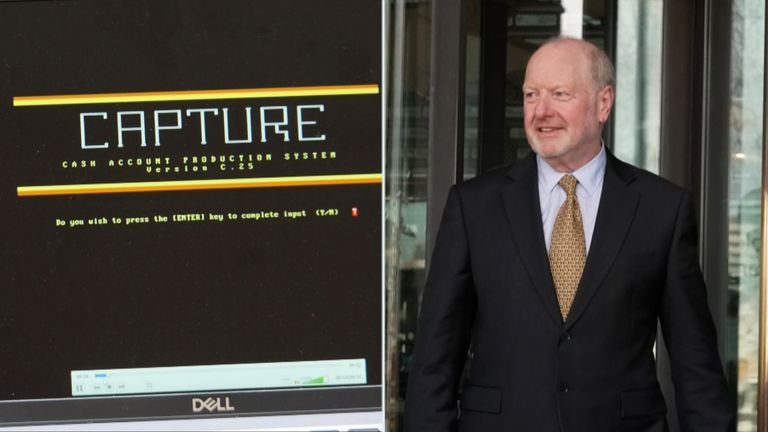
Alan Bates: New redress scheme ‘half-baked’
“It has become the last thing I think about before I go to sleep and the first thing when I wake up.
“We have waited 27 years for justice, and this additional wait feels never-ending.”
Ms Owen’s case is the first time a conviction based on Capture has reached the Court of Appeal since the scandal was exposed.
Read more from Sky News:
Corporate manslaughter charges considered in Post Office scandal
21 ‘Capture’ cases investigated for miscarriages of justice
Lawyers have said that if Ms Owen is exonerated posthumously, it may “speed up” the handling of others.
CCRC chair Dame Vera Baird also told Sky News in the summer it could be a “touchstone case” for other victims.
The CCRC is also continuing to investigate around 30 other “pre-Horizon” convictions.
A Post Office spokesperson said: “We have sought an extension of time to fully consider and respond to the CCRC’s Statement of Reasons in Ms Owen’s case.
“We deeply regret the impact our request for further time will have on Ms Owen’s family.
“We have a duty to carefully consider the evidence presented in the Statement of Reasons submitted by the CCRC and do everything we can to fully assist the Court when it considers this conviction.”
Meanwhile, the first-ever redress scheme for victims of the Post Office Capture IT scandal was launched this autumn.
The Capture Redress Scheme will provide payments of up to £300,000, and more in “exceptional” cases, to former postmasters who suffered financial losses.

-
 Sports2 years ago
Story injured on diving stop, exits Red Sox game
-
 Sports3 years ago
‘Storybook stuff’: Inside the night Bryce Harper sent the Phillies to the World Series
-
 Sports2 years ago
Game 1 of WS least-watched in recorded history
-
 Sports3 years ago
Button battles heat exhaustion in NASCAR debut
-
 Sports3 years ago
MLB Rank 2023: Ranking baseball’s top 100 players
-
Sports4 years ago
Team Europe easily wins 4th straight Laver Cup
-
 Environment3 years ago
Japan and South Korea have a lot at stake in a free and open South China Sea
-
 Environment1 year ago
Here are the best electric bikes you can buy at every price level in October 2024