
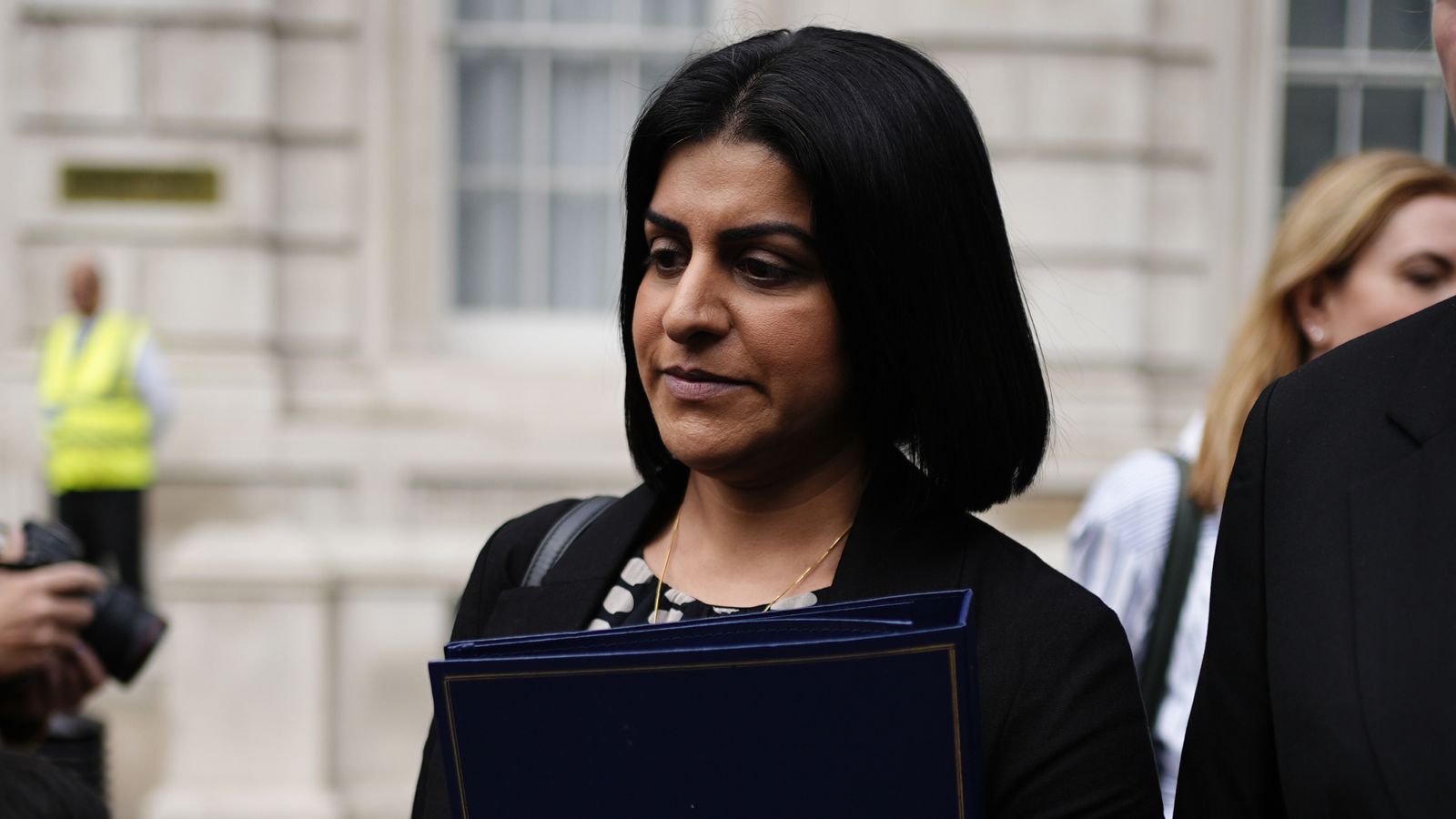
UK on ‘slippery slope’ to ‘death on demand’, Justice Secretary Shabana Mahmood warns ahead of assisted dying vote

The UK is on a “slippery slope towards death on demand”, according to the justice secretary ahead of a historic Commons vote on assisted dying.
In a letter to her constituents, Shabana Mahmood said she was “profoundly concerned” about the legislation.
“Sadly, recent scandals – such as Hillsborough, infected blood and the Post Office Horizon – have reminded us that the state and those acting on its behalf are not always benign,” she wrote.
“I have always held the view that, for this reason, the state should serve a clear role. It should protect and preserve life, not take it away.
“The state should never offer death as a service.”
Analysis: Justice secretary’s intervention is potentially embarrassing for the PM
On 29 November, MPs will be asked to consider whether to legalise assisted dying, through Kim Leadbeater’s Terminally Ill Adults (End of Life) Bill.
Details of the legislation were published last week, including confirmation the medicine that will end a patient’s life will need to be self-administered and people must be terminally ill and expected to die within six months.
Minister ‘leans’ to assisted dying bill
Ms Mahmood, however, said “predictions about life expectancy are often inaccurate”.
“Doctors can only predict a date of death, with any real certainty, in the final days of life,” she said. “The judgment as to who can and cannot be considered for assisted suicide will therefore be subjective and imprecise.”
Read more: Gordon Brown says assisted dying should not be legalised
Under the Labour MP’s proposals, two independent doctors must confirm a patient is eligible for assisted dying and a High Court judge must give their approval.
The bill will also include punishments of up to 14 years in prison for those who break the law, including coercing someone into ending their own life.
Details of end of life bill released
Read more: Where does the cabinet stand on assisted dying?
However, Ms Mahmood said she was concerned the legislation could “pressure” some into ending their lives.
“It cannot be overstated what a profound shift in our culture assisted suicide will herald,” she wrote.
“In my view, the greatest risk of all is the pressure the elderly, vulnerable, sick or disabled may place upon themselves.”
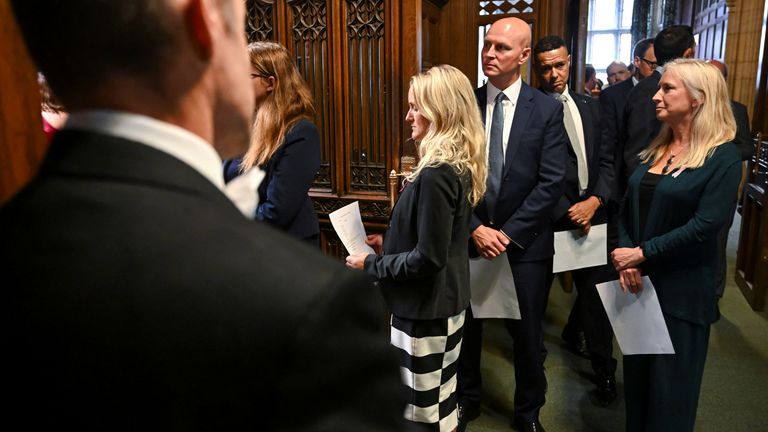
Kim Leadbeater waits to present the Assisted Dying Bill. File pic: House of Commons/Reuters
Labour MP Kim Leadbeater, who put forward the bill, said some of the points Ms Mahmood raised have been answered “in the the thorough drafting and presentation of the bill”.
“The strict eligibility criteria make it very clear that we are only talking about people who are already dying,” she said.
“That is why the bill is called the ‘Terminally Ill Adults (End of Life) Bill’; its scope cannot be changed and clearly does not include any other group of people.
“The bill would give dying people the autonomy, dignity and choice to shorten their death if they wish.”
In response to concerns Ms Mahmood raised about patients being coerced into choosing assisted death, Ms Leadbeater said she has consulted widely with doctors and judges.
“Those I have spoken to tell me that they are well equipped to ask the right questions to detect coercion and to ascertain a person’s genuine wishes. It is an integral part of their work,” she said.
In an increasingly fractious debate around the topic, multiple Labour MPs have voiced their concerns.
In a letter to ministers on 3 October, the Cabinet Secretary Simon Case confirmed “the prime minister has decided to set aside collective responsibility on the merits of this bill” and that the government would “therefore remain neutral on the passage of the bill and on the matter of assisted dying”.
UK
World Cup 2026 – who England, Scotland, Wales, Northern Ireland and the Republic of Ireland will play
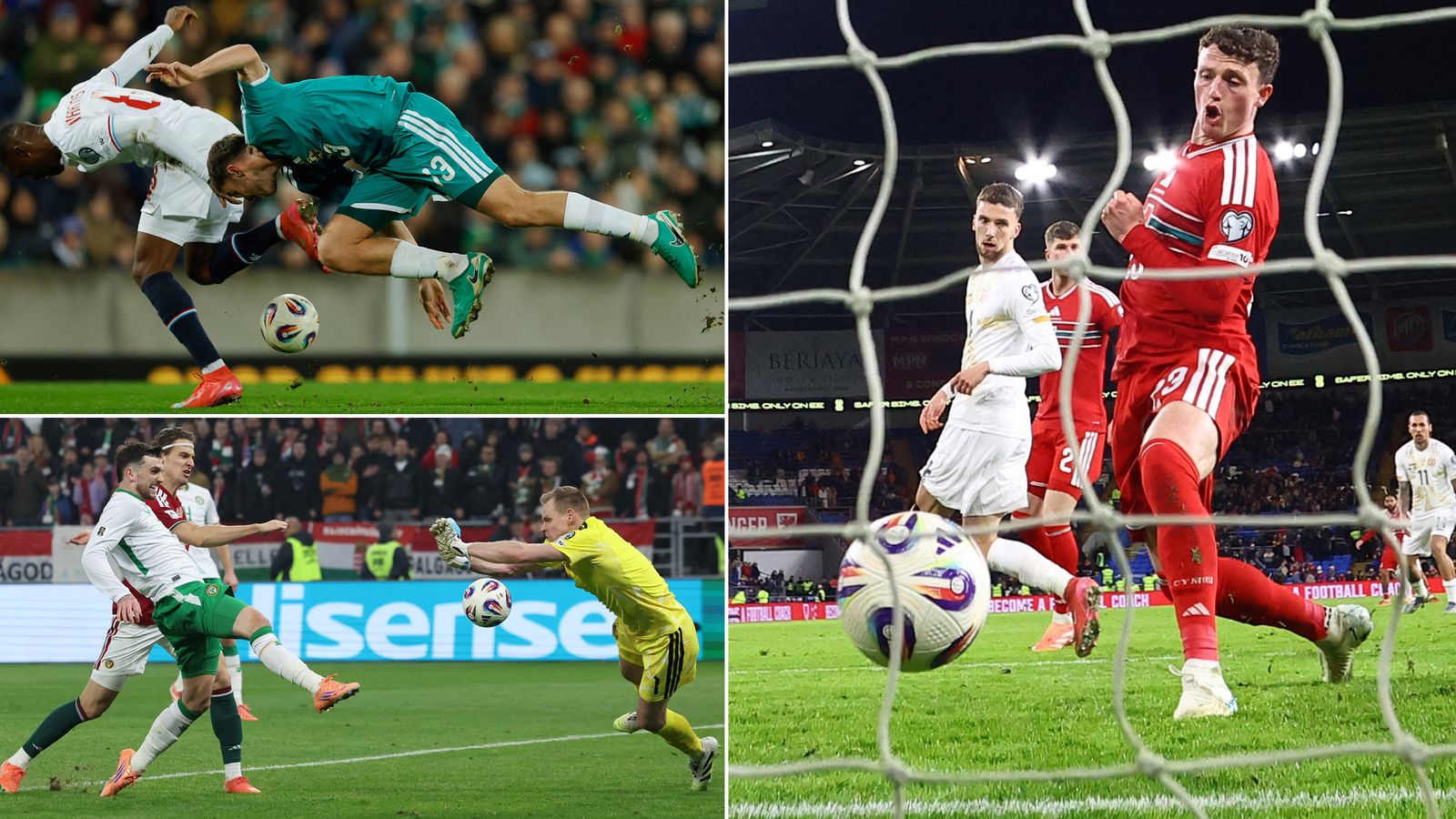
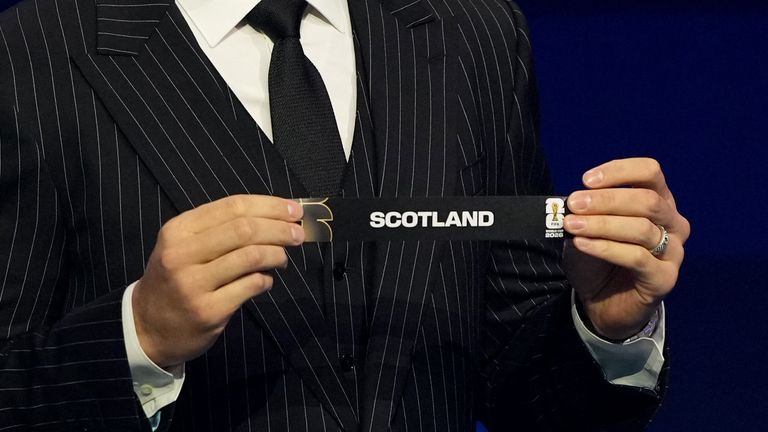
Scotland and England now know who they will face in the group stage of the next summer’s world cup.
But the fates of Northern Ireland, the Republic of Ireland and Wales won’t be determined until they compete in pre-tournament play-off matches in March.
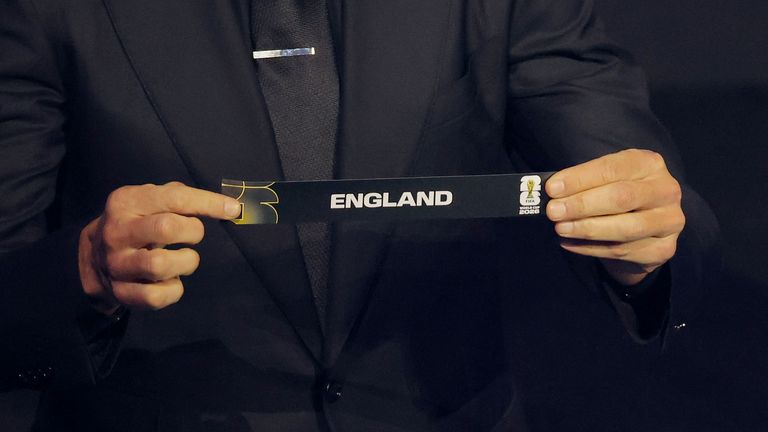
England are in Group L along with Croatia, Panama and Ghana. Their first match will be against Croatia, who beat them in the semi-finals of the 2018 World Cup in Russia.
Pic: Reuters
Scotland’s first match will be against Haiti, in Group C.
Brazil and Morocco are the other Group C teams – both countries were also in the same opening group as Scotland in the 1998 World Cup in France.
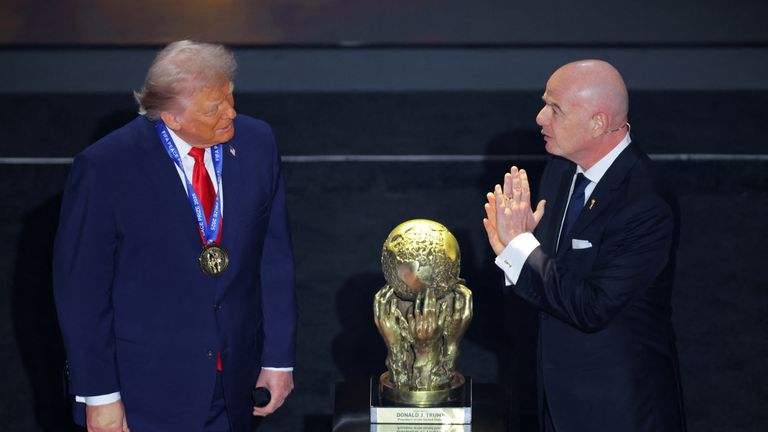
Trump and Infantino at the World Cup draw
Wales have yet to find out if they will qualify as they must face a play-off against Bosnia and Herzegovina in Cardiff, and then either Italy or Northern Ireland, if they are victorious.
Read more:
EasyJet staff at Luton Airport to strike over Christmas
If they can overcome these play-off opponents then they will secure their place in Group B along with Canada, Qatar and Switzerland. But Northern Ireland will also be vying and hoping to guarantee their spot in the same group if they can beat Italy and then either Wales or Bosnia and Herzegovina.
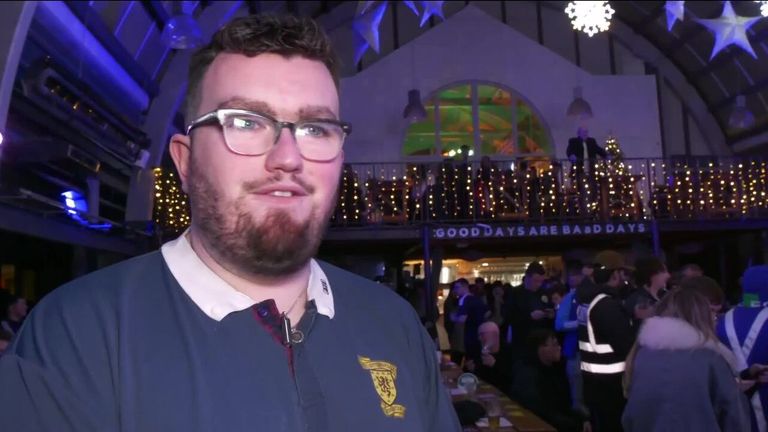
‘Bring it on!’: Scotland fans react to World Cup draw
The Republic of Ireland also need to get through the play-offs first and are paired against the Czech Republic for their semi-final. Should Ireland win that match, they will need to beat either North Macedonia or Denmark to get to the finals where an opening group containing joint hosts Mexico, South Africa and South Korea awaits.
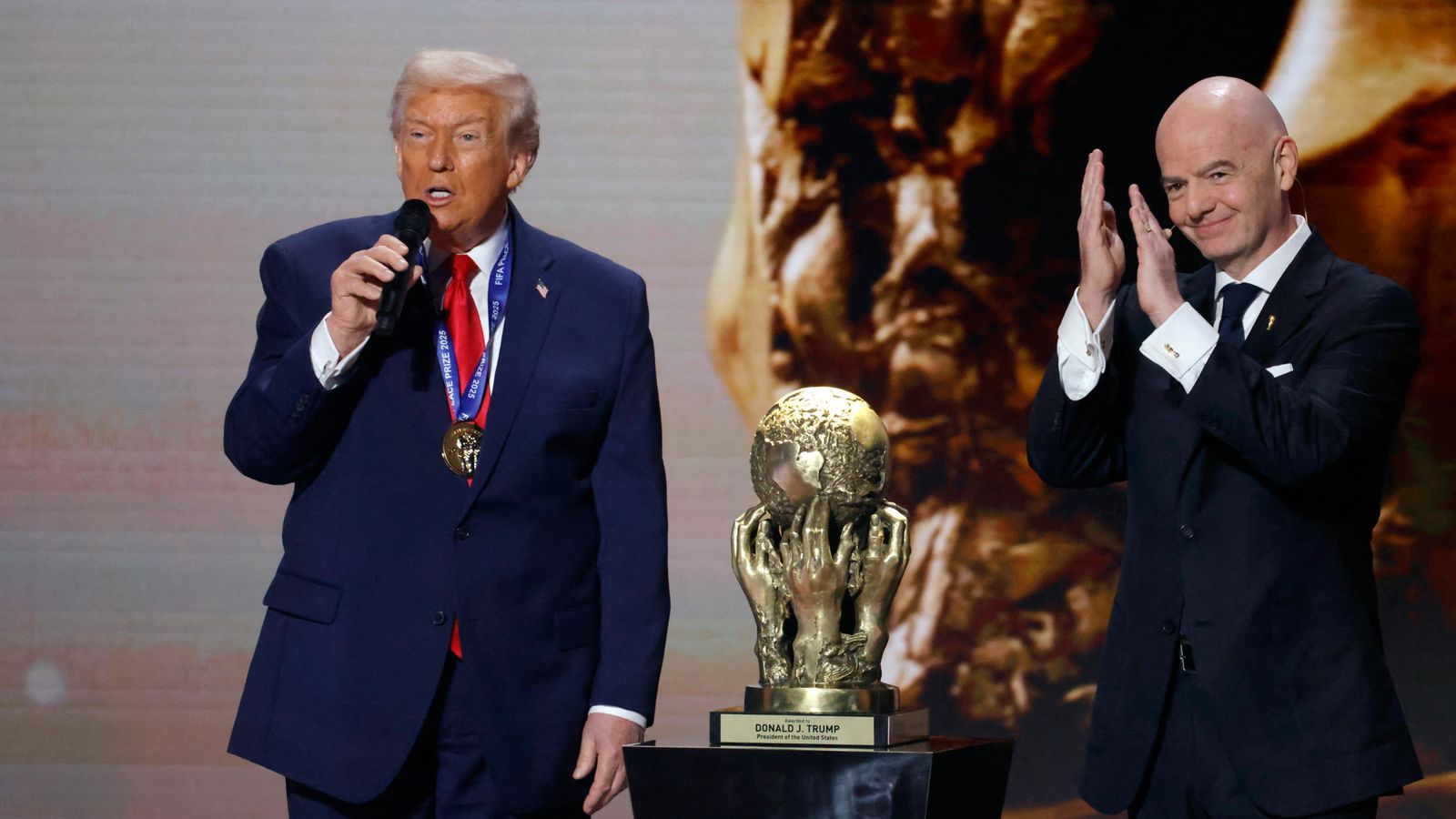
This was a World Cup draw like no other. Crafted less for the teams but for one man.
The choice of venue. The creation of a new trophy. The closing music act.
Donald Trump was lavished with the adulation he craves by FIFA President Gianni Infantino and feels others unfairly deny him.
Knowing how much being overlooked by the Nobel Committee hurt the US president, there was Mr Infantino with FIFA’s newly-created Peace Prize to hand over. And a medal for Mr Trump to wear.
“This is truly one of the great honours of my life,” he said. “And beyond awards, Gianni and I were discussing this. We saved millions and millions of lives.”
This was all on the stage in front of an audience who turned up to find out who they will be playing at the World Cup.
England handed an undaunting route past Croatia, Panama and Ghana. Scotland paired with newcomers Haiti before tricky reunions from their last men’s World Cup in 1998 against Brazil and Morocco.
Pic: Reuters
But the show before the draw could even begin – presided over by Rio Ferdinand – took almost as long as a football match, at 87 minutes after the noon kick-off was delayed.
There was a walk of self-promotion to complete – “I guess they have to wait” – before taking his seat in the Kennedy Center. Or the Trump Kennedy Center as the president takes to calling the venue picked 1.5 miles from the White House.
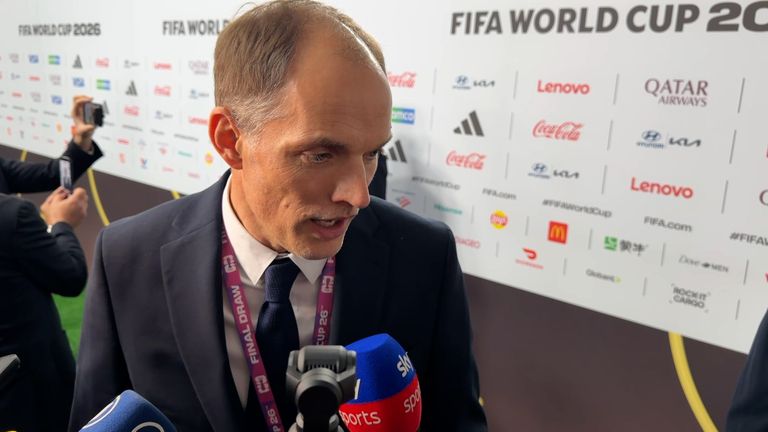
England manager Thomas Tuchel reacts to draw
“It was falling apart,” he said, delaying the walk into the auditorium. “And now it’s, it’s pretty much back.”
Mr Infantino could only watch on, beaming, at his friend.
“We had a dead country,” Mr Trump went on, “and now we have the hottest country anywhere in the world”.
There was the awkwardness of being reminded, before receiving the peace accolade, about threats to launch military strikes on Venezuela to stop the drugs trade.
“I did settle eight wars, and we have a ninth coming,” he swatted away the question. “Which nobody’s ever done before. But I want to really save lives. I don’t need prizes.”
But FIFA knew how much he wanted more gold for the collection with the prize.
More on this story:
What draw means for England, Scotland, Wales, Northern Ireland and Republic of Ireland
Donald Trump and FIFA president Gianni Infantino. Pic: Reuters
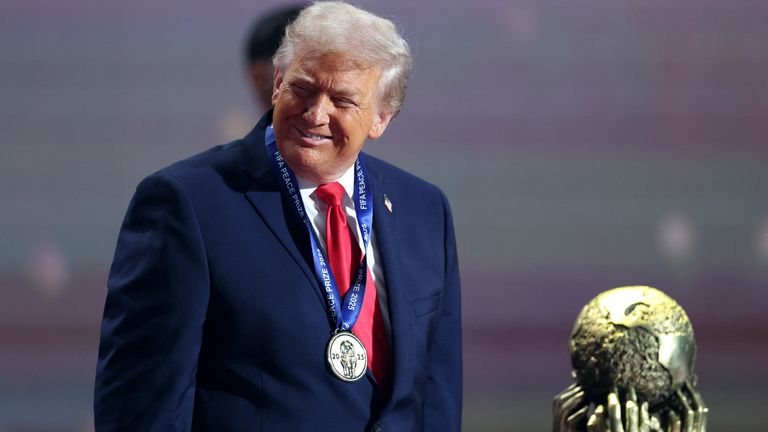
Pic: Reuters
And for all the mockery and disdain targeted at FIFA, how many sports would relish having the US president spend several hours attending a procedural event determining the placing of teams in groups for a tournament?
How many would dish out the same flattery to secure direct lines to the leader of the nation staging their championship?
Many have benefited from Mr Trump’s stardust and swagger being attached to this spectacle.
Even Port Vale’s most famous fan – Robbie Williams – secured a walk-on role, exceeding his profile this side of the Pond.
And the Village People are reaping the rewards of becoming the unlikeliest of Trump hype acts.
The festivities ended with eyes fixed back up to the presidential seating and the YMCA dance being performed.
This was an afternoon that dispelled any pretence that FIFA keeps a distance from politics. It was unapologetically political. But few speak out in the FIFA world as the redistributed wealth keeps rolling back in their direction.
It would be easy to forget this isn’t entirely America’s World Cup. They’re sharing hosting with Canada and Mexico.
Read more from Sky News:
Netflix agrees blockbuster $72bn deal for Warner Bros studios
Several sites go down after Cloudfare outage
‘Bring it on!’: Scotland fans react to World Cup draw
And eventually the spotlight was ceded to their leaders – very briefly – as Mexican President Claudia Sheinbaum and Canadian Prime Minister Mark Carney drew out their countries’ names.
But it did live up to FIFA’s mantra that football can unite the world.
The neighbours were brought together here on a snowy day in Washington. And tensions – often stoked by Mr Trump with Canada and Mexico – thawed in the name of football.
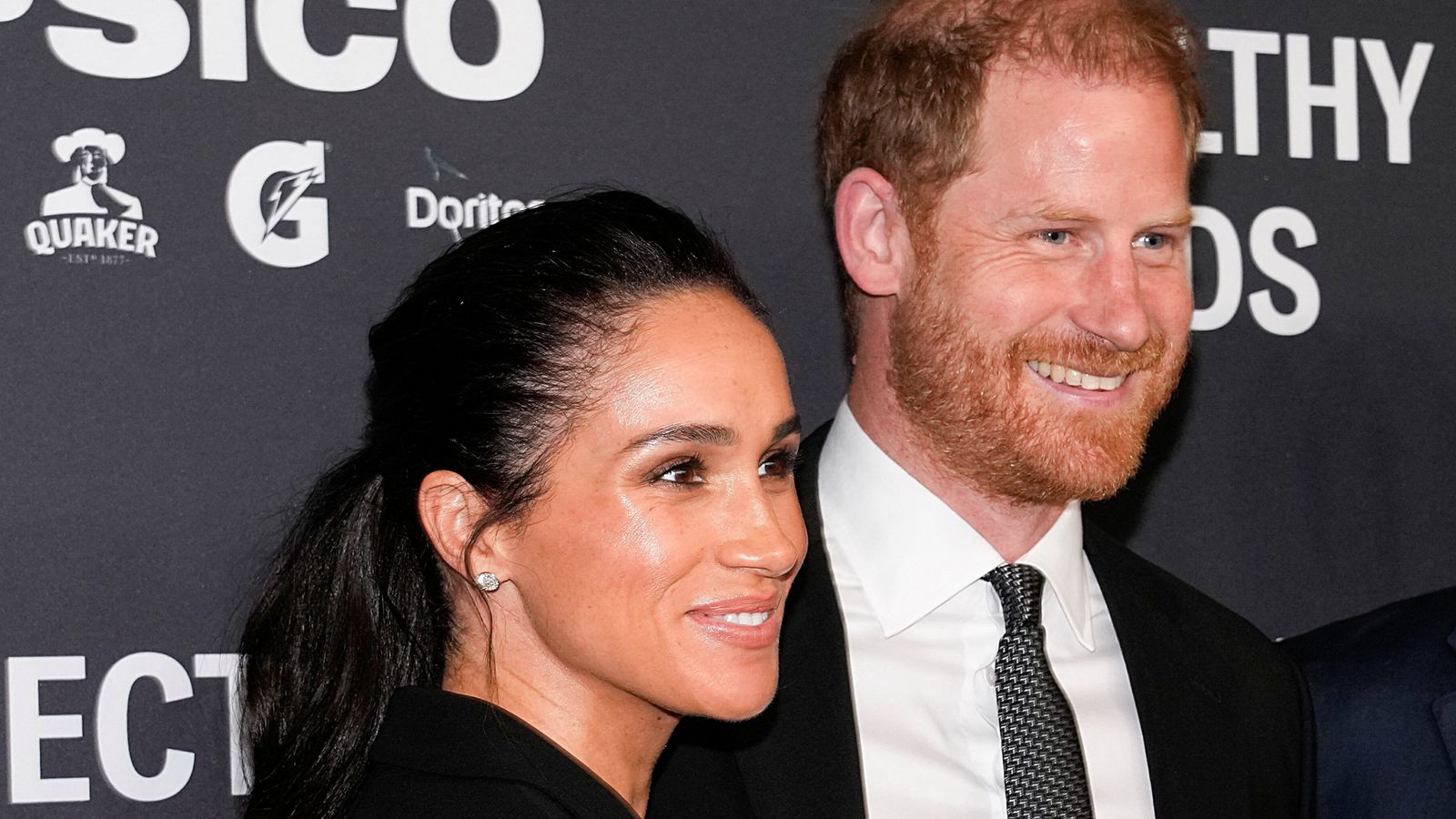
Meghan Markle has “reached out” to her estranged father after reports he had his leg amputated, her spokesperson has said.
Thomas Markle, 81, reportedly had his leg amputated following surgery in the Philippines, where he moved to this year.
Meghan has been estranged from her father since around the time of her wedding to Prince Harry in May 2018.
Mr Markle, a retired television lighting director and director of photography, made headlines across the globe after he was caught staging paparazzi photographs in the days ahead of the ceremony.
A spokesperson for the Duchess of Sussex said: “I can confirm she has reached out to her father.”
Meghan is said to have previously tried to reach out to him in the past.
Mr Markle has never met his grandchildren Prince Archie and Princess Lilibet.
At the start of this year, Mr Markle told of how he dreamed of bringing his “whole family together” and wished his daughter “no ill-will”.
Mr Markle revealed that he didn’t “like some of the things” Meghan had done but would “always love her”.
Read more:
Prince Harry apologises to Canada for wearing cap at World Series
Prince Harry and Meghan named Humanitarians of the Year
His interview with the Mail on Sunday came amid the duchess’ return to Instagram and the release of a trailer for her lifestyle show on Netflix.
Mr Markle said: “I’m not running away. I am going in search of a more positive life.
“Every day I see something about Meghan. This week it has been the new TV show.”
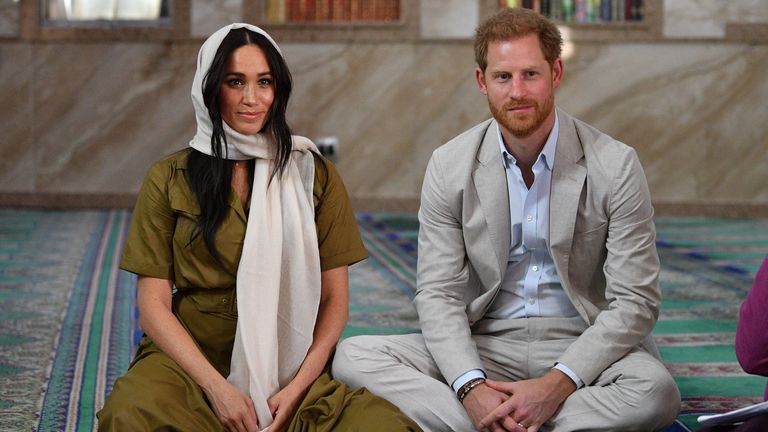
The Duke and Duchess of Sussex during a trip to Cape Town. Pic: Reuters
In his first interview after his daughter’s wedding, Mr Markle said he didn’t attend the big day because he was embarrassed about staging the photos.
“The truth is I couldn’t get over the fact that that had happened. All that stuff was working on me, I had a bit of a heart condition.
“This pushed me a little further to the part where I had heart palpitations. I had to drive at 2am to a hospital. They sent me to another little hospital and then they sent me to a bigger hospital and I had a heart attack.”
A day-and-a-half later he said he felt better and checked himself out against doctors’ wishes in a bid to make it to the wedding, but the heart palpitations returned when he got home, which at the time was in Mexico.
“At that time I started getting chest pains and I said I have to cancel because I didn’t take care of the heart problem before. I had a good friend take me back to a hospital across the border to the States where I was told that my condition was very bad and they had to operate, and I had heart surgery.”
-
 Sports2 years ago
Story injured on diving stop, exits Red Sox game
-
 Sports3 years ago
‘Storybook stuff’: Inside the night Bryce Harper sent the Phillies to the World Series
-
 Sports2 years ago
Game 1 of WS least-watched in recorded history
-
 Sports3 years ago
Button battles heat exhaustion in NASCAR debut
-
 Sports3 years ago
MLB Rank 2023: Ranking baseball’s top 100 players
-
Sports4 years ago
Team Europe easily wins 4th straight Laver Cup
-
 Environment3 years ago
Japan and South Korea have a lot at stake in a free and open South China Sea
-
 Environment1 year ago
Here are the best electric bikes you can buy at every price level in October 2024