

Harriet Harman calls for ‘mini inquiry’ into race issues raised by grooming gangs scandal


Harriet Harman has suggested a “mini inquiry” into issues raised by the grooming gangs scandal and called on Sir Keir Starmer and Kemi Badenoch to discuss “terms of reference”.
The Labour peer told Sky’s political editor Beth Rigby on the Electoral Dysfunction podcast that there should “openness” to a future probe as long it does not repeat the previous investigations.
In particular, she said people need to be “trained and confident” that they can take on matters “which are in particular communities” without being accused of being racist.
“I think that whether it’s a task force, whether it’s more action plans, whether it’s a a mini inquiry on this, this is something that we need to develop resilience in,” Ms Harman said.
The grooming gangs scandal is back in the spotlight after Elon Musk hit out at the Labour government for rejecting a new national inquiry into child sexual exploitation in Oldham, saying this should be done at a local level instead.
The Tories also previously said an Oldham inquiry should be done locally and in 2015 commissioned a seven-year national inquiry into child sex abuse, led by Professor Alexis Jay, which looked at grooming gangs.
However, they didn’t implement any of its recommendations while in office – and Sir Keir has vowed to do so instead of launching a fresh investigation into the subject.
Ms Harman said she agreed with ministers that there is “no point” in a rerun of the £200m Jay Review, which came on top of a number of locally-led inquiries.
👉 Click here to follow Electoral Dysfunction wherever you get your podcasts 👈
Read More:
Grooming gangs are ‘in every single part of our country’, Jess Phillips says
Grooming gangs: What happened?
However, she said there’s “always got to be an openness to further analysis, further consideration of what proposals would move things forward”.
She called on the Conservative Party to start “sensibly discussing with the government what should be the parameters of a future inquiry”, as they “can’t really be arguing they want an absolute repeat of the seven years and £200 million of the Jay inquiry”.
She said the Tories should set out their “terms of reference”, so “the government and everybody can discuss whether or not they’ve already got that sorted”.
Girls as young as 11 were groomed and raped across a number of towns in England – including Oldham, Rochdale, Rotherham and Telford – over a decade ago in a national scandal that was exposed in 2013.
In many cases the victims were white and the perpetrators of south Asian descent – with the local inquiry into Telford finding that exploitation was ignored because of unease about race.
The Jay review did not assess whether ethnicity was a factor in grooming gangs due to poor data, and recommended the compilation of a national core data base on child sex abuse which records the ethnicity of the victim and alleged perpetrator.
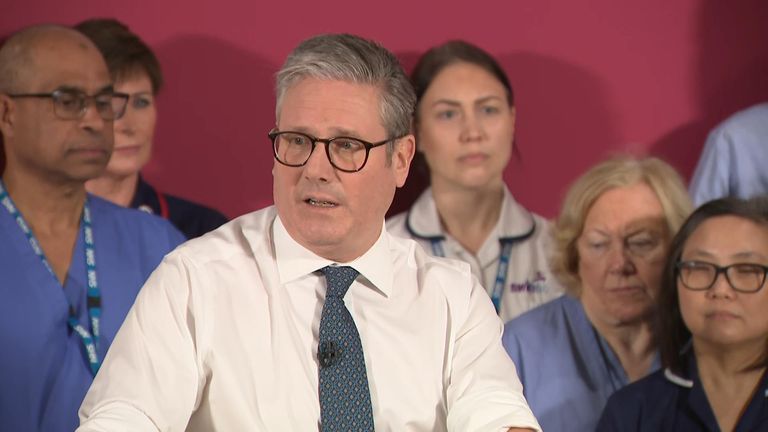
PM: People ‘spreading lies’ are ‘not interested in victims’
Ms Harman’s comments come after the Labour Metro Mayor of Greater Manchester, Andy Burnham, said he believed there was a case for a new “limited national inquiry”.
He told the BBC that a defeated Tory vote on the matter was “opportunism”, but a new probe could “compel people to give evidence who then may have charges to answer and be held to account”.
Jess Phillips, the safeguarding minister who has born the brunt of Mr Musk’s attacks, has told Sky News “nothing is off the table” when it comes to a new inquiry – but she will “listen to victims” and not the world’s richest man.
Sir Keir has said he spoke to victims this week and they do not want another inquiry as it would delay the implementations of the Jay review – though his spokesman later indicated one could take place if those affected call for it.
Tory leader Ms Badenoch has argued that the public will start to “worry about a cover-up” if the prime minister resists calls for a national inquiry, and said no one has yet “joined up the dots” on grooming.
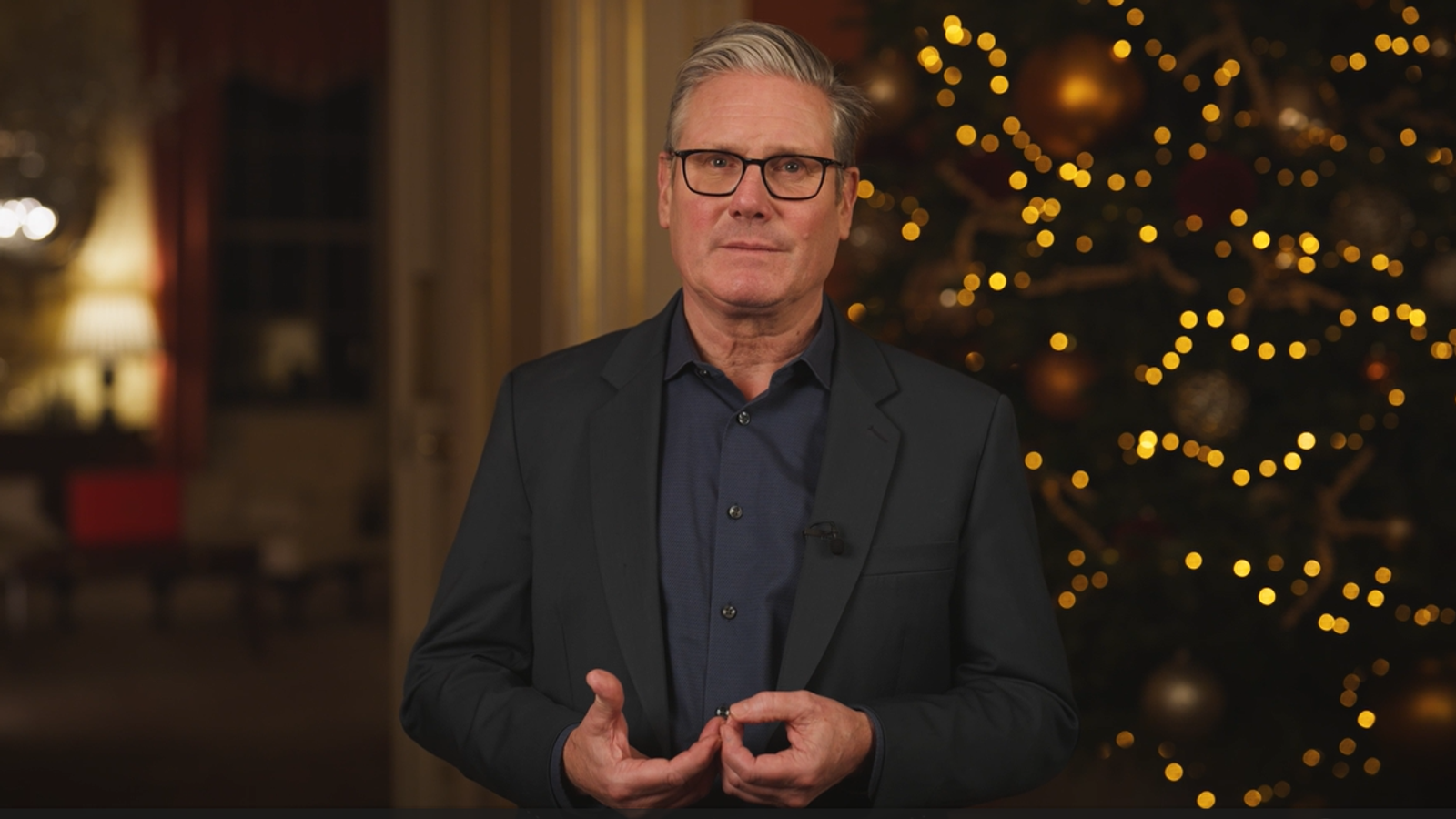
The prime minister has acknowledged Britons’ cost-of-living struggles in his Christmas message – and vowed that helping with the issue is his “priority”.
Sir Keir Starmer also urged members of the public to “each do our bit” and “reach out” to friends, relatives and neighbours during the festive period.
His message comes at the end of a difficult year for his government, with economic growth stuttering and Chancellor Rachel Reeves facing criticism over tax rises in the budget.
In a message recorded inside 10 Downing Street, Sir Keir said: “I know many across Britain are still struggling with the cost of living. Helping with that is my priority.
“But at this time of the year, which celebrates love and abundance, loss or hardship can feel even more acute.
“So call around to a neighbour. Check in on a friend or a relative who you haven’t heard from for a while. Reach out. It can make a huge difference.
“That is what Christmas is about.”
Sir Keir Starmer delivers his Christmas message from inside Downing Street. Pic: Downing Street
The prime minister thanked NHS workers along with members of the military and the emergency services who will be on duty on Christmas Day.
“Just as so many put their feet up, some truly special people will be pulling on their uniforms and heading out to work,” he said.
“Our NHS staff emergency services and the brave men and women of our armed forces, all playing their part, doing their bit to care for the nation and to keep us safe.
“Many volunteers will be out there as well. Serving food. Reaching out to help those lonely or in need.
“So on behalf of the whole country, I want to say a big thank you.
“As a nation, we should raise a glass to you this Christmas. But more than that, we should each do our bit as well.”
Read more from Sky News:
How does your Christmas compare to rest of UK? Take our quiz
The famous faces we said goodbye to this year
Conservative leader Kemi Badenoch used her Christmas message to talk about “Christian values” and thanked “everyone who has supported me during my first year as leader of the opposition”.
“It’s been the biggest challenge of my life,” she said. “But it’s also been a wonderful year. I can’t wait to get back to work next year to create a better United Kingdom.”
Liberal Democrat leader Sir Ed Davey spoke about the Christmas tree in London’s Trafalgar Square – an annual gift from Norway to thank the UK for its support during the Second World War – in his message.
While saying the tree may “look a little underwhelming” on first glance, the Liberal Democrat leader said it was a reminder of “friendship and loyalty”.
He added: “It makes me think about people standing together in tough times – whether against the Nazis in the 1940s, or right now in Ukraine.
“And yeah, it might not be perfect, but this tree in Trafalgar Square makes me think about families and friends looking out for one another right here at home.
“I can’t think of a better symbol of the Christmas spirit of generosity, love and hope. Of light in the darkness.”


The International Monetary Fund’s mission chief for El Salvador issued a statement confirming that government authorities were proceeding with negotiations for the sale of the country’s Chivo Bitcoin wallet.
In a Monday statement, the IMF said El Salvador’s government was continuing to discuss its Bitcoin (BTC) project with the fund’s officials, and “negotiations for the sale of the government e-wallet Chivo are well advanced.” The announcement signaled that the government may be preparing to sell some or all of its crypto holdings in the Chivo wallet.
The statement followed a May deal with El Salvador in which the IMF would pay $120 million as part of a 2024 loan agreement for $1.4 billion. As part of the deal, the government would stop acquiring Bitcoin.
It’s unclear whether El Salvador is abiding by the terms of the deal. Though the IMF reported in July that the country’s government had not purchased any BTC since December 2024, El Salvador’s Bitcoin Office continues to announce crypto buys, including 1,090 Bitcoin worth about $100 million in November.
Related: CFTC changes guard as Selig takes reins, Pham departs
According to the terms of the IMF-El Salvador deal made public, the government would make public sector engagement of BTC-related economic activity “confined,” the private sector’s acceptance of Bitcoin would be voluntary, and it would wind down involvement in the Chivo wallet. Cointelegraph reached out to the IMF for comment but had not received a response at the time of publication.
El Salvador recognized Bitcoin as legal tender in 2021 and began acquiring the cryptocurrency as part of a strategy largely pushed by President Nayib Bukele. According to data provided by the country’s Bitcoin Office, the government held 7,509 Bitcoin as of Monday, worth about $659 million at the time of publication.
‘It’s not stopping,’ says Bukele on Bitcoin buys
Despite the reported deal between the IMF and El Salvador, Bukele said in March that the government would continue its Bitcoin investment strategy, purchasing at least one BTC daily. It’s unclear how the president’s statement could affect the IMF agreement.
Magazine: When privacy and AML laws conflict: Crypto projects’ impossible choice
-
 Sports2 years ago
Story injured on diving stop, exits Red Sox game
-
 Sports3 years ago
‘Storybook stuff’: Inside the night Bryce Harper sent the Phillies to the World Series
-
 Sports2 years ago
Game 1 of WS least-watched in recorded history
-
 Sports3 years ago
Button battles heat exhaustion in NASCAR debut
-
 Sports3 years ago
MLB Rank 2023: Ranking baseball’s top 100 players
-
Sports4 years ago
Team Europe easily wins 4th straight Laver Cup
-
 Environment3 years ago
Japan and South Korea have a lot at stake in a free and open South China Sea
-
 Environment1 year ago
Here are the best electric bikes you can buy at every price level in October 2024