
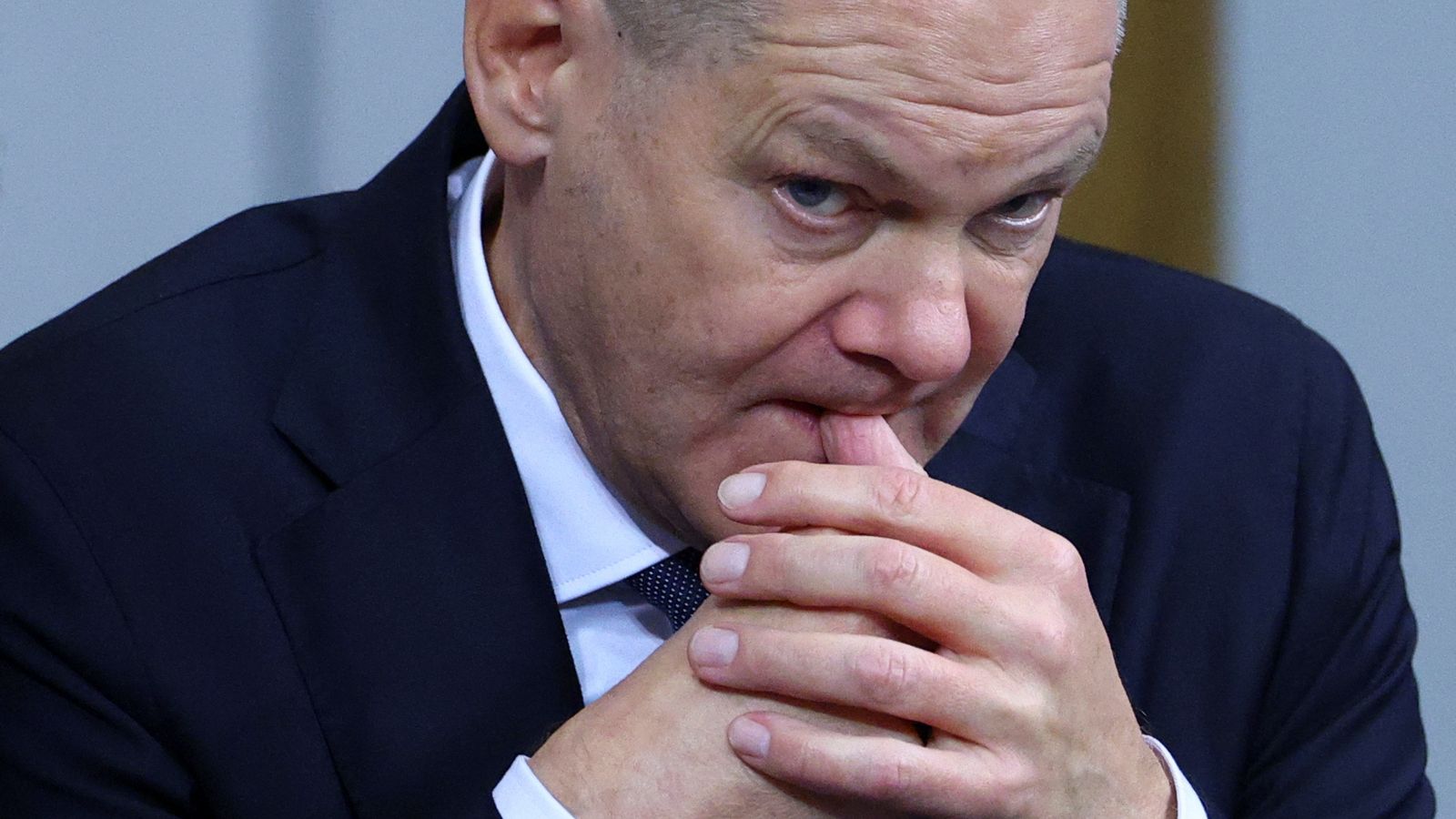
Germany: Europe’s largest economy is facing a third consecutive year of recession


Forget this week’s minor decrease in the UK inflation number.
The most important European data release was the confirmation from Germany that, during 2024, its economy contracted for the second consecutive year.
Europe’s largest economy shrank by 0.2% during 2024 – on top of a 0.3% contraction in 2023.
Now it must be stressed that this was a very early estimate from Germany’s Federal Statistics Office and that the numbers may be revised higher in due course. That health warning is especially appropriate this time around because, very unexpectedly, the figures suggest the economy contracted during the final three months of the year and most economists had expected a modest expansion.
Money latest: Guinness rival’s sales surge 632%
If unrevised, though, it would confirm that Germany is suffering its worst bout of economic stagnation since the Second World War.
The timing is lousy for Olaf Scholz, Germany’s chancellor, who faces the electorate just six weeks from now.
Worse still, things seem unlikely to get better this year, regardless of who wins the election.
How young people intend to vote in Germany
Germany, along with the rest of the world, is watching anxiously to see what tariffs Donald Trump will slap on imports when he returns to the White House next week.
Germany, whose trade surplus with the United States is estimated by the Reuters news agency to have hit a record €65bbn (£54.7bn) during the first 11 months of 2024, is likely to be a prime target for such tariffs.

Fallout of Trump’s tariff plans?
Aside from that, Germany remains beset by some of the problems with which it has been grappling for some time.
Because of its large manufacturing sector, Germany has been hit disproportionately by the surge in energy prices since Russia invaded Ukraine nearly three years ago, while those manufacturers are also suffering from intense competition from China. The big three carmakers – Volkswagen, Mercedes-Benz and BMW – were already staring at a huge increase in costs because of having to switch to producing electric vehicles instead of cars powered by traditional internal combustion engines. That task has got harder as Chinese EV makers, such as BYD, undercut them on price.
Other German manufacturers – many of which have not fully recovered from the COVID lockdowns five years ago – have also been beset by higher costs as shown by the fact that, remarkably, German industrial production in November last year was fully 15% lower than the record high achieved in 2017.
German consumer spending, meanwhile, remains becalmed. Consumers have kept their purse strings closed amid the economic uncertainty while a fall in house prices has further depressed sentiment. While home ownership is lower in Germany than many other OECD countries, those Germans who do own their own homes have a bigger proportion of their household wealth tied up in bricks and mortar than most of their OECD counterparts, including the property-crazy British.
Consumer sentiment has also been hit by waves of lay-offs. German companies in the Fortune 500, including big names such as Siemens, Bosch, Thyssenkrupp and Deutsche Bahn, are reckoned to have laid off more than 60,000 staff during the first 10 months of 2024. Bosch, one of the country’s most admired manufacturing companies, announced in November alone plans to let go of some 7,000 workers.
More of the same is expected in 2025.
Volkswagen shocked the German public in September last year when it said it was considering its first German factory closure in its 87-year history. Analysts suggest as many as 15,000 jobs could go at the company.
Accordingly, hopes for much of a recovery are severely depressed.
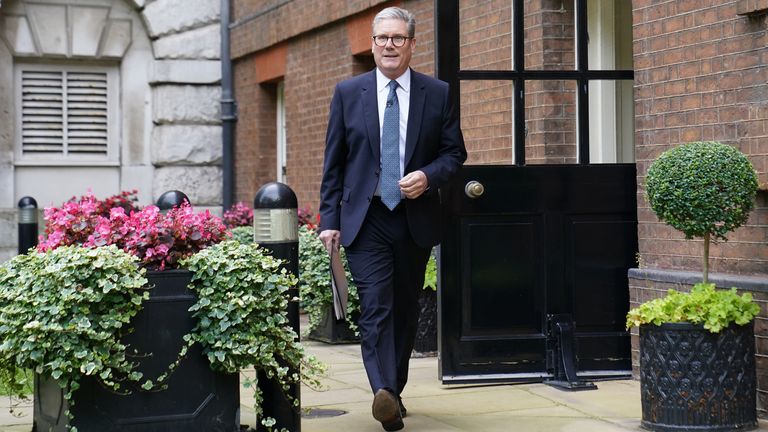
Starmer in Germany to boost relations
As Jens-Oliver Niklasch, of LBBW Bank, put it today: “Everything suggests that 2025 will be the third consecutive year of recession.”
That is not the view of the Bundesbank, Germany’s central bank, whose official forecast – set last month – is that the economy will expand by 0.2% this year. But that was down from its previous forecast of 1.1% – and growth of 0.2%, for a weary German electorate, will not feel that different from a contraction of 0.2%.
And all is not yet lost. The European Central Bank is widely expected to cut interest rates more aggressively this year than any of its peers. Meanwhile, one option for whoever wins the German election would be to remove the ‘debt brake’ imposed in 2009 in response to the global financial crisis, which restricts the government from running a structural budget deficit of more than 0.35% of German GDP each year.
The incoming chancellor, expected to be Friedrich Merz of the centre-right CDU/CSU, could easily justify such a move by ramping up defence spending in response to Mr Trump’s demands for NATO members to do so. Mr Merz has also indicated that policies aimed at supporting decarbonisation will take less of a priority than defending Germany’s beleaguered manufacturers.
But these are all, for now, only things that may happen rather than things that will happen.
And the current economic doldrums, in the meantime, will only push German voters to the extreme left-wing Alliance Sahra Wagenknecht or the extreme right-wing Alternative fur Deutschland.

The first-ever Capture case has been delayed at the Court of Appeal as the Post Office asks for an extension to respond, Sky News has learned.
Pat Owen, a former sub postmistress who has since passed away, was convicted of stealing in 1998 based on evidence from computer software.
The system, known as Capture, was used in up to 2,500 branches in the 1990s, before the infamous Horizon system was introduced.
Hundreds of sub-postmasters were wrongfully convicted between 1999 and 2015 as part of the Horizon scandal.
Earlier this year, Sky News unearthed a 1998 report showing the Capture software was also faulty.
That report, commissioned by the solicitors acting for Mrs Owen in 1998, was served on the Post Office and may never have been seen by the jury in her case.
‘All we want is her name cleared’
Ms Owen was given a suspended prison sentence and fought to clear her name subsequently – but died in 2003.
Her case was referred by the Criminal Cases Review Commission (CCRC) to the Court of Appeal in October.
The Post Office had until 5 December to respond to papers put forward by Mrs Owen’s defence team but they have now asked for an extension until 30 January.
Ms Owen’s daughter, Juliet Shardlow, described the family’s suffering at the lengthening wait.
“I need to emphasise the profound impact the ongoing delay is having on our family,” she said.
“The continuous uncertainty only compounds our heartache, stress, and anxiety.
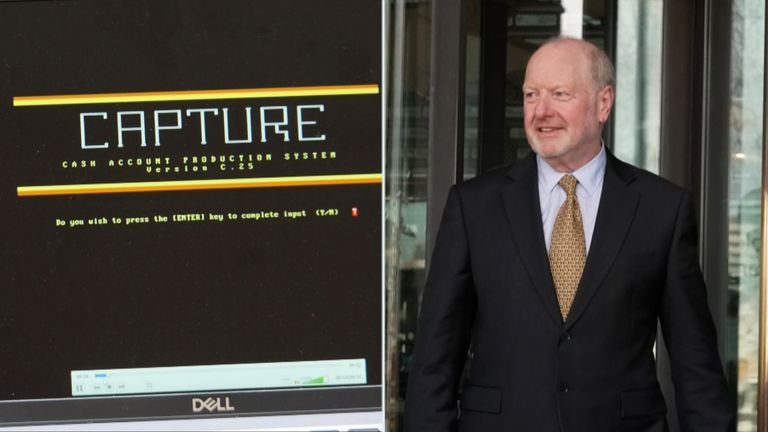
Alan Bates: New redress scheme ‘half-baked’
“It has become the last thing I think about before I go to sleep and the first thing when I wake up.
“We have waited 27 years for justice, and this additional wait feels never-ending.”
Ms Owen’s case is the first time a conviction based on Capture has reached the Court of Appeal since the scandal was exposed.
Read more from Sky News:
Corporate manslaughter charges considered in Post Office scandal
21 ‘Capture’ cases investigated for miscarriages of justice
Lawyers have said that if Ms Owen is exonerated posthumously, it may “speed up” the handling of others.
CCRC chair Dame Vera Baird also told Sky News in the summer it could be a “touchstone case” for other victims.
The CCRC is also continuing to investigate around 30 other “pre-Horizon” convictions.
A Post Office spokesperson said: “We have sought an extension of time to fully consider and respond to the CCRC’s Statement of Reasons in Ms Owen’s case.
“We deeply regret the impact our request for further time will have on Ms Owen’s family.
“We have a duty to carefully consider the evidence presented in the Statement of Reasons submitted by the CCRC and do everything we can to fully assist the Court when it considers this conviction.”
Meanwhile, the first-ever redress scheme for victims of the Post Office Capture IT scandal was launched this autumn.
The Capture Redress Scheme will provide payments of up to £300,000, and more in “exceptional” cases, to former postmasters who suffered financial losses.

-
 Sports2 years ago
Story injured on diving stop, exits Red Sox game
-
 Sports3 years ago
‘Storybook stuff’: Inside the night Bryce Harper sent the Phillies to the World Series
-
 Sports2 years ago
Game 1 of WS least-watched in recorded history
-
 Sports3 years ago
Button battles heat exhaustion in NASCAR debut
-
 Sports3 years ago
MLB Rank 2023: Ranking baseball’s top 100 players
-
Sports4 years ago
Team Europe easily wins 4th straight Laver Cup
-
 Environment3 years ago
Japan and South Korea have a lot at stake in a free and open South China Sea
-
 Environment1 year ago
Here are the best electric bikes you can buy at every price level in October 2024