

Kevin O’Leary says he would ‘love to do a TikTok deal,’ but the law prevents it


Kevin O’Leary is seen in Midtown Manhattan, New York City, on May 28, 2024.
James Devaney | Gc Images | Getty Images
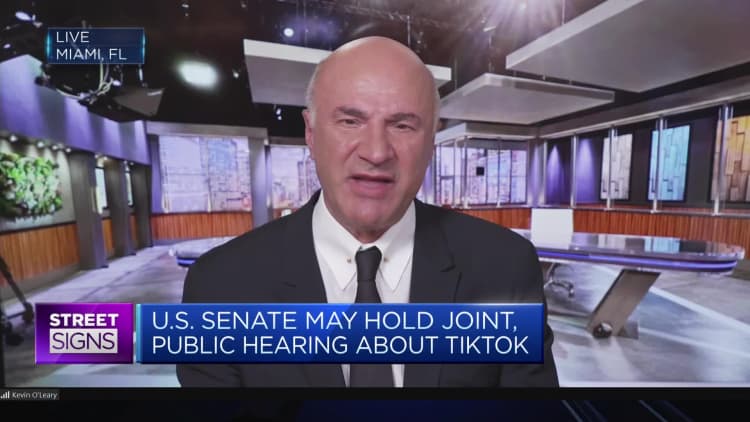
Canadian investor Kevin O’Leary is still interested in a TikTok deal, but it’s not possible under current law, he told CNBC, as President Donald Trump extended the deadline for a ban on the social media platform.
As part of a wave of executive orders on Monday, Trump delayed by 75 days the imposition of a law that would effectively ban TikTok in the U.S., allowing for “an opportunity to determine the appropriate course of action.”
Trump had promised the move in a social media post on Sunday, also floating a deal that would see the platform stay active under a joint venture with 50% American ownership.
“That 50/50 deal, I would love to work with Trump on, so would every other potential buyer … But the problem with some of these ideas is they are inconsistent with the ruling of the Supreme Court,” said O’Leary, widely known from his role in ABC’s “Shark Tank.”
The investor announced that he, along with “The People’s Bid for TikTok,” an effort led by Project Liberty Founder Frank McCourt, had offered ByteDance $20 billion in cash to buy TikTok in an appearance on Fox News’ “America’s Newsroom.”
Speaking to CNBC, he said the proposed deal did not include ByteDance’s TikTok algorithm, which has been a key point of scrutiny from U.S. lawmakers, adding that his group had its own alternative.
TikTok temporarily temporarily went dark in the the U.S. after the Supreme Court upheld the law Protecting Americans from Foreign Adversary Controlled Applications Act, or PAFACA.
McCourt confirmed to CNBC that the Project Liberty team remained “ready to work collaboratively with the Trump Administration, ByteDance, and a consortium of American partners” to finalize a deal and keep TikTok online.
“Project Liberty has a proven tech stack that is already in use and offers a clear path to address the national security concerns of Congress while keeping TikTok operational,” he added.
Legal hurdles
Firms involved with TikTok have had differing reactions to Trump’s executive order. Service providers such as Oracle and Akamai have willingly kept TikTok online, while Apple and Google are yet to restore ByteDance-owned apps on their stores.
According to O’Leary, while Trump’s ban extension has likely lent protection to the likes of Oracle and Akamai, it’s unclear if ByteDance’s deadline to divest will be extended.
“What we need is not really a 75 day extension. What we need is to go back and ask congress to open the order and provide for these new options, because they’re not provided for right now,” he said.
“I would love to do a deal, if the law provided for it, but I don’t have the luxury of breaching the order of the Congress,” he added.
Law experts who spoke to CNBC agreed that the legal status of TikTok and Trump’s executive order remained uncertain and that any efforts to make a TikTok deal could face challenges.
“The Order does not appear to comply with the statute. Congress carefully included certain dates and procedures in the law, which SCOTUS found to be constitutional,” said Carl Tobias, a law professor at the University of Richmond.
“Thus, a federal court could find that the Order violates the law and invalidate it,” he said, noting, however, that such an action could take a long time if the government appealed to SCOTUS.
Sarah Kreps, Director at the Tech Policy Institute at Cornell University, agreed the executive order was not consistent with the Supreme Court’s decision, adding that it said nothing about progress toward a qualified divestiture.
Given that violators of the TikTok law could face billions in fines, it’s not entirely prudent for parties to take Trump’s assurances over the law and SCOTUS’s ruling, Kreps said.
“They’re certainly gambling with the law and putting considerable faith in executive authority,” she added.
China softens stance?
O’Leary told CNBC that TikTok could fetch $20-$30 billion on the market in March last year, a huge discount, given any sale would likely exclude the platform’s algorithms.
Instead, the value in a potential deal was the opportunity to gain the strong domestic brand of TikTok and its over 100 million users, he said.
Still, around the time conversations about a TikTok sale ramped up, Beijing was seen as a major barrier to a BytdeDance divestment.
China, however, recently signaled openness to a deal that would see U.S. companies gain ownership of the platform.
“When it comes to actions such as the operation and acquisition of businesses, we believe they should be independently decided by companies in accordance with market principles,” a Beijing spokesperson told reporters Monday when asked about President Donald Trump’s proposal.
According to O’Leary, any potential sale of ByteDance is still expected to be negotiated between Trump and Chinese President Xi Jinping.
“With TikTok, I have the right to either sell it or close it, and we’ll make that determination and we may have to get an approval from China too,” Trump told reporters following his inauguration.
While signing the executive order, the President reportedly suggested that he could impose tariffs on China if Beijing failed to approve a U.S. deal with TikTok. On Monday stateside, he said he would consider the likelihood of Tesla CEO Elon Musk or Oracle Chairman Larry Ellison buying TikTok.
Meanwhile, O’Leary told CNBC that he was in Washington still working on a potential TikTok deal with U.S. lawmakers.


Oracle CEO Clay Magouyrk appears on a media tour of the Stargate AI data center in Abilene, Texas, on Sept. 23, 2025.
Kyle Grillot | Bloomberg | Getty Images
Oracle on Friday pushed back against a report that said the company will complete data centers for OpenAI, one of its major customers, in 2028, rather than 2027.
The delay is due to a shortage of labor and materials, according to the Friday report from Bloomberg, which cited unnamed people. Oracle shares fell to a session low of $185.98, down 6.5% from Thursday’s close.
“Site selection and delivery timelines were established in close coordination with OpenAI following execution of the agreement and were jointly agreed,” an Oracle spokesperson said in an email to CNBC. “There have been no delays to any sites required to meet our contractual commitments, and all milestones remain on track.”
The Oracle spokesperson did not specify a timeline for turning on cloud computing infrastructure for OpenAI. In September, OpenAI said it had a partnership with Oracle worth more than $300 billion over the next five years.
“We have a good relationship with OpenAI,” Clay Magouyrk, one of Oracle’s two newly appointed CEOs, said at an October analyst meeting.
Doing business with OpenAI is relatively new to 48-year-old Oracle. Historically, Oracle grew through sales of its database software and business applications. Its cloud infrastructure business now contributes over one-fourth of revenue, although Oracle remains a smaller hyperscaler than Amazon, Microsoft and Google.
OpenAI has also made commitments to other companies as it looks to meet expected capacity needs.
In September, Nvidia said it had signed a letter of intent with OpenAI to deploy at least 10 gigawatts of Nvidia equipment for the San Francisco artificial intelligence startup. The first phase of that project is expected in the second half of 2026.
Nvidia and OpenAI said in a September statement that they “look forward to finalizing the details of this new phase of strategic partnership in the coming weeks.”
But no announcement has come yet.
In a November filing, Nvidia said “there is no assurance that we will enter into definitive agreements with respect to the OpenAI opportunity.”
OpenAI has historically relied on Nvidia graphics processing units to operate ChatGPT and other products, and now it’s also looking at designing custom chips in a collaboration with Broadcom.
On Thursday, Broadcom CEO Hock Tan laid out a timeline for the OpenAI work, which was announced in October. Broadcom and OpenAI said they had signed a term sheet.
“It’s more like 2027, 2028, 2029, 10 gigawatts, that was the OpenAI discussion,” Tan said on Broadcom’s earnings call. “And that’s, I call it, an agreement, an alignment of where we’re headed with respect to a very respected and valued customer, OpenAI. But we do not expect much in 2026.”
OpenAI declined to comment.
WATCH: Oracle says there have been ‘no delays’ in OpenAI arrangement after stock slide

-
 Sports2 years ago
Story injured on diving stop, exits Red Sox game
-
 Sports3 years ago
‘Storybook stuff’: Inside the night Bryce Harper sent the Phillies to the World Series
-
 Sports2 years ago
Game 1 of WS least-watched in recorded history
-
 Sports3 years ago
Button battles heat exhaustion in NASCAR debut
-
 Sports3 years ago
MLB Rank 2023: Ranking baseball’s top 100 players
-
Sports4 years ago
Team Europe easily wins 4th straight Laver Cup
-
 Environment3 years ago
Japan and South Korea have a lot at stake in a free and open South China Sea
-
 Environment1 year ago
Here are the best electric bikes you can buy at every price level in October 2024