
How Donald Trump’s tariffs could impact consumers

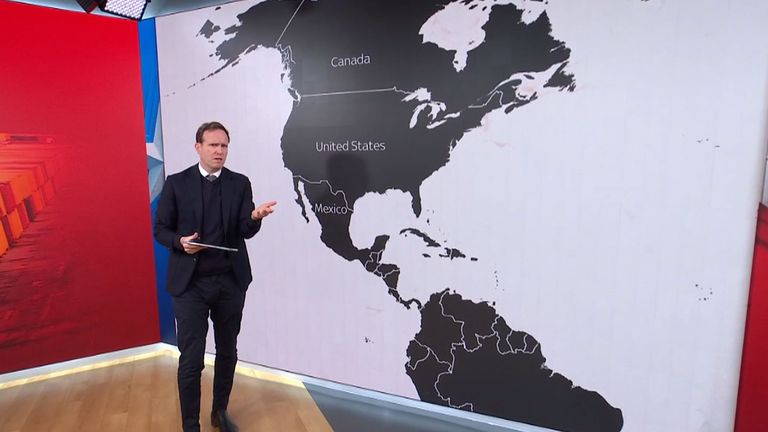
Donald Trump has long threatened increasing tariffs on goods from Mexico, Canada, and China.
The second-time president argues higher levies will help reduce illegal migration and the smuggling of fentanyl to the US.
On Saturday 1 February the three tariffs came into effect, with Mexican and Canadian goods subject to the full 25% – and Chinese imports to 10%.
Although the Trump administration says the changes will boost domestic production, there will likely be wide-ranging negative consequences for the US consumer.
Economists argue supply chains will be disrupted and businesses will suffer increased costs – leading to an overall rise in prices.
Analysis:
Why has Trump targeted Mexico and Canada?
Both Mexico and Canada rely heavily on their imports and exports, which make up around 70% of their Gross Domestic Products (GDPs), putting them at even greater risk from the new tariffs.
China only relies on trade for 37% of its economy, having made a concerted effort to ramp up domestic production, making it relatively less vulnerable.
Here we look at where US consumers will feel the biggest impact.
Tariffs to focus on Mexico and Canada
Avocados – and other fruit and veg
The US imports between half and 60% of its fresh produce from Mexico – and 80% of its avocados, according to figures from the US Department of Agriculture.
Canada also supplies a lot of the US’s fruit and vegetables, which are mainly grown in greenhouses on the other side of the US border.
This means that increased tariffs will quickly be passed on to consumers in the form of higher prices.
The US still grows a considerable amount of its own produce, however, so the changes could boost domestic production.
But economists warn that overreliance on domestic goods will see those suppliers increase their prices too.
Petrol and oil prices
Oil and gas prices are likely to be impacted – as Canada provides around 60% of US crude oil imports and Mexico roughly 10%.
According to the US Energy Information Administration, the US received around 4.6 million barrels of oil a day from Canada last year – and 563,000 from Mexico.
Most US oil refineries are designed specifically to process Canadian products, which would make changing supply sources complex and costly.
There has been some speculation that Mr Trump may exempt oil from the new changes – but if he doesn’t, the US could see an increase in fuel prices of up to 50 cents (40p) a gallon, economists have predicted.
Cars and vehicle parts
The US car industry is a delicate mix of foreign and domestic manufacturers.
The supply chain is so complex, car parts and half-finished vehicles can sometimes cross the US-Mexico border several times before they are ready for the showroom.
If this continues, the parts would be taxed every time they move countries, which would lead to an even bigger increase in prices.
To mitigate this, General Motors has said it will try to rush through Mexican and Canadian exports – while brainstorming on how to relocate manufacturing to the US.
Trump 100: Why is he blaming diversity push for the Washington DC plane crash?
Electronic goods
When Donald Trump imposed a 50% tariff on imported washing machines during his first term in 2018, prices suffered for years afterwards.
China produces a lot of the world’s consumer electronics – and smartphones and computers specifically – so the 10% tariff could have a similar effect on those devices.
The Biden administration tried to legislate to promote domestic production of semiconductors (microchips needed for all smart devices) – but for now, the US is still heavily reliant on China for its personal electronics.
This will mean an increase in prices for consumers unless tech companies can relocate their operations away from Beijing.
Boost for the steel industry
The sector that could feel the most benefit from the Trump tariffs is the steel and aluminium industry.
It has long been lobbying the government to put tariffs on foreign suppliers – claiming they are dominating the market and leaving US factories without enough business and at risk of closure.
Steel imports increasing in price would promote domestic production – and possibly save some of the plants.
But when Mr Trump increased steel tariffs during his first term, prices also increased – which business leaders said forced them to pass on costs and left them struggling to complete construction projects on budget.
Overall inflation
An increase in the prices of all these goods would inevitably lead to widespread overall inflation.
According to analysis by Capital Economics, the Canadian and Mexican tariffs would put inflation above 3% – which is much higher than the Federal Reserve’s target of 2% – and the Chinese levies would see it rise even further.


“Many options” are on the table to deal with Venezuelan drug gangs, the White House has said, as the US considers attacking on land.
President Trump is meeting his national security team on Monday and could discuss what would be a major escalation in strikes that have so far only targeted boats.
Karoline Leavitt, the president’s press secretary, did not detail what the meeting would focus on. However, Mr Trump said last week that land strikes would start “very soon”.
“There’s many options at the president’s disposal that are on the table – and I’ll let him speak on those,” Ms Leavitt told reporters.
Three killed as US strikes another alleged drug boat
American forces have carried out at least 21 strikes on boats it claims were carrying narcotics to its shores over the last few months.
The US has accused Venezuelan President Nicolas Maduro of being involved in the drugs trade – a claim he denies.
Venezuela has said the attacks, which have killed more than 80 people, amount to murder and that President Trump’s true motivation is to oust Mr Maduro and access its oil.
President Maduro – widely considered a dictator by the West – said on Monday that Venezuelans are ready “to defend [the country] and lead it to the path of peace”.
“We have lived through 22 weeks of aggression that can only be described as psychological terrorism,” he said.
Concerns have been raised over the legality of the US attacks, which the Pentagon has sought to justify by designating the gangs as foreign terror organisations.

Image of an alleged drug boat being targeted by the US military. Pic: Truth Social
Tensions remain high over America’s large deployment in the Caribbean Sea and eastern Pacific, which includes its flagship aircraft carrier and thousands of troops.
The US has released videos of boats being blown up but has not provided evidence – such as photos of drugs – to support the smuggling claims.
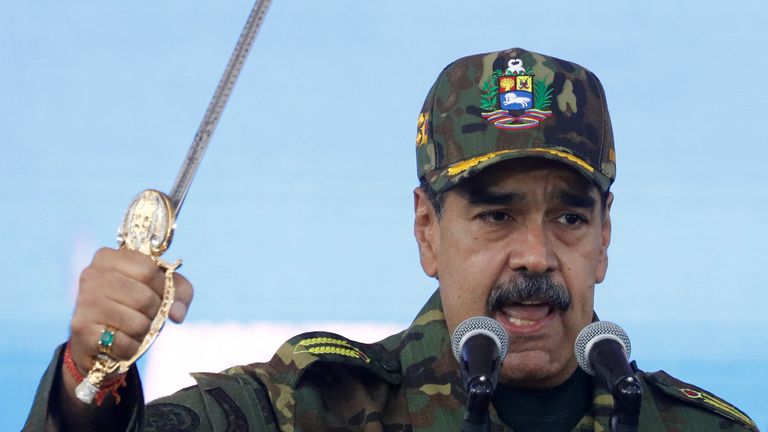
President Maduro is widely considered a dictator by the West. Pic: Reuters
Controversy also surrounds the first incident, on 2 September, in which 11 people were killed – with a follow-up strike targeting the boat after the first attack left two survivors in the water.
US media reported defence secretary Pete Hegseth gave an order beforehand that everyone on board should be killed.
However, there are concerns about the legality of the second strike if the survivors posed no threat.
Mr Hegseth dismissed the reporting as “fake news” and insisted all actions in the region are compliant with US and international law.
“Every trafficker we kill is affiliated with a Designated Terrorist Organization,” he said on X.
President Trump said on Sunday he would not have wanted a second strike and that Mr Hegseth had denied giving such an order.
Read more from Sky News:
Hong Kong fire: 13 arrested as death toll hits 151
More than 1,100 confirmed dead in Asia floods

Is US about to go to war with Venezuela?
Ms Leavitt confirmed on Monday that the boat had been hit by a second strike – but denied Mr Hegseth gave the order for the follow-up.
Instead, she said he had authorised US navy vice admiral Frank Bradley to attack and the admiral acted “well within his authority and the law, directing the engagement to ensure the boat was destroyed and the threat to the US was eliminated”.
As the US weighs its next steps, Mr Trump said on Sunday he had spoken to President Maduro by phone and that the conversation went neither “well or badly”.
In recent days, he also stated that Venezuela’s airspace should be considered closed – with the South American nation calling it a “colonial threat” and “illegal, and unjustified aggression”.
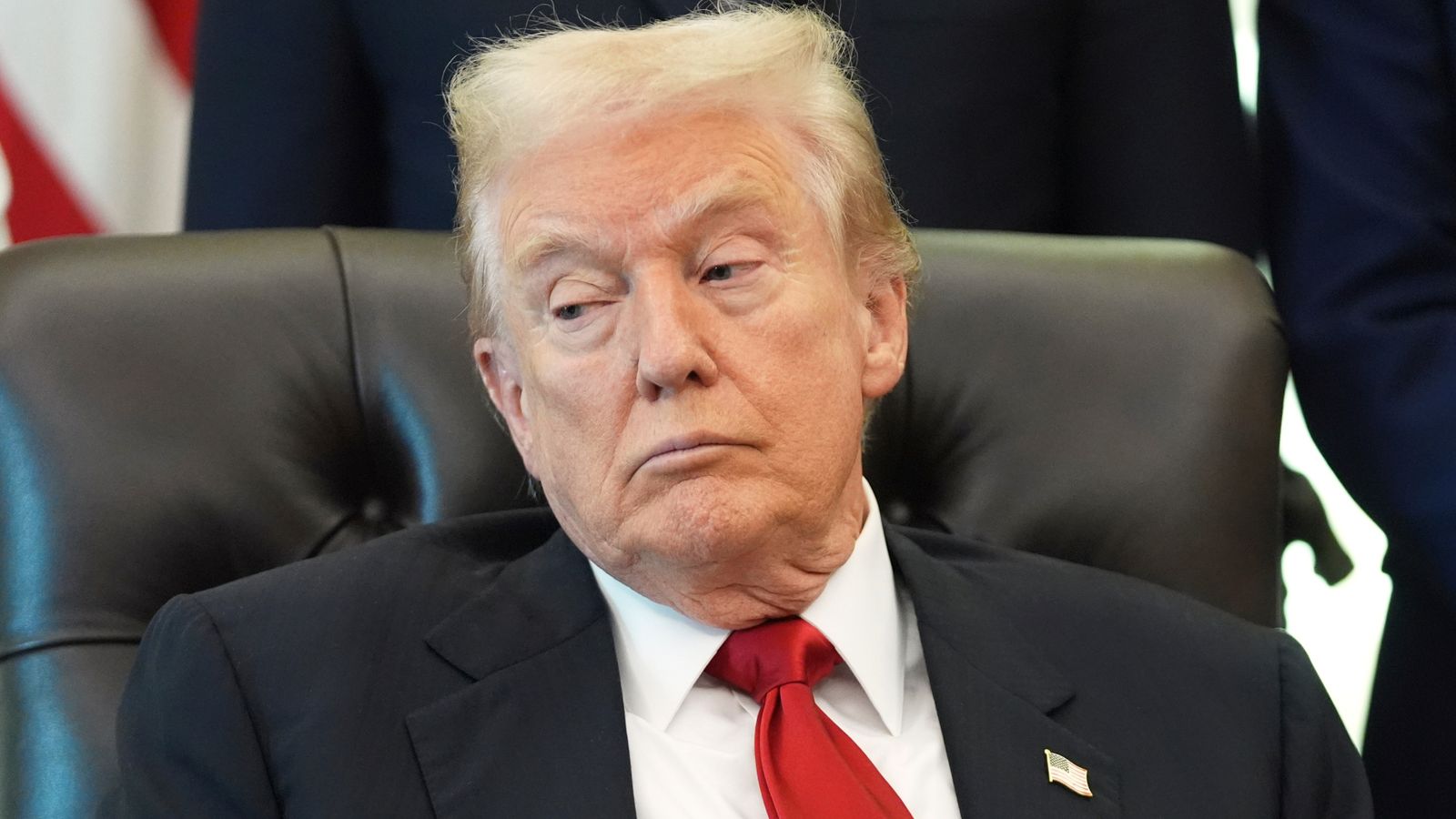

The White House has revealed details of Donald Trump’s recent medical evaluation involving a scan of his cardiovascular system and abdomen.
The US president, 79, underwent a magnetic resonance imaging (MRI) scan in October, which was confirmed in a memo from his doctor, Sean P Barbabella.
The White House physician wrote that the cardiovascular and abdominal imaging was “perfectly normal”.
“The purpose of this imaging is preventive: to identify issues early, confirm overall health, and ensure he maintains long-term vitality and function,” said Dr Barbabella.
He added that there was “no evidence of arterial narrowing impairing blood flow or abnormalities in the heart or major vessels”.
“The heart chambers are normal in size, the vessel walls appear smooth and health, and there are no signs of inflammation, or clotting.”
As for the abdominal imaging, he wrote that “all major organs appear very healthy and well-perfused”.
“Everything evaluated is functioning within normal limits with no acute or chronic concerns.”
He said the imaging was done “because men in his age group benefit from a thorough evaluation of cardiovascular and abdominal health”.
While speaking to reporters on Sunday, the US president said he didn’t know what part of his body was examined but added: “It wasn’t the brain because I took a cognitive test and I aced it.”
He described the results of the MRI as “perfect”.
Read more from Sky News:
Trump targets ‘third world’ immigrants
Venezuela accuses Trump of ‘colonial threat
Trump to cancel all Biden executive orders
Donald Trump in July with a swollen ankle. File pic: AP
In 2022, Donald Trump described himself as “the healthiest president that’s ever lived” but in July was diagnosed with chronic venous insufficiency (CVI) after noticing “mild swelling” in his lower legs.
Dr Barbabella said CVI, which causes blood to pool in the veins, was a “benign and common condition, particularly in individuals over the age of 70”.
Concerns were also raised in July about photos which showed bruising on the back of Mr Trump’s hand that had been covered with make-up.
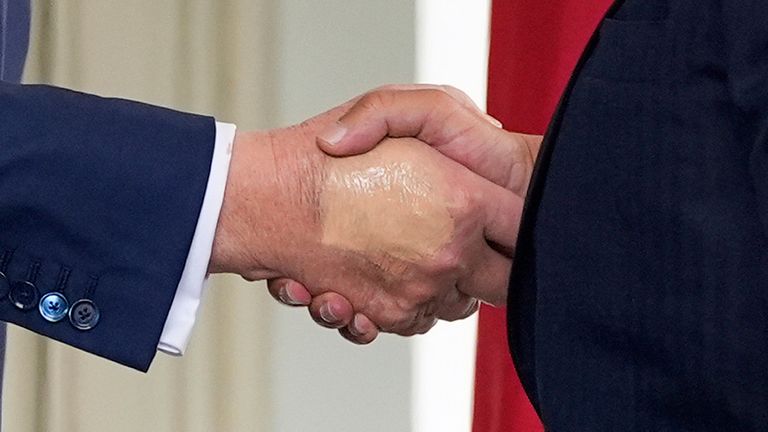
Make-up covering bruising on Mr Trump’s hand. File pic: AP
White House press secretary Karoline Leavitt clarified this was “minor soft tissue irritation from frequent handshaking and the use of aspirin” to reduce the risk of heart attack and stroke.
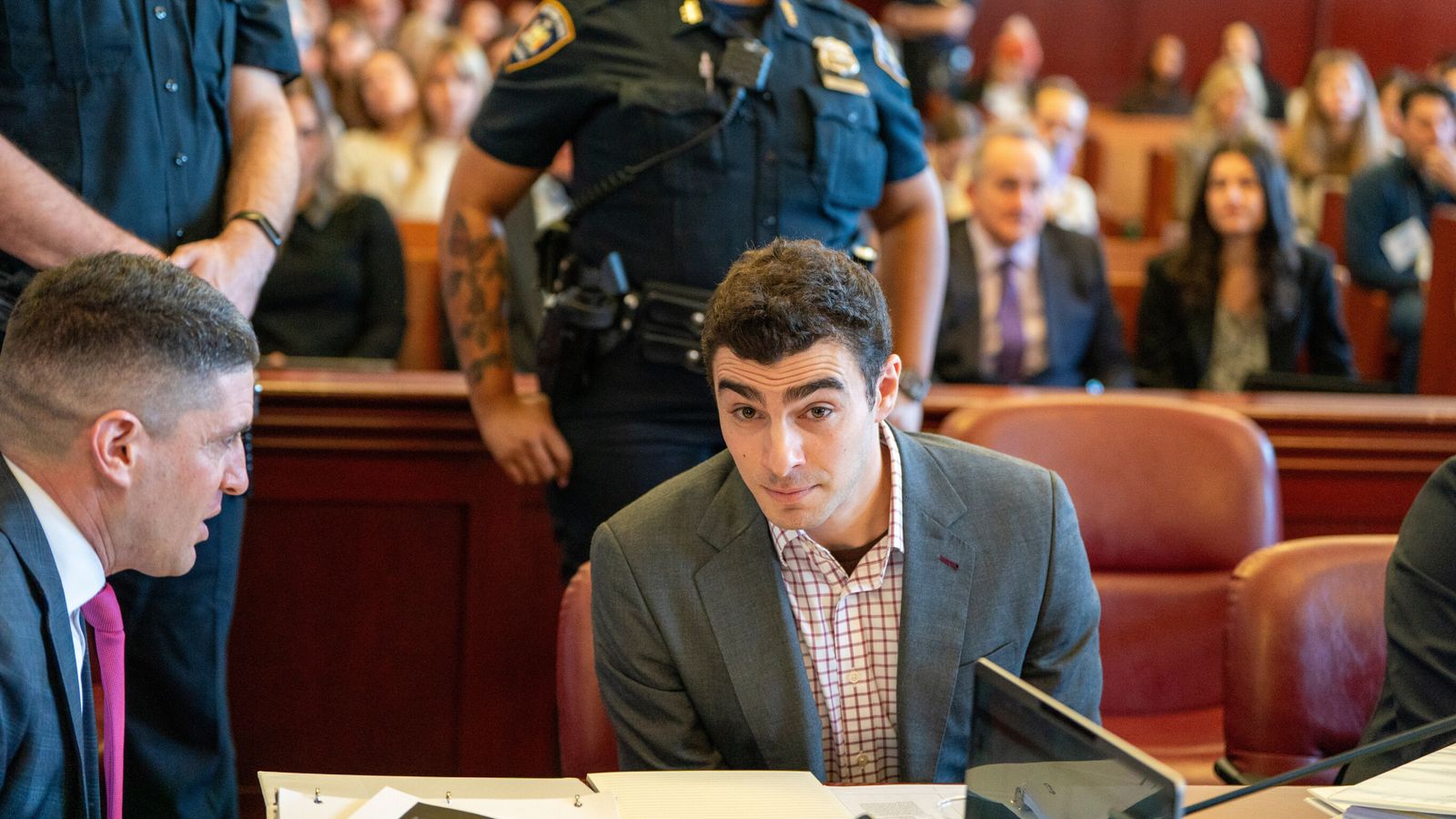
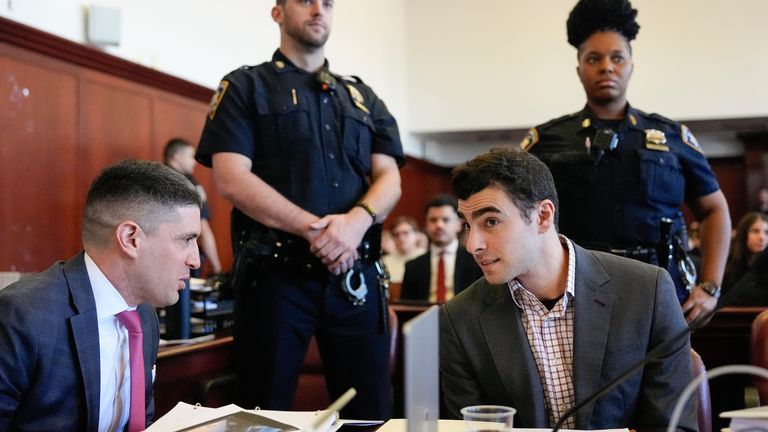
Luigi Mangione has watched surveillance videos of the killing of UnitedHealthcare CEO Brian Thompson at a court appearance.
Mangione has pleaded not guilty to state and federal murder charges over the killing of Mr Thompson. The state charges carry the possibility of life in prison, while federal prosecutors are seeking the death penalty.
The 27-year-old’s lawyers are seeking to bar evidence, including a 9mm handgun and a notebook in which prosecutors say he described his intent to “wack” a health insurance executive, from his New York state trial.
Both were allegedly found in a backpack Mangione had with him when he was arrested.
Mr Thompson, 50, was shot dead on 4 December last year as he walked to a New York City hotel for his company’s annual investor conference, sparking a five-day manhunt.
Mangione was arrested after a McDonald’s employee in Pennsylvania alerted authorities to a customer who looked like the suspect in the killing.
Luigi Mangione was shown a video of the killing of UnitedHealthcare CEO Brian Thompson. Pic: AP
Mangione, wearing a white shirt with a red checked pattern under a grey suit, watched without emotion as prosecutors played surveillance videos showing Mr Thompson’s killing on a Manhattan pavement, as well as his own arrest, at a court appearance in New York on Monday.
The videos, including footage from the McDonald’s restaurant in Pennsylvania where he was arrested, kicked off a hearing on Mangione’s fight to bar evidence from his trial, including the gun prosecutors say matches the one used in the early-hours attack.
Read more from Sky News:
US and UK agree zero tariffs on pharmaceuticals
More than 1,100 confirmed dead in catastrophic Asia floods
After getting state terrorism charges thrown out in September, Mangione’s lawyers are focusing on what they argue was unconstitutional police conduct threatening his right to a fair trial.
They are seeking to block prosecutors from using evidence allegedly discovered in his backpack during his arrest, and statements he made to police, arguing that he was illegally searched and questioned.
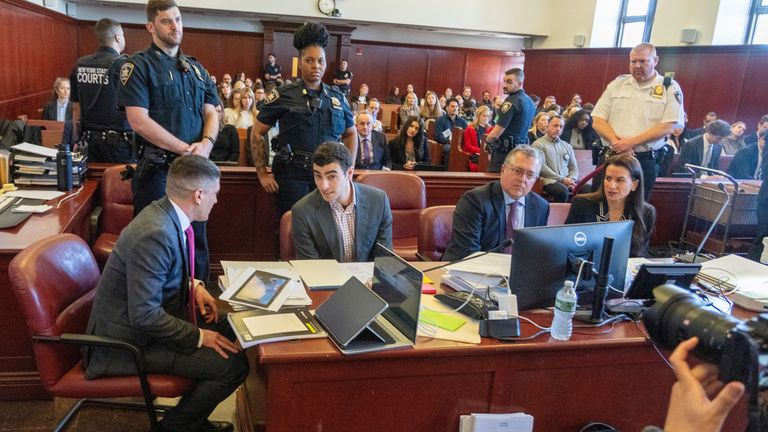
Luigi Mangione appears in court for an evidence hearing on 1 December 2025, in New York. Pic: AP
Eliminating the gun and notebook would be huge wins for Mangione’s defence, and a major setback for prosecutors, depriving them of a possible murder weapon and evidence they say points to motive.
Mangione also faces seven counts of criminal possession of a weapon, and one count of possessing a false identification.
Judge Gregory Carro dismissed two terrorism counts against Mangione in September.
He found that prosecutors had not presented enough evidence that Mangione intended to intimidate health insurance workers or influence government policy.
Trial dates have not been set in either the state or federal cases.
Mangione has been held in federal custody in Brooklyn since his arrest.
-
 Sports2 years ago
Story injured on diving stop, exits Red Sox game
-
 Sports3 years ago
‘Storybook stuff’: Inside the night Bryce Harper sent the Phillies to the World Series
-
 Sports2 years ago
Game 1 of WS least-watched in recorded history
-
 Sports3 years ago
Button battles heat exhaustion in NASCAR debut
-
 Sports3 years ago
MLB Rank 2023: Ranking baseball’s top 100 players
-
Sports4 years ago
Team Europe easily wins 4th straight Laver Cup
-
 Environment3 years ago
Japan and South Korea have a lot at stake in a free and open South China Sea
-
 Environment1 year ago
Here are the best electric bikes you can buy at every price level in October 2024