
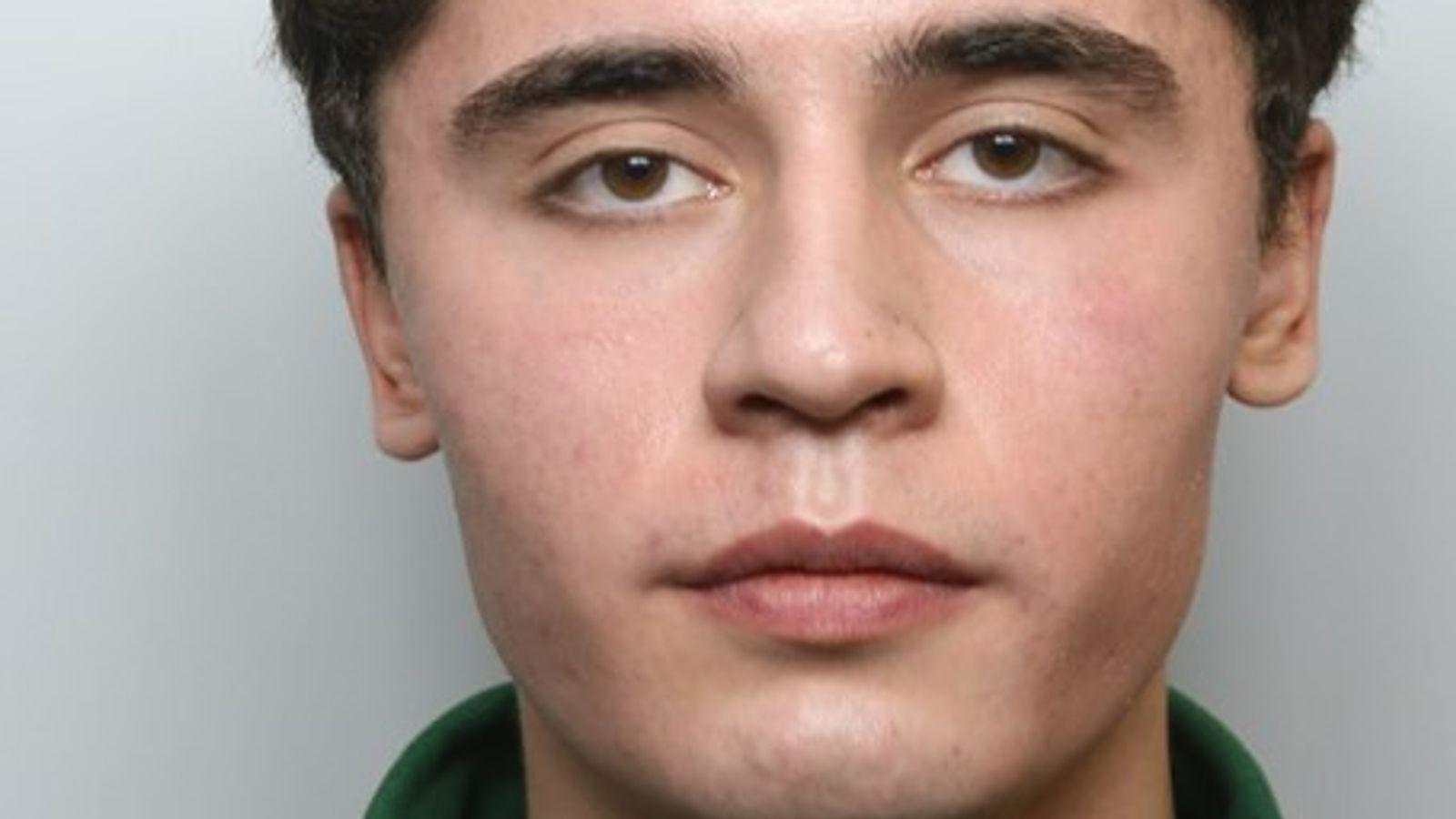
Prison escape: Former soldier Daniel Khalife jailed for 14 years and three months

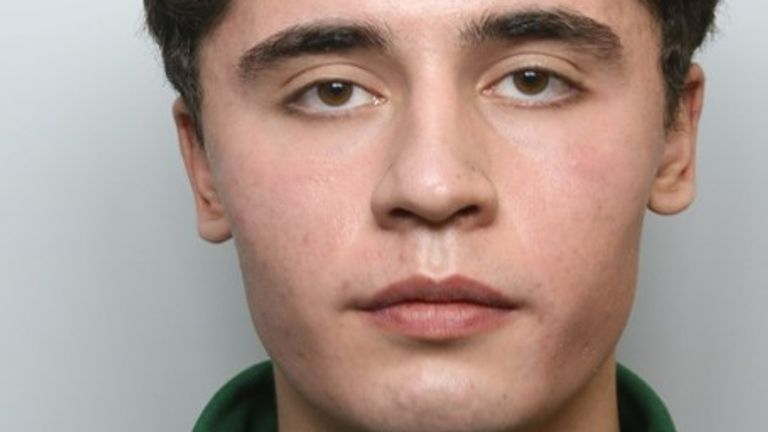
A former British soldier who escaped from Wandsworth prison while awaiting trial for spying for Iran has been jailed for 14 years and three months.
Daniel Khalife, 23, sparked a nationwide manhunt after clinging to the underside of a food delivery lorry to break out of the Category B jail on 6 September last year.
He evaded capture for three days before he was spotted riding a stolen mountain bike along the canal towpath in Northolt, west London – about 14 miles away.
Khalife, who was a lance corporal in the Royal Signals, was being held on remand accused of using his role in the military to pass secret information to Iranian spies.
He was arrested after telling the British security services he wanted to be a “double agent” and claimed he had cultivated the relationship over more than two years in the national interest.
But he was found guilty of a charge under the Official Secrets Act and another under the Terrorism Act at the end of last year at Woolwich Crown Court, having admitted escaping from lawful custody part-way through his trial.
Daniel Khalife jailed for spying and prison escape. Pic: Met Police
Sentencing Khalife, Mrs Justice Cheema-Grubb told him: “When you joined the Army as a young man, you had the makings of an exemplary soldier. However, through the repeated violation of your oath of service, you showed yourself to be, instead, a dangerous fool.”
She added: “You embarked on the course of conduct I have described because of a selfish desire to show off, to achieve by unregulated means what you were told will be difficult for you to achieve by conventional promotion.
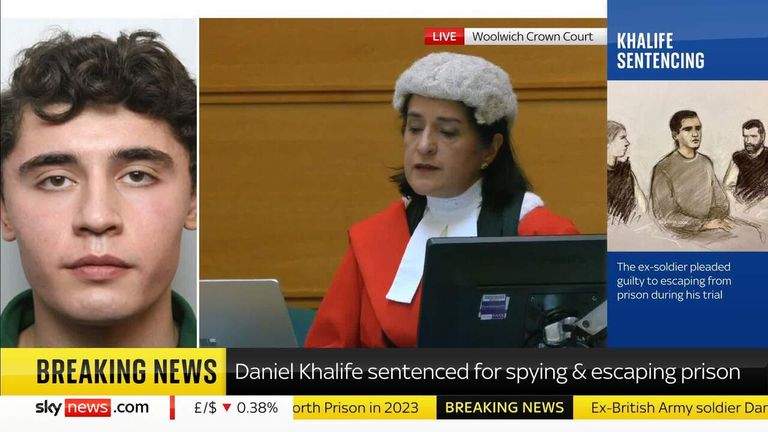
Watch Iran spy Daniel Khalife get jail sentence
“The mere fact that you started on this dangerous and fantastical plan demonstrates your immaturity and lack of wisdom, that you thought it was appropriate to insert yourself – an unauthorised, unqualified and uninformed junior soldier – into communication with an enemy state is perhaps the clearest indication of the degree of folly in your failure to understand at the most obvious level the risk you posed.”
She said he would have been a blackmail risk for his whole career had he not been caught.
The judge said Khalife contacted MI5 and MI6 in his attempts to become a double agent but was ignored. She added: “The greater mischief in your offending is that, having failed to engage any response from the intelligence services of the United Kingdom, you continued betraying your country and exposed others to the possibility of harm.”
There was no reaction from Khalife, who looked down as the judge read out his sentence.
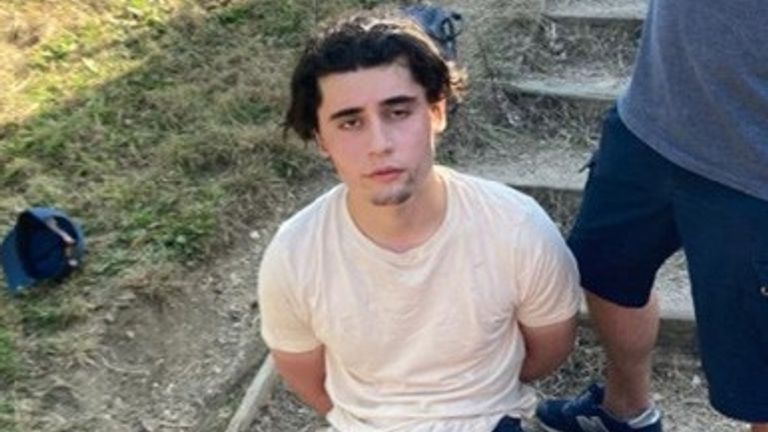
Khalife was caught after three days on the run. Pic: Met Police
The court heard Khalife, from Kingston, in southwest London, joined the Army aged 16, before contacting an Iranian middle-man through Facebook.
Giving evidence, he said he wanted to prove himself after a senior officer told him he would not be able to work in intelligence because his mother was born in Iran.
Khalife left material in public locations in exchange for cash in an old-fashioned spy tactic known as the “dead drop” or “dead letter box”.

Khalife joined Army aged 16
He told his handlers he would stay in the military for 25-plus years for them and twice travelled from his barracks, in Staffordshire, to the Iranian embassy in South Kensington, in London.
The court heard he flew to Istanbul, where he stayed in the Hilton hotel between 4 and 10 August 2020, and “delivered a package” for Iranian agents.
The contact continued while he was deployed to Fort Hood, Texas, where he received training in Falcon, a military communications system and even after he was arrested and released on bail.
Khalife told the jury he was an English “patriot” and “not a terrorist or a traitor,” claiming he “thought he could be James Bond” but had only passed on fake or useless information.
But prosecutors said he “exposed military personnel to serious harm” when he shared sensitive information including a handwritten list of serving soldiers, including some in the SAS and SBS special services.
Khalife’s spying activities will not go down in the “annals of history,” his barrister told the court at his sentencing.
Gul Nawaz Hussain KC reminded the judge how they described his actions as more Scooby Doo than James Bond, adding: “What Daniel Khalife clearly chose to do was not born of malice, was not born of greed, religious fervour or ideological conviction.
“His intentions were neither sinister nor cynical.”
Mr Hussain told the court some of the documents Khalife had forged to pass to the Iranians were “laughably fake”.

Khalife escaped under a food delivery lorry. Pic: Met Police
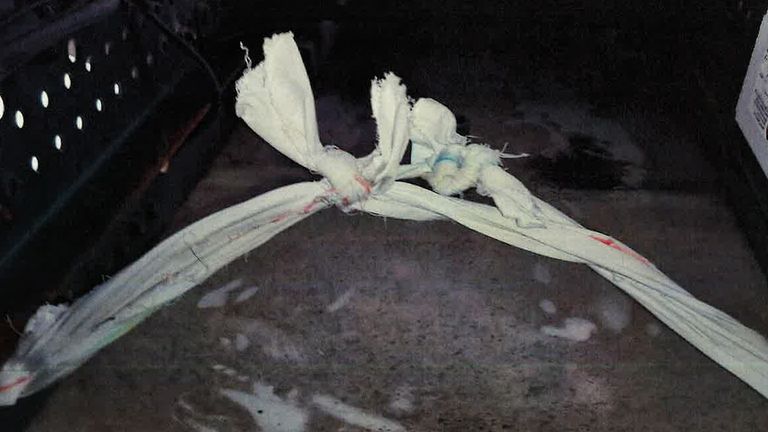
Khalife used a makeshift sling. Pic: Met Police
Police said he had been planning his “pretty audacious” escape for “quite some time” and the court heard he wrote in his prison diary of a “failed” attempt on 21 August last year.
Khalife, who got a job in the prison kitchen, said he used the trousers inmates wore as uniform, to make a rope, which he attached to the Bidfood lorry on 1 September to test prison security as it made its daily deliveries.
“When I had made the decision to actually leave the prison I was going to do it properly,” he said, describing how he concealed himself, resting his back on the sling as the vehicle was searched.
The driver Balazs Werner said two guards told him someone was missing as they checked the truck with a torch and mirror and he was surprised he was allowed to drive off and that the prison was not in lockdown.
Khalife said he waited for the lorry to stop, dropped to the ground and lay in the prone position until it moved off.
MI5, the Ministry of Defence and counter-terrorism police launched a nationwide manhunt, fearing Khalife would try to flee to Tehran or get to the Iranian embassy in London.
He used the phone at the Rose of York pub in Richmond before a contact withdrew £400 from a nearby cashpoint, which he used to buy a sleeping bag, a mobile phone and a change of clothes.
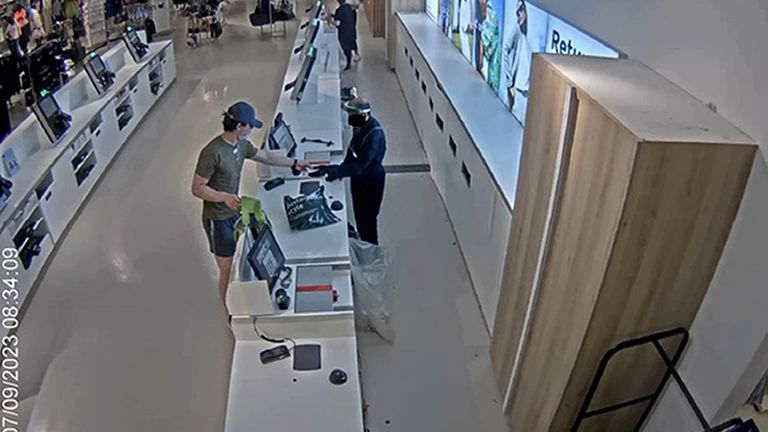
Khalife caught on CCTV
CCTV footage captured his movements as he bought clothes from Marks & Spencer, stole a hat from Mountain Warehouse, drank coffee at McDonald’s and even read about his escape in the newspaper.
The court heard that while he was on the run, Khalife was in contact with his Iranian handlers, who used the code name “David Smith”, and he sent the message: “I wait.”
When he was arrested on the footpath of the Grand Union Canal on 9 September Khalife told police: “My body aches. I f****d myself up under the lorry” and “I don’t know how immigrants do it”.
He told jurors his time on the run showed “what a foolish idea it was to have someone of my skillset in prison”.
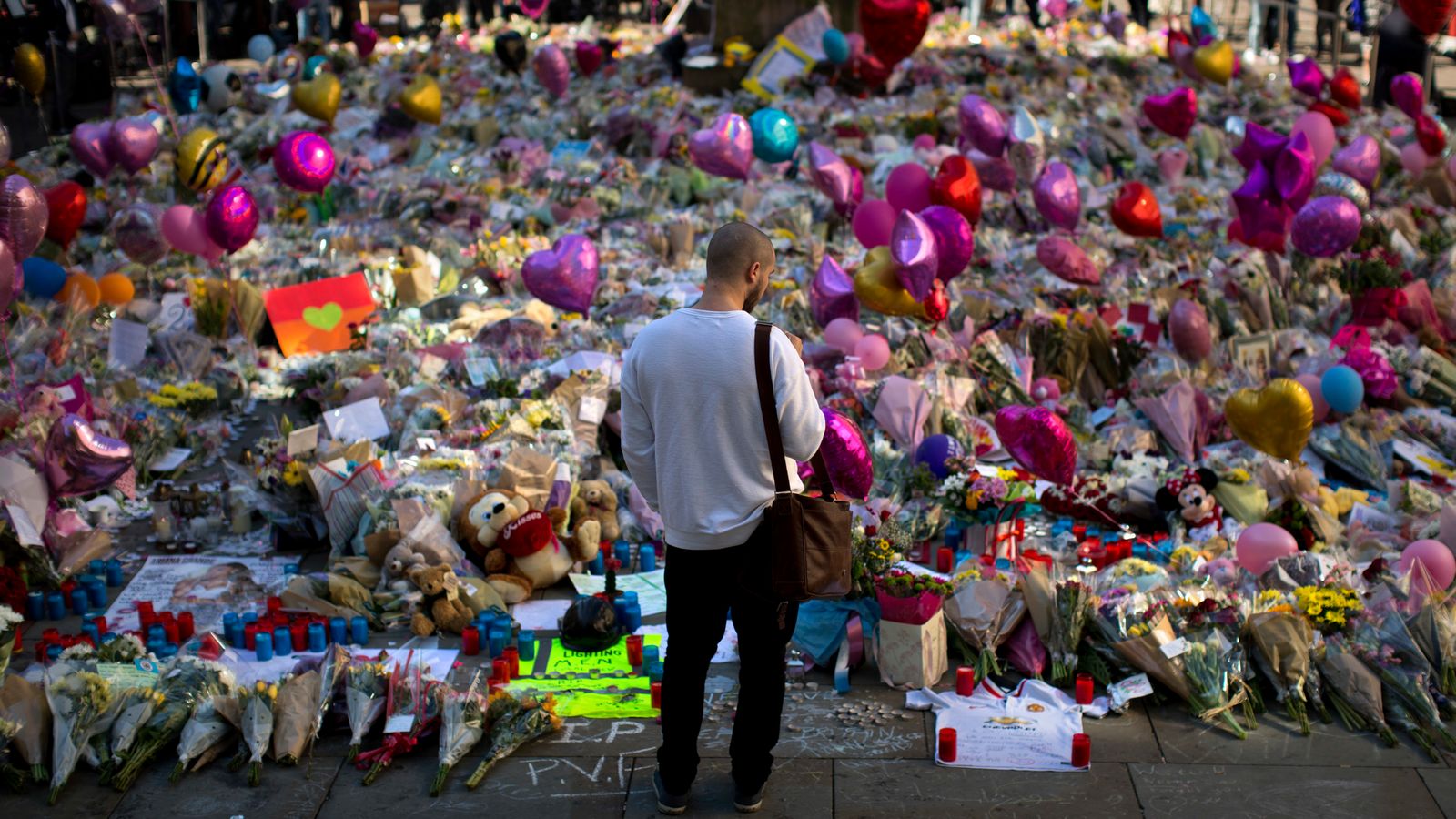
A judge has ruled that nearly £20m is to be paid out to 16 survivors of the Manchester Arena bombing who were children at the time of the tragedy.
Twenty-two people were murdered and hundreds injured in the suicide bombing at an Ariana Grande concert at Manchester Arena on 22 May, 2017.
Amounts of between £2,770 and £11.4m were agreed at a hearing on Thursday at the Manchester Civil Courts of Justice for 16 youngsters, all aged under 16 at the time of the attack.
The total amount to be paid comes in at £19,928,150.
Some of the youngsters suffered “catastrophic” and life-changing injuries, and others suffered psychological damage after 22-year-old Salman Abedi detonated a backpack bomb leaving the concert.
The claims were made against, and will be paid by, the defendants in the case – those responsible for the safe and secure running of the arena event.
People hold a minute of silence in a square in central Manchester, on 25 May 2017. Pic: AP
Those contributing to the settlement include: SMG Europe Holdings, which managed the venue; Showsec International Ltd, responsible for crowd management; and British Transport Police (BTP) and Greater Manchester Police (GMP), responsible for policing the area.
A public inquiry into the bombing, led by Sir John Saunders, found that chances to prevent the attack had been missed, and also noted “serious shortcomings” in security and individual failings.
Read more from Sky News:
Actors vote for industrial action over AI concerns
Terrorism arrests soar by 660% after Palestine Action ban
On Thursday, Judge Nigel Bird approved the 16 claims – agreed between their lawyers and the defendants – as they all involved children or those without mental capacity.
The 16 survivors and their families cannot be identified, due to a court order.
It is understood that following the hearing, claims by another 352 people, all adults deemed to have capacity, including the families of the 22 who lost loved ones, will now be agreed between lawyers for the claimants and the defendants.
Those agreements have been made out-of-court, so no details of any public money to be paid out by public bodies BTP and GMP have been made public.

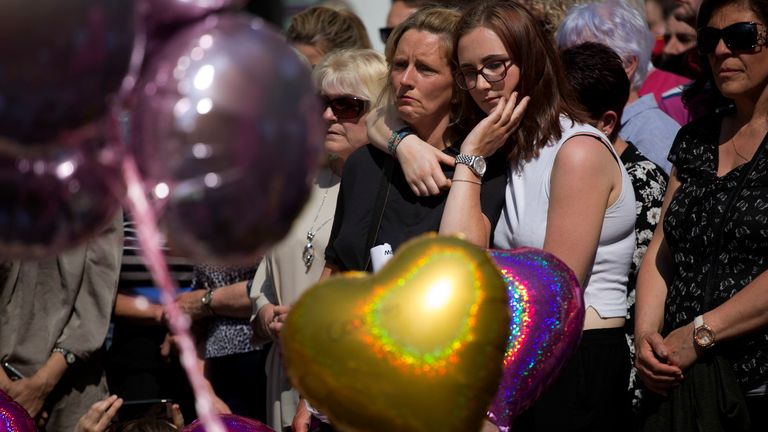
Pic: AP
The four organisations have apologised to the bereaved families and to the survivors, lawyers for the claimants said, and have admitted their failures.
Judge Bird told the hearing: “Each of these cases has a common link, that is injuries and loss suffered, arising out of a single and unimaginable act of terrorism committed on the evening of May 22 2017 at the end of a concert attended by very many young people and their families.”
“The love and care a parent gives to an injured child is beyond monetary value,” he added.
Judge Bird also paid tribute to the “courage, dedication and fortitude” of the families involved in each case, adding: “Each through their quiet determination has brought about promises of change in the hope that in the future, other families need not go through what they have been through.”
After the hearing, a joint statement was issued from the legal teams at Hudgell Solicitors, Slater & Gordon and Broudie Jackson Canter, the three main firms representing the claimants.
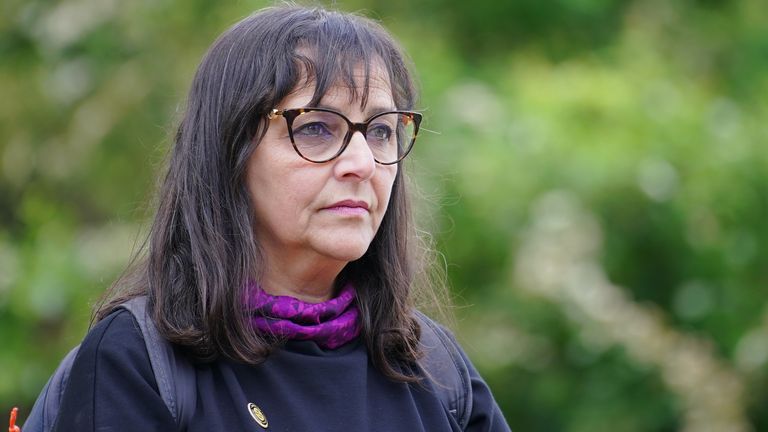
Figen Murray, mother of 29-year-old victim Martyn Hett. Pic: PA
The statement said: “This is not a day of celebration. It is a moment to acknowledge the mistakes that were made and the unimaginable suffering our clients have endured over the past eight and a half years.
“We now expect all parties to honour their commitment to do what they can to prevent those same mistakes from happening again.”
Martyn’s Law, named in memory of Martyn Hett, 29, who was killed in the attack, has since been implemented, to better protect public venues from terror attacks.
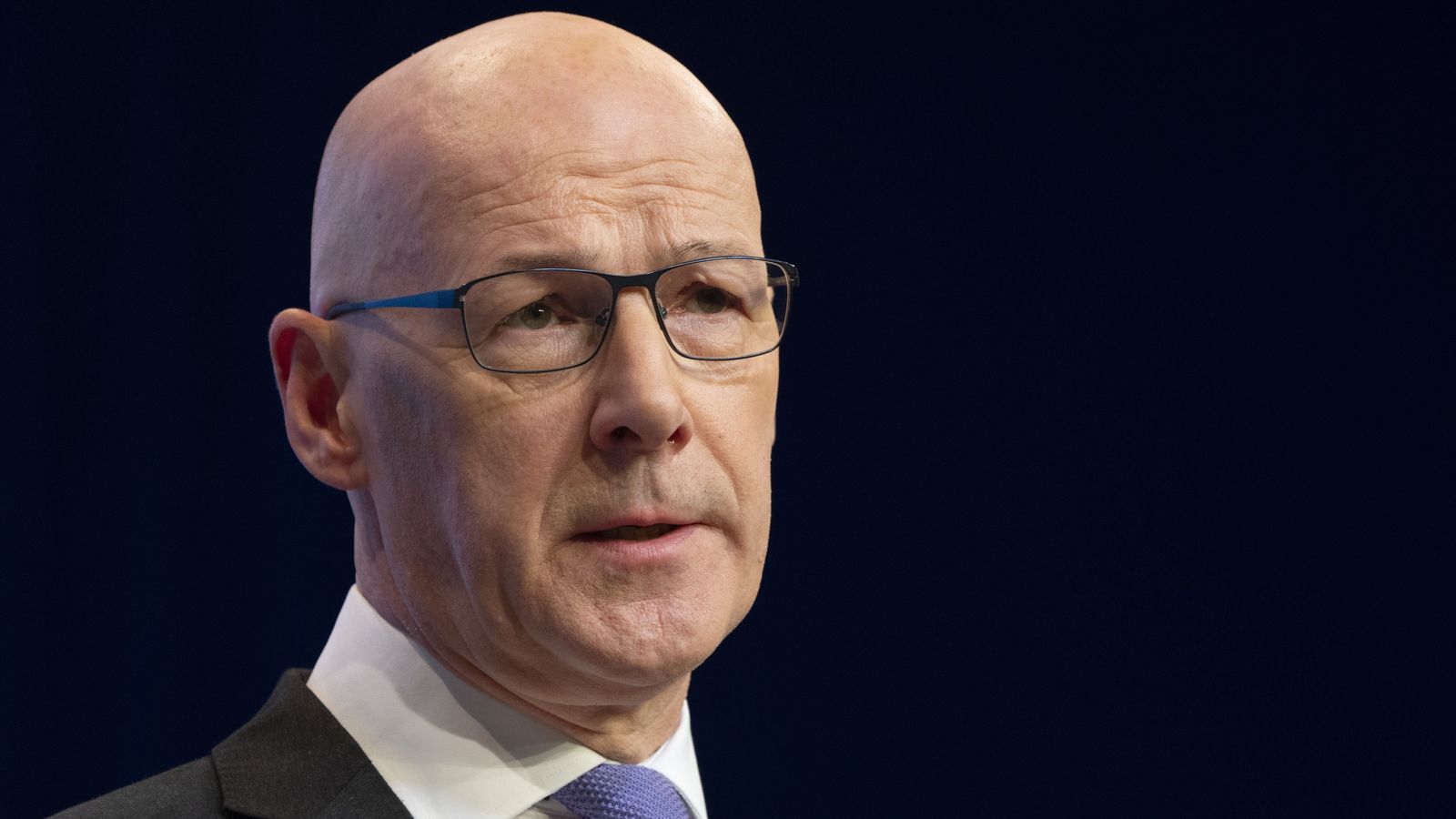

Reports a female MSP had a secret recording device planted in her office by a member of her own staff are “completely and utterly unacceptable”, SNP leader John Swinney has said.
Scottish parliament officials are investigating the alleged bugging incident by a man, which is said to have taken place in 2023 at Holyrood.
The Scotsman newspaper reported the staffer is still involved with the SNP and moved on to work with a male MP after the issue came to light.
Sky News has yet to independently verify the details, but one senior party source with knowledge of events has said it is “100% true”.
The source alleges “the SNP did nothing; indeed he simply got moved and continued to be promoted by very senior members of executive”.
It is suggested the female MSP, who has not been publicly named, is liked, rated and respected by her colleagues.
The Scottish parliament building in Edinburgh. Pic: PA
First Minister Mr Swinney was stopped by reporters in Edinburgh on Thursday where he said he was “not familiar with all of the details… but that type of conduct is completely and utterly unacceptable”.
“Individuals are entitled to operate in an open and transparent environment that shouldn’t be subjected to that kind of behaviour,” he concluded.
Read more from Sky News:
Millions could see council elections delayed again
Bank of England rate cut to 3.75% following fall in inflation
MPs and MSPs employ staff directly, rather than the political party.
Sky sources confirmed the victims of the incident had to get counselling in the aftermath before suggesting the SNP “definitely has a woman problem”.
The source claims it is “not a one-off incident”, adding: “Women are habitually treated differently.”
An SNP spokesperson said: “The SNP has no involvement in the employment processes of parliamentarians. That is a confidential matter between elected members, employees, and Scottish parliament authorities.
“The reports outline a very traumatic situation for those involved and nobody should ever have to experience fear or harassment for doing their job.”
Scottish Labour deputy leader Jackie Baillie said: “These jaw-dropping revelations pose serious questions for the SNP top brass.
“It appears a grave breach of privacy and potentially criminal behaviour has been swept under the carpet by the SNP.
“Once again it looks like the SNP chose to close ranks and protect their own, rather than dealing with serious misconduct head-on.”
A spokesperson for the Scottish parliament said: “Each MSP is an employer in their own right and is responsible for managing staff welfare issues and employment disputes.
“Complaints about staff conduct are investigated by an independent adviser, and it is for the member to act on their findings accordingly.
“As a matter of standard practice, we do not comment upon or confirm any individual cases.”
-
 Sports2 years ago
Story injured on diving stop, exits Red Sox game
-
 Sports3 years ago
‘Storybook stuff’: Inside the night Bryce Harper sent the Phillies to the World Series
-
 Sports2 years ago
Game 1 of WS least-watched in recorded history
-
 Sports3 years ago
Button battles heat exhaustion in NASCAR debut
-
 Sports3 years ago
MLB Rank 2023: Ranking baseball’s top 100 players
-
Sports4 years ago
Team Europe easily wins 4th straight Laver Cup
-
 Environment3 years ago
Japan and South Korea have a lot at stake in a free and open South China Sea
-
 Environment1 year ago
Here are the best electric bikes you can buy at every price level in October 2024