
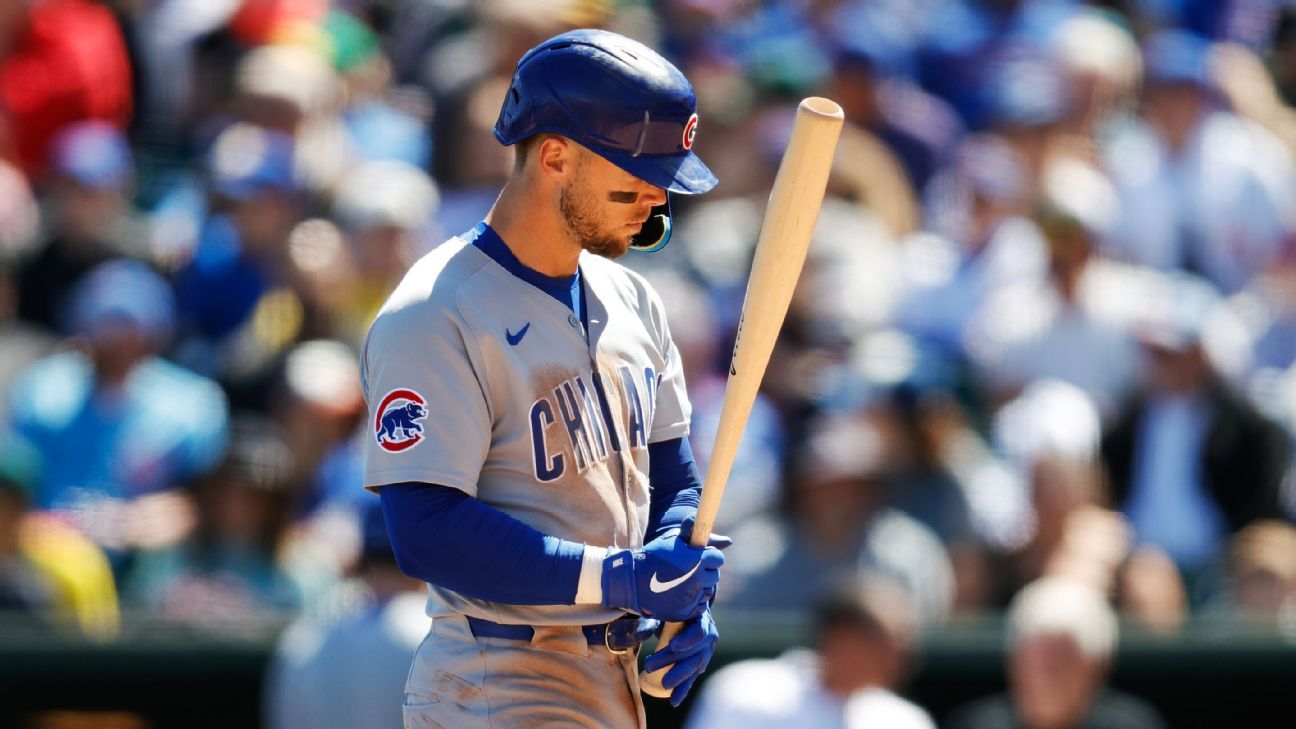
What MLB players and coaches are saying about torpedo bats


A week has passed since torpedo bats burst onto the scene as the talk of the 2025 MLB season, and the hitting innovation is still buzzing through the industry.
We asked our MLB reporters to talk to players and coaches to see if they think the bowling pin-shaped bat trend is here to stay, how much it really helps hitters — and if they believe it should be allowed in the majors.
Here’s what those around baseball had to say about the trend taking the sport by storm.
When did you first hear about torpedo bats?
Andrew Benintendi, OF, Chicago White Sox: I had never heard of it. I’ve used the same bat for nine years so I think I’ll stick with that. It’s pretty interesting. It makes sense. If it works for a guy, good for him. If it doesn’t, stick with what you got.
Robert Van Scoyoc, hitting coach, Los Angeles Dodgers: I’ve heard about bat fitting. We do bat fitting and all that. I just haven’t heard about this specifically. When I first heard about [torpedo bats specifically] was when everyone else kind of knew about it.
Ryan O’Hearn, first baseman, Baltimore Orioles: (Orioles assistant GM and former NASA engineer) Sig Mejdal deserves credit. Sig has been on the torpedo bat for a long time. He’s been trying to get guys to experiment with it, use it. He’ll send them out, send us everybody. He sent some in the offseason. He sent me the traditional torpedo bat and then he sent me a special model that, based off of my batted ball data, would fit better. He’s been all over it. I think I first heard about it in maybe the end of ’23 from Sig. And then he made them available. I took BP with it. I was unsure because it does feel a little different. Not in a bad way, just different. I feel like I was hitting balls and kind of feeling the vibrations on the end, which I didn’t really like.
Dansby Swanson, SS, Chicago Cubs: This offseason. It’s just caught on. People have used it before. It’s not that new.
Adam Ottavino, veteran reliever: I noticed last year that there were some guys with different shaped bats. I think [Francisco] Lindor had one. And, honestly, I didn’t think too much of it because there’s always been a lot of tinkering with bat models since I’ve been in the big leagues. There’s so many bat models. Even like custom handles like big knobs. Some hockey puck knobs. And there’s like those triangular knobs. So I didn’t really think too much of it. I didn’t maybe understand what they were going for.
Nolan Schanuel, 1B, Los Angeles Angels: I heard about it in spring training this year. Chuckie Robinson had a bat. We kind of weren’t serious about it, you know? He pulled it out and we were like, “Uh, that’s kind of strange.” But the science behind it makes total sense. I didn’t really think about that from that standpoint at all until the science came up for it and said why it would benefit certain people’s swings.
[Robinson] never used it … I don’t know if he had it the year prior, but for some reason he had one. And we were just like, “That’s a weird-looking bat.” I didn’t think anything of it until come Opening Day, you see all these guys swinging it in the regular season.
Martin Maldonado, C, San Diego Padres: I don’t know anything about it other than what I read on Twitter.
Have you used a torpedo bat before and if not, are you planning to try it now? If so, how did it feel?
Max Muncy, 3B, Los Angeles Dodgers: It felt good. The swing felt good. But after the Dylan Lee at-bat (in which Muncy struck out in the sixth inning last Wednesday), I felt like the bat was causing me to be a little bit off-plane, a little bit in and out of the zone. My swings felt really, really good tonight but just a little bit off. So the last at-bat I decided just to go back to my regular bat.
Matt Shaw, 3B, Chicago Cubs: I’ve used it in batting practice. I wasn’t a big fan. The weight felt a little heavier. The ball feedback wasn’t as good. But we’ll see.
Swanson: It’s not the perfect product. There are so many nuances involved. I’ve committed to using it enough to get a good sample size. There is definitely validity in everything, but it just has its media craze right now.
Jed Hoyer, president of baseball operations, Chicago Cubs: I talked to [Swanson] a lot this winter about it. He was very open-minded. It’s a process. That’s why we wanted to have guys use them in spring training. The more the veteran guys do it, hopefully that has a carry-over effect.
Michael A. Taylor, OF, Chicago White Sox: I would love to try one. I’m sure everyone is trying to order one right now. It’s interesting. I’m not too educated on the science behind it, but it seems pretty straightforward. I tried the axe bat then the puck bat so the torpedo bat is the latest thing. I want to try it.
Byron Buxton, OF, Minnesota Twins: I haven’t tried it. Not going to try it either. I’ve been doing perfectly fine with my bats. No point in trying to switch it up now. People blowing up the Yankees about all the homers they hit. Same guys that hit homers are the same guys that hit homers last year. It’s not that big of a deal.
O’Hearn: I’ve used a torpedo bat for one major league at-bat. I struck out. And then I threw it in the trash. Didn’t even make contact. I’m weird, man. I just remember guys laughing at me, being like, you’re done with it already?
Salvador Perez, catcher, Kansas City Royals: No, but it’s interesting. I’m going to talk to Davy (Royals VP of major league team operations Jeff Davenport) about that. Are we going to put in some orders for that bat? I talked to Gary Sanchez yesterday. He used the bat yesterday. The first time that I saw that bat, I grabbed it. Big barrel. I think if it helps, why not? Why not just try it out and see what happens?”
Mark Canha, outfielder, Kansas City Royals: It wasn’t anything I was aware of during spring until that half of the first week. I’m using kind of a modified one right now. It’s torpedo-esque. It’s not as drastic. I didn’t even know what I was ordering. Pete Alonso told me to get that model. It’s great. And usually he knows a lot. He’s really likes stuff like that. So I kind of just trusted him, and it’s been working. I like it. But I do like that there’s more barrel, a little lower than I’m used to swinging. It feels a little different. It’s not as ringy when I get it closer to the label, which I like.
Schanuel: I mostly miss [the ball] on the inner side of the barrel, so if I miss the barrel, I get jammed the most. If I were to get a torpedo bat … I think it would help me out a lot, especially my bat path and seeing the ball deep. I’d be more than willing to try it yet.
Nicky Lopez, 2B, Los Angeles Angels: I gave it a little bit of a test run in spring training because that’s what everyone was kind of doing. But it takes a little bit of getting used to.
Your whole career you’ve been using a bat that you know, and you know where the sweet spot is, and it’s one kind of length. You have the specifications of it and you kind of feel where that barrel is, and now when you move that barrel down a little bit, you have to refine where that sweet spot is. It takes a little bit to get used to. I used it a little bit in BP and I’m going to continue to use it and just see where it’s at.
Nico Hoerner, 2B, Chicago Cubs: I’ve used it since mid-spring training. Every AB I’ve taken this year has been with some version of the reverse taper barrel (which is what the Cubs call the torpedo bat). Still in the process of figuring that out, but I like it. It’s not something I’m thinking of when I go to the plate. A misconception I’ve heard is guys are not changing what they do to fit the bat. It’s kind of the opposite.
What do you make of the way the topic has blown up across the sport?
Ottavino: I mean, listen, first of all, it’s the Yankees and they scored a million runs in the first few games and it’s cool to hate the Yankees and it’s cool to look for the boogeyman and that’s what some people are going to do and can’t really stop that. But there’s also a lot of misinformation and noneducation on it too.
I was in Boston this spring and there were a bunch of guys using those types of bats over there too. So, they’re all over the place. It’s not unique to this organization. Maybe it originated in [the Yankees clubhouse], but I mean, there’s no secrets in baseball. Everybody’s going to be using what they think’s going to give them the best result. So I don’t really make too much of people complaining about it, honestly.
Schanuel: I think it’ll help out, especially to boost offensive performances. I think it’s good for MLB itself. Fans would like to see it. Everyone loves homers. Everyone loves when guys get on base. I think it’ll help out a lot. I mean it’s just exciting talking about it.
Mark Leiter, reliever, New York Yankees: I wouldn’t say I’m surprised just because I think there’s a level of it’s something to talk about in a big market. I mean, just the fact that it’s within the rules and stuff, I just think it’s more surprising that it took this long for somebody to do this. Just because you know about customizing golf clubs and stuff like that. Like, it makes a lot of sense.
Buxton: Everyone is blowing up the Yankees about all the homers they hit. Same guys you see hit homers, are the same guys that hit homers last year. It’s not that big of a deal. It’s like when the sweeper came around. We were like, “What’s a sweeper?” We had never heard of sweepers. And now we’ve never heard of torpedo bats and now they pop.
Shaw: The Yankees hitting a bunch of home runs made it blow up. Aaron Judge not using the torpedo bat is funny to me. It blew up with the Yankees, but he doesn’t swing it. You can clearly see both sides. They might work, but the old bats work too. The difference might be very small.
Do you think it should be allowed in the sport to use torpedo bats?
Canha: Yes. I do feel like we need all the help we can get. These guys are throwing so hard now. But it’s not a cheat code. We’ll see how it plays out over a little bigger sample size.
Freddie Freeman, 1B, Los Angeles Dodgers: I do not look down on anybody. If it’s legal, you can do whatever you want. I swung the same bat for 16 years. I will not be changing to a torpedo bat. I’ve swung the same length, ounces, everything. If it works for the guys, go for it. I know some of our guys are getting them, so, we’ll see. I will not be swinging them.
Jake Cronenworth, 2B, San Diego Padres: [Torpedo bats] give everyone something to talk about. If any team hit 15 home runs, you’d be like, “What bats are they using? Are they legal?” And they are.
Are torpedo bats a trend based on this week’s buzz or something that is here to stay?
Lopez: I think so, yeah. I really do. I think this can be a good thing for a lot of hitters.
Van Scoyoc: I’m sure some guys will try it out. Someone gets hot, then you’ll probably see more guys going to it. I think it’s good. In pitching they have Trackman. In hitting we do, too. But we don’t capture the bat, which is essentially our same equipment. That’s why I think hitting is behind — because they just get more information that’s useful a lot faster.
O’Hearn: It’s kind of like the axe handle or puck knob. I think just because the Yankees went bananas for two games, it’s going to blow up. And I honestly felt bad for Sig when it went crazy because I was like, I don’t know if he was the first one on it, but I feel like he’s sitting around somewhere, like, ‘I wish the Orioles would’ve done this.’
Freeman: I promise you I have not read a thing about it. I only know there’s a torpedo bat and it looks kind of like the barrel’s shorter or lower down. That’s all I’ve got. Nor will I read into it. That’s just me. I’m not the right guy to ask those kind of questions. I swing the same bat every day.
Muncy: Baseball is not a one-size-fits-all sport, going from socks to batting gloves to shoes to pants. It’s not a one size fits all for anyone in this game. So, everyone swings different. Everyone likes their bat different. There’s some guys I think it could be a real benefit for, and there’s some guys it might be a detriment. I still don’t know where I’m at on that scale.
Hoerner: I think [it’s a trend]. There was the axe handle. A lot of guys with the Red Sox had success with that. Then in 2021, there was the big puck knob trend. You still see some of those. This is a little different when you’re changing where you impact the ball with. The jury is still out. I don’t look at that Yankees series and think it would have been a totally different series without the bats. It’s about marginal differences over the course of 600 ABs. That really matters.
Hoyer: This isn’t the kind of thing, one team did it and everyone copied. There were a number of teams on this. There is a lot of attention because of the size of the market and [the Yankees] scored 20. Guys were hitting in the cage with them last year. Pete [Crow-Armstrong] used it in a game last year in September (he flew out). It’s new, but it’s not like it started game two last weekend and everyone copied it quickly.
-
 Sports2 years ago
Story injured on diving stop, exits Red Sox game
-
 Sports3 years ago
‘Storybook stuff’: Inside the night Bryce Harper sent the Phillies to the World Series
-
 Sports2 years ago
Game 1 of WS least-watched in recorded history
-
 Sports3 years ago
Button battles heat exhaustion in NASCAR debut
-
 Sports3 years ago
MLB Rank 2023: Ranking baseball’s top 100 players
-
Sports4 years ago
Team Europe easily wins 4th straight Laver Cup
-
 Environment3 years ago
Japan and South Korea have a lot at stake in a free and open South China Sea
-
 Environment1 year ago
Here are the best electric bikes you can buy at every price level in October 2024