
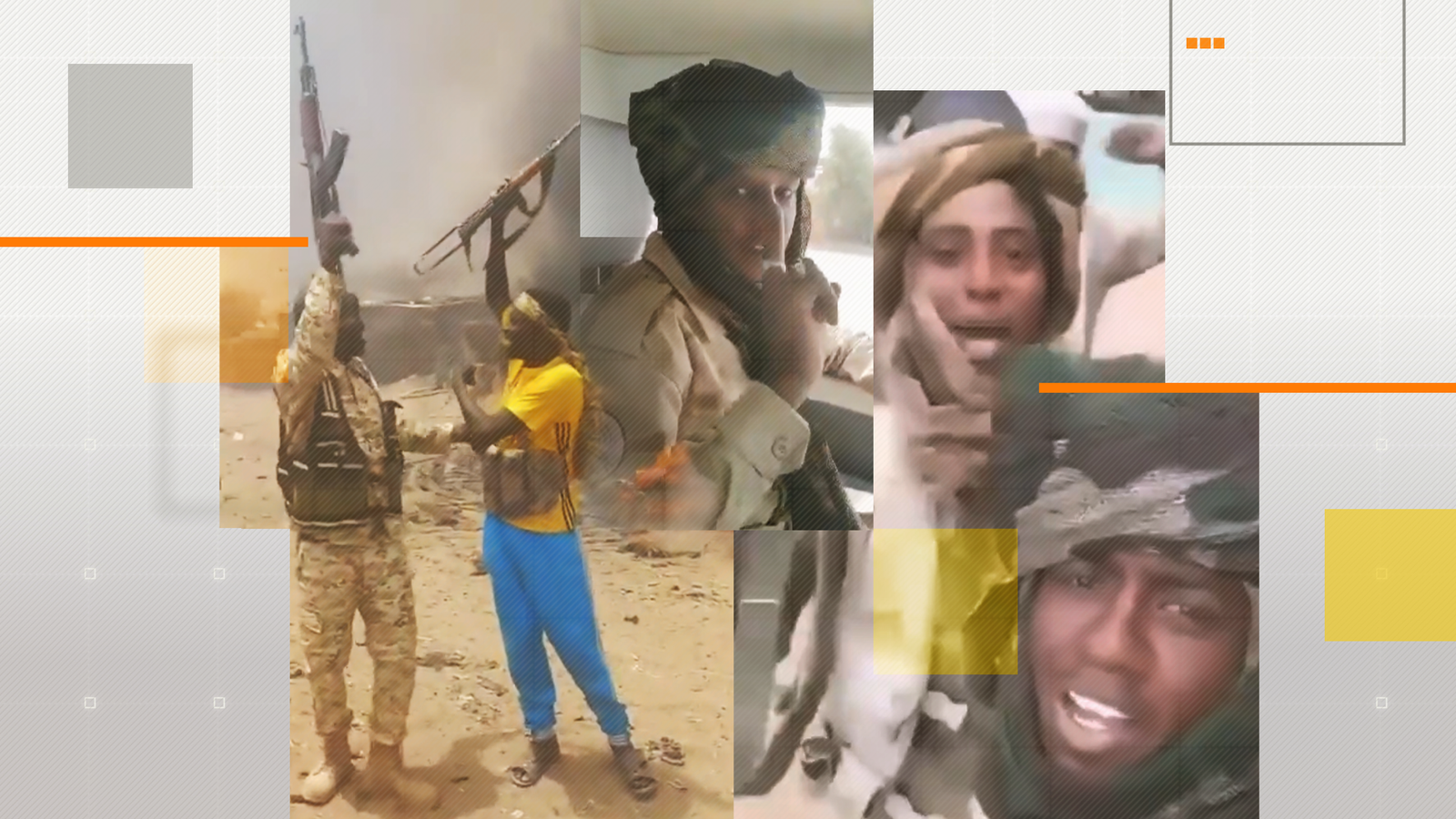
What does Sudan execution video tell us?

On 11 April, the Rapid Support Forces (RSF) and its affiliates attacked Zamzam camp in North Darfur.
The RSF is a paramilitary organisation comprised of militias that used to be be aligned with Sudan’s government.
For exactly two years it has been been locked in a civil war with the government’s Sudan Armed Forces (SAF). Both sides have been accused of human rights abuses over the course of the conflict.
After the capture of Zamzam, the RSF claimed in a statement released on Telegram that the camp was being used as a barracks, accusing the SAF of using civilians as “human shields”.
It further claimed, “the Rapid Support Forces were able to secure civilians during the liberation operation and prevent them from being harmed”.
Satellite imagery and footage from the ground paints a darker picture, showing the execution of an unarmed man and widespread fires within the camp at the time of its capture.
Zamzam sits just to the south of Al Fashir, North Darfur’s capital city, which has been a key target of the RSF in recent months.
Filming of an execution
Shortly after the RSF attack began on 11 April, a video began circulating on social media. It shows a group of gunmen standing over two unarmed men and a child.
One of the men squats in front of a gunman holding an assault rifle. The gunman shoots him at close range, killing him.
The child, less than a meter away, lies face down with his hands covering the back of his head.
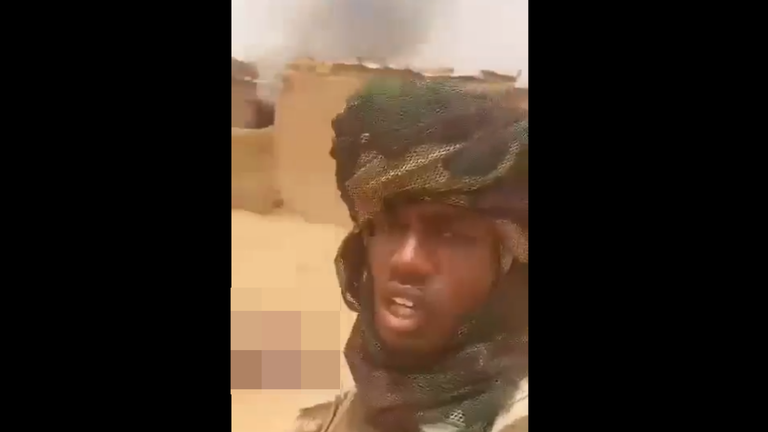
A fighter films himself while another executes an unarmed man.
While the footage does not contain much contextual information, the person filming turns the camera to his face before showing a close-up view of the dead body behind him.
Sky News has geolocated a second video showing the same man, wearing the same clothing and equipment, at another location within the camp at the time of its capture.
The footage shows the fighter with a group of gunmen celebrating as they enter a compound in the south of the camp.
Gunfire can be heard, and smoke rises from nearby as the group cheer.
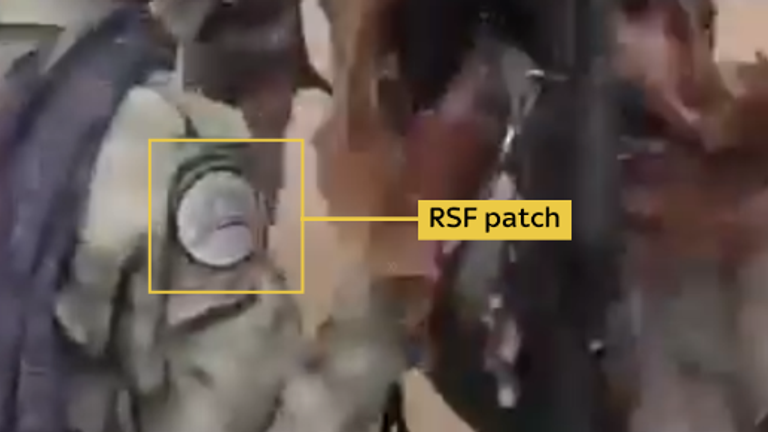
An RSF patch is visible on a fighter filmed by the man present at the execution.
At one point, a uniformed fighter wearing an RSF patch can be seen, confirming that at least this individual is affiliated with the organisation.
Both videos appear to have been filmed within a short timeframe.
The fighter seen in both videos is wearing the same head covering, clothing and tactical gear. The pattern on his head covering is oriented identically in both, suggesting it has not been removed in the time between filming.
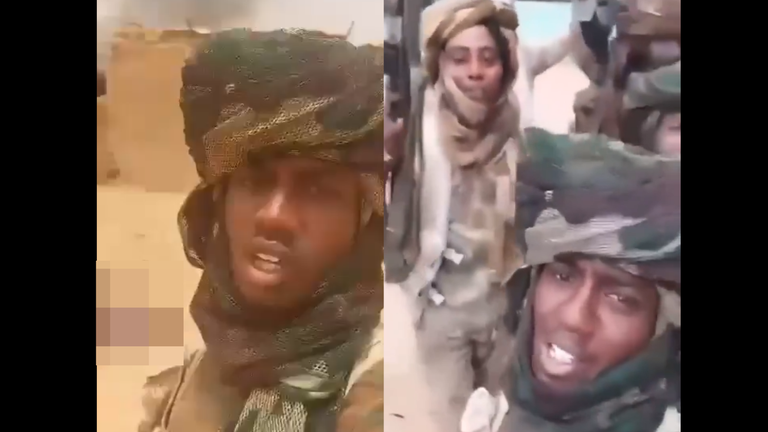
A fighter filmed at two seperate locations wearing the same head covering, clothing and tactical gear.
Widespread fires
Available footage and satellite images show the RSF’s capture of Zamzam was closely followed by fires being lit across the camp.
In one video, a man in an RSF uniform can be seen driving on the camp’s main road while thick smoke rises from nearby fires.
Data from FIRMS, a NASA project that uses satellite data to detect thermal anomalies, provides a wider view.
Following the arrival of the RSF on 11 April, fires were detected across the south and east of the camp.
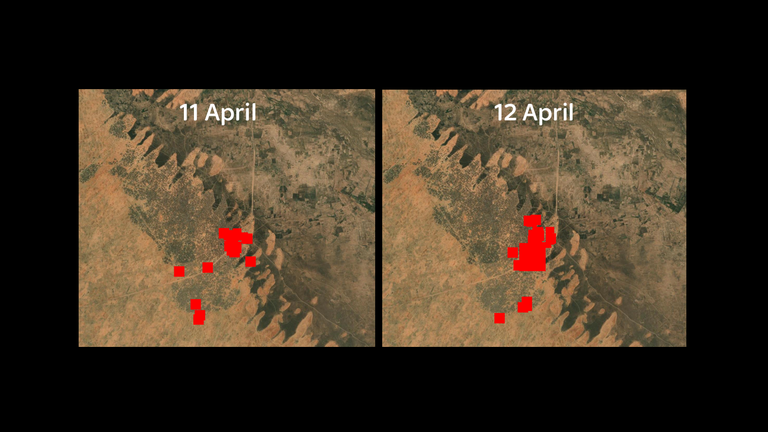
FIRMS data showing thermal anomalies indicating fires following the RSF capture of Zamzam.
More fires were detected in the east and south on 12 April, with areas in the north of the camp being affected on the 13 April.
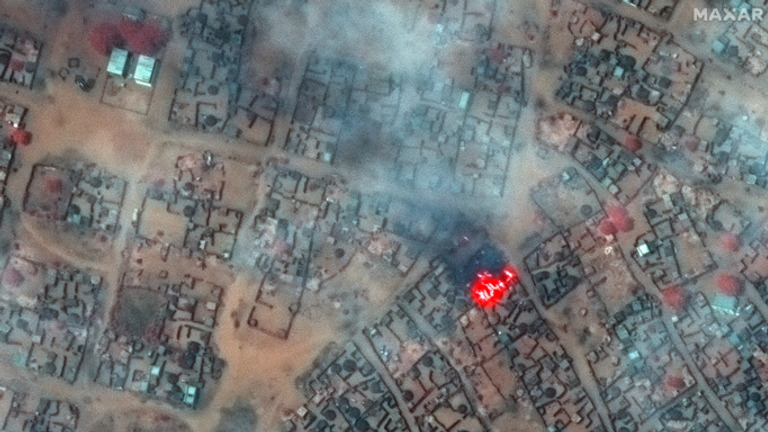
Satellite imagery showing buildings on fire in Zamzam. Pic: Maxar.
Satellite images form Maxar confirm buildings burned across the south of the camp on April 11, close to where fighters were seen.
On Tuesday, the African Union and European government’s including the UK called for an immediate cessation of the hostilities in which tens of thousands of people have been killed in the last two years.
The Data and Forensics team is a multi-skilled unit dedicated to providing transparent journalism from Sky News. We gather, analyse and visualise data to tell data-driven stories. We combine traditional reporting skills with advanced analysis of satellite images, social media and other open-source information. Through multimedia storytelling we aim to better explain the world while also showing how our journalism is done.
World
‘Cheap ceasefire’ between Ukraine and Russia would create ‘expensive peace’ for Europe, Norway’s foreign minister warns
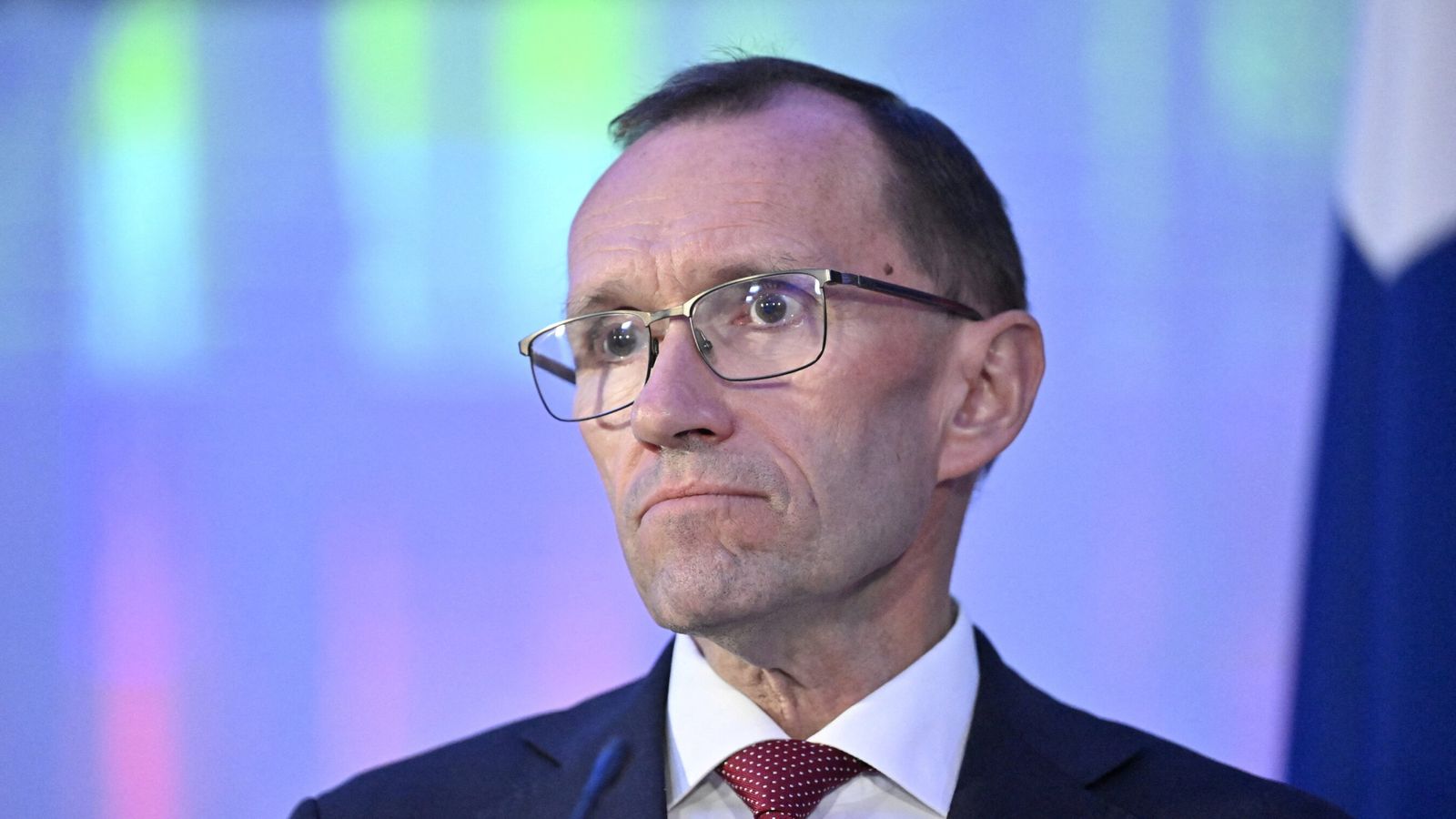
A “cheap ceasefire” between Ukraine and Russia – with Kyiv forced to surrender land – would create an “expensive peace” for the whole of Europe, Norway’s foreign minister has warned.
Espen Barth Eide explained this could mean security challenges for generations, with the continent’s whole future “on the line”.
It was why Ukraine, its European allies and the US should seek to agree a common position when trying to secure a settlement with Vladimir Putin, the top Norwegian diplomat told Sky News in an interview during a visit to London on Tuesday.
Ukraine war latest: Trump says Putin has upper hand in peace talks
“I very much hope that we will have peace in Ukraine and nobody wants that more than the Ukrainians themselves,” Mr Eide said.
“But I am worried that we might push this to what in quotation marks is a ‘cheap ceasefire’, which will lead to a very expensive peace.”
Explaining what he meant, Mr Eide said a post-war era follows every conflict – big or small.
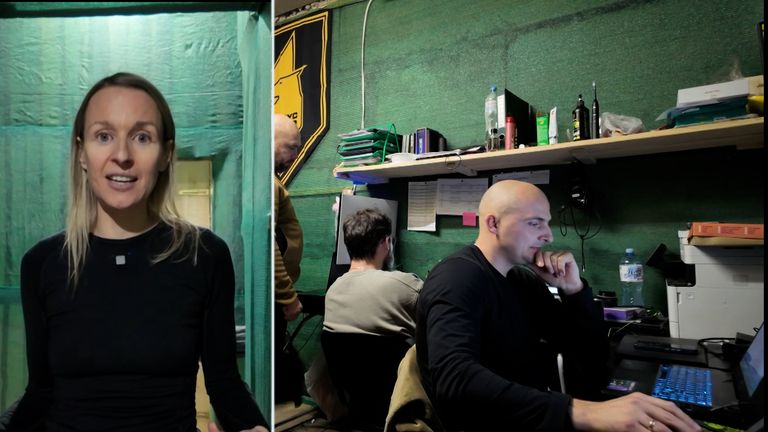
Inside Ukraine’s underground military HQ
How that plays out typically depends upon the conditions under which the fighting stopped.
“If you are not careful, you will lock in certain things that it will be hard to overcome,” he said.
“So if we leave with deep uncertainties, or if we allow a kind of a new Yalta, a new Iron Curtain, to descend on Europe as we come to peace in Ukraine, that’s problematic for the whole of Europe. So our future is very much on the line here.”
He said this mattered most for Ukrainians – but the outcome of the war will also affect the future of his country, the UK and the rest of the continent.
“This has to be taken more seriously… It’s a conflict in Europe, it has global consequences, but it’s fundamentally a war in our continent and the way it’s solved matters to our coming generations,” the Norwegian foreign minister said.
Russia ‘will know very well how to exploit vagueness’
Asked what he meant by a cheap ceasefire, he said: “If Ukraine is forced to give up territory that it currently militarily holds, I think that would be very problematic.
“If restrictions are imposed on future sovereignty. If there’s vagueness on what was actually agreed that can be exploited. I think our Russian neighbours will know very well how to exploit that vagueness in order to keep a small flame burning to annoy us in the future.”
Progress being made on peace talks
Referring to the latest round of peace talks, initiated by Donald Trump, Mr Eide signalled that progress was being made from an initial 28-point peace plan proposed a couple of weeks ago by the United States that favoured Moscow over Kyiv.
That document included a requirement for the Ukrainian side to give up territory it still holds in eastern Ukraine to Russia and Mr Eide described it as “problematic in many aspects”.
But he said: “I think we’ve now had a good conversation between Ukraine, leading European countries and the US on how to adapt and develop that into something which might be a good platform for Ukraine and its allies to go to Russia with.
“We still don’t know the Russian response, but what I do know is the more we are in agreement as the West, the better Ukraine will stand.”
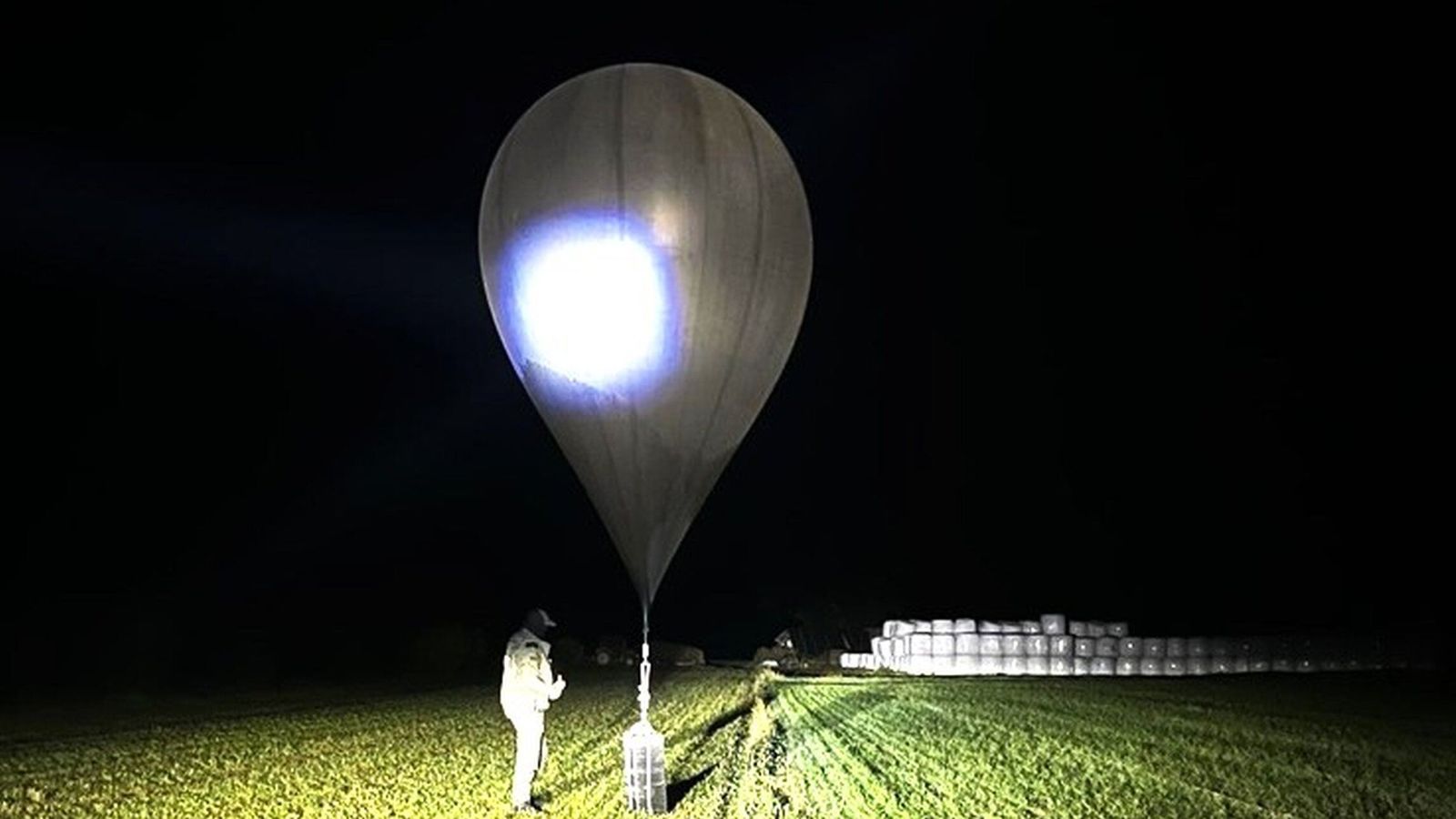
Lithuania has declared a state of emergency over smuggler balloons from Belarus that have disrupted aviation.
Vilnius airport has been closed because of the balloons, which Lithuania says have been sent by smugglers transporting cigarettes in recent weeks.
It also says they constitutes a “hybrid attack” by Belarus, which is a close ally of Russia.
Lithuania is a NATO member and ally to Ukraine during its fight against Russia’s full-scale invasion in 2022.
On Tuesday Lithuania’s interior minister Vladislav Kondratovic told a government meeting: “The state of emergency is announced not only due to civil aviation disruptions but also due to interests of national security.”
Mr Kondratovic added that the Lithuanian government had asked parliament to grant the military powers to act with police, border guards and security forces during the state of emergency.
Should parliament agree, the army will be given permission to limit access to territory, stop and search vehicles, perform checks on people, their documents and belongings, and to detain those resisting or suspected of crimes.
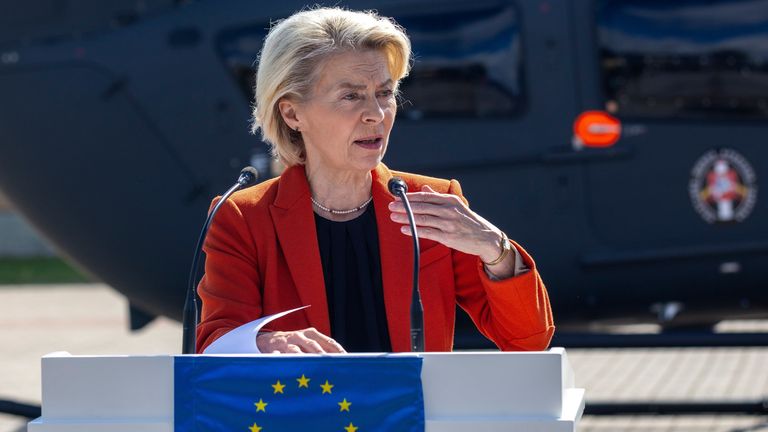
European Commission President Ursula von der Leyen described the balloon incursions as “completely unacceptable”. Pic: AP
Lithuania’s defence minister Robert Kaunas said the military would be permitted to use force for these functions.
Belarus has denied responsibility and accused Lithuania of provocations.
This includes sending a drone to drop “extremist material”, which Lithuania denies.
Read more:
Belarus opposition leader Siarhei Tsikhanouski freed from jail
Russia’s ‘hybrid attacks’ against NATO ‘look like war’
The emergency measures in Lithuania will last until the government calls them off.
European Commission President Ursula von der Leyen said on 1 December the situation at the border was worsening.
She described the balloon incursions a “hybrid attack” by Belarus, and branded it “completely unacceptable”.
World
Ukraine war: The signs Putin is expecting more conflict, not less – and the frank conversation Keir Starmer needs to have
With more than a thousand troops being killed or wounded every day, there’s no sign that Donald Trump’s push to end Russia’s war in Ukraine is reducing the battles on the ground.
Quite the opposite.
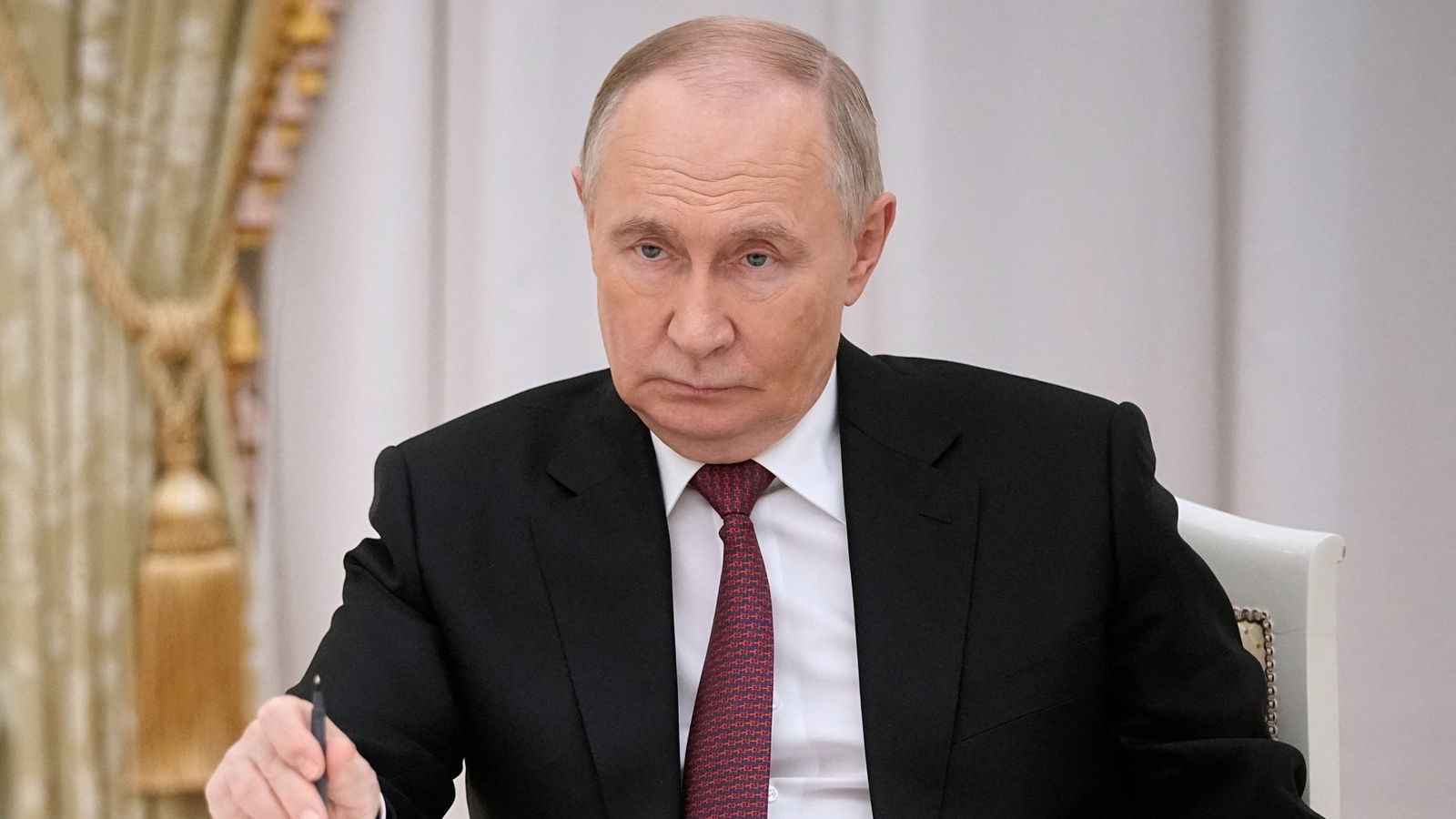
Ukraine‘s military chief says Vladimir Putin is instead using the US president‘s focus on peace negotiations as “cover” while Russian soldiers attempt to seize more land.
That means much greater pressure on the Ukrainian frontline, even as Russian and American, or American and Ukrainian, or Ukrainian and European, leaders shake hands and smile for cameras before retreating behind closed doors in Moscow, Alaska, and London.
This was not an upbeat meeting of Ukraine and its allies
Putin’s not counting on peace
The lack of any indicators that the Kremlin is looking to slow its military machine down also makes the risk of war spreading beyond Ukraine’s borders increasingly likely.
It takes a huge amount of effort, time, and money to put a country on a war footing as Putin has done, partially mobilising his population, allocating huge portions of government spending to the military and realigning Russia’s vast industrial base to produce weapons and ammunition.
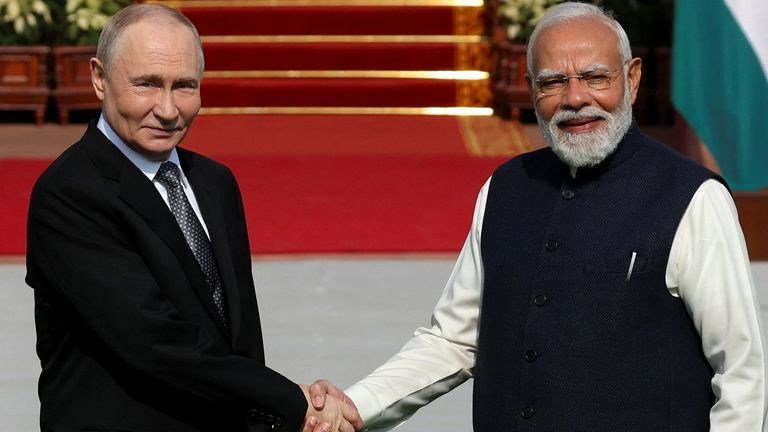
Putin has been in India to shore up support from Narendra Modi. Pic: Reuters
But when the fighting stops, it requires almost as much focus and energy to switch a society back to a peace time rhythm.
Deliberately choosing not to dial defence down once the battles cease means a nation will continue to grow its armed forces and weapons stockpiles – a sure sign that it has no intention of being peaceful and is merely having a pause before going on the attack again.
The absence of any preparations by Moscow to slow the tempo of its military operations in Ukraine – where it has more than 710,000 troops deployed along a 780-mile frontline – is perhaps an indicator that Putin is anticipating more not less war.
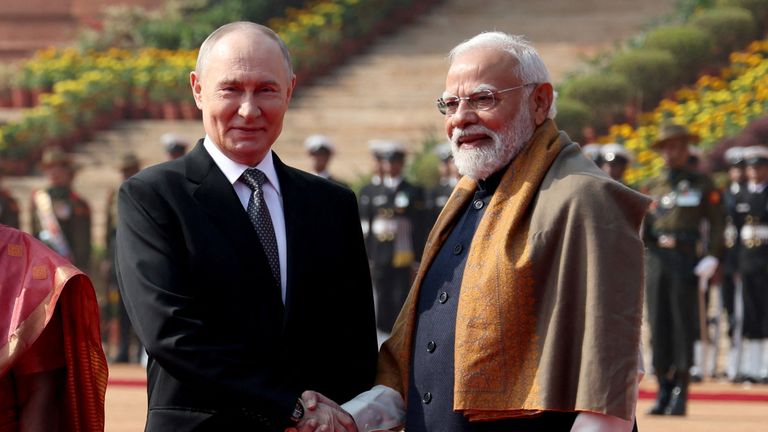
What is Putin trying to achieve in India?
How could the war end?
What happens next in Europe will depend on the content of any peace deal on Ukraine.
An all-out Russian defeat is all but impossible to conceive without a significant change of heart by the Trump White House and a massive increase in weapons and support.
The next best result for Ukraine would be a settlement that seeks to strike a fair balance between the warring sides and their conflicting objectives.
This could be done by pausing the fighting along the current line of contact before substantive peace talks then take place, with Ukraine’s sovereignty supported by solid security guarantees from Europe and the US.
But such a move would require Europe’s NATO allies, led by the UK, France and Germany, genuinely to switch their respective militaries and populations back to a wartime footing, with a credible readiness to go to war should Moscow attempt to test their support of Ukraine.
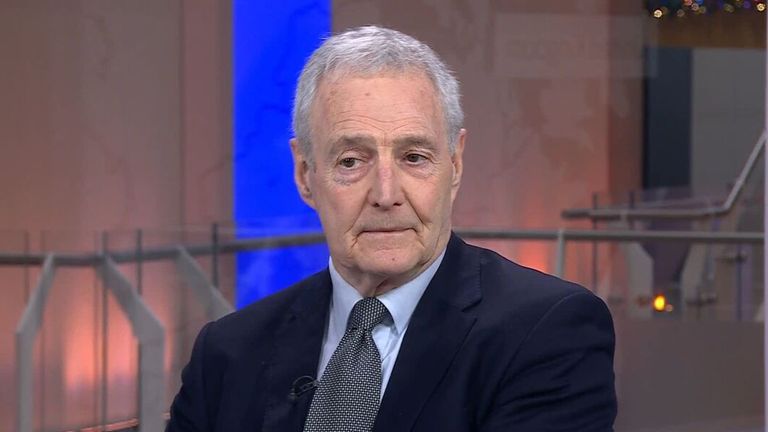
Why Ukraine’s allies may welcome Trump walking away
Will Starmer level with the public?
That does not just mean increased spending on defence at a much faster rate – in the UK at least – than is currently planned. It is also about the mindset of a country and its willingness to take some pain.
France is already openly saying that parents may have to lose their children in a war with Russia, while Germany is requiring all 18-year-old men to undergo medical checks for possible national service.
No such tough but frank conversation is being attempted by Sir Keir Starmer with the British public.
The furthest his military chief has gone is to say “warfighting readiness” is his top priority.
But that is meaningless jargon for most of the public. Being ready for war is about so much more than what the professional armed forces can do.
Armies fight battles. Countries fight wars.
Read more:
UK unveils undersea tech
Navy chief offers chilling warning
Does Britain’s threat to Russia ring hollow?
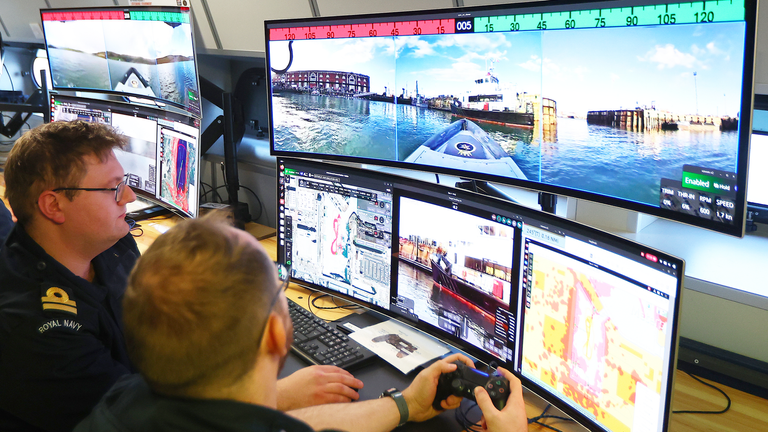
New UK military technology unveiled
Worst case scenario?
The other alternative when it comes to Ukraine is a scenario that sees a sidelined Europe unable to influence the outcome of the negotiations and Kyiv forced to agree to terms that favour Moscow.
This would include the surrender of land in the Donbas that is still under Ukrainian control.
Such a deal – even if tolerated by Ukraine, which is unimaginable without serious unrest – would likely only mean a temporary halt in hostilities until Putin or whoever succeeds him decides to try again to take the rest of Ukraine, or maybe even test NATO’s borders by moving against the Baltic States.
With Trump’s new national security strategy making clear the US would only intervene to defend Europe if such a move is in America’s interests, it is no longer certain that the guarantees contained in NATO’s founding Article 5 principle – that an attack on one member state is an attack on all – can be relied upon.
To have a sense of how a war with Russia might play out without the US on NATO’s side, Sky News and Tortoise ran a wargame that simulates a Russian attack on the UK.
In the scenario, Washington does not come to Britain’s defences, which leaves the British side with very few options to respond short of a nuclear strike.
-
 Sports2 years ago
Story injured on diving stop, exits Red Sox game
-
 Sports3 years ago
‘Storybook stuff’: Inside the night Bryce Harper sent the Phillies to the World Series
-
 Sports2 years ago
Game 1 of WS least-watched in recorded history
-
 Sports3 years ago
Button battles heat exhaustion in NASCAR debut
-
 Sports3 years ago
MLB Rank 2023: Ranking baseball’s top 100 players
-
Sports4 years ago
Team Europe easily wins 4th straight Laver Cup
-
 Environment3 years ago
Japan and South Korea have a lot at stake in a free and open South China Sea
-
 Environment1 year ago
Here are the best electric bikes you can buy at every price level in October 2024