

MP who introduced assisted dying bill ‘confident’ it will be voted through


The politician who introduced the assisted dying bill has said she is “confident” MPs will push it through to the next stage on Friday.
Speaking at a news conference ahead of a Commons vote, Kim Leadbeater said: “I do feel confident we can get through tomorrow successfully.”
If new amendments are voted through on Friday, the bill to give some terminally ill adults the right to end their lives will get closer to becoming law as it will go through to the next stage in the House of Lords.
Politics latest: PM should decide if MPs get vote on military action
Ms Leadbeater, who introduced the bill in October last year, said if MPs do not vote it through on Friday, “it could be another decade before this issue is brought back to parliament”.
But she said there was a “good majority” who voted for the bill at the last major vote, the second reading in November, when MPs voted it through by 330 to 275.
“There might be some small movement in the middle, some people might change their mind or will change their mind the other way,” she said.
“But fundamentally, I do not anticipate that that majority would be heavily eroded.”
A new YouGov poll found 72% of Britons supported the bill as it stands, including 59% of those who say they support assisted dying in principle but oppose it in practice, and 67% were opposed to the principle of euthanasia but are willing to back it in practice.
How will the Assisted Dying Bill work?
Criticism by doctors
The Labour MP was joined by bereaved and terminally ill people at Thursday’s news conference as she made her case for a change in the law.
The proposed legislation would allow terminally ill adults, with fewer than six months to live, to apply for an assisted death, subject to approval by two doctors and a panel featuring a social worker, senior legal figure and psychiatrist.
Recently, the Royal College of Psychiatrists, the Royal College of Pathologists and the Royal College of Physicians have raised concerns about the bill.
The Royal College of Psychiatrists said the bill, in its current form, did “not meet the needs of patients”.
It has also expressed concern over the shortage of qualified psychiatrists to take part in assisted dying panels.
Read more:
Assisted dying bill does not meet needs of patients, says Royal College of Psychiatrists
Why cancer patient is praying assisted dying bill passes major vote

People in favour of assisted dying demonstrate in Parliament Square. Pic: PA
But Ms Leadbeater said doctors and psychiatrists have their individual views on assisted dying and royal colleges have, over the years, been neutral because of that.
“My door is open, so if they have got concerns, they can come and speak to me about those concerns,” she said.
“But what I would say is they were very keen that there was psychiatric involvement in the process, and that’s why I included it. And I do think that’s important.”
On Friday, MPs will vote on a number of amendments proposed by Ms Leadbeater after months of discussions with the assisted dying committee, made up of MPs both for and against the bill.
At the start of the session they will vote on a person not being eligible for assisted dying if their wish to end their life was substantially motivated by factors such as not wanting to be a burden, a mental disorder, a disability, financial considerations, a lack of access to care, or suicidal ideation.
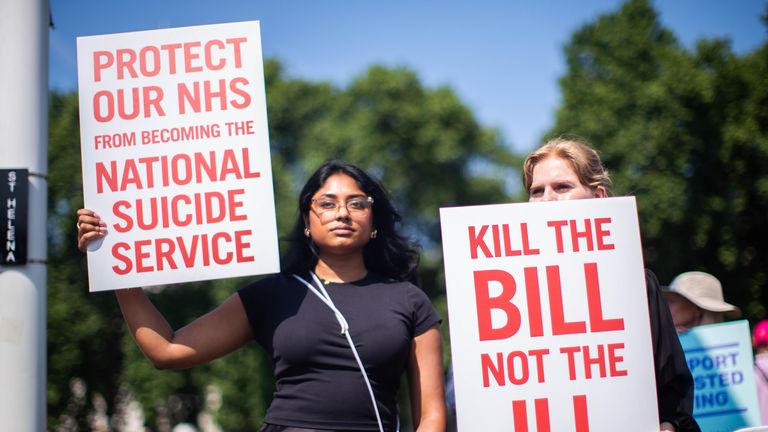
People opposed to assisted dying demonstrate in Parliament Square. Pic: PA
The Speaker has indicated he will also choose these amendments for MPs to vote on:
• Supported by Ms Leadbeater – Requiring the government to publish an assessment of palliative and end-of-life care within a year of the bill passing
• Supported by Ms Leadbeater – A person cannot be considered terminally ill solely because they voluntarily stopped eating or drinking
• Not supported by Ms Leadbeater – Disapply the presumption a person has capacity unless the opposite is established
• Not supported by Ms Leadbeater – Prevent section 1 of the NHS Act 2006, which sets out the NHS’ purpose, from being amended by regulations.

Bitcoin’s latest pullback may already be bottoming out, with asset manager Grayscale arguing that the market is on track to break the traditional four-year halving cycle and potentially set new all-time highs in 2026.
Some indicators are already pointing to a local bottom, not a prolonged drawdown, including Bitcoin’s (BTC) elevated option skew rising above 4, which signals that investors have already hedged “extensively” for downside exposure.
Despite a 32% decline, Bitcoin is on track to disrupt the traditional four-year halving cycle, wrote Grayscale in a Monday research report. “Although the outlook is uncertain, we believe the four-year cycle thesis will prove to be incorrect, and that Bitcoin’s price will potentially make new highs next year,” the report said.

Related: Cathie Wood still bullish on $1.5M Bitcoin price target: Finance Redefined
Still, Bitcoin’s short-term recovery remains limited until some of the main flow indicators stage a reversal, including futures open interest, exchange-traded fund (ETF) inflows and selling from long-term Bitcoin holders.
US spot Bitcoin ETFs, one of the main drivers of Bitcoin’s momentum in 2025, added significant downside pressure in November, racking up $3.48 billion in net negative outflows in their second-worst month on record, according to Farside Investors.

More recently, though, the tide has started to turn. The funds have now logged four consecutive days of inflows, including a modest $8.5 million on Monday, suggesting ETF buyer appetite is slowly returning after the sell-off.
While market positioning suggests a “leverage reset rather than a sentiment break,” the key question is whether Bitcoin can “reclaim the low-$90,000s to avoid sliding toward mid-to-low-$80,000 support,” Iliya Kalchev, dispatch analyst at digital asset platform Nexo, told Cointelegraph.
Related: Strategy unveils new credit gauge to calm debt fears after Bitcoin crash
Fed policy and US crypto bill loom as 2026 catalysts
Crypto market watchers now await the largest “swing factor,” the US Federal Reserve’s interest rate decision on Dec. 10. The Fed’s decision and monetary policy guidance will serve as a significant catalyst for 2026, according to Grayscale.
Markets are pricing in an 87% chance of a 25 basis point interest rate cut, up from 63% a month ago, according to the CME Group’s FedWatch tool.

Later in 2026, Grayscale said continued progress toward the Digital Asset Market Structure bill may act as another catalyst for driving “institutional investment in the industry.” However, for more progress to be made, crypto needs to remain a “bipartisan issue,” and not turn into a partisan topic for the midterm US elections.
That effort effectively began with the passage of the CLARITY Act in the House of Representatives, which moved forward in July as part of the Republicans’ “crypto week” agenda. Senate leaders have said they plan to “build on” the House bill under the banner of the Responsible Financial Innovation Act, aiming to set a broader framework for digital asset markets.
The bill is currently under consideration in the Republican-led Senate Agriculture Committee and the Senate Banking Committee. Senate Banking Chair Tim Scott said in November that the committee planned to have the bill ready for signing into law by early 2026.
Magazine: Bitcoin to see ‘one more big thrust’ to $150K, ETH pressure builds

Poland’s President Karol Nawrocki declined to sign a bill imposing strict regulations on the crypto asset market, drawing praise from the crypto community and sharp criticism from others in the government.
Nawrocki vetoed Poland’s Crypto-Asset Market Act, saying its provisions “genuinely threaten the freedoms of Poles, their property, and the stability of the state,” according to a statement by the president’s press office on Monday.
Introduced in June, the bill has drawn criticism from industry advocates such as Polish politician Tomasz Mentzen, who had anticipated the president’s refusal to sign it as it cleared parliamentary approval.
Although crypto advocates welcomed the veto as a win for the market, several government officials condemned the move, claiming the president had “chosen chaos” and must bear full responsibility for the outcome.
Why the president vetoed the bill
One of the main reasons cited for the veto was a provision allowing authorities to easily block websites operating in the crypto market.
“Domain blocking laws are opaque and can lead to abuse,” the president’s office said in an official news release.
The president’s office also cited the bill’s widely criticized length, saying its complexity reduces transparency and would lead to “overregulation,” especially when compared with simpler frameworks in the Czech Republic, Slovakia and Hungary.

“Overregulation is an easy way to drive companies to the Czech Republic, Lithuania or Malta, rather than create conditions for them to operate and pay taxes in Poland,” the president said.
Nawrocki also highlighted the excessive amount of supervisory fees, which may prevent startup activity and favor foreign corporations and banks.
“This is a reversal of logic, killing off a competitive market and a serious threat to innovation,” he said.
Critics jump in: “The president chose chaos”
Nawrocki’s veto has triggered a strong backlash from top Polish officials, including Finance Minister Andrzej Domański and Deputy Prime Minister and Minister of Foreign Affairs Radosław Sikorski.
Domański warned on X that “already now 20% of clients are losing their money as a result of abuses in this market,” accusing the president of having “chosen chaos” and saying he bears full responsibility for the fallout.
Related: Spain’s junior ruling party proposes 47% crypto tax in ‘attack against Bitcoin’
Sikorski echoed the concern, saying that the bill was supposed to regulate the crypto market. “When the bubble bursts and thousands of Poles lose their savings, at least they will know who to thank,” Sikorski argued on X.

Crypto advocates, including Polish economist Krzysztof Piech, quickly pushed back, arguing that the president cannot be held responsible for authorities failing to pursue scammers.
He also noted that the European Union’s Markets in Crypto-Assets Regulation (MiCA) is set to provide investor protections across all EU member states starting July 1, 2026.
Magazine: When privacy and AML laws conflict: Crypto projects’ impossible choice

The US Federal Deposit Insurance Corporation will propose a framework for implementing US stablecoin laws later this month, according to its acting chair, Travis Hill.
“The FDIC has begun work to promulgate rules to implement the GENIUS Act; we expect to issue a proposed rule to establish our application framework later this month,” Hill said in prepared testimony to be delivered on Tuesday to the House Financial Services Committee.
He added the agency will also have a “proposed rule to implement the GENIUS Act’s prudential requirements for FDIC-supervised payment stablecoin issuers early next year.”
President Donald Trump signed the GENIUS Act in July, which created oversight and licensing regimes for multiple regulators, with the FDIC to police the stablecoin-issuing subsidiaries of the institutions it oversees.
The FDIC insures deposits in thousands of banks in the event that they fail, and under the GENIUS Act, it will also be tasked with making “capital requirements, liquidity standards, and reserve asset diversification standards” for stablecoin issuers, said Hill.

Federal agencies, such as the FDIC, publish their proposed rules for public feedback, and they then review and respond to the input, if necessary, before publishing a final version of the rules, a process that can take several months.
Related: Republicans urge action on market structure bill over debanking claims
The Treasury, which will also regulate some stablecoin issuers, including non-banks, began its implementation of the GENIUS Act in August and finished a second period of public comment on its implementation proposal last month.
FDIC is working on tokenized deposit guidelines
Hill said in his remarks that the FDIC has also considered recommendations published in July by the President’s Working Group on Digital Asset Markets.
“The report recommends clarifying or expanding permissible activities in which banks may engage, including the tokenization of assets and liabilities,” Hill said.
“We are also currently developing guidance to provide additional clarity with respect to the regulatory status of tokenized deposits,” he added.
Fed helping regulators with stablecoin rules
The Federal Reserve’s vice supervision chair, Michelle Bowman, will also testify on Tuesday that the central bank is “currently working with the other banking regulators to develop capital, liquidity, and diversification regulations for stablecoin issuers as required by the GENIUS Act.”
Bowman added, according to her prepared remarks, that “we also need to provide clarity in treatment on digital assets to ensure that the banking system is well placed to support digital asset activities.”
“This includes clarity on the permissibility of activities, but also a willingness to provide regulatory feedback on proposed new use cases,” she said.
The House Finance Committee’s hearing on Tuesday will also see remarks from the heads of the Office of the Comptroller of the Currency and the National Credit Union Administration, which will both have a role in implementing stablecoin rules.
Magazine: Bitcoin vs stablecoins showdown looms as GENIUS Act nears
-
 Sports2 years ago
Story injured on diving stop, exits Red Sox game
-
 Sports3 years ago
‘Storybook stuff’: Inside the night Bryce Harper sent the Phillies to the World Series
-
 Sports2 years ago
Game 1 of WS least-watched in recorded history
-
 Sports3 years ago
Button battles heat exhaustion in NASCAR debut
-
 Sports3 years ago
MLB Rank 2023: Ranking baseball’s top 100 players
-
Sports4 years ago
Team Europe easily wins 4th straight Laver Cup
-
 Environment3 years ago
Japan and South Korea have a lot at stake in a free and open South China Sea
-
 Environment1 year ago
Here are the best electric bikes you can buy at every price level in October 2024