
Final 2025 update! Top 10 prospects and next to debut for all 30 MLB teams


-
Kiley McDaniel
Now that the 2025 MLB trade deadline is behind us, it’s the perfect time for our final team-by-team MLB prospect rankings big board update of the season. The top 10 prospects for all 30 teams are updated below — with deadline additions included.
What has changed since our last in-season list update?
Here are the rankings for your favorite team, along with what to know for this month and who we expect to reach the majors next. Players in the big leagues are eligible for this update as MLB rookie eligibility rules apply here — 130 at-bats, 50 innings pitched or 45 days on the active roster. All 30 of these lists have been updated regularly throughout the season.
Jump to team:
American League
ATH | BAL | BOS | CHW | CLE
DET | HOU | KC | LAA | MIN
NYY | SEA | TB | TEX | TOR
National League
ARI | ATL | CHC | CIN | COL
LAD | MIA | MIL | NYM | PHI
PIT | SD | SF | STL | WSH

AL East

What changed this season: Coby Mayo graduated and the back half of the preseason top 10 had bad seasons. On the bright side, the O’s made the most of having the biggest draft pool by adding Irish, Aloy, de Brun, and Bodine. My pick-to-click Gibson delivered while George and Mejia also took huge steps forward.
Who could debut next: Beavers seems likely to get a look before the season ends.

What changed this season: A lot! The triumvirate of Roman Anthony, Marcelo Mayer and Kristian Campbell all graduated. I got a lot of flack before the season for being the low guy on Campbell (“attention-seeking behavior” a few called it) despite being the high guy on him in the 2023 draft, but weirdly nobody came back to apologize. Arias and Tolle emerged while Garcia, Early, Gonzales, Clarke and Soto also took steps forward. Witherspoon was added in the draft and James Tibbs was added then subtracted via trade.
Who could debut next: Garcia is probably next since he’s on the 40-man roster, but Tolle, Early and David Sandlin could all get the call if a starting pitcher is needed first.

What changed this season: This system’s depth has been depleted by trades. Jones, Schlittler and Lagrange have all made real progress this year, but the list bottoms out quickly: Hampton and Lalane have thrown a combined 12 innings this season. Kilby was the Yankees’ top pick in the draft. Jasson Dominguez and Will Warren graduated from the preseason list.
Who could debut next: Jones needs to be added to the 40-man roster this winter, so he should get the call next among players on this list who haven’t debuted yet.

What changed this season: Chandler Simpson and Mason Montgomery graduated this year while Areinamo was the notable prospect added at the deadline, and Pierce and Summerhill headlined the draft haul. Gillen has emerged while most of the top prospects in the system plateaued a bit, and Brayden Taylor has had a rough year.
Who could debut next: Williams is quite obviously next up and he needs to be added to the 40-man this winter, so a September call-up seems likely.

What changed this season: The 2024 draft pitching class was fantastic, landing Yesavage, King and the third-best prospect traded at the deadline, another top 100 prospect in Khal Stephen (Now with Cleveland). The Jays also traded Kendry Rojas and Juaron Watts-Brown from their pitching depth at the deadline, but will add Tiedemann and Bloss next season when both are scheduled to come back from elbow surgery. This year’s draft was more position-player focused with Parker, Cook, Blaine Bullard and Tim Piasentin.
Who could debut next: Yesavage seems next from this group as he has sliced through the minors like a knife through hot butter.
AL Central

What changed this season: Montgomery and Schultz started the season as the top two prospects and ended at No. 1 and No. 3, but had rocky seasons. Montgomery is about to graduate, started really slow and fell down the list, but is now raking in the big leagues. Schultz is having trouble throwing strikes, as is Smith and if this continues next season, it’ll be time to worry. Bonemer has been really good, Wolkow is hitting more than I expected, and I liked the draft additions of Carlson and Fauske.
Who could debut next: Gonzalez is in Triple-A, so I’ll bet on him debuting before Smith and Schultz starting throwing more strikes and get promoted twice.

What changed this season: Largely the same group of about 15 names was shuffled a bit from the preseason list, with no major graduations — but the addition of Stephen at the deadline and Laviolette in the draft. Kayfus and Doughty have both been arrow-up this season.
Who could debut next: Messick seems overdue to get a big league look and will need to be added to the 40-man this winter anyway.

What changed this season: McGonigle continued to progress, now in the mix for the top prospect in the sport. The top six names have all made steady progress this year amid a number of graduations: Jackson Jobe, Trey Sweeney, Jace Jung, Dillon Dingler, and Brant Hurter. Oliveto, Yost and Witherspoon were all added in the draft, and no one that was close to the top 10 was traded at the deadline.
Who could debut next: Lee is in Triple-A and needs to be added to the 40-man roster this winter, so he could get a September look.

What changed this season: Jac Caglianone and Noah Cameron graduated but otherwise this list is pretty similar to the preseason list, with a slight shuffle, the emergence of Chourio and some draftees added. Hammond, Gamble and Lombardi led that draft haul in July.
Who could debut next: Jensen is in Triple-A and needs to be added to the 40-man in the winter, so he has a shot to get a look in September.

What changed this season: Tait, Abel and Rojas were the headliners from a deadline teardown, and Keaschall is back from injury and probably will graduate in the next month. Prielipp continues to progress now that he’s fully healthy. Keep an eye on high-variance draftees Riley Quick and Quentin Young.
Who could debut next: Rodriguez is in Triple-A and on the 40-man roster so he’ll probably be next to come up, though Prielipp needs to be added to the 40-man this winter and could get a September look.
AL West

What changed this season: The A’s continue to move young players to the big league team, graduating Nick Kurtz, Jacob Wilson, Denzel Clarke, Max Muncy and J.T. Ginn this year, with Morales, Perkins and Colby Thomas (just missed) also in the majors but still with prospect status.
De Vries was the prize of the deadline while Arnold’s slide was one of the big surprises of the draft, and Jump’s, ahem, rise up prospect lists is one of the bigger adjustments from last year’s draft. Lastly, Morii is a very interesting prospect and somewhat unprecedented as a two-way player signed out of a Japanese high school for a seven figure bonus.
Who could debut next: Nett (needs to be added to the 40-man this winter) and Jump (dealing) are the best two candidates.

What changed this season: Cam Smith, Colton Gordon, Shay Whitcomb and Zach Dezenzo graduated this season. Matthews took a step forward this year while Powell, Alvarez and Janek have had nice pro debuts. Neyens, Mitchell, Frey, and 2B Nick Monistere (just missed the list) were the top prospects acquired in the draft. Chase Jaworsky and Esmil Valencia were traded at the deadline to acquire Jesus Sanchez.
Who could debut next: Nobody on the list will debut later this year, but Miguel Ullola, just off the list, has a shot to get a look in September.

What changed this season: The draft haul this year was unique, with the Angels going well under slot to land Bremner then spreading those savings to land prep arms — Johnny Slawinski, Robert Mitchell, C.J. Gray, Talon Haley and Luke Lacourse. Slawinski is the best of the group and ranks 11th on the team list. Lugo and Guzman are both arrow-up among position players, and Gregory-Alford and Johnson are both arrow-up among 2024 pitching draftees.
Who could debut next: Rada and Klassen both have a shot to be up in the first half next year, as does Shores if he’s pushed in a relief role.

What changed this season: Cole Young, Logan Evans and Ben Williamson all graduated this season while Tyler Locklear, Brandyn Garcia, Juan Burgos, Ashton Izzi, Jeter Martinez and Hunter Cranton were the top prospects Seattle traded at the deadline. The farm was replenished by landing Anderson, Stevenson and Nick Becker (just missed) in the draft and with arrow-up performances this spring by Sloan, Arroyo, and Montes.
Who could debut next: Ford is in Triple-A and needs to be added to the 40-man this winter, so he makes sense to be called up next.

What changed this season: Kumar Rocker, Jack Leiter and Alejandro Osuna graduated from the preseason top 10; Rosario has sat out the season after elbow surgery and Santos hasn’t pitched much this year. Fien, Owens and Russell headlined the incoming group from the draft and Fitz-Gerald and Scarborough were sleepers from recent classes emerging this season.
Who could debut next: Davalillo needs to be added to the 40-man this winter, so I could see him getting a call-up down the stretch.
NL East

What’s changed this season? Drake Baldwin and A.J. Smith-Shawver graduated while Caminiti rose and Fuentes had a breakout year despite mixed results in his big league debut. Southisene, McKenzie and Lodise were added in the draft and there wasn’t an impactful deadline deal, so there wasn’t as much movement as in other farm systems.
Who could debut next: With Fuentes, Alvarez and Waldrep already having debuted, there might not be another prospect debut until next season, but Ritchie seems next up having just matriculated to Triple-A.

What changed this season: White continued his ascent up the top 100 while Snelling’s stuff came back to life after being acquired at last year’s deadline and he’s now back in the top 100. Arquette and Cannarella were the top two picks from the draft while Defrank emerged as a power arm in the low minors and Marsee is going wild in his first taste of the big leagues.
Who could debut next: Mack, Acosta and Snelling are all in Triple-A, and I’d rank their debut dates in that order since Mack needs to be added to the 40-man this winter and Acosta is already on the 40-man.

What changed this season: Ronny Mauricio and Luisangel Acuna graduated while Drew Gilbert and Jesus Baez were the top prospects traded at the deadline as the Mets gear up for a playoff run. The top of this system is tightly packed with the top five almost interchangeable at this point. Ewing, Benge, Reimer, Tong and McLean have all been arrow-up in a notable way this year.
Who could debut next: Six players on this list are in Triple-A, haven’t debuted yet, and don’t need to be added to the 40-man until after next season. I’ll rank them in this order: Tong, McLean, Williams, Clifford, Benge and Sproat.

What changed this season: The most notable riser in the system was Mick Abel, who was packaged with Eduardo Tait in a deadline trade to land Jhoan Duran. Painter has been solid in his return from two full regular seasons without an appearance. Wood was one of the best values in the first round of the draft, with the concerns being durability and reliever risk — but he could move quickly. Escobar has probably been the second-most notable breakout in the system behind Abel.
Who could debut next: Painter needs to be added to the 40-man roster in the winter, so he would make sense as a September call-up.

What changed this season: Dylan Crews and Brady House have graduated from the preseason top 10, and Cavalli could join them soon. Willits, Petry, Harmon and James headlined the 2025 draft group while Dickerson and King are the best prospects from the Nats’ 2024 draft. Sykora had his second surgery of the year (hip, now elbow) and figures to sit out all of next season but fits in the top half of the top 100 when healthy. Susana could be a star if he can throw more strikes.
Who could debut next: There’s not a good candidate on this list as Clemmey, Susana or King would seem to be next and I’m not sure any of them even debuts next season. Christian Franklin and Jake Bennett both just missed the list and both need to be added to the 40-man this winter.
NL Central

What changed this season: Matt Shaw and Cade Horton graduated while Caissie and Wiggins took a step forward. I liked the approach to the draft, landing Conrad, Hartshorn, Kane Kepley and Kaleb Wing (both just missed the list). Only secondary and tertiary players were traded at the deadline, to the chagrin of some fans.
Who could debut next: Caissie seems likely to get an extended look after being called up this week and possibly as a long-term replacement for Kyle Tucker.

What changed this season: The first three on this list are tightly packed, and Lowder’s injury-affected season has allowed Stewart and Duno to sneak up on him as Collier’s injury also kept him from moving up. Sammy Stafura and Adam Serwinowski were both traded at the deadline just after Hall and Watson were added in the draft. Lewis is flashing huge tools in his pro debut but still has a ways to go.
Who could debut next: Stewart is in Triple-A and might hit his way to the big leagues even though he isn’t on the 40-man and doesn’t need to be added this winter.

What changed this season: Jacob Misiorowski just graduated with one of the more notable big league debuts in recent memory — right up there with Paul Skenes. Made and Pena both had breakout DSL seasons last year and will finish this season in High-A as 18-year-olds who are headlining the system. Adams continues to grow his sleeper bona fides while Fischer and Payne were the top picks from the past two drafts.
Who could debut next: Quero is on the 40-man and in Triple-A, so he should get a look when there’s a need at catcher.

What changed this season: Griffin went from the highest-variance prospect in the 2024 draft to in the running for the top prospect in the sport in 12 months. Griffin, Hernandez and Sanford (along with Levi Sterling, who just missed) were the top picks from the past two drafts while Stafura and Flores were the headliners of their deadline haul. Mike Burrows and Braxton Ashcraft both were on the preseason list and graduated this year.
Who could debut next: I’ve been waiting for Chandler’s call-up for months, but he hasn’t been pitching well his last half-dozen starts or so, so that keeps getting delayed. Chandler, Barco and Flores all need to be added to the 40-man this winter, so it would make sense for them to get looks in September.

What changed this season: The pitching at the top of the system hasn’t had the best year: Hjerpe sat out the season after elbow surgery and Roby also had surgery last month while Hence and Mathews both had slow starts to the season. Doyle was the top pick in the draft and helps to beef up that group. Rodriguez was a revelation this year while Baez and Jordan were the top prospects acquired at the deadline.
Who could debut next: Wetherholt’s protection timeline doesn’t necessitate calling him up anytime soon, but he’s really good and he’s in Triple-A so you could justify it. Same goes for Doyle if he’s used in shorter stints.
NL West

What changed this season: Crisantes’ season was cut short because of a shoulder injury while the top three 2024 draftees Caldwell, Waldschmidt and Dix took big steps forward. There was a fresh infusion of talent with Cunningham and Forbes headlining the 2025 draft group while Locklear and Drake headline the deadline return.
Who could debut next: Drake was just acquired in the Merrill Kelly trade and needs to be added to the 40-man this winter, so he could get a look in September.

What changed this season: Chase Dollander and Adael Amador both graduated to less than excellent big league performances. Holliday was a big win for the organization in the draft and I liked the additions of Middleton and Belyeu with their next picks. Riggio and LHP Griffin Herring (just missed) were nice additions at the deadline. Karros took a nice step forward and got a call-up recently while the other names stagnated a bit.
Who could debut next: Carson Palmquist is in Triple-A and on the 40-man roster but just missed the list. Riggio has a shot to be a call-up early next season.

What changed this season: Roki Sasaki, Dalton Rushing and Justin Wrobleski graduated while Sirota is the player who took a huge step forward after being acquired in January from the Reds. James Tibbs was acquired at the deadline for Dustin May, and the top draftees from both this year and last year just missed the list: Charles Davalan, Zach Root, Kellon Lindsey and Chase Harlan.
Who could debut next: I don’t think anyone new from this list will debut this season, but De Paula, Hope, Sirota and Ferris all have a shot to come up next year.

What changed this season: If you thought the Yankees hollowed out their system with a number of trades, you ain’t seen nothing. Leodalis De Vries, Braden Nett, Boston Bateman and Cobb Hightower were the headliners dealt at this deadline while Quintana was the notable incoming prospect. Schoolcraft and Harvey were the top players added in this year’s draft with Ryan Wideman and Michael Salina next up but just missing the list.
Who could debut next: Mendez seems to be next up and he needs to be added to the 40-man this winter, so the Padres might want to get his feet wet in low-leverage situations.

What changed this season: Gonzalez and Level have emerged as the next standout talents produced by the international scouting group while Gilbert and Tidwell were the top prospects acquired at the deadline, and Kilen was the Giants’ top pick in the draft. Other than that, this system has mostly been a shuffling of the top names from the preseason list with Gutierrez the main player emerging to join this group.
Who could debut next: Eldridge is next up, but it seems as if the time might not be until next season.

-
Rachel Kryshak
Close
Rachel Kryshak
ESPN
- Rachel Kryshak is a professional data consultant specializing in data communication and modelling. She’s worked in the NHL and consulted for professional teams across North American and Europe. She hosts the Staff & Graph Podcast and discusses sports from a data-driven perspective.
-
Greg Wyshynski

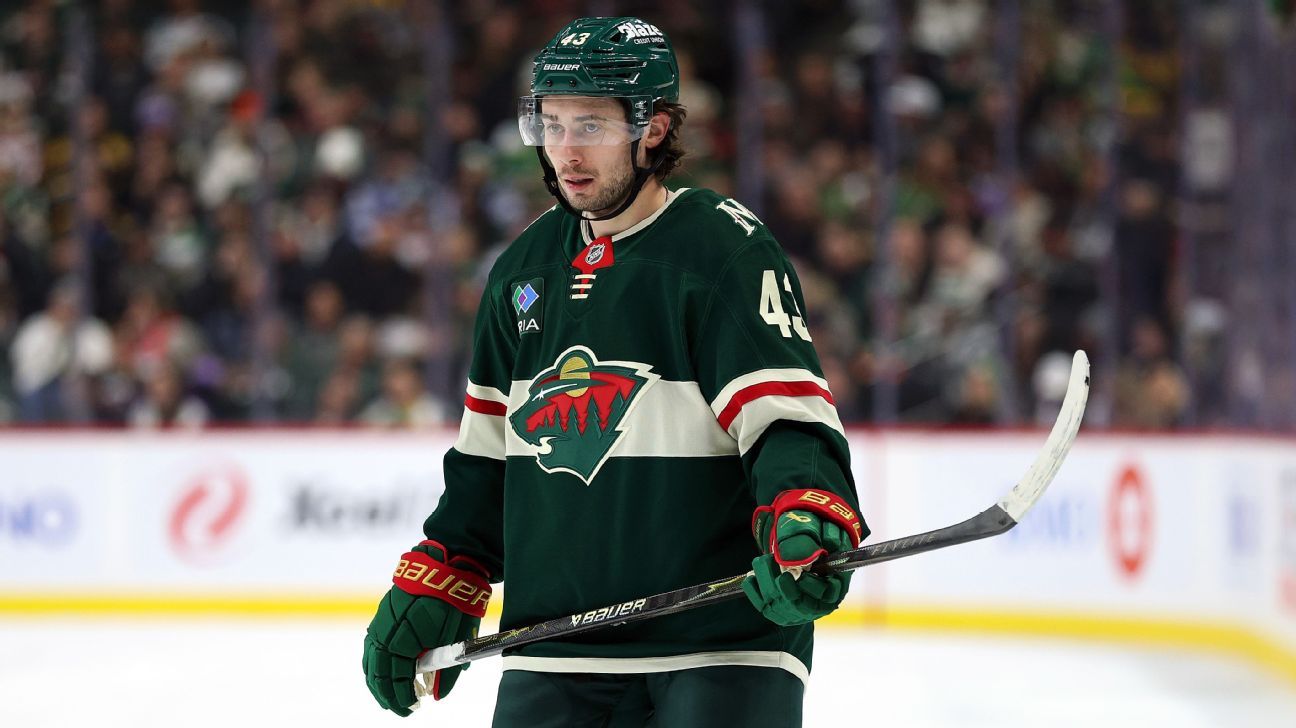
In his first game as the greatest player ever acquired by the Minnesota Wild, Quinn Hughes immediately started doing Quinn Hughes things for his new team.
It was a home game against the Boston Bruins on Sunday. The star defenseman looked up the ice and started sprinting. He saw four Bruins deep in their own zone, leaving plenty of room for Hughes to smoothly glide over the blue line and turn a Ryan Hartman pass into a goal, snapping the puck past goalie Jeremy Swayman.
The fans roared. The Wild’s social media team declared “WELCOME TO QUINNESOTA” when posting the highlight.
Welcome, indeed.
“It felt like we had a little more swagger out there today,” goalie Filip Gustavsson said.
Ecstatic that their team landed the coveted defenseman in a trade last Friday, Wild fans gave Hughes an ovation as he left the ice in warmups, then another during starting lineups. They cheered every time he touched the puck.
“That was pretty special, honestly,” Hughes said after Minnesota’s 6-2 win. “I know it’s a hockey market, but that was exciting.”
Also exciting: When one of the NHL’s superstar players is traded in-season to a surprise destination.
1:47
Why Quinn Hughes’ trade to Wild puts rest of NHL on notice
Greg Wyshynski breaks down why he loves the trade of Quinn Hughes to the Minnesota Wild.
Hughes, 26, played for the Vancouver Canucks for eight seasons, establishing himself as a franchise player and one of the world’s premier defensemen. He’s been a finalist for the Norris Trophy in two straight seasons, winning the award in 2024. Since 2022, he’s second only to Colorado Avalanche star Cale Makar (372 points) in points by a defenseman, with 336.
The Canucks were going nowhere except into a rebuild. Hughes was going to walk away as a free agent in the summer of 2027. So the decision was made by Vancouver president of hockey operations Jim Rutherford and the Hughes camp to seek a trade.
“It was a tough situation,” Hughes said. “But I felt like it was time. And I think Jim did, too.”
Hughes didn’t end up in New Jersey, where his brothers Jack and Luke play. He didn’t end up in Detroit, in the state the Hughes family calls home. He didn’t end up on any of the teams heavily rumored to be discussing a trade for him.
Quinn Hughes ended up in Minnesota, to the shock of the NHL. That’s because the Wild were never mentioned as a destination, and because of what the team traded to acquire him. The Wild gave up three former first-round selections — center Marco Rossi, forward Liam Ohgren and defenseman Zeev Buium — and a 2026 first-round pick to acquire Hughes, with no guarantee that he’ll sign an extension in Minnesota.
How did this trade happen? What does it mean for the teams involved and the teams that didn’t — or couldn’t — make this trade?
After conversations with around a dozen NHL executives, agents and players from around the league, here’s the behind-the-scenes story on one of the most significant trades in recent hockey history — and the aftershocks.
Why Quinn Hughes is no longer in Vancouver
To understand why Hughes is no longer with the Canucks, it’s important to understand how things got so bleak as to have him want to leave now.
In May 2020, former Vancouver GM Jim Benning announced that amateur scouting director Judd Brackett could not reach a new contract agreement and would part ways with the team.
Brackett and highly respected scout Dan Palango left Vancouver and joined the Wild under GM Bill Guerin. In a short time, Brackett terraformed the Wild’s prospect field. He had a hand in drafting every player the Wild just traded to Vancouver for Hughes — who, it should be said, Vancouver selected at seventh overall in 2018 on Brackett’s advice.
The next five Canucks drafts after Brackett left produced just one selection who played more than 50 NHL games: defenseman Elias N. Pettersson, taken 80th overall in 2022.
As the Canucks’ prospect pool was drying up, there was trouble among the veterans.
In September 2022, Vancouver signed J.T. Miller to a seven-year, $56 million contract, which started a domino effect. The Canucks essentially chose Miller over pending free agent center Bo Horvat, who was traded the following January to the New York Islanders. In doing so, the Canucks overlooked the personal issues between Miller and star center Elias Pettersson that had been growing since the regime that preceded Rutherford and his general manager, Patrick Allvin.
In January 2025, the internal drama had intensified to the point where Miller was traded to the New York Rangers.
So began Vancouver’s need to bolster the center position, which was among the team’s strongest prior to Horvat’s trade. Many in the league still wonder how the Canucks’ fortunes would be different if Horvat had been extended in the summer of 2022.
Vancouver finished with a .549 points percentage last season, missing the playoffs. Coach Rick Tocchet decided to leave the Canucks for the Philadelphia Flyers. Tocchet and Hughes were close, but the coach’s exit was a symptom of larger issues.
Addressing reporters after the trade, Rutherford said his team started to believe Hughes wasn’t going to sign an extension over a year and a half ago. Allvin said the team thought “about a year ago” that this “might be the path that Quinn wants to go.” But both Vancouver ownership and management refused to accept that fate.
“We were trying to do everything to convince him to stay,” Allvin said.
Case in point: the Miller trade and its aftermath. The Canucks acquired the oft-injured 26-year-old center Filip Chytil from the Rangers along with a lottery-protected 2025 first-round pick. Rather than use that pick, Vancouver moved it to the Pittsburgh Penguins for more immediate help: Defenseman Marcus Pettersson, 29, who signed a six-year, $33 million contract extension after the trade. Pittsburgh then turned that Rangers pick into a pair of low first-rounders in a trade with Philadelphia.
Vancouver continued to make counterintuitive decisions for a team on the road to a potential post-Hughes rebuild. The Canucks extended 30-year-old goalie Thatcher Demko (three years, $25.5 million) and 29-year-old winger Conor Garland (six years, $36 million), who both would have been unrestricted free agents next summer. They brought back unrestricted free agent winger Brock Boeser, 28, on a seven-year, $50.75 million deal that carries a full no-movement clause until 2029.
Trying to convince Hughes to stay extended to off-ice moves. When Tocchet left for the Flyers, the Canucks elevated assistant coach Adam Foote — who had one year of previous head coaching experience, with the Western Hockey League’s Kelowna Rockets in 2019-20 — to the big job. Foote was responsible for coaching the Canucks’ defensemen, and the hire was immediately labeled as a way to curry favor with Hughes.
Following the trade, Rutherford said there was nothing “concrete” about Hughes’ future until last offseason, when his agent Pat Brisson had informed the Canucks that “it was highly unlikely that [Hughes] was going to sign an extension” in Vancouver.
“He wanted to be closer to his family, closer to his brothers, wanted to play with his brothers at some point,” Rutherford said. “It doesn’t mean it has to be in the next couple of years. He could do it in his 30s, I suppose. So that was really around the time that I was pretty much 100% sure that there wasn’t going to be any convincing him to change his mind.”
NHL sources indicated that the machinery on this trade didn’t start turning until around U.S. Thanksgiving, when Brisson and Hughes had discussions with Canucks management and ownership about potential landing spots.
The Canucks were 9-12-2 and hovering near the Western Conference basement heading into Thanksgiving. Because of that mediocre start, Rutherford and Allvin informed the rest of the NHL that they were looking to make trades. While their motivation was moving pending unrestricted free agents such as forwards Evander Kane and Kiefer Sherwood, the memo kicked up interest in whether Hughes was available, too.
Suddenly, the captain was answering questions about his future after practices and games. He was asked about it during a charity event at a local food bank.
“He was a true pro,” Rutherford said, “but it was clear that it was getting harder for him.”
0:47
Quinn Hughes notches goal on the power play
Quinn Hughes notches goal on the power play
On Dec. 6, Sportsnet reported that the Canucks and Devils had “a conversation” about Hughes. Suddenly, the simmering speculation about Hughes turned to a boil. The trade rumors started to impact Hughes’ Canucks teammates, according to Foote.
“It’s there. These guys are human,” the coach said. “They can feel it. It can affect a locker room.”
It was clear the Canucks could not wait any longer to trade Hughes. Through his decades as an NHL general manager — winning Stanley Cups with Carolina and Pittsburgh — Rutherford had become known for making deals well ahead of the NHL trade deadline to create his own market. This was no different.
“In order to not get painted into the corner with one team, we felt that trying to do a deal in December or the first half of January would give us the most leverage,” Rutherford said after the trade.
With that, the trade process for Hughes began in earnest.
Which teams made offers?
Rutherford said Allvin asked him to take the lead on fielding trade offers, as the general manager “had a lot on his plate.”
The Canucks knew they couldn’t whiff on a Hughes trade. The consensus from sources around the NHL was that the Canucks were seeking a young center with NHL experience that could play in their top six, and a young defenseman, preferably left-handed. Teams knew a first-round pick would have to be part of any package as well.
The initial focus for Vancouver was trading Hughes to a team in the Eastern Conference “to get him closer to his brothers and family,” according to Rutherford. So talks began with the team in closest proximity to Jack and Luke — the one on which they play.
“The process probably started a couple of weeks ago with the understanding that New Jersey was the potential team,” Rutherford said.
The Devils were thought to be an inevitability in the Hughes derby. All three brothers stated that they wanted to play together in the NHL. Rutherford reiterated that was Quinn’s goal during news conference last season that also helped spark months of trade speculation surrounding his captain.
“Honestly, I was a little surprised that [Rutherford] would be so forthcoming with that,” Jack Hughes told ESPN in September.
According to an NHL source, there were discussions between the teams about Devils center Nico Hischier, their 26-year-old captain, even though he could also become an unrestricted free agent in 2027. New Jersey didn’t have interest in that swap. But the Devils did have a lot of what the Canucks were looking for in a trade.
The belief is that Vancouver would have wanted a package of 21-year-old defenseman Simon Nemec, drafted second overall in 2022; 24-year-old center Dawson Mercer; KHL defenseman Anton Silayev, drafted 10th overall in 2024; and a first-round pick. That package was crafted with the understanding that Hughes was likely to sign an extension with the Devils.
The problem with the Devils’ trade bid wasn’t necessarily the bid itself — although, ultimately, Minnesota’s offer was better — but in their inability to clear the necessary salary cap space to take on Hughes’ $7.85 million AAV.
The Devils have 14 players with some level of trade protection on their current contracts. That includes veteran forward Ondrej Palat and defenseman Dougie Hamilton, two players they could have shipped out to facilitate the trade.
“They handed out some regrettable trade protection in the past and it handcuffed them,” one NHL executive said.
The Canucks heard from plenty of NHL teams. Some dropped out quickly when the asking price came into focus.
“We were not even close,” one NHL general manager who was in on the trade talks said.
Others saw their interest in a Hughes trade inflated by media speculation. One of those teams was the Washington Capitals, who were portrayed as a serious suitor. Sources told ESPN that was overstated, especially when it was made clear that the Capitals didn’t want to move young forwards Ryan Leonard, Aliaksei Protas and Ilya Protas. That meant a Hughes bid could be built around center Connor McMichael and defensive prospect Cole Hutson of Boston University, but that wasn’t going to beat other offers.
The Carolina Hurricanes, as they have with every big-name player available over the past few years, made their pitch. But their trade package wasn’t in the ballpark of Minnesota’s, according to an NHL source.
The Rangers inquired, given their proximity to Hughes’ brothers’ team. Winger Alexis Lafreniere has been a target for the Canucks for some time — unsurprising, given his former agent, Émilie Castonguay, is their assistant general manager. But he wasn’t the only player Vancouver coveted: The Canucks also were interested in forwards Gabe Perreault, Will Cuylle and Noah Laba, as well as defenseman Braden Schneider. Ultimately, the Rangers did not want to part with the requisite players to acquire Hughes.
The Detroit Red Wings made a pitch for Hughes, whose family relocated to Michigan around eight years ago. He also played for the University of Michigan and the U.S. National Development Team, which is headquartered in the state. Detroit captain Dylan Larkin is a friend. There was a thought that Detroit could acquire Hughes, extend him and then lure Jack there as a free agent in 2030. But for Detroit to match Minnesota’s offer, it likely would have taken defenseman Simon Edvinsson, the sixth overall pick in 2021; winger Michael Brandsegg-Nygard, selected 15th overall in 2024; either Marco Kasper or Nate Danielson, two young centers with a taste of NHL experience; and a first-round pick. The Red Wings reportedly balked at a portion of that package.
The Buffalo Sabres reportedly made their pitch, desperately seeking a path back to the playoffs for the first time since 2011. Forward Zach Benson is a player the Canucks have coveted since they passed on him in favor of defenseman Tom Willander in the 2023 draft. Benson and defenseman Bowen Byram would have been the primary pieces in any deal that saw Hughes end up in Buffalo.
There was some reading between the lines when Hughes spoke after his debut with the Wild on Sunday, and praised the all-in aspect of Guerin’s offer.
“There are other teams that probably could have thrown in certain packages like that too, but at the end of the day, they didn’t want to do that. They didn’t want to trade two or three assets from their team like Billy did,” Hughes said. “I’ll remember that. That means a lot to me, that Billy did that.”
Into the Wild
Both Guerin and Devils GM Tom Fitzgerald have history with Rutherford. Fitzgerald was hired by the Penguins’ front office in 2007 to work under Ray Shero, their general manager.
Shero then hired Guerin in 2011 as a Penguins developmental coach. When Rutherford replaced Shero in 2014, both Guerin and Fitzgerald were named his assistant general managers. Reports at the time noted that Guerin appeared to move ahead of Fitzgerald in the front office pecking order. Fitzgerald left the organization in 2015 in a lateral move, becoming Shero’s assistant GM in New Jersey before replacing him in 2020.
Guerin took over the Wild in 2019 and brought Shero on in an advisory capacity. The bold trade for Hughes is exactly the type of move that the late Shero would have made. The infamous “one-for-one” Taylor Hall-for-Adam Larsson trade was a bold stroke from Shero.
The Wild have yet to play for the Stanley Cup since entering the NHL in 2000. The team hasn’t won a playoff series since 2015. But if there was a time to get aggressive as a contender, it is now, and Guerin hopes his boldness leads to playoff success.
The cap penalties from Guerin’s buyouts of forward Zach Parise and defenseman Ryan Suter have finally eased: The Wild had $14.7 million in dead cap space last season, but from 2026 to ’29, the annual cap penalty is just $1,666,666. Minnesota signed superstar winger Kirill Kaprizov to an NHL record contract through the 2033-34 season. Guerin’s team had amassed a collection of young talent that could bolster his roster — either through their play or as a trade asset.
This is why he called Rutherford.
“He told me what they wanted to try and accomplish with the move,” Guerin said. “I felt we could satisfy their needs.”
The Wild made the offer, and didn’t have to make another. “We came out of the gates with that,” Guerin said. “They wanted to check certain boxes, and we had to check them for them. We’re not going to sneak one past them. They’re smart.”
Buium has potential to be a top-pairing defender and power-play quarterback. His defending has a long way to go, but he’s an elite skater and the toolkit is there to blossom into a solid defender.
Guerin had been trying to move Rossi for a long time. The Wild gave him just a three-year deal when they re-signed the restricted free agent in August. Vancouver had tried to trade for him previously, and he finally gives them a young center who can provide offense.
Ohgren hasn’t put things together yet in the NHL over three seasons. He has previous chemistry with Canucks forward Jonathan Lekkerimaki from their time in Sweden.
“I don’t think there’s a team that could offer something similar to this right now,” one NHL executive said. “Not many teams can give up their 2C and a 20-year-old, top-four defenseman and still feel like they’re going to contend this year — while also having a reasonable shot of extending Quinn Hughes.”
Rutherford liked the return but wanted to make sure that Hughes saw Minnesota was a suitable landing spot.
“It was clearly the best offer. And so then there was a process of letting the other teams have another chance and seeing if Quinn had interest in going to Minnesota,” Rutherford said after the trade. “He thought, at this time, Minnesota would be a good fit for this year. Where it goes from there, that’s up to everybody else.”
Minnesota was well positioned to make the deal because not only had the team drafted the players included in the deal, but it has players who can replace those players: Riley Heidt, Hunter Haight, Ryder Ritchie and Charlie Stramel up front, along with Carson Lambos and David Jiricek on the back end — reinforcements there are a less pressing need given the acquisition of Hughes.
When Guerin initially reached out, Rutherford was blunt: Yes, the Wild could jump into the Hughes derby. “But the odds are against you, based on Quinn’s criteria.”
Yet the Wild had plenty that Hughes appreciated, from its proximity to home to defense partners like Brock Faber. But a primary catalyst for his decision was, in fact, Guerin. The two got to know each other through USA Hockey, as Guerin was the general manager for the 4 Nations Face-Off roster and the 2026 Winter Olympic team. (Hughes was one of the first six players named to the Olympic squad back in June.)
Where Hughes really gained respect for Guerin was during 4 Nations, which he missed because of an oblique injury sustained with the Canucks.
“How he handled me with the 4 Nations really gave me a glimpse of what a good person he is. Honestly, he was a big reason why I wanted to come here,” Hughes said of Guerin.
Hughes felt that last Thursday’s game against Buffalo would be his final game in Vancouver. He traveled with the team to New York, where he had dinner with some soon-to-be-former teammates and spent time with Jack and Luke. On Friday morning, he knew a trade was imminent.
Guerin said he was in the middle of making meatballs for his family’s Christmas Eve dinner when Rutherford called to say the Canucks had accepted the Wild’s trade offer.
“I had to take my latex gloves off. He told me we had a deal. There was a fist pump involved,” Guerin said. “They’re really good meatballs. It’s my wife’s recipe. I’m just doing the grunt work.”
Guerin and assistant GM Chris Kelleher flew to New Jersey to collect Hughes so he could make his debut Sunday against Boston. Rossi, Buium and Ohgren all played their first games for the Canucks in their win against New Jersey on Sunday, while still processing their whirlwind 48 hours.
In the case of Buium, who had a goal and an assist in his Canucks debut, it meant going from a foundational piece of the Wild’s future to the fulcrum of a blockbuster trade to Vancouver.
“I don’t think anything they told me was a lie. I really don’t,” Buium told ESPN on Sunday. “Bill Guerin is an unbelievable person. He’s such a smart guy. He wants to try and win now, and that’s a move he thought was best for the team. At the end of the day, you have to do what’s best for the team.”
The Canucks rebuild … sort of
Many around the NHL feel that the Canucks got a decent return under the circumstances. “They did as well as they could, but it’s risky,” one NHL executive said. “Ohgren seems like a bust, Rossi’s been shopped, Buium is so young.”
Of course, none of those players is Quinn Hughes. And without their star defenseman, it’s time for the Canucks to pivot to the next phase.
Like many team executives, Rutherford has been hesitant to use the term “rebuild” to describe that phase. As late as a month ago, he told Sportsnet that “a rebuild is not something that we’re going to look at doing” but rather that the team was “in transition.”
That changed last Friday. In the official statement announcing the return on the Hughes trade, Rutherford said, “They will be a key part of the rebuild that we are currently in, giving us a bright future moving forward.”
While the rest of the league took notice of that verbiage, Rutherford once again wanted to draw the distinction between a “rebuild” and a “full-blown” rebuild.
“People throw around different words. I believe that we’ve been in a rebuild here for a little bit, and we’ve been able to acquire some good young players. But this move gives us some really good young players,” he told reporters Friday. “It may not change our team in the next few months or even this season, but this doesn’t have to be a full-blown rebuild where it’s going to take five or seven years.”
Rutherford also defended keeping the Canucks’ other veterans on the roster.
“We’ve added some veteran players, but the veteran players have a purpose. They’re mentors for these guys. If you just go with all young players, it can get too frustrating. But we will stick with that plan, and the majority of people that we add going forward will be younger,” he said on Friday.
0:49
Brock Boeser lights the lamp for Canucks
Brock Boeser lights the lamp
Rutherford, 76, called players like Boeser, Garland and Filip Hronek “relatively young guys” who could combine with the next wave to create something successful.
“I don’t believe we have to go to a full-blown rebuild where we just trade all the players we have,” he said. “Sure, we’re going to trade some players away. We’re going to get more draft capital.”
Rutherford also confirmed that the first-round pick acquired from Minnesota might be in play in a subsequent trade if the return were to be a young player, because it would expedite the rebuild.
Beyond the specific trade and what it means for a rebuild, Allvin was asked whether the Canucks have a culture problem that needs to be fixed, in light of the Miller-Pettersson situation last season as well.
“A culture problem? On our team? I don’t believe so,” he said. “I don’t think that’s the reason Quinn Hughes was traded.”
Quinn’s path to playing with his brothers — in New Jersey or otherwise
One current NHL player wondered whether Hughes actually made sense for the Devils, considering they just gave Luke Hughes a contract extension with a $9 million annual cap hit.
“Wouldn’t he take his brother’s ice time and his power-play time?” they asked.
But another player believes the Devils should go after Hughes, despite that lineup redundancy. That player is Luke Hughes.
“I would have loved to have him here. Obviously Jack would [too]. Not just because he’s our brother, but because he’s a top-two D in the league,” the Devils’ 22-year-old defenseman said. “But at the same time, it’s sports.”
Sources we spoke with believe Quinn could join his brothers in New Jersey, with Jack signed through 2029-30 and Luke signed through 2031-32. Cap flexibility won’t be an issue should they sign Quinn in summer 2027, as the Devils have only 11 players under contract for the 2027-28 season. One of those players, Dougie Hamilton, will be entering the last year of a contract that carries a $9 million cap hit. One of the free agents at that time is Hischier, a player they’ll have to bring back at a significant raise over his $7.25 million AAV.
Of course, having Quinn Hughes sooner than later might have helped turn around their spiraling season.
The Devils are 6-10-0 since Jack injured his hand in a freak accident at a team dinner on Nov. 13. That .375 points percentage ranks them 30th in the NHL over that span, ahead of only Winnipeg (.367), who lost starting goalie Connor Hellebuyck to injury; and Vancouver (.357), who just traded their star defenseman because of that futility. New Jersey went from being a top-10 offensive team (3.35 goals per game) to the fourth-worst offense (2.38 goals per game) with their star center out.
Obviously, the Devils hung onto their assets that could have gone to Vancouver, some of whom could be repurposed in a trade for other more pressing needs. New Jersey has been linked to Nashville Predators center Ryan O’Reilly, for example. But it could also mean that Mercer and Nemec would be around if Quinn Hughes arrives in 2027.
“The fact is that they didn’t have the chips needed to win Quinn Hughes,” one NHL executive said.
Combine that with cap inflexibility from those no-movement clauses, and Fitzgerald could only watch as Hughes was traded to Minnesota, which now has what amounts to an exclusive negotiating window with him.
If the trio doesn’t land together in New Jersey, Detroit seems like a reasonable guess, given the Hughes family lives in Michigan. But if Quinn is feeling Minnesota, could Jack be the next to go Wild in 2030, followed eventually by Luke?
Another theory that’s floated around the NHL during the Hughes derby: What if he signs an extension in Minnesota or elsewhere through 2029-30, so both Jack and Quinn hit free agency in the same summer?
“We’ve always wanted to play together,” Luke Hughes said. “You never know what can happen. We’ve got a lot of years left in our careers.”
The Wild’s swing and a pitch
Of the Wild’s eight postseason series defeats since 2015, five of them have come at the hands of Central Division opponents. They are in the NHL’s proverbial group of death, where all a second- or third-place finish delivers is a first-round series against one of the best teams in the NHL.
The Avalanche, the NHL’s top team, lead the Central. They have a franchise defenseman in Cale Makar. The Dallas Stars have kept pace with them in second place. They have a franchise defenseman in Miro Heiskanen.
Now, the Wild can boast their own elite blueliner in Hughes.
“I believe in our players. I believe in what we’re doing here. We have an extremely competitive division. You’re going through the meat grinder here,” Guerin said. “We respect our opponents, but we want to compete for the Stanley Cup.”
Hughes helps greatly to that end. On top of being a Norris Trophy-winning defenseman and offensive point producer, he’s a panacea for several underlying issues for the Wild, from their poor zone entries to failing to generate chances on the rush to turnovers.
“Hughes is a one-man breakout. He cuts through the neutral zone as well as any defenseman in the NHL,” said Mike Kelly, an analyst for NHL Network. “Hughes also leads the league in stretch pass completions. The Wild attempt more stretch passes than any team but connect at a below-average rate. For as much as Hughes had the puck on his stick in Vancouver, maybe too much at times, he also rarely turned it over.”
Hughes gives the Wild a better chance to get through the Central and play for a championship, but he’s not a cure-all. The Wild remain a team whose depth at center pales in comparison to other Western Conference powers, including Vegas and Edmonton, winner of the West for two straight seasons.
But Minnesota has cap flexibility and additional assets it can use to address that weakness before the NHL trade deadline in March. It will have even more flexibility in the offseason, with the salary cap rising again and players such as Mats Zuccarello and Vladimir Tarasenko becoming unrestricted free agents. It has two shots to build the right roster for a playoff run with Hughes. Unless, of course, he’s in Minnesota for more than two seasons.
The biggest chatter of the past few days is how open Hughes was to remain in Minnesota on a contract extension.
“I mean, extremely open-minded. They’ve got an amazing core. Minnesota being so close to Michigan, [being] the ‘State of Hockey’ and just the passion here,” he said. “And I’ve got a lot of time for Billy, for ‘sacking up’ and making the deal like he did. How he valued me.”
Guerin said he wasn’t given any assurances that Hughes would be interested in an extension with the Wild, which the defenseman can’t sign until July 1. A source close to Hughes said his focus isn’t on his future but on “having a really great hockey experience” in Minnesota in the short term.
The Wild do have something to offer Hughes that no one else can at the moment: an eight-year, front-loaded contract.
The new NHL collective bargaining agreement goes into effect in September 2026. It lowers the maximum number of contract years for a team re-signing its own player, from eight years to seven years. It also caps total signing bonuses — aka “guaranteed money” — at 60% of the total contract value. For example, Mitch Marner‘s contract last summer that pays out $60 million of $96 million in signing bonuses would be prohibited. But Hughes could still get a contract with similar structure if he signs with the Wild before Sept. 15.
Guerin believes they have a shot.
“This is a great place to play, but no matter what, the hockey has to be good,” he said. “You can live in the sun. You can make a little more money. But if the hockey isn’t good, you won’t be happy. And I think Quinn will be really happy here.”
Unless, of course, he’d be happier with his brothers.

-
Ryan S. Clark
The 2025-26 NHL trade season has officially begun!
On Friday, the Vancouver Canucks traded Quinn Hughes to the Minnesota Wild, in exchange for Zeev Buium, Marco Rossi, Liam Ohgren and a 2026 first-round pick. Earlier in the day, the Pittsburgh Penguins sent goaltender Tristan Jarry and forward Sam Poulin to the Edmonton Oilers in exchange for goaltender Stuart Skinner, defenseman Brett Kulak and a 2029 second-round pick.
Throughout the season up until the March 6 deadline, ESPN reporters will be grading each side on all of the big swaps, with the latest deals highest up on this page.
Read on for more, and keep this page bookmarked as the trade volume rises throughout the campaign!
Jump ahead: Hughes to MIN
Jarry to EDM
Everything was quiet Friday … until it wasn’t. Because that’s when the first blockbuster trade of the season happened, with an expected name going to an unexpected place.
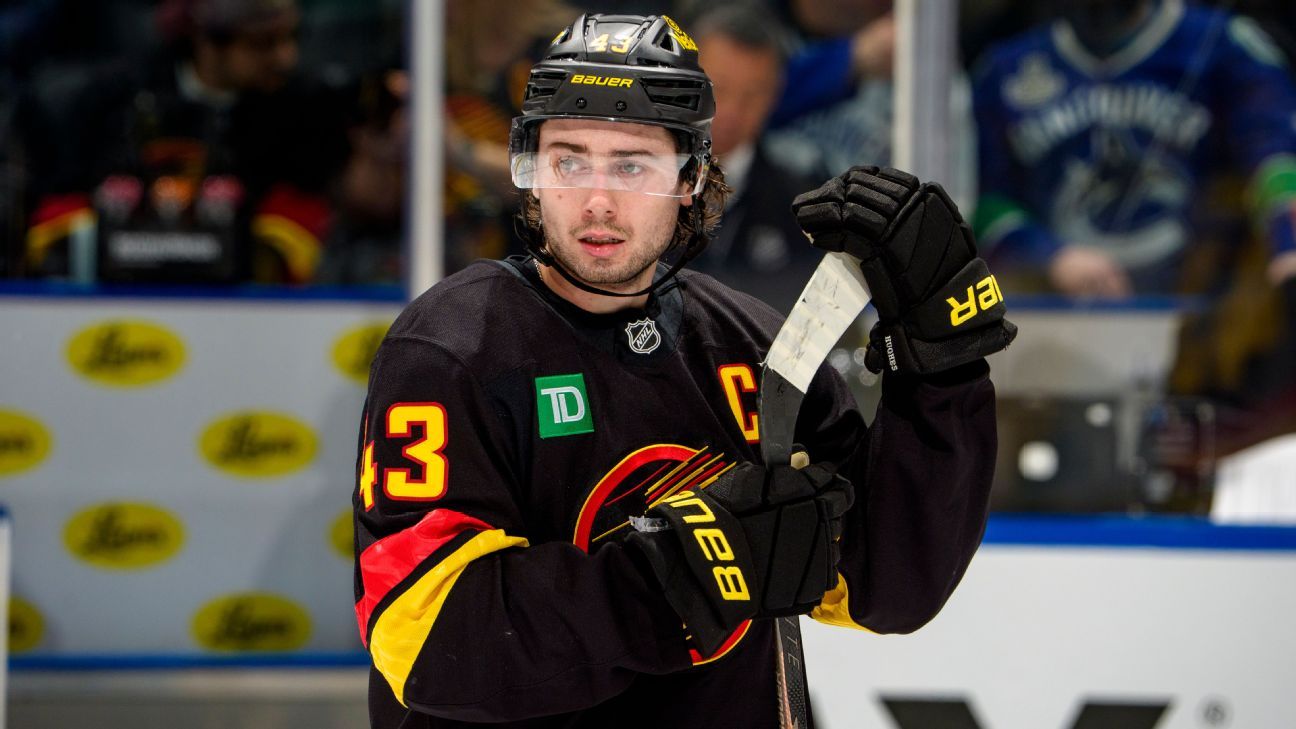
The Vancouver Canucks traded captain and star defenseman Quinn Hughes to the Minnesota Wild with defenseman Zeev Buium, forward Liam Ohgren, forward Marco Rossi and a 2026 first-round pick going in the other direction.
How did both general managers perform in what is easily the biggest trade of the season to this stage?

Wild grade: A-
In recent years, the Wild built one of the best farm systems in the NHL. Investing in their system and in player development gave them options … and they used three of those options to land one of the NHL’s best defensemen.
Hughes gives the Wild a Norris Trophy winner who can be used in every situation, starting with the offensive zone. Finding ways to consistently score goals has been a challenge for the Wild over the past few seasons.
Not that Hughes can single-handedly solve for that one problem. But he can definitely help, considering he has had four straight seasons of more than 60 assists and is projected to finish with 56 having missed a portion of this season with an injury.
How crucial is that for the Wild? Hughes’ 60 assists alone would have been tied for second on the team in points last season. His 76 total points also would have led the Wild outright in that category. The 21 assists that he has this season would already be the most if he played the whole season for the Wild, and his 23 points are tied for the third most on the roster.
Hughes also provides the Wild with another option — in addition to Brock Faber — who can be trusted to play in every key situation for long periods. The Wild could even pair them together if needed to form a combination that can defend and then quickly break out into transition.
The Wild’s top-four defensive unit also features Jonas Brodin, Jared Spurgeon and Faber, while Jake Middleton is logging more than 18 minutes per game.
Of course, adding Hughes came with a premium package going the other way. Buium was in his first full NHL season, having been a first-round pick in 2024. Ohgren was a first-round pick in 2022, and Rossi was a first-round pick in 2020.
The thought was that Buium would be part of the long-term plan, whereas Ohgren was a bit more of a work in progress given he had spent part of the season in the AHL. Rossi re-signed with the Wild having just spent the 2024-25 season and the early portion of the offseason as a possible trade target before agreeing to that new deal.
But there was also the matter of where those three fit into the Wild’s current lineup. Buium was on the third pairing, with the idea that he could be elevated into the top four at some point. Ohgren was playing amid the Wild’s injury crisis — Rossi and others had been on IR this season — but has zero points in 18 games.
Parlaying a sizable part of their future to get Hughes signals that the Wild are intent on breaking into that collection of teams that are in a championship window. Two of them — the Colorado Avalanche and the Dallas Stars — are ahead of the Wild in the Central Division standings right now.
Hughes has one more year left on his current contract at $7.85 million before hitting free agency in the summer of 2027, but he can sign an extension as of July 1, 2026. Whatever happens between now and then could play a role in defining one of the biggest trades in Wild franchise history.

Canucks grade: A
Going from being a game away from the Western Conference finals in 2024 to potentially winning the lottery over a two-year period prompted some difficult questions in Vancouver.
Figuring out whether the franchise needed to move on from Hughes might have been the most difficult.
Speculation about Hughes’ future ramped up significantly this offseason, when team president Jim Rutherford said that Hughes wanted to play with his brothers, Jack and Luke, who are on the New Jersey Devils.
Eventually, the Canucks were playing out two hypotheticals: one in which they kept Hughes, attempted to turn things around but ran the risk of losing him in free agency with nothing in return at the end of the 2026-27 season, and another in which they moved on from him at some point, commanding the sort of trade package that could help them now and in the future.
They went with the second option, which has a chance to potentially start paying dividends now for a franchise that entered Friday with the worst record in the NHL — but that is also the owner of two first-round picks in this summer’s draft.
0:49
Zeev Buium scores power-play goal vs. Predators
Zeev Buium scores power-play goal vs. Predators
Buium projects as a top-pairing, puck-moving defenseman who could be used in various situations. He joins a top four that includes Filip Hronek, Marcus Pettersson and Tyler Myers. He gives the Canucks another young defenseman for the future, in a young group that also includes Elias N. Pettersson and Tom Willander. He’s in the second year of his entry-level contract and will become a restricted free agent at the end of the 2026-27 season.
Ohgren is a potential top-nine option who has shown promise with what he has done at the AHL level. By skating more minutes with the Canucks, he could possibly find offensive consistency. He has two years remaining before becoming an RFA.
Rossi has a chance to establish himself as the Canucks’ second-line center upon his return from injury. Trading J.T. Miller last season created a void that was slated to be filled by a player who came over in that deal, Filip Chytil. Chytil had three goals through six games before sustaining an upper-body injury that has kept him out of the lineup since Oct. 19.
Rossi, who is in the first year of a three-year bridge deal, could return as soon as Sunday to provide the Canucks with another top-six option down the middle.
The Edmonton Oilers finally addressed their multiple-season problem in goal by acquiring Pittsburgh Penguins netminder Tristan Jarry.
The Oilers sent goalie Stuart Skinner, defenseman Brett Kulak and a 2029 second-round pick to Pittsburgh for Jarry and forward Sam Poulin.
How did both GMs do in this deal? Let’s dive in.

Penguins grade: B+
This trade is primarily about Jarry, of course. But it’s about someone else, too: Sergei Murashov.
The 21-year-old, who was a fourth-round pick by the Penguins in 2022, has grown into potentially their most promising prospect. He starred in the MHL, the premier Russian junior league, for two seasons after he was drafted. He also won four of his seven KHL games while posting a .928 save percentage in those stints.
Murashov came to North America last season where he posted a .922 save percentage over 26 ECHL games before a .913 mark in the AHL in 16 games. He has a .943 save percentage in 11 AHL games this season, while having a .912 save percentage and a 1.90 goals-against average in four games with the Penguins.
It’s the sort of trajectory that makes it evident that the Penguins have found their goalie of the future — who could be playing right now. Even more so given Murashov has a chance to be the latest Russian goalie to make an impact in what has been a golden age for Russian netminders.
Murashov has one more year left on his contract at a team-friendly $861,000. Arturs Silovs and Skinner, who are both on the NHL roster, are in the final years of their deals. Together, they cost the Pens a combined $3.45 million in cap space, with Silovs set to become a restricted free agent this coming offseason.
Skinner does provide them with an experienced option in net, given that Murashov is in just his second season of North American hockey while Silovs has only 32 games, with a career-high 13 of those performances coming this season.
It creates the sort of environment that allows the Penguins to continue developing Murashov with the idea that they can give him the necessary minutes, rather than trying to juggle his workload versus that of a goalie such as Jarry, who was a significant financial investment with two more years left on his contract at north of $5 million annually.
Getting Jarry’s contract off the books means the Penguins can now pave the way for Murashov to receive more playing time. They are now also armed with the sort of cap space that will allow them make other moves in their bid to reach the playoffs for the first time in three years.
PuckPedia projects that the Penguins have $9.164 million in salary cap space after the trade, which could give the Penguins an advantage entering the trade deadline. They entered Friday in the second Eastern Conference wild-card spot in a race that has 10 teams separated by six points.
Adding Kulak in the deal gives the Penguins an experienced top-six defenseman and someone who could anchor their bottom pairing. The Penguins have a clearly established top four, but have shuffled through their bottom-pairing options; they’ve had five defensemen who have played more than nine games and who have logged close to or more than 15 minutes per game. Kulak is averaging 17:42 in ice time per game this season.
Kulak can also provide the Penguins with another option on their penalty kill, as he has logged more than 100 short-handed minutes in two of his three most recent seasons.
0:16
Tristan Jarry makes big-time save vs. Stars
Tristan Jarry makes big-time save vs. Stars

Oilers grade: B
Any personnel decision the Oilers make is going to be viewed through the prism of whether it can help them win the Stanley Cup now. Trading for Jarry — or any goaltender — while moving away from Skinner reflects that reality.
There had been more than enough evidence in place to suggest that the Oilers needed a change in net. Advancing to the Stanley Cup Final in consecutive seasons made it extremely clear that the Oilers are in a championship window. Constantly having to press the proverbial reset button on Skinner in both of those runs to the Cup Final, however, played a significant role in what made their chances of winning a title rather murky by comparison.
Skinner recovered the first time the Oilers pulled him and brought him back during the 2024 playoffs. He finished with a save percentage greater than .900 in eight combined Stanley Cup Final and Western Conference playoff games. Last postseason, Skinner had four games with a save percentage greater than .900 in the Cup Final and conference finals — with three of those games coming in the conference finals.
It’s an even more damning reality with the consideration that the Oilers have possessed one of the strongest defensive structures in the NHL since hiring Kris Knoblauch in November 2024. The last two years have seen the Oilers rank in the top eight in allowing the fewest shots per 60 minutes, the fewest scoring chances per 60 and the fewest high-danger scoring chances allowed per 60, according to Natural Stat Trick.
Only to then have the ninth-lowest team save percentage in 5-on-5 play over that same span.
This season has been no different. The Oilers are a top-10 team in terms of the fewest shots allowed per 60 and the fewest high-danger scoring chances allowed per 60. That’s why they entered Friday in the first of the two Western Conference wild-card spots.
But despite that strong defensive structure, they are last in team save percentage in 5-on-5 play. That’s also why they entered Friday in a wild-card spot instead of sitting atop the Pacific Division — granted, they’re just five points behind first place.
Another item that hinted that a change could be coming was the fact that Skinner and Calvin Pickard are in the final season of their respective contracts, at figures that could be moved. Skinner is earning $2.60 million this season, while Pickard is at $1 million.
Jarry provides the Oilers with a two-time All-Star goalie who they believe can give them the consistency that’s been missing. Five of his six most recent campaigns have seen Jarry finish with a save percentage of more than .900.
He will also be under contract for two more years after this one, at $5.38 million annually. That means he’ll come off the books after the 2027-28 season — the same time that superstar captain Connor McDavid‘s two-year extension will be over and could potentially see him hit free agency for the first time.
Will the Oilers have won a Cup by then? Or will the next two years see them get close only to fall short again? — Ryan S. Clark

-
Adam Rittenberg
EUGENE, Ore. — When wide receiver Malik Benson transferred to Oregon in January, Dante Moore, the team’s projected starter at quarterback, drove him around town.
They went to different stores so Benson could pick up items for his new home. They attended church together and visited several spots to eat. But what struck Benson was the playlist in Moore’s car.
“I’m like, ‘Man, this is the music my mom would listen to when we had to get up and clean the house,'” Benson said. “It was early 2000s R&B. He’s an old head, for sure.”
Much of Moore’s soundtrack stretches back well beyond his birth date. He’ll play everything from Al Green to The O’Jays to New Edition to Lauryn Hill.
“He’s an old soul,” Otha Moore, Dante’s father, said of his youngest son.
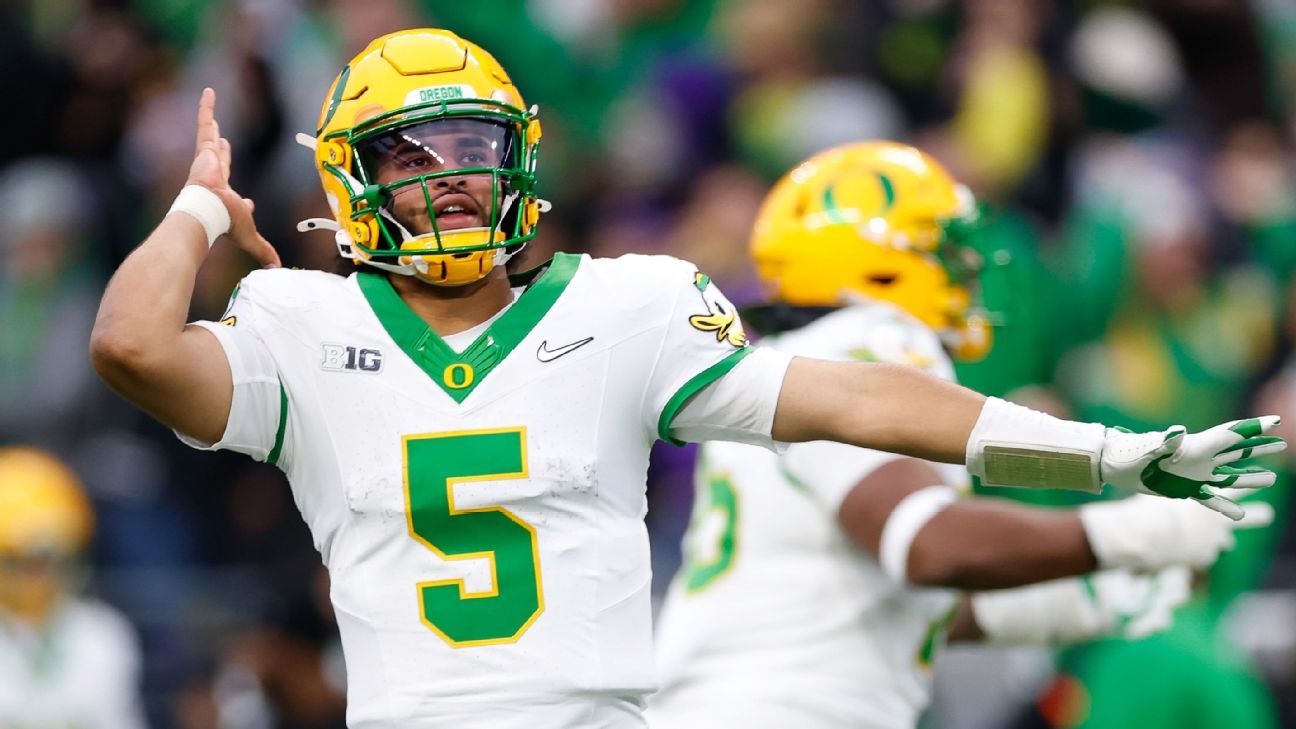
Dante Moore, who started college at 17 and turned 20 in May, doesn’t dispute the designation. He had to grow up fast for different reasons, including being one of the best quarterbacks in the country before he entered high school. Maturity came easier to him than most.
Among the many old-school things about him is how he ended up at Oregon, and what happened back in 2024. Moore essentially took a gap year after transferring from UCLA to Oregon, fully knowing the Ducks had already added one of college football’s most prolific and accomplished quarterbacks in Dillon Gabriel.
Moore spent most of last season watching, waiting and learning. For decades, transfers were forced to sit out a year, but since those rules changed several years ago, it hardly ever happens. The allure of immediate playing time has top players, especially quarterbacks, hopscotching the country in search of a starting job.
So why did Moore, the nation’s No. 2 overall recruit, who had always started and immediately became a starter at UCLA, take the throwback route?
“I could have gone to multiple places, any place in the country, to be honest,” said Moore, who will lead Oregon against No. 12 seed James Madison on Saturday night in a first-round College Football Playoff game. “I just felt like I needed to sit back and get myself together.”
THE FIRST THING to know about Moore’s gap year at Oregon is that he was always in line to play there. Things just took a bit longer than expected.
He started out as an unlikely Duck. Moore grew up in Detroit, with parents on either side of the Michigan–Ohio State rivalry. Otha is a Detroit native and still has an allegiance to Michigan; Moore’s mother, Jera Bohlen-Moore, is an Ohioan, from a family of Buckeyes.
“It was like a battle in the living room,” Dante said.
Dante said he initially was an Ohio State fan — he loved former Buckeyes quarterback Braxton Miller — and considered playing for major programs near home, especially Notre Dame. But in July 2022, he announced on “SportsCenter” that he would be attending Oregon. He and his family had bonded with new Ducks coach Dan Lanning.
“Our relationship was amazing,” Moore said. “He’d come out [to Detroit] a lot. We used to go on walks. I would show him around. I remember our Christmas lighting, everybody kept posting us being at the Christmas tree. We were always kicking it with each other.”
Moore also had a strong connection to Ducks offensive coordinator Kenny Dillingham. But in late November 2022, Dillingham landed the head coaching job at Arizona State, his alma mater. Oregon acted quickly in finding a replacement and hired Will Stein from UTSA.
Lanning immediately dispatched Stein to Detroit on a red-eye flight to meet Moore and his family. Stein’s wife is from Michigan, and he and Moore had a nice initial vibe. But things felt rushed. Moore said if he knew then what he does now about Stein, he would have remained with Oregon.
Stein was a promising young playcaller but had never held an on-field role for a power-conference school.
“It was something that we had our heart stuck on from the beginning,” Otha Moore said. “And that last-minute coaching change kind of threw a wrench in the fan and we kind of jumped to conclusions a little bit fast.”
Other teams remained in pursuit of Moore, a top-3 recruit in the 2022 class. Among them: UCLA, which was coached by Chip Kelly, the offensive guru who had molded top quarterbacks and whose scheme and philosophy first gained national attention at, of all places, Oregon. UCLA also offered an immediate path to a starting job.
“It was Chip Kelly vs. Will Stein,” Stein explained. “My name now probably carries a little bit more weight in the quarterback world than it did then.”
Moore signed with UCLA several days later. Lanning had seen communication wane leading up to signing day, and Moore had visited UCLA’s campus.
His decision didn’t come as a surprise. Lanning shot Moore a text: “Love you, man. Wish you nothing but the best.”
“I was pretty disappointed,” Lanning said. “You want to make sure you handle those relationships the right way, but in our mind, it wasn’t necessarily thinking, ‘Hey, we’re going to get another opportunity to coach this guy down the road.'”
OTHA MOORE RAISED Dante and his two older children mostly as a single dad. He worked as an engineer for Ford, but also held other jobs, including a landscaping business.
Dante has helped Otha since he was around 10 years old. One time, he didn’t know how to dump the debris bag on the mower without assistance. So he took the bag off and kept cutting.
“My dad’s like, ‘What are you doing? Figure it out. I’m not going to help you,'” Dante said. “So I’m sitting there, like, trying to put this bag into the thing. He showed me, with situations in life, sometimes you’ve got to find a way on your own.”
Dante entered one of those situations in 2023. He was on campus at UCLA, far from home, billed as the next big thing for Bruins football. But just after spring ball, his mother called with bad news: She had breast cancer. She would have surgery that November.
Things started off well for Moore on the field. He became UCLA’s starter by Week 2 and threw seven touchdown passes in his first three college games. But then he opened Pac-12 play against three consecutive top-15 opponents and completed just 51 of 112 pass attempts with six interceptions. He was benched after a Week 7 loss to Oregon State, and while he saw extensive action in the regular-season finale against Cal, he threw two interceptions in a 33-7 loss.
“A lot of hype, true freshman going in, hasn’t been since … a long time,” Moore said. “My first couple games are going amazing and then you hit that block. It’s like, ‘I’m not playing for the city of Detroit anymore. I’m playing for people that are UCLA fans across the whole world,’ so you get so much hate and trauma put onto you.”
Oregon’s coaches sensed that Moore could have a tough season.
“There’s a clear difference between UCLA and Oregon, at that point,” Stein said. “Everybody could see that.”
Moore prepared to enter the transfer portal. He huddled with his family and his agent, Brandon Grier, and assessed the landscape. They wanted a place where Moore would grow and also have the right players protecting him up front, catching his passes and sharing the backfield.
“Dante had aged in a way. When he was a freshman at UCLA, he could have still been a senior in high school,” Grier said. “That really allowed him to take a step back and look at [2024] as a reset year. Where he may have been rushing to be the guy, he wanted to step back and look at it from a big-picture standpoint.”
Moore soon focused on Oregon as his transfer destination. He already knew the coaches and would have the talent around him to guide his development.
But on Dec. 9, 2023, Gabriel, who had four 3,000-yard passing seasons as a starter at Oklahoma and UCF, and more than 14,000 passing yards at the FBS level, announced he would play his sixth and final season at Oregon. Gabriel would follow Bo Nix, another veteran transfer who became a record-setting quarterback for the Ducks.
“We got Dillon, and he was going to be our locked-in starter,” Stein said. “But then when Dante called and said, ‘Hey, I’m really interested in coming back and willing to sit and learn, just have a growth year,’ we took it and said: ‘How can we turn this opportunity down?'”
Just nine days later, Moore announced he would be joining the Ducks.
“The goal, at first, from high school, was he’ll learn from Bo Nix [at Oregon],” said Ty Spencer, who coached Moore at King High School in Detroit. “But it was just kind of the opposite. He tried it at UCLA, and he understood, ‘Hey, I’ve got a lot more to learn than I think, and I’m OK with humbling myself.'”
WHEN MOORE ARRIVED at Oregon in early 2024, the focus wasn’t on football right away. Otha Moore remembered Lanning, whose wife is a cancer survivor, asking about the family and specifically how Dante’s mother was doing with her treatment.
“From the time we first met them, from Will to Dan, they’ve never changed,” Otha Moore said. “They’ve been the same guys.”
Lanning sensed that the year at UCLA had weighed on Moore. Los Angeles is a media and entertainment hub and Moore, because of his recruiting accolades, found himself in the spotlight. At Oregon, he would share a quarterback room with an older, more accomplished player in Gabriel.
Moore also wouldn’t be the center of attention in Eugene.
“It’s a little bit off the beaten path,” Lanning said. “It’s not necessarily right in the center of L.A. or New York or Houston. For the guys looking to sit courtside and be at a concert every night, this isn’t the place for them. But for a guy looking to focus, grow as a player and a person, this is the right place.”
The setting might have been ideal, but the role was unfamiliar. Moore had been a starting quarterback ever since he was 9, when he requested to play up on a youth team of 13-year-olds called the Southfield Falcons. Otha had told Dante that he wouldn’t play right away, and Dante was good with that. Although he ended up becoming a starter that season for the Southfield Falcons after an injury, Oregon would be different.
Dante knew Gabriel would only be there a year and saw benefits to being around him.
“It made me really want to come here even more, knowing that he was coming,” Moore said. “I would get to learn, see how a vet quarterback moves and takes control of the offense. And I got to see him every day.”
Stein said Moore never asked him about playing time. Moore received reps with the second-team offense in practice. He prepared as if he was the starter, even though the chances of supplanting Gabriel were slim.
“We never saw moments of disinterest or mind wandering in different spots,” Stein said. “Only one guy’s playing, so some [backups] kind of wait to prep like your starter until, ‘Oh my gosh, I might be it.’ He always [prepared].”
Stein knew about Moore’s arm and physical ability, and Moore would make throws in practice that “nobody else on our roster can make,” including Gabriel. But Moore’s mental approach toward understanding the game and growing his knowledge stood out to his coaches.
Moore’s “elite football IQ,” Stein said, showed up in him suggesting schematic concepts, different checks, protections or route stems that most underclassmen aren’t relaying. Moore didn’t shy away from asking challenging questions or showing leadership, even as QB2.
“I remember Dillon got hit at practice and Dante talked to the entire team about how we’ve got to protect our quarterback,” Lanning said.
Moore took a proactive mindset to his gap year. He reached out often to Cam Newton, the former Heisman Trophy winner and NFL MVP quarterback, whom Moore met through 7-on-7 football in high school. Newton, also an ESPN analyst, has mentored Moore and talked about playing at Florida in 2007 behind Tim Tebow, who that season became the first sophomore to win the Heisman.
Oregon surged to an undefeated regular season and a Big Ten championship, and Gabriel became a Heisman finalist while recording career highs in passing yards (3,857), passing touchdowns (30) and completion percentage (72.9). During games, Moore would conduct pre-snap reads and play the game out in his mind.
His 2024 season stats: 7 completions, 8 pass attempts, 49 yards, zero touchdowns or interceptions.
“There were many times I wanted to go out there and throw touchdown passes and things like that,” Moore said. “But it wasn’t my time yet.”
AS OREGON’S 2025 season opener against Montana State approached, Moore felt the nerves. He had not started for 687 days.
But he also trusted those around him at Oregon and what he had learned in the previous year and a half.
“I get my confidence now from my teammates,” he said. “It’s like, we all move together.”
A month into the season, he stood on the field at earsplitting Beaver Stadium, with No. 6 Oregon trailing No. 3 Penn State by a touchdown in overtime. Oregon faced fourth-and-1 from the Penn State 5-yard line, and Moore, not known for his mobility, converted on a designed quarterback draw. He found Jamari Johnson for the tying score moments later, then opened the second overtime with a 25-yard touchdown pass to Gary Bryant Jr. as Oregon went on to win 30-24.
Six weeks later, he once again was in a tough road environment at Iowa, where a cold steady rain fell all game. After leading almost the entire way, Oregon had fallen behind 16-15 with 1:51 left and Moore, who had just 65 passing yards to that point, had to rally the offense. On the final drive, he completed five passes, including a dart to Benson up the sideline for 24 yards, to set up the winning field goal.
“I never did a two-minute drive to win a game before,” Moore said. “It’s been a lot of experiences this year.”
Not all of them have been enjoyable. Moore finished with only 186 passing yards, a touchdown and two interceptions in Oregon’s only loss, a 30-20 home setback against Indiana. The IU game began a midseason stretch where Moore completed less than 62% of his passes in three of four games.
But he responded to average 283 passing yards on 77.5% completions in Oregon’s final three games, entering Saturday’s CFP first-round matchup against James Madison at Autzen Stadium. This season he has thrown for 2,733 yards and 24 touchdowns.
“He humbled himself before he knew he’s going to do great things,” Benson said. “Not a lot of people sit for a year, knowing where he could have gone, probably anywhere in the country. But for him to come sit for a year, learn the offense, that’s why you see our offense go how it’s going. Even though this is his first year playing in the offense, it’s not new to him.”
Stein calls Moore “an elite processor,” able to diagnose defenses quickly and then display anticipation and accuracy. Moore throws with pace and touch, whether he’s targeting receivers in short, intermediate or deep routes.
“I would love to see somebody better than him in throwing a football consistently,” said Stein, who was named Kentucky‘s head coach earlier this month but will stay on with Oregon through the CFP. “It’s not just one throw a game, ‘Whoa!’ and the other throws suck.”
Although Moore wasn’t a Heisman finalist like his Oregon predecessors, he has surged as an NFL prospect. ESPN’s Mel Kiper lists Moore at No. 1 overall on his Big Board for the 2026 NFL draft, ahead of Indiana’s Fernando Mendoza, the Heisman winner. ESPN’s Field Yates has Moore at No. 2 behind Mendoza in his latest mock draft.
While the gap year has helped, not hurt, Moore’s NFL chances, the redshirt sophomore will be making only his 18th career start Saturday, below the typical thresholds — 25 or 30 — for quarterback draft prospects. Gabriel finished college with an FBS-record 63 starts, breaking Nix’s mark of 61.
“There’s no rush,” Otha Moore said. “Whenever he feels like he’s ready, he’ll step up to that next level. Everyone says, ‘Hey, you should go now, you should go now.’ We don’t care about the pick where he’s going to go. It’s just about the mental aspect.”
Dante Moore’s college career might be bookended by a fast start and a fantastic finish, but the period in between perhaps molded him the most.
Could he start a trend? Might other top quarterback recruits who struggle early take the old-school approach to transferring, rather than rushing into whatever next starting role presents itself?
“It would be smart for guys to look at what he’s done, and try to emulate it,” Grier said.
Added Stein: “Most people could benefit, but nobody wants to wait, nobody wants to grind, nobody wants to think about process, they want to think about results. It’s just not reality.”
Moore attributes the pattern to “our generation” and “our society,” not excluding himself from that group, but also speaking with some earned perspective.
“When it comes to social media, when it comes to just fame in this world, people want it, and if you don’t get talked about in the current moment, you feel like you’re not worth it,” he said. “I was going through the same thing in high school. I was seeking attention on Instagram, people posted me and there’s followers.”
He reached a point where the chase for outside recognition exhausted him, while the quest for inner growth gave him a second wind. After intentionally exiting the spotlight, Moore returned to it with a readiness for whatever comes his way.
“It’s OK to be developed, it’s OK to wait your turn,” he said. “At the end of day, I hope people look at my story in the future and be like, ‘It’s OK to do it. It’s OK to sit back and learn.'”
-
 Sports2 years ago
Story injured on diving stop, exits Red Sox game
-
 Sports3 years ago
‘Storybook stuff’: Inside the night Bryce Harper sent the Phillies to the World Series
-
 Sports2 years ago
Game 1 of WS least-watched in recorded history
-
 Sports3 years ago
Button battles heat exhaustion in NASCAR debut
-
 Sports3 years ago
MLB Rank 2023: Ranking baseball’s top 100 players
-
Sports4 years ago
Team Europe easily wins 4th straight Laver Cup
-
 Environment3 years ago
Japan and South Korea have a lot at stake in a free and open South China Sea
-
 Environment1 year ago
Here are the best electric bikes you can buy at every price level in October 2024