
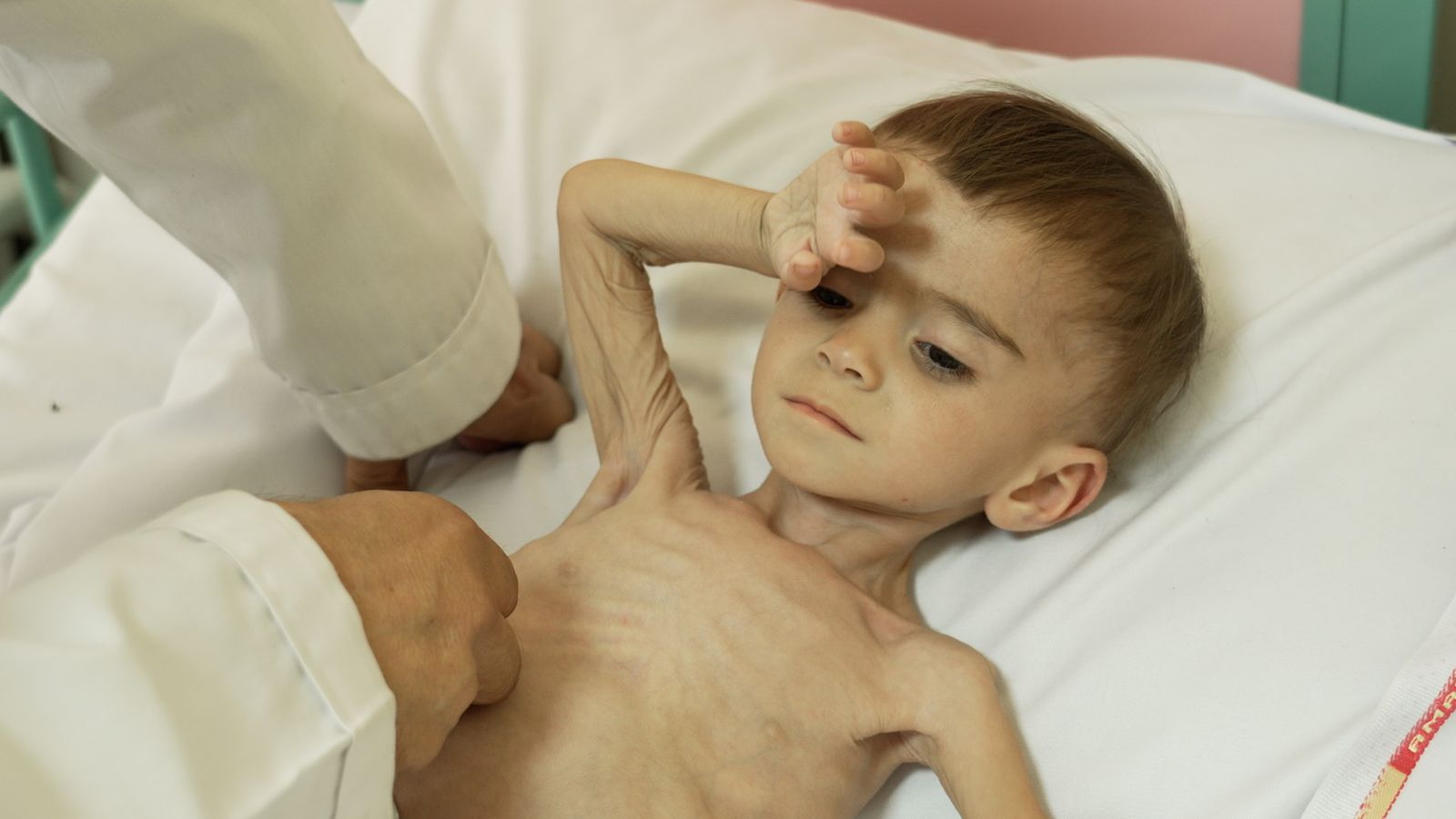
Crying babies dimmed by hunger fill this Afghanistan hospital – where parents fear each day might be the last

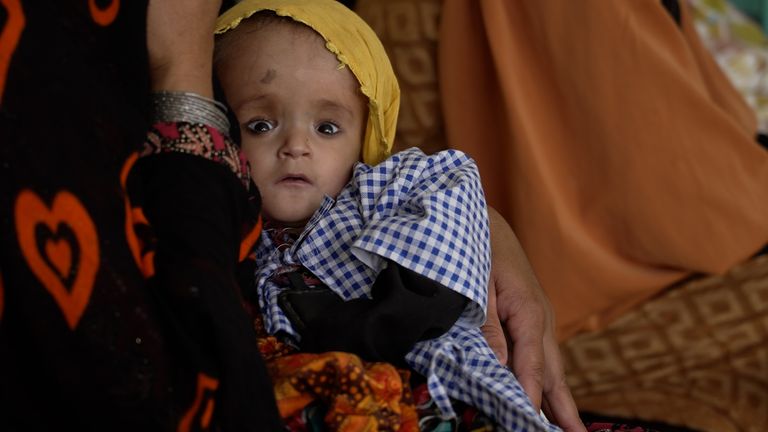
You can see, feel, hear the distress in Badakhshan’s Provincial Hospital in Afghanistan.
Warning: This article contains content some readers may find distressing.
The halls are heavy with the sound of crying babies. The rooms, full of malnourished children, many two to a bed. Their frail, fragile bodies expose their wasting bones, with some so weak they’re dependent on oxygen tanks to breathe.
Afghanistan is facing an unprecedented crisis of hunger. More than 4.7 million women and children require urgent treatment for malnutrition, according to the UN. And 90% of children under the age of five are in food poverty.
The hospital team in Badakhshan, in the northeast of the country, are doing all they can to keep the children alive. But increasing numbers are dying.
In the last three months alone, roughly one baby died every three days here. Fifty-three have passed away so far this year – that’s a 50% increase on the same time last year.
Faisal is 12 months old. He’s severely malnourished and has acute diarrhoea too. But like many on this ward, he has other serious complications.
Among these is hydrocephalus, a condition that causes water to gather around his brain. His poor mother is so exhausted, she’s lying on the floor by his bed.
Baby Faisal is only 12 months old
As she sits down to speak with us, she reveals she has already lost three children to malnutrition.
“I am worried about him and what might come next,” she tells me.
“I’ve already lost three of my children. My first daughter died at eight years old. Two more of my children passed away when they were two-and-a-half years old.”
The ward is full of lost-looking eyes, dimmed by hunger.
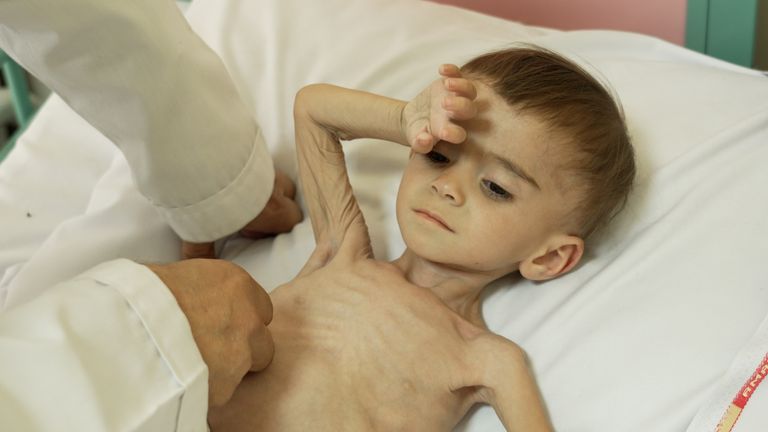
Baby Asma is malnourished
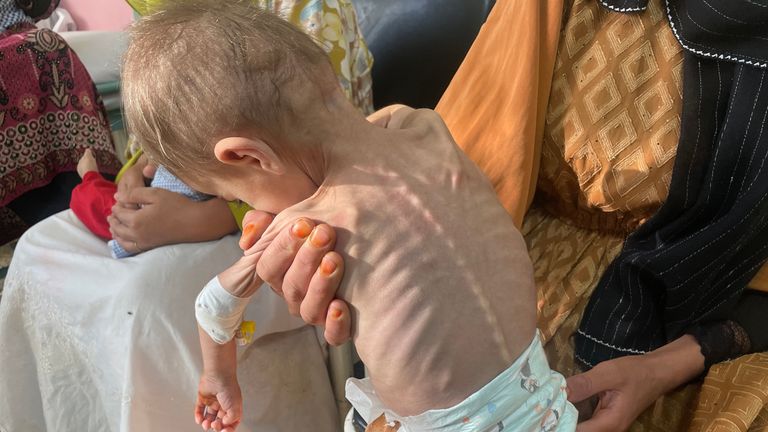
A horrifying thing to watch
Asma is 13 months old. But she weighs little over nine pounds (4kg) – less than half of what she should.
Doctors fear she might not survive the night. But she’s put on oxygen and by the morning, she thankfully starts to improve.
“I’m really afraid,” her mother Khadijah says as her eyes fill.
“Of course I’m afraid, I’ve cried so much. I’m so thankful to the doctors, they’ve kept my baby alive. I’m so grateful to them,” she says.
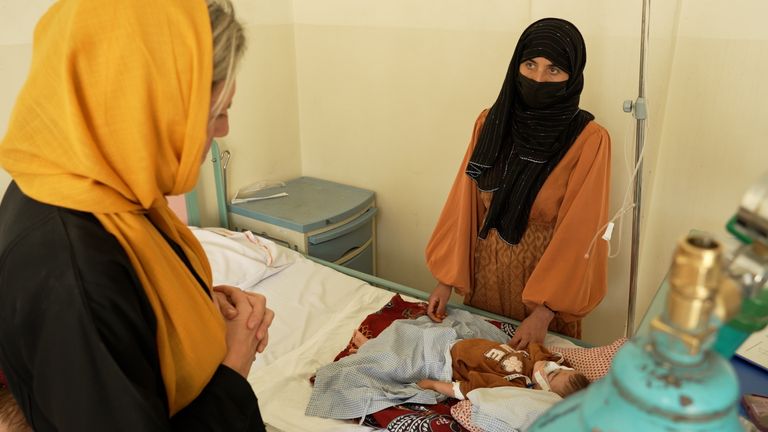
Asma’s mother says she is really afraid for her child
But it’s touch and go for her daughter, and there are long periods when her chest fails to rise and fall.
It’s a horrifying thing to watch – imagine as a parent sitting day and night, wondering whether the next breath might be her last.
There is a stream of desperate cases coming through the doors here.
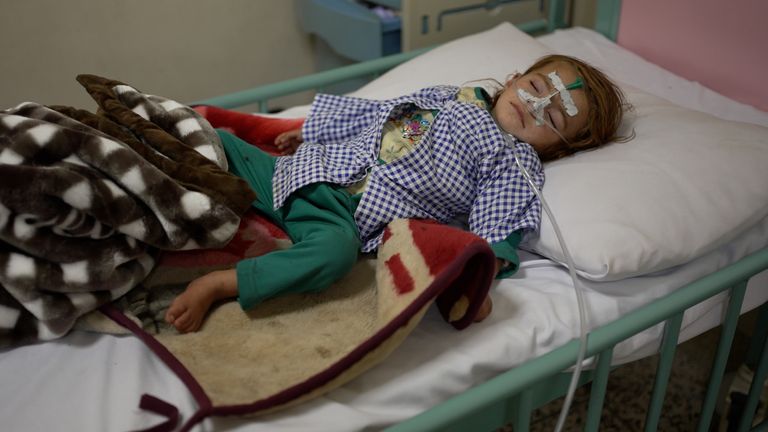
Masouda’s family travelled 13 hours to get her help
Today, there are 20 babies to just 12 beds. Sometimes, it is even more crowded.
There are suddenly two new arrivals. One of them, little Masouda. Her family travelled 13 hours to get here – spending what little they had left.
She, too, has to be quickly placed on oxygen and she’s painfully thin. Doctors tell us they fear she won’t make it.
The team are doing an incredible job during a hugely demanding time. But they need more staff, more medicine, more equipment.
Hospitals and health clinics across Afghanistan have suffered major funding cuts. The US, which was Afghanistan’s biggest aid donor, this year pulled almost all of its funding to the country. And the Taliban’s restrictions on women and girls have proved a major barrier for many international donors.
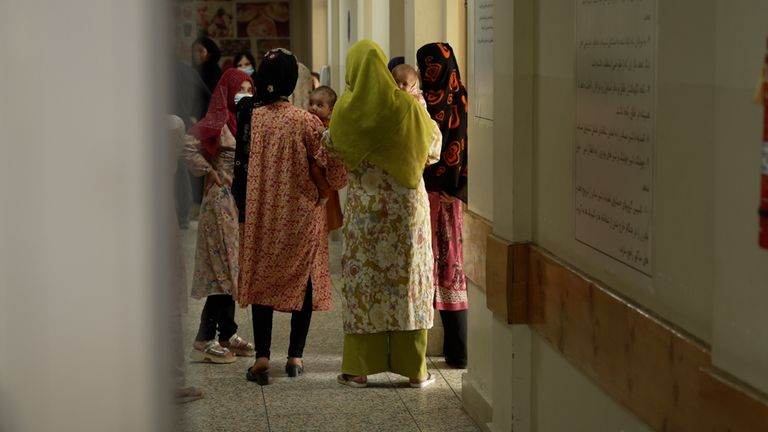
Women gather in Badakhshan Provincial Hospital in Afghanistan
It’s having a direct impact on children’s chances of survival.
Daniel Timme, chief of communication at UNICEF, said: “The nutrition situation for children in Afghanistan is very serious and the numbers speak for themselves. Over 3.5 million children under five are acutely malnourished, including 1.4 million suffering life-threatening forms of wasting.
“It must be clear to everyone: when funding drops as we are seeing it now in a context with such high levels of malnutrition, preventable child deaths rise.”
A vital lifeline
In rural areas, poverty is as extreme as the landscape, and help for families with malnourished children is getting harder to reach.
Layaba Health Clinic is a vital lifeline.
The waiting room is full of mothers looking for medical assistance for their babies. Some women here tell us the Taliban’s restrictions on them working and earning money have also played a part, making it harder for them to feed their families.
“They are to blame,” one woman says with surprising candor.
“Every girl had her own dreams. I wanted to be a doctor. I took my responsibility for my children seriously. And I wanted to support my husband too.”
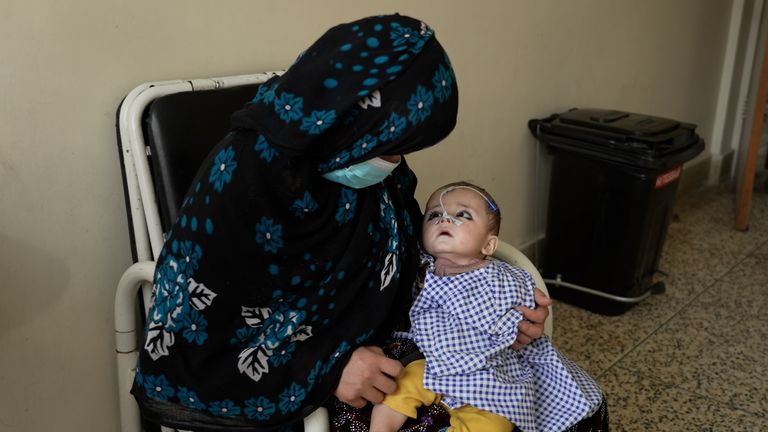
A baby looks up at her mother at Badakhshan Provincial Hospital
Another woman tells us she earned more than her husband as a teacher, but now finds herself unable to contribute financially.
The Taliban’s response
In an exclusive interview with Sky News, the Taliban’s spokesman, Zabihullah Mujahid, said the malnutrition crisis was the product of decades of conflict.
“We have had to start from zero to rebuild and restore our national resources. The Islamic Emirate is making every possible effort to address these challenges.”
Mr Mujahid said his government had a five-year plan to “tackle malnutrition, unemployment, and other pressing social issues”.
In response to the complaints of the women we spoke to, he said that men in the “vast majority” of Afghan families were the breadwinners and claimed the Islamic Emirate had made “significant efforts to promote vocational opportunities for women”.
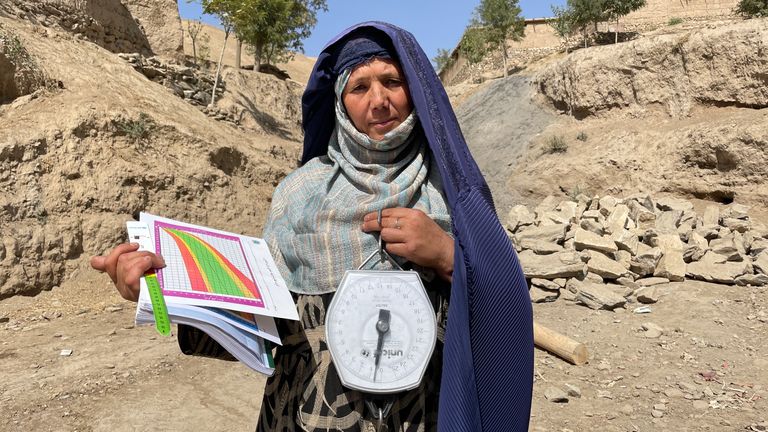
Community health worker Harira
But under the Taliban, women can no longer train to be doctors, nurses and midwives. And in remote villages, community workers like Harira are often the only lifeline – a project part-funded by UNICEF.
She goes door-to-door carrying baby scales, carrying out check-ups, trying to teach families about what to feed their children and when needed, get them to clinics and hospitals for treatment.
It saved Ramzia’s son’s life.
She had measles when she was pregnant and her son Faisal was very underweight.
“His legs and hands were as small as my fingers. Now he’s much better,” Harira says – beaming as she delights in the weight he has now put on.
“I was afraid I’d lose him,” Ramzia says. “He was so weak. But Harira came here and taught me how to feed him and give him milk when he needed it.”
Read more:
Families fear months ahead after earthquake wiped out entire villages
Taliban internet blackout has created an extreme scenario
Reeling from death, fighting for life
Keeping children alive in this climate is a battle.
Nasrullah and Jamilah, who live on the outskirts of Fayzabad, are holding their two-month-old twins.
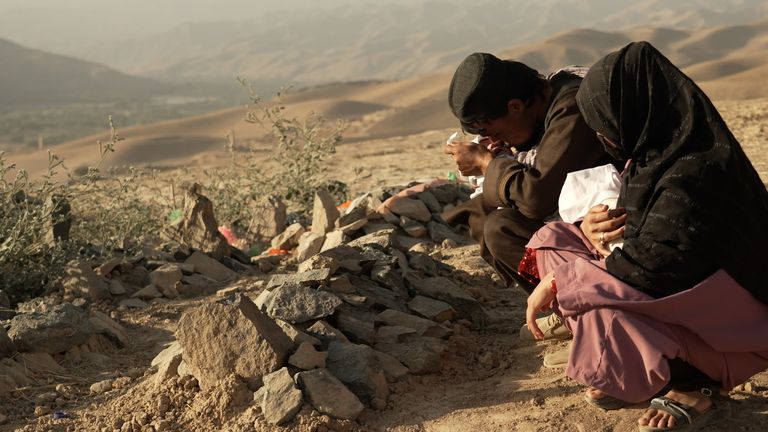
Nasrullah and Jamilah at the grave of their daughter, Shukriya
But they’re also in the throes of grief – on a journey to the grave of the baby they lost only a month ago. Her name was Shukriya. She was 18 months old.
“She was our child, we loved her. I will never forget her, so long as I’m alive. We really tried, we went to the doctors for check-ups, for ultrasounds, for blood work – we tried our very best. But none of it could save her.”
Both parents say they feared their twins could also face the same fate. Shukriya’s grave is covered with one of her babygrows. It is haunting to see. And there are other little graves next to hers.
Deaths aren’t documented in a lot of these communities. But locals tell us more and more children are dying because of malnutrition. A silent, searing loss that is spreading.
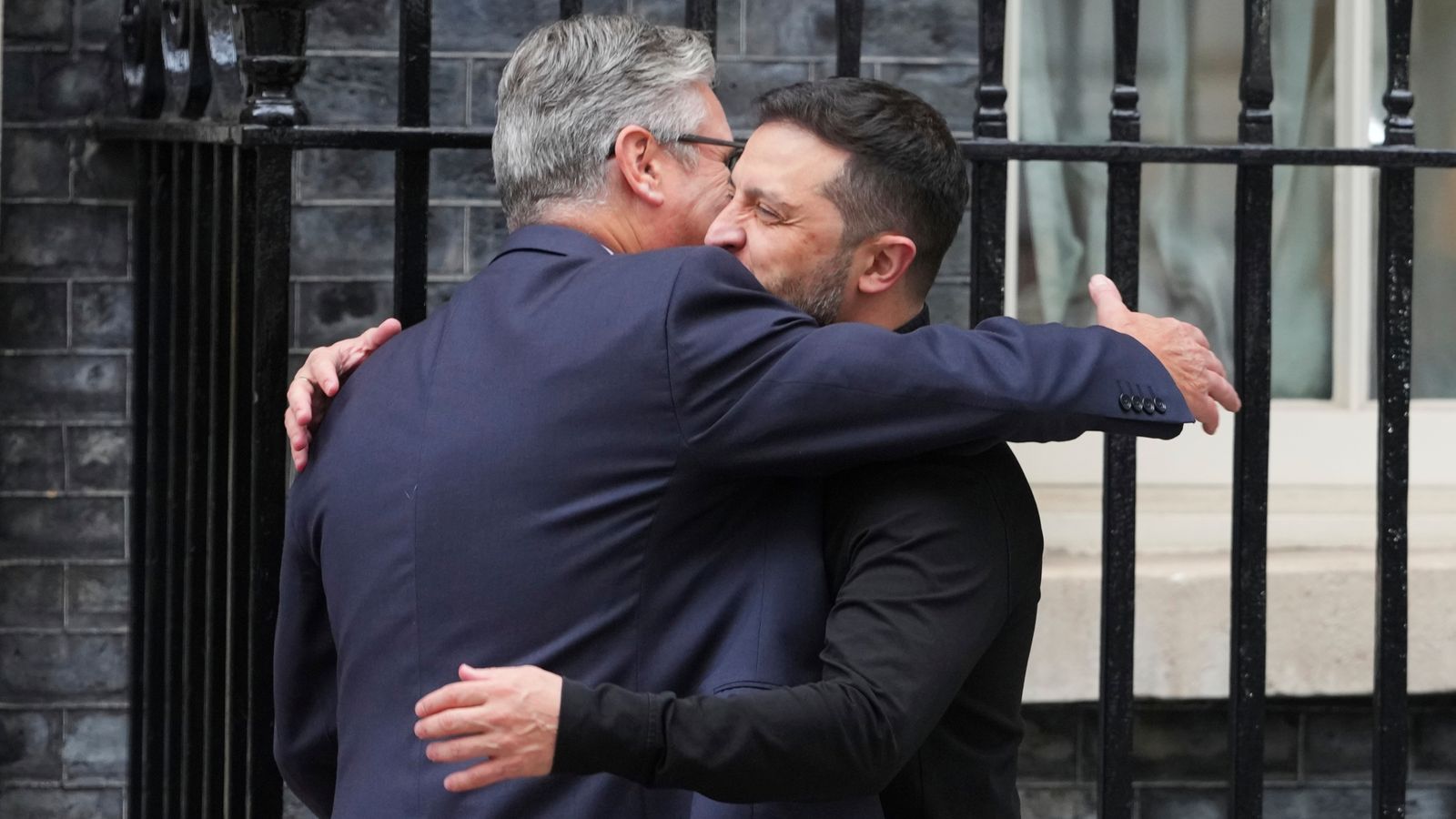
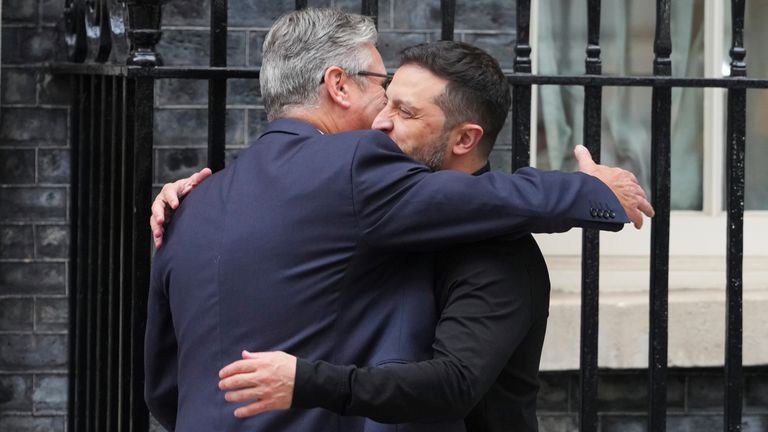
Volodymyr Zelenskyy is heading to Downing Street once again, but Prime Minister Sir Keir Starmer will be keen to make this meeting more than just a photo op.
On Monday the prime minister will welcome not only the Ukrainian president, but also E3 allies France and Germany to discuss the state of the war in Ukraine.
French President Emmanuel Macron and German Chancellor Friedrich Merz will join Sir Keir in showing solidarity and support for Ukraine and its leader, but it’s the update on the peace negotiations that will be the main focus of the meet up.
The four leaders are said to be set to not only discuss those talks between Ukraine, the US and Russia, but also to talk about next steps if a deal were to be reached and what that might look like.
Ahead of the discussions, Sir Keir spoke with the Dutch leader Dick Schoof where both leaders agreed Ukraine’s defence still needs international support, and that Ukraine’s security is vital to European security.
But while Russia’s war machine shows no signs of abating, a warm welcome and kind words won’t be enough to satisfy the embattled Ukrainian president at a time when Russian drone and missile attacks continue to bombard Kyiv.
Keir Starmer welcoming Volodymyr Zelenskyy to Downing Street during a previous visit. Pic: AP
What is the latest in negotiations?
Over the weekend, Mr Zelenskyy said he had discussed “next steps” with US President Donald Trump’s advisers and was “determined to keep working in good faith”.
“The American representatives know the basic Ukrainian positions,” Mr Zelenskyy said in his nightly video address. “The conversation was constructive, although not easy.”
But on Sunday evening, ahead of an event at the Kennedy Center, President Trump said he was “disappointed” with Mr Zelenskyy, as was asked about the next steps in Russia-Ukraine talks following negotiations.
He said: “We’ve been speaking to President Putin and we’ve been speaking to Ukrainian leaders, including Zelenskyy, President Zelenskyy.
“And I have to say that I’m a little bit disappointed that President Zelenskyy hasn’t yet read the proposal. That was as of a few hours ago.
“His people love it. But he hasn’t – Russia’s fine with it. Russia’s you know, Russia, I guess, would rather have the whole country when you think of it. But Russia is, I believe, fine with it, but I’m not sure that Zelenskyy’s fine with it. His people love it but he hasn’t read it.”
Read more:
Ukraine has become Europe’s war – so why doesn’t it act like it?
Inside a secret underground military base in eastern Ukraine
On Saturday, Keith Kellogg, Trump’s outgoing Ukraine envoy, had told the Reagan National Defence Forum that efforts to resolve the conflict were in “the last 10 metres”.
Kremlin spokesman Dmitry Peskov praised new US security strategy over the weekend, adding that Russia hopes this would lead to “further constructive cooperation with Washington on the Ukrainian settlement”.
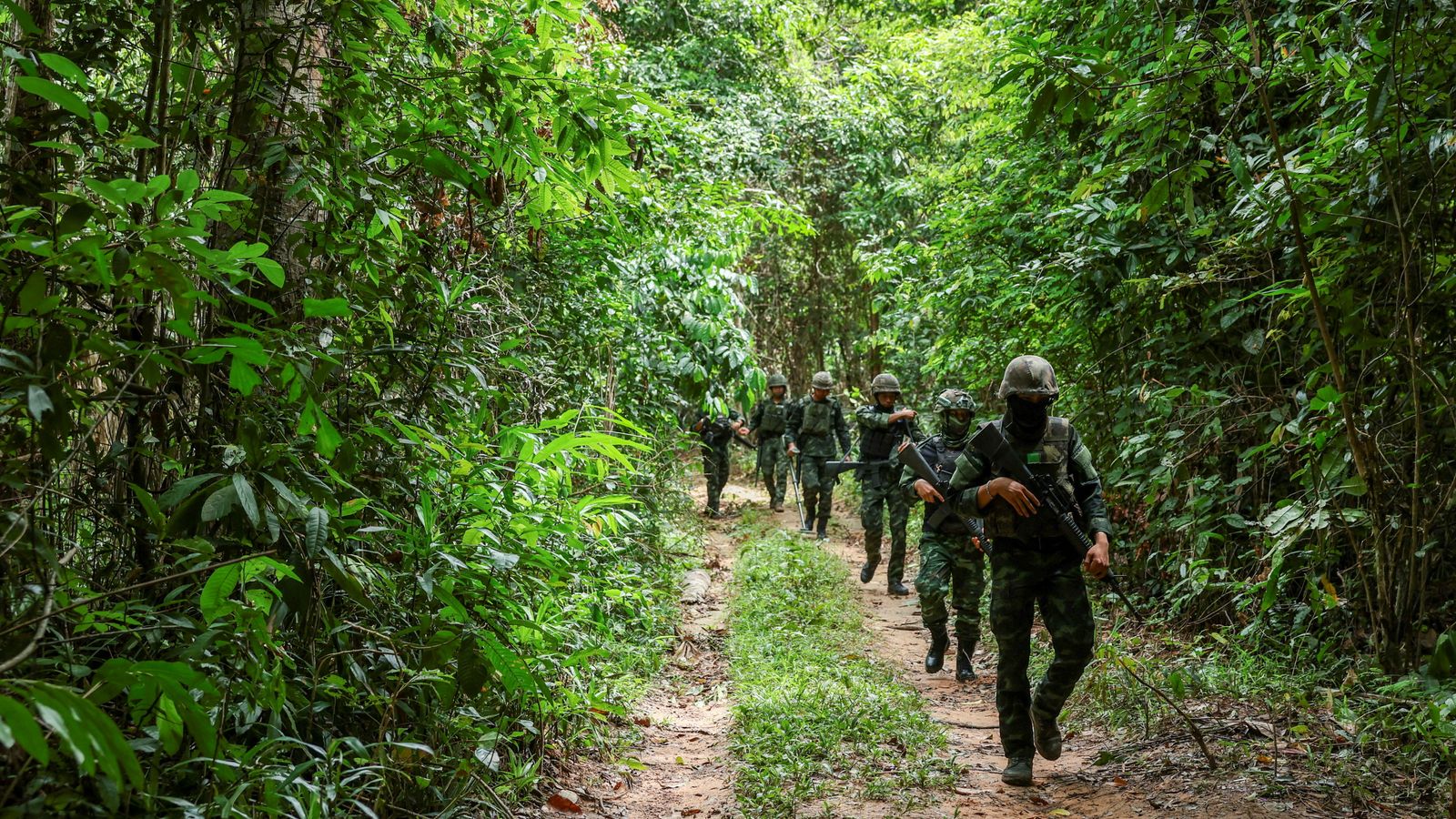
Thailand has launched airstrikes and said it has struck military targets along the border with Cambodia, as both sides accused the other of attacking first.
One Thai soldier was killed and eight others wounded, according to Thai army spokesperson Major General Winthai Suvaree, who also said Cambodian troops fired first into Thai territory.
Thailand used aircraft “to strike military targets in several areas to suppress Cambodian supporting fire attacks,” he added.
In Cambodia, Met Measpheakdey, deputy governor of Oddar Meanchey province, wrote in a Facebook post that three civilians had been seriously injured.
Cambodian officials said the Thai military attacked their troops first in Preah Vihear province.
“Cambodia urges that Thailand immediately stop all hostile activities that threaten peace and stability in the region,” said Cambodian defence ministry spokesperson Maly Socheata.
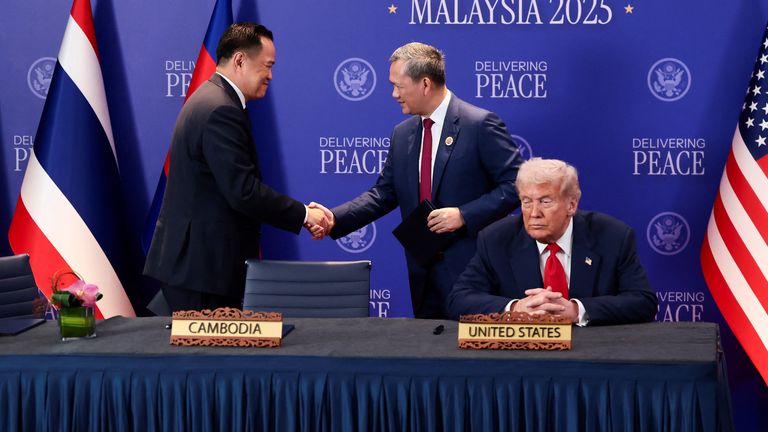
Tensions have simmered since the neighbouring countries signed a US-brokered ceasefire agreement in October, put forward by US President Donald Trump.
Thailand’s Prime Minister Anutin Charnvirakul and Cambodia’s Prime Minister Hun Manet shake hands next to US President Donald Trump in October. Pic: Reuters
Their territorial disputes led to five days of combat in July that killed dozens of soldiers and civilians.
Thai Prime Minister Anutin Charnvirakul said that military operations would be carried out as necessary to defend the country and protect public safety.
“Thailand has never wished for violence. I’d like to reiterate that Thailand has never initiated a fight or an invasion, but will never tolerate a violation of its sovereignty,” he said.
In Thailand, more than 385,000 civilians across several border districts are being evacuated, with over 35,000 already housed in temporary shelters, military officials said.
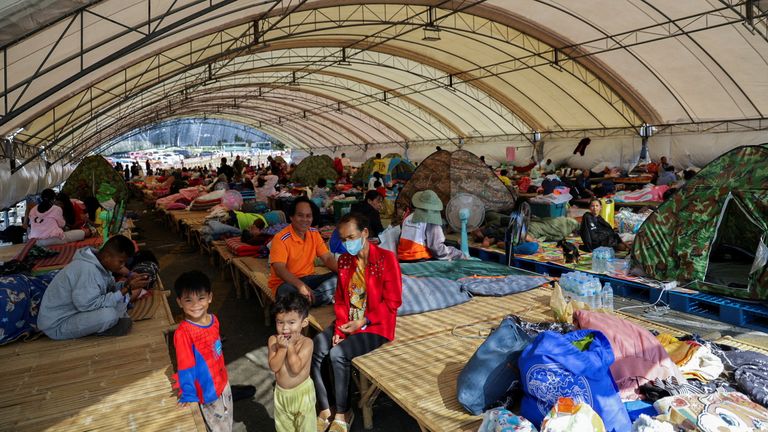
People rest at a shelter in Buriram province, Thailand, after fresh military clashes. Pic: Reuters
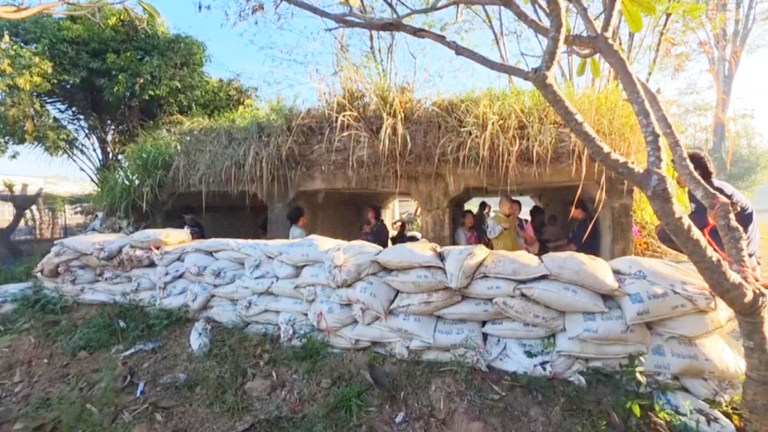
A concrete shelter in Thailand’s Ubon Ratchathani province. Pic: AP
Meanwhile, the Cambodian Education Ministry said several schools along the border had been shut.
Footage posted online showed what appeared to be students hurriedly leaving classes to meet their parents.
Malaysia’s Prime Minister Anwar Ibrahim urged Thailand and Cambodia to “exercise maximum restraint”.
In a post on social media, he added: “Our region cannot afford to see long-standing disputes slip into cycles of confrontation.”
Si Sa Ket, Surin and Ubon Ratchathani provinces in Thailand, and Cambodia’s Preah Vihear and Oddar Meanchey provinces were among the areas said to be caught up in the latest clashes.
On Sunday, both nations accused each other of opening fire along the border in what the Thai army said was an incident that lasted around 20 minutes and resulted in the injury of two of its soldiers.
But Cambodia said that the Thai side fired first and that Cambodian troops did not retaliate.
For more than a century, Thailand and Cambodia have contested sovereignty at points along their 508-mile (817km) land border.
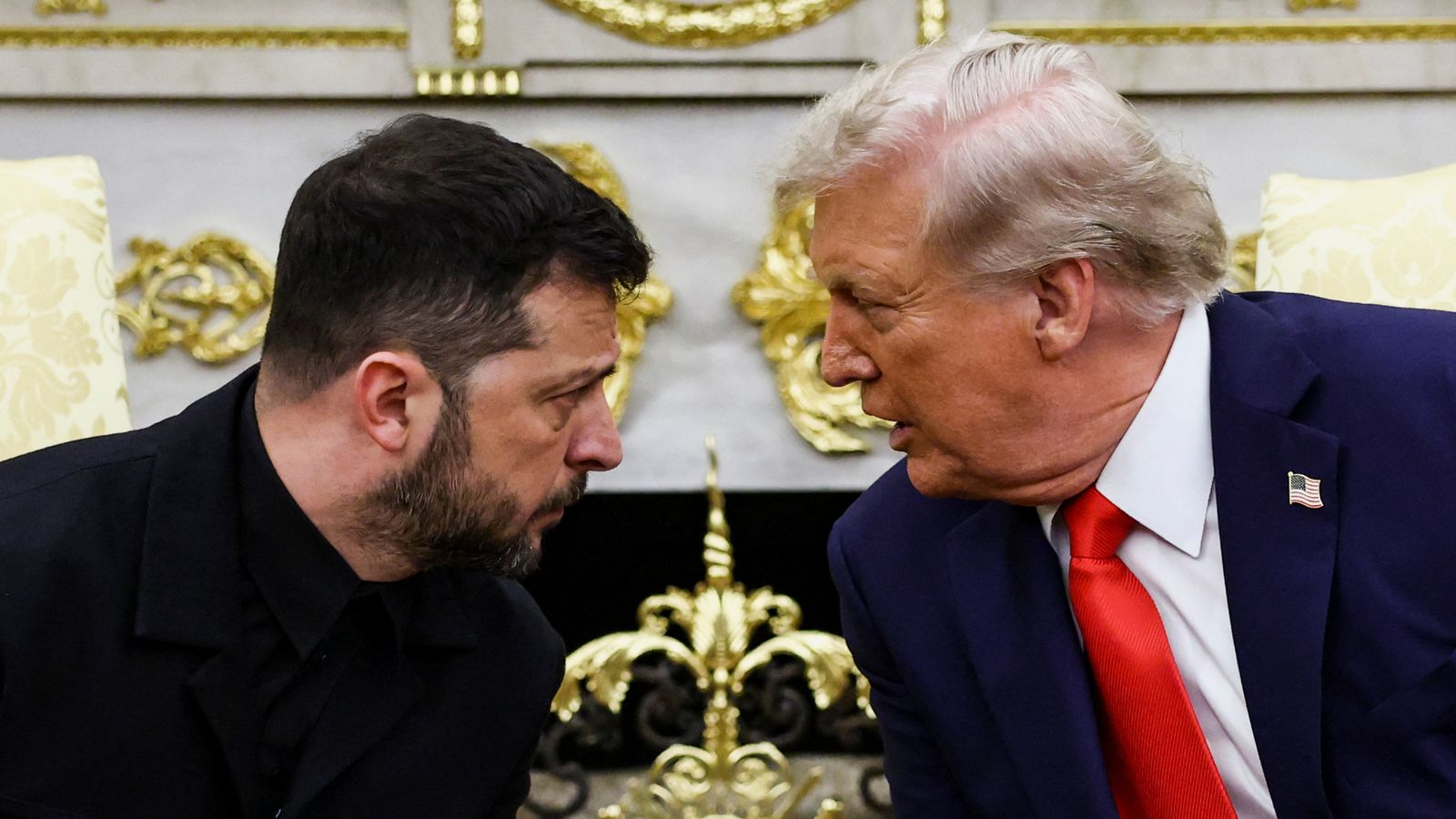
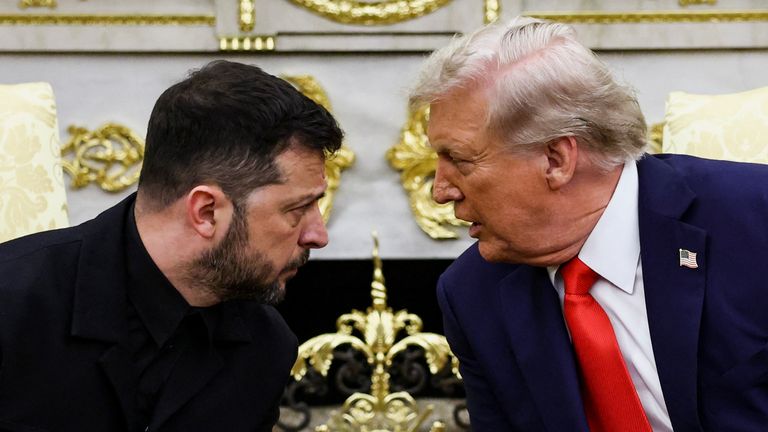
Donald Trump’s eldest son has said his father may walk away from the Ukraine peace process, claiming the issue is not a priority for Americans, and signalling Europe needs a better plan.
In a wide-ranging discussion with Sky’s lead world news presenter Yalda Hakim at Doha Forum 2025, Donald Trump Jr addressed issues including the US administration’s recent diplomatic efforts around the world.
He was speaking in his capacity as a business leader, setting out his agenda for “America first” investments in defence technology and artificial intelligence (AI), drawing a direct line between global stability and economic prosperity.
Ukraine war latest – follow live updates
Donald Trump meeting Volodymyr Zelenskyy in Washington earlier this year. Pic: Reuters
When asked directly if he believed the US president would walk away from Ukraine, he answered: “I think he may, what’s good about my father and what’s unique about my father is you don’t know what he’s going to do. He’s unpredictable.”
President Trump has led renewed efforts for a ceasefire deal with Russia in recent months.
Drawing a parallel with his father’s current “war” on drug cartels, Donald Trump Jr described gangs bringing illegal drugs into America as a “far greater clear and present danger to the US than anything [going on] in the Ukraine or Russia”.
While he said he did not believe Ukraine would be “abandoned”, he said: “The American public doesn’t have the appetite [for endless wars and further funding of Ukraine’s military efforts].”
Describing Ukraine as “a far more corrupt country than Russia”, he characterised Ukrainian President Zelenskyy as “one of the great marketeers of all time”, who he said had become “a borderline deity, especially to the left”.
He went on to describe President Trump’s approach as “common sense”.
China rivalry was the focus, but Musk got a mention

In a country and at a conference which is friendly, even admiring of the Trump administration, Don Jr was in his element.
He’s here in his capacity as a business leader, promoting his venture, 1789 Capital which claims to be focused on “America First” investments.
But he wasn’t shy about discussing his father’s foreign policy achievements, boasting that Donald Trump had resolved seven or eight wars – conflicts that most ordinary Americans were unaware of.
His pitch is bullish and direct – the current US administration is projecting strength globally, stopping wars and creating investment opportunities which serves the American economy. It’s the MAGA mentality for the global audience.
It’s clear that the rivalry with China is their biggest focus, especially finding ways to combat their dominance over critical minerals.
“America can no longer just sit there and hope that China is going to be a good actor… I think the rest of the world understands that they want America to be at the forefront of all of that.”
When I asked him about recent efforts by President Trump to bring the war in Ukraine to an end, he responded forcefully. “We want peace, we want to stop the death.”
But he went on to say that Europe needed to shoulder the burden and currently they have no plan.
As he sat on the stage in Qatar, the country which has been at the centre of the ceasefire efforts for Gaza, he expressed hope that peace would prevail, but balanced expectations America would fund its re-construction. This would have to be a global effort.
“If there’s one thing my father is, it’s a builder… I think he can be the greatest construction manager in the history of the world, but no one in America wants to bear the entire responsibility of that.”
And, away from international diplomatic efforts, he was happy to announce a breakthrough closer to home.
The “bromance” with Elon Musk and President Trump is back on – calling the entrepreneur a “generational talent, a generational level of genius”.
‘Bromance’ back on
He also confirmed that Tesla billionaire Elon Musk was “100% back in the fold”, after previously appearing to fall out with the president.
Earlier this year, Donald Trump Jr’s investment company, 1789 Capital, heavily invested in some of Musk’s companies, including SpaceX.

Elon Musk and Donald Trump in the Oval Office at the White House in May. Pic: AP
Directly comparing President Trump with Musk, he said: “Imagine dealing with one Donald Trump – now I have to deal with two.
“They’re very similar that way, so it created some headaches… but the reality is they’re both very much aligned, they’re on message with what we want to do with our country. What we want to do with freedom of speech.”
He went on: “Elon did incredible things for Twitter, really allowed the democratisation of truth and freedom and free speech to occur. That’s something that is a true threat in America right now.”
He also praised Musk as “changing the face of free speech, science and technology”, adding, “we have to protect our geniuses”.
When asked whether Mr Trump would stand for a third term, he joked that he could be “just trolling” those on the left.
He went on, “He’s the most unpredictable person, probably in the history of politics. Which is why he’s able to get something done. We’ll see.”
-
 Sports2 years ago
Story injured on diving stop, exits Red Sox game
-
 Sports3 years ago
‘Storybook stuff’: Inside the night Bryce Harper sent the Phillies to the World Series
-
 Sports2 years ago
Game 1 of WS least-watched in recorded history
-
 Sports3 years ago
Button battles heat exhaustion in NASCAR debut
-
 Sports3 years ago
MLB Rank 2023: Ranking baseball’s top 100 players
-
Sports4 years ago
Team Europe easily wins 4th straight Laver Cup
-
 Environment3 years ago
Japan and South Korea have a lot at stake in a free and open South China Sea
-
 Environment1 year ago
Here are the best electric bikes you can buy at every price level in October 2024