
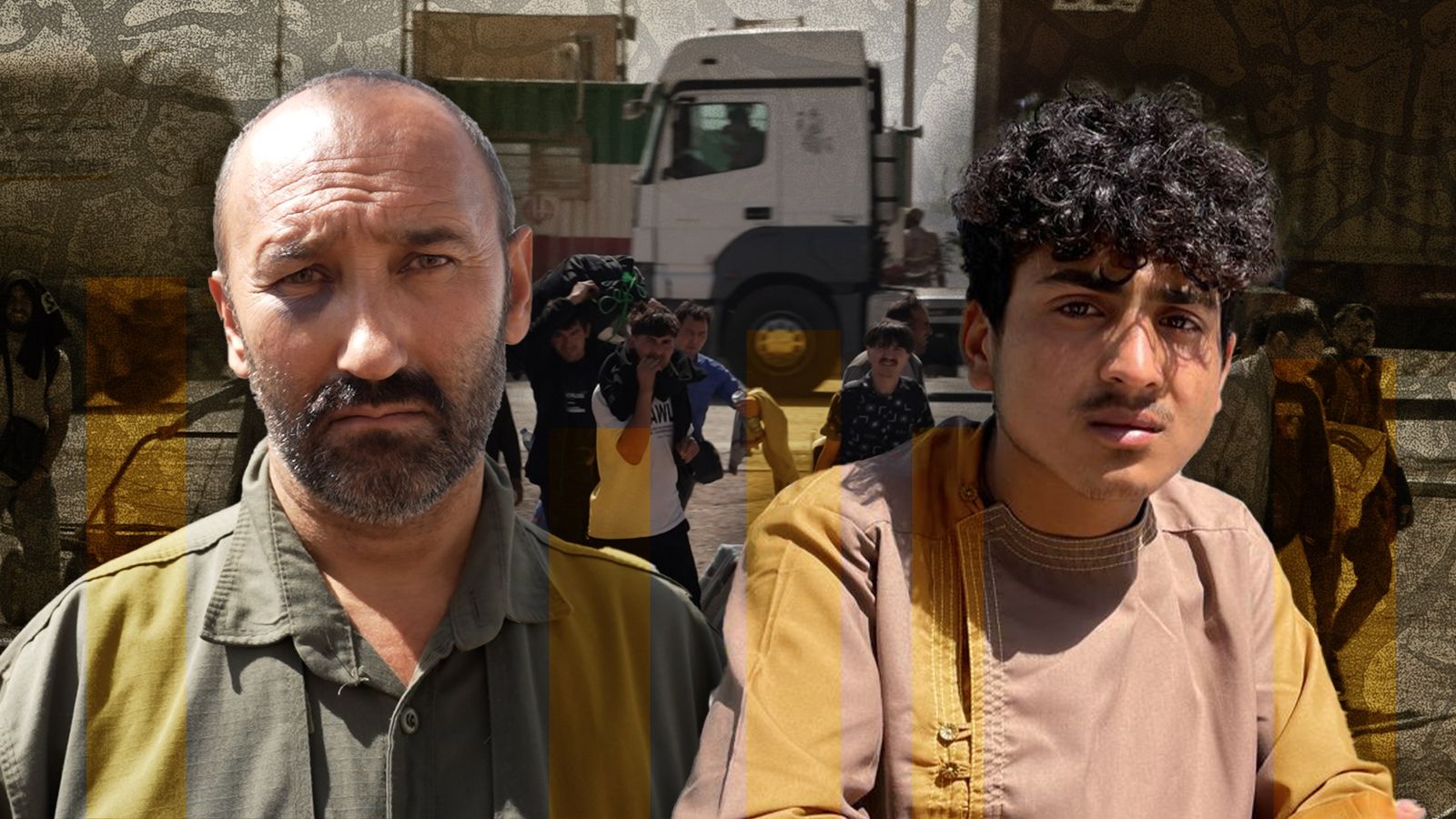
‘Beaten for 16 days’: Deported Afghans describe brutal treatment by Iran – yet are desperate to return

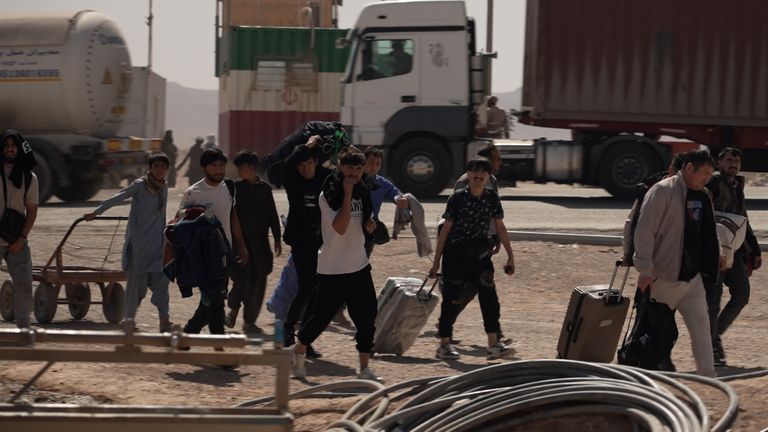
It’s dusty, sweltering, crowded. Waves of people start to arrive.
Some have suitcases. Many, just the clothes on their backs. There are some walking alone, others in groups or with their families.
Nearly all look exhausted, bewildered, worried.
People cross the border with their belongings
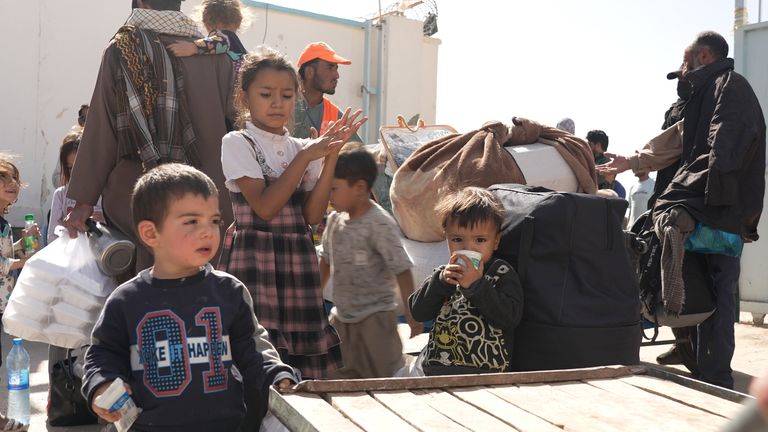
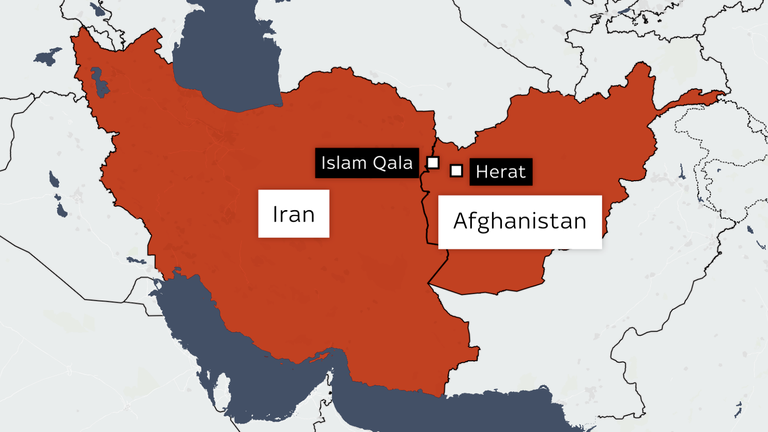
We’re at Islam Qala in Afghanistan, on the border with Iran. The people we’re seeing crossing over are some of the 1.3 million Afghans who Iran has deported this year.
Many left their homeland for economic survival. Now they’re being forced back to where they started, full of anxiety and some, with stories of violent arrests.
Rohullah Mohammadi stands out. He’s wearing a smart blue suit and loafers. He has a youthful but serious face. He looks ready for a business meeting, not a sandy border crossing.
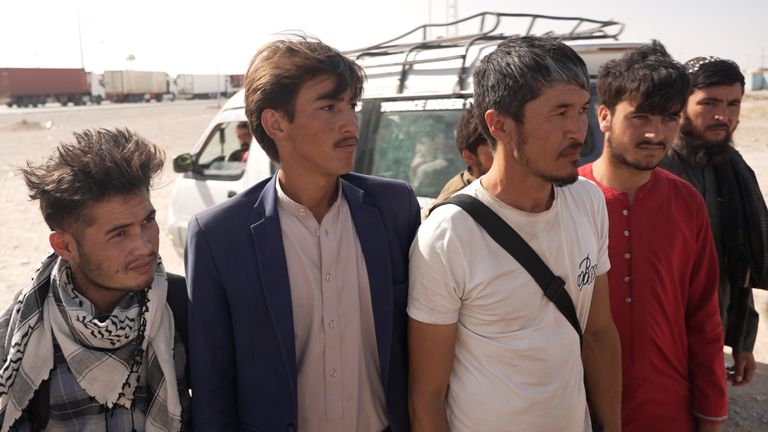
Rohullah Mohammadi, in the blue suit, says he was sent back to Afghanistan
He went to Iran to build a better life and earn money to send back to his struggling family. But like many we meet, he crossed illegally, living undocumented in Iran until the police caught up with him.
“They took everything I had and sent me back to Afghanistan,” he says.
“They even beat me. They injured my ear. Is this how Islam is supposed to be practised?”
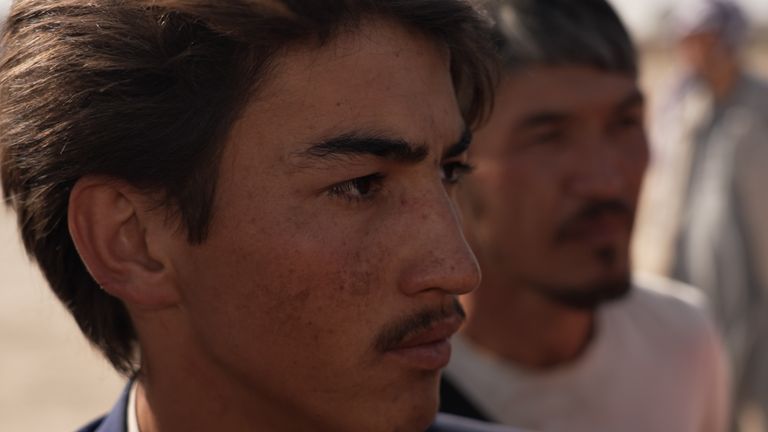
Rohullah says he was beaten
At its peak, as many as 28,000 people have come through this border crossing in just a single day.
Some manage to stay for a day or two, helped by the UN alongside the Taliban authorities.
But the pressure of returning to the difficult life you left, and working out how you’ll survive going forward, quickly hits people.
‘Never paid’
In a tent for families, we meet Fatimah. She says she took her children to Iran to escape poverty.
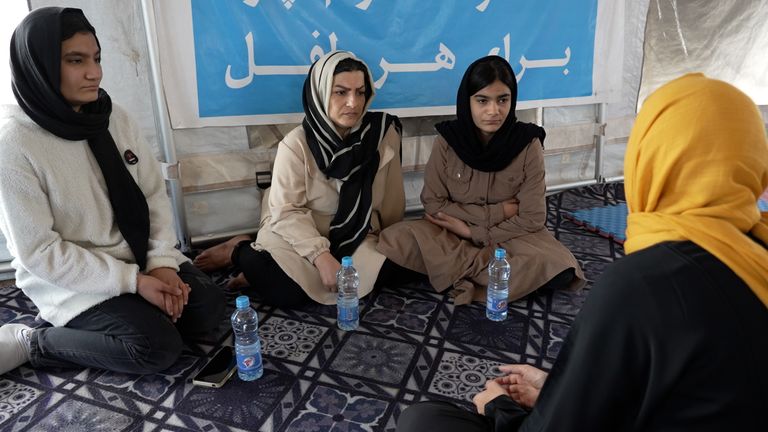
Fatimah (centre) speaks to Sky’s Cordelia Lynch
“My two daughters worked from six in the morning until 8.30 at night,” she recalls, wiping tears from her eyes.
“But they were never paid. The Iranians didn’t give them any money.”
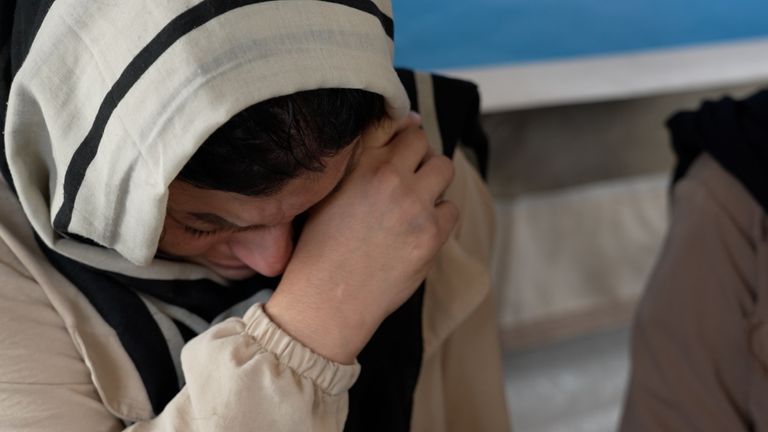
Fatimah breaks down in tears
’16 days beaten in detention’
Lots of children we meet are alone. They all say they were smuggled into Iran, taking on debt owed to the traffickers.
At just 15, baby-faced Tahir says he’s the breadwinner for his six siblings and two parents.
He tells us he’s just spent 16 days being beaten in a detention centre. And yet he is already feeling compelled to return to Iran – feeling the weight of responsibility for his family.
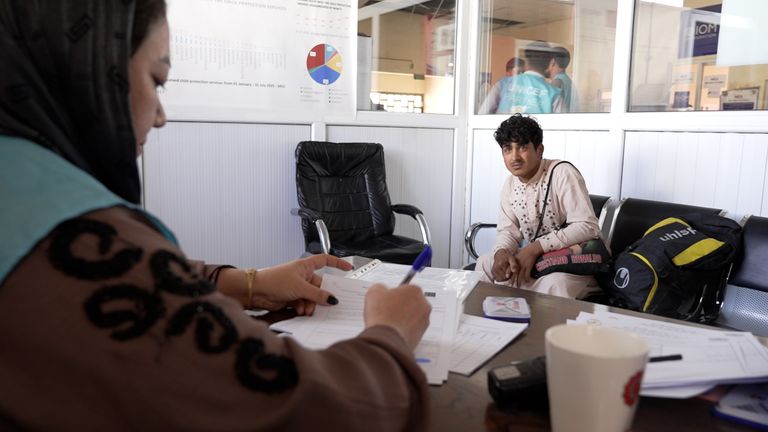
Tahir is the breadwinner for his six siblings and parents
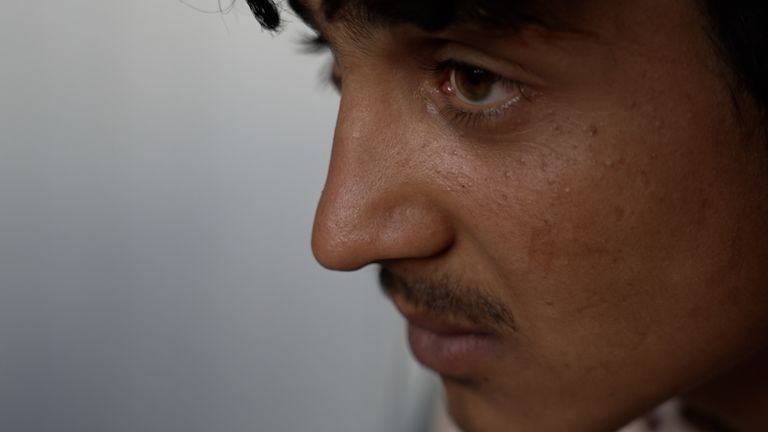
“I love my homeland Afghanistan deeply and I am even ready to sacrifice my life for it,” he says.
“But if there is no work here, how can I survive? I have a family, and they have expectations of me. I must work.”
In a room close by, we meet 15 others like him. A whole room of unaccompanied boys who have crossed the border.
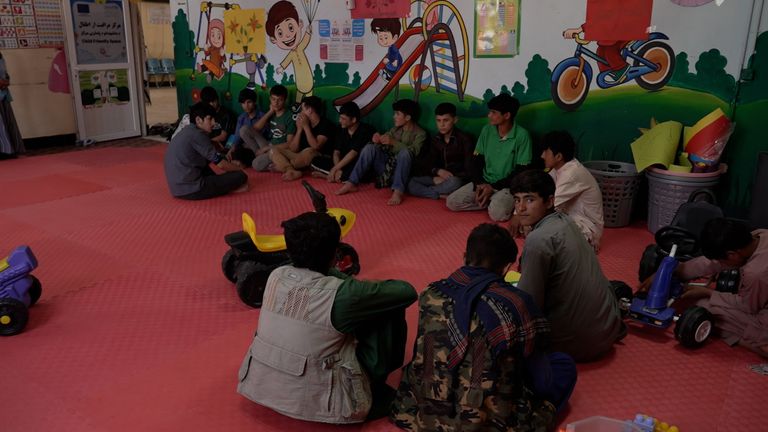
A room of boys who have crossed the border
The UN is moving them to the nearby city of Herat, where they will stay for a night before being reunited with their families across Afghanistan.
We join them on the journey. Most are strangers to each other.
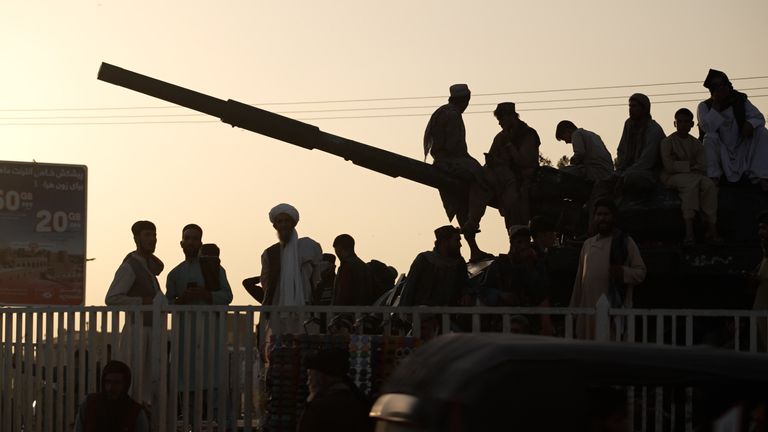
Afghans deported from Iran first move to the city of Herat
‘Kicked on concrete floor’
For Tahir, it’s a soft landing, but a hard adjustment. He looks disorientated as he watches some of the others play football.
He says he can’t stop thinking about the brutal detention centre he’s just left.
“They would force us to lie down on the concrete floor and kick us,” he says.
“In the detention rooms, if someone spoke up they would be forced to lie on the ground. If they protested, they would be sent to a dark solitary cell.”
Read more:
Families’ fears after quake wiped out entire villages
Malnourished children fill this hospital
Taliban ‘will never hand over air base to US’
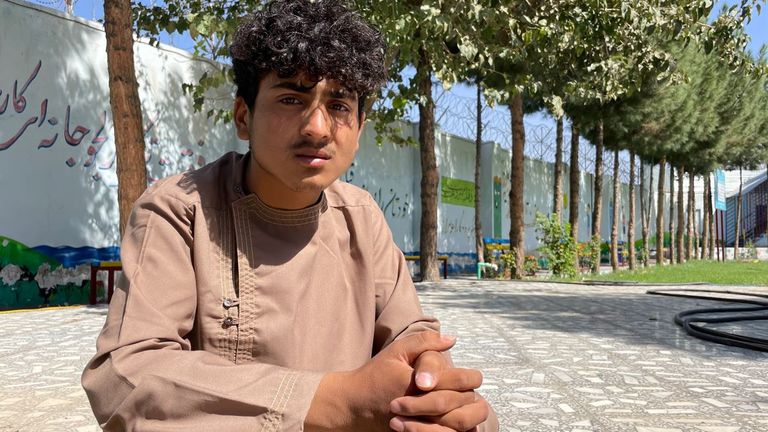
Tahir is already making plans to return to Iran
What is shocking to learn is that nearly every single one of the boys we met says they were smuggled to Iran by traffickers – and nearly every single one says they were beaten in detention.
But Tahir is already making plans to return to Iran. He doesn’t think he has a choice.
“I would rather kill myself than see my father begging for money for his hungry children,” he says. “I couldn’t bear it.”
Tahir is one of millions caught up in Iran’s crackdown on illegal immigrants. Authorities there set a deadline in September for all undocumented Afghans to leave.
But human rights groups say those living legally in Iran have also been swept up in deportations, and that the numbers crossing have pushed Afghanistan to breaking point.
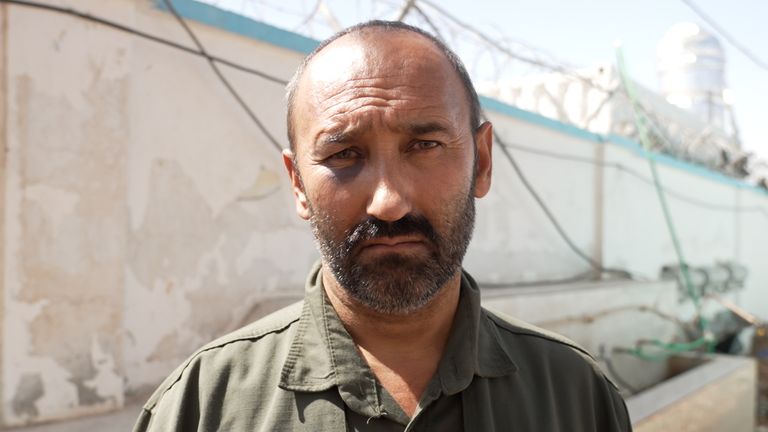
Gholam Ali shows us his black eye, which he says Iranian police gave him
The country is also being squeezed on its eastern border – Pakistan too has deported tens of thousands of Afghans this year.
We asked the Iranian government about the allegations made by the Afghans we met, including Tahir, but it did not respond to our request for comment.
Girls fleeing Taliban restrictions
Other expelled Afghans we meet fled for an education – girls who were no longer able to attend secondary schools in Afghanistan.
We speak to one mother recently forced to return – struggling with the fact she’s now back.
“Every day brought a new restriction, a new policy aimed at preventing women from working,” she says.
“There was the compulsory niqab, and also limitations on education for women and girls.”
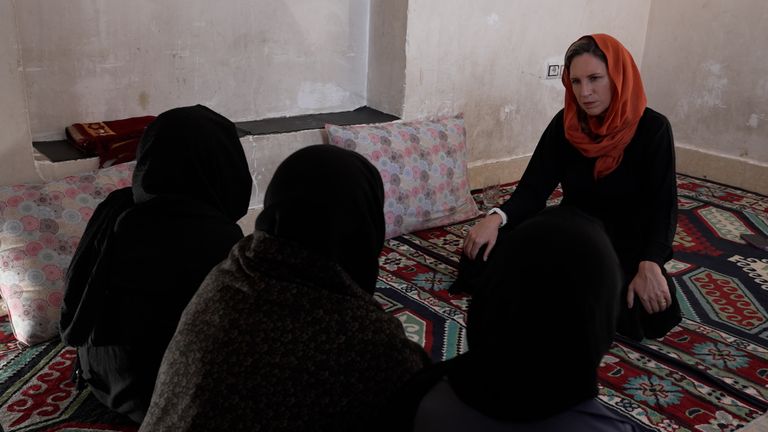
A mother speaks to Sky News with her daughter and niece
She seems overwhelmed. “When you see the future of your daughter, of your children, slipping away day by day, it’s devastating,” she adds.
Her daughter tells me she used to love reciting poetry. But when the Taliban returned to her city, she was forced to stop.
Bittersweet family reunion
Tahir hasn’t seen his family for two years, and it’s a bittersweet return.
His siblings rush out of the house to greet him. His mother cries as she embraces him.
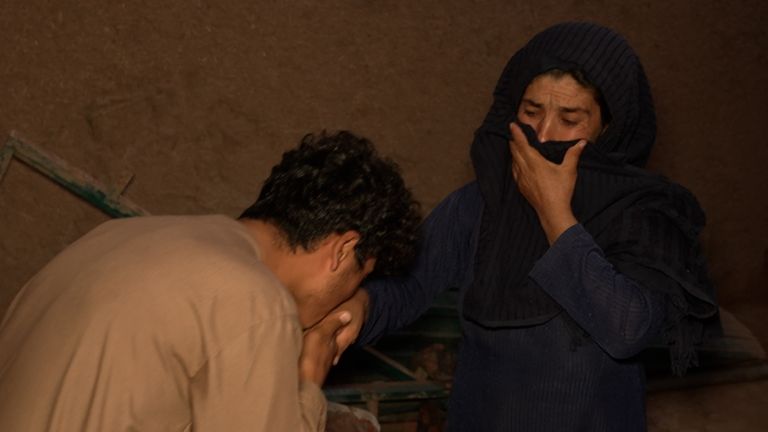
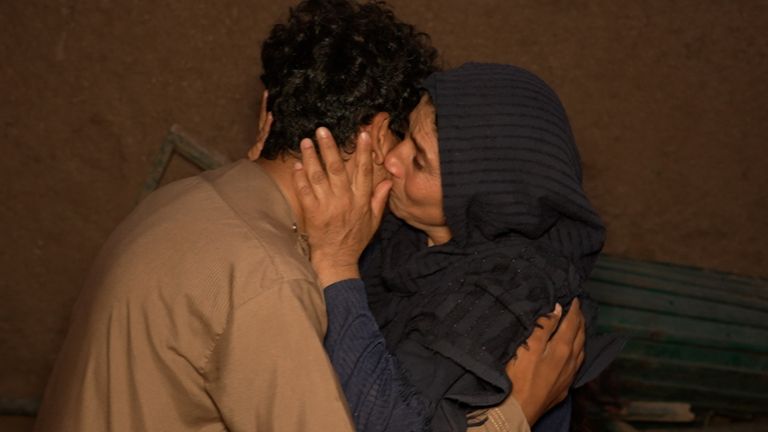
Tahir’s mother embraces him on his return
The living room is packed with the siblings he’s been financially supporting. They’re a wonderful, kind and close family.
His mother Gulghoty sobs as she explains why she had to let him go and likely will again.
“Life here was very hard for him,” she says.
“We have a delivery cart but with that alone he could not pay for himself and take care of me. He needs a stable life and a future.”
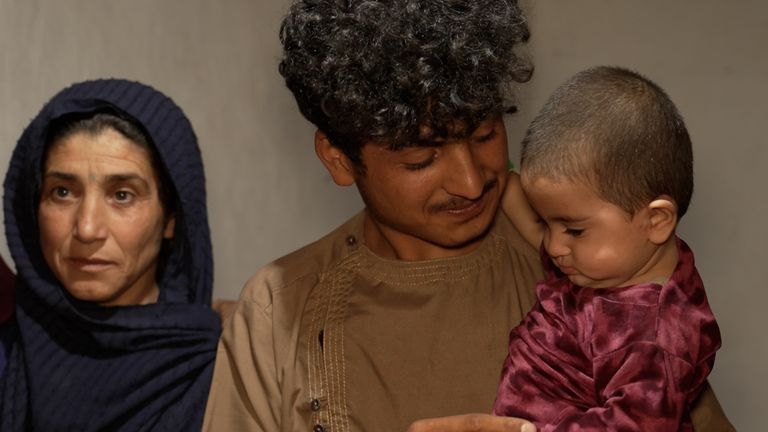
Tahir is reunited with his one-year-old sister Sana
Tahir says, with sobering pragmatism, that he must go back to Iran and “endure the oppression” to save his family.
It’s a dynamic playing out across Afghanistan. Huge burdens on young shoulders and a country unable to share the load.
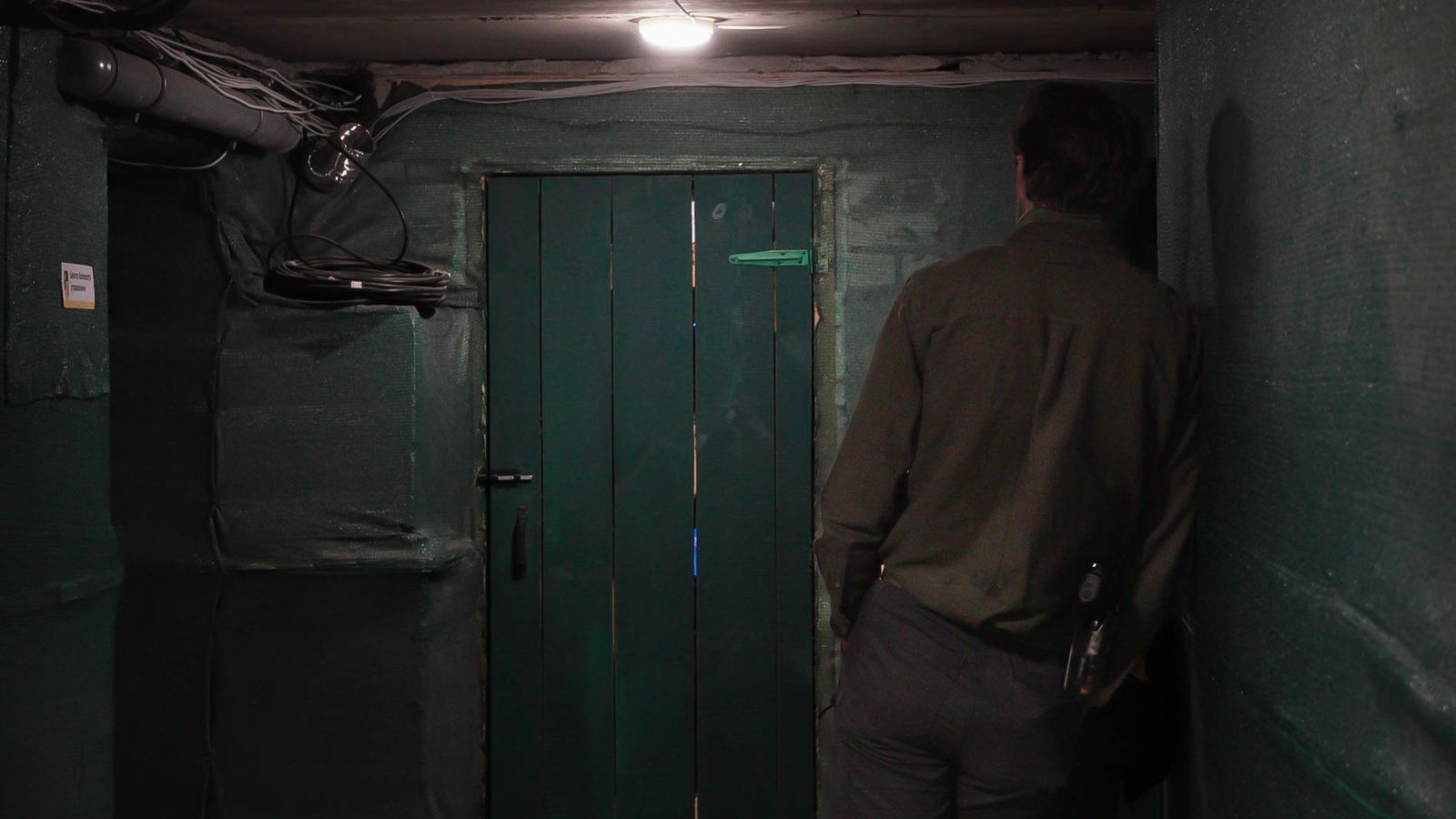

A hidden, underground military base in eastern Ukraine is so secret, soldiers change into civilian clothes whenever they step outside to avoid drawing attention.
Journalists are not usually allowed access.
But the unit that has been using this vast, subterranean warren of war rooms, a dormitory, kitchen, canteen and makeshift gym as its headquarters since the summer is imminently relocating, so Sky News was invited inside.
Lieutenant Colonel Arsen Dimitric – call sign Lemko – is the chief of staff of 1st Corps Azov of the National Guard of Ukraine, one of the country’s most effective combat forces.
Lemko
He sat with us in the base, next to a large square table, covered by a map of the Donbas region.
His soldiers have been fighting in this area since the summer, countering a surge in Russian attacks in and around the frontline city of Pokrovsk.
“We aim to destroy as much of the enemy as possible,” he said.
“Will we take losses? Yes. Will it hurt? Absolutely.”
But he said if Russia is allowed to advance, even more Ukrainians will suffer.
“Their [the Russians’] only advantage is numbers,” he said.
“They don’t care how many people they lose.”
Lemko said almost 17,000 Russian soldiers had been killed or wounded fighting in this section of the warzone alone between August to November.
Read more:
Russia hits Ukraine with massive missile and drone attack

Ukrainian video footage of the battlefield showed Russian armoured vehicles being taken out by drones and artillery fire.
At one point, Russian soldiers mounted on motorbikes try to advance, only to be stopped by Ukrainian fire.
“Our task is to hit them as hard as possible in various areas,” Lemko said. “We focus on our operations, others on theirs, and leadership will negotiate the best possible terms.”
The Azov Corps soldiers are fighting over land that should be handed over to Russia, according to an initial draft of a peace deal proposal between Kyiv and Moscow put forward by the United States. This is despite swathes of the Donbas remaining under Ukrainian control.
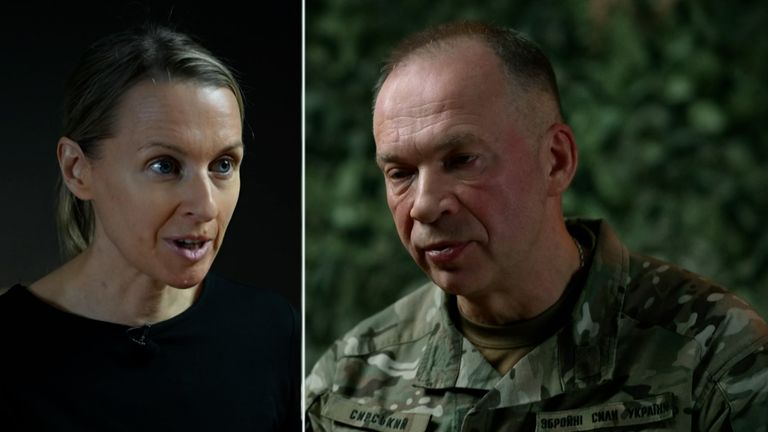
But General Oleksandr Syrskyi, the head of the Ukrainian armed forces, has since told Sky News that simply surrendering territory would be “unacceptable”.
Giving up territory ‘unacceptable’, Ukraine’s military chief says
For Lemko, he says the job of his troops is to inflict as much damage as possible on the Russian side to help strengthen Ukraine’s hand in negotiations.
“Simply giving it [land] away isn’t the way,” he said.
“Diplomats do their work, we do ours. Our job as soldiers is to give as many advantages as possible to our negotiating team. And we’re doing exactly that.”
Lemko, who has been battling against Russia since the Crimean annexation in 2014, also had a warning for the rest of Europe about a rise in hybrid attacks, such as mysterious drone sightings, acts of sabotage and cyber hacks suspected of being linked to Moscow.
He said Ukraine’s experience showed that if attacks by Russia that fall under the threshold of conventional war are not successfully countered, full-scale conflict could follow.
“Ukraine once lost a hybrid war that had been waged since the very start of our independence,” he said.
“Because of that defeat, there was a physical operation against us in Crimea and then a physical operation in 2022.
“Now the hybrid war has reached its climax, and it is moving into the Baltic States and Europe.
“That is why, in my opinion – and in the opinion of most of our officers – now is the moment for all countries to unite and counter this hybrid war. Because the consequence may be a physical one.”
Production: Katy Scholes, security and defence producer, and Azad Safarov, Ukraine producer.
Camera operator: Mostyn Pryce
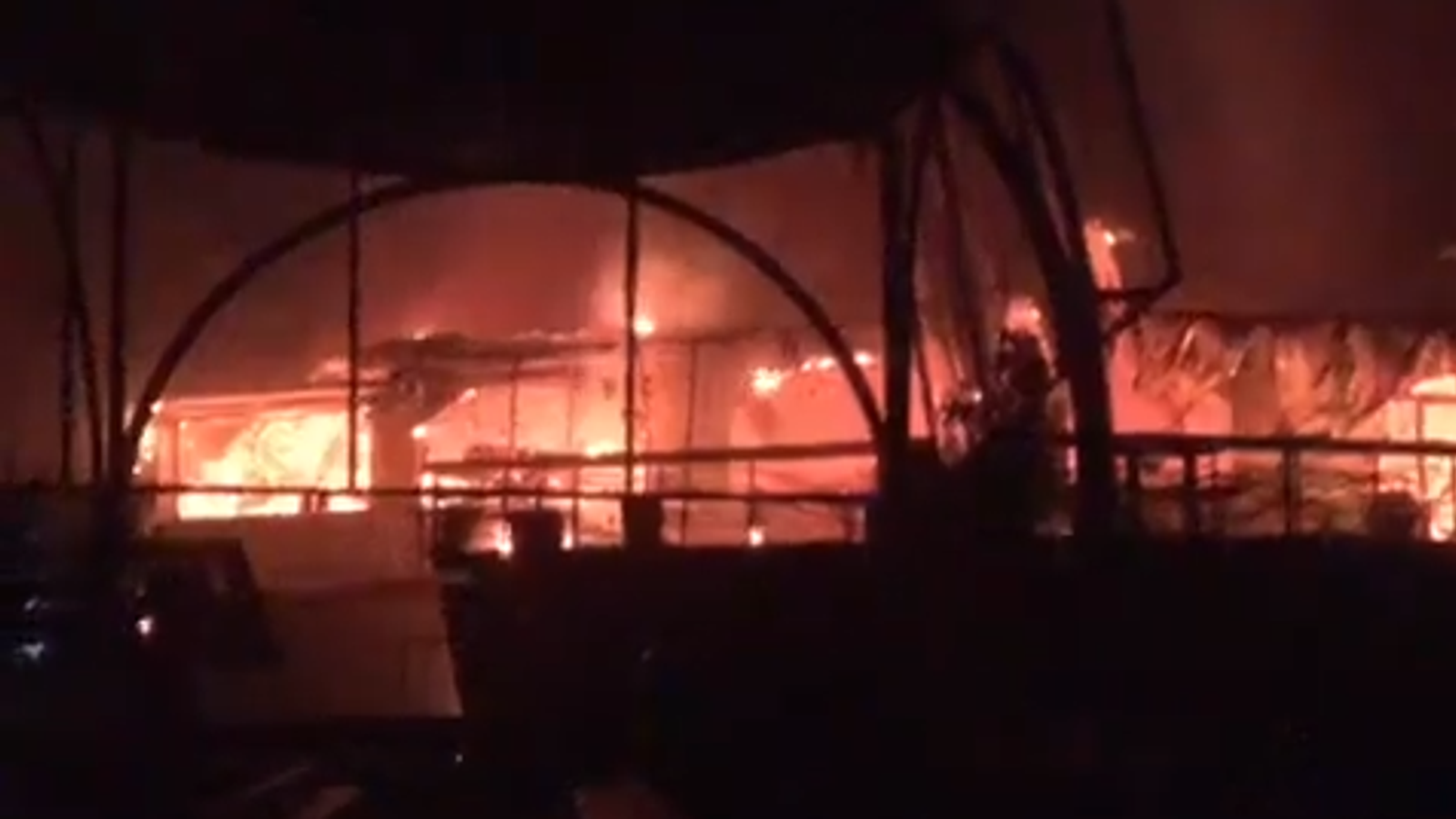

At least 25 people have been killed after a fire at a nightclub in Goa, the state’s police service has said.
The fire reportedly started around midnight on Saturday local time.
The majority of victims were kitchen staff at the club – although around three to four tourists are thought to be among those killed.
Videos on social media showed emergency services lining up to help the injured – some of whom were taken to nearby hospitals.
Dr Pramod Sawant, Goa’s chief minister, said: “I am deeply grieved and offer my heartfelt condolences to all the bereaved families in this hour of unimaginable loss.”
He later said he was “closely reviewing the situation arising from the tragic fire” – adding six additional people had been injured.
“All six injured persons are in a stable condition and are receiving the best medical care,” he said.
Pic: NDTV
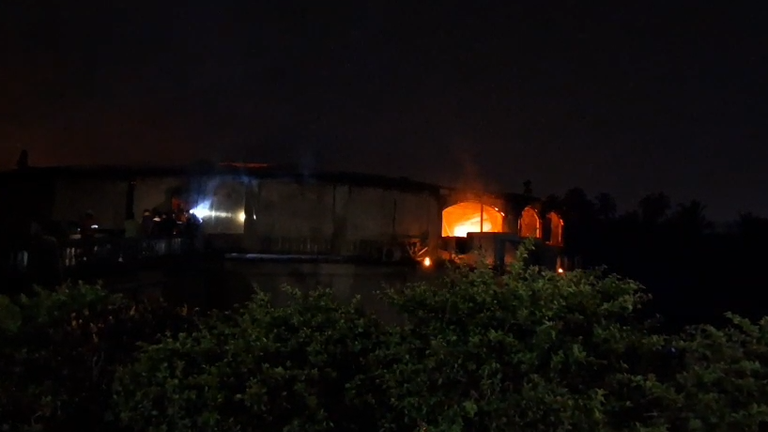
Fire at nightclub in Goa. Pic: NDTV
Authorities worked through the night to bring the situation under control and all bodies have been recovered, the state’s police chief told reporters, according to Reuters news agency.
India’s Prime Minister Narendra Modi said the deadly fire was “deeply saddening”.
He said he had spoken with Goa’s chief minister and that “the state government is providing all possible assistance to those affected”.
Dr Sawant said he has “ordered an inquiry” to discover what happened after visiting the site.
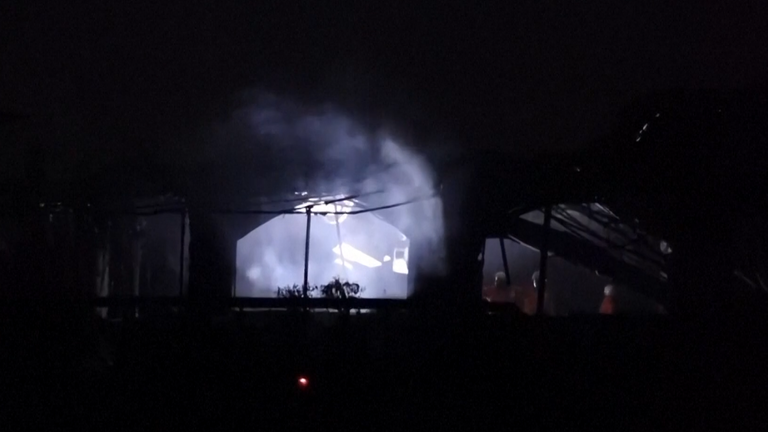
Pic: AP
“The inquiry will examine the exact cause of the fire and whether fire safety norms and building rules were followed,” he said.
“Those found responsible will face most stringent action under the law – any negligence will be dealt with firmly.”
Goa, a small state on India’s western coast, is a popular tourist destination, attracting millions of tourists every year.
Russia launched a massive missile and drone attack on Ukraine overnight, after US and Ukrainian officials said they would meet for a third day of talks aimed at bringing the war to an end.
The two sides said they had made progress on a security framework for post-war Ukraine, but that any “real progress toward any agreement” will depend “on Russia’s readiness to show serious commitment to long-term peace.”
Russia launched 653 drones and 51 missiles in its attack on Ukraine, triggering air raid alerts across the country, Ukraine’s air force said.
Giving up territory ‘unacceptable’ – Ukraine’s military chief
Ukrainian forces shot down and neutralised 585 drones and 30 missiles, the air force said, adding that 29 locations were struck.
At least eight people were wounded in the attacks, Ukraine’s minister of internal affairs Ihor Klymenko said.
Russia conducted a “massive missile-drone attack” on power stations and other energy infrastructure in several regions, Ukraine’s national energy operator Ukrenergo said on Instagram.
Ukraine’s Zaporizhzhia nuclear power plant temporarily lost all off-site power overnight, the International Atomic Energy Agency said.
The plant is in an area that has been under Russian control since early in Moscow’s invasion of Ukraine. It is not in service, but needs reliable power to cool its six shutdown reactors and spent fuel in order to avoid any catastrophic nuclear incidents.
Read more from Sky News:
Young Germans fear return to conscription
Giving up territory would be ‘unjust’, says Kyiv armed forces chief

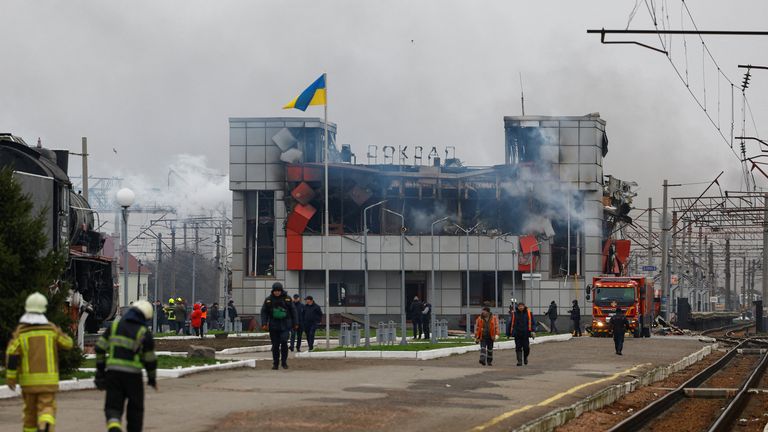
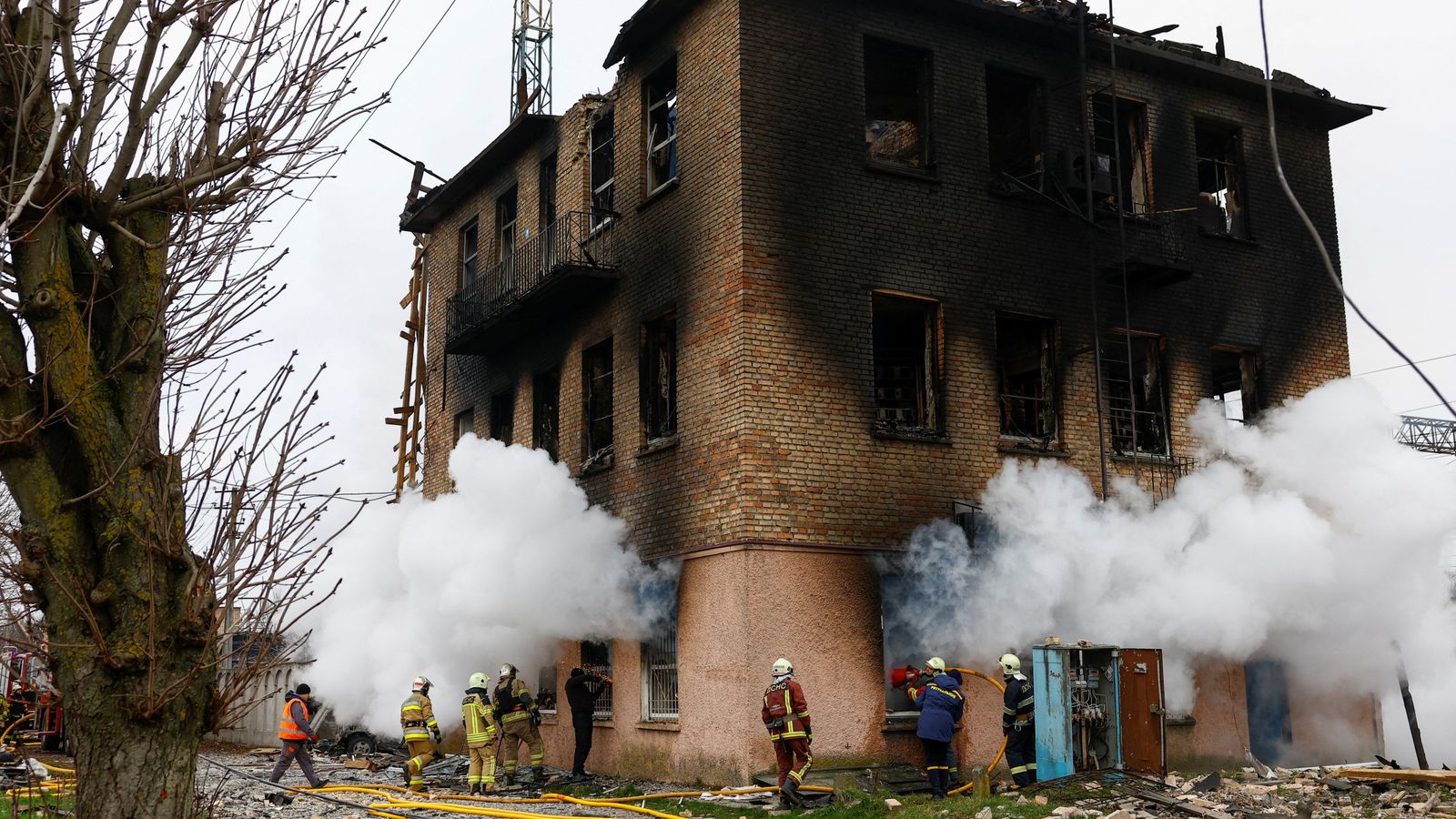
Russia struke a train station in the city of Fastiv. Pics: Reuters
Zelenskyy condemns ‘meaningless’ strikes
Ukrainian President Volodymyr Zelenskyy condemned the strikes as “meaningless” from a military point of view.
He said energy facilities were the main targets, but a drone strike had “burned down” a train station in the city of Fastiv, in the Kyiv region.
“The Russians’ goal is to hurt millions of Ukrainians, and they have sunk so low that they are launching missiles at peaceful cities on St. Nicholas Day,” he said.
“That is why additional pressure is needed. Sanctions must work, and so must our air defence, which means we must continue to support those who defend our lives.”
Ukraine strikes oil refinery
Meanwhile, Russia’s defence ministry said its air defences had shot down 116 Ukrainian drones over Russian territory overnight.
The General Staff of the Ukrainian Armed Forces said Ukrainian forces had struck Russia’s Ryazan Oil Refinery, while Russian Telegram news channel Astra shared footage appearing to show a fire breaking out and plumes of smoke rising above the refinery.
Over the last few months, Ukraine has used long-range drones to target Russian refineries in an attempt to deprive Moscow of the oil export revenue it needs to continue the war.
Meanwhile, Kyiv and its Western allies say Russia is trying to cripple Ukraine’s power grid and deny civilians access to heat, light and running water in winter, which Ukrainian officials call “weaponising” the cold.
On Monday, Mr Zelenskyy will meet Sir Keir Starmer in London to discuss the ongoing negotiations mediated by the US, along with French President Emmanuel Macron and German Chancellor Friedrich Merz.
-
 Sports2 years ago
Story injured on diving stop, exits Red Sox game
-
 Sports3 years ago
‘Storybook stuff’: Inside the night Bryce Harper sent the Phillies to the World Series
-
 Sports2 years ago
Game 1 of WS least-watched in recorded history
-
 Sports3 years ago
Button battles heat exhaustion in NASCAR debut
-
 Sports3 years ago
MLB Rank 2023: Ranking baseball’s top 100 players
-
Sports4 years ago
Team Europe easily wins 4th straight Laver Cup
-
 Environment3 years ago
Japan and South Korea have a lot at stake in a free and open South China Sea
-
 Environment1 year ago
Here are the best electric bikes you can buy at every price level in October 2024