
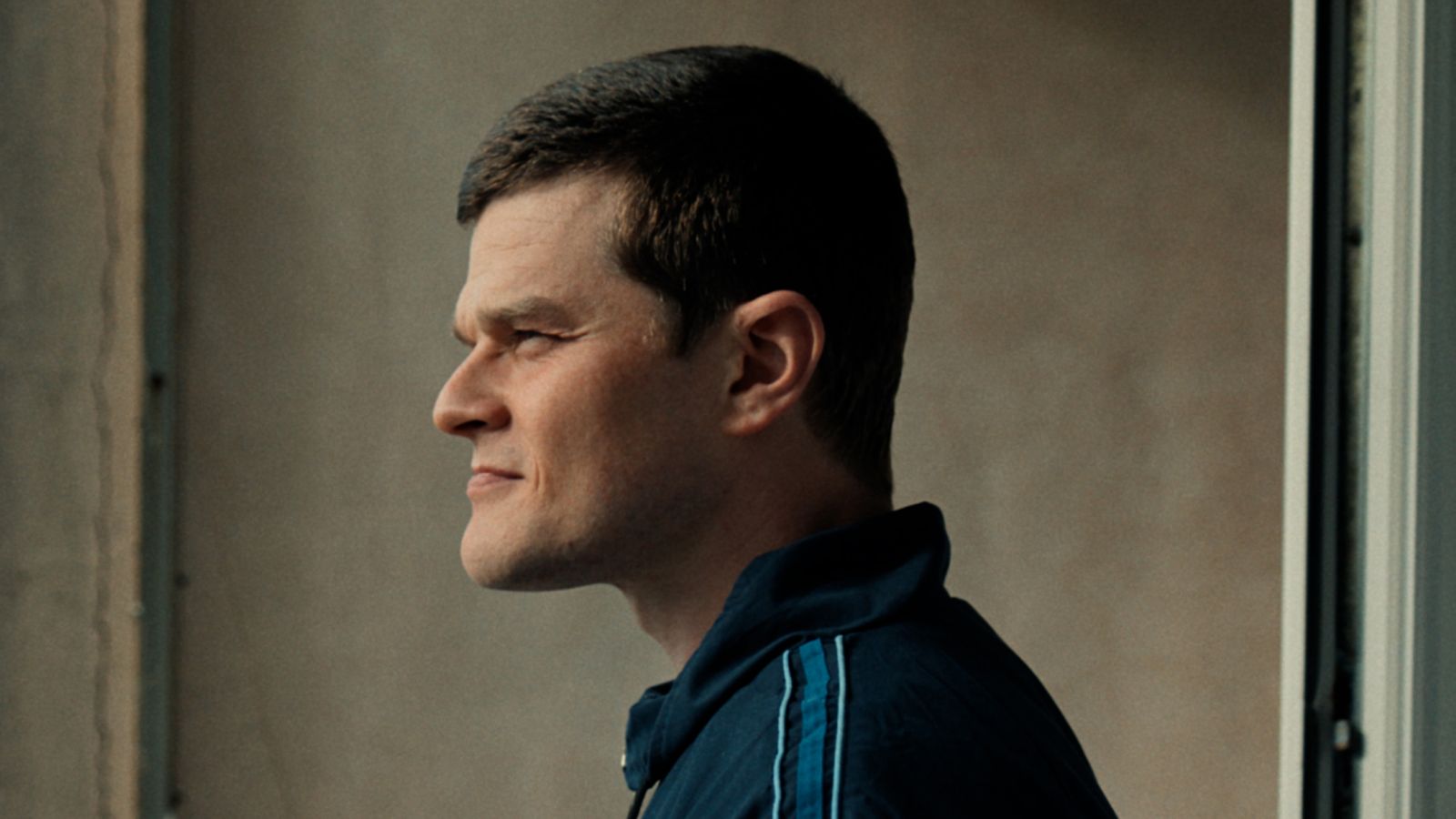
I Swear: The film fighting back against abuse and ‘cheap laughs’ at Tourette’s expense

When John Davidson was 10 years old, he experienced his first symptoms of Tourette syndrome – small facial tics and eye blinking.
By the time he was 13, the neurological condition was causing full-body movements so extreme he compares himself with the young heroine in horror film The Exorcist.
John tells Sky News: “There’s a scene where the girl’s on the bed and her whole body’s twitching about and screaming. That’s almost what it felt like. My tics became so extreme that I was hurting myself. I was pulling muscles. I was tired all the time.
“I would break down and cry so many times in a day because I was totally out of control. Something had completely taken over my mind and my body.”
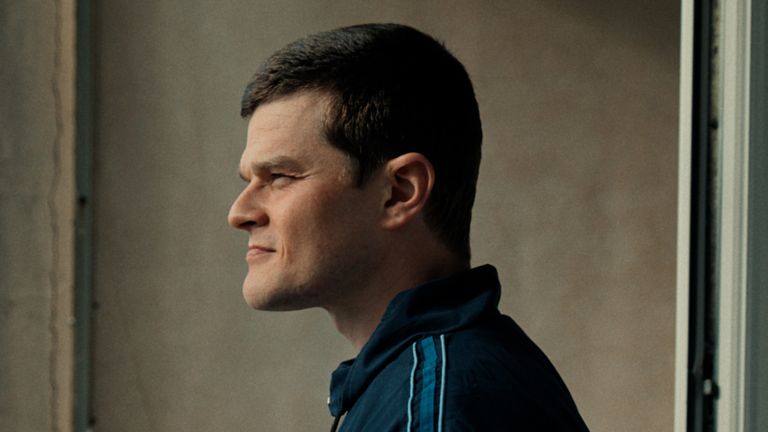
John Davidson’s life story has been made into a film, with Robert Aramayo in the lead role. Pic: StudioCanal
Growing up in Galashiels in the Scottish Borders, John was repeatedly told his symptoms were in his head – or worse, intentional – when a chance meeting with a visiting junior doctor while in hospital led to a diagnosis.
Largely unheard of in the 1980s, today, high-profile figures including Scottish musician Lewis Capaldi and US star Billie Eilish have publicly spoken about living with Tourette’s.
Affecting more than 300,000 people in Britain, it’s more common than many think. One schoolchild in every hundred is estimated to be affected by the syndrome, according to NHS England.
While severity can range, there is currently no cure.
And while the University of Nottingham is working on a device which uses electrical pulses to suppress tic urges, the wristband – called Neupulse – is currently awaiting full medical approval.
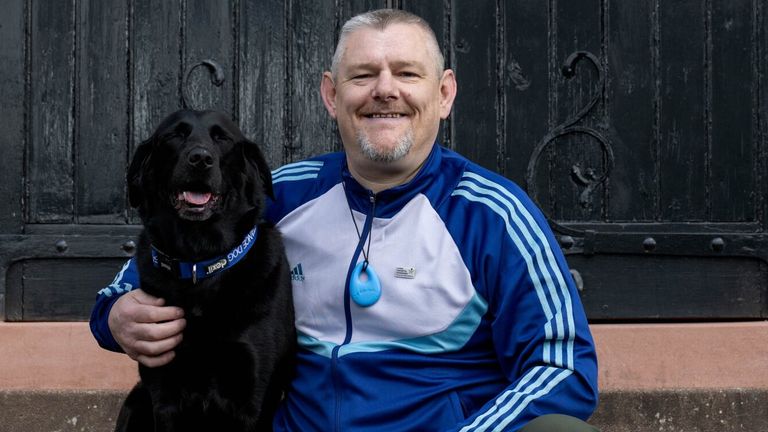
John Davidson MBE, with his black Labrador Suki. Pic: StudioCanal
‘Medication turned me into a zombie’
Treated with drugs as a child, John suffered devastating side-effects: “Anti-psychotic medications turned me into a zombie. I’ve got probably about a two-year period in my teens where I have no real proper memories.”
Frustrated by the lack of support available to him growing up, John is now a Tourette syndrome campaigner, recognised for his work with an MBE.
But even that came with challenges unique to his condition. At the 2019 ceremony at Holyrood Palace, when collecting his award, John shouted “F*** the Queen” at Elizabeth II.
He says: “It was horrific for me. It was like the last thing I ever wanted to have to shout. And I think that’s the nature of the coprolalia, part of the condition, where it’s the worst possible thing you could say in that situation.”
Affecting a minority of the Tourette’s population, coprolalia is the involuntary utterance of socially inappropriate words or phrases.
While less common, it’s the feature of Tourette’s most often portrayed in the media.
John goes on: “It came as much of a shock to me as to everyone else, you know? But I’m the one in the moment having to deal with those emotions and feelings of wanting the ground to swallow me up. [Thinking] I don’t want to be here any more.”
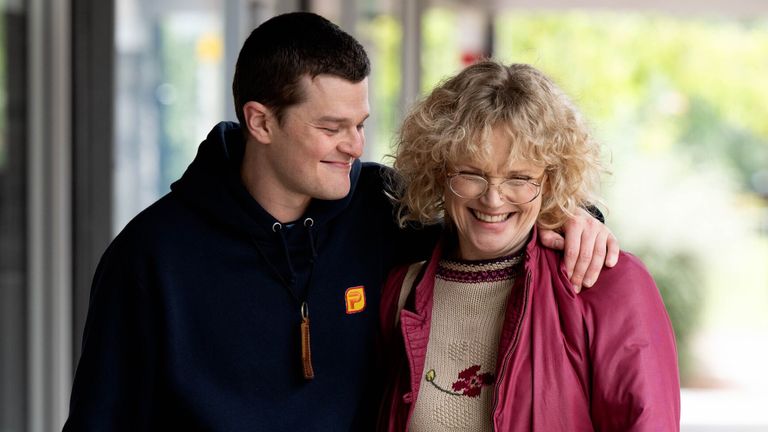
Maxine Peake also stars in the film. Pic: StudioCanal
‘Living with it is absolutely awful’
Now, in a bid to tackle the stereotype, a film is being made about John’s life based on his 2025 memoir, with Game Of Thrones star Robert Aramayo playing the lead role.
No stranger to media exposure himself, John has appeared in numerous documentaries over the years, following on from the groundbreaking 1989 documentary about his life, John’s Not Mad. But it hasn’t always been a positive experience.
John says: “Every time they make a documentary, they make such a thing about the swearing part, which then stigmatises the condition because people are then left to assume that everyone with Tourette’s swears and shouts obscenities.”
In reality, coprolalia is not typical of the condition and only affects around one in 10 people with Tourette’s.
John acknowledges there is a comedic element to this: “When people think of uncontrollably swearing like that, it’s funny. ‘Oh my God’, you know, ‘shock, horror’. But for the one living with it, it’s absolutely awful.”
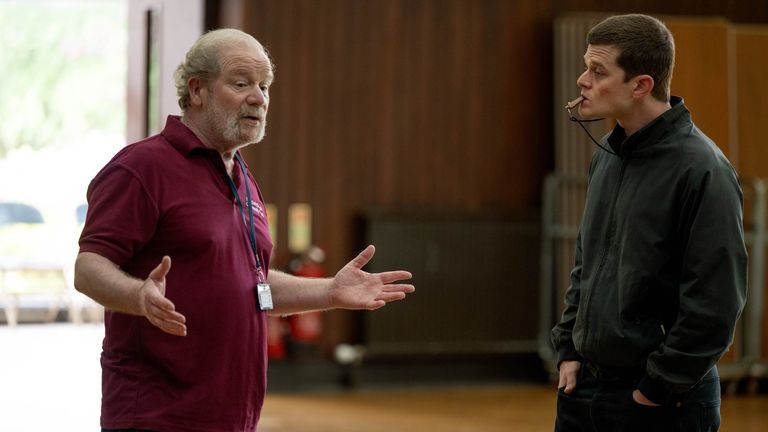
Scottish actor Peter Mullan with Robert Aramayo. Pic: StudioCanal
‘Let’s have sex!’
It’s a sentiment the film’s director echoes.
Kirk Jones first met John in 2022. Meeting him at his house to discuss the potential of making the film, John opened the door and, after inviting him in, shouted in his face: “Let’s have sex!”
His first introduction to John’s verbal ticks, the director admits it was a “steep learning curve”.
He tells Sky News: “There’s something about Tourette’s, which I don’t think has made it a very friendly or accessible condition. I think that’s down to the fact that people who have coprolalia come across as being aggressive or argumentative or difficult or upsetting people, and I think that’s unfair. They need as much support as anyone else.”
The director says it took him some time to gain John’s trust, showing he wanted to do more than just revisit tired stereotypes.
He says: “The Tourette’s community had been kind of abused in the past. They’ve been invited to appear on TV shows or radio or be in newspaper articles, under the guise of helping people to understand Tourette’s more. But what the TV channel or the radio show really wanted was just a cheap laugh.
“When I first met John and started talking about the idea of the film, he was understandably suspicious.”
Handing over some creative control, John is also an executive producer on the film.
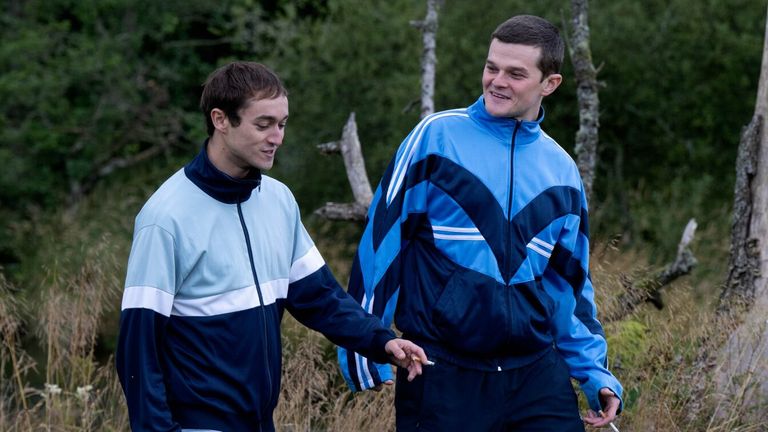
Actor Francesco Piacentini-Smith as Murray. Pic: StudioCanal
‘When you laugh, it breaks the ice’
Now, at 54, and having lived with the condition for over 40 years, John believes people are becoming more tolerant of Tourette’s, but would love to see further acceptance.
“It’s about not being shocked. It’s not about being dead serious with a straight face. Feel free to laugh, because when you laugh, it breaks the ice.
“I wish people had the confidence to approach people with Tourette’s and just deal with it as if it was an everyday thing.”
The director, too, hopes the film will have a real-world impact and open people’s eyes to the reality of the condition.
He says: “I hope this film can play a small part in starting to refocus people’s attention on helping and supporting people rather than just laughing or mocking.”
I Swear is in UK and Irish cinemas from Friday 10 October.
Anyone looking for support or information about Tourette syndrome can access resources at Tourettes Action or Tourette Scotland for those living in Scotland.

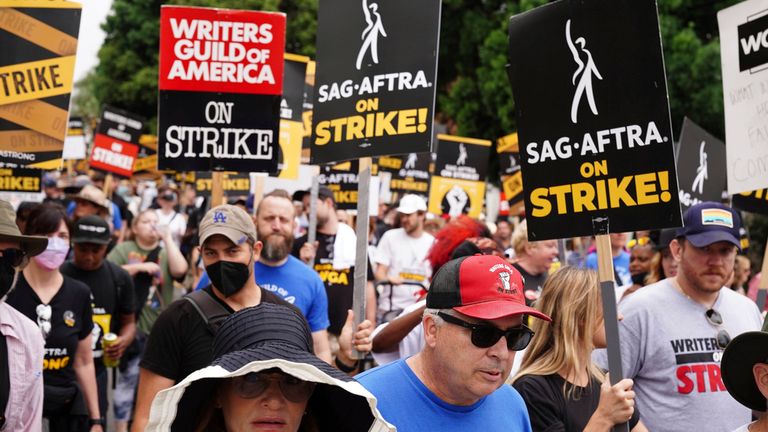
Thousands of members of actors’ trade union Equity are being asked whether they would support industrial action over artificial intelligence protections.
The organisation has launched an indicative ballot among about 7,000 members working in film and TV.
Performers are being asked whether they are prepared to refuse to be digitally scanned on set in order to secure adequate artificial intelligence protections.
It will be the first time the performing arts and entertainment trade union has asked this whole section of its membership to vote in a ballot.
The Hollywood strikes took place in 2023. File pic: AP
The announcement follows the Hollywood strikes in 2023, when members of Equity’s sister union in the US, SAG-AFTRA, and writers, went on strike over issues including AI.
Video game actors in the US also protested over the use of AI, ending almost a year of industrial action earlier in 2025.
Equity’s ballot opens on Thursday and runs for two weeks, and will show the level of support the union has for action short of a strike.
Another statutory ballot would have to be made before any industrial action is taken.
“While tech companies get away with stealing artists’ likeness or work, and the government and decision makers fret over whether to act, unions including Equity are at the forefront of the fight to ensure working people are protected from artificial intelligence misuse,” Equity general secretary Paul W Fleming said in a statement.
“If bosses can’t ensure someone’s likeness and work won’t be used without their consent, why should performers consent to be digitally scanned in the first place?”
Mr Fleming said the ballot would give members the opportunity to “send a clear message to the industry: that it is a basic right of performers to have autonomy over their own personhood and identity”.
The union has no choice but to recommend members support industrial action, he said.
“It’s time for the bosses to step away from the brink and offer us a package, including on AI protections, which respects our members,” added Mr Fleming.
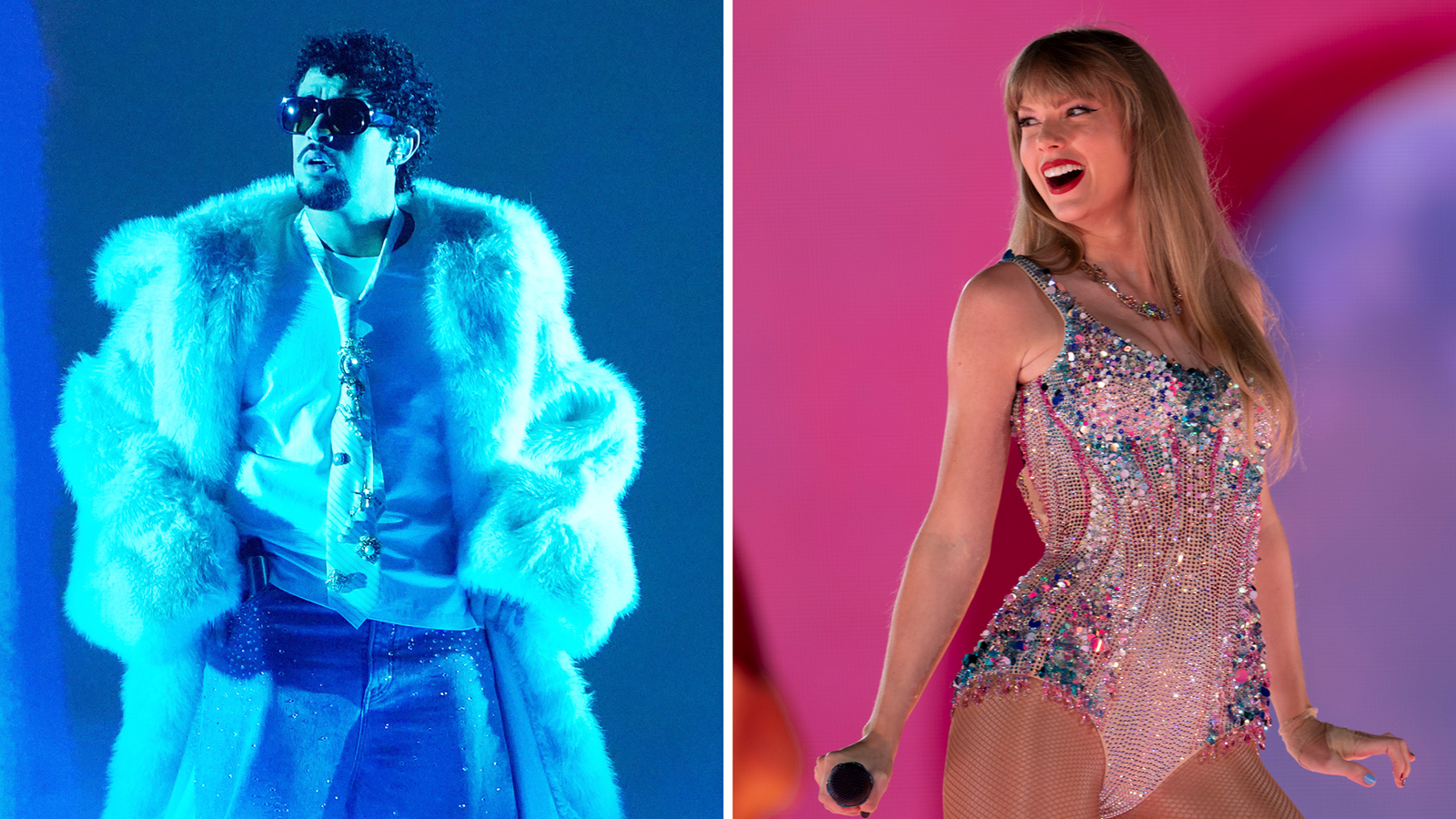

The hotly anticipated Spotify Wrapped is revealing our top tracks, artists and albums for 2025.
But how does the streaming service calculate personalised summaries of users’ listening habits and rank the UK’s hottest artists?
Here’s a look at how your data is used.
The platform describes the annual statistics as “a chance to look back on your year in sound”.
It says data is captured between January and mid-November on every account, although it mostly excludes anything streamed in private mode. (Don’t worry, your passion for the Spice Girls can be kept secret.)
Wrapped presents personalised listening statistics, which Spotify calls the “real story of your year of listening”, alongside global figures for comparison.
The streaming service says Minutes Listened reflects the actual time spent listening to audio on the platform.
Once a user streams at least 30 tracks, Spotify generates a list of Your Top Songs. Similarly, Your Top Artists ranks artists based on total minutes listening to a particular performer.
Other metrics identify the top genres users have played, as well as podcasts and audiobooks ranked by total minutes listened. And if you’ve listened to at least 70% of tracks on a record, you’ll see top albums too.
Spotify also creates Your Listening Age, a guesstimate of your age based on the era of the music “you feel most connected to”.
The streaming service says the statistic is calculated using a five-year span of music which users engaged with more than other listeners of a similar age.
Spotify has been summing up 2025’s most listened to tracks. Pic: Spotify
Swift vs Bunny
Pop superstar Taylor Swift has been named the UK’s most-streamed artist on Spotify for the third year in a row.
But she dropped out of the top spot in the global rankings, coming second to Puerto Rican superstar Bad Bunny, who secured more than 19.8 billion streams. Third were The Weeknd, followed by Drake and Billie Eilish.
Bad Bunny’s LP Debi Tirar Mas Fotos was the most listened-to album worldwide.
Read more from Sky News:
Sabrina Carpenter fury at video
Drake’s lawsuit dismissed
Spotify hikes UK prices
Spotify revealed Drake was the UK’s second most-listened to artist, followed by Sabrina Carpenter in third, The Weeknd in fourth and Billie Eilish in fifth.
Despite being the most listened-to artist, Swift failed to break into the UK’s top five most listened-to songs and albums of the year.
Alex Warren’s Ordinary was the most-streamed song, and Short ‘N’ Sweet, released by Carpenter last year, the top album.
-
 Sports2 years ago
Story injured on diving stop, exits Red Sox game
-
 Sports3 years ago
‘Storybook stuff’: Inside the night Bryce Harper sent the Phillies to the World Series
-
 Sports2 years ago
Game 1 of WS least-watched in recorded history
-
 Sports3 years ago
Button battles heat exhaustion in NASCAR debut
-
 Sports3 years ago
MLB Rank 2023: Ranking baseball’s top 100 players
-
Sports4 years ago
Team Europe easily wins 4th straight Laver Cup
-
 Environment3 years ago
Japan and South Korea have a lot at stake in a free and open South China Sea
-
 Environment1 year ago
Here are the best electric bikes you can buy at every price level in October 2024