
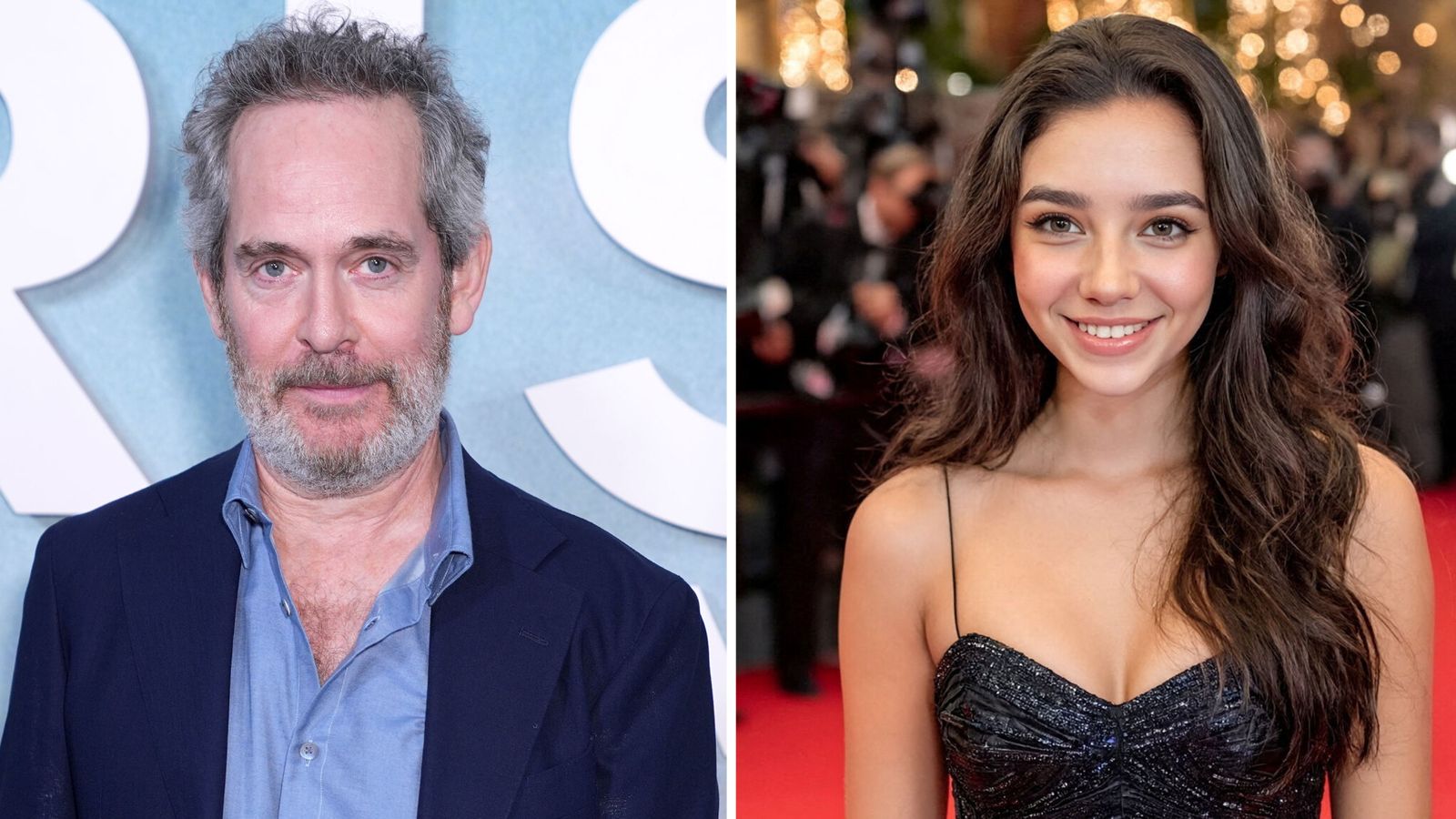
Tom Hollander on AI actor Tilly Norwood : ‘Perhaps I’m not scared enough’

Tom Hollander says he’s not worried about AI actors replacing real ones and thinks the creation of synthetic performers will only boost the value of authentic, live performance.
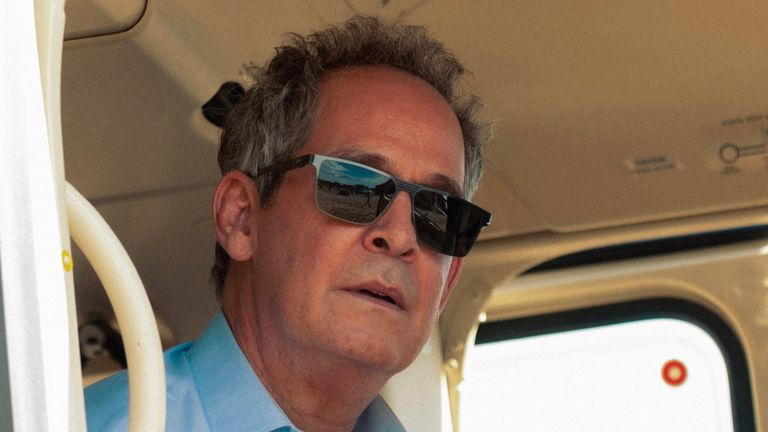
The 58-year-old plays entrepreneur Cameron Beck in The Iris Affair, a drama about the world’s most powerful quantum computer.
Dubbed “Charlie Big Potatoes” – it could eat ChatGPT for breakfast.
It’s a timely theme in a world where Artificial Intelligence is advancing at pace, and just last week, the world’s first AI starlet – Tilly Norwood – made her Hollywood debut.
Hollander is not impressed. He suggests rumours that Norwood is in talks with talent agencies are “a lot of old nonsense”, and questions the logistics of working with an AI actor, asking “Would it be, like a blue screen?”
Norwood – a pretty, 20-something brunette – is the creation of Dutch actor and comedian Eline Van der Velden and her AI production studio Particle6. It’s planning to launch its own AI talent studio, Xicoia, soon.
Hollander tells Sky News: “I’m perhaps not scared enough about it. I think the reaction against it is quite strong. And I think there’ll be some legal stuff. Also, it needs to be proven to be good. I mean, the little film that they did around her, I didn’t think was terribly interesting.”
The sketch – shared on social media and titled AI Commissioner – poked fun at the future of TV development in a post-AI world.
Stars including Emily Blunt, Natasha Lyonne and Whoopi Goldberg have objected to Norwood’s creation too, as has US actors’ union SAG-AFTRA.
Hollander compares watching an AI performer to watching a magic trick: “You know with your brain that you’re watching something that’s bullshit… If they don’t have to tell you, that would be difficult. But if they’ve told you it’s AI, then you’ll watch it with a different part of your brain.”
Pic: Sky Atlantic
Always screen-ready, with no ego and low salary requirements, Norwood is being billed as a studio’s dream hire. In line with Hollywood’s exacting standards for female beauty, she’ll also never age.
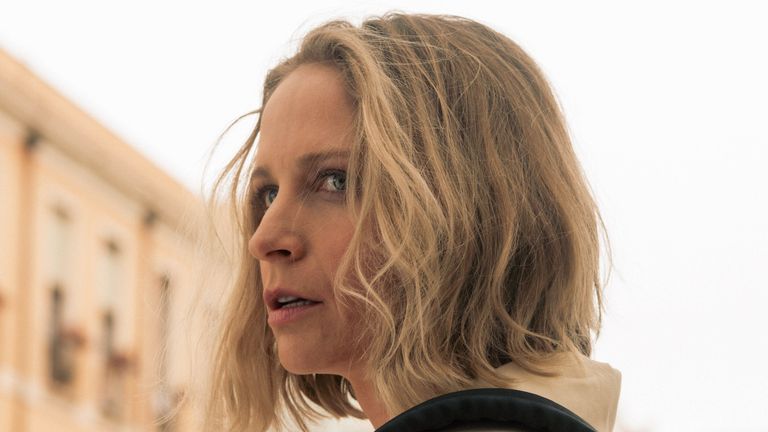
Hollander’s Iris Affair co-star Niamh Algar, who plays genius codebreaker Iris Nixon in the show, doesn’t feel threatened by this new kid on the block, poking fun at Norwood’s girl-next-door persona: “She’s a nightmare to work with. She’s always late. Takes ages in her trailer.”
But Algar adds: “I don’t want to work with an AI. No.”
She goes on, “I don’t think you can replicate. She’s a character, she’s not an actor.”
Pic: Sky Atlantic
Algar says the flaw in AI’s performance – scraped from the plethora of real performances that have come before it – is that we, as humans, are “excited by unpredictability”.
She says AI is “too perfect, we like flaws”.
Hollander agrees: “There’ll be a fight for authenticity. People will be going, ‘I refuse makeup. Give me less makeup, I want less makeup because AI can’t possibly mimic the blemishes on my face'”.
He even manages to pull a positive from the AI revolution: “It means that live performance will be more exciting than ever before…
“I think live performance is one antidote, and it’s certainly true in music, isn’t it? I mean, partly because they have to go on tour [to make money], but also because there’s just nothing like it and you can’t replace it.”
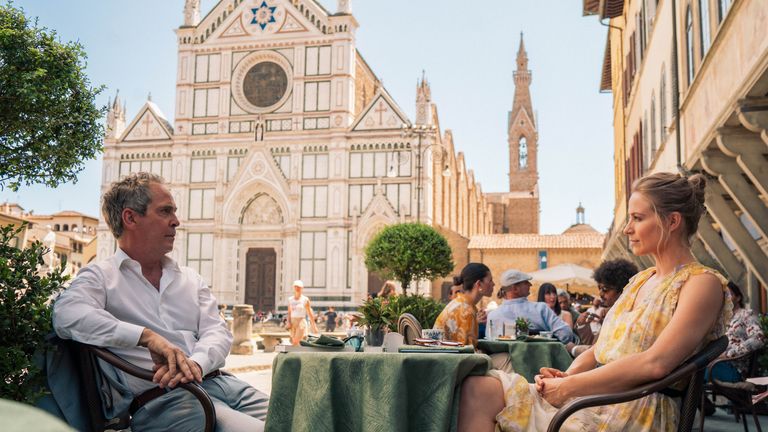
Algar enthusiastically adds: “Theatre’s going to kick off. It’s going to be so hot.”
Pic: Sky Atlantic
As for using AI themselves, while Hollander admits he’s used it recently for “a bit of problem solving”, Algar says she tries to avoid it, worrying “part of my brain is going to go dormant”.
Indeed, the impact of technology on our brains is a source of constant inspiration – and torture – for The Iris Affair screenwriter Neil Cross.
Cross, who also created psychological crime thriller Luther, tells Sky News: “We are at a hinge point in history.”
He says: “I’m interested in what technological revolution does to people. I have 3am thoughts about the poor man who invented the like button.
“He came up with a simple invention whose only intention was to increase levels of human happiness. How could something as simple as a like button go wrong? And it went so disastrously wrong.
“It’s caused so much misery and anxiety and unhappiness in the human race entire. If something as simple as a small like button can have such dire, cascading, unexpected consequences, what is this moment of revolution going to lead to?”
Indeed, Cross says he lives in “a perpetual state of terror”.
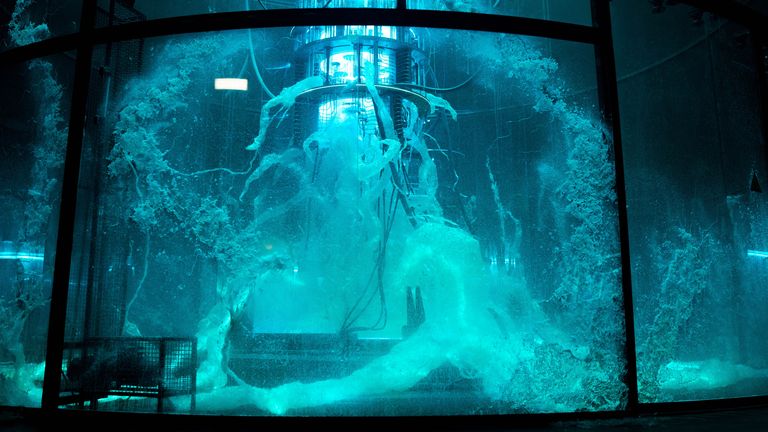
Supercomputer ‘Charlie Big Potatoes’. Pic: Sky Atlantic
He goes on: “I’m always going to be terrified of something. The world’s going to look very different. I think in 50 or 60 years’ time.
He takes a brief pause, then self-edits: “Probably 15 years’ time”.
With The Iris Affair’s central themes accelerating out of science fiction, and into reality, Cross’s examination of our instinctual fear of the unknown, coupled with our desire for knowledge that might destroy us is a powerful mix.
Cross concludes: “We’re in danger of creating God. And I think that’s the ultimate danger of AI. God doesn’t exist – yet.”
The Iris Affair is available from Thursday 16 October on Sky Atlantic and streaming service NOW
Entertainment
Scottish artist Nnena Kalu wins Turner Prize 2025 for hanging Barcelona sculptures and Liverpool exhibition
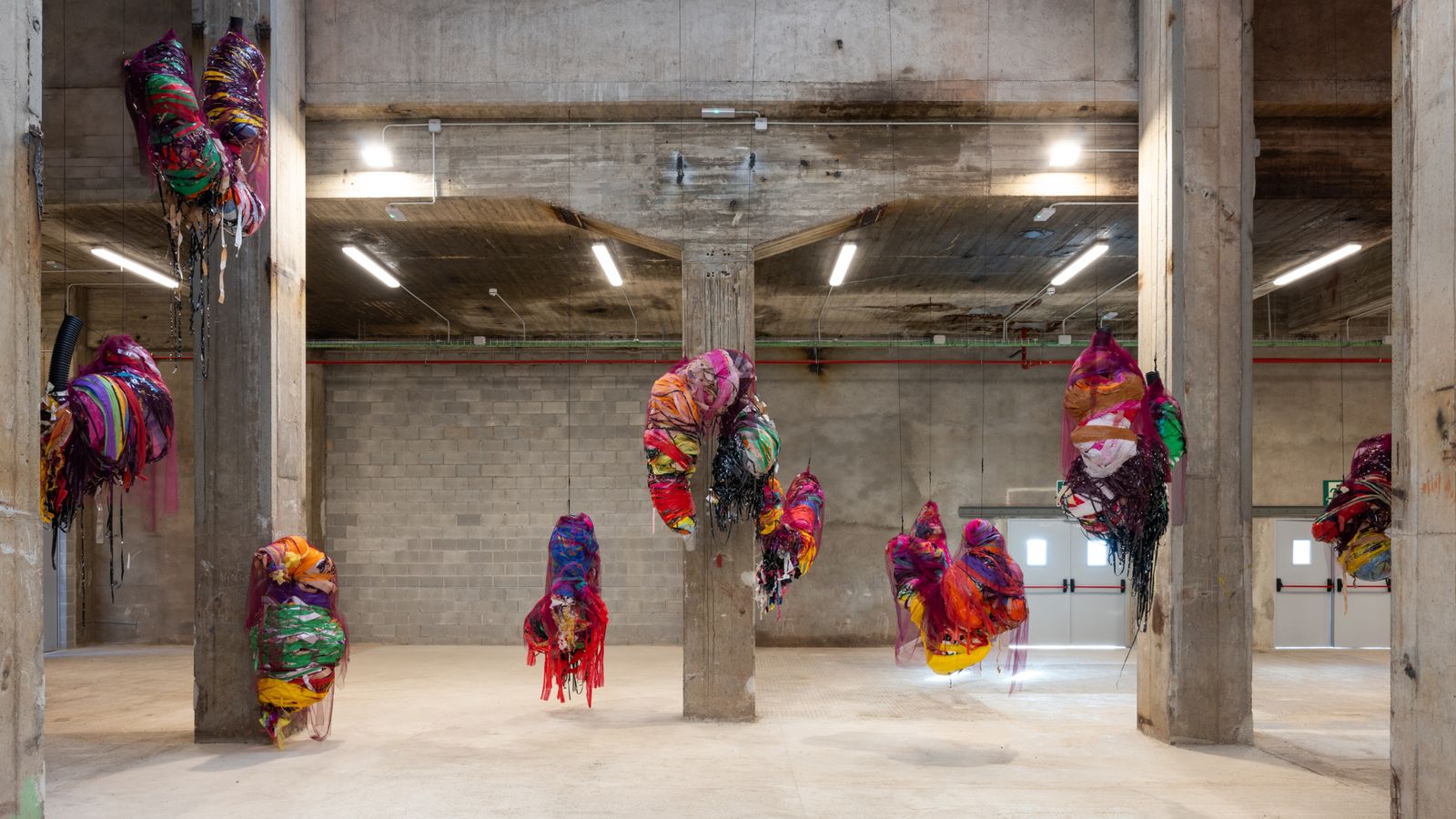
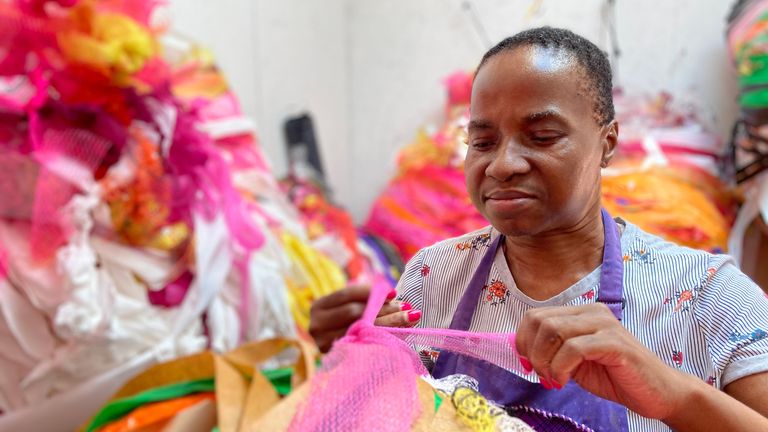
Scottish artist Nnena Kalu has won the 2025 Turner Prize with two exhibitions, including a series of brightly coloured sculptures.
The Glaswegian, 59, took home the visual arts prize along with £25,000 at an award ceremony on Tuesday in Bradford, this year’s UK City of Culture.
As reported by The Guardian, she is the first artist with a learning disability to win the award.
Nnena Kalu, from Glasgow, is the winner of this year’s Turner Prize. Pic: Nnena Kalu/ActionSpace/PA
Along with Hanging Sculpture 1-10, which European art exhibitors Manifesta commissioned her to create at a disused power station in Barcelona, Ms Kalu won for her presentation in Conversations, a group exhibition at Walker Art Gallery in Liverpool.
For the sculpture series, the artist created the vividly-coloured works from repeated lines and wrappings of different materials, making nest or cocoon-like forms.
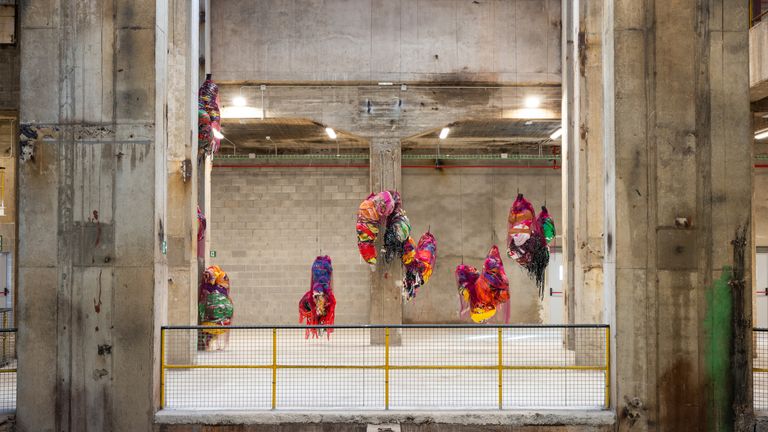
Hanging Sculpture 1 – 10 by Nnena Kalu. Pic: PA
The installation consisted of 10 large brightly-coloured sculptures that hung from grey concrete pillars of the industrial site.
Meanwhile, for Conversations, Kalu presented work in pen, graphite and chalk pen on two pieces of paper.
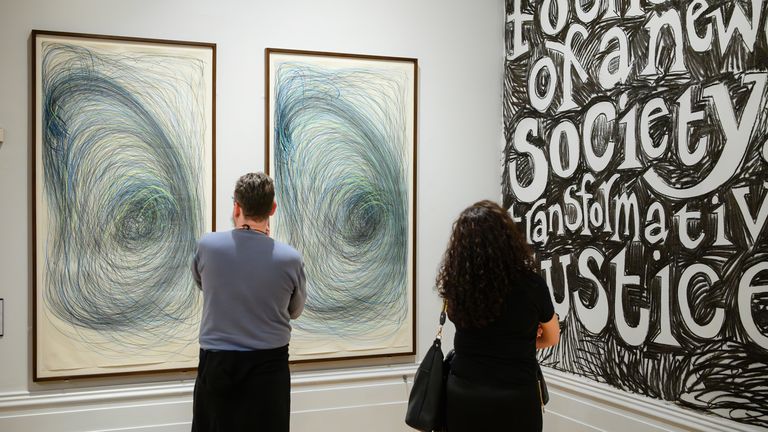
Conversations by Nnena Kalu. Pic: PA
The jury, which was chaired by Alex Farquharson, the director of Tate Britain, commended Kalu’s “bold and compelling work” and praised the “lively translation of expressive gesture” in the abstract sculpture and drawing.
The panel also acknowledged her scale, composition and colour, highlighting “the powerful presence” her works have.
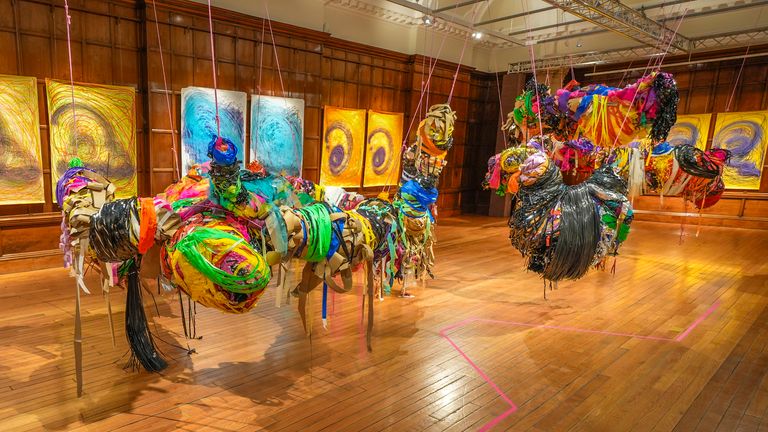
Nnena Kalu’s nominated Turner Prize works. Pic: PA
Kalu is also a resident artist at ActionSpace’s studio, which supports learning disabled artists across London at Studio Voltaire, and beat out fellow shortlisted artists Rene Matic, Mohammed Sami and Zadie Xa.
The works by the four artists are currently available to see at a free exhibition at Bradford’s Cartwright Hall Art Gallery until 22 February.
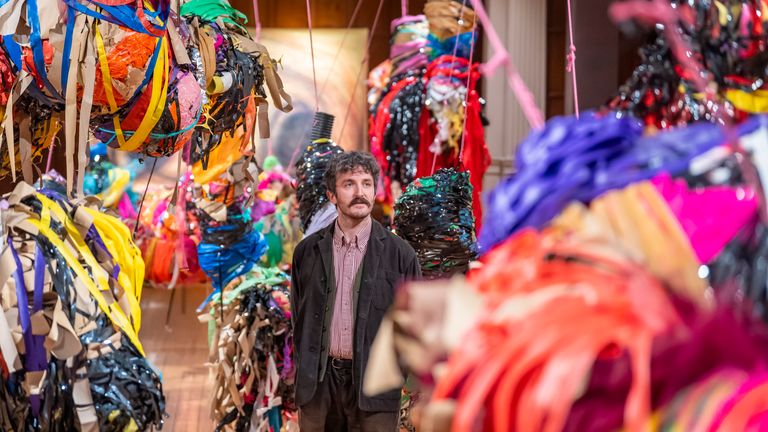
Jonathan Orrell views work by Nnena Kalu for the Turner Prize. Pic: PA
Named after British painter JMW Turner, this year’s prize marked the 250th anniversary of his birth.
Read more from Sky News:
Storm Bram brings 90mph winds, rain and flooding
‘Illegal, industrial-scale waste operation’ suspected in London
Previous winners include artist Damien Hirst in 1995 and filmmaker Sir Steve McQueen in 1999, while last year’s winner, Jasleen Kaur, picked up the prize for Alter Altar – which covered a red sports car with a giant ornamental doily mat.
Entertainment
Rappers Bob Vylan sue Irish broadcaster RTE over claim lead singer led ‘antisemitic chants’ at Glastonbury gig

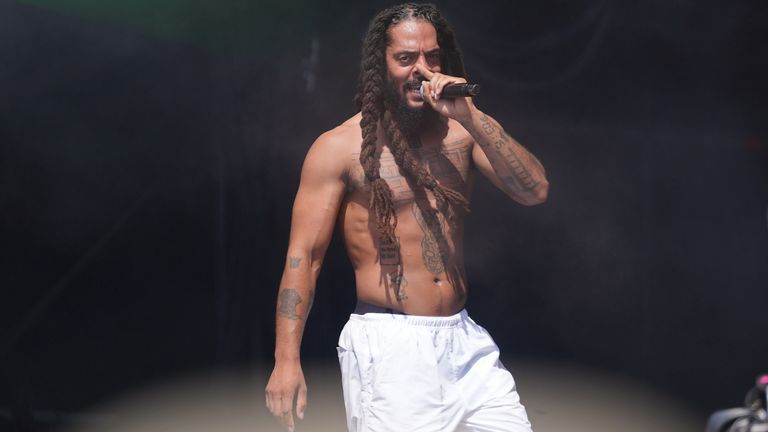
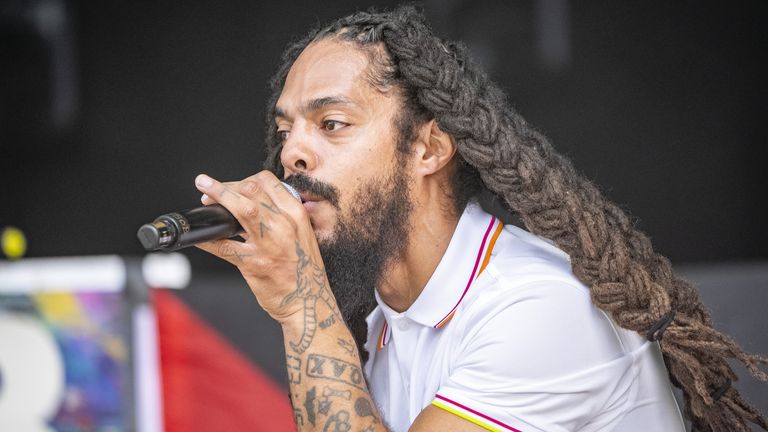
Punk-rap duo Bob Vylan are suing Irish national broadcaster RTE for defamation, claiming it misrepresented chants led by the band when they played this year’s Glastonbury festival.
The group, which performed at Dublin’s Vicar Street last month, claim they were defamed in a report by RTE News that said the lead singer led antisemitic chants when they played the Somerset festival in June.
During their performance, singer Pascal Robinson-Foster, whose stage name is Bobby Vylan, led a chant of “death, death, to the IDF [Israel Defence Forces]”.
File pic: PA
Pic: PA
It provoked widespread criticism of the artist, including from Glastonbury organiser Emily Eavis, and the BBC, which live streamed their show.
Phoenix Law launched legal action on behalf of Robinson-Foster and drummer Wade Laurence George at Ireland’s High Court on Monday, according to court records.
The firm said: “The proceedings arise from a broadcast aired by RTE News following Bob Vylan’s performance at Glastonbury Festival on 28 June 2025.
“During this broadcast, comments were made alleging that the lead singer of Bob Vylan led antisemitic chants. These allegations are categorically denied by our clients and are entirely untrue.”
Phoenix Law said Bob Vylan had made statements expressing support for Palestinian self-determination and criticising military actions by the IDF (Israel Defence Forces).
His comments did not target Jewish people or express hatred towards any group, the firm said, suggesting they were “politically charged but not antisemitic in nature”.
Solicitor Darragh Mackin said the pair “are no stranger to utilising their freedom of expression to speak out against the genocide in Gaza“.
Mr Mackin said there was “a fundamental distinction between speaking critically about the role of the Israeli state forces, and being antisemitic”.
“The former is speech within the confines of political expression, whereas the latter is a form of hatred directed towards Jewish people,” he added.
Read more on Sky News:
Who are Bob Vylan?
The BBC apologised, including to the Jewish community, and said it regretted not pulling the live stream of the set and promised not to live stream “high-risk” acts in future.
It partially upheld complaints made over the broadcast, accepting the live stream broke the corporation’s editorial guidelines.
Ofcom’s chief executive, Dame Melanie Dawes, said the BBC needed to “get a grip quicker” on handling such controversies and complete its internal reports and investigations sooner.
Last month, the Metropolitan Police said detectives would take no further action over similar alleged chants made at a Bob Vylan gig in London in May.
The individual was not arrested but an investigation was ongoing, the Met said.
Avon and Somerset Police said a man, in his 30s, understood to be Mr Robinson-Foster, had voluntarily attended an interview in relation to the band’s Glastonbury performance. Enquiries are ongoing, the force said on Tuesday.
The US condemned the act’s “hateful tirade”, revoking their visas, while several festivals cancelled their upcoming appearances.
Speaking to Louis Theroux in October, Bobby Vylan said he had no regrets about the chants and would do it again “tomorrow”.
Sky News has contacted RTE for comment.
-
 Sports2 years ago
Story injured on diving stop, exits Red Sox game
-
 Sports3 years ago
‘Storybook stuff’: Inside the night Bryce Harper sent the Phillies to the World Series
-
 Sports2 years ago
Game 1 of WS least-watched in recorded history
-
 Sports3 years ago
Button battles heat exhaustion in NASCAR debut
-
 Sports3 years ago
MLB Rank 2023: Ranking baseball’s top 100 players
-
Sports4 years ago
Team Europe easily wins 4th straight Laver Cup
-
 Environment3 years ago
Japan and South Korea have a lot at stake in a free and open South China Sea
-
 Environment1 year ago
Here are the best electric bikes you can buy at every price level in October 2024