
Part of Birmingham ‘can’t be no-go area for Jews’, cabinet minister tells Sky News

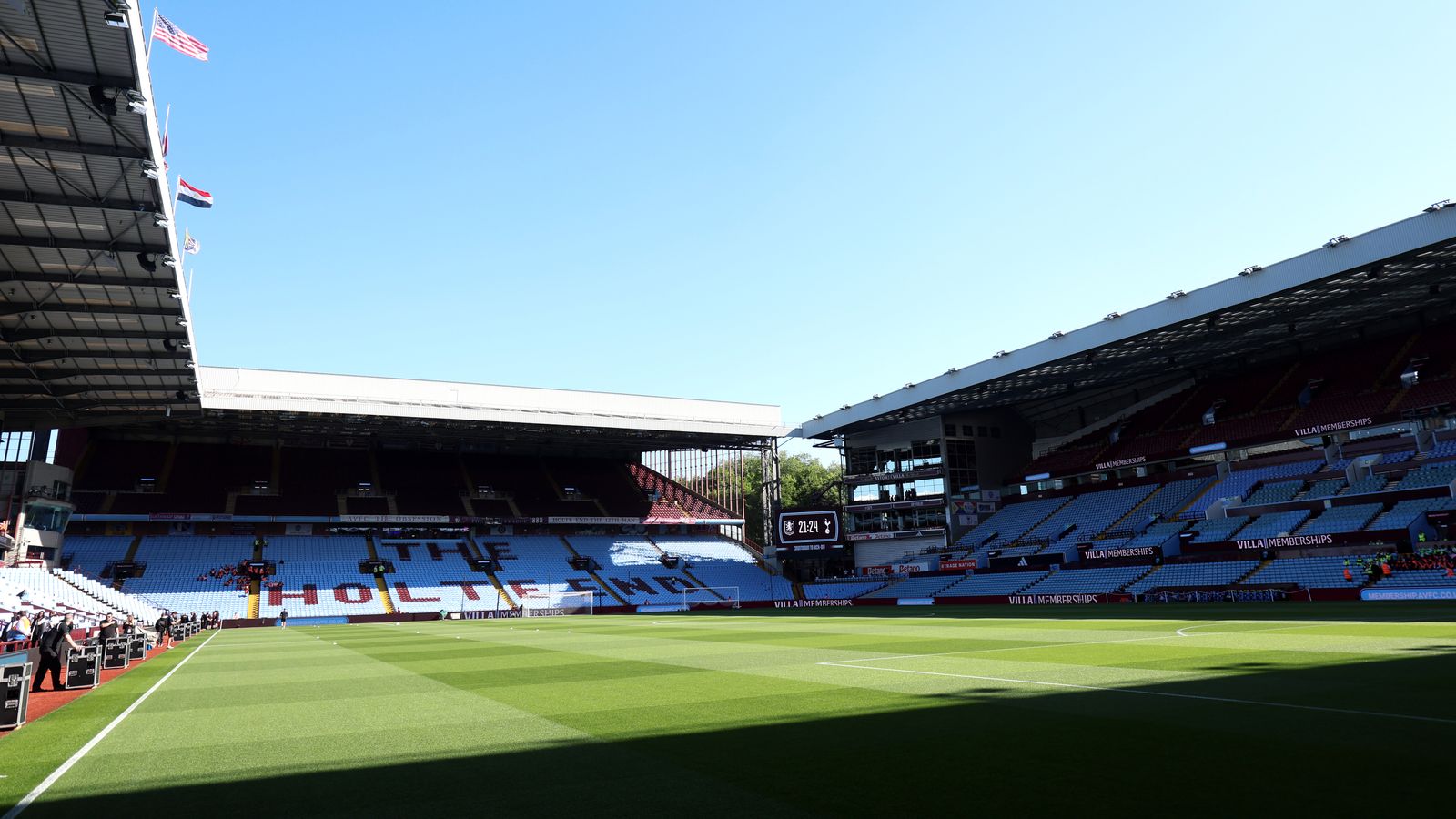
Aston in Birmingham can’t become a “no-go area” for Jews, a senior cabinet minister has told Sky News, amid controversy over fans of an Israeli football club being barred from attending a match next month.
Energy Secretary Ed Miliband said he “profoundly” disagrees with the “approach” taken by a local MP who started a petition calling for fans of Maccabi Tel Aviv to be banned from the Aston Villa game, saying it “cannot be the basis on which our country operates”.
But while he said the government is “working with the relevant authorities” to overturn the move, he can not guarantee it will happen.
Politics latest: Miliband ‘welcomes’ Jeremy Clarkson challenge
Villa Park. PA
Alongside politicians of all parties, Sir Keir Starmer has strongly criticised the decision, calling it “wrong”, and the government has said it will work with local authorities to ensure both sets of fans can attend.
Speaking to Sky’s Sunday Morning With Trevor Phillips, Mr Miliband said work is still ongoing.
“We are working with the relevant authorities on this issue, he said. “I think the principle here is we do not want a situation where people of a particular faith or from a particular country can’t come to a football match because of their faith, because of where they’re coming from.”
Asked if Maccabi Tel Aviv fans will definitely be able to attend the game, the minister replied: “I’m not going to say come what may, but I’m giving you a very, very clear indication of what we are working towards, which is that, you know, the fans from both teams can attend the match.”
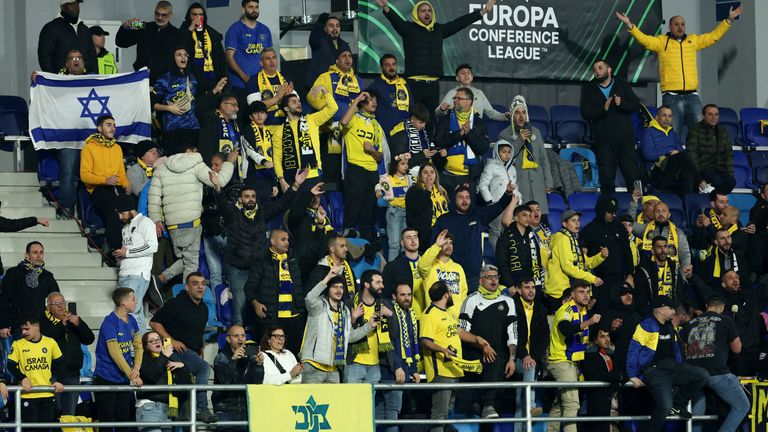
Miliband on Israeli football fan ban
Phillips put to Mr Miliband that a petition to ban their fans, launched by local independent MP Ayoub Khan, has been signed by nearly 4,000 people. It states the upcoming game is “not a normal match” because the Israeli fans would be arriving in “Aston, a diverse and predominantly Muslim community”.
Asked if Aston is now a no-go area for Jews, Mr Miliband replied: “No and it can’t be. And I’m very, very clear about that.
“I believe we as a country, we pride ourselves on our diversity, but also our tolerance and our hatred of prejudice, frankly. And so we cannot have a situation where any area is a no-go area for people of a particular religion or from a particular country.”
Asked if the local MP was justified in what he wrote, Mr Miliband replied: “No. I profoundly disagree with that approach, with what is being said in that petition, because that cannot be the basis on which our country operates.”
This isn’t how the vast majority of people in the UK operate, he added. “So let’s not take this petition and say it paints a picture of our country.”
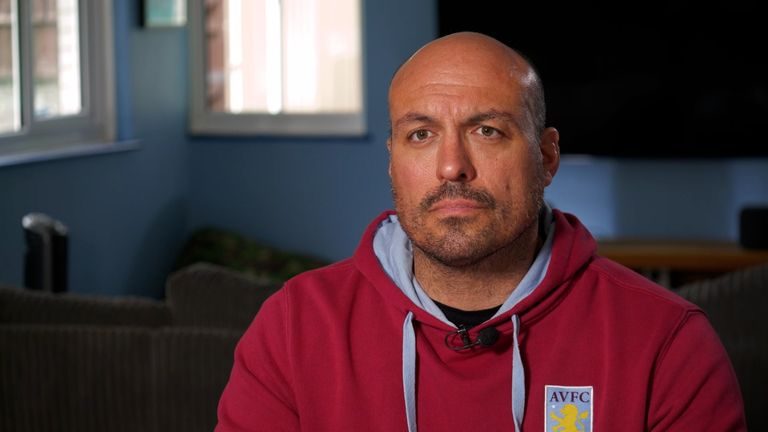
Aston Villa fan says he has received death threats.
Top Tory criticises ‘sectarian politics’
His Tory counterpart, Claire Coutinho, was highly critical of the petition, telling Phillips: “I think politicians need to have the courage to name some of the problems that this country is facing. And one of those problems is political Islam.
“Now, that’s not to say the moderate Muslim community are a problem in Britain, but we have seen in the past extremist Islamism […] and now we are seeing a movement of people – last election, five MPs elected – simply on sectarian politics. That may be higher at the next election.
“So we have to grip this, and part of that is dealing with rising antisemitism. But part of that is dealing with integration.”
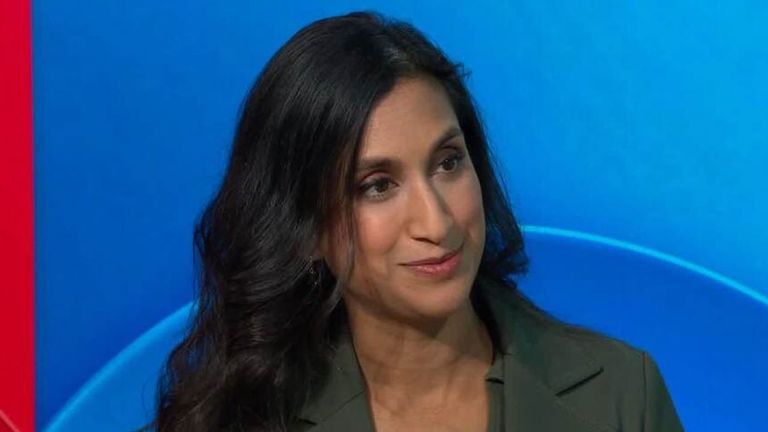
Tory calls out ‘lack of integration’
The senior Tory MP described the ban overall as a “disgrace”, saying: “I think the message that is being sent to Jewish people in this country is that they’re not welcome here.
“This has always been a safe haven for Jewish people, and I think to say that we could not possibly police Israeli Jewish fans to watch a football match safely is reinforcing that message that Jews are not welcome here. And I think that is wrong.”
Match classified as ‘high risk’
In a statement on Thursday, Aston Villa said Birmingham’s Safety Advisory Group (SAG) – which issues safety certificates for every match at the ground – had “formally written to the club and UEFA to advise no away fans will be permitted to attend” the fixture at Villa Park on 6 November, as it had been classified as “high risk”.
The club said police had advised of “public safety concerns outside the stadium bowl and the ability to deal with any potential protests on the night” – a statement that triggered outrage across the political spectrum.
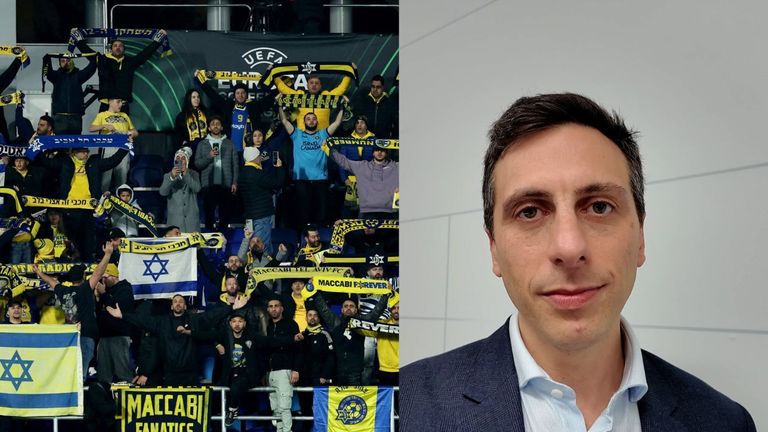
Will ban on Maccabi Tel Aviv fans from Aston Villa be lifted?
The move has been condemned by political and Jewish leaders, including Israeli foreign minister Gideon Sa’ar, who called it a “shameful decision”.
The Jewish Leadership Council said it was “perverse” to ban away fans because police can’t guarantee their safety, adding: “Aston Villa should face the consequences of this decision and the match should be played behind closed doors.”
Read more:
Why are Maccabi Tel Aviv fans banned?
Analysis: Ban raises serious questions
Sky News has contacted Mr Khan for a response to the comments made this morning.
Former Labour leader and now independent MP Jeremy Corbyn defended his fellow member of the Independent Alliance group in parliament yesterday, writing on X: “Ayoub Khan has been subject to disgusting smears by MPs and journalists, who have wilfully misrepresented his views in order to stoke anger and division.”
He added that he and his colleagues “diligently represent people of all faiths and none in their communities”.

As the government drags on, the US Senate is preparing a vote to end it while lawmakers plan to meet crypto leaders Wednesday to discuss the stalled market structure bill.

Bolivian President-elect Rodrigo Paz plans to use blockchain for public procurement and include crypto in asset declarations for a new fund.

Brain-computer interfaces like Neuralink concentrate mental control in corporate hands. Decentralized science offers shared governance over neural data.
-
 Sports3 years ago
‘Storybook stuff’: Inside the night Bryce Harper sent the Phillies to the World Series
-
 Sports2 years ago
Story injured on diving stop, exits Red Sox game
-
 Sports2 years ago
Game 1 of WS least-watched in recorded history
-
 Sports3 years ago
Button battles heat exhaustion in NASCAR debut
-
 Sports3 years ago
MLB Rank 2023: Ranking baseball’s top 100 players
-
Sports4 years ago
Team Europe easily wins 4th straight Laver Cup
-
 Environment2 years ago
Japan and South Korea have a lot at stake in a free and open South China Sea
-
 Environment1 year ago
Here are the best electric bikes you can buy at every price level in October 2024