Connect with us

Published

on

On Oct. 20 of last year, college football’s first two firings unfolded with little fanfare — East Carolina let go of Mike Houston and Southern Miss dismissed Will Hall.

By that date in 2025, there already were 11 programs — including seven major conference teams — that dismissed their coach.

Those seven openings far outpace the final statistics from 2024, when just three coaches were fired for performance — Purdue’s Ryan Walters, UNC’s Mack Brown and West Virginia’s Neal Brown.

Since this season started, there have been six firings at major conference schools — UCLA, Virginia Tech, Oklahoma State, Arkansas, Penn State and Florida. (Stanford’s firing of Troy Taylor came after off-field tumult this offseason.)

So, how did we get to the point where there are 11 open jobs on the 2025 calendar — including UAB, Oregon State, Kent State and Colorado State — before the first open job in 2024?

There’s a confluence of factors that range from the slow power conference cycle in 2024 to the professionalization of college programs demanding instant results. (One industry source said jokingly that Curt Cignetti’s instant success at Indiana ruined the expectation curve for all coaches.)

How crazy will this cycle get? One industry source summed it up this way: “There’s not enough good coaches to fill all of these spots. It’s never a good year to be in the market, but especially not this year.”

We dove into the numbers and asked industry sources how they see it playing out, as the busiest and most expensive coaching carousel in the sport’s history looms.

Could this be the busiest coaching carousel ever?

In short, yes. Especially with the early flurry of Power 5 jobs.

Comparisons are tricky because of conference realignment and variables like season-long interim coaches. But the most major conference jobs open in a recent season happened in the 2021-22 cycle, when there were 14, per ESPN Research. That cycle included USC (Lincoln Riley), LSU (Brian Kelly), Notre Dame (Marcus Freeman), Florida (Billy Napier), Miami (Mario Cristobal), Oklahoma (Brent Venables) and Oregon (Dan Lanning).

This year is shaping up to rival that, as in the modern era, this is the earliest we’ve seen seven power conference jobs open.

Also on the radar are Auburn, Florida State and Wisconsin, with the latter two schools issuing statements about the futures of their coaches this week.

There are also eyes on Deion Sanders’ health at Colorado, Kyle Whittingham’s potential retirement at Utah and Bill Belichick’s struggles at UNC. Kentucky is 0-4 in the SEC under Mark Stoops, but the Wildcats would owe him nearly $38 million within 60 days of firing him.

And there are still six weeks left in the season. The legacy of Franklin’s firing at Penn State is that nearly every coach is a three-game losing streak from his job being in trouble. So, don’t be surprised if another school or two finds its situation untenable as the losses pile up. And never rule out a surprise retirement or two, as we’ve seen veteran coaches monitor the landscape and head off to their beach houses in recent years in college football and basketball.

Combine current openings with potential ones and the inevitable dominoes of hiring away sitting coaches from other power conference jobs, and it’s clear that the recent benchmark of 14 power jobs from the 2021-22 cycle and 2015-16 cycle will be threatened. (That number is 15 in 2021-22 if you count SMU, which has since moved to the ACC, and 16 in 2015-16 if you count UCF and BYU. College sports never makes these things easy.)

From a pure numbers standpoint, we’re likely amid a historic three-year run. The NCAA keeps annual tabs on new coaches in the FBS, and the past two cycles have been the first time in college football history, per the NCAA, that at least 30 new coaches have arrived in back-to-back years.

There were 32 to start the 2024 season, and there were 30 to start this season. The only other time in the FBS era there have been more than 30 is 2013, when there were 31 new coaches, good for a record 25.2% turnover.

That 30-coach benchmark appears likely to be eclipsed again. Even with a handful of duplicate jobs those years, it means somewhere over 60% of the sport is destined to turn over in three years.

How large will buyouts loom?

For decades, coaches were the largest talent expense for a program. And because of the competition to hire and retain them, it became standard practice for schools to offer lengthy guaranteed salaries.

And that has led to piles of dead money being paid to coaches. An ESPN study found $533.6 million in dead money in athletic departments for coaches over an 11-year period from Jan. 1, 2010, to Jan. 31, 2021. There’s already more than $100 million in buyout money owed this year, although many contracts are subject to offset and mitigation. (If Franklin gets a job for $25 million over five years, for example, that would be subtracted from the $49 million he’s owed through the 2031 season.)

But there are also a few more big figures potentially looming — Mike Norvell’s $58 million with Florida State, Freeze’s $15 million with Auburn and Luke Fickell’s more than $25 million with Wisconsin. Those will factor into decision-making at those schools.

As another industry source adds: “Look at the candidate pool. If it’s close and you think you might have the right guy, you don’t go in.”

What became apparent through calls this week is that the fervor over coaches is unlikely to translate to changed behavior in contracts. Restraint and discipline don’t often coincide with desperation.

Could a coach who makes the playoff jump to a new job?

Technically, sure. But in reality, that would be a hire that redefines awkward. ESPN spoke to a half a dozen sources about this, and the answers vary. With the transfer portal not opening until Jan. 2, there’s certainly a chance that a school could wait out a playoff coach.

But two looming factors would be difficult to overcome, even if there’s a proverbial “deal in the drawer” that a coach has agreed to in advance.

The first is that the coach would put his current team’s title hopes at risk, as his team would be suspicious if a major job remained open and he dodged answers about it. (Not to mention, didn’t sign a new deal with his current school.)

The second is simple — what happens if a coach wins a few games? A coach could play in the first round Dec. 19 or Dec. 20, lose the game and leave a day or two after to set up his roster in time for next year. But a win or two could extend his season into mid-January, and any athletic director who waits a month and doesn’t have a coach in place for the start of the portal would get squeamish.

“The tough part will be, if you have that search open, how do you keep it quiet?” an industry source said. “You’re going to have to keep a process going. The only way I see it happening is that school would have to keep a search going all that time.”

The portal might officially open Jan. 2, but most deals will be done long before. Even with a strong general manager at a program, the ambiguity would undercut the first year’s roster tremendously.

Essentially, the coach and school would have to announce that he’s leaving. The coach would then coach out the playoff, with the idea that the players are all free agents at the end of every season. It would be awkward and heavily criticized, but that might be the only option.

So, if a program wants a coach projected to reach the playoff — think Ole Miss’ Lane Kiffin, USF’s Alex Golesh or Georgia Tech’s Brent Key — there would be some hard conversations.

Who are the big names who could move?

Kiffin and Nebraska coach Matt Rhule will be the biggest names looming over the carousel, as they are the speculative favorites for the jobs at Florida (Kiffin) and Penn State (Rhule).

There are three former power conference coaches who could factor into the major jobs this year — former Northwestern coach Pat Fitzgerald, former Wake Forest coach Dave Clawson and former Florida State/Texas A&M coach Jimbo Fisher. The opportunity to go early and avoid the dangerous game of musical chairs may make those coaches attractive.

There are plenty of sitting power conference coaches who’ll generate interest and could move.

In the ACC, SMU’s Rhett Lashlee, Georgia Tech’s Key ($4 million buyout), Louisville’s Jeff Brohm ($1 million) and Cal’s Justin Wilcox ($1 million to leave after regular season) all have been bandied about.

In the Big Ten, Rhule, Minnesota’s P.J. Fleck and Washington’s Jedd Fisch are being discussed. (Rhule’s buyout is $5 million, Fleck’s is $5.5 million and Fisch’s is $10 million.)

In the SEC, Missouri’s Eliah Drinkwitz’s buyout drops from $5 million to $4 million after Dec. 1. Clark Lea has Vanderbilt 6-1, and the Commodores are the toast of the country this year. South Carolina’s Shane Beamer ($5 million buyout) will remain a name at Virginia Tech until that job is filled.

In the Big 12, the buzziest names are Iowa State’s Matt Campbell ($2 million buyout), ASU’s Kenny Dillingham ($4 million) and BYU’s Kalani Sitake (unknown).

Any of those would create further ripples.

How did we get here?

Well, everything changed. So, it makes sense that the coaching cycle would, too. There will be PhD projects and books written about the past handful of years in college athletics.

If you consider the entire player procurement and payment model being overhauled, it makes sense that there’s constant turnover on the landscape.

And with bigger investments by schools come more urgency for results. And acquisition mistakes are magnified because they come with an actual price tag.

“I think in the last three or four years, because of NIL, I just think it’s changed so much,” an industry veteran said. “If you’re going to lead a bunch of 18-to-23-year-olds, the relationship part is so different now that money is involved. Coaching and getting the most out of kids is so different because of the financial implications.”

Combine that with bosses stressed over money and boosters having more sway because they are footing the NIL bills, and the coaching market is haywire. Another industry source joked that “every school’s Cody Campbell” now has bigger sway in hires, referencing the ubiquitous Texas Tech booster.

With investment and uncertainty on parallel tracks, it only makes sense that volatility follows.

Marisa Dowling contributed to this report.

Continue Reading

Sports

Who will hoist the Heisman in 2026? A way-too-early look

Published

on

By

Who will hoist the Heisman in 2026? A way-too-early look

Indiana quarterback Fernando Mendoza, who led the No. 1 Hoosiers to a perfect 13-0 record and their first Big Ten title since 1967, captured the 91st Heisman Trophy on Saturday night.

Mendoza beat out quarterbacks Diego Pavia (Vanderbilt) and Julian Sayin (Ohio State) and running back Jeremiyah Love (Notre Dame) to take home the trophy during a ceremony in New York.

Mendoza, who played two seasons at California before joining the Hoosiers this season, completed 71.5% of his pass attempts for 2,980 yards with 39 total touchdowns.

He was only the second Heisman Trophy finalist from Indiana. Running back Anthony Thompson was runner-up to Houston quarterback Andre Ware in one of the closest votes in 1989.

With Mendoza, Pavia and Love expected to move on to the NFL after this season, who are the top returning Heisman Trophy candidates for 2026?

In compiling the list of potential candidates, I projected that quarterbacks John Mateer (Oklahoma), Ty Simpson (Alabama) and Dante Moore (Oregon); receivers Carnell Tate (Ohio State), Zachariah Branch (Georgia) and Makai Lemon (USC); and running back Emmett Johnson (Nebraska) will turn pro (along with the aforementioned finalists from this year).

Here is a look at some of the top potential contenders (in no particular order):

2025 stats: 80 catches, 1,086 receiving yards, 12 total touchdowns

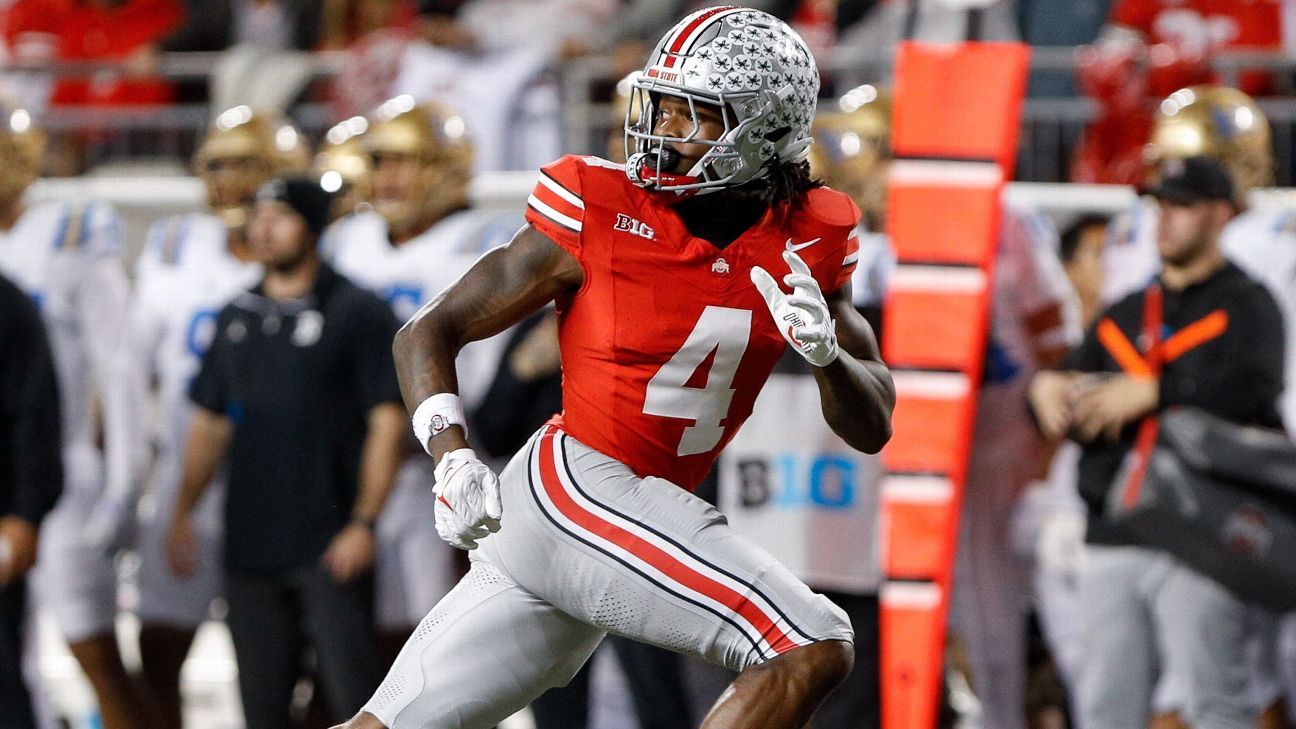
Smith’s highlight reel of acrobatic, one-handed catches continues to grow, and he arguably has been the best player in college football this season. He was the fastest Buckeyes player to reach career marks of 2,000 receiving yards (24 games), 100 catches (20) and 25 touchdown receptions (25).


2025 stats: 78.4% completion pct, 3,323 passing yards, 31 touchdowns, 6 interceptions

Sayin might have captured the Heisman Trophy this season if Ohio State’s offense hadn’t flopped in its 13-10 loss to Indiana in the Big Ten championship game. In his first season as a starter, Sayin is on pace to break the NCAA single-season pass completion record of 77.4%, set by Oregon’s Bo Nix in 2023.


2025 stats: 70.7% completion pct, 2,691 passing yards, 442 rushing yards, 31 total touchdowns

In his first full season as Georgia’s starting quarterback, Stockton helped guide the Bulldogs to a 12-1 record and SEC title. His legs and right arm were a big reason the Bulldogs averaged 31.9 points, despite enduring myriad injuries on the offensive line. Stockton was at his best when the game was on the line — he completed 86% of his passes with 11 touchdowns and one interception in the fourth quarter against ranked opponents.


2025 stats: 84 receptions, 970 receiving yards, 7 receiving touchdowns

Toney’s teammates call him “Baby Jesus,” and the true freshman delivered in a big way in his first season with the No. 10 Hurricanes. He ranks sixth in the FBS with 84 catches and had 1,328 all-purpose yards. Toney even threw for two scores. Not bad for an 18-year-old who would be a senior in high school if he hadn’t reclassified to the class of 2025.


2025 stats: 61.4% completion pct, 2,942 passing yards, 32 total touchdowns

Even after all the hand-wringing about Manning being overrated at the start of the season, the former five-star recruit ended up putting together a good campaign, throwing for 2,942 yards with 24 touchdowns. The No. 13 Longhorns need to find some offensive linemen (he was sacked 23 times) and receivers to help him in 2026.


2025 stats: 65.5% completion pct, 3,016 passing yards, 24 total touchdowns

Ole Miss officials have submitted a waiver to the NCAA on Chambliss’ behalf for another season of eligibility. He played his first three seasons at Division II Ferris State before transferring to Ole Miss this year. He was named SEC Newcomer of the Year after taking over the starting job in the third game of the season.


2025 stats: 1,560 rushing yards, 16 touchdowns

A transfer from Louisiana-Monroe, Hardy led the FBS with 130 rushing yards per game and was No. 2 with 1,560 total rushing yards. He had eight 100-yard games for the Tigers, including a whopping 300-yard effort with three touchdowns in a 49-27 victory against Mississippi State on Nov. 15.


2025 stats: 61.8% completion pct, 2,932 passing yards, 466 rushing yards, 31 total touchdowns

Reed announced this week that he plans to stay at Texas A&M next season, which is great news for the No. 7 Aggies. He was a threat with the ball in his hands, throwing for 2,932 yards with 25 touchdowns and running for 466 yards with six scores. His decision-making needs to continue to improve, so he can cut down on his 10 interceptions.


2025 stats: 63.6% completion pct, 3,117 passing yards, 20 total touchdowns

There’s a reason new Bears coach Tosh Lupoi took a late-night flight to Hawai’i to make sure Sagapolutele was staying at Cal. He was only the second true freshman in FBS history to pass for 200 yards or more in each of his first 11 starts. In the Bears’ late-season upsets of then-No. 21 SMU and No. 15 Louisville, Sagapolutele passed for a combined 653 yards with six touchdowns and no picks.


2025 stats: 1,279 rushing yards, 20 touchdowns

After transferring from Missouri, Lacy helped the No. 6 Rebels win 11 games in the regular season for the first time. He ranks No. 2 in the FBS with 20 rushing touchdowns and piled up 1,279 yards on the ground. Will he follow former coach Lane Kiffin to LSU or remain with the Rebels in 2026?


2025 stats: 66.2% completion pct, 3,431 passing yards, 29 total touchdowns

If Maiava returns to the No. 16 Trojans for another season, he’ll probably flourish in Lincoln Riley’s offense. This year, he threw for 3,431 yards with 23 touchdowns and 8 interceptions. He ranks No. 1 with a 91.2 total QBR. According to Pro Football Focus, he was second in the FBS with 26 big-time throws. (A big-time throw is defined as a high-difficulty, high-value pass.)


2025 stats: 1,035 rushing yards, 6 total touchdowns

Jackson became the fifth true freshman in OSU history to produce a 1,000-yard season, joining Robert Smith (1990), Maurice Clarett (2002), JK Dobbins (2017) and TreVeyon Henderson (2021). That’s good company. And, of course, he’d be the second Bo Jackson to collect a stiff-armed trophy.


2025 stats: 70.2% completion pct, 4,129 passing yards, 36 total touchdowns

Mestemaker is one of the best stories in college football. He didn’t start a single game in high school, then joined North Texas as a walk-on. This season, he led the FBS with 4,129 passing yards, helping him capture the Burlsworth Trophy as the top walk-on in the country. Will he join former Mean Green coach Eric Morris at Oklahoma State in 2026?


CJ Carr, QB, Notre Dame

2025 starts: 66.6% completion pct, 2,741 passing yards, 24 touchdowns

Fighting Irish coach Marcus Freeman entrusted Carr to lead his offense after a heated battle in preseason camp. The decision paid off, as Carr put together one of the best performances by a first-time starter in Notre Dame history. He threw for at least one touchdown in each of his first 12 starts, becoming the first Irish player to do that since Everett Golson in 2012-14. Carr’s 24 passing touchdowns are tied for the most in the first 12 starts by a Notre Dame player since 1966.


2025 stats: 70% completion pct, 2,850 passing yards, 595 rushing yards, 27 total touchdowns

Williams is one of the best dual-threat quarterbacks in the FBS, and his ability to run and throw was on display in the Huskies’ 38-19 victory against Rutgers on Oct. 10. He became the first player in school history to pass for at least 400 yards (400) and run for at least 100 (136) in the same game. Williams was second on the team with 595 rushing yards.

Others to watch: Sam Leavitt, QB, TBA; Cam Coleman, WR, Auburn; Brendan Sorsby, QB, Cincinnati; Josh Hoover, QB, TCU; Darian Mensah, QB, Duke; Nate Frazier, RB, Georgia; LJ Martin, RB, BYU; Bear Bachmeier, QB, BYU; LaNorris Sellers, QB, South Carolina; Bryce Underwood, QB, Michigan

Continue Reading

Sports

QB Mendoza first Hoosier to win Heisman Trophy

Published

on

By

QB Mendoza first Hoosier to win Heisman Trophy

NEW YORK — Fernando Mendoza, the enthusiastic quarterback of No. 1 Indiana, won the Heisman Trophy on Saturday night, becoming the first Hoosier to win college football’s most prestigious award since its inception in 1935.

Mendoza claimed 2,362 points, including 643 first-place votes. He beat Vanderbilt quarterback Diego Pavia (1,435 points), Notre Dame running back Jeremiyah Love (719 points) and Ohio State quarterback Julian Sayin (432 points).

Mendoza guided the Hoosiers to their first No. 1 ranking and the top seed in the 12-team College Football bracket, throwing for 2,980 yards and a national-best 33 touchdown passes while also running for six scores. Indiana, the last unbeaten team in major college football, will play a College Football Playoff quarterfinal game in the Rose Bowl on Jan. 1.

Mendoza, the Hoosiers’ first-year starter after transferring from California, is the triggerman for an offense that surpassed program records for touchdowns and points set during last season’s surprise run to the CFP.

A redshirt junior, the once lightly recruited Miami native is the second Heisman finalist in school history, joining 1989 runner-up Anthony Thompson. Mendoza is the seventh Indiana player to earn a top-10 finish in Heisman balloting and it marks another first in program history — having back-to-back players in the top 10. Hoosiers quarterback Kurtis Rourke was ninth last year.

Quarterbacks have won the Heisman four of the last five years, with two-way player Travis Hunter of Colorado ending the run last season.

The Heisman Trophy presentation came after a number of accolades were already awarded. Mendoza was named The Associated Press player of the year earlier this week and picked up the Maxwell and Davey O’Brien awards Friday night while Love won the Doak Walker Award.

THE CONFIDENT COMMODORE

Pavia threw for a school-record 3,192 yards and 27 touchdowns for the Commodores, who were pushing for a CFP berth all the way to the bracket announcement. He is the first Heisman finalist in Vanderbilt history.

Generously listed as 6 feet tall, Pavia led Vanderbilt to its first 10-win season along with six wins against Southeastern Conference foes. That includes four wins over ranked programs as Vandy reached No. 9, its highest ranking in The Associated Press Top 25 since 1937.

Pavia went from being unrecruited out of high school to junior college, New Mexico State and finally Vanderbilt in 2024 through the transfer portal.

Brash and confident, the graduate student from Albuquerque, New Mexico, calls himself “a chip on the shoulder guy” and he was feisty off the field, too: He played his fourth Division I season under a preliminary injunction as he challenges NCAA eligibility rules; he contends his junior college years should not count against his eligibility, citing the potential losses in earnings from name, image and likeness deals as an illegal restraint on free trade.

Vandy next plays in the ReliaQuest Bowl against Iowa on Dec. 31.

THE LEADER OF THE BUCKEYES

Sayin led the Buckeyes to a No. 1 ranking for most of the season, throwing for 3,329 yards while tying for second in the country with 31 TD passes ahead of their CFP quarterfinal at the Cotton Bowl on Dec. 31.

The sophomore from Carlsbad, California, arrived at Ohio State after initially committing to Alabama and entering the transfer portal following a coaching change. He played four games last season before winning the starting job. He led the Buckeyes to a 14-7 win in the opener against preseason No. 1 Texas and kept the team atop the AP Top 25 for 13 straight weeks, tying its second-longest run.

Sayin was only the second Bowl Subdivision quarterback in the last 40 years to have three games in a season with at least 300 yards passing, three touchdowns, no interceptions, and a completion rate of at least 80%. West Virginia’s Geno Smith was the other in 2012.

Sayin follows a strong lineage of Ohio State quarterbacks since coach Ryan Day arrived in 2017. Dwayne Haskins (2018), Justin Fields (2019), C.J. Stroud (2021), and Kyle McCord (2023) averaged 3,927 passing yards, 40 TDs, and six interceptions, along with a 68.9% completion rate during their first seasons.

THE LOVE OF THE IRISH

The last running back to win the Heisman was Alabama’s Derrick Henry in 2015. Love put himself in the mix with an outstanding season for Notre Dame.

The junior from St. Louis was fourth in the Bowl Subdivision in yards rushing (1,372), fifth in per-game average (114.3) and third with 18 rushing touchdowns for the Fighting Irish, who missed out on a CFP bid and opted not to play in a bowl game.

He was the first player in Notre Dame’s storied history to produce multiple TD runs of 90 or more yards, a 98-yarder against Indiana in the first round of last year’s playoffs and a 94-yarder against Boston College earlier this season.

He padded his Heisman resume with a series of highlights displaying an uncanny ability to maintain his balance while hurdling defenders, spinning out of tackles or rolling off opponents. He teamed with Jadarian Price to create one of the season’s top running back duos, a combination that helped first-time starter CJ Carr emerge as one of the nation’s best young quarterbacks.

Continue Reading

Sports

Washington staying with Terrapins for ’26 season

Published

on

By

Washington staying with Terrapins for '26 season

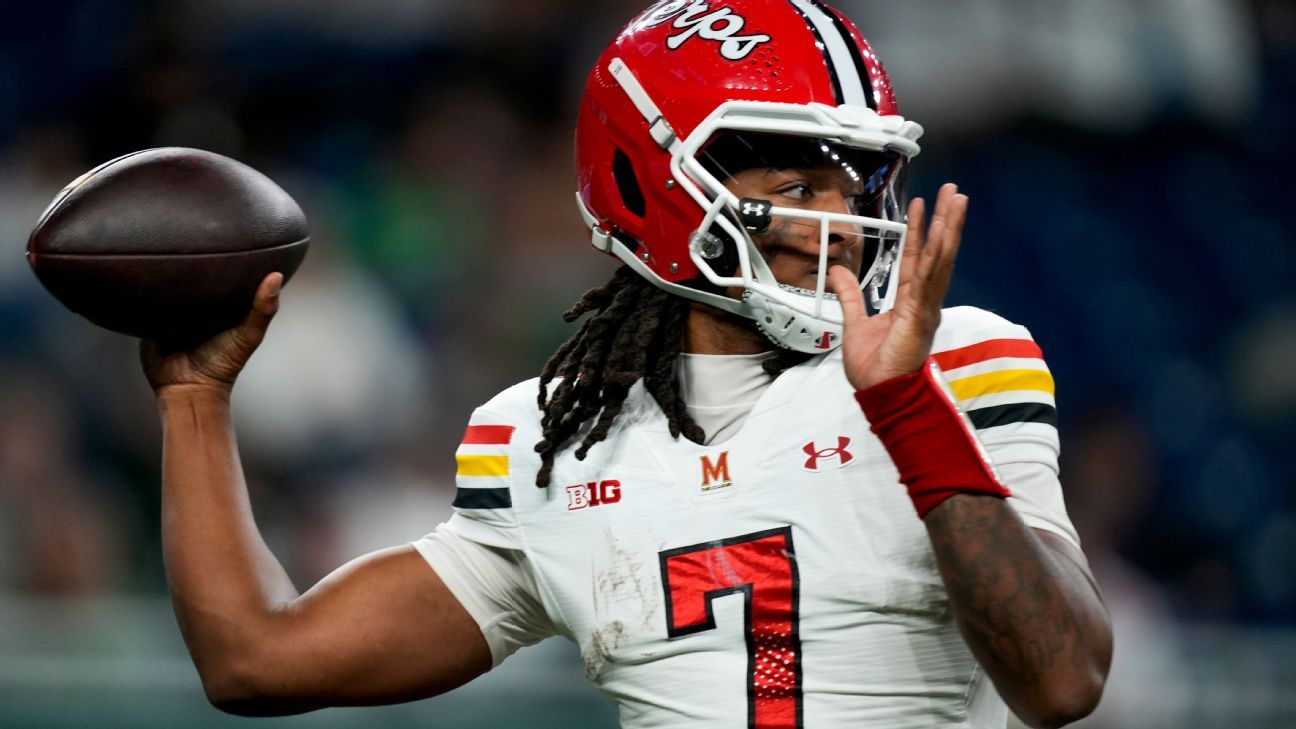
Maryland quarterback Malik Washington, who set the team’s freshman passing record this fall, will return to the Terrapins for the 2026 season.

Washington set Maryland freshman records for passing yards (2,963) and completions (273) this season, while connecting on 17 touchdown passes. He reached 200 passing yards in all but one game and finished as just the second Big Ten freshman since 1996 to record at least 2,500 passing yards and at least 300 rushing yards.

“Representing this team, this area, means so much to me and my family,” Washington said in a statement Saturday. “This is home and we’re going to continue keeping the best athletes from this area here with the Terps. I believe in everyone in our facility and I know we’re building something that our fans will be excited about for years to come.”

Washington, the nation’s No. 134 recruit in the 2025 class, grew up in Severn, Maryland, about 30 miles from Maryland’s campus. Despite a 4-8 record that included only one Big Ten win, Maryland announced that coach Mike Locksley, who recruited Washington, would return in 2026. Locksley will enter his eighth season as Maryland’s coach.

“Malik is a Terp through and through and I’m thrilled he’s coming back to lead this football team,” Locksley said in a statement. “He means so much to this area and this area means so much to him. What we saw from Malik this past season is only the tip of the iceberg. He has such a bright future and he’s already started putting the work in towards the 2026 season.”

Continue Reading

Trending