
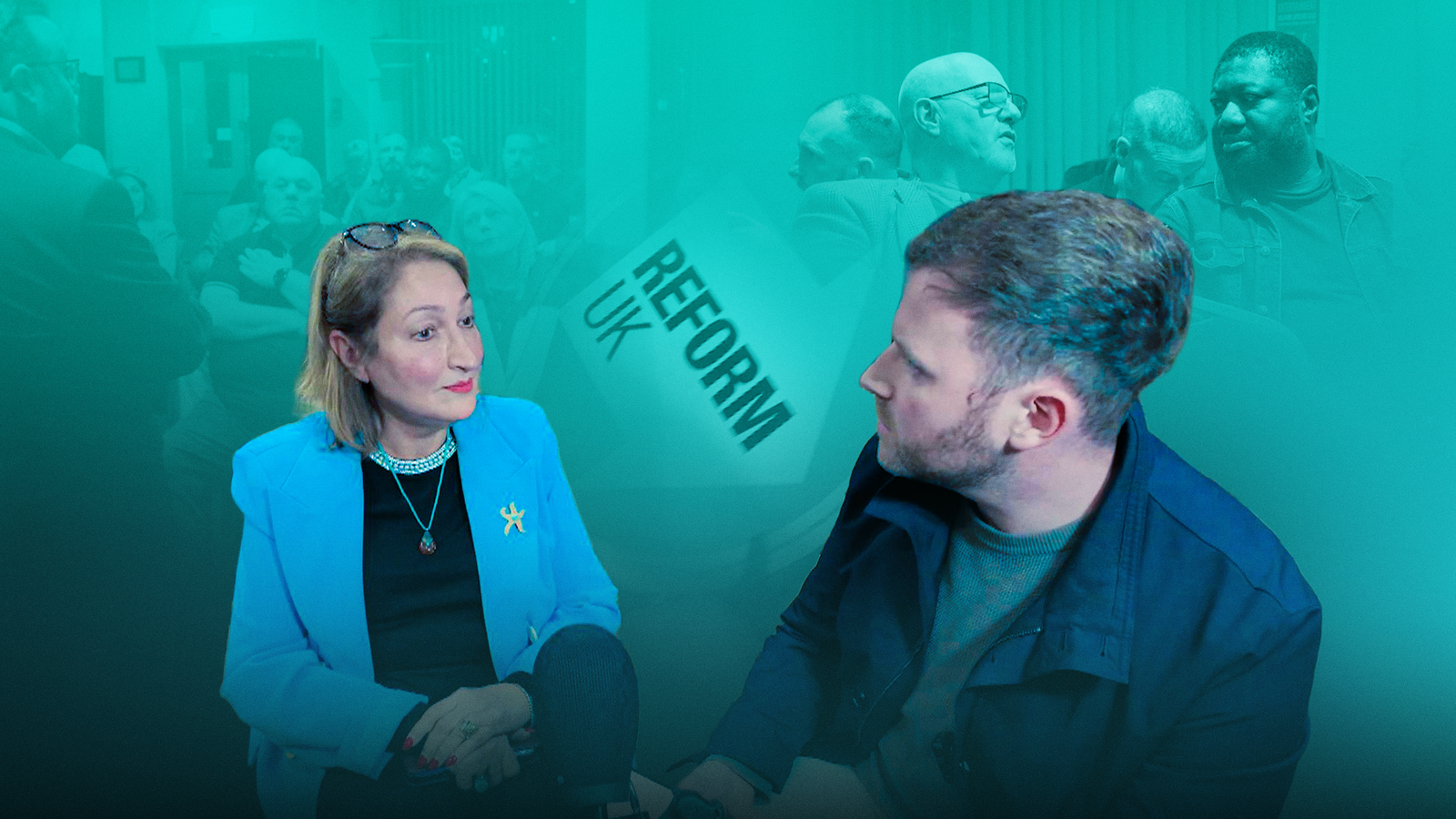
‘Put them in camps and deport them’: Sky News gets rare access inside Reform UK meeting

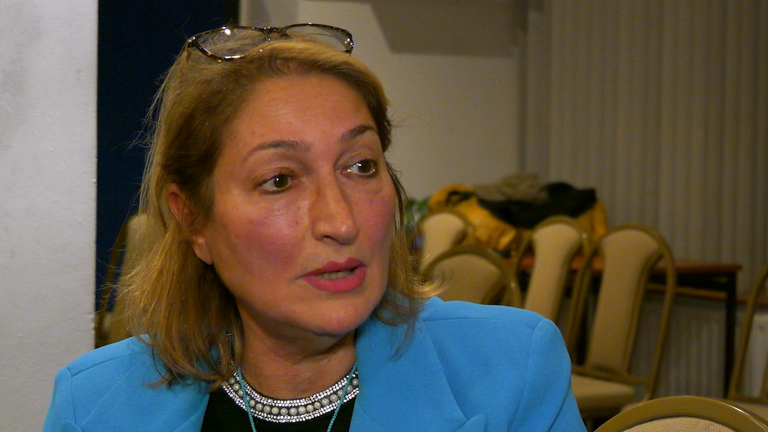
“Put them in camps and deport them.”
That is the view on illegal immigrants of Faten Hameed, who has passed the vetting stage and is now hoping to stand for Reform UK in next year’s Scottish parliamentary elections.
Ms Hameed, who moved to Scotland from Iraq 30 years ago, believes the country is now “drained” and says asylum seekers “shouldn’t be here”.
She is one of about 1,000 members of Reform’s branch in Glasgow, with the party attempting to come from nothing to become Holyrood’s second largest.
Faten Hameed says people in the UK illegally should be put in camps and deported
Reform rarely opens up, with the party often keeping events quiet and relying on encrypted WhatsApp groups to coordinate their efforts.
But we’ve been given exclusive access to a branch meeting inside a small bowling club.
The group’s discussion is raw and unfiltered.
‘Natives first’
Grant Caldwell didn’t mince his words.
“I am sick of the same old politics,” he said.
Asked what he wanted changed, he said: “I am more concerned about the social housing aspect from native people.

Niall (left) and Grant say homeless Scots should be prioritised for housing
“There is a lot of homeless Scots that aren’t getting a bed or a homeless accommodation – to suit the migrants.
“Natives first, I think.
“Obviously, I don’t mind helping people out, but we have to prioritise our own people first.”
Nodding along beside him is Niall.
A former UKIP member, he tells me Reform now feels like home.
We then meet Audrey Dempsey, who quit as a Labour councillor after being accused of making racist remarks.
She now represents Reform in Glasgow.
“If they [migrants] were arriving in the country, and they were fitting in with our culture and values and learning our way of life then that would be more than welcome,” she says.
Asked what she meant, Ms Dempsey says: “Well, instead of trying to inflict their culture on other people here like Sharia law. They are trying to bring that here.”

Audrey Dempsey quit as a Labour councillor
Questioned on who she believed was introducing Sharia law and where, she said: “The asylum seekers. Some of the asylum seekers. The legal migrants. Absolutely.
“Do you not have conversations in the street? You just have to take a walk through Glasgow city centre on any given day. I think by the line of questioning that you haven’t, if you are so shocked by this.”
Asked for evidence to substantiate her claims, Ms Dempsey said there was “stacks of evidence online”.
And questioned if she believed “they are coming to take over,” the Reform councillor said: “I don’t quite know what I believe at this moment.”
Ms Dempsey said there had been “too many” crimes involving asylum seekers in Glasgow, but was unable to provide any specific details “off the top of my head right now”.

Audrey Dempsey says migrants need to ‘fit in with our culture’
‘It’s a fix’
At another table I am introduced to retiree Gordon Miller, who is now the treasurer of Reform’s Glasgow operation.
He accused the SNP of rigging the system when I told him polls suggested John Swinney’s party could win again and enter their third decade in power.
He said: “There is nothing like a bit of gerrymandering to make sure the constituencies fit your profiles.
“It has been a fix for donkey’s years, and the facts speak for themselves. They keep changing the borders so regularly.”
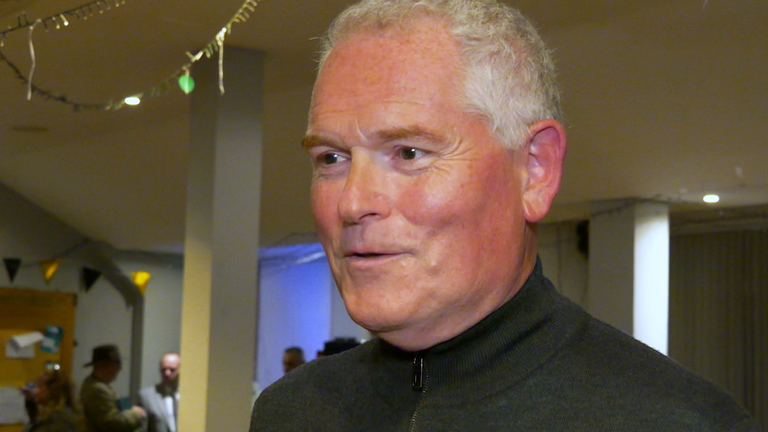
Gordon Miller claims Scottish boundaries are rigged
A review of changes to constituency boundaries has been submitted to Scottish ministers for approval.
Reform plans to stand a candidate in each Scottish constituency next May.
Those hoping to be successful are currently going through a vetting process and “assessment centres” and mock interviews.
One of those wannabe MSPs is Paul Bennie, an army veteran turned ambulance worker who joined Reform UK a year ago.
“Politics is bust,” he says. “We do need Reform. We need to change the way we do politics and change people’s futures for the better.”
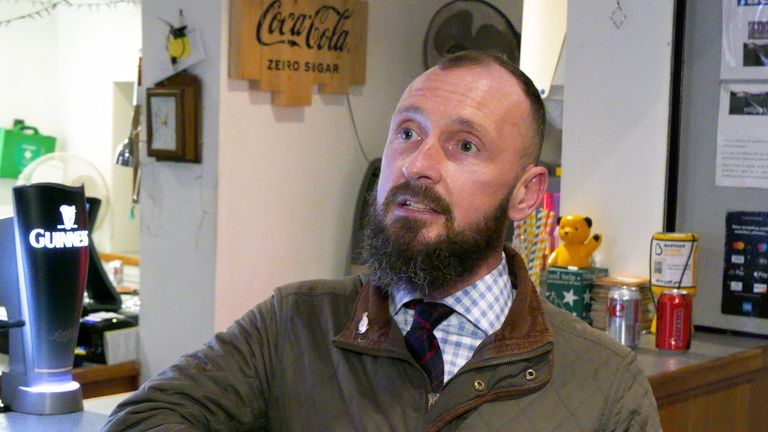
‘Politics is bust,’ says Paul Bennie
‘Put them in camps’
Ms Hameed has been part of three political parties since 2020.
She was once a Labour general election candidate before switching to the Conservatives and recently defected to Reform.
The Scottish Iraqi Association chairwoman has passed the official vetting stages to stand for Reform in May.
She tells us that immigration is one of her top two priorities.
Asked if Reform would deport anyone, she said: “For illegal immigration, yes. Put them in camps and deport them. They shouldn’t be here.”
Questioned on whether she was calling for the establishment of deportation camps in the UK, Ms Hameed said: “Why not? Other countries have done it.”
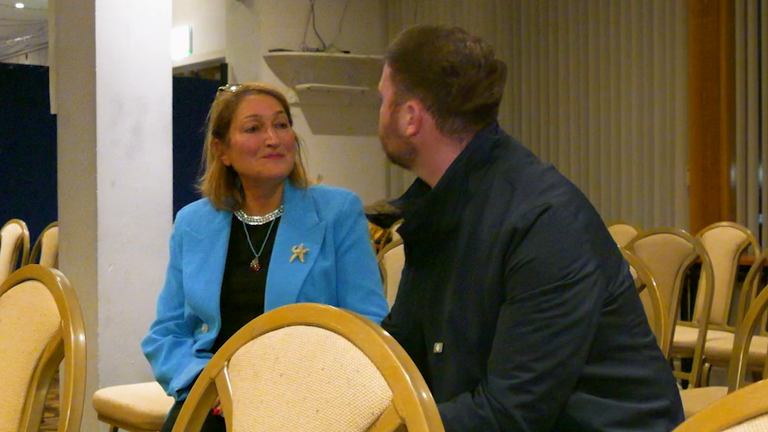
Faten Hameed recently defected to Reform and will stand as a candidate in May’s Scottish Parliament elections
When pushed on where camps should be set up, she said: “It is for the government to decide”.
“They would be in the UK as the boats are coming to us,” she says. “They are all seeking asylum. Why are they here? Why?”
She denied making policy up as she goes along, saying: “It’s not a matter of what is Reform policy, it is a matter of what is required. The country is drained.”
Reform a ‘serious competitor’ in Scotland
Britain’s leading polling expert, Professor Sir John Curtice, told Sky News there was a “very clear race” between Reform and Labour for second place in Scotland.
He said: “The rise of Reform is a remarkable story. They are a serious competitor for becoming the principal opposition party at Holyrood.”
A Survation poll in May suggested Nigel Farage’s party will beat the other unionist parties in 2026, although by September Labour had edged ahead by two points.
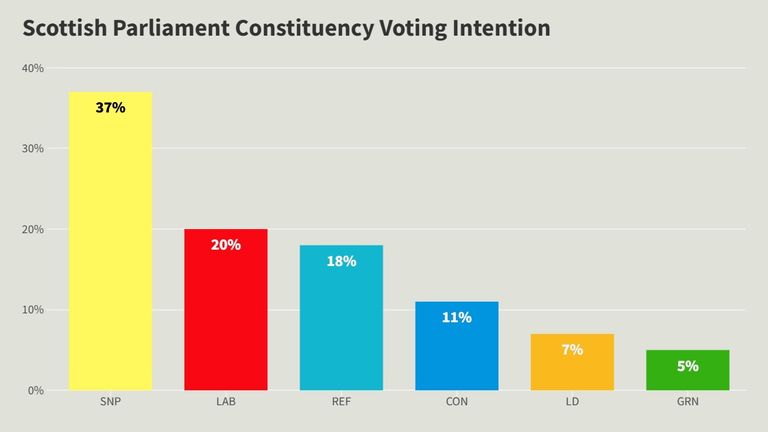
Survation polling from September
Mr Farage previously told me he would not be standing in the Holyrood election, and the party would have a bespoke leader north of the border.
Thomas Kerr, a Glasgow councillor who defected from the Conservatives to Reform in January, did not deny he would throw his hat in the ring to be the Scottish party chief.
He told us that the potential candidates we met going “off-script” was “problem we are working with”.
But he insisted vetting procedures have been strengthened and “every candidate we will see standing for Reform UK will be top-notch”.
Responding to the claims made in this report, SNP leader and First Minister John Swinney said he was “very concerned”.
“Sharia law is not taking over Scotland, and I find the idea of deportation camps just utterly repugnant,” he said.
“I think what you are sharing with me reinforces my view that the politics of Nigel Farage are repulsive, and Scotland should have nothing to do with it.”
The Reform UK party in London told Sky News it had nothing further to add in response to this report.

The US Securities and Exchange Commission (SEC) sent warning letters to several exchange-traded fund (ETF) providers, halting applications for leveraged ETFs that offer more than 200% exposure to the underlying asset.
ETF issuers Direxion, ProShares, and Tidal received letters from the SEC citing legal provisions under the Investment Company Act of 1940.
The law caps exposure of investment funds at 200% of their value-at-risk, defined by a “reference portfolio” of unleveraged, underlying assets or benchmark indexes. The SEC said:
“The fund’s designated reference portfolio provides the unleveraged baseline against which to compare the fund’s leveraged portfolio for purposes of identifying the fund’s leverage risk under the rule.”

The SEC directed issuers to reduce the amount of leverage in accordance with the existing regulations before the applications would be considered, putting a damper on 3-5x crypto leveraged ETFs in the US.
SEC regulators posted the warning letters the same day they were sent to the issuer, in an “unusually speedy move” that signals officials are keen on communicating their concerns about leveraged products to the investing public, according to Bloomberg.
The crypto market took a nosedive in October after a flash crash caused $20 billion in leveraged liquidations, the most severe single-day liquidation event in crypto history, sparking discussions among analysts and investors over the dangers of leverage and its effect on the crypto market.
Related: Vanguard’s 50M+ clients will soon have access to crypto ETFs
Leverage in crypto heats up, amplifying gains, losses, and suppressing markets
“Leverage is clearly out of control,” analysts at The Kobeissi Letter said in response to the SEC warning letters.
Crypto liquidations have nearly tripled this market cycle, according to crypto analysis platform Glassnode.

Liquidations in the crypto futures market during the last cycle averaged about $28 million in long positions and $15 million in shorts per day.
The current cycle is clocking about $68 million in long liquidations and $45 million in short liquidations daily, according to Glassnode.
Demand for leveraged crypto ETFs surged following the 2024 presidential election in the United States, in anticipation of a better regulatory climate for crypto in the US.
Leveraged ETFs are not subject to margin calls and automated liquidations like leveraged crypto derivatives, but can still deal a serious blow to investor capital in a bear market or even a sideways market, as losses compound more quickly than gains.
Magazine: Stop piling into leveraged Bitcoin ETFs and consider this instead


Former US Securities and Exchange Commission Chair Gary Gensler renewed his warning to investors about the risks of cryptocurrencies, calling most of the market “highly speculative” in a new Bloomberg interview on Tuesday.
He carved out Bitcoin (BTC) as comparatively closer to a commodity while stressing that most tokens don’t offer “a dividend” or “usual returns.”
Gensler framed the current market backdrop as a reckoning consistent with warnings he made while in office that the global public’s fascination with cryptocurrencies doesn’t equate to fundamentals.
“All the thousands of other tokens, not the stablecoins that are backed by US dollars, but all the thousands of other tokens, you have to ask yourself, what are the fundamentals? What’s underlying it… The investing public just needs to be aware of those risks,” he said.
Gensler’s record and industry backlash
Gensler led the SEC from April 17, 2021, to Jan. 20, 2025, overseeing an aggressive enforcement agenda that included lawsuits against major crypto intermediaries and the view that many tokens are unregistered securities.
Related: House Republicans to probe Gary Gensler’s deleted texts
The industry winced at high‑profile actions against exchanges and staking programs, as well as the posture that most token issuers fell afoul of registration rules.

Under Gensler’s tenure, Coinbase was sued by the SEC for operating as an unregistered exchange, broker and clearing agency, and for offering an unregistered staking-as-a-service program. Kraken was also forced to shut its US staking program and pay a $30 million penalty.
The politicization of crypto
Pushed on the politicization of crypto, including references to the Trump family’s crypto involvement by the Bloomberg interviewer, the former chair rejected the framing.
“No, I don’t think so,” he said, arguing it’s more about capital markets fairness and “commonsense rules of the road,” than a “Democrat versus Republican thing.”
He added: “When you buy and sell a stock or a bond, you want to get various information,” and “the same treatment as the big investors.” That’s the fairness underpinning US capital markets.
Related: Coinbase files FOIA to see how much the SEC’s ‘war on crypto’ cost
ETFs and the drift to centralization
On ETFs, Gensler said finance “ever since antiquity… goes toward centralization,” so it’s unsurprising that an ecosystem born decentralized has become “more integrated and more centralized.”
He noted that investors can already express themselves in gold and silver through exchange‑traded funds, and that during his tenure, the first US Bitcoin futures ETFs were approved, tying parts of crypto’s plumbing more closely to traditional markets.
Gensler’s latest comments draw a familiar line: Bitcoin sits in a different bucket, while most other tokens remain, in his view, speculative and light on fundamentals.
Even out of office, his framing will echo through courts, compliance desks and allocation committees weighing BTC’s status against persistent regulatory caution of altcoins.
Magazine: Solana vs Ethereum ETFs, Facebook’s influence on Bitwise — Hunter Horsley
-
 Sports2 years ago
Story injured on diving stop, exits Red Sox game
-
 Sports3 years ago
‘Storybook stuff’: Inside the night Bryce Harper sent the Phillies to the World Series
-
 Sports2 years ago
Game 1 of WS least-watched in recorded history
-
 Sports3 years ago
Button battles heat exhaustion in NASCAR debut
-
 Sports3 years ago
MLB Rank 2023: Ranking baseball’s top 100 players
-
Sports4 years ago
Team Europe easily wins 4th straight Laver Cup
-
 Environment3 years ago
Japan and South Korea have a lot at stake in a free and open South China Sea
-
 Environment1 year ago
Here are the best electric bikes you can buy at every price level in October 2024