

VMAX VX2 Hub 33 MPH e-scooter review: Fast yet surprisingly stable – and affordable!

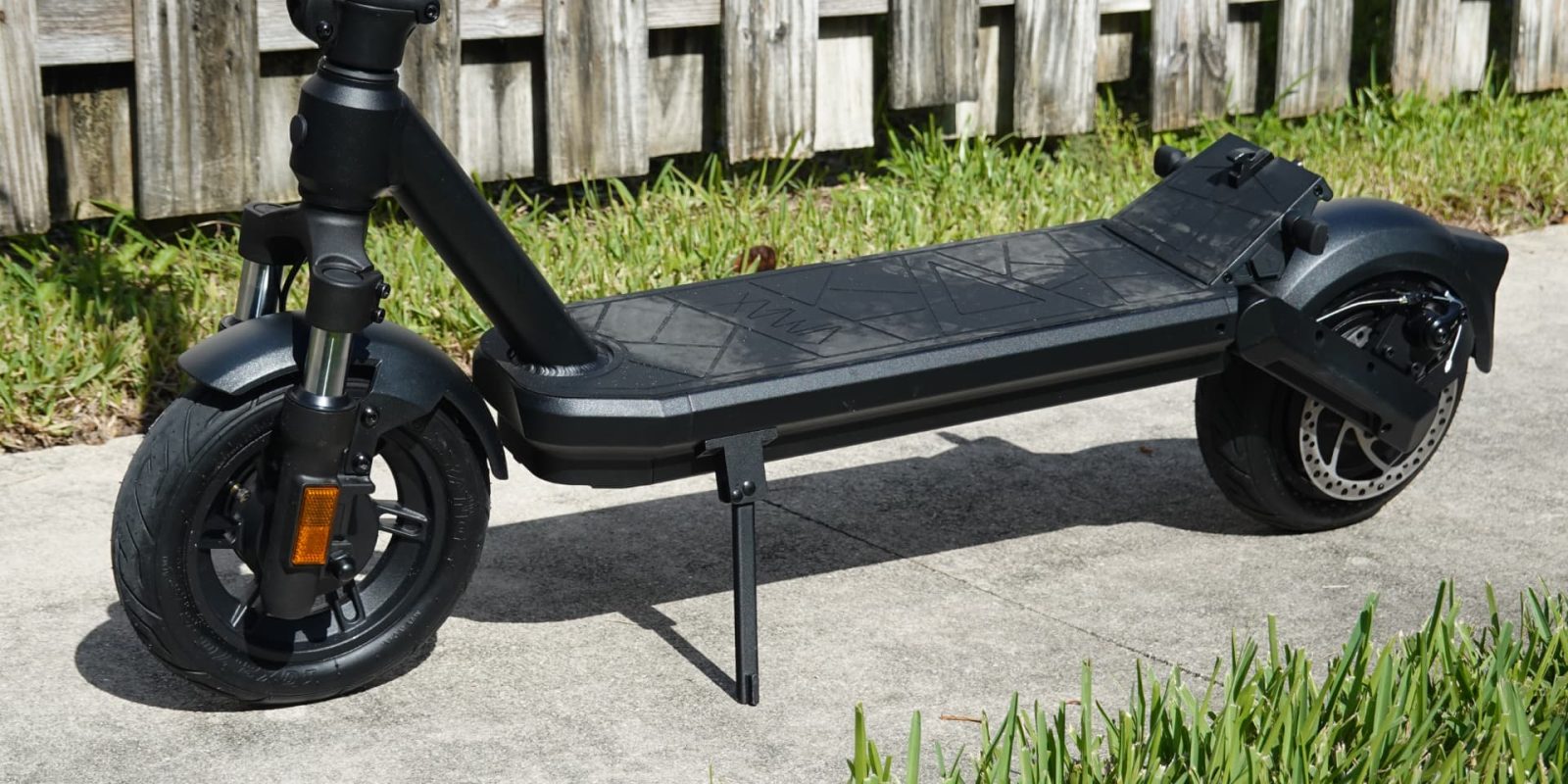
When it comes to high-performance electric scooters that are still reasonably priced, it’s a tricky balance. Most affordable scooters are underpowered and wobbly. The powerful ones often creep into motorcycle territory – with prices to match. But the VMAX VX2 Hub might just be the sweet spot we’ve been waiting for. It’s fast, it’s strong, it’s well-built, and most importantly – it actually feels good to ride.
Let’s dive into what makes this scooter stand out.
VMAX VX2 Hub video review
First of all, I know that seeing is believing, so for those who actually want to see the scooter in action, check out my video review below. Or keep reading for everything else!
Speed and power that actually feel usable
The VMAX VX2 Hub comes in two versions based on battery size – either a 642 Wh (13 Ah) pack or an 874 Wh (18.2 Ah) extended-range model. Both feed a rear hub motor capable of putting out a peak of 1,900W, giving the scooter enough torque to climb 35% grade hills. That’s steeper than pretty much anything you’ll find in San Francisco, and trust me, you’ll feel that power when you hit the throttle.
The top speed is a solid 33 mph. And unlike some scooters that get shaky or sketchy at high speeds, this one feels comfortable even as the numbers climb. It’s the kind of top-end performance that’s thrilling without becoming reckless – though yes, safety gear is still a good idea.
Just don’t do what I did and launch it in full-power mode on your first ride. I gave it full throttle, wasn’t ready for how torquey it was, and immediately pulled a wheelie. This isn’t your budget Amazon scooter with a throttle that’s either “on” or “off.” This one demands finesse – more like driving a vehicle than riding a toy.
And I love that about it, since it’s bad form (and a bad habit) to treat a throttle like an all-or-nothing affair. But weaker e-scooters teach us that bad habit, and when you finally get something with some real power, you have to remember that power is a spectrum.
Comfort, control, and a little class
The rubberized deck provides excellent grip, though it is a bit of a footprint magnet – something I learned when I ruined my clean b-roll shots riding it to the filming location.
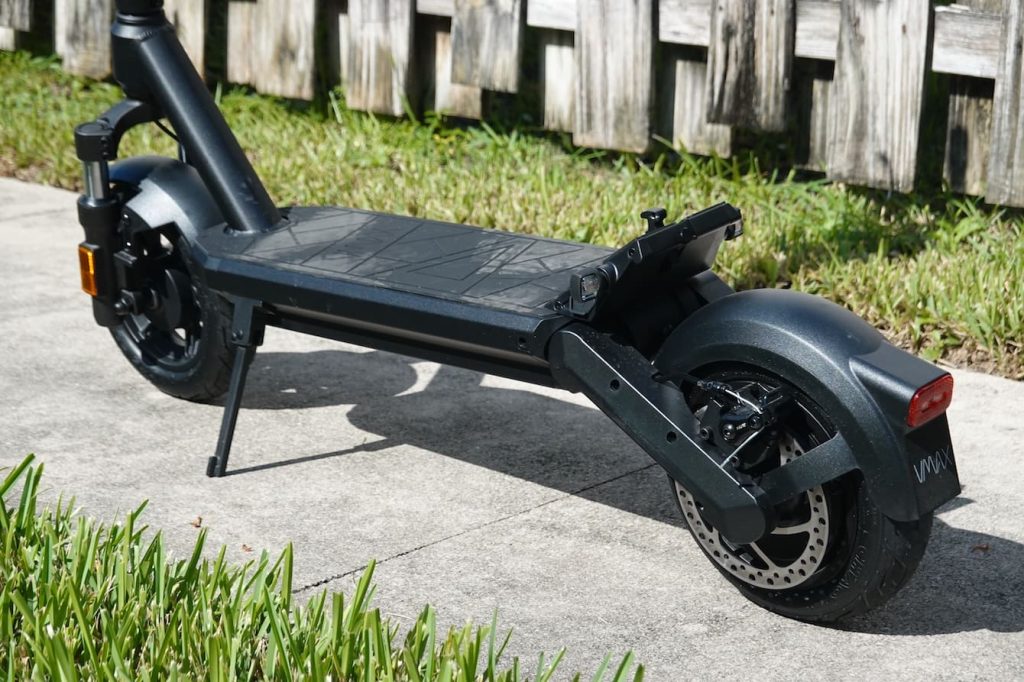
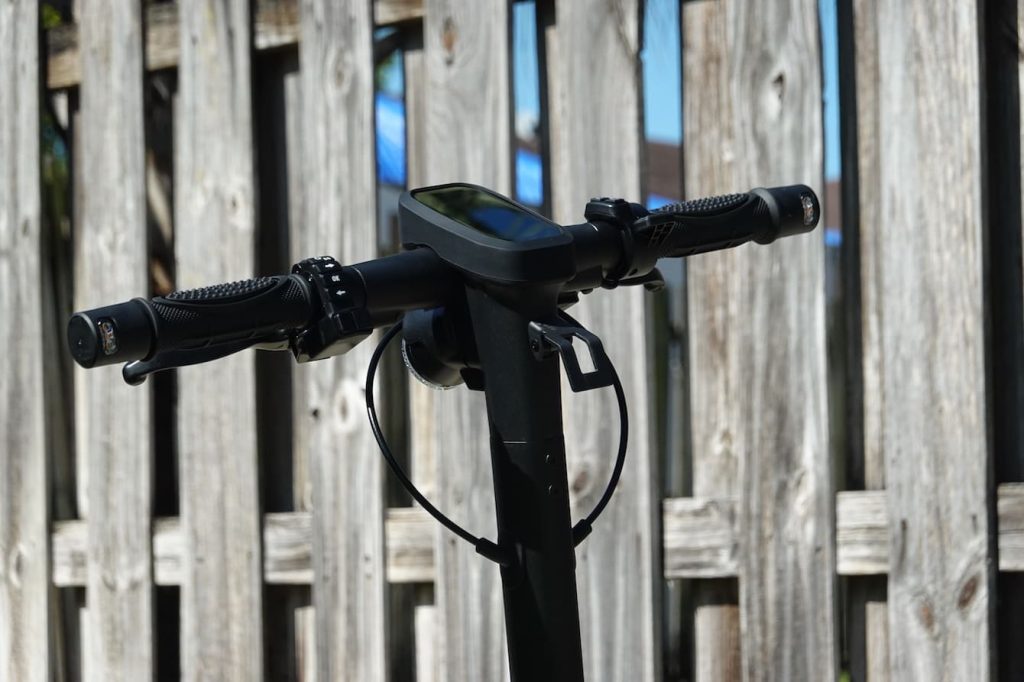
The folding mechanism is particularly well-designed, staying sturdy even under hard riding. And I appreciate the hidden hook-and-lock design at the rear of the deck, which keeps the handlebars secured when folded without a hook being an annoying protrusion during rides, like on most scooters. Just push the spring-loaded button and the locking hook pops up from its flush mount on the rear kick plate. It’s a really slick design. See it in my video review above.
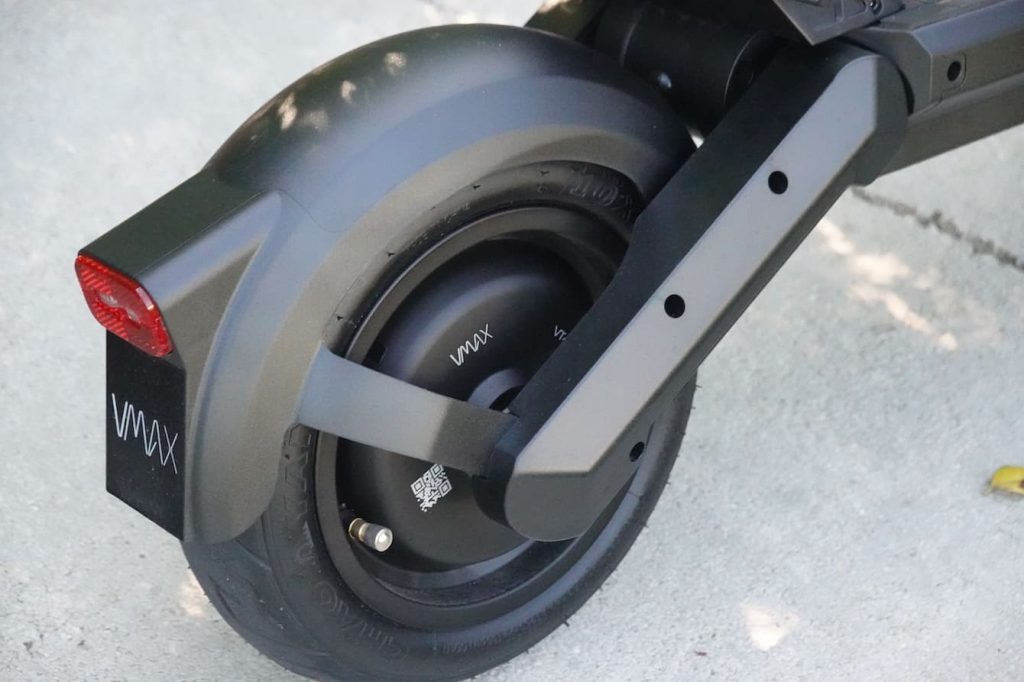
Lighting is another big win here. Rear turn signals stick out wide enough to actually be questionably useful in traffic, if cars are looking for turn signals on the back of a scooter. But there are also turn signals on the handlebars, too, facing both forward and rearward. Night commuting on VMAX scooters has always felt safer thanks to their lighting setups, and the VX2 Hub keeps that tradition strong.
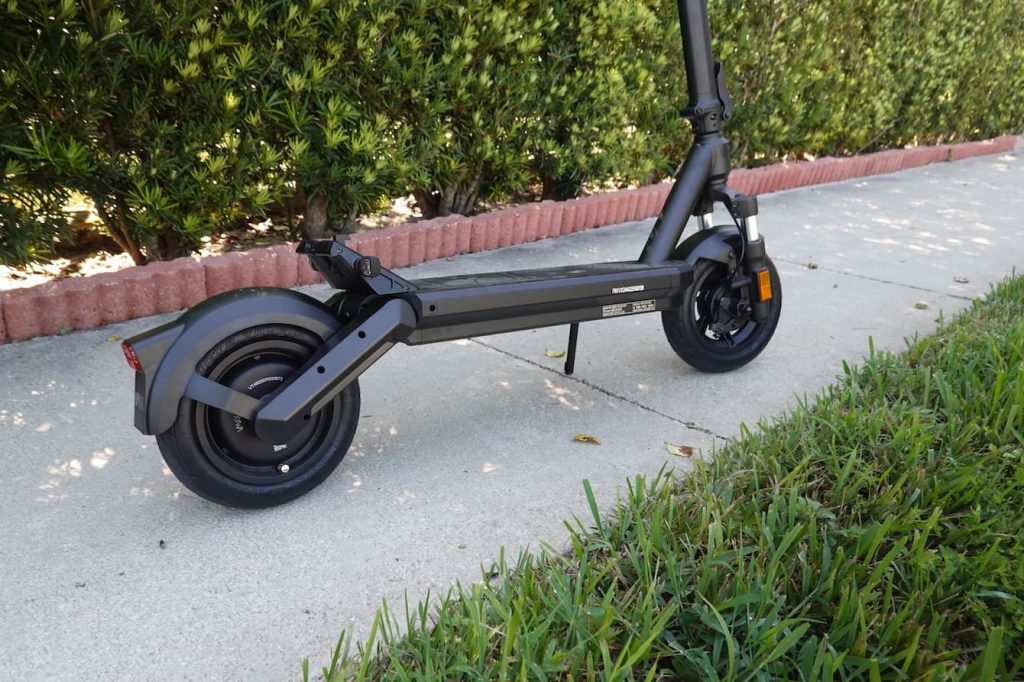
Suspension-wise, it’s not an off-roader – but it doesn’t pretend to be. You can still take it off the paved path now and again, as I did several times, cutting across grassy embankments or taking the odd shortcut through a park. On flatter trails or grassy areas, the full suspension soaks up bumps better than you’d expect. It’s certainly worlds better than a rigid frame or single-suspension setup.
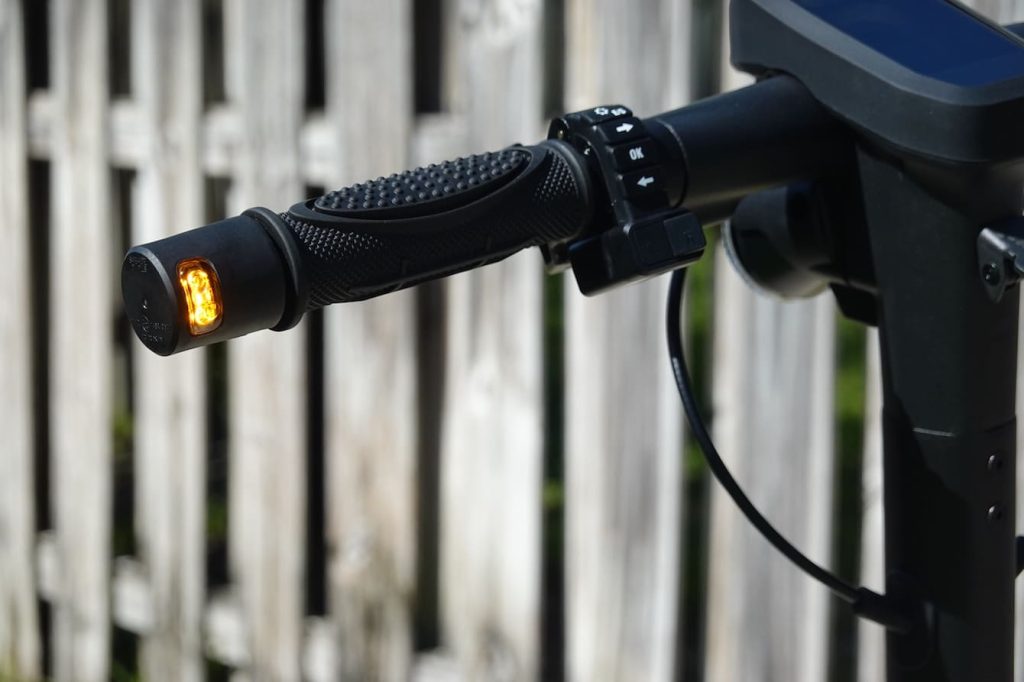

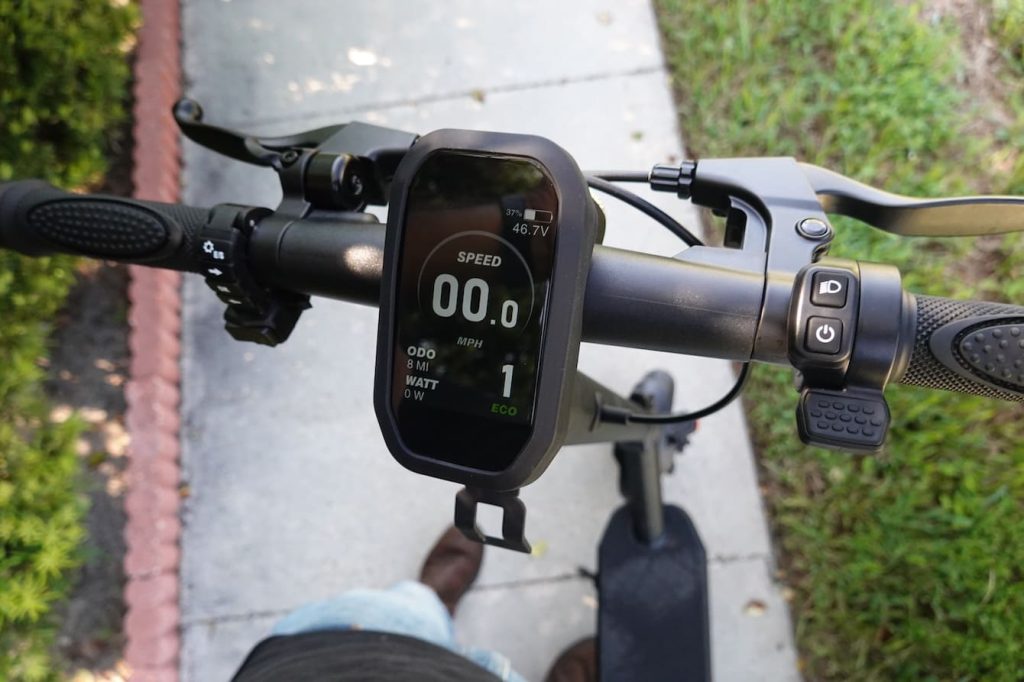
One feature I love is the presence of a USB-C charging port onboard. It’s small, but thoughtful, giving you a convenient way to keep your phone charged on the handlebars. So many scooters still have an older USB-A port, so I’m glad to see VMAX is rolling with the times.
And while VMAX does offer a fairly robust smartphone app, it’s completely optional. You don’t need the app to turn on or ride the scooter – just to unlock a few extra features and getting deeper ride data to nerd out on the numbers. That’s a breath of fresh air in an age where every company wants you to download yet another app just to use the basic functions of your device.
Pricing and value
At $1,199 for the standard battery and a couple hundred more for the extended-range version, the VX2 Hub isn’t a cheap scooter – but it’s an incredible value for what you get. Between the 10-inch tubeless tires, full suspension, fast performance, and sturdy build, it honestly feels more like a mini motorcycle than a last-mile scooter.
And that’s the point. This isn’t a toy. It’s a real vehicle. A compact, fun, efficient, and powerful one.
Over many years, I’ve tested everything from budget scooters to ultra-premium ones, and the VMAX VX2 Hub hits that elusive middle ground where performance meets practicality. It’s got the power and speed you want, with the safety and quality you need – and it doesn’t require a second mortgage.
If your idea of micromobility includes skipping over budget compromises and going straight to the good stuff without breaking the bank, the VX2 Hub deserves a serious look.


FTC: We use income earning auto affiliate links. More.

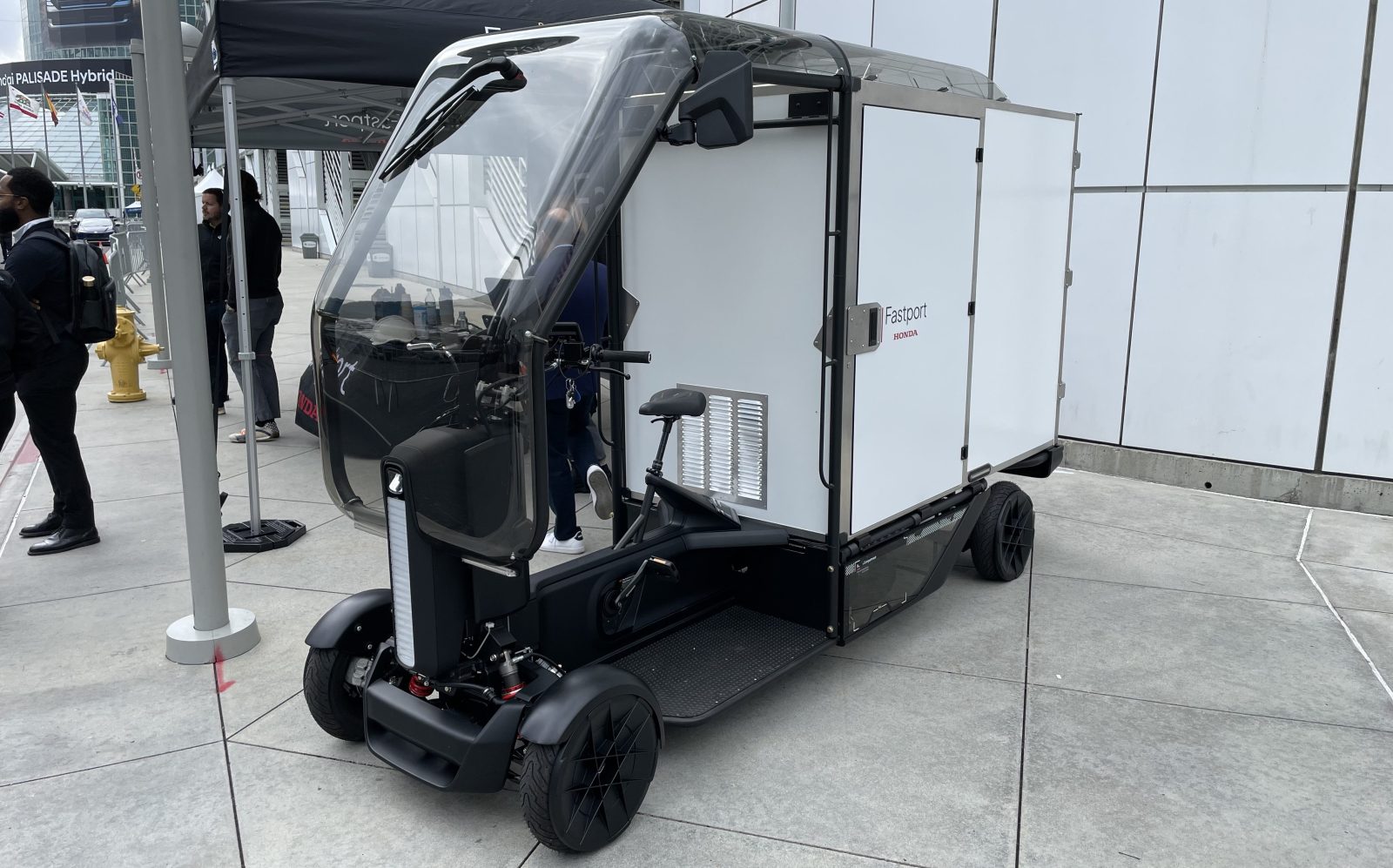
Honda is moving forward with its Fastport delivery quadcycle, and we got a chance to see it up close and take it for a quick spin.
We told you about Honda’s 4-wheeled delivery vehicle back in June, and we were excited about the idea of right-sizing delivery vehicles in urban centers that are often clogged with car traffic.
To catch you up, it’s a four-wheeled electric cargo vehicle that Honda has been working on for short-range, intra-city deliveries. It has 650lb capacity and a 12mph top speed, with 23 miles of range.
That’s not a huge range number, but we’re talking about cities here – Manhattan is 13×2 miles, San Francisco is 7×7 miles, for example. Also, the 2 x 1.3kWh batteries are 22lbs each and easily swappable if you need a little more juice.
The main concept here is that the vehicle is small, built to fit within the width of a bike lane, and to be treated as one in vehicle regulations. This means you can get cargo around in a smaller package than big delivery trucks, causing less traffic, congestion, road wear, and pollution.
Its presence in the bike lane is the reason for some of those limitations above – EU regulations mean the motor can only go up to 250W continuous draw, which also leads to a 12mph top speed for a vehicle that could be laden with ~1,700lbs of bike, cargo and rider (there is also a “small” version which is narrower and shorter, with 320lb capacity, for smaller roads).
But all that is nice on paper, what’s it like in person?
We got a little tour of the bike up close, and then a very brief ride and chance to do a couple three-point turns. And they did have to be three-point turns – this bike is quite long and unwieldy. A smaller turning circle would be nice.
Honda calls the drive system “pedal-by-wire,” and describes it as unique, and it certainly felt as such. The pedaling experience feels fully disconnected from the motor – you do spin the pedals, but the bike seems to do its own thing entirely. This felt strange to me as a person who is used to a torque sensor e-bike, where I’m still pushing even if the bike is helping me.
You might ask why there’s no throttle if the pedals just send a signal to the motor – this is to comply with regulations, making this technically a “pedal assist” vehicle, even though the bike is doing everything.
This is nice for accessibility, as you won’t need to be an athlete to drag 650lbs of cargo around behind you, but it also means the motor and batteries will be doing all of the work and you’ll be limited to a total of 250W of power (whereas if you combined that with the legs of a cyclist, you could add another hundred watts or two of human pedal power).
One question I had is how 2.6kWh worth of batteries could run a 12mph, 250W draw motor for only 23 miles – some napkin math suggests that the range should be much higher than that. But it turns out that the motor has much higher peak draw, as when we were accelerating, it would pull well over 2kW according to the display. And given the batteries are easily swappable, this isn’t much of a limitation.
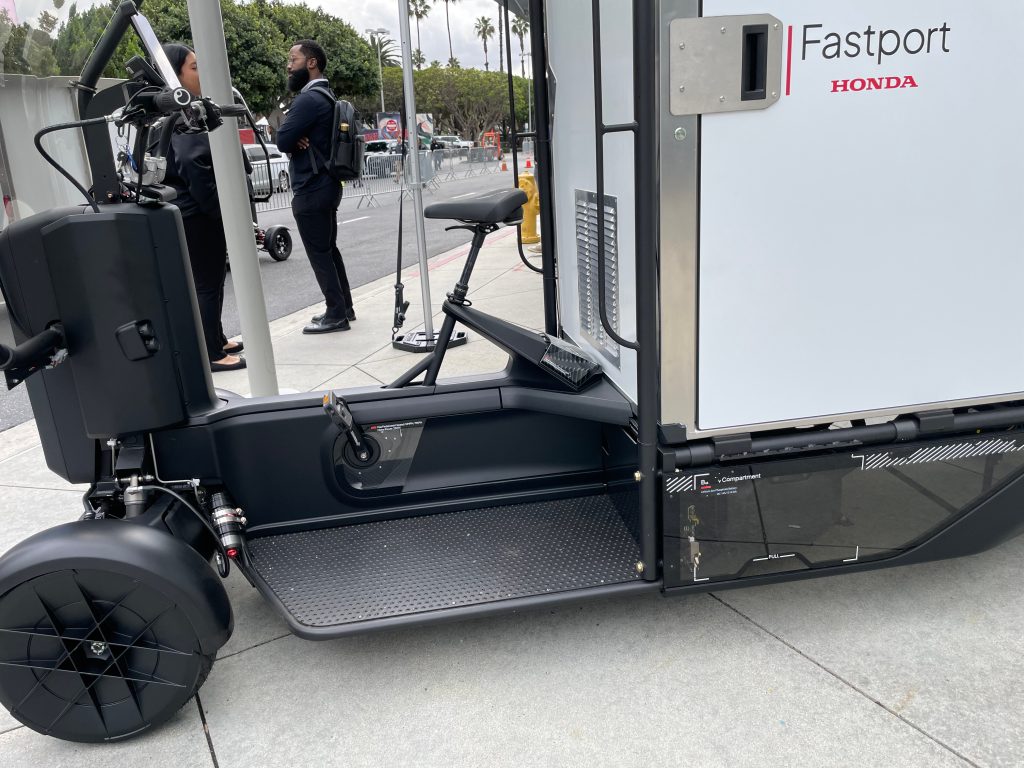
The display and handlebars are much more normal-looking than those seen in early renders. Rather than a large iPad-like display in the center, there’s a smaller one with a rear-view camera (helpful, but not well-calibrated – it makes you seem closer to objects than you actually are), and a side display with the sort of details you’d see in most bike computers, like speed and motor power. The displays are usable with polarized glasses, which is nice, since I’ve encountered quite a few bike displays which aren’t.

The shroud covering the rider’s “compartment” blocks UV light and helps to insulate from rain and wind. The final version will extend further down, adding more wind protection for legs and feet – but when it’s hot out, there’s a ventilation fan as well. Honda told us some things about the bike are still being tweaked from the version we saw… but first deliveries are supposed to start imminently, so we imagine the final version will look quite a lot like what we saw.
The cargo area on the bike is quite basic, just a big box. Shelving or other attachments could be added, depending on the specific implementation (food delivery, flowers, or whatever else). The box can be opened from the side or rear, with a horizontal sliding door on the side, and a vertical sliding door on the rear. It’s available in two sizes, depending on how big your bike lanes and delivery needs are.
But in addition to that basic cargo area, the vehicle has telematics built in, which are very valuable to fleets who want to know where their items are and how deliveries are going at any given time. And will help enable Honda to offer these quads as a “fleet as a service,” where businesses can get access to delivery vehicles, and Honda will even handle battery swaps.
Electrek’s Take
I love the idea of moving deliveries to smaller vehicles, especially since giant trucks can be such a problem in city centers.
But it’s particularly interesting looking at this vehicle versus the type of small delivery trucks that exist in other countries and that we don’t get much of here in the US.
For example, Japanese kei trucks can have a cargo capacity of 700-1000lbs, GVWR of ~2,500lbs, and a maximum length of 134 inches. Compare that to a cargo capacity of 320-650lbs (for small and large versions, respectively), GVWR of 1,433-1,765lbs and length of 134-148 inches for the Honda delivery quad.
So the kei truck has quite a bit more cargo capacity for a similar footprint, but then it makes pollution and requires more road infrastructure than the quad would. And of course… we simply don’t have them in the US.
So, whether comparing them to a gigantic delivery vehicle or even the smaller trucks available in Japan or some parts of Europe, this offers a distinct new option for getting goods around in a city – and one which requires less of the car and truck infrastructure that has taken over our public spaces.
That said… I think a higher speed would be preferable so as not to get in the way of cyclists, or in the case that the vehicle decides to take a real lane and can then keep up with traffic. It will be interesting to see how this and other cargo bikes turn out, whether they gain traction and what sort of challenges they might help cities avoid… or present on their own.
The 30% federal solar tax credit is ending this year. If you’ve ever considered going solar, now’s the time to act. To make sure you find a trusted, reliable solar installer near you that offers competitive pricing, check out EnergySage, a free service that makes it easy for you to go solar. It has hundreds of pre-vetted solar installers competing for your business, ensuring you get high-quality solutions and save 20-30% compared to going it alone. Plus, it’s free to use, and you won’t get sales calls until you select an installer and share your phone number with them.
Your personalized solar quotes are easy to compare online and you’ll get access to unbiased Energy Advisors to help you every step of the way. Get started here.
FTC: We use income earning auto affiliate links. More.


US-based Factorial Energy and South Korea’s POSCO FUTURE M are teaming up on all-solid-state batteries, the “holy grail” of battery tech.
Factorial and POSCO take on all-solid-state EV batteries
All-solid-state batteries promise significant improvements in driving range, charging times, and safety. Although next-gen battery tech shows promise in the lab, proving it in the real world hasn’t been easy.
For one, new equipment is needed to manufacture them. All-solid-state batteries also use a solid electrolyte, unlike the liquid electrolyte used in current lithium-ion batteries.
One of the biggest challenges in bringing the new battery tech to market has been finding a solid material that doesn’t crack yet still conducts electricity.
Factorial Energy and POSCO look to change that. The two companies announced a new partnership at the Future Battery Forum in Berlin this week. Under the agreement, Factorial and POSCO will combine resources to develop materials for all-solid-state batteries.
POSCO already supplies cathode and anode materials to global battery leaders, including LG Energy Solution, SK On, Samsung SDI, and Ultium Cells. Now, it’s looking to strengthen its all-solid-state materials business.


The company is already developing new cathode and silicon anode materials for all-solid-state batteries, but POSCO said it’s also continuing R&D on lithium-metal anode materials and sulfide-based solid electrolytes.
“Solid-state batteries are entering a new era of commercial readiness,” according to Factorial’s CEO, Siyu Huang.

Factorial said that by teaming up with POSCO, it will not only accelerate material development, but also “drive meaningful cost reductions at scale.”
In 2022, Mercedes-Benz, Hyundai, and Stellantis were among the major automakers that invested in Factorial’s $200 million fundraising. The company delivered the first solid-state battery cells based on its FEST (Factorial Electrolyte System Technology) platform last summer.
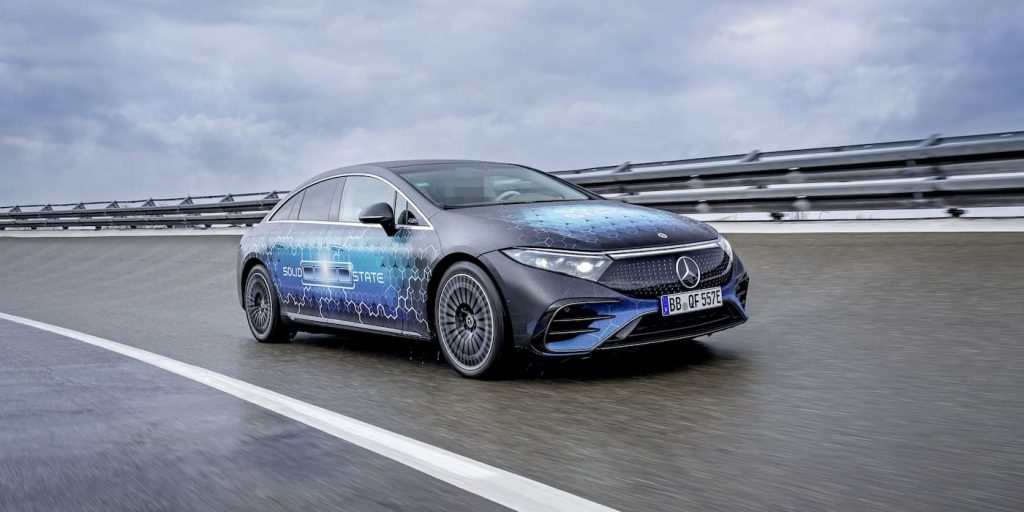
Factorial and Mercedes introduced the co-developed Solstice all-solid-state battery in September 2024, based on the FEST platform.
The company aims to deliver a driving range of over 600 miles with the new battery tech. Mercedes announced in September that it had driven a modified EQS, equipped with a solid-state battery from Stuttgart, Germany, to Malmö, Sweden. After covering 750 miles (1,205 km), the EV still had 85 miles of range remaining.
Mercedes’ tech boss, Markus Schäfer, called solid-state batteries “a true gamechanger for electric mobility,” adding the new tech “delivers not only in the lab but also on the road.”
FTC: We use income earning auto affiliate links. More.

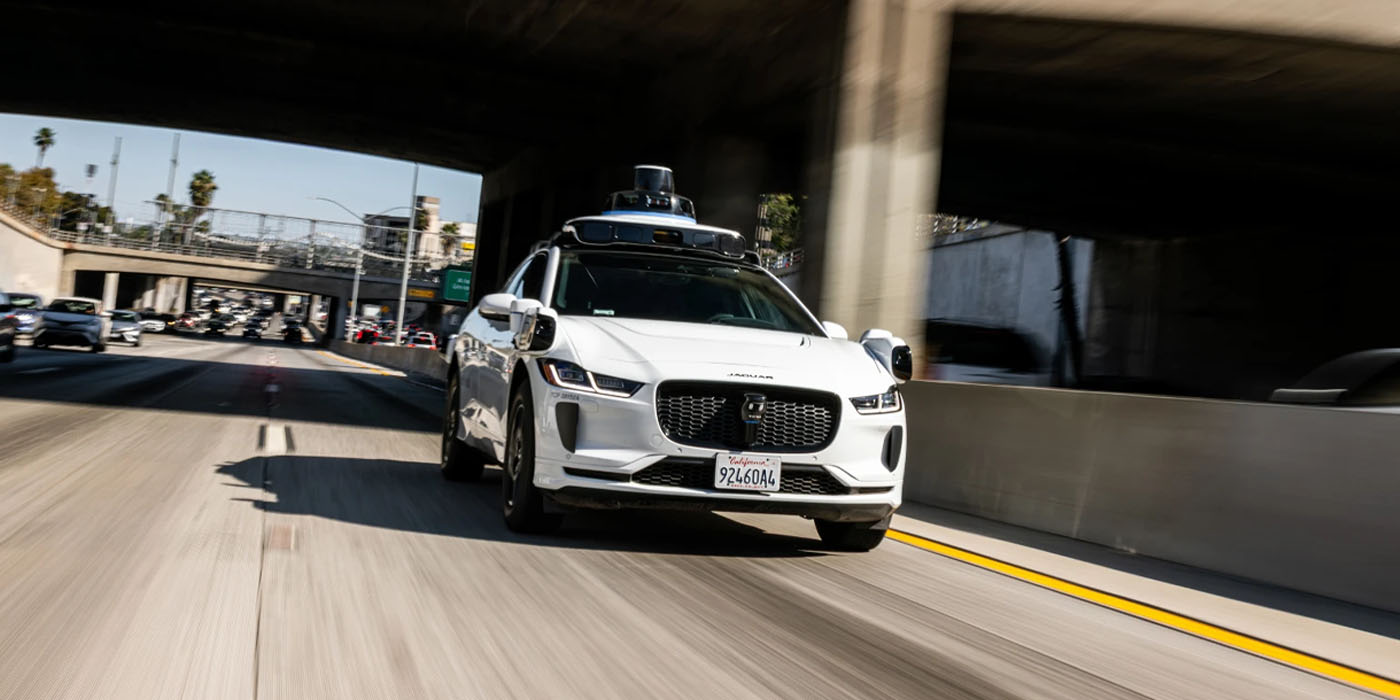
For years, the loudest and most persistent argument coming from the Tesla camp, including Elon Musk himself, against Waymo has been simple: “Sure, it works, but it can’t scale.”
The narrative, usually pushed by those heavily invested in the promise of Tesla’s “generalized Full Self-Driving”, was that Waymo was a geofenced parlor trick. They argued that Waymo’s reliance on lidar, radar, and, specifically, high-definition (HD) mapping would mean it would take years to launch in every new city.
But the narrative is now dying, as Waymo went from testing to fully autonomous in a couple of Texas cities in just a few months.
Unlike Tesla, Waymo has been offering fully autonomous commercial rides for years, which has been a threat to the narrative Elon Musk has been pushing: that Tesla is the leader in autonomous driving.
Musk’s solution has been to claim that Waymo’s system is not scalable compared to Tesla’s and Tesla investors have been betting heavily on him being right on this.
Well, that narrative just officially died deep in the heart of Texas.
Based on the latest operational updates as of early December 2025, Waymo has pulled human safety drivers from its vehicles in both Dallas and Houston. While currently restricted to employee rides before a public launch in 2026, the vehicles are now operating fully autonomously in these complex urban environments.
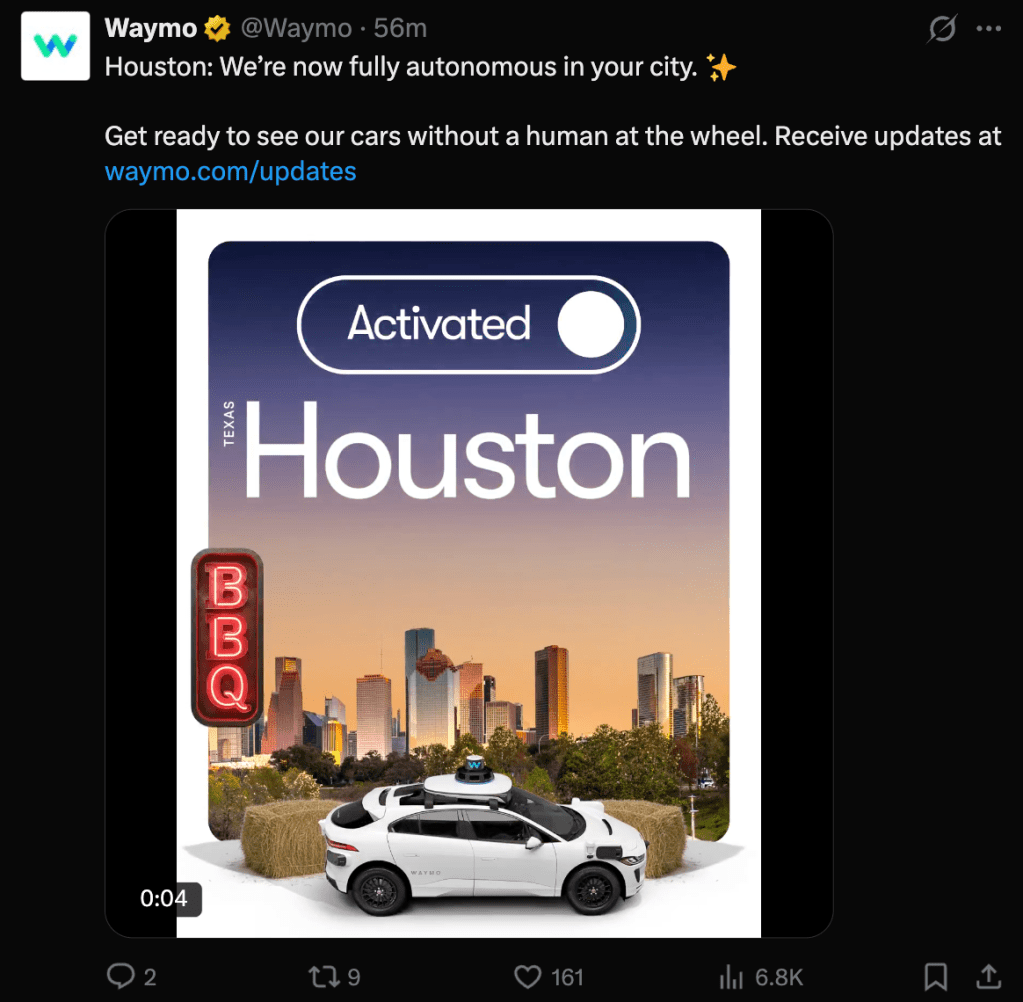

But the fact that they are autonomous isn’t the biggest news here. The biggest news is the timeline.
Waymo only officially began on-road testing with its Jaguar I-Pace fleet in Dallas and Houston around May of 2025. That means it took the Alphabet-owned company roughly six to seven months to go from “wheels on the ground” initial mapping and testing to removing the human driver entirely in two massive, distinct metropolitan areas simultaneously.
To put that in perspective, think about Waymo’s original pilot in Chandler, Arizona. We watched that program iterate for what felt like half a decade before they were confident enough to fully remove the safety drivers. San Francisco was faster, but it was still a long, arduous slog of validation under intense regulatory scrutiny.
This pace in early markets is what fueled the “Waymo can’t scale” argument. Critics looked at the years spent in the Phoenix suburbs and assumed that was the permanent velocity of Waymo’s expansion.
The Texas rollout proves that assumption wrong. What changed? Waymo has achieved what they describe as a “generalizable Waymo Driver.”
Waymo’s AI isn’t relearning the concept of a stop sign or a pedestrian every time it enters a new zip code. It already knows how to drive. When it enters a new market now, it is primarily validating that base knowledge against local flavor, specific types of intersections, regional driving aggression levels, or unique Texas U-turn laws.
The “crutch” of HD mapping, which Tesla CEO Elon Musk once famously called “unscalable,” is proving to be much less of a hurdle than predicted. Waymo has clearly streamlined the process of generating and updating these maps to the point where they can spin up two major U.S. cities in half a year, with many more to come.
Electrek’s Take
I’ve been saying for a while now that the “Waymo is stuck in a geofence” argument was running on fumes, but this Texas news should be the final nail in the coffin.
Now, the other argument that the Tesla crowd is going to cling to is cost. Tesla undoubtedly has a big advantage there, but again, it’s priced lower as a system that hasn’t achieved unsupervised autonomy yet.
Meanwhile, Waymo has reduced the cost of its driver by more than 50% with its 5th-generation system, and it is expected to cost less than $20,000 with the 6th generation in the new Zeeker van. That’s starting to be competitive with Tesla price-wise, and again, with a system that actually has already achieved level 4 autonomy.
The goalposts for AV success are constantly moved by critics, but the speed of deployment was the last verifiable metric where Tesla bulls felt they had the upper hand, theoretically. The idea was that once Tesla “solved” FSD, it would work everywhere instantly, leapfrogging Waymo’s plodding city-by-city approach.
But reality is catching up to theory. While Tesla’s FSD (supervised) is an incredibly impressive driver-assist system, it is still stuck at Level 2, requiring constant human attention after years of “robotaxi next year” promises.
Musk claimed Tesla would remove supervisors from cars in Austin “within a few months”, but it has now been almost 6 months, and the crash rate indicates that Tesla shouldn’t remove the supervisors any time soon.
Meanwhile, on the same timeline, Waymo just dropped into two of the largest, most car-centric cities in America and went fully driverless.
The scoreboard speaks for itself.
FTC: We use income earning auto affiliate links. More.
-
 Sports2 years ago
Story injured on diving stop, exits Red Sox game
-
 Sports3 years ago
‘Storybook stuff’: Inside the night Bryce Harper sent the Phillies to the World Series
-
 Sports2 years ago
Game 1 of WS least-watched in recorded history
-
 Sports3 years ago
Button battles heat exhaustion in NASCAR debut
-
 Sports3 years ago
MLB Rank 2023: Ranking baseball’s top 100 players
-
Sports4 years ago
Team Europe easily wins 4th straight Laver Cup
-
 Environment3 years ago
Japan and South Korea have a lot at stake in a free and open South China Sea
-
 Environment1 year ago
Here are the best electric bikes you can buy at every price level in October 2024