
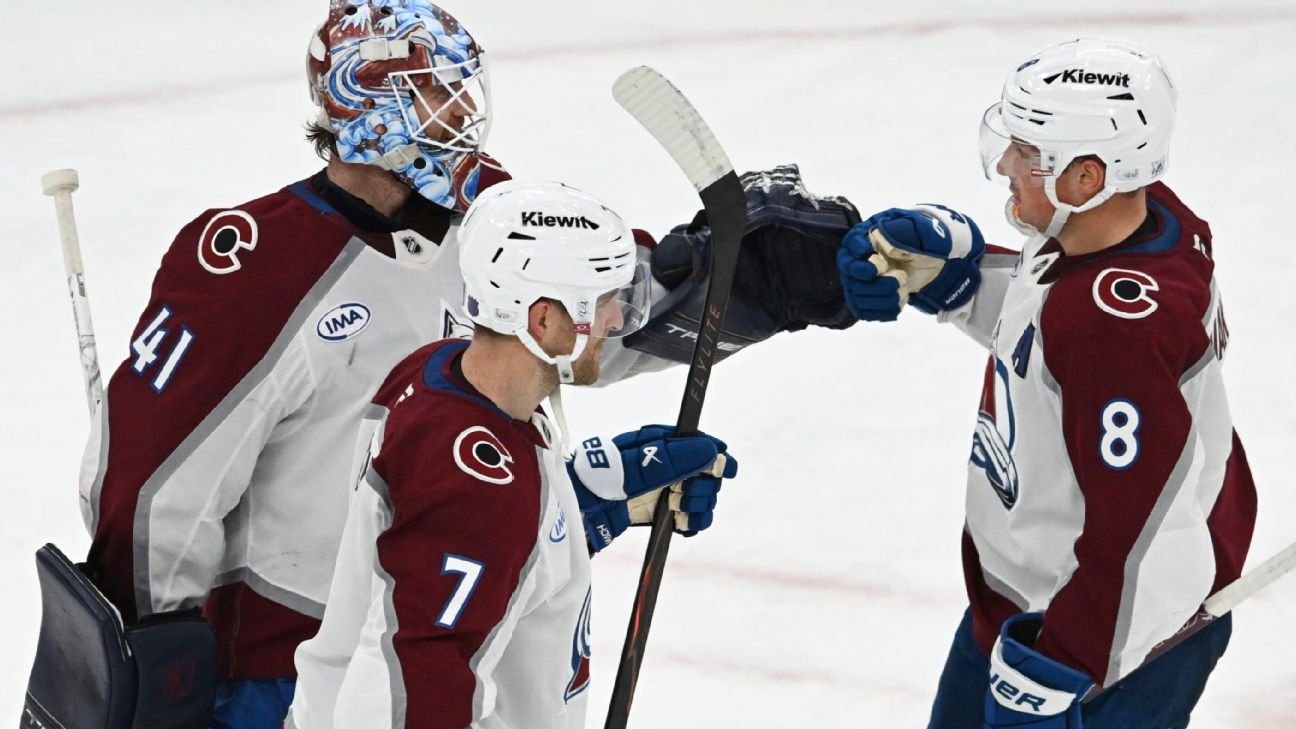
Who’s making the grade, and who’s failing at the NHL quarter mark? Grades for all 32 teams


-
Ryan S. Clark
-
Kristen Shilton

The 2025-26 NHL season has reached its quarter mark, with all 32 teams having played more than 20 games.
As usual, there are some positive surprises — looking squarely at the Pittsburgh Penguins and Anaheim Ducks — as well as the not-so-positive surprises, including the Toronto Maple Leafs, St. Louis Blues and Vancouver Canucks.
But, how does each team grade out on its report card for the first 25% of the season? Here’s a rundown of what has gone right, what has gone wrong and a first-quarter letter grade for all 32 clubs.
Note: Teams are listed alphabetically by letter grade. Ryan S. Clark graded the Pacific and Central Division teams, and Kristen Shilton graded the Metropolitan and Atlantic Division teams. Stats are through the games of Nov. 23.

A grades

Preseason over/under: 103.5
Current points pace: 137.9
What has gone right? They lead the NHL in goals per game while also giving up the fewest goals per game. They’re generating the most scoring chances per 60 minutes, shots per 60 and scoring chances per 60 in 5-on-5 play. Their defensive structure has made them a top-10 team in terms of the fewest shots allowed per 60 and fewest high-danger chances per 60.
Nathan MacKinnon is in a position to win his second Hart Trophy. Cale Makar could win his third Norris Trophy — and could challenge MacKinnon for the Hart. They now appear to have the supporting cast capable of providing consistent contributions.
The Avs might be the best team in the NHL. And at their current pace, they could threaten, if not surpass, the Bruins’ record of 135 regular-season points set in the 2022-23 regular season.
What has gone wrong? Leading the NHL with 4.00 goals per game comes with the assumption that the Avs can score in any situation. But, the Avs are struggling when it comes to consistently scoring goals on the power play. Entering Monday, the Avs had a bottom-10 power-play unit that was converting on only 15.7% of its opportunities.
Grade: A+

Preseason over/under: 83.5
Current points pace: 108.1
What has gone right? They’re fighting for the Pacific Division crown. They have the second-most prolific attack in terms of goals per game. They’re continuing to see their young talent grow all while offseason addition Chris Kreider had 14 points in his first 15 games.
But what might be the strongest indication of just how well the Ducks are doing this season is Leo Carlsson‘s projected scoring pace. A Ducks player has finished with more than 100 points in a season only four times in franchise history. Carlsson is not only on pace to join a list with Paul Kariya and Teemu Selanne, but he’s projected to finish with 108 points. That places Carlsson in a position to have what could be one of the best individual seasons in team history, and threaten Selanne’s franchise record of 109 points.
What has gone wrong? An overreliance on Lukas Dostal in the defensive zone. Dostal has started 17 of the Ducks’ first 22 games. It’s a pace that has him projected to play 63 games — which is the sort of workload reserved for top-tier goalies such as Connor Hellebuyck, Juuse Saros and Andrei Vasilevskiy.
But there’s also the underlying numbers. The Ducks are in the top three in terms of most scoring chances allowed, shots against and high-danger scoring chances allowed per 60, per Natural Stat Trick. It’s a contrast from Dostal posting a 5.42 goals saved above expected, which is sixth among goalies with more than 10 games.
Grade: A

Preseason over/under: 103.5
Current points pace: 111.8
What has gone right? Glen Gulutzan’s second stint in charge of the Stars could be defined by perspective. There are some questions why the Stars are in the bottom 10 in scoring chances per 60, shots per 60 and high-danger scoring chances per 60. But there are also those who would argue that maybe it’s just a sign of efficiency. The Stars have the NHL’s No. 2 power-play unit, and are also 10th in goals per game.
It’s a promising return on a season that began with questions about how they would fare under a new coach, while taking into account that they lost three forwards in Evgenii Dadonov, Mikael Granlund and Mason Marchment in the offseason.
What has gone wrong? There has been a bit of a disconnect with how the Stars perform in the defensive zone in 5-on-5 play compared to the penalty kill. They’re among the top 10 teams in fewest goals allowed per game, and high-danger scoring chances allowed per 60. They are also sitting around league average in allowing the fewest shots per 60. Yet their PK hasn’t been up to par, with a success rate of 75.7%, which is in the bottom 10 in the NHL.
Grade: A

Preseason over/under: 84.5
Current points pace: 96.3
What has gone right? Detroit is having its best start in a decade, and it’s not for one reason in particular. This is a group effort delivering on GM Steve Yzerman’s vision for the Red Wings as a high-skilled, defensively responsible team. Head coach Todd McLellan is maximizing Detroit’s potential in his first full season.
The defensive buy-in isn’t only reflected in stats — such as how the Red Wings average among the fewest shots against per game this season — but in how skaters such as Dylan Larkin are thriving. The Red Wings’ captain leads the team in goals and points and has provided invaluable leadership to the equally impressive rookie forwards Emmitt Finnie and Nate Danielson.
On the back end, rookie Axel Sandin-Pellikka has been an important presence, and provided Detroit with the depth it needed to be among the Atlantic’s best.
What has gone wrong? The Red Wings have leaned on a strong power play this season; it’s their even-strength scoring that can improve. It won’t be sustainable for Detroit to rely on the extra man to see it through.
Although the Red Wings have shored up collectively on defense, they’re still giving up over three goals against per game, which speaks in part to their goaltending. Cam Talbot has been better this season than last but John Gibson — Yzerman’s big offseason acquisition — hasn’t been any sort of savior. The Red Wings have to hope that tandem can be a difference-maker for them from here.
Grade: A

Preseason over/under: 84.5
Current points pace: 99.8
What has gone right? Let’s start with the obvious: Matthew Schaefer. The rookie defenseman arrived better than advertised after New York selected him No. 1 in the 2025 draft. Schaefer is electric at both ends of the ice, and takes on important minutes (over 22 per game) that shows how much confidence coach Patrick Roy already has in the Calder Trophy favorite.
And he’s not the only exciting rookie that has Islanders fans buzzing. Maxim Shabanov delivered a breakout three-point performance to cap off a recent 6-1-0 trip, illustrating why New York coveted the former KHL player (and why he’s likely to earn a promotion from the fourth line).
Beyond those two skaters, the Islanders are getting solid goaltending from Ilya Sorokin and David Rittich and, for a team that has consistently searched for more offense, New York is top 10 in the NHL in goals, on the efforts of Bo Horvat (having his best start in years) and a healthy Mathew Barzal and Kyle Palmieri.
What has gone wrong? The Islanders aren’t packing a potent power play (it’s among the league’s worst) and there’s concern that their offense might be too top-heavy to keep pace with deeper clubs. New York also just lost one of its best defensemen — Alexander Romanov — for five to six months after shoulder surgery following a hit from Dallas’ Mikko Rantanen.
Given how the Islanders have exceeded expectations so far, it’s hard to nitpick what else hasn’t worked for them in the grand scheme of the first quarter.
Grade: A

Preseason over/under: 77.5
Current points pace: 97.6
What has gone right? Pittsburgh is arguably one the season’s most surprising contenders. Few would have picked the Penguins to be in the Eastern Conference playoff mix at the season’s quarter mark.
This is a different Penguins’ team under first-year head coach Dan Muse, who is pushing all the right buttons. Muse’s system brings out the best in Pittsburgh’s skaters by giving them freedom to operate, and that has paid off in the Penguins’ growing confidence. Pittsburgh is giving up the second-fewest goals this season, ranks top 10 in offense and has the league’s best power play. The Penguins’ goaltending has benefitted from the emergence of Arturs Silovs and an improved Tristan Jarry. Basically, it has been all systems go for Pittsburgh.
What has gone wrong? The Penguins have a problem closing out certain games — namely, those stretching beyond regulation. Pittsburgh is 0-4 this season in overtime and the shootout, something Muse has sought to address with practice drills focused on the club’s 3-on-3 work. The standings this season are closer than ever, and leaving points on the board that often is a small area Pittsburgh can clean up.
Rickard Rackell is out for two months because of a broken hand sustained in October, and that will will continue to affect the Penguins’ depth. Jarry going on injured reserve earlier this month was a blow too, and will test Pittsburgh’s resilience.
Grade: A

Preseason over/under: 105.5
Current points pace: 111.8
What has gone right? Carolina isn’t the league’s most exciting team, but it’s one of its best for a reason. The Hurricanes thrive in head coach Rod Brind’Amour’s structure that emphasizes smothering defensive play. Their offense has really excelled this season though, ranking second overall thanks to a potent Seth Jarvis — who leads the team in goals — a slippery Sebastian Aho — pacing Carolina in points — and the always-steady Jordan Staal.
Goaltender Pyotr Kochetkov has been excellent in net amid starter Frederik Andersen‘s tough start. Overall, the Hurricanes are deep, detailed and disciplined. It’s no wonder they have lost consecutive games only once this season.
What has gone wrong? The Hurricanes haven’t thrived on special teams. Their power play is the worst in the league, and they’re 21st on the penalty kill. It’s a stark reality given how Carolina can dominate at even-strength (it ranks third in 5-on-5 goals) and might be a temporary glitch if Brind’Amour can figure out why the man advantage especially is such a momentum killer.
Carolina also has a goaltending conundrum with Andersen. The often-injured veteran has already dealt with a concussion this season and his numbers have been poor when he is available. Kochetkov can’t be expected to carry the load entirely, so Carolina will need to either get Andersen on track or search for further goaltending options.
Grade: A-

Preseason over/under: 99.5
Current points pace: 108.1
What has gone right? New Jersey’s star-studded offense has been producing at a solid rate this season — Jack Hughes had 20 points through 17 games, Jesper Bratt had 21 through 21 and Nico Hischier is still capable of being one of the league’s premier two-way centers.
The Devils’ goaltending is another strength because of veteran Jake Allen, who has been excellent handling an increased workload this season. Meanwhile, defenseman Simon Nemec has blossomed after taking a bit longer to hit his stride than some expected after he went No. 2 in the 2022 draft. He has taken on a heavy workload, and that has only amplified how good he can be in the Devils’ own end as well as jumping into the rush.
What has gone wrong? The Devils just wanted to have a pleasant team dinner in Chicago — and instead, the night ended with Hughes requiring surgery on his finger after a freak accident at the restaurant. Having Hughes healthy is (almost) all New Jersey needs to be a Stanley Cup contender, and now that he’s out for multiple weeks (along with Cody Glass and Brett Pesce) the Devils will be dipping into their depth to cover.
Speaking of depth, it’s a good thing Allen has been so hot to start the season because Jacob Markstrom has not. With Hughes out now, it’s even more imperative that New Jersey finds ways to keep scoring and not expose Allen to an onslaught that wears him down.
Grade: A-
B grades

Preseason over/under: 80.5
Current points pace: 88.8
What has gone right? The Bruins were supposed to be Atlantic Division basement dwellers. But — plot twist — they’ve actually been one of its top contenders. Full credit to first-year head coach Marco Sturm for implementing a defense-first structure that Boston has embraced enough to mitigate some of the sting from top center Elias Lindholm sitting out most of the season to date because of a lower-body injury.
Defenseman Nikita Zadorov has been particularly strong, bringing a bruising presence to the Bruins’ blue line. Boston has also benefitted from Jeremy Swayman‘s return to form this season, and the team is top 10 on both the power play and penalty kill. The Bruins weren’t expected to be a powerhouse up front, but David Pastrnak has been his usual dynamic self and Morgan Geekie is a budding offensive star.
What has gone wrong? Injuries are adding up. Defenseman Charlie McAvoy is out indefinitely after taking a puck to the face, and all of Casey Mittelstadt, Viktor Arvidsson and Jordan Harris also have been sidelined of late. The Bruins have overachieved out of the gate, but it doesn’t feel sustainable if skaters such as Lindholm and McAvoy are sitting out extended time and the rest of the league gets healthy enough to catch up.
Even with Sturm’s messaging and Swayman’s solid play, the Bruins are still bottom 10 in goals against, and that’s not an encouraging stat now that McAvoy won’t be around to anchor the back end. The Bruins need consistency, and could struggle to find it.
Grade: B+

Preseason over/under: 67.5
Current points pace: 89.5
What has gone right? Think about the issues the Blackhawks faced last season. Many of them have become the bedrock for a team that’s in the running for the NHL’s biggest surprise through the first quarter of the regular season.
The questions about Connor Bedard have been replaced with another set of questions: Will he make Canada’s Olympic team while also possibly winning a scoring title? Bedard is on pace for 116 points and if that holds, it’ll be the highest-scoring season of any Blackhawks player not named Denis Savard. Plus, any of the concerns about their veterans’ struggles from last season have been erased by what they’re doing this season.
Though Bedard is generating a lot of attention, the goaltending could signify just how much has changed with the Blackhawks from last season. They finished with a team save percentage of .894 in 2024-25 but have begun this season with a .911 mark through the first 22 games, tied for fourth in the NHL. Spencer Knight is presenting his case for why he could be under Olympic consideration for Team USA.
What has gone wrong? Finding cohesion within their defensive structure remains a bit of an issue. Make no mistake, the Blackhawks were expected to encounter some challenges on the defensive end due in part to being what Elite Prospects lists as the third-youngest team in the NHL this season. Their top-four defensemen, in terms of minutes played, are younger than 24, and two of them are rookies.
Having that much youth along with the Blackhawks’ structure has played a role in why they are in the bottom four of scoring chances allowed per 60, high-danger scoring chances allowed per 60 and shots allowed per 60 in 5-on-5 play through their first 22 games.
Grade: B+

Preseason over/under: 90.5
Current points pace: 97.6
What has gone right? Montreal didn’t think rookie goalie Jakub Dobes would be a backbone to their early-season success, but the rising star became exactly that by outperforming starter Sam Montembeault as one of the league’s breakout netminders. Dobes has been aided by the Canadiens’ more consistent defensive effort. Montreal didn’t pay enough attention on that end of the ice last season, and it hurt them. Now, the Canadiens have been stronger through the neutral zone and played with tighter gaps to limit rush chances.
The Canadiens’ top skaters have also delivered, with Cole Caufield already notching 13 goals and Nick Suzuki compiling 22 points in his first 20 games.
What has gone wrong? The Canadiens have regressed recently after their impressive start. Dobes and Montembeault have both been below average and Montreal’s confidence appears shaken by lopsided losses (like a 7-0 defeat against Dallas) that call into question all the strides they appeared to have made across the board.
Injuries also continue to take their toll, with Kaiden Guhle, Kirby Dach, Patrik Laine and Alex Newhook all out for significant stretches. Montreal was a surprise playoff team last season but showed it was no fluke given how well they started this season. To stay in that conversation means Montreal has to rely on its depth and not lose sight of those difference-making defensive details.
Grade: B+

Preseason over/under: 83.5
Current points pace: 97.6
What has gone right? Philadelphia is right in the Eastern Conference’s mushy middle and that’s not so bad if you’re the Flyers. Rick Tocchet’s group is finding ways to win hockey games with solid defensive play — they’ve hovered near the top 10 in goals against per game. That has rubbed off on their penalty kill too, which is near the top of the league.
Goaltender Dan Vladar has been a surprisingly reliable starter, going from a tandem option with Samuel Ersson to a backbone of Philadelphia’s whole operation.
Another pillar is defenseman Travis Sanheim, who has been in superb command of the Flyers’ blue line. And up front, Trevor Zegras — acquired in the offseason to bolster Philadelphia’s center depth — is averaging over a point per game to lead the Flyers’ offense along with Travis Konecny.
What has gone wrong? The Flyers have a good pool of forwards, but they aren’t producing at a high enough rate. Philadelphia is 26th in goals per game this season, and its power play is operating below 20%. Though Vladar and the team’s collective defensive approach has put the Flyers in a solid position for now, it won’t last unless they can find more contributors on the score sheet.
Specifically, Matvei Michkov has taken a step back this season — with only nine points in his first 19 games — and Philadelphia is still searching for consistency throughout the lineup. There’s also the issue of Ersson, and whether he can support Vladar as the season progresses. Some nights Ersson can pass the eye test, but if Vladar stumbles or gets hurt, they’ll be counting on the backup to step up.
Grade: B+

Preseason over/under: 70.5
Current points pace: 89.1
What has gone right? Any conversation around the Sharks at this moment is one that requires a level of nuance.
Their current projection has them on pace to finish with more than 80 points for the first time since the 2018-19 season, which was also their last playoff appearance. They’ve seen progress from their young core of Yaroslav Askarov, William Eklund and Will Smith while their veterans continue to help in ways that can and can’t be measured.
Then there’s an entirely different conversation that can be had about Macklin Celebrini. Yes, Celebrini has been so good that he is among the league leaders in points and could be playing his way on to Canada’s Olympic team. Yet what might get lost in the discussion around Celebrini is the idea he could end up having the greatest individual season in Sharks history. He’s currently on pace for 121 points, and if that holds, he’d surpass Joe Thornton for the most in a single season (114).
What has gone wrong? The six-game losing streak to start the season. They gave up more than three goals in each of those defeats, which only amplified what it meant to begin the season in a hole. It was a streak that also played a role in why the Sharks are in the bottom 10 in goals per game, goals allowed per game and have the 11th-worst penalty kill.
To put it another way: Since the losing streak ended on Oct. 23, the Sharks have the fourth-most points in the NHL
Grade: B+

Preseason over/under: 78.5
Current points pace: 104.4
What has gone right? Only the Rangers have committed a higher percentage of their active salary cap space to their goalies than the Kraken. The early returns of that investment are one of the major reasons why the Kraken are actively fighting for a playoff spot at the moment.
Natural Stat Trick’s metrics show that the Kraken were leading the NHL in team save percentage in 5-on-5 play as of Monday, and were tied for fourth in team save percentage in all situations. Joey Daccord, Philipp Grubauer and Matt Murray have provided a continuity in net that has complemented the Kraken’s defensive structure.
Lane Lambert’s first season as coach has seen the Kraken reestablish their defensive identity as one of the stronger teams in the NHL at limiting high-danger scoring chances per 60, and scoring chances per 60 in 5-on-5 play.
What has gone wrong? Giving up 2.59 goals per game has made the Kraken one of the harder teams to score against this season. But scoring 2.55 goals per game will make it harder for the Kraken to stay in the hunt for a playoff spot. The margins have been so tight that they had identical numbers when it came to goals scored per game and goals allowed per game as recently as Friday. Having such little margin for error is part of a larger composite that illustrates how the Kraken have struggled to score goals and find ways to generate those opportunities for goals.
There are only three teams in the NHL that are averaging fewer goals per game than the Kraken. It’s a process that has been made even more difficult by the fact that the Kraken are last in scoring chances per 60, shots per 60 and high-danger chances per 60. And yet, they entered Monday just a point behind the Ducks for first place in the Pacific Division — having been in a wild-card spot just four days earlier. Because that’s what the landscape has looked like in the Western Conference through the opening quarter.
Grade: B+

Preseason over/under: 104.5
Current points pace: 100.6
What has gone right? They’re finding defensive continuity without Alex Pietrangelo. Scoring goals is important, but there was a strong belief the Golden Knights were going to score many of them anyway — and they have this season. Losing their No. 1 defenseman in Pietrangelo as he recovers from a bilateral femur reconstruction created questions about how they would fare without him.
They’ve used the first quarter to establish themselves as one of the more consistent defensive structures in the NHL. The Golden Knights have been a top-three team this season in terms of allowing the fewest high-danger scoring chances per 60 and shots per 60.
What has gone wrong? Here’s where it gets bizarre. The Golden Knights are limiting high-danger chances and shots in ways that should benefit their goalies. And yet there’s still something of a disconnect with how their goalies have performed this season.
The Golden Knights are around league average in team save percentage in 5-on-5 play but rank in the bottom third of the NHL when it comes to team save percentage in all situations, at .893. It’s part of what played into the decision to sign Carter Hart, who is currently playing for their AHL affiliate as he’ll be eligible for reinstatement on Dec. 1 as part of the Hockey Canada trial in which five players were acquitted for sexual assault.
Grade: B+

Preseason over/under: 84.5
Current points pace: 89.1
What has gone right? Columbus can always count on Zach Werenski to deliver, and the Blue Jackets’ best player has been exactly that to start the season. Werenski is tied for the second-most points on the team — having notched his 400th career point earlier this month — and plays nearly 27 minutes per game.
Up front, it’s Kirill Marchenko, Dmitri Voronkov and Adam Fantilli showcasing how promising Columbus’ present and future are on offense, as those young skaters continue to grow and mature into their individual games. The Blue Jackets have had notable scoring success at 5-on-5 as well thanks to one of the league’s best attacks on the rush.
The goaltending — specifically from Jet Greaves — has been better than expected to keep Columbus right in the Eastern Conference wild-card mix.
What has gone wrong? The Blue Jackets haven’t had much luck on special teams, having a middling power play and one of the league’s worst penalty kills. Though the man advantage has shown signs of life recently it has been a thorn in Columbus’ side not being able to capitalize on more of those chances — or keep their opponents’ chances from ending up in the net.
The Blue Jackets have star performers, but there is a significant drop-off in contributors throughout the lineup. Losing captain Boone Jenner to injury hurts Columbus there, and the Blue Jackets might struggle in the wake of his absence trying to sort out their offensive attack.
Grade: B

Preseason over/under: 98.5
Current points pace: 99.8
What has gone right? It has been the defensive consistency for the Kings. Playoff teams are going to be judged on what allowed them to win and/or be eliminated. Giving up 20 goals over the final four games of their first-round series last season against the Oilers — after having a 2-0 series lead — created quite a few questions about the Kings. Among the items that came into question was their defensive structure.
They’ll probably need to wait until the playoffs to definitively answer any of the questions raised after their four straight first-round exits. But the way they’ve started the season — allowing the fifth-fewest goals per game — has at least presented the notion that they’re adept at playing close games, with goal prevention at the heart of that plan.
What has gone wrong? Scoring goals has been a problem for the Kings. They’re in the bottom six in goals per game and on the power play.
But the detail that makes the Kings’ struggles equally fascinating and perplexing would be how their underlying numbers skew. On one hand, they’re ranked sixth in high-danger scoring chances per 60, and 12th in shots. But, they rank just below league average in scoring chances per 60. It’s a formula that has further reinforced why their defensive consistency matters, as they’re averaging 2.68 goals while giving up 2.68 goals entering Monday.
Grade: B

Preseason over/under: 94.5
Current points pace: 99.8
What has gone right? Being able to consistently field the same roster. Injuries took the Wild from having one of the best starts of any team last season to one that had to fight just to grab a wild-card spot.
To be clear, this season has had its challenges. But it comes with the context that they’ve had eight players appear in every game, and 13 of their skaters have played in 20 or more of their first 23 games. The impact of that has been reflected in the Wild’s defensive core: Three of the top four defensemen in terms of average ice time have played in every game, and Jonas Brodin has sat out only one.
What has gone wrong? They need to score more goals. Anyone who follows the Wild knows how this all works; they struggle to consistently score goals but can often rely or in some cases rely too much on their defensive structure and goaltending to win games.
This season has seen its share of disconnects with that approach. Minnesota’s underlying numbers suggest it should be scoring more goals. The Wild are in the top half of the NHL in scoring chances per 60 and shots per 60. They are also 18th in high-danger chances, only to be in the bottom 10 of goals per game. To to get in a more secure playoff position — they’ve been jockeying between third place in the Central or a wild-card spot — they’ll need to ramp up the scoring.
Grade: B

Preseason over/under: 95.5
Current points pace: 96.9
What has gone right? Ottawa got off to a shaky start before recommitting to head coach Travis Green’s defensive structure. That shift has been a game-changer, as the Senators staked their claim among the Atlantic’s top three clubs. The Senators are giving up the third fewest shots against per game this season, and their goals against average has trended downward since adapting that new mindset in late October.
Ottawa hasn’t had trouble scoring with Drake Batherson — leading the Sens with 19 points in 17 games — Tim Stutzle, and Shane Pinto all contributing regularly. Jake Sanderson continues to be a revelation at both ends for Ottawa, and that has been especially impactful with captain Brady Tkachuk still sidelined after an early-season injury.
What has gone wrong? The Senators have too often been fighting themselves because of subpar goaltending from Linus Ullmark. The Vezina Trophy winner hasn’t been in top shape this season, giving up three or more goals in 10 of his first 16 starts, while forcing Ottawa to try to outscore every mistake. Backup Leevi Merilainen has done his best to step in when called upon, but Ullmark has to maintain control of the crease with more consistency from here for Ottawa to keep up in the crowded Atlantic race.
And to that end, recent injuries to top defenseman Thomas Chabot and forward Ridly Greig could certainly damage Ottawa’s depth as they wait for Tkachuk to return.
Grade: B

Preseason over/under: 101.5
Current points pace: 104.4
What has gone right? The Lightning are, well … the Lightning. Regardless of what a season throws at them, this team adjusts to its circumstances and remains dangerous.
Jake Guentzel and Nikita Kucherov pack a one-two punch up front to lead the offense, and Guentzel’s performance has been particularly strong this season while the Lightning’s depth has been under the microscope. The Lightning also have Anthony Cirelli as an archetypal 200-foot center, and Victor Hedman can still go toe-to-toe to be among the league’s best defenders. The Lightning are a solid defensive group overall and dominate on the penalty kill.
Jon Cooper makes the most of his lineup every night, and that’s one of Tampa Bay’s true superpowers.
What has gone wrong? The Lightning are going through it with injuries already — and now Hedman is out for a couple of weeks. Only six skaters have appeared in all Tampa Bay’s games this season, forcing the Lightning to rely on call-ups to fill in the gaps. It has worked well enough to keep the team in the playoff picture, but without the same swagger the Lightning are used to wielding.
Speaking of missing swagger, what happened to Brayden Point‘s? The usually dynamic top-line skater is a shadow of his previous seasons’ performances, with only three goals and 11 points in his first 20 games. The Lightning are accustomed to getting quite a bit more out of him.
Grade: B

Preseason over/under: 97.5
Current points pace: 93.7
What has gone right? The Jets can score goals, sometimes in bulk. They can get those goals from different line combinations and defense pairings in ways that many teams throughout the league can’t replicate. The manner in which they’ve received offensive contributions from different players complements how Kyle Connor, Josh Morrissey and Mark Scheifele are each averaging more than a point per game.
It’s part of the reason behind why they are in the top 12 of goals per game while also boasting a top 10 power play. Knowing they can generate goals at a high rate could prove useful upon the news that three-time Vezina recipient Connor Hellebuyck could sit out up to six weeks.
What has gone wrong? Missing Hellebuyck for an extended period could present challenges and potentially amplify what has been an area of concern for the Jets when it comes to their defensive structure. There are only three teams that have given up more scoring chances per 60. They’ve also given up the ninth-most high-danger chances per 60 in addition to being in the top 10 of allowing the most shots per 60.
It’s what makes the work done by Eric Comrie and Hellebuyck even more vital through the first quarter. The Jets had a top-five team save percentage in all situations, and the eighth-best team save percentage in 5-on-5 play before Hellebuyck’s injury. Now they’ll need Comrie — and World Junior Championships hero Thomas Milic — to provide continuity in Hellebuyck’s absence.
Grade: B

Preseason over/under: 106.5
Current points pace: 93.2
What has gone right? Florida has proved depth and resiliency can be a weapon. Or, at least a helpful tool. The Panthers are adaptive in the face of injury woes, and that next-man-up mentality could see them through as it has in the past.
Florida is getting some of Brad Marchand‘s best hockey in years as the team’s goals and points leader, complementing strong starts from Sam Reinhart and Anton Lundell. The Panthers can seemingly weather a storm better than most thanks to, well, you know — being back-to-back Stanley Cup champions and all, and the confidence that comes with it.
What has gone wrong? Florida has been cratered by injuries. Captain Aleksander Barkov tore his ACL and MCL during a preseason practice and is out for the season. Eetu Luostarinen was sidelined after sustaining burns in a barbecuing accident. Cole Schwindt needed surgery after breaking his arm colliding with Panthers’ goaltender Sergei Bobrovsky. And all of those follow Matthew Tkachuk being out after offseason surgery.
Florida is truly putting “bend-don’t-break” to the test, and it’s hard to even assess what the Panthers can be given how long the injured list is — and, more specifically, the caliber of players who are on it.
Grade: B-

Preseason over/under: 92.5
Current points pace: 96.3
What has gone right? There has been enough of a sample size that proves the Mammoth could have something good with their current roster. A seven-game winning streak was part of a sequence that saw them open the regular season winning eight of their first 10 games.
One reason why they were in the top five in giving up the fewest goals per game in that span is because they were also a top-five team when it came to giving up the fewest shots per game. They were also in the top five of most shots per game, which translated into them being in the top five of goals scored per game.
What has gone wrong? There also has been enough of a sample size that proves the Mammoth still need more. Consider how they’ve performed since that seven-game winning streak ended Oct. 28. They’ve had a pair of three-game losing streaks, with their second such streak reaching four. It’s part of a larger sequence that has seen them lose nine of their 12 most recent games.
In that span, they’re in the bottom four in terms of goals scored per game and are in the bottom 10 in terms of giving up the most goals per game.
Grade: B-
C grades

Preseason over/under: 96.5
Current points pace: 92.7
What has gone right? Washington has Alex Ovechkin still playing premier hockey into his 40s. That simply can’t be taken for granted. The Capitals’ captain tied for the team lead with 20 points in his first 20 games, and also added another hat trick earlier this month.
He’s not the only veteran contributing for Washington — Tom Wilson, John Carlson and Jakob Chychrun have all been difference-makers in D.C.
Goaltender Logan Thompson also has been outstanding, ranking among the league’s top starters in save percentage and goals-against average.
What has gone wrong? The Capitals aren’t the same team that finished atop the Eastern Conference standings last season. Coach Spencer Carbery’s aim to build Washington into a faster club that can keep pace with the league’s speedier lineups isn’t happening. There’s a lack of consistency in the scoring attack, and that was made worse when Pierre-Luc Dubois hit injured reserve this month. And now Nic Dowd is also out.
It’s only more recently the Capitals have consistently produced at even strength — bolstering their offensive stats accordingly — but their power play is well below average, and their penalty kill is bottom five in the league. There’s just something off about how the Capitals show up on a game-to-game basis. Though their top players appear mostly dialed in, the supporting cast isn’t doing its part on a regular basis.
Grade: C+

Preseason over/under: 83.5
Current points pace: 82
What has gone right? Buffalo found a potential hidden gem in goaltender Colten Ellis. The Sabres claimed Ellis off waivers from St. Louis in October, and he has stepped in recently to help stabilize Buffalo in net. Ellis was 3-1-0 in his first four games, with a .914 save percentage, earning a longer look in the starter’s role and providing a bright spot amid an otherwise difficult season.
Josh Doan is another new face that has fit in well, playing over 15 minutes per game and notching 12 points in his first 20 games.
The Sabres have shown they can score in bunches — that 9-3 victory over Chicago this month was proof — and they’ve produced the league’s best penalty kill (89.8%). And, Buffalo’s actually starting to heat up; after losing five straight, the Sabres have rebounded to win four of their past five.
What has gone wrong? The Sabres aren’t yet close to snapping that historically long playoff drought. Buffalo sank to the bottom of the Atlantic Division early, and are only now making slow progress out of it. The Sabres are leaky defensively, their offense is top-heavy and inconsistent, plus their power play is sputtering too often.
Injuries have invariably played a role in Buffalo’s struggles — only a handful of skaters have appeared in every game this season — and the Sabres simply haven’t had the depth to make up for their frequently full infirmary. It’s hard not to question if coach Lindy Ruff’s messaging is already falling on deaf ears if Buffalo can’t turn things around. And what happens then?
Grade: C

Preseason over/under: 103.5
Current points pace: 85.4
What has gone right? Being a point out of the final wild-card place at this point. Much of that has been due to Leon Draisaitl and Connor McDavid both averaging more than a point per game while others such as Evan Bouchard, Ryan Nugent-Hopkins and Jack Roslovic have also made offensive contributions for the Oilers.
The two-time defending Western Conference champions have done this before. They’ve had slow starts — some even slower than what they’ve encountered this season — and have still reached the Stanley Cup Final.
What has gone wrong? The thing about slow starts is that it leads to the same questions being asked every season.
That’s what could make Nov. 19 a potentially crucial date for the Oilers after giving up seven goals in a loss to the Capitals. It was the 13th time in 22 games that the Oilers gave up more than four goals. Watching the Oilers be exposed led to Sportsnet’s broadcast pointing out that they gave up the most goals in the NHL, the most goals in 5-on-5 play and had the lowest team save percentage.
Grade: C-

Preseason over/under: 95.5
Current points pace: 82.0
What has gone right? New York is a superior defensive team under first-year coach Mike Sullivan, and that has kept them afloat. The Rangers are one of the NHL’s stingiest teams — averaging 2.65 goals-against per game — and that’s credit to many of New York’s skaters playing some of the best defense of their careers.
And of course the offseason addition of Vladislav Gavrikov changed the narrative there too; the big-bodied defender has been a strong partner to Adam Fox anchoring the Rangers’ blue line.
Igor Shesterkin and Jonathan Quick have been a terrific goaltending tandem for the Blueshirts as well, a good reflection of the Rangers’ defensive commitment.
What has gone wrong? The Rangers can’t score enough goals, which might be an understatement. New York scored one goal in its first four games, and still hasn’t lit the league on fire. The Rangers’ offense ranks 30th overall (2.48 goals per game) for good reason: their star scorers being anything but. J.T. Miller had 12 points in 22 games — and is now out because of an upper-body injury. Mika Zibanejad managed only 15 points through 23 games. Not even Artemi Panarin is averaging a point-per-game pace.
It’s a good thing New York has shut down opponents defensively because Sullivan has yet to find an answer for the sputtering offense. Fittingly, it’s made New York a team without a clear identity.
Grade: C-

Preseason over/under: 99.5
Current points pace: 78.3
What has gone right? Toronto could not have anticipated John Tavares turning back the clock. That’s the case though, and a good thing too because Tavares — along with William Nylander — has been powering the Leafs’ success up front. Tavares’ 12 goals in his first 21 games was top 10 in the NHL, and Nylander compiled 27 points in his first 19 games. Nick Robertson is also a surprise standout with a regular top-six role.
Toronto has managed to rank top five in goals scored and second in 5-on-5 goals. The Leafs recently welcomed Joseph Woll back from dealing with a personal issue to start the season, and the netminder has barely missed a beat stepping in as Toronto’s reigning No. 1 goalie.
What has gone wrong? Mitch Marner is no longer on the roster, and unsurprisingly, they just don’t look the same.
Granted, Toronto’s difficulties stem from much more than just Marner’s absence. Toronto thrived in coach Craig Berube’s defense-first system last season, but are one of the league’s worst teams against the rush and are top three in goals against per game this season. Toronto has no real identity; frankly, it has been difficult to establish one. The Leafs have been decimated by injuries everywhere, from goaltender Anthony Stolarz (who struggled in his early starts), to top forwards Auston Matthews and Matthew Knies, to depth centers Nicolas Roy and Scott Laughton and right through the blue line, with Chris Tanev and Brandon Carlo both sitting out time.
That has left Berube to try to patch together a lineup too often lacking chemistry — or confidence. Tavares and Nylander have been instrumental in keeping the Leafs afloat, but Toronto’s recent stretch going 1-5-2 has left them at a loss for answers, and at the bottom of the Eastern Conference standings.
Grade: C-
D grades

Preseason over/under: 83.5
Current points pace: 64.9
What has gone right? Being in contention for the worst record in the NHL usually comes with the association of a porous defensive structure. Unless it’s the Flames, apparently.
Their defensive structure would be the hallmark of a team that’s trying to make a push for a playoff spot. They’re in the top four in terms of allowing the fewest scoring chances per 60 and high-danger scoring chances per 60. The Flames are also 13th in shots allowed per 60.
What has gone wrong? Their struggles in the offensive zone have played a significant part in why the Flames have alternated between having either the worst record in the NHL or one of the worst marks in the league. They were averaging 2.10 goals per game throughout the early portion of November.
But their recent three-game winning streak has seen them average 4.66 goals in those victories, which has raised their average to 2.38 goals per game. Don’t get too excited; that’s now the second-lowest average goals per game in the NHL. It’s a figure that also makes them one of the more offense-challenged teams in NHL history. The Flames’ current goals per game average would be in the bottom 200 teams all time in terms of single-season goals per game.
Grade: D

Preseason over/under: 90.5
Current points pace: 71.3
What has gone right? Winning four of their first six games. That window provided a glimpse into how a healthy version of the Canucks could function. A fully healthy Thatcher Demko looked like the version of himself that was a Vezina Trophy finalist in 2023-24. Filip Chytil scored three goals during that stretch and was starting to answer questions about whether he could find consistency as a top-six center.
There was also the continued emergence of Kiefer Sherwood — who went from having 19 goals in his first season with the Canucks to scoring four times in those six games as part of a month in which he finished with nine goals.
What has gone wrong? Nearly everything since Oct. 21. That’s when the Canucks went on the first of what has been three, three-game losing streaks, along with a rash of injuries that has greatly altered their lineup.
They have needed 29 skaters and three goaltenders just to get through their first 23 games. They’re a bottom-10 team in terms of shots per 60, scoring chances per 60 and high-danger chances per 60, and have faced even greater struggles defensively. The Canucks are either the worst or second-worst team in the NHL when it comes to allowing the most shots per 60, scoring chances per 60 and high-danger chances per 60.
Grade: D

Preseason over/under: 92.5
Current points pace: 71.3
What has gone right? A positive that can quickly be turned into a negative appears to be the most succinct way to describe the Blues in 2025-26.
They’re among the best teams in the NHL at limiting scoring chances. They are a top-10 team when it comes to giving up the fewest scoring chances and high-danger scoring chances per 60. OK, so how is having what appears to be a functional defensive structure a bad thing? It’s because the Blues are giving up the third-most goals per game at 3.64 goals per game.
What has gone wrong? They’ve had one of the more disappointing starts in the NHL. They were a playoff team that used the offseason to add a 25-goal scorer in Pius Suter to a group that had seven returning players who reached double figures in goals.
But they’ve gone through the first quarter with the third-fewest points in the NHL. They’re averaging the fifth-fewest goals per game, while residing in the bottom 10 of shots per game. Their goaltending has disrupted their defensive structure by having the fourth-lowest team save percentage in all situations, and the fifth worst in 5-on-5 play. The Blues came into Monday five points adrift of the final wild-card spot, with the idea that what happens in the near future could determine if they’re a playoff team or one destined for the lottery.
Grade: D-
F grade

Preseason over/under: 86.5
Current points pace: 59.6
What has gone right? Well, they have an above league average penalty kill. So, there’s that at least.
Filip Forsberg is continuing to build upon his legacy as the best forward in the franchise’s history. He’s projected to reach the 30-goal mark for the fourth time in the past five seasons, and for the fifth time in his career. Plus, Matthew Wood is presenting a strong case to make the All-Rookie Team and potentially be a Calder Trophy finalist. All of that, along with the fact that the Tennessee-Vanderbilt game Saturday could have College Football Playoff implications for both teams.
What has gone wrong? They were the last team to reach the 50-goal mark this season, and have the lowest goals-per-game average in the NHL at 2.29. This has a chance to be one of the more offense-challenged seasons in league history should it continue. They entered Monday in the bottom 125 in league history when it comes to the lowest single-season averages in goals per game.
Those frustrations have extended to other areas, with the Preds giving up the sixth-most goals per game. They have a bottom-seven power play. They’ve been without their best defenseman and arguably best player in Roman Josi for most of the season. And Steven Stamkos, who has scored more than 580 career goals, is on pace to finish with fewer than 20 for the first time in his career in a non-injury season.
Grade: F

-
Dan Wetzel
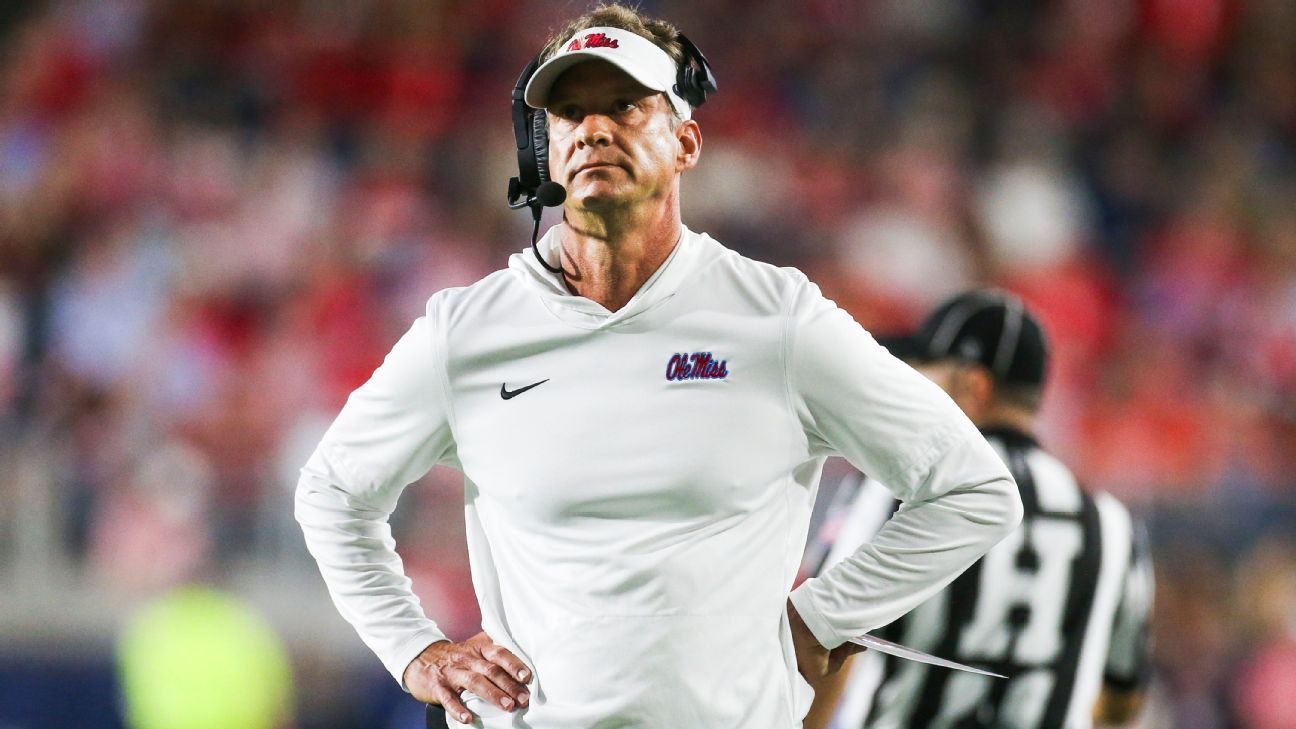
As victims go, Lane Kiffin doesn’t seem like one.
He could have stayed at Ole Miss, made over $10 million a year, led his 11-1 team into a home playoff game and become an icon at a place he supposedly found personal tranquility. Or he could’ve left for LSU to make over $10 million a year leading a program that has won three national titles this century.
Fortunate would be one description of such a fork in life’s road. The result of endless work and talent would be another.
But apparently no one knows a man’s burdens until they’ve walked a mile in his hot yoga pants.
Per his resignation statement on social media, it was spiritual, familial and mentor guidance that led Kiffin to go to LSU, not all those five-star recruits in New Orleans.
“After a lot of prayer and time spent with family, I made the difficult decision to accept the head coaching position at LSU,” he wrote.
In an interview with ESPN’s Marty Smith, Kiffin noted “my heart was [at Ole Miss] but I talked to some mentors, Coach [Pete] Carroll, Coach [Nick] Saban. Especially when Coach Carroll said, ‘Your dad would tell you to go. Take the shot.'” Kiffin later added: “I talked to God, and he told me it’s time to take a new step.”
After following everyone else’s advice, Kiffin discovered those mean folks at Ole Miss wouldn’t let him keep coaching the Rebels through the College Football Playoff on account of the fact Kiffin was now, you know, the coach of rival LSU.
Apparently quitting means different things to different people. Shame on Ole Miss for having some self-esteem.
“I was hoping to complete a historic six-season run … ,” Kiffin said. “My request to do so was denied by [Rebels athletic director] Keith Carter despite the team also asking him to allow me to keep coaching them so they could better maintain their high level of performance.”
Well, if he hoped enough, Kiffin could have just stayed and done it. He didn’t. Trying to paint this as an Ole Miss decision, not a Lane Kiffin decision, is absurd. You are either in or you are out.
Leaving was Kiffin’s right, of course. He chose what he believes are greener pastures. It might work out; LSU, despite its political dysfunction, is a great place to coach ball.
Kiffin should have just put out a statement saying his dream is to win a national title, and as good as Ole Miss has become, he thinks his chance to do it is so much better at LSU that it was worth giving up on his current players, who formed his best and, really, first nationally relevant team.
At least it would be his honest opinion.
Lately, the 50-year-old Kiffin has done all he can to paint himself as a more mature version of a once immature person. In the end, though, he is who he is. That includes traits that make him a very talented football coach. He is unique.
He might never live down being known as the coach who bailed on a title contender. It’s his life, though. It’s his reputation.
One of college sports’ original sins was turning playcallers into life-changers. Yeah, that can happen, boys can become men. A coach’s job is to win, though.
A great coach doesn’t have to be loyal or thoughtful or an example of how life should be lived.
This is the dichotomy of what you get when you hire Kiffin. He was on a heater in Oxford, winning in a way he never did with USC or Tennessee or the Oakland Raiders.
That seemingly should continue at resource-rich LSU. Along the way, you get a colorful circus, a wrestling character with a whistle, a high-wire act that could always break bad. It rarely ends well — from airport firings to near-riot-inducing resignations to an exasperated Nick Saban.
LSU should just embrace it — the good and the not so good. What’s more fun than being the villain? Kiffin might be a problem child, but he’s your problem child. It will probably get you a few more victories on Saturdays. He will certainly get you a few more laughs on social media.
It worked for Ole Miss, at least until it didn’t. Then the Rebels had to finally push him aside. This is Lane Kiffin. You can hardly trust him in the good times.
If anything, Carter had been too nice. He probably should have demanded Kiffin pledge his allegiance weeks back, after Kiffin’s family visited Gainesville, Florida, and Baton Rouge.
Instead, Kiffin hemmed and hawed and extended the soap opera, gaining leverage along the way.
Blame was thrown on the “calendar,” even though it was coaches such as Kiffin who created it. And leaving a championship contender is an individual choice that no one else is making.
Blame was put on Ole Miss, like it should just accept desperate second-class hostage status. Better to promote defensive coordinator Pete Golding and try to win with the people who want to be there.
To Kiffin, the idea of winning is seemingly all that matters. Not necessarily winning, but the idea of winning. Potential playoff teams count for more than current ones. Tomorrow means more than today. Next is better than now.
Maybe that mindset is what got him here, got him all these incredible opportunities, including his new one at LSU, where he must believe he is going to win national title after national title.
So go do that, unapologetically. Own it. Own the decision. Own the quitting. Own the fallout. Everything is possible in Baton Rouge, just not the Victim Lane act.


Closer Ryan Helsley and the Baltimore Orioles are in agreement on a two-year, $28 million contract that includes an opt-out after the first season, sources told ESPN, continuing the remaking of Baltimore’s beleaguered pitching staff with one of the most sought-after relievers on the free agent market.
While multiple teams sought to sign Helsley as a starter, the 31-year-old right-hander chose to remain in the role that made him a two-time All-Star and will hand him the ninth inning for the Orioles while retaining the ability to reach the open market after 2026.
Helsley, whose deal is pending a physical, is the second bullpen addition of the winter for Baltimore, which reacquired right-hander Andrew Kittredge from the Cubs after dealing him to Chicago at the trade deadline. With a moribund pitching staff, the Orioles went 75-87 and finished in last place in the American League East after consecutive postseason berths.
Orioles president of baseball operations Mike Elias trawled the free agent market for a late-inning option and landed on Helsley, who over his seven-year career has a 2.96 ERA in 319⅔ innings with 377 strikeouts, 133 walks and 105 saves.
Among the lowest points were the final two months of Helsley’s 2025 season, when, following a deadline deal from St. Louis to the New York Mets, he posted a 7.20 ERA and allowed 36 baserunners in 20 innings. Coming off an All-Star showing for St. Louis in 2024, which included a National League-leading 49 saves and a 2.04 ERA, Helsley saved 21 games with a solid 3.00 ERA for the Cardinals before the deadline, when he was sent to the Mets for three prospects.
Acquired to deepen a New York bullpen anchored by closer and fellow free agent Edwin Diaz, Helsley struggled badly during his time with the Mets. He blew saves in three straight appearances in mid-August and spent most of the past month working in low-leverage situations as New York collapsed down the stretch and missed the postseason.
Baltimore saw more noise than signal in Helsley’s downturn and is banking on Helsley’s stuff — which pitch-quality metrics rate as some of the best in the game — returning him to dominance. Helsley deploys one of baseball’s hardest fastballs, which averaged 99.3 mph in 2025, according to Statcast, ranking in the 99th percentile of all pitchers.
With incumbent closer Felix Bautista expected to miss the 2026 seasons following rotator cuff and labrum surgeries in August, the Orioles entered the winter with only right-hander Yennier Cano and left-hander Keegan Akin as veteran bullpen options. Beyond Helsley and Kittredge, Baltimore could add another reliever, sources said. The Orioles’ need for pitching help isn’t limited to their bullpen, either. Following the trade of Grayson Rodriguez to the Los Angeles Angels for left fielder Taylor Ward, Baltimore continues to pursue starting-pitching options to join left-hander Trevor Rogers and right-hander Kyle Bradish at the top of their rotation, sources said.
A fifth-round pick out of Northeastern State in Oklahoma, Helsley was a full-time starter throughout the minor leagues until he joined the Cardinals’ big league roster. From 2022 to ’24, he was arguably the most valuable reliever in the NL, alongside right-hander Devin Williams, a free agent with whom the Orioles spoke as well.
ESPN’s Bradford Doolittle contributed to this report.
Sports
Will there be baseball in 2027? Is a salary cap coming? What you need to know about MLB’s looming labor battle
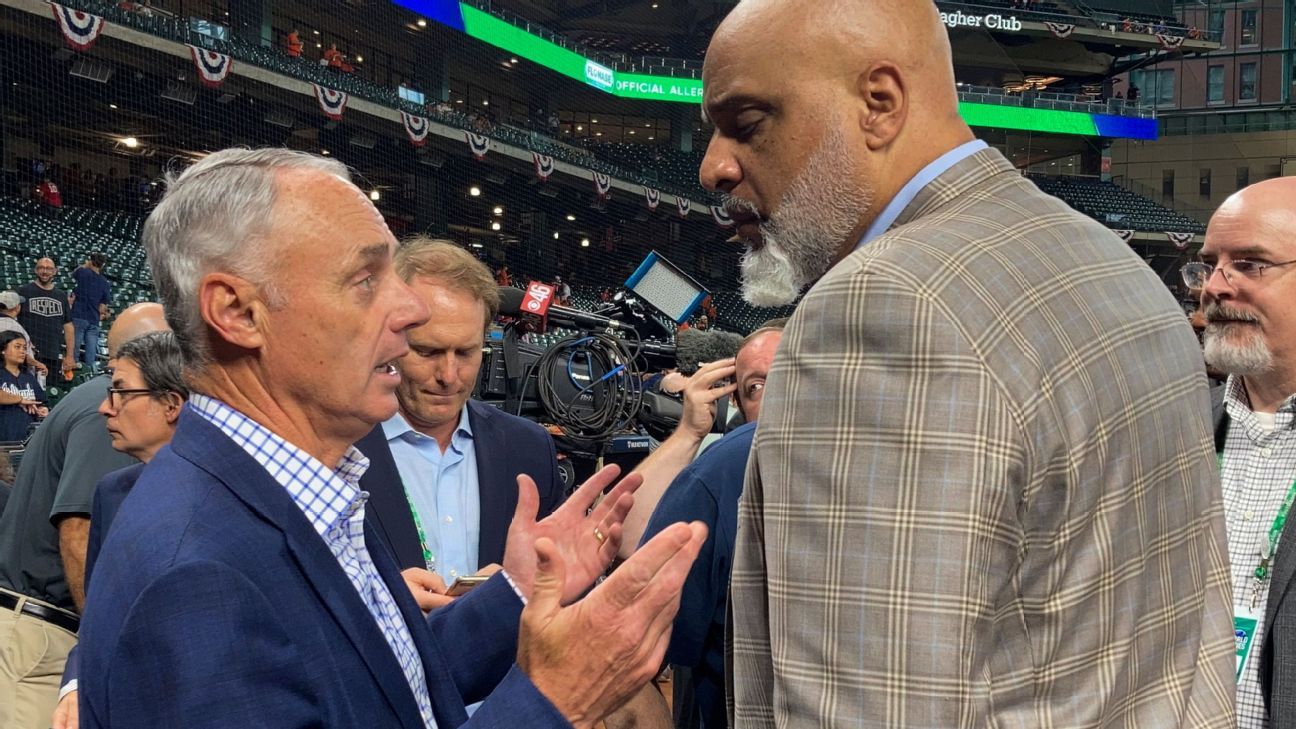

Is Major League Baseball headed for disaster?
One year from today — on Dec. 1, 2026, at 11:59 p.m. ET, to be exact — the league’s current labor agreement expires.
As the owners and players look to agree on a new collective bargaining agreement, there are major hurdles to clear and some key areas of disagreement.
Will we see a work stoppage in 2027? Is a salary cap coming? ESPN MLB experts Jeff Passan, Jesse Rogers and Alden Gonzalez field some of the biggest questions looming over the sport.
Is there any chance that the two sides could come to an agreement before next December’s deadline — and what happens if they don’t?
Sure. There’s always a chance. It’s akin to the chance that Lloyd Christmas had with Mary Swanson, but it’s a chance nonetheless.
The greater likelihood, if past is indeed prologue, points toward the league locking out the players Dec. 1, 2026. A lockout would shut down free agency and trades, as it did in 2021, and set an even more important, though informal, deadline: early to mid-March 2027, the drop-dead date for potentially losing regular-season games.
What happens between today and a year from today could have significant bearing on avoiding the doomsday scenario: that not only are the players locked out, but the sides cannot find common ground thereafter. The greatest threat of an extended work stoppage — baseball’s last was in 1994-95 — would come if owners insist on an overhaul of the game’s economic system to include a salary cap. Player leadership has indicated it won’t even entertain the notion of a capped system.
At the same time, the union and executive director Tony Clark are in the middle of a federal investigation into MLBPA finances that launched around May 2025. Any pursuit of a prosecution by the government could have a demonstrable effect on union leadership and, potentially, its positions in bargaining. — Jeff Passan
What is the timeline for negotiations between now and Dec. 1, 2026?
While the sides held a preliminary meeting this fall and could have more informal sessions over the coming months, bargaining typically cranks up during spring training.
At that point, the sides will begin to make their priorities clear to each other, and it will offer a better sense of the issues that are expected to be central to the negotiations. The most pertinent will be just how firm the league is on its desire for a cap.
The initial offers are important to outline the broad strokes of the negotiations to come. The most important meetings, however, will take place closer to the Dec. 1, 2026, deadline, with November the most vital month to establish where the sides stand before the expected lockout. — Passan
Who are the primary names fans should know on both sides of the negotiations?
For the players: Deputy executive director Bruce Meyer is the lead negotiator, Clark the ultimate authority. There is a 38-member executive board of players, made up of eight elected, high-ranking subcommittee members (Cy Young winners Paul Skenes and Tarik Skubal, plus veterans Chris Bassitt, Jake Cronenworth, Pete Fairbanks, Cedric Mullins, Marcus Semien and Brent Suter) and one representative from each team — the delegates for the rank-and-file.
For the league: Deputy commissioner Dan Halem is the lead negotiator, commissioner Rob Manfred the ultimate authority. The league’s labor policy committee — headed by Colorado Rockies owner Dick Monfort, who is joined by Hal Steinbrenner (New York Yankees), John Sherman (Kansas City Royals), Jerry Reinsdorf (Chicago White Sox), Ray Davis (Texas Rangers) and Jim Pohlad (Minnesota Twins) — is the proxy for the 30 owners. — Passan
How will the looming potential of a prolonged labor stoppage impact free agency this offseason?
Executives, league officials and agents are in agreement on one thing at this moment in the offseason: They’re simply not sure how things will shake out just yet in terms of spending. There are no grand predictions about the theme of the offseason, and the few early signings haven’t foreshadowed much, either.
Having said that, two emerging narratives seem to be prevalent. It’s business as usual for the annual World Series contenders like the Yankees, the Philadelphia Phillies and the Los Angeles Dodgers — and now we can include the Toronto Blue Jays in that category.
Phillies president Dave Dombrowski didn’t even hesitate when asked how the final year of labor might impact their winter.
“That is not something we talk about,” he said. “We’re going to proceed normally.”
You can expect the same from the Dodgers, who are attempting a rare three-peat in 2026.
Other organizations are waiting for more certainty, potentially in the form of a new economic system, before they jump back into serious spending. That might not come until after the next CBA is signed, which means that the looming end of the CBA will have some say in the offseason, even if it’s a small impact.
Chicago Cubs president Jed Hoyer admitted at the end of last season that many of his player contracts were designed to be up after 2026 — in other words when the CBA expires — in order to have relatively clean books heading into 2027 and beyond. Several agents and teams believe that cost certainty in the form of a new CBA — and, if MLB gets its way, a first-ever salary cap — will return spending back to higher levels simply because teams will understand their yearly costs more intimately after a new deal.
In the meantime, there’s a postseason and World Series to be played in 2026. And it’s just not the major markets that want to get a playoff run under their belts before things change, according to insiders. So look for free agents to do well in the market even with labor concerns percolating this winter. Yes, a few might take one-year deals, hoping the next economic system benefits them when they go back into the market — but there is certain to be plenty of momentum.
Agent Scott Boras summed it up when asked if spending would be depressed this winter, knowing what’s to come after next season.
“Historically we haven’t seen that, because teams always want to be their best,” he said. “The bottom line is teams understand they don’t have to pay players when there are strikes [or lockouts].” — Jesse Rogers
Will the battle over a potential salary cap be the primary topic discussed between owners and players in the year ahead?
There doesn’t appear to be much doubt about that. Economic disparity has been a hot-button issue for decades. The crumbling of the regional sports network (RSN) television model, which led to several teams losing out on local media revenue, has brought that topic to the forefront in recent years. And the unmitigated spending of teams like the Dodgers and New York Mets has only exacerbated the anger from owners throughout the industry, who continue to claim they don’t have the revenues to keep up.
Even Yankees owner Hal Steinbrenner recently downplayed his franchise’s profit margins and spoke out in favor of a salary cap. If Steinbrenner, who presides over one of the most powerful sports franchises in the world, sounds open to one, imagine how strongly his counterparts in markets such as Pittsburgh, Milwaukee and Tampa feel.
But the prevalence of free markets has been a tentpole issue throughout the MLB Players Association’s existence. Remember that, and you’ll start to understand how ugly this could get. — Alden Gonzalez
Which other issues will fans hear most from each side in the year ahead before the CBA expires?
A central issue for the union during the last round of talks was on how to get players paid sooner, a counter to the middle class of free agency continuing to dry up. As a result of the current CBA, minimum salaries went up, the prospect promotion incentive was introduced, and pre-arbitration bonus pools were established. Expect more talk around that subject in general. In all likelihood, MLB will once again argue that higher compensation for younger players needs to be coupled with a lower luxury tax threshold and will try once again to pair that with a salary floor. The MLBPA probably will say that steers too close to a traditional salary cap system, and on and on we’ll go again.
So, yes, economics will dominate — particularly with changes to the revenue-sharing model desired by both parties and potentially providing a path to an agreement. But two other topics figure to be front and center. One is how MLB implements rule changes. In the last basic agreement, the league secured full autonomy over the implementation of new rules. The union desires more control. And then there’s the subject of an international draft. The league wants one.
During the last round of talks, the union entertained the possibility. After a new CBA was ratified, the two sides gave themselves an additional four months to agree on a trade: The league gets an international draft, the union does away with the qualifying offer. They couldn’t agree by the deadline, but this will come up again. — Gonzalez
-
 Sports2 years ago
Story injured on diving stop, exits Red Sox game
-
 Sports3 years ago
‘Storybook stuff’: Inside the night Bryce Harper sent the Phillies to the World Series
-
 Sports2 years ago
Game 1 of WS least-watched in recorded history
-
 Sports3 years ago
Button battles heat exhaustion in NASCAR debut
-
 Sports3 years ago
MLB Rank 2023: Ranking baseball’s top 100 players
-
Sports4 years ago
Team Europe easily wins 4th straight Laver Cup
-
 Environment3 years ago
Japan and South Korea have a lot at stake in a free and open South China Sea
-
 Environment1 year ago
Here are the best electric bikes you can buy at every price level in October 2024