
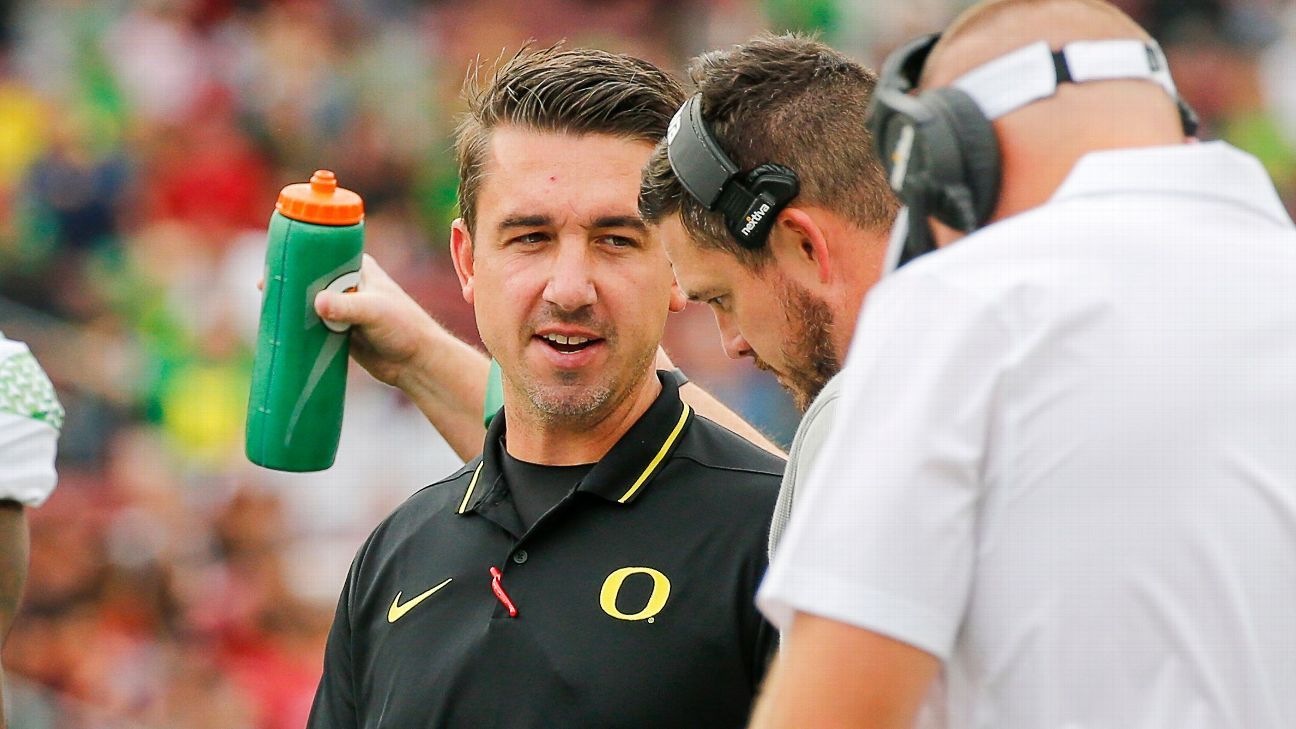
Grading coaching hires: Stein to Kentucky, Fitzgerald to MSU and more


-
Adam Rittenberg
The wildest college football coaching cycle — perhaps ever — has reached the hiring phase.
Schools around the Power 4 that fired their coaches in the first two months of the season — or, in Stanford’s case, way back in late March — are targeting candidates and finalizing deals. Interestingly enough, one of the first major coaches to lose his job, Penn State’s James Franklin, was the first noninterim coach to be hired, as he is headed to Virginia Tech.
New hires always come with hope and optimism, grand proclamations and the chance to get programs on the right track. But not all hiring processes are the same. The financial component with jobs is essential — what schools are willing to spend not just on their head coach, but the assistants and support staff and, perhaps most important, the team roster.
We will be reviewing all of the major coaching hires in the 2025-26 cycle, evaluating how each coach fits in the job, their major challenges and what it will take to be successful. We will also assign an initial letter grade for each hire.
Jump to: Kentucky | Michigan State | UCLA | LSU | Ole Miss | Florida | Arkansas
Auburn | Stanford | Oklahoma State | Virginia Tech


Why is this a good fit?
Stein loves Kentucky. He told me that when I visited Oregon recently. We were talking about the coaching carousel, jobs that had opened and potential openings, and he mentioned his connection to Kentucky. How both of his parents went there and that his dad, Matt, played defensive end for the Wildcats under coach Jerry Claiborne. Stein is from Louisville and played quarterback for the University of Louisville, Kentucky’s in-state rival, but grew up attending UK games. Despite other suitors in this cycle and likely in future ones, Stein had a desire to coach Kentucky, which really matters.
He also gives Kentucky a vision for the offense that it needs after the past few seasons. Since the start of the 2022 season, Kentucky ranks 115th nationally in scoring and 101st in total offense. Stein has quickly emerged as one of the sport’s top playcallers, and has won with different quarterbacks, from the record-setting Frank Harris at UTSA to Bo Nix, Dillon Gabriel and now Dante Moore at Oregon. He operates a system that should attract talented offensive players to Lexington. Stein also has been around strong mentors, from Jeff Traylor to Dan Lanning.
What are the biggest challenges for Stein?
Stein has shown he can handle quarterbacks and design offensive game plans, but how ready is he to oversee an SEC program? He has made a quick rise after landing his first on-field job in the FBS in 2020. The SEC is seemingly getting deeper by the year and can be merciless to coaches and programs that aren’t buttoned-down in every aspect. Stein will need to compile a strong staff, especially on defense but also with a veteran mentor or two. He must take the best elements of coaches like Lanning and Traylor, and apply them as he shapes his own program.
The other big challenge is personnel and upgrading Kentucky’s talent level, ideally with greater resources than Stoops had at the end of his tenure. Stein’s childhood connection to Kentucky and personality should get donors and fans engaged, but the program has fallen behind operationally as teams like Vanderbilt and Missouri have accelerated. Athletics director Mitch Barnhart and university president Eli Capilouto have been in their roles a long time, but they’re also nearing the ends of their careers. Stein must push both leaders to help him get what he needs, especially during the first 12-18 months of his tenure.
Grade: A-
Stein’s lack of head-coaching experience is the only thing keeping the grade from being a full-on A. Kentucky needed a coach who wanted to be there, knew enough about the program and had a plan to elevate its offensive production after Mark Stoops went through a revolving door of coordinators late in his tenure. Kentucky will score and be exciting under Stein, who already has a baked-in connection to the program. Stein will need a strong staff around him but should give UK a chance to rise, even in the difficult SEC. — Adam Rittenberg

Why is this a good fit?
The Big Ten always made the most sense as the setting for Fitzgerald’s return to the sideline. His connections to Northwestern and the Chicago area are obviously extensive, and he has a son playing for Kirk Ferentz at Iowa, where he attended several games this season. Fitzgerald knows the league and the recruiting footprint, and also how to do more with less. Jonathan Smith is a good coach but had never worked outside of the Pacific Northwest; Fitzgerald is a true Midwesterner who has seen firsthand how good Michigan State can be. He coached at Northwestern when MSU won three Big Ten titles under Mark Dantonio and recorded three consecutive AP top-6 finishes from 2013 to 2015. Fitzgerald should create an immediate connection with MSU fans that Smith unfortunately lacked.
The 50-year-old will receive improved resources at Michigan State, both financially and with admissions, that he never really had at Northwestern. He put together Northwestern’s most consistently successful stretch of the modern era from 2008 to 2018, when the program had five AP Top 25 finishes, won two Big Ten West titles and appeared in 10 bowl games. He will need a much better plan for the staff than he showed toward the end of his Northwestern tenure, when the team’s results fell off a cliff. But sometimes several years away from the game can give a talented coach like Fitzgerald the perspective needed to shift certain philosophies that held him back. — Rittenberg
Biggest challenges Fitzgerald will face?
Michigan State’s quarterbacks have struggled the past decade, following the years of stability with Drew Stanton, Kirk Cousins, Brian Hoyer and Connor Cook, who all gave the Spartans offense a high floor. Aidan Chiles, who came over with Smith from Oregon State two years ago, was benched in favor of Alessio Milivojevic on Nov. 1. Milivojevic lost his first three starts before throwing four touchdowns in the season-ending win over Maryland. To have any chance at instant success, Fitzgerald will have to look at the quarterback situation, potentially bringing in a transfer. Fitzgerald will also have to be smart with who he brings in at coordinator.
Northwestern never recovered after Fitzgerald fired longtime offensive coordinator Mick McCall in 2019 and veteran defensive coordinator Mike Hankwitz retired in 2020. The Wildcats won four games combined in 2021-22. The Big Ten is also different from when Fitzgerald last coached. Oregon, Washington and USC — combined with the emergence of Indiana — have made the Big Ten that much tougher for programs like Northwestern and Michigan State. — Jake Trotter
Grade: B
Fitzgerald deserved another opportunity after settling his lawsuit with Northwestern this past summer and being publicly cleared of culpability in the hazing scandal. There has been some selective amnesia in evaluating his candidacy, though. He wasn’t the first coach to win at Northwestern (predecessors Randy Walker and Gary Barnett both won Big Ten titles there). While he had a really nice run before NIL, the transfer portal and when the Big Ten had divisions, he also went 4-20 in his last two seasons and won three games or fewer in three of the last four. Fitzgerald must harness the qualities that made him a consistent winner at Northwestern but also show growth in how he hires staff and approaches roster-building to win at MSU. — Rittenberg

Why is this a good fit?
For UCLA to come out of a competitive hiring cycle with a coach like Chesney is certainly a big win for the program. Chesney not only has continued the success predecessor Curt Cignetti had at James Madison, but he has won everywhere else he has coached. The 48-year-old guided Holy Cross to five consecutive FCS playoff appearances, including a No. 6 finish in 2022. Chesney went 44-16 at Assumption University in Massachusetts and 23-9 at Salve Regina, a Division III program in Rhode Island. There might not be an exact replica of Cignetti out there, but Chesney’s background as a program-builder, with a clear vision, provides a nice pathway for UCLA after a tumultuous period.
Penn State seemingly would have made more sense for Chesney, a Pennsylvania native who has spent his entire career in the region. But UCLA pried him away and gives itself a chance to reset after a 2025 season that began with great optimism but sidetracked quickly with the firing of coach DeShaun Foster. Chesney is charismatic and should be able to connect with key UCLA stakeholders and garner the support needed to move the program forward. UCLA has tried several coaches with ties to its program who haven’t really panned out. Chesney is a bit of a departure but could be the one to get the Bruins more competitive in the Big Ten. — Rittenberg
What are the biggest challenges for Chesney?
When Foster was hired to be UCLA’s next head coach after Chip Kelly’s departure, the challenge was making UCLA attractive again. The Bruins opted for familiarity with a former player and first-time head coach and it backfired. Now, they’ve gone outside the box to a coach who hasn’t spent any time on the West Coast. There lies Chesney’s biggest challenge.
UCLA may not be able to immediately recruit or use the transfer portal with the likes of USC and Oregon on this side of the college football world, but Chesney has the pedigree of being able to develop players at lower levels and win wherever he has been. How he can harness that into not only excitement around the program, but also substance and results will be crucial.
There’s plenty of talent on the West Coast for UCLA to be better than it has been in recent years, but Chesney may need to completely revamp the school’s reputation on the recruiting trail (and in his roster-building approach utilizing the portal) as he sets out to create a vision for what kind of team he wants the Bruins to be.
It never quite felt like Foster was able to do just that, and though interim Tim Skipper did infuse life into the team after Foster’s firing, this is a program that needs a clear, viable and effective long-term directive. The question is whether Chesney can concoct the right recipe to turn a fledgling brand into more than just a Big Ten also-ran. — Paolo Uggetti
Grade: B+
Chesney is a really strong hire for UCLA. My only hesitation is the location — and, to a degree, the league — as Chesney has never worked anywhere near the West Coast. UCLA is a hard job even for those familiar with campus politics, the University of California system, the stadium situation and the Southern California recruiting scene. Although parallels will be drawn between Cignetti and Chesney, Cignetti worked in the Power 4 for Nick Saban at Alabama, as well as NC State and Pitt. There will be an adjustment period for Chesney, but his track record suggests UCLA will be winning soon and consistently. — Rittenberg

Why is this a good fit?
LSU got the coach it wanted ahead of other suitors, further confirming that its coaching job, despite the drama and dysfunction, remains one of the best in college football. Kiffin left a great situation at the height of his powers because he knows that LSU can consistently compete for national titles in ways that other programs simply cannot. In Kiffin, LSU gains a coach accustomed to the bright lights and the big stadiums, who can attract and develop talent and potentially restore the program to national powerhouse status. LSU can offer the big stage Kiffin lacked at Ole Miss, and wanted again.
Kiffin hasn’t worked at LSU but knows the SEC well after stops at Ole Miss, Alabama and Tennessee. Like Kiffin did at Ole Miss, he should put together an excellent staff that can scour Louisiana, Texas and the surrounding areas for top talent. He certainly will try to bring some of Ole Miss’ top players with him. Kiffin brings the offensive chops that LSU lacked at the end of Kelly’s tenure. He’s one of the nation’s best at identifying and developing quarterbacks, and the emergence of running back Kewan Lacy and others underscores that the Kiffin plan works on offense. — Rittenberg
Biggest challenges Kiffin will face
LSU has a reputation as a place where it is possible to win championships, and that expectation will be placed on Kiffin immediately – especially with the money he is being paid. The Tigers pride themselves on this fact as Nick Saban, Les Miles, then Ed Orgeron all won national titles. Brian Kelly was an awkward fit from the start and never truly got the vibe down on the Bayou. Kiffin has his own unique way of running a program, but he has to find a way to work with all the different “cooks in the kitchen” so to speak. The entire state is heavily invested in LSU football, and though Kiffin has an extremely high profile, he is moving to an even bigger spotlight in Baton Rouge — the only Power 4 school in the state. Kiffin must embrace that, and everything that comes with it. As coveted as he was in this cycle, Kiffin has never won a conference title and finding a way to get over the hump at a school like LSU has to happen. This will be his best shot to get it done, and the clock will start ticking as soon as his first press conference ends. — Andrea Adelson
Grade: A-
The fixation around Kiffin the past few weeks would normally be attached to a multi-time national championship winner, or at least a coach who has won a Power 4 conference title. Kiffin did tremendous work at Ole Miss but still needs to show he can win the biggest games consistently. LSU is a national championship-or-bust type of program, and Kiffin will be judged at the very highest level, which he craves. He brings the right ingredients to get it done in Baton Rouge, especially his work with quarterbacks. — Rittenberg

Ole Miss makes DC Pete Golding new head coach
Why is this a good fit?
Under normal circumstances, Ole Miss could run a complete coaching search, thoroughly assess candidates currently in head-coaching roles, and others who might help build on the historic success under Lane Kiffin. But these are the strangest of times in Oxford, as Kiffin exits for LSU, a College Football Playoff first-round game looms for the Rebels, and emotions are running extremely high. Kiffin certainly will try to poach the roster for top pieces, and Ole Miss must do what it can to protect as many players as possible. Golding was the lead recruiter for many of them. He’s well-liked by players and won’t need to familiarize himself with Oxford, the administration and how Ole Miss is set up to compete.
Golding, 41, might not have been on the wish list for other SEC jobs just yet, but Ole Miss found itself in a unique situation. He’s a Louisiana native who has spent his entire career in the region, first at his alma mater Delta State and other smaller programs, and then Southern Miss and UTSA before getting his big break with Nick Saban at Alabama in 2018. Golding spent five seasons as a coordinator under Saban, and helped the Crimson Tide to a national title in 2020, before joining Kiffin at Ole Miss. He gives Ole Miss a chance not only for success in this year’s CFP, but can minimize disruptions during a very bumpy coaching transition.
What will be Golding’s biggest challenge?
Golding should be able to handle the next few weeks, but his true readiness for the enormity of the job is unclear. Again, he didn’t emerge as a candidate for the other SEC openings in this cycle, which suggests some external concern about his ability to handle such a role. Any first-time coaching job brings its challenges and even though Golding knows Ole Miss, he hasn’t been the face of the program. He’s also replacing a coach who put together the team’s most successful run since John Vaught in the late 1950s and early 1960s.
Although Golding has shown his talents in recruiting and with schematics, how will he handle the media? How does he do in front of donors and other key stakeholders with the university? Perhaps he just needed the chance, which he now has, but assistant coaches that are shielded from the media often take some time to get fully comfortable.
Grade: B
Coaching hires can’t be evaluated in a vacuum, and Golding’s ultimate success or failure at Ole Miss will be judged by what he accomplishes beyond the 2025 season. But what happens in Ole Miss’ first CFP appearance, after losing Kiffin to a rival SEC school, absolutely does matter, too, and Golding gives Ole Miss a chance to prolong a really special season. There’s little doubt he will continue to compile strong rosters. He will need a strong supporting staff, especially a talented offensive coordinator hire, to ultimately sustain and even elevate the program. The key question here is whether other SEC programs missed out on a great candidate in Golding, or will Ole Miss suffer for making an in-the-moment decision that could backfire long-term? — Rittenberg

Why is this a good fit?
Florida fans: Sumrall isn’t Billy Napier. Yes, Sumrall is another promising Group of 5 coach from a program in Louisiana, just as Napier was when he came to Gainesville. But Sumrall is a different personality who comes from the opposite side of the ball and has more ties to the SEC, where he both played (Kentucky) and coached (Ole Miss, Kentucky). He is more comfortable than Napier was in being the face of a major program and will delegate to his coordinators while compiling a strong staff. Although Auburn seemed like a more natural spot for Sumrall because of his connections to the state of Alabama, Florida gives him an even bigger platform at the lone SEC program in one of the nation’s top talent-producing states.
The other thing Sumrall brings is wins. He won Sun Belt titles in both of his seasons at Troy and went to the American Conference title game in his first year at Tulane. Sumrall has succeeded in different ways and with different types of quarterbacks. He hasn’t won in the Power 4 or at a program such as Florida, which is an understandable concern. But Sumrall is ready for the opportunity and should be able to foster the consistency Florida has lacked for far too long. Florida didn’t have a talent problem under Napier, and Sumrall should continue to excel in personnel while translating it better on the field. — Rittenberg
Biggest challenges Sumrall will face
Where do we start? First and foremost, Sumrall has to find a way to win over a fan base that thought it had a shot at landing Lane Kiffin. Whether that was a reality or not, Gators fans had their hopes up that Kiffin would choose them. With that, Sumrall has to convince fans he is not another version of Napier. Once Sumrall has done that, he has to find a way to win at what has proved to be one of the hardest jobs to crack in the SEC. Florida has not won an SEC title since 2008, and while there remains a belief it is one of the best jobs in the country, Florida goes through coaches at a fairly frequent clip. If past is precedent, Sumrall will be given a year or two to find success before the fan base starts to turn on him; four years max to compete for a championship. Expectations are sky-high, and Sumrall will be given no leeway to learn on the job. — Adelson
Grade: B+
Sumrall has the ingredients to become the next great SEC coach. He’s an excellent communicator who connects with a range of people and should get Florida fans excited about the future, even if they might be skeptical at first because of his background. Florida isn’t where I initially saw Sumrall ending up in a wild coaching cycle, but if the school gives him some time, he should stabilize and elevate the Gators’ on-field performance and start getting more out of very talented rosters there. — Rittenberg

Why is this a good fit?
Silverfield has quietly become a really successful coach in the region, and he certainly seems ready for a Power 4 opportunity such as Arkansas. Although he hasn’t generated as much buzz as Tulane’s Jon Sumrall and other American Conference coaches, Silverfield has beaten many of them in head-to-head matchups and boasts a 29-9 record since the start of the 2023 season, including an AP Top 25 finish last fall. Silverfield led Memphis to a win against Arkansas earlier this season, and he has beaten four consecutive Power 4 opponents, including West Virginia and Iowa State in bowl games over the past two seasons.
He has led Memphis since late 2019 but has been at the program since 2016, so he understands the recruiting landscape and where Arkansas must look for players. Arkansas’ location can be a challenge for acquiring talent, but Silverfield shouldn’t be intimidated by it. He also brings a strong background on offense to Fayetteville and should compile a staff that has similar knowledge to the area and possibly the SEC.
What are the biggest challenges for Silverfield?
The SEC is only getting tougher with the additions of Texas and Oklahoma, the emergence of Texas A&M, Ole Miss and Vanderbilt, and the pressure on a traditional heavyweight such as Florida to start making the CFP. Where does Arkansas really fit in the SEC pecking order? Silverfield likely will have to do more with less initially and win games against programs that have been on steadier footing. His real challenge will be trying to energize and unite the financial hubs around the Arkansas program, which give it a chance to accelerate but haven’t always been harnessed.
Athletic director Hunter Yurachek was blunt earlier this year about the increased resources needed to better compete in the SEC. Arkansas seemingly could access those individuals and corporations with the right coach and vision. That’s where Silverfield comes in, as Arkansas can use those relationships to overcome some of its baked-in obstacles. Silverfield will need a strong introductory period, as Arkansas fans might not know him that well and need to embrace his personality and leadership style. The first offseason will be critical to make sure the program doesn’t fall further behind.
Grade: B
Silverfield’s consistency and success tended to go under the radar at a program such as Memphis, where people have grown accustomed to really strong seasons. But his steady leadership style, shown in 2023, 2024 and most of this year, should help an Arkansas program that needs clear direction. He hasn’t coached in the SEC, and there could be a learning curve, but he shouldn’t be surprised walking in the door at Arkansas after spending so much time with Memphis. — Rittenberg

Why is this a good fit?
Every SEC school asks its head coaches to be engaged in recruiting, and Auburn is no exception. Although Auburn never got the results it wanted with Hugh Freeze, the school’s approach toward NIL and acquiring talent — a major draw when it tried to lure Lane Kiffin from Ole Miss — showed up on the roster. Golesh is the type of head coach who could harness Auburn’s established personnel apparatus and really maximize things going forward. He’s about as hands-on in the recruiting space as head coaches get. When Golesh was offensive coordinator at Tennessee, I remember sitting in his office and seeing him monitor all the recruiting transactions from social media on a giant screen. Golesh will get after it to upgrade Auburn’s roster and use all the resources available to him. He won’t be intimidated by the SEC recruiting scene and has ties to multiple states, including Florida and Ohio.
Golesh also brings an offensive background that should energize Auburn fans, especially after how poorly things went on that side of the ball under Freeze. Golesh spent time with Matt Campbell early in his career then with Josh Heupel at both UCF and Tennessee. South Florida ranks in the top five nationally in both scoring and total offense this season, and its defense shined in wins against Boise State and Florida.
What will be Golesh’s biggest challenge?
The challenge at Auburn is almost always the same: Can the head coach truly capitalize on the best parts of the place — an advantageous recruiting location, strong financial resources and a large and extremely devoted fan base — while navigating the big donors and other significant forces that have clashed too often over time and ultimately held back the program’s progress? Golesh is a strong communicator and brings a good mix of experience to the Plains, most notably his two seasons as an SEC coordinator at Tennessee.
He hasn’t been an SEC head coach, though, and he will need to show he won’t be pushed around or swayed by the forces that have doomed Auburn in the past. Golesh’s staff hires at Auburn will be especially important on defense, as South Florida made strides on that side this season but also struggled in key losses to Memphis and Navy. The other element worth watching is how Golesh balances the personnel element, undoubtedly his passion, with some of the other key responsibilities that come with managing an exciting but complicated program such as Auburn.
Grade: B+
Despite no Power 4 head coaching experience, Golesh checks a lot of boxes with his background, having worked in the Big Ten, Big 12 and SEC, and in the Midwest, South and Southeast. His time at Tennessee should really help him at a program such as Auburn, which has a chance to move up in the SEC pecking order but will need a smart, aggressive approach. Golesh’s record of 23-15 doesn’t really jump off the page, and he hasn’t been part of a conference championship just yet. But his assertive vision as a recruiter gives Auburn a chance to quickly improve its roster and win more in an increasingly difficult SEC. — Rittenberg

Why is this a good fit?
Pritchard understands Stanford — its advantages, limitations and possibilities — better than most. He played quarterback for the Cardinal from 2006 to 2009, ahead of Andrew Luck’s run, and then spent the first 13 years of his coaching career with his alma mater, until joining the Washington Commanders‘ staff in 2023. He won’t be blindsided by what he’s walking into at Stanford. He also has a very close relationship with Luck, who is truly directing the program. There will be no feeling-out period between head coach and general manager.
Pritchard, 38, was part of Stanford’s seismic shift under Jim Harbaugh, quarterbacking the team to a signature win against USC in 2007. He then witnessed Stanford’s rise to a consistent contender and, more importantly, saw how things went downhill so quickly after COVID and in the portal/NIL era. His ability to learn from those difficult times and ensure Stanford avoids them will be important. But again, he’s not doing this alone, as he comes in immediately aligned with Luck. — Rittenberg
What will be Pritchard’s biggest challenge?
Generating momentum. Few people share as close an association with some of the biggest moments in Stanford history as Pritchard, but during those heights, the Cardinal never truly resonated broadly within a competitive San Francisco Bay Area sports market. With the collapse of the Pac-12 and six losing seasons in the past seven years, Stanford football has essentially become irrelevant locally. Building a program under those circumstances is difficult.
The academic side of things will always be a draw and should, in theory, help the program limit excessive outgoing transfers, but there also needs to be a robust NIL program. At Stanford that doesn’t have to be a problem. The university’s alumni base is notably wealthy, but it also has not proved to be a group eager to part with large sums of money to help field a better football team. That’s perhaps more of an issue that Luck will be responsible for dealing with, but it is very much part of the hand Pritchard has been dealt.
Beyond the structural challenges, this is just a team that needs a talent upgrade. They don’t have the players right now to compete at a high level. — Kyle Bonagura
Grade: C+
Luck didn’t make the most imaginative hire here. He went with a close friend who needs no introduction to Stanford and the vision for success there. But Pritchard hasn’t been a head coach before and wasn’t mentioned as being on the radar for many other college or NFL jobs. Stanford is really betting on potential here. He only really knows Stanford, which might work out in this case, but he also must learn from what happened toward the end of David Shaw’s tenure and chart out a new path. — Rittenberg

Why is this a good fit?
Oklahoma State needed a coach who knew the Big 12 and the region, and someone who could bring a clear vision, especially on offense. Quarterback play was central to Oklahoma State’s identity under Mike Gundy, and Morris has become one of the best talent identifiers in recent years. Oklahoma State needs to accelerate its recruiting, but likely won’t have the first choice for players, and Morris has repeatedly shown the ability to find and develop under-the-radar players. Ideally, he can bring quarterback Drew Mestemaker and others to Stillwater, and perhaps more importantly, make Oklahoma State an attractive destination for top offensive performers again.
Morris played and coached in the Big 12 at Texas Tech and spent time at Houston early in his career, so he won’t be unfamiliar with the key characteristics of a program like Oklahoma State. He’s not a Gundy disciple, but he can respect what Gundy did to elevate the program, while implementing his own vision, which worked both at Incarnate Word and at North Texas. — Rittenberg
What will be Morris’ biggest challenge?
The answer here is twofold: 1) Morris must live up to the unprecedented levels of consistent success his predecessor brought Oklahoma State; 2) Morris will also have to figure out exactly how to take the Cowboys’ football program to the future.
On the first point, whomever Oklahoma State chose to hire this cycle was going to be replacing a coach who won more — and more consistently — than any other figure in program history. Before 2023, the Cowboys made 18 consecutive bowl appearances under Gundy, winning eight or more games in 13 of those seasons. Past leading Oklahoma State to the very top of the sport and turning the program into a national brand, Gundy’s greatest achievement was transforming a school that had registered back-to-back 10-win seasons only once before he took over in 2005 into a perennial winner. Morris, who made two playoff appearances at Incarnate Word and has North Texas contending for the American this fall, has a history of producing quick turnarounds. Getting Oklahoma State upright — which will likely require a massive roster and staff overhaul — should be his first objective. From there, Morris will be judged on the expectations set by Gundy before him.
How does Morris take Oklahoma State into the future? Gundy’s initial, outspoken reluctance, then too-little, too-late embrace of college football’s NIL/transfer portal era hurt the Cowboys on the field and laid the groundwork for his unceremonious departure earlier this fall. Oklahoma State has fallen behind in terms of roster budgeting compared to its Big 12 counterparts, and industry sources suggested that the Cowboys’ ability to present improved resources would be a key piece of the hiring process. Morris has built a career on making more out of less, and that will serve him well in Stillwater. He has also proven capable of navigating the transfer portal and the current complexities of the sport. With help from Oklahoma State (and its boosters), Morris must take steps to modernize the program. If he can, a Big 12 conference landscape that remains wide open outside of Texas Tech could once again be Oklahoma State’s for the taking. — Eli Lederman
Grade: A-
Morris is only 40 (cue the Gundy memes), hasn’t been a Power 4 head coach, and before this season had only middling results with North Texas. His quarterback track record is his superpower, though, and Oklahoma State needs a renaissance at the position after things fell off too sharply. Morris can recruit Texas and build up the roster. Time will tell if he has the expertise to win one-score games in a league where programs are extremely similar. — Rittenberg

0:32
Paul Finebaum: Is Virginia Tech an upgrade for James Franklin?
Paul Finebaum weighs in on James Franklin reportedly being hired as Virginia Tech’s next coach.
Why is this a good fit?
When Franklin was fired and almost immediately announced his intentions to coach in 2026, Virginia Tech emerged as a natural landing spot for the 53-year-old. He has spent most of his career near the mid-Atlantic region, twice serving as a Maryland assistant, leading programs in Vanderbilt and Penn State and even working within the state at James Madison in 1997.
He understands the key recruiting areas extremely well. Franklin ultimately was fired for not winning the biggest games at Penn State, but he still won a lot of them (104) and understands how to build a consistently successful program. Virginia Tech ultimately had to do more of the selling here and convince a veteran coach that it was financially serious enough to contend in the ACC. Franklin isn’t shy about asking for what he needs, and he wouldn’t take the job if he didn’t feel that Virginia Tech’s investments are sufficient to compete for ACC championships. — Rittenberg
What will be Franklin’s biggest challenge?
This hire would not have happened without the financial investment Virginia Tech is about to make in football. The Hokies have languished behind their ACC counterparts in nearly every area — from staffing to salaries to NIL — and some of that has to do with an outdated way of thinking. The one through line has been the thought that the Hokies could win the way Frank Beamer won. That is a big reason why they hired Brent Pry, who served as Franklin’s defensive coordinator, as head coach in November 2021. That clearly did not work, as Pry never won more than seven games in a season. Virginia Tech pledged to add $229 million to its overall athletics budget over the next four years — a huge concession that the old model no longer works in this new era of college football.
But Franklin has to get the entire athletic department to believe the old Beamer days truly are over and things must be done his way. That is challenge No. 1. The second challenge is to restore Virginia Tech’s prowess in recruiting its home state. Franklin had success taking players out of Virginia Tech’s backyard and turning them into stars at Penn State. Will he be able to do the same now at Virginia Tech, which has lost an enormous amount of ground to powers outside the state? The high school players being recruited now were toddlers the last time Virginia Tech was a nationally respected program playing in BCS games. They don’t remember the Hokies being elite. Convincing players to stay in state will be a challenge, but one that Franklin can achieve given his track record. — Adelson
Grade: A
Virginia Tech’s two post-Frank Beamer hires were a coach who had not led a Power 4 program (Justin Fuente) and a first-time head coach (Brent Pry). In Franklin, Virginia Tech gets a proven winner from the Big Ten and SEC, who knows the region extremely well and will be extremely motivated to compete for league titles and CFP appearances.
Franklin’s big-stage shortcomings are a concern but perhaps not as much for a program like Virginia Tech, which is seeking to become a consistent conference title contender again. — Rittenberg

-
David Hale
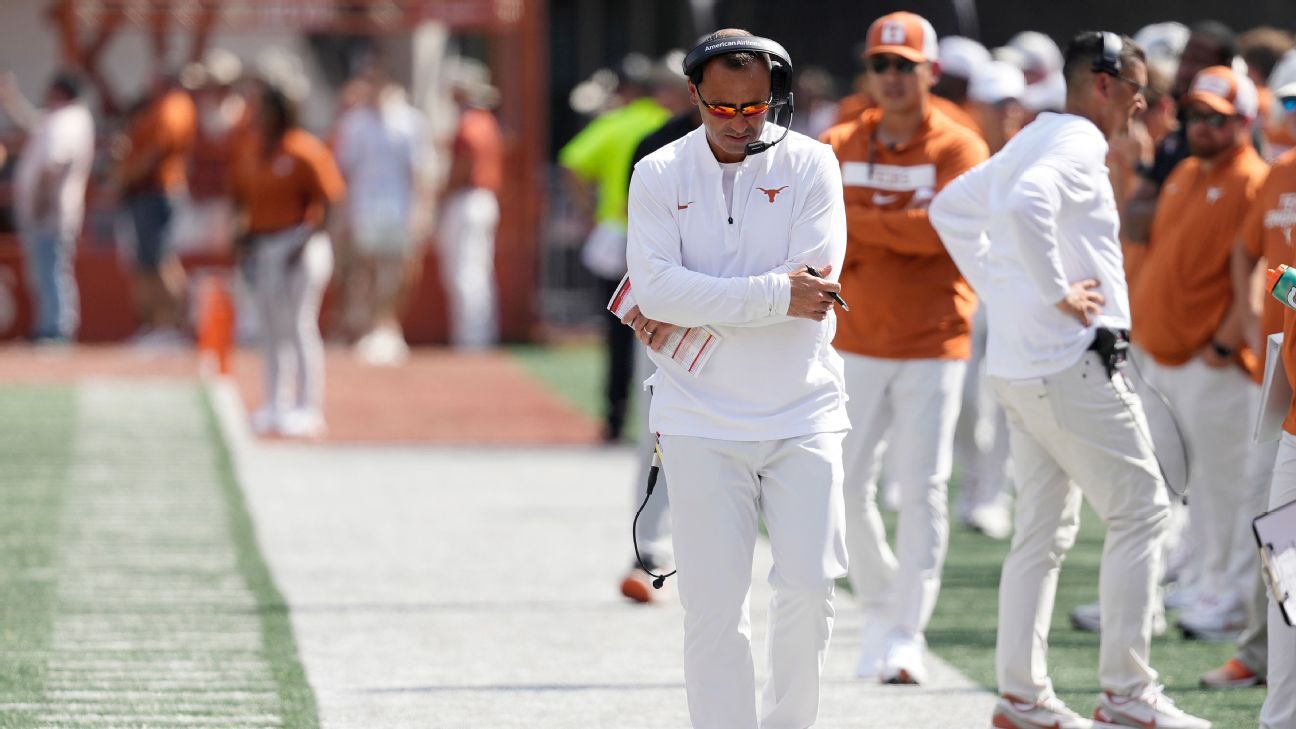
The first College Football Playoff rankings came out five weeks ago. They looked a lot like tonight’s rankings.
We’ve had precious little movement at the top, with a few teams jockeying up or down a slot, but effectively no seismic shifts in the landscape. BYU and Texas are the only two teams that were projected in the field in the committee’s first ranking that aren’t now — and they’re just barely on the outside with reasonable arguments for inclusion.
Teams ranked in the top 18 by the committee this year are a combined 55-9, with six of those losses coming to other teams ranked in the top 18. All three outliers are courtesy of — you guessed it — the ACC (Louisville to Cal, Virginia to Wake and Georgia Tech to Pitt).
That’s a massive anomaly. Last year, top-18 teams at this point had lost 19 games, including 14 to teams outside their own grouping. Top-10 teams are 33-4 this year. In the first 11 years of the playoff, top-10 teams had lost an average of nine games by this point in the season.
The two words that best describe this year’s playoff push are “status quo.”
That, of course, has been bad news for all the teams on the outside looking in — from those with valid cases such as Miami, BYU and Vanderbilt, to underdogs such as USC, Utah or Arizona that might’ve had a shot in a more chaotic year.
But the real loser in this copy and paste rankings season is all the fans who just want to see things get weird. It’s a sad state of affairs when we’re left to rely on MACtion and the ACC to do all the heavy lifting when it comes to college football drama. The power players need to step up — or, perhaps, ratchet down — their game to add a bit more drama.
The good news is, the committee’s ad hoc reasoning, mushmouthed explanations and mind-boggling about-faces still leave plenty to argue about, even if the big picture hasn’t changed all that much.
Here’s this week’s biggest slights, snubs and shenanigans.

It’s not entirely clear how this committee values wins. For the past month, the priority has certainly appeared to be about which team has the better losses (unless, of course, you’re Alabama).
That seems a foolish way to prioritize playoff teams, since the goal of the playoff isn’t to lose to good teams but to win games.
Does Texas have a bad loss? Yes. A 29-21 defeat to woeful Florida — even if the Gators also played Georgia and Ole Miss close and just walloped a team that beat Alabama head-to-head — is problematic.
But look who Texas has beaten: No. 7 Texas A&M by 10, No. 8 Oklahoma by 17 and No. 14 Vandy by three (in a game they led by 24 in the fourth quarter). That’s the résumé of a team capable of winning a national championship — even if the Horns were also capable of losing to a second-rate SEC team.
Are we trying to find teams with the most upside or give participation trophies to the ones which have not lost an ugly one? (Except, again, Alabama.)
And it’s not as if the committee believes an extra loss is disqualifying. Oklahoma, Alabama, Notre Dame and Miami all have two losses and are ranked ahead of one-loss BYU (more on that in a moment), so what’s the harm of moving a three-loss Texas ahead of a two-loss team that has accomplished less?
This all comes back to the most frequent and justified criticism of the committee: The same rules aren’t applied evenly. In some cases, record matters. In some cases, best wins matter. In some cases, better losses matter. The standard varies based on the team being considered. But if the committee is going to err in favor of any team, it should probably do so for one that’s proved — not once, not twice, but three times — that it can beat an elite opponent.
Oh, and moving Texas up ahead of, say, Notre Dame would also have the added bonus of allowing the committee to sidestep another tricky situation. Which leads us to…


We’re putting these two teams together because we’ve already lamented the committee’s utterly disingenuous evaluation of them repeatedly, so it feels redundant to keep going down the same rabbit hole. But, for the sake of two programs being astonishingly misevaluated, let’s do one more round.
For Miami, the logic is obvious: The Canes beat Notre Dame head-to-head.
But let’s keep going. Miami’s two losses — SMU and Louisville — would rank as the fourth- and fifth-toughest games on Notre Dame’s schedule, had the Irish played them. Instead, Notre Dame has cruised through an essentially listless slate. Six of Notre Dame’s 10 wins came against teams that beat zero or one other Power 4 opponent. Stanford — seriously, Stanford! — is Notre Dame’s fourth-best win (by record). Yes, Notre Dame played well enough in losses to two very good teams, but one of those teams has the same record and is somehow ranked lower! Even if this is strictly about the “eye test,” there’s little argument for ignoring the head-to-head outcome. Notre Dame’s strength of record is 13th. Miami’s is 14th. Notre Dame’s game control is fifth. Miami’s is sixth. If all else is the same, how is head-to-head not the deciding factor?
Yet, here’s a little more salt in the wound for the Canes: Had Florida State finished 6-2 instead of 2-6 in ACC play, Miami would’ve won the (fifth) tiebreaker for a spot in the ACC title game and could’ve locked up its place in the playoff by simply beating Virginia. Instead, the Canes will sit at home and watch and hope and, at this point, probably get left out. Chess, not checkers, by rival FSU.
As for BYU, the committee’s desire to overlook the Cougars makes no sense. Let’s take a look at a blind résumé, shall we? (Note: Best wins and composite top 40 based on an average of SP+, FPI and Sagarin ratings.)
Team A: No. 6 strength of record, No. 14 game control, best win vs. No. 11, next vs. No. 28, loss to No. 5, four wins vs. composite top 40, five wins vs. teams that finished 7-5 or better
Team B: No. 7 strength of record, No. 10 game control, best win vs. No. 13, next vs. No. 27, loss to No. 7, three wins vs. composite top-40, two wins vs. teams that finished 7-5 or better
Now, just based on that information, Team A would seem the obvious choice. Now what if I told you Team B just lost its head coach, too?
That’s right, Team A is BYU and Team B is Ole Miss. Every bit of data here suggests the Cougars are, at worst, on even footing with the Rebels or ahead, and yet the committee has Ole Miss ranked five spots higher.
This is, arguably, the second year in a row in which BYU was clearly the most overlooked team in the country.

A week ago, Notre Dame was ranked one spot ahead of Alabama.
Then on Saturday, the Irish beat 4-8 Stanford by 29 (in a game they at one point led 42-3), while Alabama beat 5-7 Auburn by seven (in a game the Tigers had a chance to tie before fumbling in Tide territory late).
The committee looked at those two results and said, “You know what, we like what we saw from the Tide! Move ’em up!”
What could possibly be the logic for shifting opinions on these two teams? The only other team that jumped another winning team was Texas, and the Longhorns beat the No. 3 team in the country emphatically, not a second-tier team that fired its head coach a month ago.
Oh, and hasn’t the committee made it pretty clear losses are supposed to matter? Well, Notre Dame has two losses to teams ranked in the top 12. Alabama got beat by a Florida State team that finished 5-7.
Even by the eye test, this makes little sense. Notre Dame has proved to be one of the most complete, dominant teams in the country, with a secondary that’s near impossible to throw on, a rookie quarterback who has been nearly flawless and a running back who might well be the best player in the country. Alabama, on the other hand, has a one-note offense that can’t run the football.
We’re not believers in using advanced metrics as a ranking of accomplishment, but if this is simply a “who’s better” debate…
-
SP+ ranks Notre Dame fifth and Alabama 12th.
-
FPI ranks Notre Dame third and Alabama sixth.
-
Sagarin ranks Notre Dame second and Alabama seventh.
-
FEI ranks Notre Dame fourth and Alabama ninth.
So, again, we ask: Why would the committee possibly make this change?
We’d wager you know the answer. That sticky Canes vs. Irish head-to-head debate is a real headache for the committee. But if Notre Dame’s currently the last team in and something unexpected happens this weekend (hello, BYU over Texas Tech), then the committee can do as it did in 2014 and wash its hands of a tough choice and keep both Notre Dame and Miami out.
(It’s also interesting that a seven-point win over a team with a losing record is enough to jump Notre Dame, but a 31-point win over a ranked Pitt did nothing for Miami’s relative placement with the Irish despite — and we’re not sure anyone has mentioned this yet — a head-to-head win!)
But, speaking of Alabama…


4. Championship game participants
Step into the time machine with us for a moment, all the way back to championship week 2024. Here’s the state of play: Alabama, at 9-3, is ranked No. 11, the first team out of the playoff and also out of the SEC title game. Still, the Tide and the SEC hope there’s a pathway to salvation because SMU — 11-1 and ranked eighth — still has a game to play against Clemson in the ACC championship. If the Mustangs were to lose, couldn’t the committee then justify slotting SMU behind Alabama based on another data point, even though the Tide were simply sitting at home watching the action?
This was the case being made throughout the run up to the ACC championship last season. SMU, which should’ve been celebrating a miraculously successful first season in the Power 4, spent hours upon hours defending itself against criticism that it didn’t belong in the same conversation with big, bad Bama. Rhett Lashlee hinted he thought the committee’s vote was rigged, SMU players lamented their status on the chopping block despite a ranking that should’ve put them safely in the playoff field, and SEC commissioner Greg Sankey made the rounds arguing that Alabama’s (and Ole Miss’ and South Carolina’s) strength of schedule ought to put them ahead of SMU (and others).
OK, back to the present day. Here we are with Alabama sitting perilously on the dividing line between in the field and out — a week ago, it would have been the last team in, but of course the committee had other ideas this time around — with a game to play against Georgia in the SEC championship. An ACC team (Miami) sits just a tick behind the Tide in the rankings, but it will be off this week.
So, what happens if Alabama loses?
The comparison to last year’s SMU isn’t even a particularly fair one. The Mustangs were at No. 8 before the ACC title game. Alabama is at No. 9 (and probably should be a spot or two lower). SMU’s game against Clemson was new territory. A loss to Georgia will actually undermine Alabama’s best argument for inclusion — the three-point win in Athens in September. And while SMU did make the playoff field last year, a last-second loss on a 56-yard field goal still dropped the Mustangs from No. 8 to No. 10 in the rankings.
Play this scenario out now: Alabama, ranked at No. 9, plays a team that currently counts as the Tide’s best win. Imagine if Georgia wins the rematch and does so convincingly. The committee docked SMU two spots for a last-second loss, so surely it will do at least that much to Alabama for a more convincing defeat, right? And here’s the other thing: Even with the ACC title game loss last year, SMU was 11-2 — one less loss than Alabama had. A Tide loss in the SEC title game will be defeat No. 3 — one more than Notre Dame or Miami or (presumably) BYU.
It’s hard not to see a conspiracy here given the committee’s inexplicable flip-flop between Alabama and Notre Dame. It’s hard not to see brand bias in how the Tide’s championship week narrative diverges from SMU’s a year ago. It’s not at all hard to envision a scenario where Alabama loses to Georgia, gets in as the last team anyway, and it’s all explained away as a completely reasonable decision.

Well, the committee finally weighed in on more than one team outside the Power 4 — mostly because it was just impossible to find enough Power 4 teams worth ranking — and the news isn’t good for JMU. With the committee deciding already that North Texas is the higher ranked team, the Dukes’ only hope for the playoff would seem to be a Duke win in the ACC title game.
But what exactly has the committee seen to warrant that decision? Check out the numbers.
Best win (by average FPI, SP+ and Sagarin ranking)
JMU: No. 54 Old Dominion
UNT: No. 62 Washington State
Next best
JMU: No. 62 Washington State
UNT: No. 68 Navy
Loss
JMU: No. 29 Louisville
UNT: No. 24 USF
Wins vs. bowl-eligible
JMU: six
UNT: five
Strength of record
JMU: 18th
UNT: 22nd
FPI
JMU: 28th
UNT: 37th
There are certainly some check marks in North Texas’ favor, including a more impressive win over common opponent Washington State and a slightly better SP+ ranking, but on the whole, James Madison has had the tougher path here. That can change should UNT beat Tulane, but the committee should’ve waited for that to happen. Instead, it has made it clear JMU isn’t sniffing the playoff unless it comes at the expense of the ACC.
Also angry this week: Vanderbilt Commodores (10-2, No. 14); The ACC leadership who voted on its tiebreaker policies; Manny Diaz, who has to try to make a coherent argument for his five-loss Duke Blue Devils getting in ahead of a one-loss JMU; Every 8-4 team with a markedly better résumé than 9-3 Houston, which isn’t ranked this week; and Lane Kiffin’s yoga instructor and Juice Kiffin’s dog walker.
Welcome to the party, James Madison.
With the inclusion of JMU at No. 25 in the selection committee’s penultimate ranking — its first appearance all season — the possibility of the ACC being excluded from the playoff entirely just got real. Five-loss Duke is nowhere to be found in the ranking.
If Duke beats Virginia in the ACC championship game, it’s not guaranteed a spot in the 12-team field. It could open the door for two Group of 5 conference champions to compete for a national title, and if the playoff were today, it would be Tulane out of the American and JMU from the Sun Belt. The ACC’s best team, Miami, is still on the outside.
At No. 12, the Hurricanes still need some help, but Alabama increased its chances of earning a spot as the SEC runner-up with a small promotion to No. 9. The conference championship games can still alter the picture, but hope on the bubble is dwindling.
Bubble Watch accounts for what we have learned from the committee so far — and historical knowledge of what it means for teams clinging to hope. Teams with Would be in status below are looking good after the committee’s fifth ranking. For each Power 4 conference, we’ve also listed Still in the mix. Teams that are Out will have to wait until next year.
The conferences below are listed in order of the number of bids they would receive, ranked from the most to least, based on the selection committee’s latest ranking.
Jump to a conference:
ACC | Big 12 | Big Ten
SEC | Independent | Group of 5
Bracket
SEC


Would be in: Alabama, Georgia, Oklahoma, Ole Miss, Texas A&M. Right now, the Crimson Tide are the last SEC at-large team in the field. Alabama will face Georgia in the SEC championship game, but the committee could have a difficult decision if Alabama loses and finishes as a three-loss runner-up. The Tide would have defeated Georgia during the regular season but lost to the Bulldogs in the championship game. Even in moving up a spot to No. 9 this week — ahead of Notre Dame — it still seems as if they have a little more margin for error, but how the SEC title game unfolds could matter. And how far Alabama drops could determine if the SEC gets four or five teams in the field. Alabama could finish as the committee’s highest-ranked three-loss team and still be excluded from the playoff to make room for a conference champion — as they were last year.
A Georgia win should lock up a first-round bye and a top-four finish for the Bulldogs, while a loss should still put them in position to host a first-round game. Georgia beat Ole Miss, so it would be surprising to see the Bulldogs drop below the Rebels with a loss, even though the Bulldogs would have one more defeat. With a 35-10 drubbing of Texas also on its résumé, Georgia would still have a strong enough case to finish as the committee’s top two-loss team.
At No. 6, the selection committee moved the Rebels up one spot, so clearly the departure of coach Lane Kiffin to LSU didn’t hurt Ole Miss or its chances of hosting a first-round home game. The bigger reasoning was a promotion after winning the Egg Bowl combined with Texas A&M losing to Texas.
Still in the mix: Texas. The Longhorns moved up to No. 13, but the win against Texas A&M wasn’t enough to put them into the field after the fifth ranking. Texas is stuck behind Miami in part because of its loss to Florida, which Miami beat. Even if BYU and Alabama were knocked out with title game losses, that still probably won’t be enough for Texas to get into the field because the bracket has to make room for conference champions.
Out: Arkansas, Auburn, Florida, Kentucky, LSU, Mississippi State, Missouri, South Carolina, Tennessee, Vanderbilt
Big Ten


Would be in: Indiana, Ohio State, Oregon. Both Indiana and Ohio State are CFP locks — even if they lose in the conference title game — and the runner-up will still have a strong case for a top-four finish and a first-round bye. The loser’s only loss will be to a top-two team, but it could fall behind Georgia in the top four if the Bulldogs win the SEC, and/or Texas Tech if it wins the Big 12.
The Ducks punctuated their résumé with a respectable win at Washington and should be secure in their playoff position, probably hosting a first-round game. Oregon received a small boost to No. 5 after Texas A&M lost to Texas.
Still in the mix: None.
Out: Illinois, Iowa, Maryland, Michigan, Michigan State, Minnesota, Nebraska, Northwestern, Penn State, Purdue, Rutgers, UCLA, USC, Washington, Wisconsin
Big 12

Would be in: Texas Tech. The Red Raiders will play BYU in the Big 12 title game and have a great case to be in the playoff regardless of the outcome. It’s highly unlikely the selection committee would drop the Red Raiders out of the field as a two-loss Big 12 runner-up — especially considering they would have a regular-season win against the eventual conference champion. It’s also possible Texas Tech earns a first-round bye as a top-four seed if the Red Raiders win the Big 12. The committee moved them into the top four Tuesday night following Texas A&M’s loss during Rivalry Week.
Still in the mix: BYU. If BYU doesn’t win the Big 12, it’s unlikely to earn an at-large bid as the conference runner-up because the Cougars are already on the bubble and would be eliminated during the seeding process if the playoff were today. It’s not impossible, though. If Alabama finishes as a three-loss SEC runner-up, it could at least open the door for debate. BYU would have lost to Texas Tech twice, and Alabama would have defeated Georgia, the eventual SEC champ once — and it was on the road. If BYU wins the Big 12, it’s the ideal scenario for the conference because it would have two teams in the playoff.
Out: Arizona, Arizona State, Baylor, Cincinnati, Colorado, Houston, Iowa State, Kansas, Kansas State, Oklahoma State, TCU, UCF, Utah, West Virginia
ACC


Would be in: TBD. The ACC championship game will feature Virginia and Duke, and if five-loss Duke wins, it’s possible the ACC is excluded from the playoff since Duke is not part of the CFP rankings. If Virginia wins, it will represent the league in the playoff, as the two-loss Cavaliers are ranked in the top 20. And no, Miami did not play Duke or Virginia during the regular season. Duke lost to Tulane, which is the top Group of 5 playoff contender and will reach the playoff if it wins the American. Duke also lost to UConn. And it has already lost to Virginia 34-17 on Nov. 15.
Still in the mix: Miami. The Canes are still the committee’s highest-ranked ACC team, but they would be excluded if the playoff were today to make room for a conference champion. That means the ACC winner could knock the league’s best team out of the playoff. The committee isn’t ignoring Miami’s head-to-head win against Notre Dame, but it also isn’t comparing the Canes only to the Irish. Miami also needs to earn an edge against BYU — which the committee has deemed better than Miami to this point. Miami inched closer to Notre Dame because Bama moved up Tuesday, but with neither team playing in a conference championship game, would the committee flip them on Selection Day with a BYU loss?
Out: Boston College, Cal, Clemson, Florida State, Georgia Tech, Louisville, North Carolina, NC State, Pitt, SMU, Stanford, Syracuse, Virginia Tech, Wake Forest
Independent
Would be in: Notre Dame. The Irish have done everything right since their 0-2 start, running the table and doing it with consistent dominance regardless of opponent. At No.10, Notre Dame is in a precarious position. If BYU wins the Big 12 and enters the field, that could bump out the Irish. If BYU wins the Big 12, both BYU and Texas Tech are highly likely to make the playoff, which means someone currently in the top 10 would have to be excluded.
Group of 5

Would be in: Tulane. If the Green Wave win the American, they will represent the Group of 5 in the playoff. Tulane is currently the highest ranked Group of 5 team, but if North Texas beats Tulane on Friday, the Mean Green would be the most likely team to reach the CFP, given the overall strength of the American Conference this season.

Still in the mix: James Madison, North Texas. JMU (11-1) has clinched the East Division and a spot in the Sun Belt Conference championship game, where it will face Troy (8-4) on Friday. North Texas will face Tulane in the American, and if it wins, it’s more likely to represent the Group of 5 in the playoff than JMU because of its schedule strength. JMU could still be considered, though, if Duke wins the ACC, giving the Group of 5 two playoff teams in the 12-team field. With JMU earning a spot in the top 25 this week, the situation became more probable.
Bracket
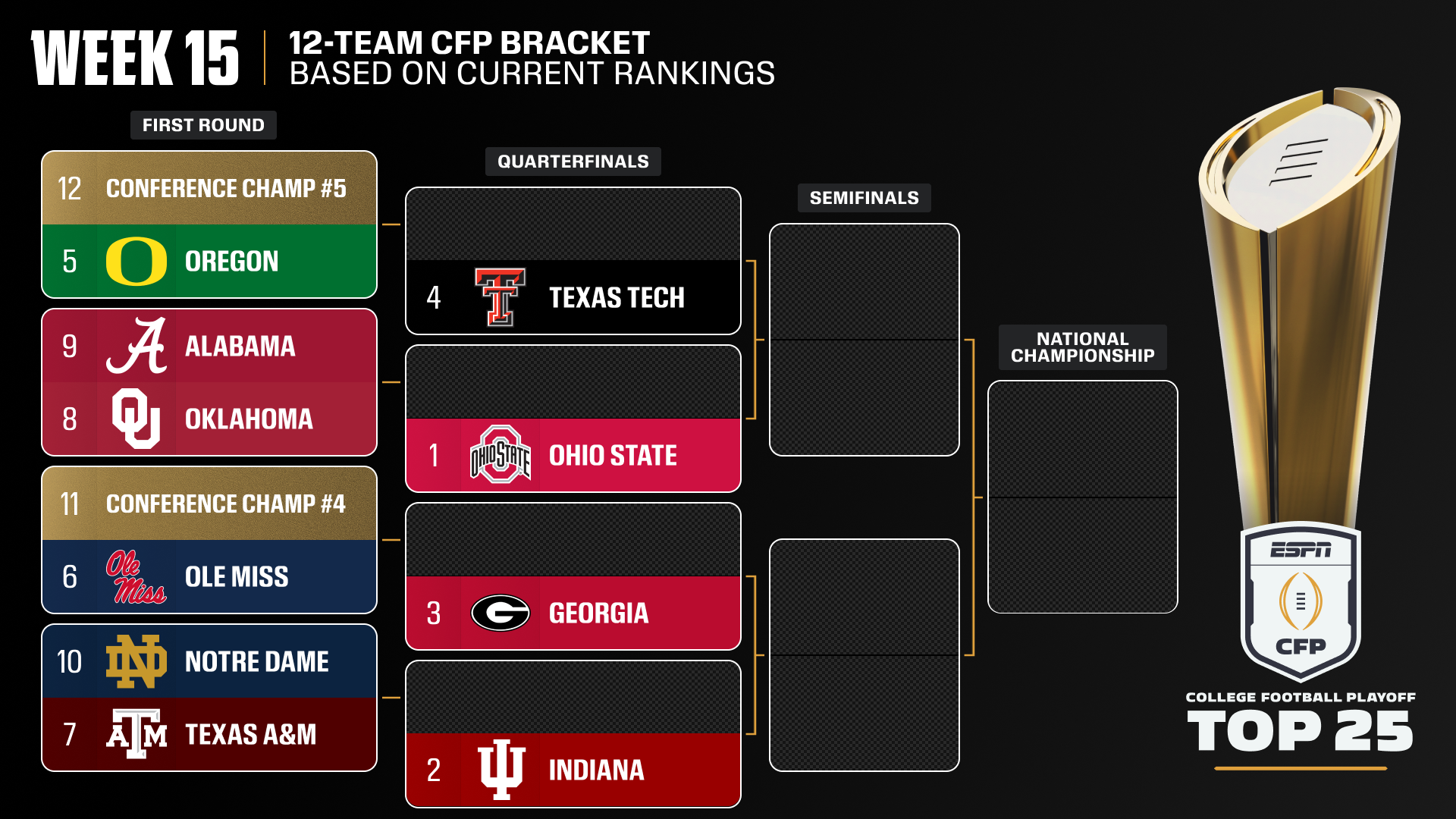
Based on the committee’s fifth ranking, the seeding would be:
First-round byes
No. 1 Ohio State (Big Ten champ)
No. 2 Indiana
No. 3 Georgia (SEC champ)
No. 4 Texas Tech (Big 12 champ)
First-round games
On campus, Dec. 19 and 20
No. 12 Tulane (American champ) at No. 5 Oregon
No. 11 Virginia (ACC champ) at No. 6 Ole Miss
No. 10 Notre Dame at No. 7 Texas A&M
No. 9 Alabama at No. 8 Oklahoma
Quarterfinal games
At the Goodyear Cotton Bowl, Capital One Orange Bowl, Rose Bowl Presented by Prudential and Allstate Sugar Bowl on Dec. 31 and Jan. 1.
No. 12 Tulane/No. 5 Oregon winner vs. No. 4 Texas Tech
No. 11 Virginia/No. 6 Ole Miss winner vs. No. 3 Georgia
No. 10 Notre Dame/No. 7 Texas A&M winner vs. No. 2 Indiana
No. 9 Alabama/No. 8 Oklahoma winner vs. No. 1 Ohio State

-
Eli Lederman
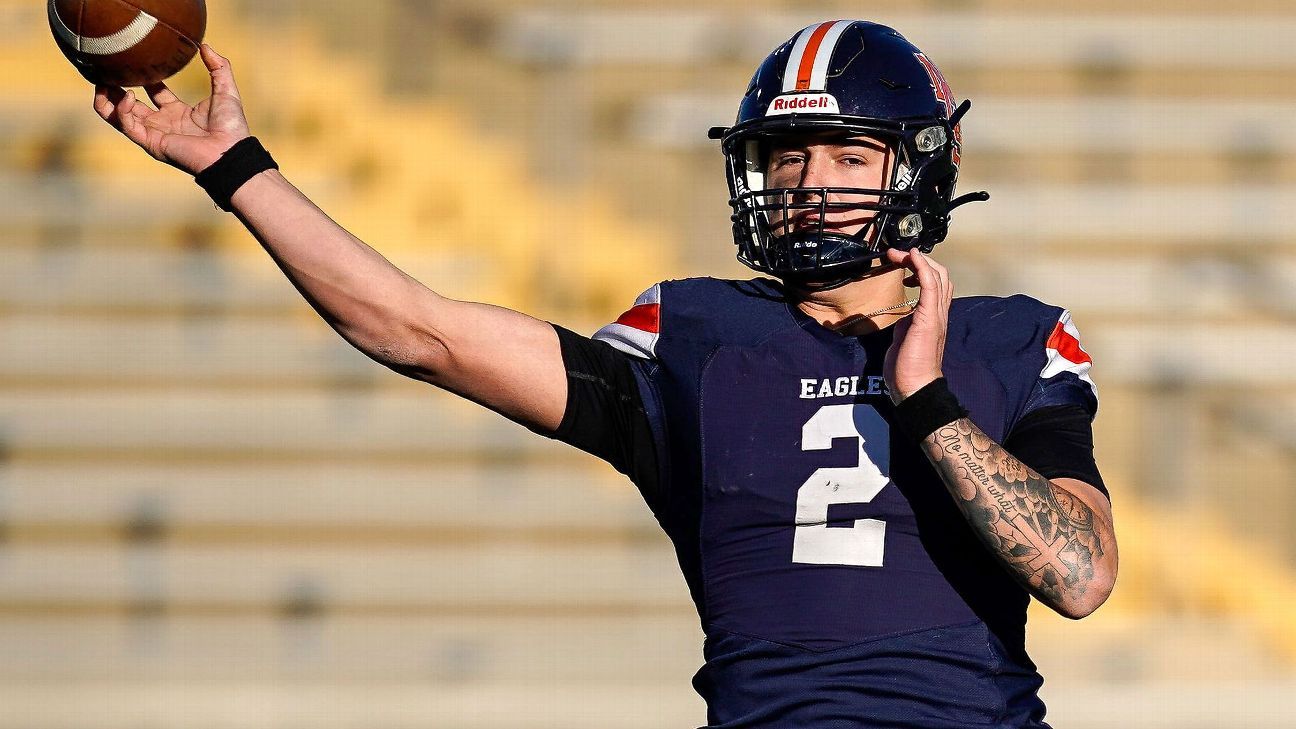
Five-star quarterback Jared Curtis, ESPN’s No. 1 pocket passer prospect, has flipped his commitment from Georgia to Vanderbilt, he announced Tuesday night, sealing a seismic move atop the 2026 class less than 24 hours before the start of the early signing period.
Curtis, a senior at Nashville (Tennessee) Christian School, is the No. 5 recruit in the 2026 ESPN 300. Multiple sources told ESPN earlier on Tuesday that Curtis’ intention was to commit to the hometown Commodores during this week’s early signing period before closing his high school career at the Division II-A state championship Thursday night.
Curtis initially shot down reports that he’d made a final decision Tuesday afternoon. According to sources close to his recruitment, he finalized the move Tuesday night and announced his pledge to Vanderbilt following phone calls with each coaching staff. He’ll sign with the Commodores on Wednesday morning as the highest-ranked signee in program history.
“Being here in Nashville and seeing what Vandy has been doing this season has been amazing and over the past few weeks, I felt more and more that I wanna be a part of that, to be close to home, to play in front of family and friends and to be what I love to be, an underdog,” Curtis wrote in a statement posted to social media. “I am excited to be a [Commodore] and excited to be part of building something here at home with Coach [Clark] Lea.”
Curtis’ flip ends a winding recruitment for ESPN’s No. 2 quarterback, who first committed to Georgia in 2024. Per ESPN sources, Vanderbilt escalated its pursuit of Curtis in October, selling the 6-foot-4, 225-pound quarterback on the chance to stay home and the lure of early playing time as a potential day one successor to Heisman Trophy contender Diego Pavia.
That push continued into November after the Commodores hosted Curtis during the program’s 17-10 win over Missouri on Oct. 25. Although Curtis affirmed his commitment to Georgia’s coaching staff multiple times over the past month, per ESPN sources, conversations between Curtis’ camp and Vanderbilt continued into the final weeks of his senior season.
Per sources close to Curtis’ recruitment, Commodores coach Lea’s potential candidacy for multiple job openings across the country remained a sticking point among Curtis’ camp in recent weeks. After Lea agreed to a reported six-year contract extension on Nov. 28, sources told ESPN that Vanderbilt’s efforts with Curtis intensified further, culminating in his flip on Tuesday.
Curtis’ pledge marks the latest victory for the Commodores amid a historic season in which Vanderbilt achieved its highest AP Top 25 ranking since 1937 earlier this fall. He now stands as the cornerstone member of the program’s 19-man recruiting class in 2026, which ranked 50th in ESPN’s class rankings for the cycle prior to his commitment.
Curtis’ signature will hand Vanderbilt its first ESPN 300 addition since cornerback Martel Hight (No. 274) in the 2023 class. The program’s first-ever five-star signee, he’ll soon replace wide receiver Jordan Cunningham (No. 107 in the 2013 ESPN 300) as the Commodores’ highest-ranked recruit in school history. Curtis will also represent Vanderbilt’s first top-10 quarterback signee since Kyle Shurmer arrived as ESPN’s No. 7 pocket passer in the 2015 class.
Curtis rose to status as one of the nation’s top pocket passers as a four-year starter at Nashville Christian. He threw for 7,637 yards and 92 touchdowns across his first three varsity seasons and led Nashville Christian to a Division II-A state championship as a junior in 2024.
Curtis initially committed to Georgia in March 2024 before reopening his process late last fall. He rejoined the Bulldogs’ incoming class on May 5, picking Georgia over Oregon in a tight, two-school recruiting battle, and Curtis remained the program’s top-ranked 2026 pledge until Tuesday, maintaining frequent contact with the school’s coaching staff this fall.
His decommitment leaves Georgia without a quarterback commitment in the nation’s second-ranked recruiting class. First-year Bulldogs starter Gunner Stockton holds another season of eligibility beyond 2025. Behind him, Georgia’s current quarterback depth includes redshirt freshman Ryan Puglisi and class of 2025 signees Ryan Montgomery and Hezekiah Millender. It is not immediately clear whether the Bulldogs will pursue another quarterback in the 2026 class.
Wednesday marks the start of the three-day early signing period for the 2026 class. The recruiting cycle will officially close with national signing day on Feb. 4.
-
 Sports2 years ago
Story injured on diving stop, exits Red Sox game
-
 Sports3 years ago
‘Storybook stuff’: Inside the night Bryce Harper sent the Phillies to the World Series
-
 Sports2 years ago
Game 1 of WS least-watched in recorded history
-
 Sports3 years ago
Button battles heat exhaustion in NASCAR debut
-
 Sports3 years ago
MLB Rank 2023: Ranking baseball’s top 100 players
-
Sports4 years ago
Team Europe easily wins 4th straight Laver Cup
-
 Environment3 years ago
Japan and South Korea have a lot at stake in a free and open South China Sea
-
 Environment1 year ago
Here are the best electric bikes you can buy at every price level in October 2024