

Ex-teen hackers warn parents are clueless as children steal ‘millions’


Children as young as seven are being referred to Britain’s national cybercrime intervention programme, the Money team can reveal, as companies reel from multimillion-pound hacks.
The average age of referrals to Cyber Choices, which receives people committing or intending to commit entry-level cybercrime, is just 15 this financial year, with the youngest only seven, the National Crime Agency told Money.
The NCA is seeing a year-on-year increase in referrals, mostly gamers aged 10 to 16, at the same time as insurance payouts to hacked UK businesses have rocketed 230%.
“I was right around that age,” says Ricky Handschumacher, a former cybercriminal whose introduction to hacking on a videogame aged 15 led him to a four-year federal prison sentence for stealing $7.6m in cryptocurrency.
“They are even more vulnerable right now than back then because it’s so mainstream.”
Handschumacher, now 32, is one of two notorious crypto hackers who warned that teenagers were increasingly following the same path in exclusive interviews with Money.
“It seems to be growing more and more, it’s not stopping,” says Handschumacher, from Florida.
“You have to really pay attention to what your kid’s doing. You may think ‘my kid would never do that’, but don’t be so sure.
“Some of these 15, 16-year-olds, they’re sitting on millions.”
Pic: Ricky Handschumacher
At least 105 referrals of all ages have been made this financial year to the Cyber Choices programme, but that’s just the start, warns Jonathan Broadbent, a senior officer at the NCA’s National Cyber Crime Unit.
“I don’t think the referrals represent the full scale of the threat,” Broadbent warns. “Cybercrime against schools – that is really quite prevalent across the country.”
Students caused 57% of insider data breaches in schools between January 2022 and August 2024, according to the Information Commissioners Office.
Escalating attacks
Britain has been given a sense of its scale in a spate of recent multimillion-pound attacks.
Marks & Spencer lost £136m to a cyberattack in April that halted online orders for weeks, while the data of 6.5m customers was stolen from Co-op.
Hackers shut down Jaguar Land Rover factories for five weeks in August, causing £1.9bn in disruption to the UK economy, according to the Cyber Monitoring Centre.
An attack on Transport for London caused months of disruption, and nursery chain Kido was held to ransom in September.
Teenagers and young adults were among the suspects in all these cases.
Watch: Angry father says Kido ‘completely failed their duty’
The gaming pathway
Gaming, which is participated in by 97% of children aged eight to 17, is a major pathway into cybercrime, according to Broadbent.
It was a route followed by both Handschumacher and another reformed hacker, Joseph Harris, 28, who was jailed for stealing $14m in cryptocurrency in 2018.
His entry to hacking at the age of 12 was Club Penguin, a children’s game where players navigate a cartoon penguin through a wintery island full of sled races, dance contests and treasure hunts.
It’s an image that is incongruous with the sight of Secret Service Agents swarming a Missouri petrol station eight years later and pointing their guns at him.

Club Penguin at the Electronic Entertainment Expo in 2011. Pic: Reuters
It all started in 2010, Harris says, when he found a bug in Club Penguin allowing him to force the game to loop when he collected coins, affording him rare items from the in-game shop.
Tutorials on YouTube convinced him it was quicker to phone email providers and trick his way into accounts that already owned these outfits and accessories.
“It sounds silly because it’s a children’s game, but some of those items were worth thousands of dollars,” says Harris.
And by age 13 that’s what he was making, selling the accounts to Club Penguin enthusiasts willing to give him $2,000 for the privilege.
“The thrill and the accomplishment was more of a rush for me than the actual money,” Harris says.
“I had really bad ADHD so I couldn’t focus on school, so a lot of the time I didn’t have the best grades.”
Harris, who now runs cybersecurity firm Dynamo, adds: “Hacking was such an interesting topic that I feel my hyper-fixation let me focus on it heavily.”
Neurodiversity
A link between neurodiversity and hacking proficiency has been suggested by some research, says chartered psychologist professor John McAlaney.
Approximately 17% of people referred to the British cybercrime investigation groups Cyber Prevent and Pursue between 2017 and 2020 were diagnosed with autism or self-referred as having autistic-like traits, far higher than the 1-2% recorded in the general population.
While the ability to hyperfocus or detect patterns may be relevant, there’s “quite a lot of stereotyping going on”, says McAlaney, author of Forensic Perspectives On Cybercrime.

Pic: Bournemouth University
Hackers aren’t lone wolves with limited social skills sitting in a dark room looking at a glowing screen, he says.
In fact, it is the social identity and positive reinforcement provided by hacking communities that can appeal to a teenager’s desire to find a sense of belonging, he says, “especially for someone who hasn’t felt understood in the offline world.
“You do get what can be surprisingly quite nice support networks on what may look like a criminal hacking forum.”
Sense of community
Unlike his unease at school, Harris started to feel at home on hacking forums as he looked for new targets such as Youtube, PlayStation and Xbox accounts.
Users were willing to pay $500 to $1000 for desirable usernames in the same way that motorists splash out on rare numberplates.
Aged 15, Harris exploited software bugs to steal personal data and trick customer support staff into handing over account access before selling them on.
He’d receive $2,000 a month and, more importantly, the approval of his online friends.
“I didn’t have that much confidence and finally people were praising me for getting these usernames,” he says.
“I started thinking maybe I am okay.”
This is a common experience among children referred to Cyber Choices, says Broadbent: “Often these young individuals can be isolated, they might be in a bedroom and maybe not engage with their families too much and they get that sense of community from being on things like forums.”
But, like McAlaney, Broadbent stresses there is no typical profile for a teenage cybercriminal.
Anyone can be a hacker

Ricky Handschumacher as a teenager
Take Handschumacher, who was a rising student baseball star playing Halo 3, a game sold to 12 million people, when he first encountered hacking.
A competitor on the multiplayer sci-fi combat game targeted him with a DDoS, a cyberattack that overloads a victim’s internet connection.
It’s the kind of hack that Broadbent commonly sees carried out by children referred to Cyber Choices, alongside remote access trojans, which allow hackers to access laptop cameras.
“How are they doing that? How can I do that?” Handschumacher asked himself as his helpless Halo soldier froze, allowing the hacker to kill them.

Pic: Reuters
He searched gaming forums, leading to hacking forums, and soon he was stealing Xbox, Instagram and Twitter accounts just like Harris.
“In my case, it was strictly for money,” he says.
“As a teenager, you like to flex. You like to be able to buy whatever you want to buy and do whatever you want to do.”
Their motivations may differ, but so similar were the pair’s path into hacking that they met when Handschumacher stole a PlayStation account from Harris that the latter had himself hacked.
“We started by butting heads,” says Harris, but by the time they’d started stealing straight from cryptocurrency wallets in their late teens and early twenties, they were collaborating – and they weren’t the only ones.
Disorganised crime
When Handschumacher stepped outside his front door in 2018 and found “about 50 cop cars” surrounding him, he was accused of being a member of an international hacking gang named The Community.
It’s a mafia-esque description often deployed by law enforcement, the media and criminals themselves, including in the attacks on M&S, Co-op and Harrods linked to “Scattered Spider” and the attack on JLR claimed by “Scattered Lapsus$ Hunters”.
Some hackers do operate like this, says Alexandra Fedosimova, digital footprint analyst at cybersecurity firm Kaspersky.
Experienced cybercriminals will recruit greener ones over Telegram or the dark web to carry out timely grunt work for cash, like accessing a company’s online infrastructure, before stepping in themselves to steal data, she says.

Alexandra Fedosimova. Pic: Kaspersky
But Harris and Handschumacher describe a far more fluid, loose network of teenagers and young adults who weren’t taking their crimes very seriously.
Any one “job” could include friends, friends of friends, a recommendation from an acquaintance and so on, some of whom used their real names while others remained anonymous.
“You wouldn’t have a specific group,” says Handschumacher, adding he didn’t know some of his co-defendants.
Indeed, the group “Scattered Lapsus$ Hunters” is thought to be made up of hackers formerly part of three different groups, Shiny Hunters, Lapsus$ and Scattered Spider, who themselves are said to have emerged from The Community.
Another game
Broadbent says child hackers he sees are often bored, curious or tech-talented children who wanted a community, a challenge, competition and status among their peers, and, like most teenagers, were willing to push boundaries to get it.
“It was more of the challenge, the thrill, the rush you get from getting those big numbers,” says Harris, who says he stole just under $30m in crypto the year he was caught.
Besides a few videogames, he says he never spent much stolen cash, remaining in a rented house with five roommates for $400 a month.
“Your moral compass fades,” he says. “I was thinking ‘it’s on the internet’, so I didn’t think it was that bad.”
Handschumacher, who spent $250,000 on jet skis, off-road vehicles and VIP access to clubs for his friends, agrees.
“It’s not in their house, it was just an online currency, so what is the actual crime?” he says he thought at the time.
But some of victims targeted by Handschumacher and his co-defendants lost their entire retirement savings, according to the US Attorney’s Office.
“You don’t see these people face to face, so you don’t realise the damage you’re doing, especially when it comes to crypto,” Handschumacher says.
This is called the disinhibition effect, explains McAlaney: “Online interactions feel less real to us than offline interactions, which can make us be more impulsive and more extreme online.”
Knowing there is a victim on an intellectual level doesn’t impress on hackers the consequences for the victim in the same way as sitting opposite them might, he says.
“Our brains have evolved over thousands of years and have not really caught up with the fact that online technology exists.”
Crashing down
For several years, Harris made “millions” exploiting software bugs or using password database breaches to gain access to email accounts used by crypto owners.
Meanwhile, Handschumacher was perfecting sim-swapping hacks, which meant finding enough personal data to impersonate a victim and convince their mobile network provider to transfer their number to a new sim card and bypass crypto wallet authentication.
Success would mean severing the victim’s phone connection, firing the starting gun on a race to steal the victim’s cryptocurrency before they realised what had happened.
This type of hack, carried out separately, would lead law enforcement to both Harris and Handschumacher in 2018.
Plain-clothes secret service officers “swarmed” a petrol station that Harris, then aged 21, was using.
“They pointed a gun at me. I thought I was getting robbed at first,” he says.
Read more long reads:
The 40 jobs ‘most at risk’ from AI – and 40 it can’t touch
Why millions of Britons are off work long-term sick
Britain’s shrinking families: An economic ‘timebomb’
Harris was sentenced to 16 months for money-laundering, grand theft, identity theft and hacking, he says, serving eight months behind bars.
Handschumacher, then aged 25 with a fiance and two children, was confronted by dozens of officers as he left work one morning.
“That was it,” he says. “It all came crashing down after that.”
He served 27 months of a four-year sentence handed to him in February 2022 due to pandemic delays, primarily for conspiracy to commit wire fraud.
Hacking games
The growing number of cybercriminals comes amid a global shortage of cybersecurity professionals.
Some four million staff members are needed worldwide, with 67% of organisations facing a moderate-to-critical skills gap, according to the World Economic Forum.
“The issue is the industry is really conventional in how they look at talent,” says Fergus Hay, founder of the Hacking Games (THG), an organisation trying to redirect teenage hackers towards legitimate jobs in cyber.
The cyber industry looks for staff on LinkedIn, expects computer science degrees and other official certificates and demands a large amount of work experience for its entry-level jobs.
“What they’re missing,” Hay says, “is an entire generation who are developing their skills in non-conventional areas like gaming.
“Every hacker is a gamer, and that’s because it’s puzzle-solving and logic mindsets.”
Find tips and deals in the Money blog
THG is working on a CV-like recruitment programme, seen by the Money team, that determines an applicant’s hacking aptitude using non-traditional metrics such as gaming performance and modifications to match hackers with careers in cyber.
Telling teenagers these jobs exist is part of the challenge, so THG is running education and awareness campaigns on social media, connecting reformed hackers with students in Co-op schools, and plans to roll out hacking eSports tournaments next year.
Cyber Choices is undertaking similar outreach, with visits to schools and workshops educating children about computer misuse law and promoting legal cyber opportunities.
But cold, hard cash needs to be part of the answer too, Handschumacher and Harris say.
Bug hunting
“I don’t have any cybersecurity certificates. I’m all self-taught, everything, so it’s hard to work for a normal company,” says Handschumacher.
The only way for “unqualified” hackers to apply their skills ethically is by collecting so-called bug bounties.
These are payments offered by companies for finding bugs in their systems before an unethical hacker does, but the payouts are tiny compared to the value of some of the bugs.
Harris says he found and reported a critical vulnerability in a gambling website that could have allowed a cybercriminal to withdraw “infinite money”.
He was paid $2,500 for his efforts, he says, not enough to put off a would-be teenage cybercriminal.
“They need to up payments by double to triple, in my opinion, then I think there’d be more incentive to do them,” says Harris.
Handschumacher put it plainly: “You’re going to either make a million or a thousand. I guarantee you, 99% of 16-years-olds are going to take the million.”
UK
Nurse Sandie Peggie who complained about sharing changing room with transgender doctor wins part of employment tribunal


A nurse who complained about sharing a changing room with a transgender doctor has won part of her employment tribunal against NHS Fife, although several claims were dismissed.
Sandie Peggie took action against the health board and transgender medic Dr Beth Upton after she was suspended from her job at Victoria Hospital in Kirkcaldy following a row with her colleague on Christmas Eve 2023.
Ms Peggie, who has worked for the NHS for 30 years, was placed on special leave after Dr Upton made an allegation of bullying and harassment, and cited concerns about patient care.
The nurse lodged a claim against NHS Fife and Dr Upton, citing the Equality Act 2010, including sexual harassment, harassment related to a protected belief, indirect discrimination, and victimisation.
The employment tribunal hearings took place in Dundee before Judge Sandy Kemp earlier this year.
In a written judgment on Monday, the harassment claim was upheld against NHS Fife, but allegations of discrimination, indirect discrimination and victimisation were dismissed.
The claims against Dr Upton did not succeed and were dismissed.
Dr Beth Upton arriving at the tribunal in February. Pic: PA
Ms Peggie stated: “I am beyond relieved and delighted that the tribunal has found that my employer Fife Health Board harassed me after I complained about having to share a female-only changing room with a male colleague.
“The last two years have been agonising for me and my family.
“I will have much more to say in the coming days once I’ve been able to properly consider the lengthy judgment and discuss it with my legal team.
“For now, I am looking forward to spending a quiet few days with my family.”
Ms Peggie paid tribute to her “incredible” legal team, which included lead counsel Naomi Cunningham, junior counsel Dr Charlotte Elves, and solicitor Margaret Gribbon.
She added: “There are many others I would like to thank and will do so in the coming days.”
Read more:
NHS Fife chief announces early retirement ahead of ruling
The tribunal found that NHS Fife had harassed Ms Peggie by failing to revoke the grant of permission to Dr Upton on an interim basis after the nurse complained, for the period until different work rotas took effect so that they would not work together and said that, as a result, Dr Upton was in the changing room when the claimant was present on two occasions.
It also found the board had harassed Ms Peggie by taking an unreasonable length of time to investigate the allegations against her; by making reference to patient care allegations against her on 28 March 2024; and giving an instruction to her not to discuss the case, until a further message a little over two weeks later which confirmed that applied only to the investigation.
A separate hearing on remedy – which could see Ms Peggie receive financial compensation – will take place at a later date.
NHS Fife said it had been a “complex and lengthy process”.
The health board added: “The employment tribunal unanimously dismissed all of the claimant’s allegations against Dr Upton and all of the allegations against the board apart from four specific aspects of the harassment complaint.
“We will now take time to work through the detail of the judgment alongside our legal team to understand fully what it means for the organisation.
“We want to recognise how difficult this tribunal has been for everyone directly and indirectly involved.
“Our focus now is to ensure that NHS Fife remains a supportive and inclusive environment for all employees and our patients and to deliver health and care to the population of Fife.”

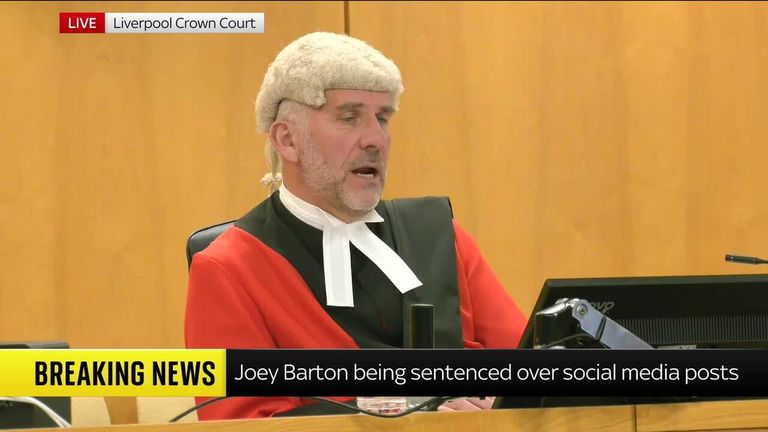
Retired footballer Joey Barton has been sentenced over X posts he sent to football pundits Eni Aluko and Lucy Ward, along with broadcaster Jeremy Vine.
Barton, 43, had been found guilty of six counts of sending a grossly offensive electronic communication with intent to cause distress or anxiety.
He was sentenced to a six-month prison sentence, suspended for 18 months, at Liverpool Crown Court on Monday.
Watch judge’s remarks in Barton sentencing
The former Manchester City, Newcastle United and Rangers midfielder had claimed he was the victim of a “political prosecution” and denied his aim was to “get clicks and promote himself”.
But the jury decided Barton, capped once for England in 2007, had “crossed the line between free speech and a crime” with the six posts he made on the social media platform.
The prosecution argued that Barton, who has 2.5 million followers, “may well be characterised as cutting, caustic, controversial and forthright”.
Peter Wright KC continued: “Everyone is entitled to express views that are all of those things.
“What someone is not entitled to do is to post communications electronically that are – applying those standards – beyond the pale of what is tolerable in society.”
Barton denied 12 counts of sending a grossly offensive electronic communication with intent to cause distress or anxiety between January and March last year.
He was found guilty on six counts, but cleared of another six.
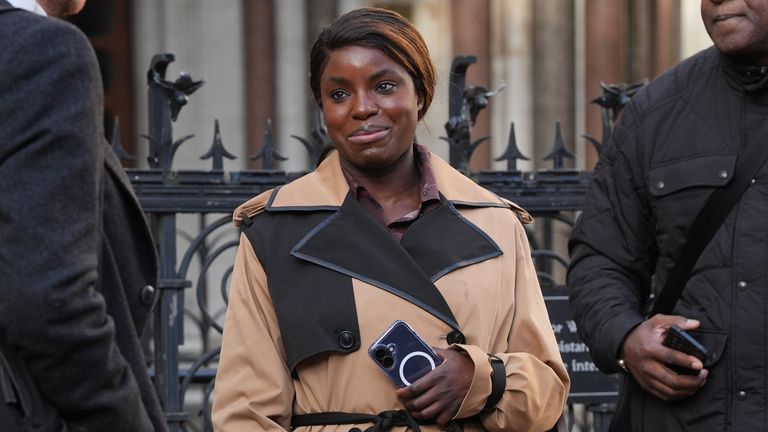
Eni Aluko at London’s Royal Courts of Justice last year for her libel claim against Barton. Photo: PA
In one post in January 2024, Barton compared Aluko and Ward to the “Fred and Rose West of football commentary”, and superimposed the women’s faces on a photograph of the serial murderers.
He also described Aluko as being in the “Joseph Stalin/Pol Pot category”, suggesting that she had “murdered hundreds of thousands, if not millions, of football fans’ ears”.
The jury found him not guilty in relation to the comparison with the Wests, Stalin and Pol Pot, but decided the superimposed image was grossly offensive.

Jeremy Vine. Pic: PA
Another message allegedly suggested Vine had a sexual interest in children, after the broadcaster posted a question relating to the posts about the football commentators asking whether Barton had a “brain injury”.
The court heard Barton replied to Vine’s tweet with a post referring to him as “you big bike nonce” and made references to convicted child sex offender Jeffrey Epstein.
The ex-footballer told the court the posts were “dark and stupid humour” and “crude banter”. He also said he had no intention of implying Vine was a paedophile.
Sentencing, the Honorary Recorder of Liverpool, Judge Andrew Menary KC, told Barton: “Robust debate, satire, mockery and even crude language may fall within permissible free speech.
“But when posts deliberately target individuals with vilifying comparisons to serial killers or false insinuations of paedophilia, designed to humiliate and distress, they forfeit their protection.
“As the jury concluded, your offences exemplify behaviour that is beyond this limit – amounting to a sustained campaign of online abuse that was not mere commentary but targeted, extreme and deliberately harmful.”
Barton was also given a two-year restraining order preventing him from contacting Aluko, Ward or Vine, or publishing any reference to them on a social media platform or broadcast platform.
He will also have to carry out 200 hours of unpaid work in the community and pay prosecution costs of £23,419.

-
 Sports2 years ago
Story injured on diving stop, exits Red Sox game
-
 Sports3 years ago
‘Storybook stuff’: Inside the night Bryce Harper sent the Phillies to the World Series
-
 Sports2 years ago
Game 1 of WS least-watched in recorded history
-
 Sports3 years ago
Button battles heat exhaustion in NASCAR debut
-
 Sports3 years ago
MLB Rank 2023: Ranking baseball’s top 100 players
-
Sports4 years ago
Team Europe easily wins 4th straight Laver Cup
-
 Environment3 years ago
Japan and South Korea have a lot at stake in a free and open South China Sea
-
 Environment1 year ago
Here are the best electric bikes you can buy at every price level in October 2024