
Moving in the shadows: Why tanker seized by US off Venezuela was ‘spoofing’ its location

An oil tanker seized by the US off the Venezuelan coast on Wednesday spent years trying to sail the seas unnoticed.
Changing names, switching flags, and vanishing from tracking systems.
That all came to an end this week, when American coast guard teams descending from helicopters with guns drawn stormed the ship, named Skipper.
A US official said the helicopters that took the teams to the tanker came from the aircraft carrier USS Gerald R Ford.
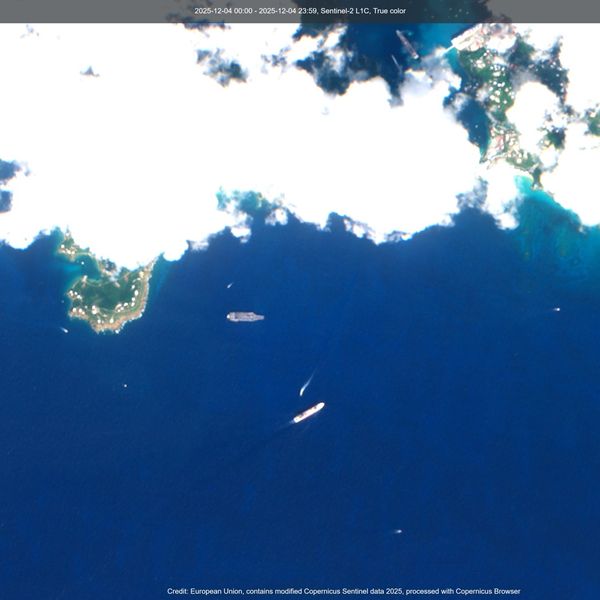
The USS Gerald R Ford (in grey) off the US Virgin Islands on 4 December. Source: Copernicus
The sanctioned tanker
Over the past two years, Skipper has been tracked to countries under US sanctions including Iran.
TankerTrackers.com, which monitors crude oil shipments, estimates Skipper has transported nearly 13 million barrels of Iranian and Venezuelan oil since 2021.
And in 2022, the US Treasury Office of Foreign Assets Control (OFAC) placed Skipper, then known as Adisa, on its sanctions list.
But that did not stop the ship’s activities.
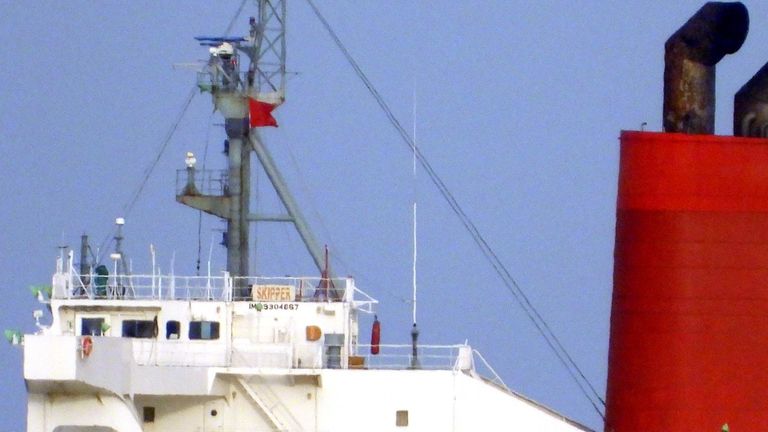
Skipper pictured from the Venezuelan shore. Source: TankerTrackers.com
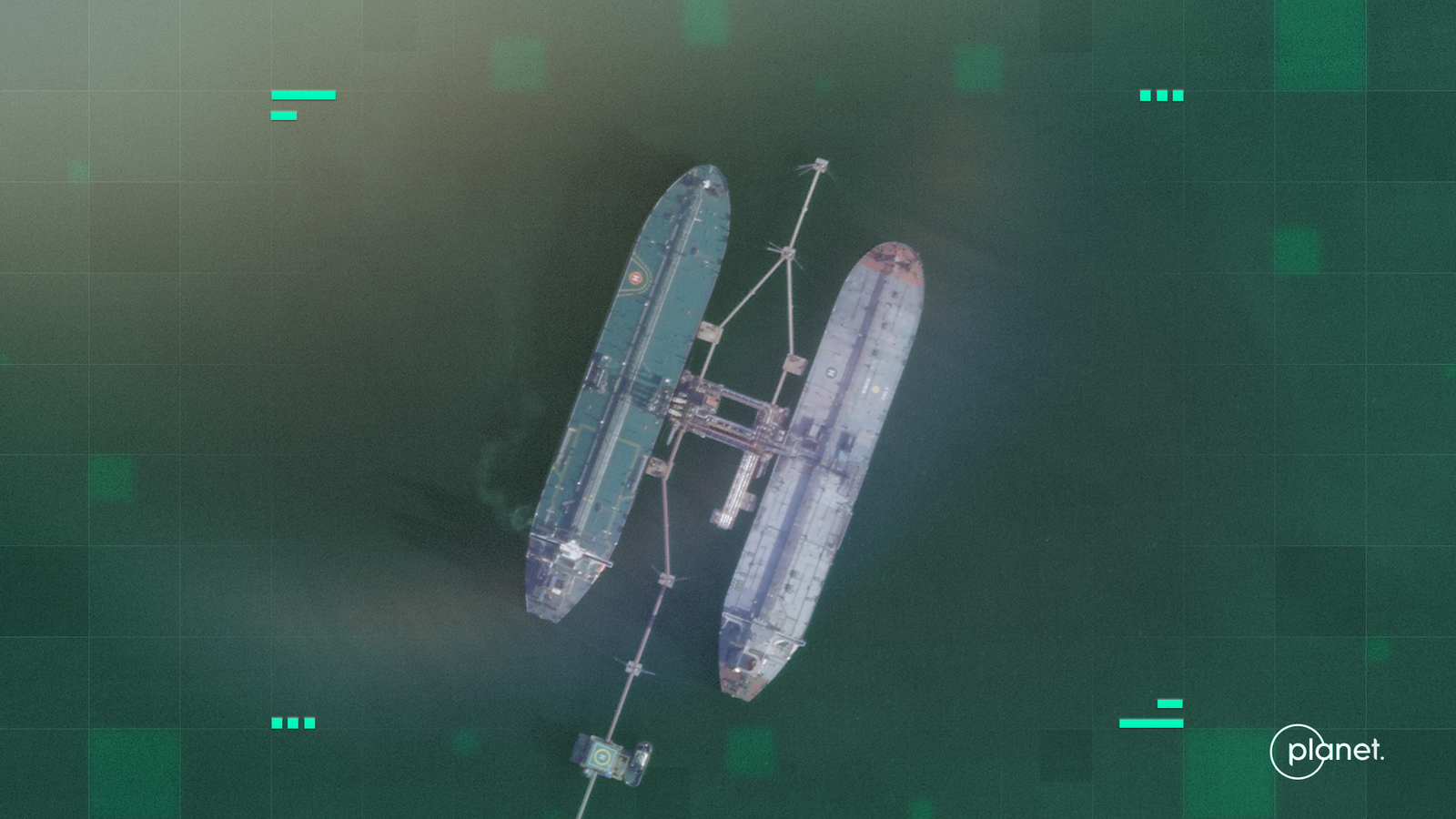
In mid-November 2025, it was pictured at the Jose Oil Export Terminal in Venezuela, where it was loaded with more than one million barrels of crude oil.

Skipper (R) loads up with crude oil at the Jose Oil Export Terminal in Venezuela. Source: Planet
It left Jose Oil Export Terminal between 4 and 5 December, according to TankerTrackers.com.
And on 6 or 7 December, Skipper did a ship-to-ship transfer with another tanker in the Caribbean, the Neptune 6.
Ship-to-ship transfers allow sanctioned vessels to obscure where oil shipments have come from.
The transfer with Neptune 6 took place while Skipper’s tracking system, known as AIS, was turned off.
Read more:
Everything we know about dramatic ship seizure
Is this what the beginning of a war looks like?
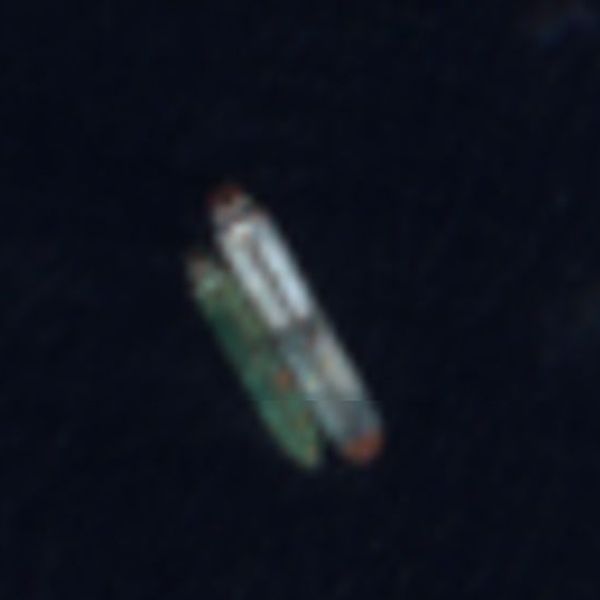
Skipper (R) and Neptune 6 in the Caribbean Sea during an AIS gap. Source: European Union Copernicus Sentinel and Kpler
Dimitris Ampatzidis, senior risk and compliance manager at Kpler, told Sky News: “Vessels, when they are trying to hide the origin of the cargo or a port call or any operation that they are taking, they can just switch off the AIS.”
Matt Smith, head analyst US at Kpler, said they believe the ship’s destination was Cuba.
Around five days after leaving the Venezuelan port, it was seized around 70 miles off the coast.
Moving in the shadows
Skipper has tried to go unnoticed by using a method called ‘spoofing’.
This is where a ship transmits a false location to hide its real movements.
“When we’re talking about spoofing, we’re talking about when the vessel manipulates the AIS data in order to present that she’s in a specific region,” Mr Ampatzidis explained.
“So you declare false AIS data and everyone else in the region, they are not aware about your real location, they are only aware of the false location that you are transmitted.”
When it was intercepted by the US, it was sharing a different location more than 400 miles away from its actual position.
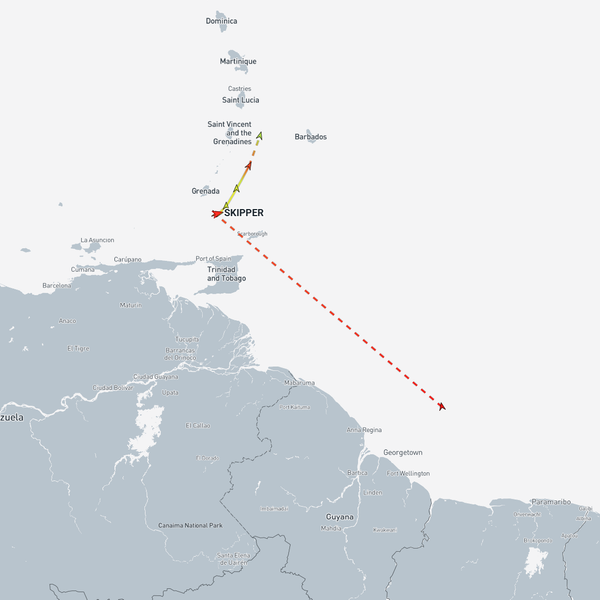
The distance between Skipper’s spoofed position on AIS (towards the bottom right hand corner) and its real position when seized by the US. Source: MarineTraffic
Skipper was manipulating its tracking signals to falsely place itself in Guyanese waters and fraudulently flying the flag of Guyana.
“We have really real concerns about the spoofing events,” Mr Ampatzidis told Sky News.
“It’s about the safety on the seas. As a shipping industry, we have inserted the AIS data, the AIS technology, this GPS tracking technology, more than a decade back, in order to ensure that vessels and crew on board on these vessels are safe when they’re travelling.”
Dozens of sanctioned tankers ‘operating off Venezuela’
Skipper is not the only sanctioned ship off the coast of Venezuela.
According to analysis by Windward, 30 sanctioned tankers were operating in Venezuelan ports and waters as of 11 December.
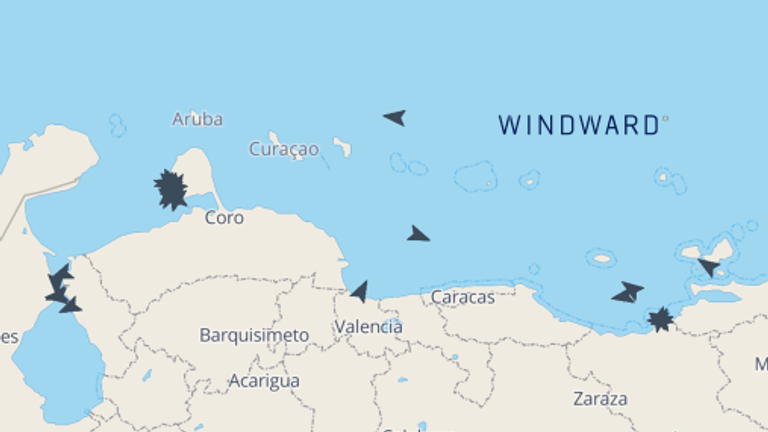
About 30 sanctioned tankers are currently operating in Venezuelan waters. Source: Windward Maritime AI Platform
The tanker seizure is a highly unusual move from the US government and is part of the Trump administration’s increasing pressure on Venezuelan President Nicolas Maduro.
In recent months, the largest US military presence in the region in decades has built up, and a series of deadly strikes has been launched on alleged drug-smuggling boats in the Caribbean Sea and eastern Pacific Ocean.
In the past, Mr Ampatzidis explained, actions like sanctions have had a limited effect on illegally operating tankers.
But the seizure of Skipper will send a signal to other dark fleet ships.
“From today, they will know that if they are doing spoofing, if they are doing dark activities in closer regions of the US, they will be in the spotlight and they will be the key targets from the US Navy.”
The Data X Forensics team is a multi-skilled unit dedicated to providing transparent journalism from Sky News. We gather, analyse and visualise data to tell data-driven stories. We combine traditional reporting skills with advanced analysis of satellite images, social media and other open source information. Through multimedia storytelling we aim to better explain the world while also showing how our journalism is done.
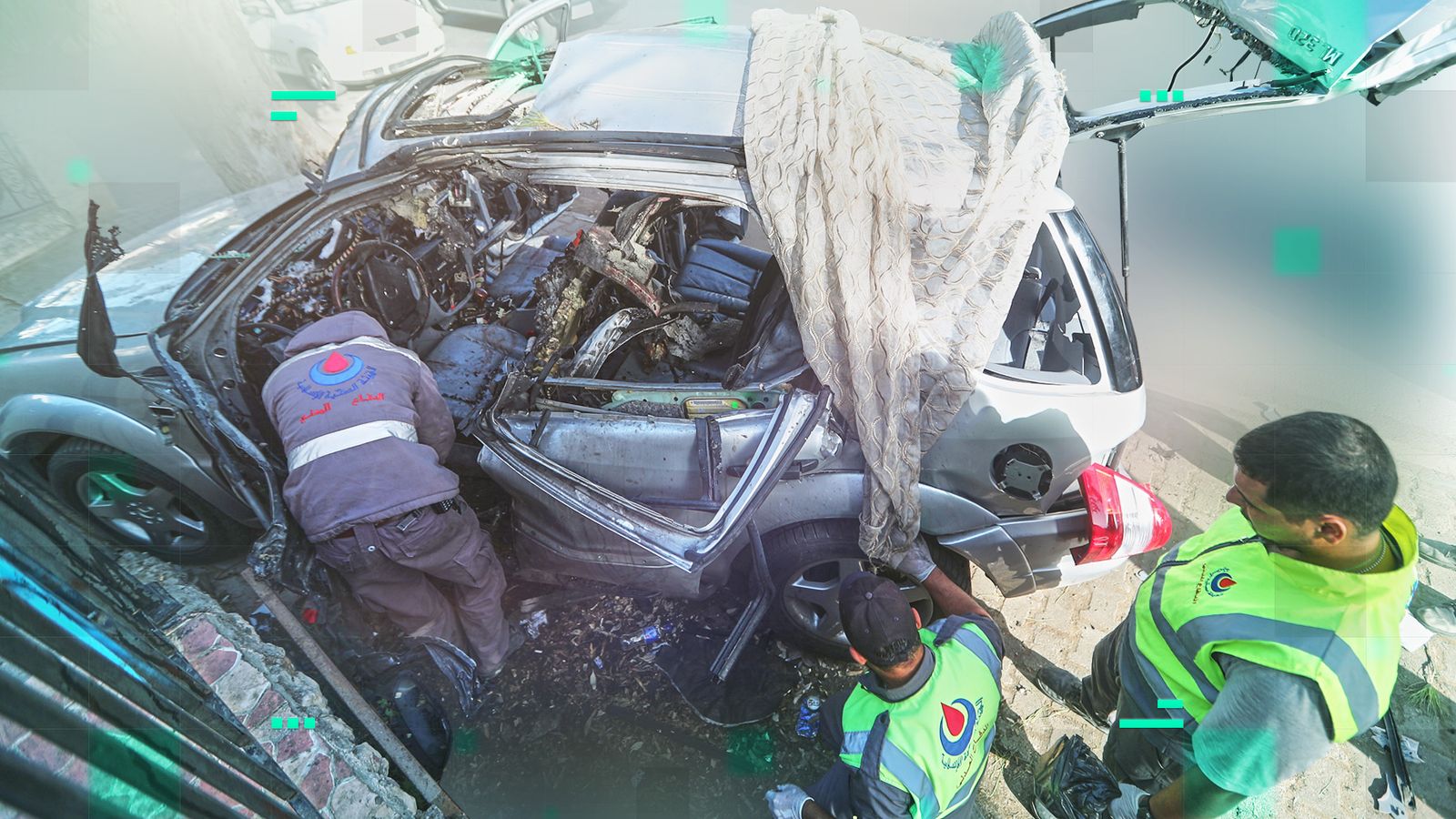
It’s been more than a year since a ceasefire was agreed in Lebanon, but data shows that the truce between Israel and Hezbollah is more fragile than ever.
The independent conflict monitoring organisation ACLED has recorded 1,846 Israeli attacks on Lebanon since the ceasefire began.
On average, only two days of each month have not seen an Israeli attack.
The bombings have grown more frequent in recent weeks, with an average of six per day so far in December, or one every four hours – the fastest pace of attacks since March.
Israel says it is targeting Hezbollah military infrastructure
The ceasefire deal requires both sides to withdraw from southern Lebanon, the area south of the Litani river.
The UN mission in southern Lebanon, UNIFIL, says the agreement has been violated more than 10,000 times – once every 53 minutes.
That includes the attacks monitored by ACLED, as well as more than 2,500 IDF ground activities and over 7,800 violations of Lebanese airspace.
It also includes the discovery, by UNIFIL, of more than 360 weapon and ammunition caches south of the Litani river.
Israel says that these caches are evidence that Hezbollah is seeking to rebuild its military infrastructure in southern Lebanon, an allegation denied by both Hezbollah and UNIFIL.
“None of these weapon caches were guarded,” says UNIFIL deputy spokesperson Kandice Ardiel. “They had no obvious signs of recent use and were presumably abandoned. Many were even destroyed already, or half-destroyed.”
An IDF spokesperson said that Hezbollah’s attempts to rebuild its military infrastructure in southern Lebanon “are not open to interpretation”.
“In the absence of sufficient enforcement by UNIFIL, and out of commitment to the security of the Israeli civilians, the IDF continues to operate in a focused manner against Hezbollah’s restoration attempts,” the spokesperson said.
At least 127 civilians have been killed by Israeli attacks since the ceasefire began, according to the UN.
Israel argues that the ceasefire agreement requires Hezbollah to disarm in all parts of Lebanon, not just the south. Hezbollah disputes this, and says it will not consider full disarmament until Israel withdraws entirely from Lebanese territory.
Israel has established five military bases inside Lebanon
This withdrawal was supposed to take place by 27 January 2025, a deadline that was later extended to 18 February.
But instead of withdrawing from its Lebanese bases, Israel began cementing its presence.
Sky News has confirmed, based on satellite imagery, that Israel started construction on a new base, shown below, between 8 and 18 February – within days of the withdrawal deadline.
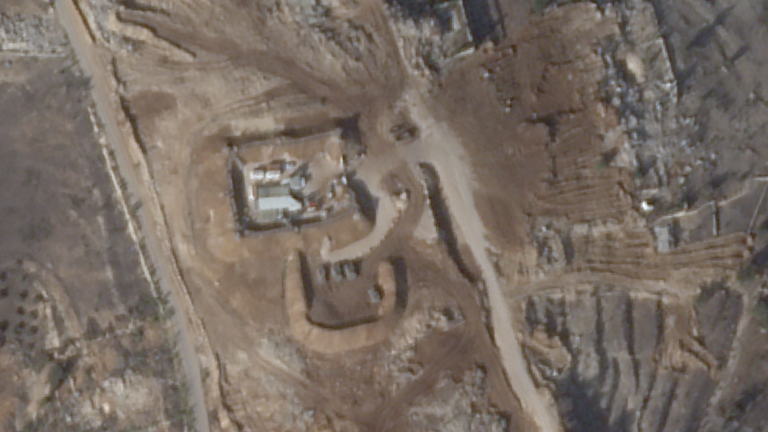
Israeli base on Tzivoni ridge, Lebanon, 18 November 2025. Pic: Planet Labs PBC
Israel retains control of four other bases on Lebanese territory, scattered along hilltops near the border.
“We need to remain at those points at the moment to defend Israeli citizens, to make sure this process is complete and eventually hand it over to the Lebanese armed forces,” IDF spokesman Nadav Shoshani said in February.
Lebanon has raised complaints with the UN about these bases, as well as Israel’s recent extension of its border wall. The UN says that two sections of the wall cross into Lebanese territory, putting around one acre on the Israeli side.
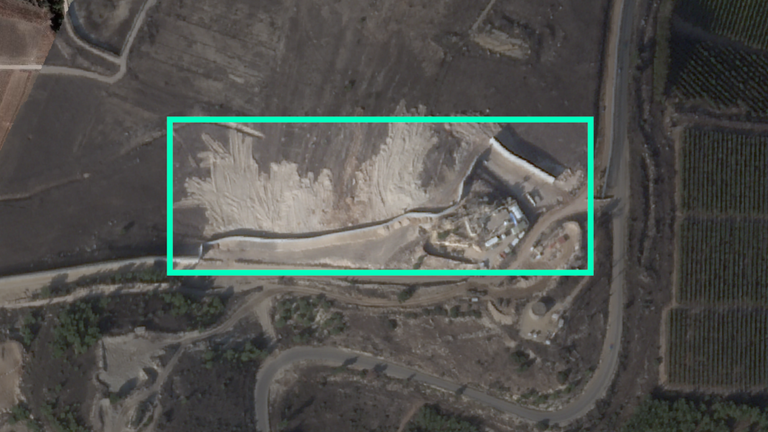
Israeli border wall under construction near Yaroun, 18 November 2025. Pic: Planet Labs PBC
Sky News asked the IDF whether it accepted the UN’s findings, but did not receive a response to this question.
In the image below, part of the newly constructed wall can be seen passing between border posts, highlighted in green, into Lebanese territory.
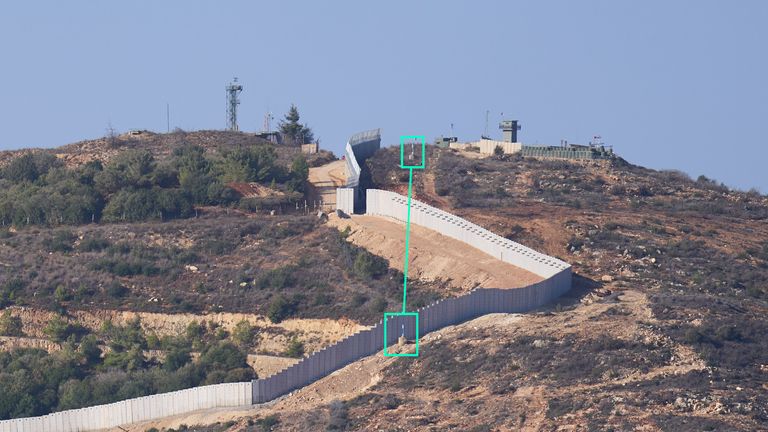
A newly-constructed portion of Israel’s border wall is seen crossing into Lebanon, with border posts highlighted. Pic: AP
Construction of the wall resumed over summer, having been halted since hostilities erupted in October 2023. Based on satellite imagery, Sky News estimates that a total of 12km of wall have been erected in recent months.
The continued presence of Israeli forces has hampered reconstruction efforts. More than 64,000 Lebanese people remain displaced from their homes.
Sky News visited one of the towns that sits in view of the Israeli base on Mount Balat. The town, Aita al Chaab, has been almost entirely destroyed.
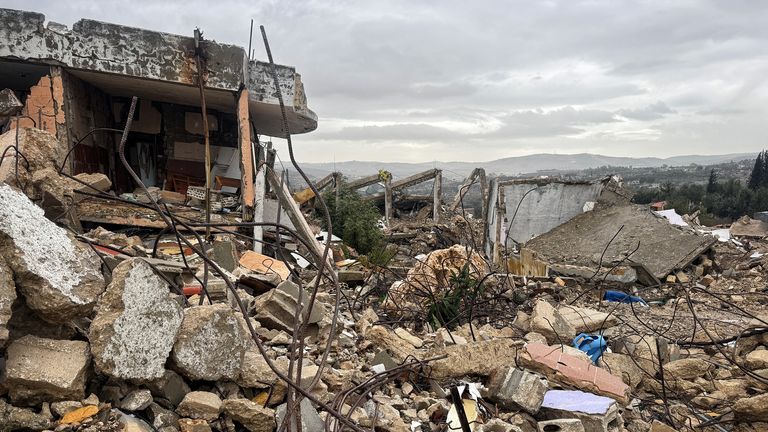
Wreckage in the border town of Aita al Chaab
Satellite imagery, taken on 24 November, shows the town in ruins. Out of 326 buildings in the town centre, 293 (91%) have been destroyed.
Since the ceasefire began, the destruction has continued and has spread to the Aita al Chaab’s outskirts.
“Anyone who comes to rebuild is attacked [by Israel],” one resident told Sky News.
The Data and Forensics team is a multi-skilled unit dedicated to providing transparent journalism from Sky News. We gather, analyse and visualise data to tell data-driven stories. We combine traditional reporting skills with advanced analysis of satellite images, social media and other open source information. Through multimedia storytelling we aim to better explain the world while also showing how our journalism is done.
EU leaders will meet in Brussels today to try to agree the release of €210bn (£184bn) to help fund Ukraine’s war with Russia.
The money, which comes from Russian assets frozen after Moscow’s full-scale invasion of Ukraine in 2022, is mostly held in the Belgian-headquartered clearing house, Euroclear.
The money is seen as vital to Ukraine’s ability to keep fighting, because the country faces bankruptcy in early 2026 if it doesn’t receive more international assistance. That means Kyiv would no longer be able to pay soldiers, police and civil servants or buy weapons to defend itself.
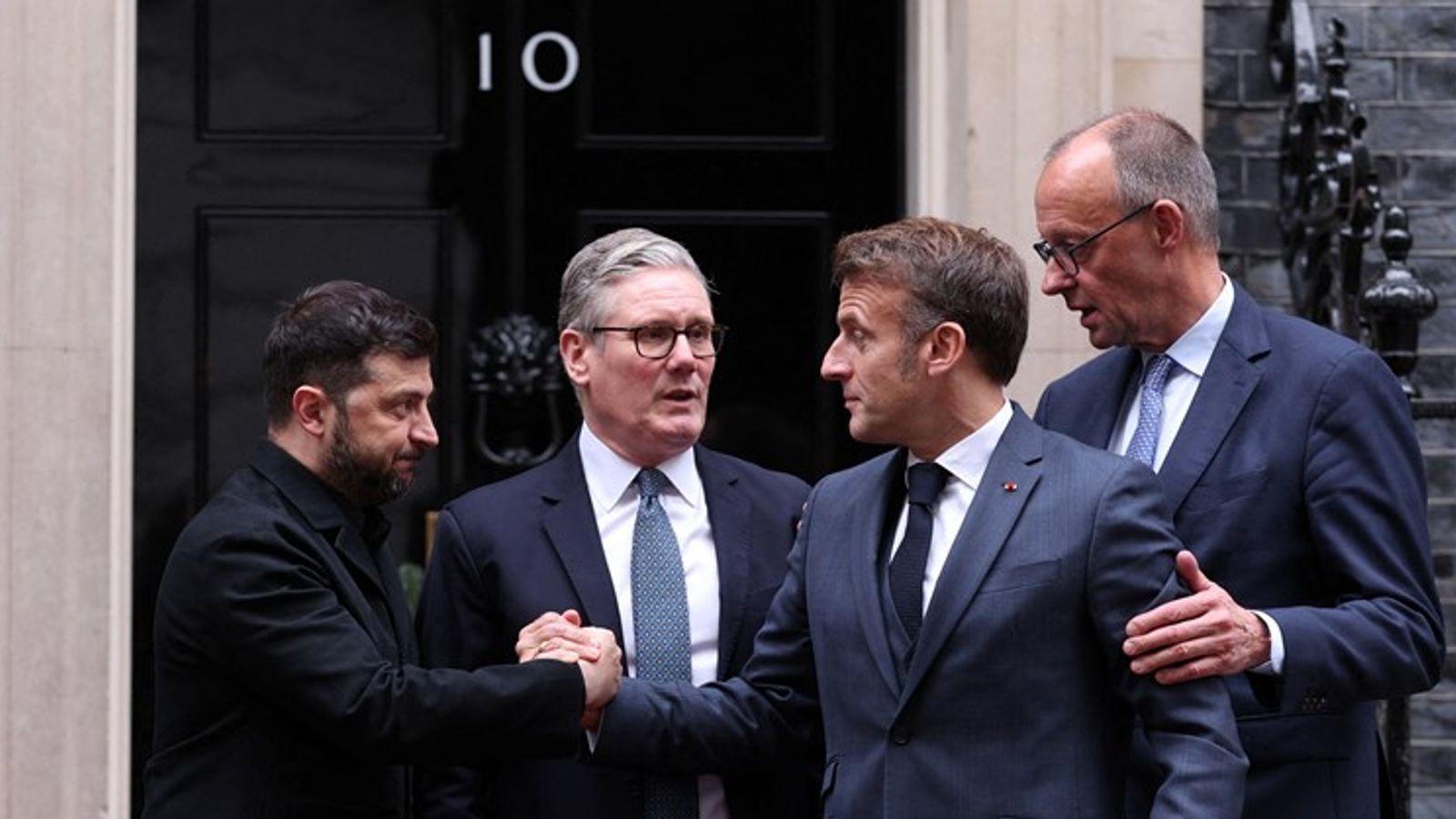
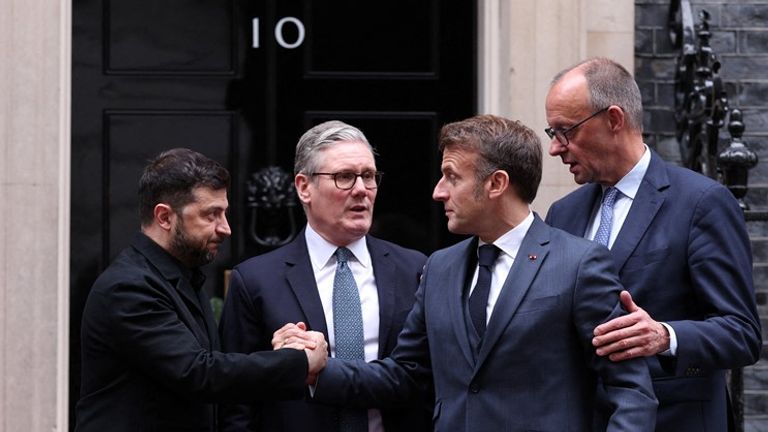
Volodymyr Zelenskyy, Sir Keir Starmer, French President Emmanuel Macron and German Chancellor Friedrich Merz. Pic: Reuters
Last night, Volodymyr Zelenskyy, who is expected to brief the EU leaders today, wrote on X: “The result Europe produces – must make Russia feel that its desire to continue the war next year is pointless, because Ukraine will have support. This rests entirely with Europe.”
The Belgian government has so far prevented the move amid fears it will expose the small country to Russian legal action in the future.
The EU is racing to find solutions to Belgium‘s concerns, including passing an emergency bill that secures the sanctions against Russia indefinitely, superseding the need to renew them every six months and thereby insulating it from veto votes from Russian-leaning EU member states like Hungary and Slovakia.
Belgium also wants guarantees that all EU members will share any financial cost of Russian action against it.
Why the push to use Russian assets?
The US, which has so far given billions of dollars to Kyiv, is losing interest under Donald Trump and can no longer be relied upon for financial support.
Previously, the EU had been giving the interest generated from the frozen assets to Ukraine, but was worried it might destabilise the Eurozone economy if it touched the assets itself.
That has changed, however, as Ukraine’s need has become more acute and fears over Russia’s wider imperialist ambitions have grown in recent months.
This unlocking of seized Russian assets is also being seen as a way to buy Brussels more leverage in peace negotiations, as well as reducing Kyiv’s dependency on Washington.
Read more:
South Africans fighting for Russia
Russia trying to ‘bully’ UK and allies
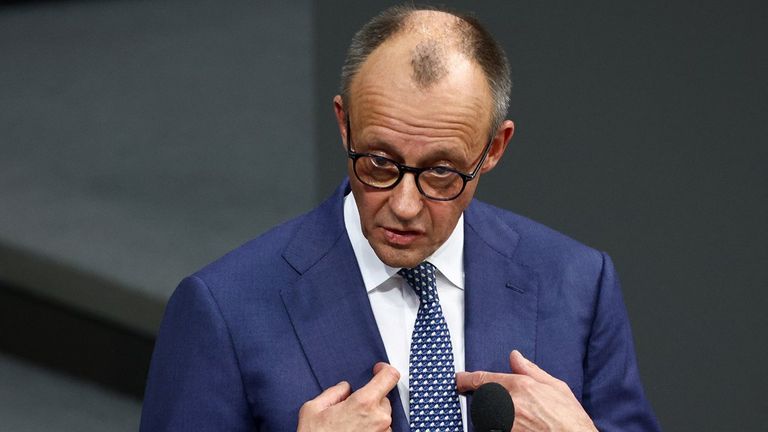
Friedrich Merz. Pic: Reuters
German Chancellor Friedrich Merz, who has been leading the campaign to release the funds, warned that “Europe would be severely damaged for years” if they fail to pass the vote and “this step is not about prolonging the war but about bringing the war to an end as soon as possible”.
In short, the consequences of using the frozen assets are now considered less risky than the consequences of not taking this action.
What’s at stake?
Trump wanted the money to be invested in two US investment funds, something the EU rejects. The US president has recently been scathing of European leaders, and the EU sees Thursday’s meeting as an opportunity to show its strength and unity.
In theory, the EU could pass the policy by majority vote, thereby sidelining the Belgian government, but officials are reluctant to go down this path for fear of alienating Belgium and causing a diplomatic rift in the alliance.
Much is riding on the meeting. If the EU fails to pass the vote, its credibility will take a severe blow. It will likely become even more irrelevant in peace talks, and Vladimir Putin might look to take advantage of a divided Europe.
One of the alleged gunmen in the killing of 15 people on Bondi Beach has been charged.
Naveed Akram, 24, faces 59 counts, including 15 of murder and a terror charge.
The other alleged attacker, his 50-year-old father Sajid, died at the scene in Sydney.
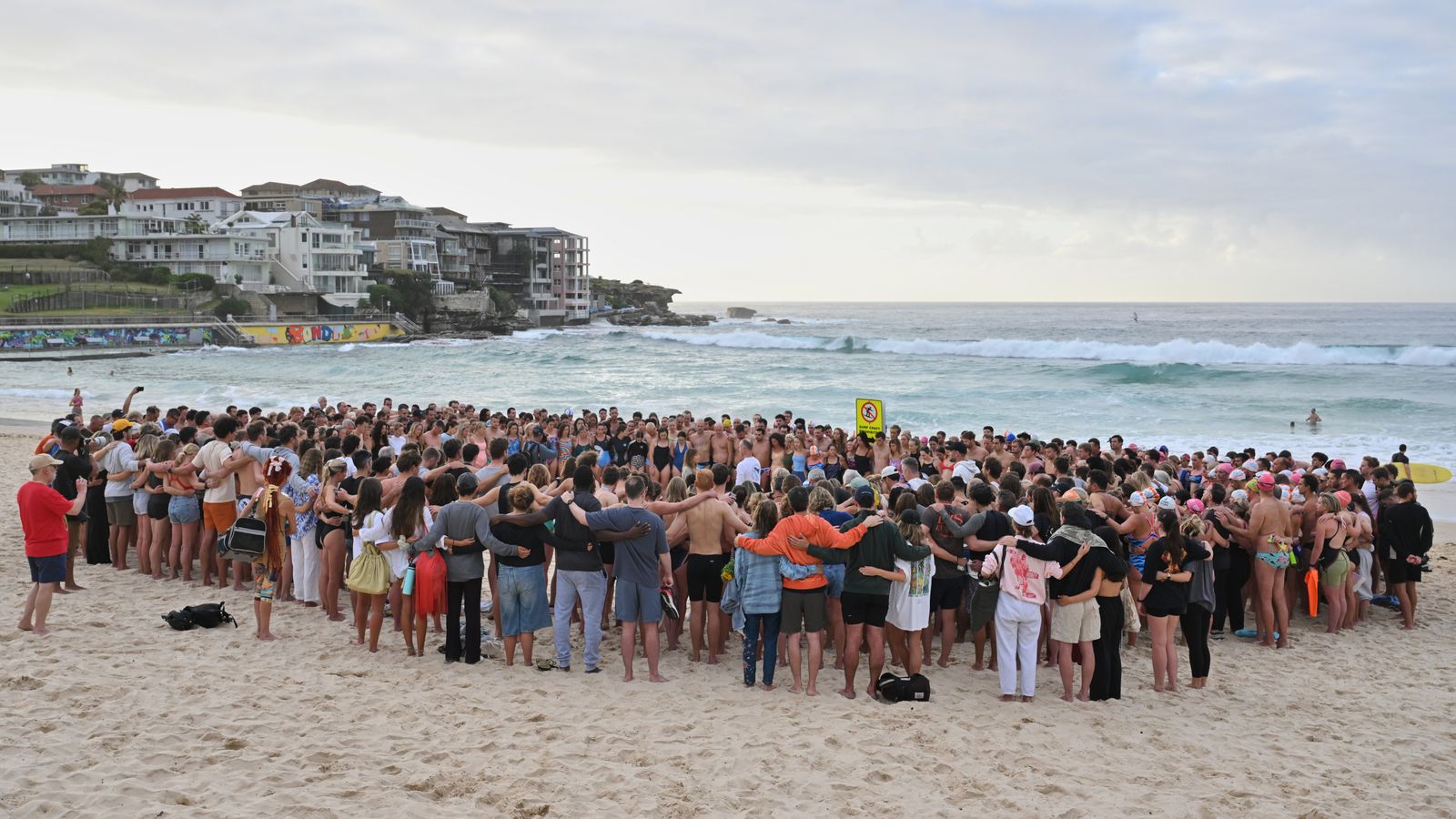
The charges came as people gathered for funerals three days after Sunday’s terror attack shocked Australia and intensified concerns about rising antisemitism.
Some 22 victims remain in hospital following the shooting, carried out at an event marking the start of the Jewish celebration of Hanukkah.
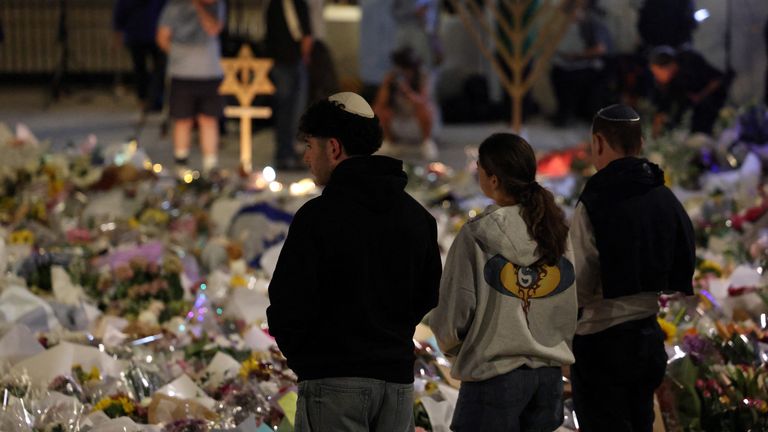
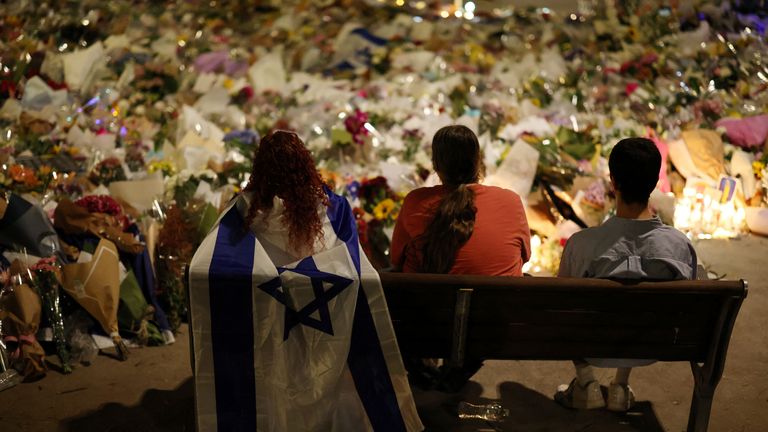
People look at flowers laid out for the victims. Pic: Reuters
At the first of the funerals, relatives mourned the death of British-born Rabbi Eli Schlanger, a 41-year-old father of five, who organised the Chanukah by the Sea event.
Often speaking through tears, his father-in-law, Rabbi Yehoram Ulman, expressed his “biggest regret” that he “could have done more” to tell him “how much we love him”.
“I hope he knew that. I’m sure he knew it,” he added. “But I think it should’ve been said more often.”
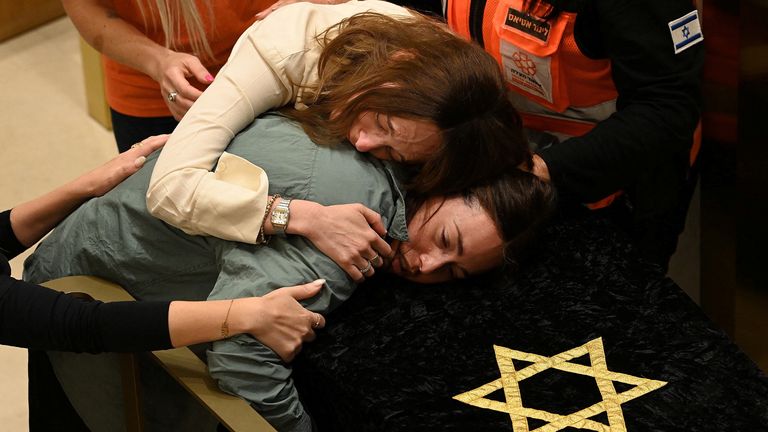
Relatives of Rabbi Eli Schlanger next to his coffin during his funeral. Pic: Reuters
The father of 10-year-old victim Matilda, whose surname has been withheld at her family’s request, spoke at a vigil on Tuesday night.
Local media reported him as saying: “We came here from Ukraine… and I thought that Matilda is the most Australian name that can ever exist.
“So just remember the name, remember her.”
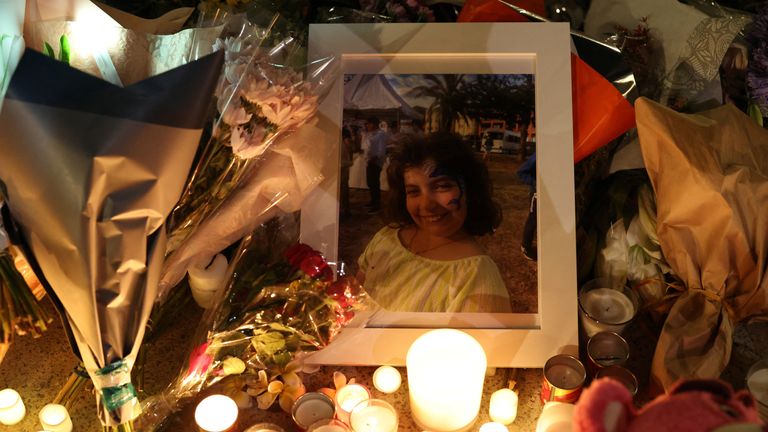
A photo of Matilda. Pic: Reuters
Read more: Who were the suspected gunmen?
Police have said the two alleged gunmen – who were shot by officers – were motivated by Islamic State ideology.
A recent trip to the Philippines is under investigation. The older Akram used an Indian passport to travel, while his son used an Australian one.
The Akrams stayed at the GV Hotel in Davao from 1 November to 28 November, according to a source, who said police had visited on Wednesday.
The pair are said to have only left their rooms for meals and no one was seen visiting them.
Davao is in an area associated with Islamic extremism but a spokesman for the president of the Philippines said he rejected the claim the country is an “ISIS training hotspot”.
New South Wales to debate gun reforms
The Australian government and intelligence services have come under pressure because the alleged attackers were legally able to acquire the high-powered rifles and shotguns used in the attack.
Prime Minister Anthony Albanese has vowed to toughen the country’s gun laws after its deadliest mass shooting in three decades, and the state parliament in New South Wales will reconvene next week to discuss reforms.
They include capping the number of guns allowed by a single person and making some shotguns harder to access.
State premier Chris Minns told a news conference: “We’ve got a monumental task in front of us. It’s huge.
“It’s a huge responsibility to pull the community together.
“We need a summer of calm and togetherness, not division.”
Mr Albanese has vowed to work with the Jewish community to “stamp out and eradicate antisemitism”. The prime minister has been accused of not doing enough to prevent its spread since the war in Gaza began two years ago.
Fellow world leaders have expressed their shock and anguish since the attack, including British Prime Minister Sir Keir Starmer, who hosted a Hanukkah event at Downing Street on Tuesday.
And speaking at the White House last night, US President Donald Trump said: “We join in mourning all of those who were killed, and we’re praying for the swift recovery of the wounded.”
-
 Sports2 years ago
Story injured on diving stop, exits Red Sox game
-
 Sports3 years ago
‘Storybook stuff’: Inside the night Bryce Harper sent the Phillies to the World Series
-
 Sports2 years ago
Game 1 of WS least-watched in recorded history
-
 Sports3 years ago
Button battles heat exhaustion in NASCAR debut
-
 Sports3 years ago
MLB Rank 2023: Ranking baseball’s top 100 players
-
Sports4 years ago
Team Europe easily wins 4th straight Laver Cup
-
 Environment3 years ago
Japan and South Korea have a lot at stake in a free and open South China Sea
-
 Environment1 year ago
Here are the best electric bikes you can buy at every price level in October 2024