
Jordan’s 23XI antitrust suit pushed dinosaurs out and NASCAR into the future

Years ago, I was in the garage at Darlington Raceway chatting with David Pearson, Bobby Allison and Cale Yarborough. All three are among the greatest racers in NASCAR history. All three had long since retired as drivers, but all three had only recently given up trying to be Cup Series team owners, the experience having crushed them all financially.
Yaborough said to me, “You are looking at three NASCAR dinosaurs.”
Pearson laughed and replied, “But we’re doing better than the dinosaurs because we’re still here.”
When I asked them what they’d figured out that the dinosaurs didn’t, Allison explained, “We were smart enough to realize we were dinosaurs and got out of the damn way before we went extinct.”
On Thursday afternoon in a Charlotte courthouse, another NASCAR dinosaur got out of the damn way.
As an antitrust lawsuit against NASCAR, filed by 23XI Racing, co-owned by Michael Jordan and three-time Daytona 500 winner Denny Hamlin, and Front Row Motorsports (FRM), began to grind its way toward the end of its second week, the two sides announced that they had reached a settlement.
As the finer details of the agreement were still being revealed into late afternoon, there was no doubt that the victory belonged to the teams over the sanctioning body because we already knew that their ultimate goal had been achieved. In the end, this was about their fight for NASCAR to make team charters, as close as stock car racing gets to stick-and-ball franchises, permanent — or as their attorney Jeffrey Kessler described it, “evergreen” — as opposed to a contract-to-contract model, renewed in conjunction with NASCAR’s massive media rights deals.
It is very difficult to find someone in the Cup Series paddock who does not believe this is the right move. In fact, every team in the Cup Series garage once stood with 23XI and FRM, although they eventually relented and were willing to let those two teams carry ahead with the fight alone. They won that fight, and as a result, so did every NASCAR team owner who is fortunate enough to have one of those 40 charters. No one calls this franchising, but that’s essentially what it now is, in line with the business model of nearly every other big league sport, such as Jordan’s longtime home, the NBA.
NASCAR lost that fight. As the trial slogged on, a defeat began to feel inevitable, for the same reason that Jordan and his team believed that the latest charter agreement, the one they refused to sign in September 2024, was unsatisfactory. A reason that everyone in that garage, including NASCAR’s commissioner and president, had already talked about behind closed doors — and in emails and texts that were revealed in and around the trial — but no one spoke about publicly until the lawsuit forced them to.
The door to the future was being blocked by a dinosaur.
Jim France is a good man, a brilliant businessman and someone who loves auto racing on a level that few can understand. But he also never wanted the job he now holds as NASCAR’s CEO and chairman. His father, Bill France, originated the position after he oversaw NASCAR’s foundational meetings in 1948. His older brother, Bill France Jr., took over those duties from their father in the early 1970s and ruled the sport for three decades with a highly respected iron fist. His heir was his son Brian, whose tenure at the helm was tumultuous at best and ended prematurely in 2018.
Through it all, legendarily introverted Jim France was happy to remain in the background, racing sports cars and working in the racetrack ownership division while enjoying much sway in the NASCAR boardroom without any of the public spotlight that his father and brother both so loved and his nephew so loathed.
But when Brian France stepped down and NASCAR’s leadership flowchart was unexpectedly detoured, it ran directly over Jim France’s desk, whether he wanted it or not. “The Steves,” NASCAR commissioner Phelps and president O’Donnell, have been the faces of that leadership, a constant paddock presence as they meet with the media and their teams. But both have always been quick to politely remind that whatever decisions they made or moves they pondered, all went through the family first, being Jim, niece Lesa France Kennedy and her son Ben.
That was clear to everyone in the sport when it came to the introduction of charters in 2016, a concept created in conjunction with team owners to help meet their financial demands. It became even clearer that everything ran through France when the latest charter agreement tug-of-war took place over the two years leading into the current agreement.
As was revealed in court, NASCAR’s most powerful team owners pleaded with France personally to make their case for a more favorable charter agreement. When asked about those meetings this week, France testified that he considered them all great friends, but he was unmoved by their pleas.
As was also revealed in court, the people who worked for France were frustrated by their repeated attempts to get him to greenlight the compromises they had reached with those owners but were rebuffed by a man they were obviously referring to in text messages such as “1996 … dictatorship,” although they refused to identify that as France during their time on the stand.
At some point, during all of that, Jim France finally realized that, no, this isn’t 1996, when his brother had the sport picking up speed toward an unparalleled decade of growth. Nor is it 1966, when his father was building and collecting the portfolio of speedways that are still the backbone of NASCAR and the France family fortune. This isn’t even 2016, when charters were born.
Instead, we are staring into 2026. Today’s world is an open book. There are no secrets. No one knows that better than NASCAR and its race teams, having had 77 years of a closed-door/closed-ledger way of doing business laid bare during this trial. For the first time, we now know how much teams and their drivers make — and lose — and we know how much cash flows through the sanctioning body’s Daytona HQ and into the France family’s bank accounts.
And when it comes to collateral damage, race fans are rightfully incensed that the commissioner of NASCAR called Richard Childress, who teamed up with Dale Earnhardt to win six Cup titles, a “stupid redneck.” We now know that Joe Gibbs, a three-time Super Bowl-winning coach and five-time Cup Series champion owner, was moved to tears when he called Jim France to say “Don’t do this us!” and was told it was his fault in part because spending habits on his team were reckless. The France family now knows how displeased their lieutenants have been. Hell, I didn’t know that Hamlin believes that I’ve spent my entire career being scared of NASCAR people until he tweeted it on the eve of the trial.
Nothing says the holiday season like a vicious family fight. An airing out of long-simmering familial grievance that steps and then resteps over a line that had long been regarded as uncrossable. Your uncle finally spoke his mind about your mom’s drinking. Your sister finally got it off her chest that your spouse creeps her out. Your mother-in-law, caught up in the heat of the moment, called you a bad parent and then piled on by adding that you also never split the check at family dinners.
So, once that clash has ended and everyone is done calling out hard truths that everyone in the family already knew but no one dared say aloud, the only thing worse than the shouting is the awkward silence that follows.
Where do you go from there?
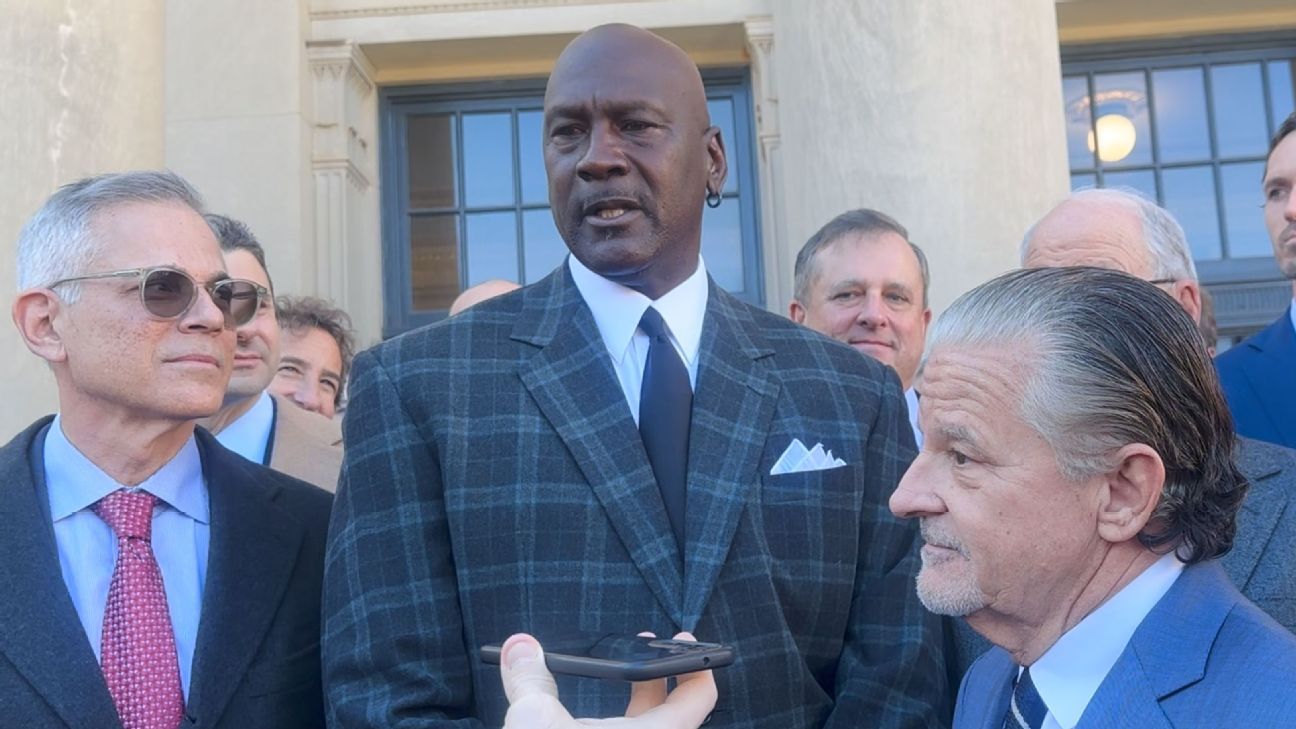
On Thursday morning, Jim France stood with Michael Jordan, surrounded by NASCAR executives, members of the France family, Hamlin, and an endless sea of lawyers. As the dinosaur and the GOAT were shoulder-to-shoulder on the steps of the very courthouse where they had just held a very public family fight, that’s the question that hovered over the scene like a storm cloud over the Daytona 500.
Some will say, as Jordan did after the settlement, that it was never personal, but strictly business. The business model of stock car racing is moving forward, and everyone seems to agree that’s the right plan of action. But hurt feelings never heal that quickly, do they?
Few communities in sports are like NASCAR. A relatively small group of people who travel together every weekend nearly year-round. It is genuinely like a family.
It’s never easy for any family to tell the patriarch he needs to hand over his car keys. You always hope he’ll realize he needs to do it first. On Thursday, Jim France did just that. Not every key on the chain, but certainly more than he, his father or his brother had ever given up before.
Hopefully, it wasn’t too late.

-
Mark Schlabach
Indiana quarterback Fernando Mendoza, who led the No. 1 Hoosiers to a perfect 13-0 record and their first Big Ten title since 1967, captured the 91st Heisman Trophy on Saturday night.
Mendoza beat out quarterbacks Diego Pavia (Vanderbilt) and Julian Sayin (Ohio State) and running back Jeremiyah Love (Notre Dame) to take home the trophy during a ceremony in New York.
Mendoza, who played two seasons at California before joining the Hoosiers this season, completed 71.5% of his pass attempts for 2,980 yards with 39 total touchdowns.
He was only the second Heisman Trophy finalist from Indiana. Running back Anthony Thompson was runner-up to Houston quarterback Andre Ware in one of the closest votes in 1989.
With Mendoza, Pavia and Love expected to move on to the NFL after this season, who are the top returning Heisman Trophy candidates for 2026?
In compiling the list of potential candidates, I projected that quarterbacks John Mateer (Oklahoma), Ty Simpson (Alabama) and Dante Moore (Oregon); receivers Carnell Tate (Ohio State), Zachariah Branch (Georgia) and Makai Lemon (USC); and running back Emmett Johnson (Nebraska) will turn pro (along with the aforementioned finalists from this year).
Here is a look at some of the top potential contenders (in no particular order):


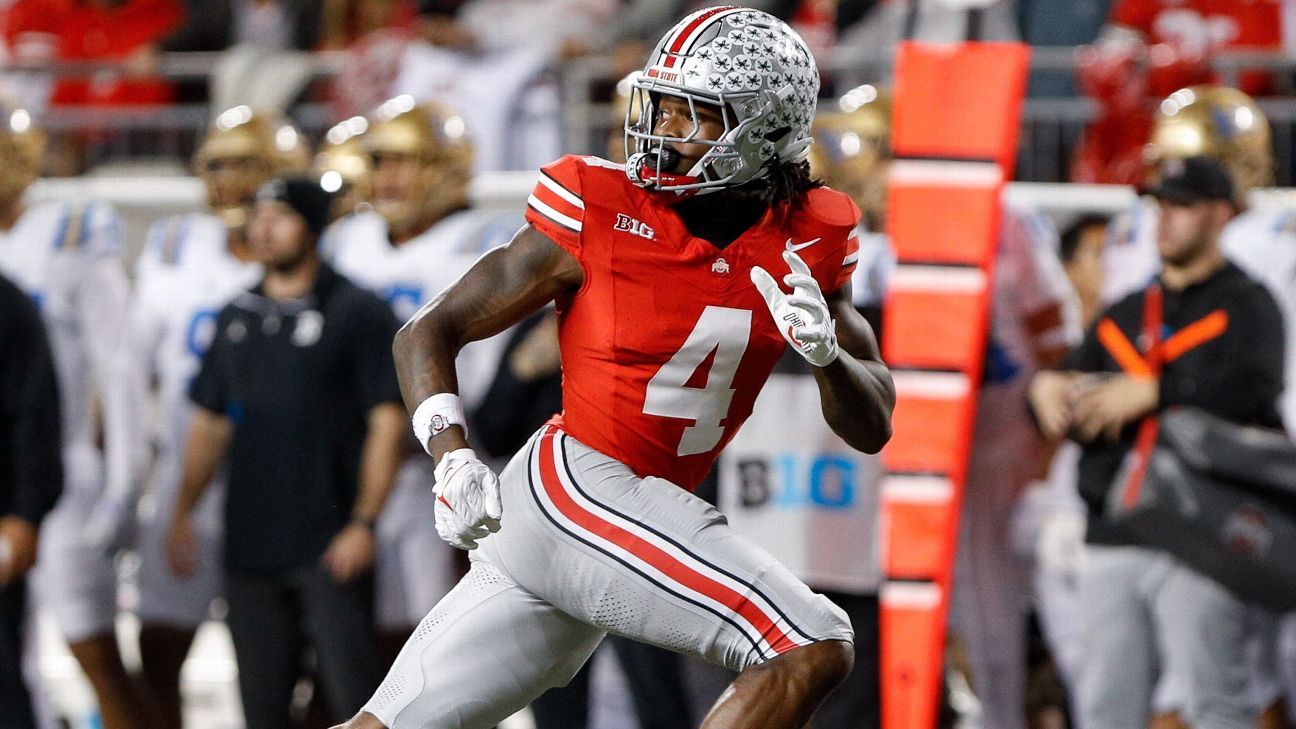
2025 stats: 80 catches, 1,086 receiving yards, 12 total touchdowns
Smith’s highlight reel of acrobatic, one-handed catches continues to grow, and he arguably has been the best player in college football this season. He was the fastest Buckeyes player to reach career marks of 2,000 receiving yards (24 games), 100 catches (20) and 25 touchdown receptions (25).
2025 stats: 78.4% completion pct, 3,323 passing yards, 31 touchdowns, 6 interceptions
Sayin might have captured the Heisman Trophy this season if Ohio State’s offense hadn’t flopped in its 13-10 loss to Indiana in the Big Ten championship game. In his first season as a starter, Sayin is on pace to break the NCAA single-season pass completion record of 77.4%, set by Oregon’s Bo Nix in 2023.

2025 stats: 70.7% completion pct, 2,691 passing yards, 442 rushing yards, 31 total touchdowns
In his first full season as Georgia’s starting quarterback, Stockton helped guide the Bulldogs to a 12-1 record and SEC title. His legs and right arm were a big reason the Bulldogs averaged 31.9 points, despite enduring myriad injuries on the offensive line. Stockton was at his best when the game was on the line — he completed 86% of his passes with 11 touchdowns and one interception in the fourth quarter against ranked opponents.

2025 stats: 84 receptions, 970 receiving yards, 7 receiving touchdowns
Toney’s teammates call him “Baby Jesus,” and the true freshman delivered in a big way in his first season with the No. 10 Hurricanes. He ranks sixth in the FBS with 84 catches and had 1,328 all-purpose yards. Toney even threw for two scores. Not bad for an 18-year-old who would be a senior in high school if he hadn’t reclassified to the class of 2025.

2025 stats: 61.4% completion pct, 2,942 passing yards, 32 total touchdowns
Even after all the hand-wringing about Manning being overrated at the start of the season, the former five-star recruit ended up putting together a good campaign, throwing for 2,942 yards with 24 touchdowns. The No. 13 Longhorns need to find some offensive linemen (he was sacked 23 times) and receivers to help him in 2026.

2025 stats: 65.5% completion pct, 3,016 passing yards, 24 total touchdowns
Ole Miss officials have submitted a waiver to the NCAA on Chambliss’ behalf for another season of eligibility. He played his first three seasons at Division II Ferris State before transferring to Ole Miss this year. He was named SEC Newcomer of the Year after taking over the starting job in the third game of the season.

2025 stats: 1,560 rushing yards, 16 touchdowns
A transfer from Louisiana-Monroe, Hardy led the FBS with 130 rushing yards per game and was No. 2 with 1,560 total rushing yards. He had eight 100-yard games for the Tigers, including a whopping 300-yard effort with three touchdowns in a 49-27 victory against Mississippi State on Nov. 15.

2025 stats: 61.8% completion pct, 2,932 passing yards, 466 rushing yards, 31 total touchdowns
Reed announced this week that he plans to stay at Texas A&M next season, which is great news for the No. 7 Aggies. He was a threat with the ball in his hands, throwing for 2,932 yards with 25 touchdowns and running for 466 yards with six scores. His decision-making needs to continue to improve, so he can cut down on his 10 interceptions.

2025 stats: 63.6% completion pct, 3,117 passing yards, 20 total touchdowns
There’s a reason new Bears coach Tosh Lupoi took a late-night flight to Hawai’i to make sure Sagapolutele was staying at Cal. He was only the second true freshman in FBS history to pass for 200 yards or more in each of his first 11 starts. In the Bears’ late-season upsets of then-No. 21 SMU and No. 15 Louisville, Sagapolutele passed for a combined 653 yards with six touchdowns and no picks.
2025 stats: 1,279 rushing yards, 20 touchdowns
After transferring from Missouri, Lacy helped the No. 6 Rebels win 11 games in the regular season for the first time. He ranks No. 2 in the FBS with 20 rushing touchdowns and piled up 1,279 yards on the ground. Will he follow former coach Lane Kiffin to LSU or remain with the Rebels in 2026?

2025 stats: 66.2% completion pct, 3,431 passing yards, 29 total touchdowns
If Maiava returns to the No. 16 Trojans for another season, he’ll probably flourish in Lincoln Riley’s offense. This year, he threw for 3,431 yards with 23 touchdowns and 8 interceptions. He ranks No. 1 with a 91.2 total QBR. According to Pro Football Focus, he was second in the FBS with 26 big-time throws. (A big-time throw is defined as a high-difficulty, high-value pass.)
2025 stats: 1,035 rushing yards, 6 total touchdowns
Jackson became the fifth true freshman in OSU history to produce a 1,000-yard season, joining Robert Smith (1990), Maurice Clarett (2002), JK Dobbins (2017) and TreVeyon Henderson (2021). That’s good company. And, of course, he’d be the second Bo Jackson to collect a stiff-armed trophy.

2025 stats: 70.2% completion pct, 4,129 passing yards, 36 total touchdowns
Mestemaker is one of the best stories in college football. He didn’t start a single game in high school, then joined North Texas as a walk-on. This season, he led the FBS with 4,129 passing yards, helping him capture the Burlsworth Trophy as the top walk-on in the country. Will he join former Mean Green coach Eric Morris at Oklahoma State in 2026?

CJ Carr, QB, Notre Dame
2025 starts: 66.6% completion pct, 2,741 passing yards, 24 touchdowns
Fighting Irish coach Marcus Freeman entrusted Carr to lead his offense after a heated battle in preseason camp. The decision paid off, as Carr put together one of the best performances by a first-time starter in Notre Dame history. He threw for at least one touchdown in each of his first 12 starts, becoming the first Irish player to do that since Everett Golson in 2012-14. Carr’s 24 passing touchdowns are tied for the most in the first 12 starts by a Notre Dame player since 1966.

2025 stats: 70% completion pct, 2,850 passing yards, 595 rushing yards, 27 total touchdowns
Williams is one of the best dual-threat quarterbacks in the FBS, and his ability to run and throw was on display in the Huskies’ 38-19 victory against Rutgers on Oct. 10. He became the first player in school history to pass for at least 400 yards (400) and run for at least 100 (136) in the same game. Williams was second on the team with 595 rushing yards.
Others to watch: Sam Leavitt, QB, TBA; Cam Coleman, WR, Auburn; Brendan Sorsby, QB, Cincinnati; Josh Hoover, QB, TCU; Darian Mensah, QB, Duke; Nate Frazier, RB, Georgia; LJ Martin, RB, BYU; Bear Bachmeier, QB, BYU; LaNorris Sellers, QB, South Carolina; Bryce Underwood, QB, Michigan

-
Adam Rittenberg
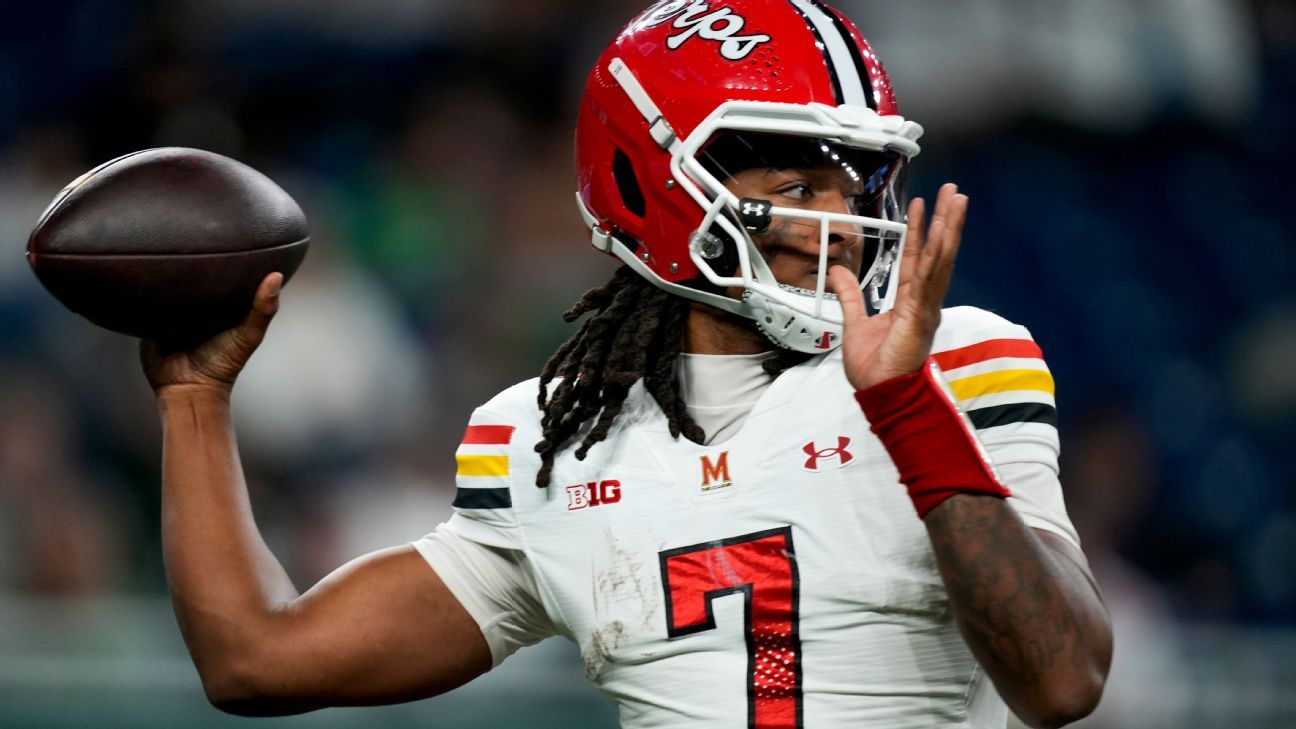
Maryland quarterback Malik Washington, who set the team’s freshman passing record this fall, will return to the Terrapins for the 2026 season.
Washington set Maryland freshman records for passing yards (2,963) and completions (273) this season, while connecting on 17 touchdown passes. He reached 200 passing yards in all but one game and finished as just the second Big Ten freshman since 1996 to record at least 2,500 passing yards and at least 300 rushing yards.
“Representing this team, this area, means so much to me and my family,” Washington said in a statement Saturday. “This is home and we’re going to continue keeping the best athletes from this area here with the Terps. I believe in everyone in our facility and I know we’re building something that our fans will be excited about for years to come.”
Washington, the nation’s No. 134 recruit in the 2025 class, grew up in Severn, Maryland, about 30 miles from Maryland’s campus. Despite a 4-8 record that included only one Big Ten win, Maryland announced that coach Mike Locksley, who recruited Washington, would return in 2026. Locksley will enter his eighth season as Maryland’s coach.
“Malik is a Terp through and through and I’m thrilled he’s coming back to lead this football team,” Locksley said in a statement. “He means so much to this area and this area means so much to him. What we saw from Malik this past season is only the tip of the iceberg. He has such a bright future and he’s already started putting the work in towards the 2026 season.”

-
 Sports2 years ago
Story injured on diving stop, exits Red Sox game
-
 Sports3 years ago
‘Storybook stuff’: Inside the night Bryce Harper sent the Phillies to the World Series
-
 Sports2 years ago
Game 1 of WS least-watched in recorded history
-
 Sports3 years ago
Button battles heat exhaustion in NASCAR debut
-
 Sports3 years ago
MLB Rank 2023: Ranking baseball’s top 100 players
-
Sports4 years ago
Team Europe easily wins 4th straight Laver Cup
-
 Environment3 years ago
Japan and South Korea have a lot at stake in a free and open South China Sea
-
 Environment1 year ago
Here are the best electric bikes you can buy at every price level in October 2024