
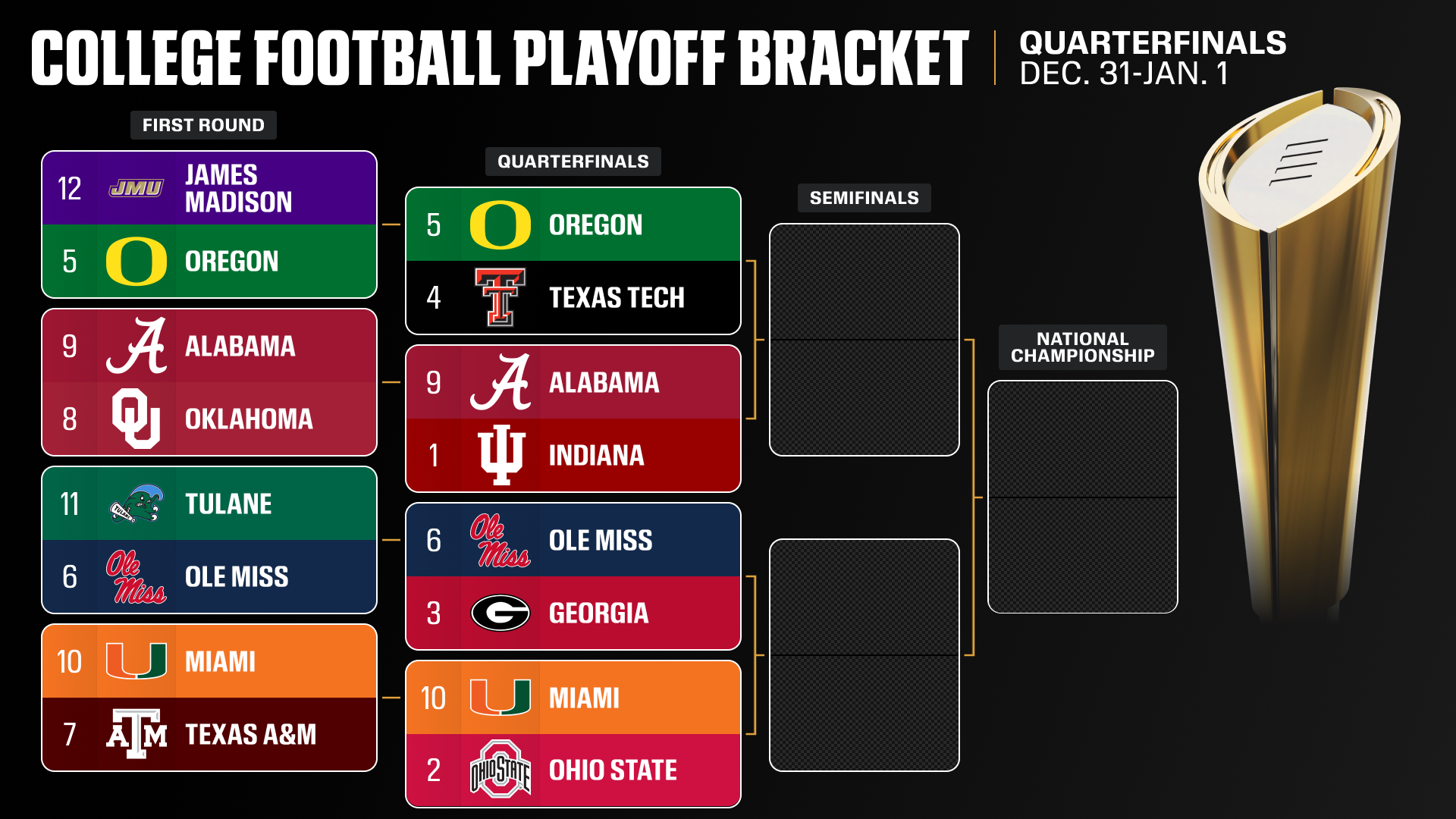
College Football Playoff 2025: Quarterfinal first look


Just win, baby.
None of the hand-wringing around who should be included in the 12-team playoff matters anymore. All that matters is advancing to the quarterfinals, and three teams have done so already.
Alabama rallied from down 17-0 to beat Oklahoma on Friday, moving on to play top-seeded Indiana in the Rose Bowl.
Then on Saturday, Miami, Ole Miss and Oregon advanced. The Canes beat Texas A&M thanks to an interception in the end zone in the final seconds of the game, and they will play Ohio State in the Cotton Bowl. The Rebels took care of business against Tulane 41-10 and will face Georgia in the Sugar Bowl. The Ducks beat James Madison 51-34 in the final first-round game and will face Texas Tech in the Orange Bowl. The Rose, Sugar and Orange bowls will be played on Jan. 1, with the Cotton Bowl set for Dec. 31.
ESPN’s college football writers are already looking ahead, so here’s a closer look at those quarterfinal matchups.
Jump to:
No. 5 Oregon vs. No. 4 Texas Tech
No. 6 Ole Miss vs. No. 3 Georgia
No.10 Miami vs. No. 2 Ohio State
No. 9 Alabama vs. No. 1 Indiana
When: Jan. 1, noon ET. TV: ESPN
Road to the playoff: Texas Tech had never come close to competing for the College Football Playoff before, but it made all the right moves this offseason and won the program’s first-ever Big 12 title.
Joey McGuire hired two excellent new coordinators in Mack Leftwich and Shiel Wood. General manager James Blanchard and the program’s billionaire benefactors put together an all-time great transfer portal class with 11 new starters who have perfectly complemented the returning talent and culture. They put it all together and then went out and practically steamrolled their schedule.
The Red Raiders won by more than 21 points in every victory this season, finishing with the best scoring margin (552-142) in the FBS. Their exceptional defensive line, led by Lombardi Award winner Jacob Rodriguez, has helped shape one of the best defenses in the country, a unit that is No. 1 against the run and top five in many other metrics. The team’s lone loss came by four points on the road against defending Big 12 champ Arizona State when quarterback Behren Morton was out due to injury.
Player to watch: Morton has been playing through pain for most of this season after suffering a hairline fracture in his right fibula in the opener. The senior aggravated the injury a month later and sat out two games to try to get better before the Big 12 title race. After the Big 12 title game, Morton told ESPN that he was feeling “about 70 percent” healthy and was looking to a first-round bye and three weeks to recover. Losing No. 2 quarterback Will Hammond to a season-ending torn ACL in late October was a setback that has made the week-to-week management of Morton’s injury more challenging.
McGuire calls him the toughest player he has ever coached, and Texas Tech’s title hopes depend on keeping Morton protected and in a good rhythm.
Biggest question: Can Texas Tech’s offense execute at a consistently high level in the red zone? The Red Raiders have played five games against teams that achieved winning records in 2025. They’ve scored touchdowns on just 32% of drives that reached the red zone, totaling 13 field goals and eight touchdowns over 25 opportunities in those games. That percentage vs. winning teams ranks fourth worst in the FBS.
Place-kicker Stone Harrington has had a solid year on field goal attempts (22-of-27), and McGuire clearly trusts him. But this team settled for a total of 11 field goal tries over its two matchups against BYU with two misses in the Big 12 title game.
A lot of factors play into this, including Texas Tech’s trust in its defense. It’ll be interesting to see what solutions Leftwich and his offensive coaches come up with from a playcalling standpoint for finishing drives in the CFP quarterfinals.
They can win if…: Texas Tech’s front seven keeps playing at an elite level. The Red Raiders led the FBS in pressures for most of the season and are also No. 1 in takeaways with 31 after grabbing four more in the Big 12 title game. The defensive line is as good as it gets with three first-team All-Big 12 performers. Rodriguez is enjoying a historic season at linebacker and also won the Butkus Award. His fellow linebackers Ben Roberts and John Curry are having terrific years as well. This team wins with defense and absolutely believes it can compete with the best of the best. In the playoff, that starts with Oregon. — Max Olson
What we learned in Round 1: There wasn’t much new revealed in the Ducks’ 51-34 win against James Madison. The game went about as expected considering the considerable gulf in talent. It reaffirmed, however, that preparations were not meaningfully impacted by offensive coordinator Will Stein (Kentucky) and defensive coordinator Tosh Lupoi (Cal) being named head coaches elsewhere in recent weeks. The Ducks started fast and put the Dukes away early in the first-ever College Football Playoff game at Autzen Stadium.
Player to watch: The marquee player is quarterback Dante Moore, who could be in his final days with the Ducks. Moore has played his way to the top of ESPN NFL draft analyst Mel Kiper Jr.’s 2026 Big Board but has yet to indicate publicly what his future plans are. Against James Madison, Moore led the Ducks to touchdowns on each of their first five drives and finished 19-of-27 for 313 yards with four TDs. He also ran for a score.
They can win if…: They limit the impact of Texas Tech’s front seven. No one in the Big 12 was equipped to deal with how dominant the Red Raiders are up front, and that set the tone almost every week. Oregon has an offensive line that should give Texas Tech its toughest challenge of the season, but — perhaps more importantly — the Ducks have a bunch of speedsters who can make life difficult on the perimeter. Neither of these teams has lost since mid-October, and on paper it might be the most evenly matched game of the quarterfinals. — Kyle Bonagura
When: Jan. 1, 8 p.m. ET. TV: ESPN

Road to the playoff: There were concerns about whether this Georgia team would be as talented as coach Kirby Smart’s championship-winning ones of the past. The Bulldogs didn’t seem to have a high number of potential NFL first-round draft picks, outside of linebacker CJ Allen, and quarterback Gunner Stockton was debuting as the full-time starter.
Yet when the dust settled, the Bulldogs were back in the SEC championship game, where they defeated Alabama 28-7 to win back-to-back conference titles for the first time since Heisman Trophy-winning tailback Herschel Walker led them to three straight in the 1980s. The Bulldogs (12-1) avenged their only loss of the regular season, a 24-21 defeat to the Crimson Tide in Athens on Sept. 27, which ended their 33-game home winning streak. Georgia won its next nine games, including victories over then-No. 5 Ole Miss, then-No. 10 Texas and then-No. 23 Georgia Tech. The Bulldogs won at least 11 games for the eighth time in the past nine seasons under Smart.
Player to watch: Georgia’s offense has mostly been steady with Stockton running the show, averaging 31.9 points and 406.9 yards per game. Receiver Zachariah Branch, a transfer from USC, has been Stockton’s No. 1 option in the passing game. Branch, from Las Vegas, is one of the most explosive players in the FBS. In 12 games, Branch has 73 receptions for 744 yards with five touchdowns. He needs only four catches to break the UGA single-season record of 76, set by Brice Hunter in 1993. A former track star, Branch has the speed and elusiveness to score every time he touches the ball. He makes plays that others don’t, as evidenced by his 13-yard touchdown catch in the SEC championship game when he sidestepped a couple of Tide defenders and then burst into the end zone.
Biggest question: Georgia’s offensive line struggled early but improved throughout the season once key players returned from injury. Then the Bulldogs lost starting center Drew Bobo to a foot injury in their 16-9 victory against Georgia Tech in the regular-season finale. Bobo, whose father is Georgia offensive coordinator Mike Bobo, will miss the CFP because of the injury. Redshirt freshman Malachi Toliver started at center against Alabama in the SEC championship and played well. Toliver, 6-foot-5 and 320 pounds, appeared in five games and made an earlier start against Charlotte. He had a couple of extra weeks to work with Stockton because of the Bulldogs’ first-round bye in the CFP.
Georgia’s offensive line ended up being among the better ones in the SEC. The team ranked third in the league in sacks allowed (18) and fifth in rushing (186.6 yards) after struggling mightily to run the ball in 2024. How well will the line hold up if the Bulldogs end up playing a menacing defensive front such as Miami’s or Texas Tech’s?
They can win if…: Georgia sticks to basics by running the ball and continuing to play tough, physical defense. Defensive coordinator Glenn Schumann caught plenty of flak early in the season when his unit struggled to stop opponents on third down. But the Bulldogs are starting to resemble the defenses that helped them win back-to-back CFP national championships in 2021 and 2022.
In its past four games, Georgia hasn’t allowed more than 81 rushing yards or 274 yards of total offense. Its opponents — Texas, Charlotte, Georgia Tech and Alabama — went a combined 10-for-48 (20.8%) on third down. The Bulldogs forced five turnovers and had nine sacks combined in those contests.
Sophomores Chris Cole (4.5 sacks) and Quintavius Johnson (2 sacks) are getting pressure on the quarterback, and Ellis Robinson IV is living up to his billing as the No. 1 cornerback in the class of 2024 by ESPN Recruiting.
If Georgia can continue to run the ball with Nate Frazier and Stockton, and its defense gets opponents off the field, the Bulldogs will be tough to beat. — Mark Schlabach

What we learned in Round 1: Sure, it was against AAC champion Tulane, which has the worst defense of the 12 teams in the CFP, but the Ole Miss offense came out firing on all cylinders in its first game without coach Lane Kiffin, who left for LSU. Each of Ole Miss’ first five plays went for 20 yards or more, and it scored touchdowns on its first two drives. Things slowed down from there in the second quarter, however, especially after star quarterback Trinidad Chambliss and tailback Kewan Lacy went down with injuries. (They returned in the second half, although Lacy went back to the locker room late in the third quarter.) As long as Lacy isn’t sidelined for long, the offense figures to be fine even without Kiffin on the sideline. — Schlabach
Player to watch: Chambliss. He has been the player to watch over the course of the season, not only for the improbability of his rise but also for the way he has played. Following his ascension to starter, Chambliss became the first SEC player with 300 passing yards and 50 rushing yards in three straight games over the past 30 years. Against Tulane on Saturday, he completed 23 of 29 passes for 282 yards with one touchdown and ran six times for 36 yards with two scores. — Andrea Adelson
They can win if …: The Rebels will need Lacy to be healthy and ready to go against Georgia in 12 days. Ole Miss’ defense figures to get a much more difficult test in New Orleans. The Rebels had a nine-point lead heading into the fourth quarter at Georgia on Oct. 18, but the Bulldogs scored 17 straight points for a 43-35 victory. Georgia bullied the Rebels at the line of scrimmage, controlling the ball for all but 1 minute, 54 seconds. The Bulldogs went 6-for-11 on third down and had 510 yards of offense, including 221 rushing. — Schlabach
When: Dec. 31, 7:30 p.m. ET. TV: ESPN
Road to the playoff: The Buckeyes knocked off then-top-ranked Texas in the opener, then cruised through the schedule, snapping a four-game losing streak to Michigan with an emphatic 27-9 victory in Ann Arbor to cap an undefeated regular season. But in the Big Ten title game, Ohio State came up empty on two second-half drives that ended inside the Indiana 10-yard line as the Hoosiers captured the Big Ten championship with a 13-10 victory. The defending national champion Buckeyes still ended up with the No. 2 seed and a first-round bye. Now, they’ll look to rebound and win back-to-back national titles for the first time in program history.
Player to watch: Quarterback Julian Sayin had the worst game of his career in the Big Ten championship game. He completed 21 of 29 passes for 258 yards and a touchdown but threw an interception on the opening drive and took five sacks as the Buckeyes struggled in the red zone and scored a season-low 10 points. Before that, Sayin had been spectacular in his first season as the starter. He still ranks second nationally with a QBR of 89.6 and owns the best single-season completion rate (78.4%) in FBS history. Will Howard bounced back from a poor performance against Michigan last year to quarterback the Buckeyes to a dominant run through the playoff and a national championship. Sayin has the talent — and supporting cast — to do the same.
Biggest question: Ohio State’s offensive line dominated the opposition for much of the regular season. But when pitted against an elite defensive line in the Big Ten championship game, the Buckeyes faltered up front. The Hoosiers constantly made their way into the Ohio State backfield, racking up nine tackles for loss while limiting the Buckeyes to 87 rushing yards. After ranking in the top 10 in lowest pressure rate allowed (25.8%) during the regular reason — 10th best among Power 4 offensive lines — Ohio State gave up a pressure rate (percentage of dropbacks where the QB was sacked, under duress or hit) of 48.6% in the Big Ten title game (Central Michigan ranked last in the FBS with a pressure rate allowed of 46.2% this season). Can the Buckeyes offensive line respond against the best in the playoff?
They can win if…: Sayin has time to find star wideouts Jeremiah Smith and Carnell Tate downfield. When the Buckeyes do that, they’re virtually unstoppable offensively. Smith and Tate battled lower-body injuries late in the season, which slowed them down a bit, but the time off should help them heal and get closer to 100 percent for the Cotton Bowl. Ohio State’s sensational defense will give the Buckeyes a chance in any matchup. If the passing attack gets back to clicking after the off night in the Big Ten title game, Ohio State can defeat anyone in the playoff, and that includes Miami. — Jake Trotter
What we learned in Round 1: That the Hurricanes belonged in the field. Miami was the last team in, making the College Football Playoff in somewhat controversial fashion, jumping Notre Dame in the final rankings despite both teams not playing in the final week. There were doubters, but Miami made its statement Saturday. In front of the second-largest crowd in playoff history in College Station, Texas, the Canes were poised, efficient and, if not always particularly explosive, they avoided any catastrophic mistakes. Mark Fletcher Jr. answered the critics of Miami’s lackluster run game with 172 yards on the ground, Malachi Toney atoned for a late turnover, and the defense — which likely cost the Canes a playoff spot a year ago — dominated, nabbing three takeaways, including the game-clinching interception in the end zone with 24 seconds left on the clock.
Player to watch: Carson Beck was supposed to be here two years ago, but his playoff dreams burst when Georgia lost to Alabama in the 2023 SEC championship, the Dawgs’ first defeat in three years. He was supposed to be here last year, but an injury in a win over Texas in the SEC title game kept him out of the playoff. He was supposed to be a star Saturday for Miami, but the passing game was mostly absent in the team’s 10-3 win. As the Canes look ahead to Ohio State, there’s only one way they advance, and that will be if Beck plays his best game. He has proved he’s capable. Against A&M, he did just enough to win. In the Cotton Bowl, he’ll need to be special. He’s overdue for that moment.
They can win if…: Miami’s defense was otherworldly against A&M, racking up seven sacks, nine tackles for loss and three takeaways, including a goal-line stand to seal the win. It was an all-time performance at Kyle Field, and the Canes will likely need another one against Ohio State’s high-powered offense. A&M managed just 89 rushing yards, and making the Buckeyes equally one-dimensional will be critical. Then it’s up to a secondary that has been a work in progress at times but that played a nearly flawless game against the Aggies. — David Hale
When: Jan. 1, 4 p.m. ET. TV: ESPN
Road to the playoff: Coach Curt Cignetti and the Hoosiers heard the hate directed at them at the end of their historic 2024 season and decided to run it back and perform even better this fall. Indiana built on its first 10-win season and first CFP appearance by becoming the only FBS team to run the table, posting a 13-0 mark, winning its first outright Big Ten title since 1945 and securing the top seed in the CFP field.
The Hoosiers navigated a much tougher Big Ten schedule than they did in 2024, taking down Oregon, Iowa and Penn State on the road, thumping then-No. 9 Illinois by 53 points in Bloomington and capping things off with a 13-10 win against Ohio State in the Big Ten title game, a matchup that paired the nation’s Nos. 1 and 2 teams.
For all the talk about a soft nonleague schedule, Indiana wasn’t hindered at all, winning all but two of its regular-season Big Ten games by double digits. The Hoosiers finished second nationally in points margin, outscoring their opponents by 404 points. They had to rally against Penn State and Iowa but were unstoppable at home, winning seven games by an average of 40.7 points.
Player to watch: After a team-record 11 wins in 2024, Indiana looked for areas to upgrade, including quarterback, despite Kurtis Rourke’s strong performance (3,042 passing yards, 29 touchdowns). The Hoosiers landed an even more coveted transfer quarterback in Cal’s Fernando Mendoza, who elevated the passing attack even further and became the school’s first Heisman Trophy winner.
Mendoza has delivered four near-flawless performances with more than 85% completions and four or more touchdowns and no interceptions. He occupies the top three spots on Indiana’s single-game completion percentage chart. Mendoza helped rally Indiana for key road wins against Penn State and Iowa and overcame one of his few major mistakes — a pick-six at Oregon — to lead two fourth-quarter scoring drives. Mendoza leads the FBS with 33 touchdown passes, an Indiana single-season record.
Biggest question: There aren’t many weaknesses in Indiana’s profile, as the Hoosiers’ offense and defense ranks in the top 10 nationally in many key statistical categories. But if Indiana wants to advance in the CFP, it likely will face some key fourth-down situations and might need to find greater efficiency. The Hoosiers ended the season 8 of 16 on fourth down, which is tied for 90th nationally and ranks well below other CFP teams such as Texas A&M, Georgia, Ohio State and Alabama. Indiana failed on all three of its fourth-down chances in a 20-15 win at Iowa and went 0-for-1 the following week at Oregon. The good news is IU then became much better on the money down, converting its final five fourth-down attempts, including a fourth-and-2 late in the first half against Ohio State to set up a field goal.
They can win if …: The Hoosiers can successfully execute a balanced offense, as they have for most of the season. Mendoza’s arrival and success have at times overshadowed Indiana’s run game, which is significantly better than it was in 2024. The Hoosiers rank 11th nationally in rushing (221.1 yards per game), up from 63rd last season (165.1). Indiana committed to the run even in lower-scoring games, as it showed against Iowa (39 attempts), Penn State (31) attempts and Ohio State (34 attempts). The offense can’t deviate from that approach against an Alabama defense that defends the run well but doesn’t rank among the nation’s very best. Indiana also is brilliant in the turnover game, tying Texas Tech for the national lead in margin at plus-17. — Adam Rittenberg
What we learned in Round 1: Alabama might not have looked as good Friday night as it did in September and October, but the Crimson Tide still showed it had another gear to kick into en route to matching the largest comeback in CFP history against Oklahoma. Unforced errors crushed the Crimson Tide in their 23-21 loss to the Sooners in November. In the opening round rematch, Alabama flipped the script, storming back from a 17-0 deficit behind Zabien Brown‘s 50-yard pick-six and a disciplined performance from quarterback Ty Simpson, who looked much more like himself two weeks from a disastrous showing in the SEC title game. The Crimson Tide played the kind of (largely) mistake-free football that eluded them over the back half of the regular season. They’ll need to do it again when they meet No. 1 Indiana in the Rose Bowl on New Year’s Day.
Player to watch: With touchdowns on either side of halftime in the first round matchup with Oklahoma, freshman wide receiver Lotzeir Brooks joined some elite company as only the fifth Alabama pass catcher to record two receiving scores in a CFP game. Alongside him on that list: DeVonta Smith (twice), O.J. Howard, Calvin Ridley and Amari Cooper. Brooks caught five passes for 79 yards in his CFP debut, finishing as the Crimson Tide’s leading receiver in the 34-24 win. Within a pass-catching corps that features Germie Bernard, Ryan Williams and Isaiah Horton, Brooks is as dynamic as anyone, and he could be a difference-maker once again against the Hoosiers 19th-ranked pass defense.
They can win if …: Alabama limits its mistakes, and Simpson plays like the Heisman-caliber quarterback we saw over the first half of the season. The Crimson Tide beat Oklahoma at its own game in the first round, forcing quarterback John Mateer into timely errors and pouncing on miscues such as Grayson Miller‘s bobbled punt attempt before halftime. Couple that with composed, accurate quarterback play from Simpson, and the Crimson Tide have the tools to give Indiana trouble. — Eli Lederman
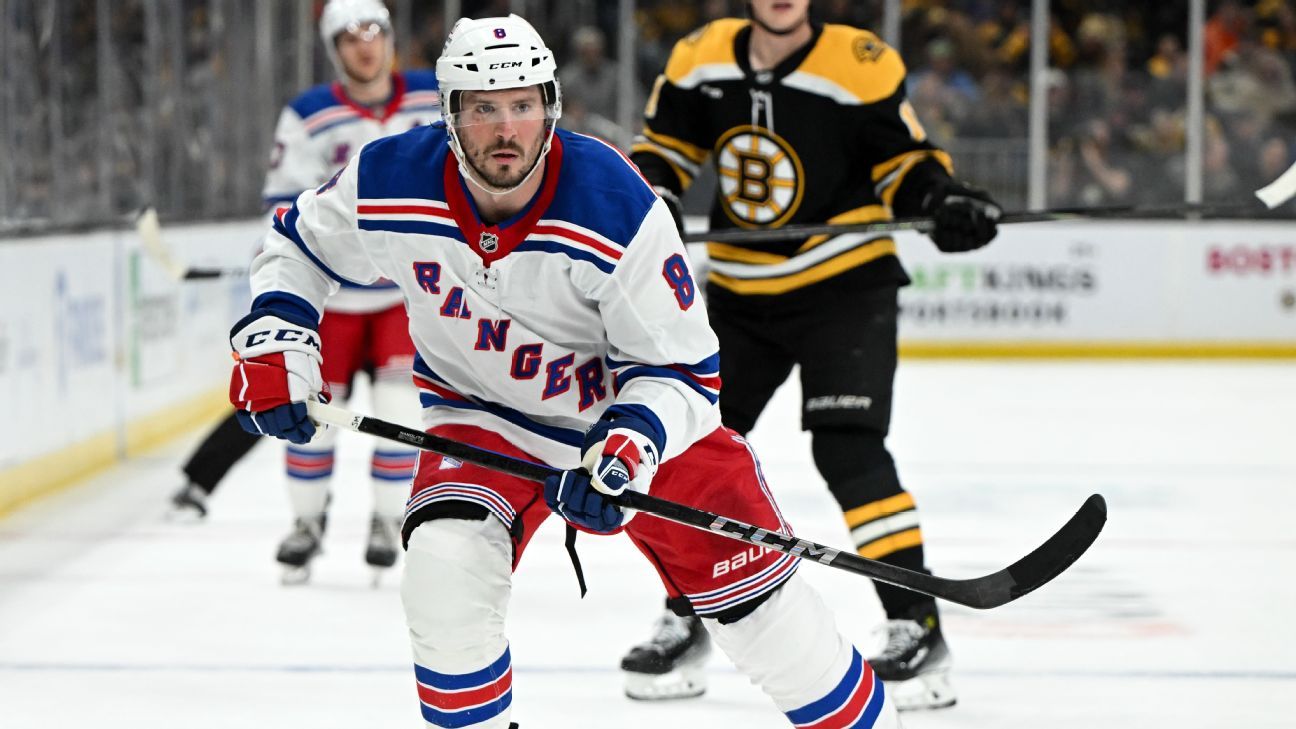

NASHVILLE, Tenn. — New York Rangers captain J.T. Miller will miss at least one game after getting injured Saturday and is not traveling with the team to Nashville.
Coach Mike Sullivan said Miller was still being evaluated back home for an upper-body injury and would not play Sunday night against the Predators.
Miller left the Rangers’ game against Philadelphia with about eight minutes left after taking a big hit from Flyers defenseman Nick Seeler and landing awkwardly. The 32-year-old forward appeared to be favoring his right arm or shoulder while in pain on the bench and skating off to go down the tunnel for medical attention.
“You don’t want to lose any teammates,” center Mika Zibanejad said. “When you see your captain go down and you don’t see him come back, that obviously becomes [a situation] for us to step up and everyone has to do a little more when a guy like that leaves. Just hoping everything is OK.”
Miller was named captain before training camp. He has 10 goals and 12 assists in 35 games this season and is believed to be in consideration for the U.S. Olympic team, though it’s unclear whether this injury could cloud that possibility.

-
Greg Wyshynski
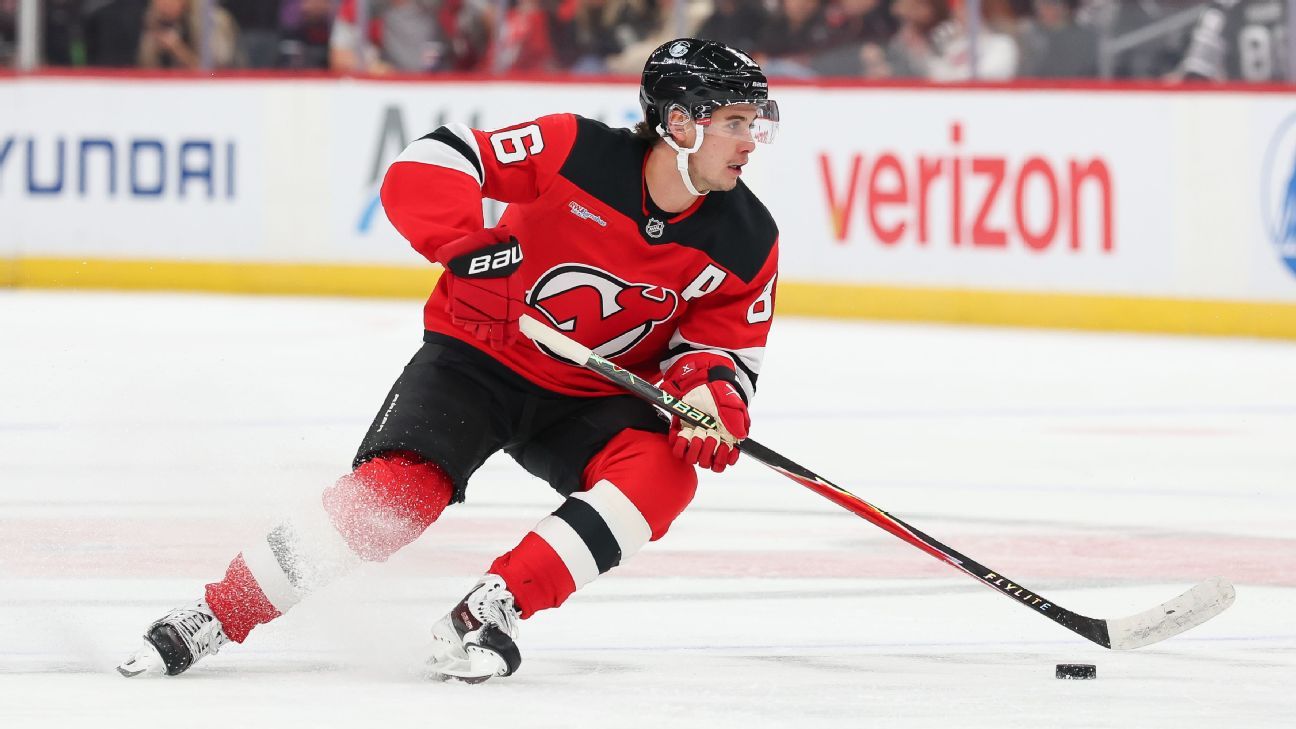
New Jersey Devils star Jack Hughes, out since Nov. 12 with a “freak” hand injury, will return to the lineup against the Buffalo Sabres on Sunday.
Hughes, 24, injured his hand at a team dinner in Chicago on Nov. 13, underwent surgery on his finger and was given a recovery window of eight weeks. He has been skating throughout his rehab and was recently spotting using a stick again on the ice.
He returned to Devils practice Sunday at an optional skate.
“Yeah, I’m going to play tonight. Might as well ease my way in,” Hughes joked after practice.
Both Hughes and the Devils were off to flying starts before his injury. New Jersey was 12-4-1, with the second-best points percentage (.735) in the NHL behind the Colorado Avalanche (.794) and first place in the Metropolitan Division. Hughes had 20 points in his first 17 games, including 10 goals.
The Devils struggled without their top-line center, going 8-10-0 (.444) and scoring 3.35 goals per game with Hughes to 2.28 goals per game without him. But they have remained in the playoff race in a competitive Eastern Conference, holding the final wild-card spot entering Sunday.
Hughes is one of three key players returning to the Devils’ lineup Sunday against surging Buffalo, which has won five straight games. Forward Timo Meier last played Dec. 9, having taken leave from the team for a family matter. He has 11 goals and 12 assists in 30 games. Forward Arseny Gritsyuk has missed the past four games due to injury. The rookie has 16 points in 31 games.
“To come back from the road trip and to have those guys in the building and then on the ice, it gives the [team] a boost,” coach Sheldon Keefe said Sunday. “There’s an emotional impact.”
Keefe said the challenge for his team is not to become suddenly passive because help has arrived.
“We’ve got to keep playing the way we’ve been playing and have those players enhance that,” he said. “Sometimes when you bring important people back to your group, there can be a tendency for the rest of the group to take a back seat. And that cannot happen.”
Sunday was Hughes’ first appearance since the injury and the first time he has faced questions about his brother, star defenseman Quinn Hughes, being traded to the Minnesota Wild last week.
Sources told ESPN that the Vancouver Canucks went to the Devils first in discussing trade destinations for Quinn Hughes, as his brothers Jack and Luke both play in New Jersey. Ultimately, the Canucks opted to trade Hughes to the Wild for center Marco Rossi, forward Liam Ohgren, defenseman Zeev Buium and a 2026 first-round pick.
“It happened fast,” Jack Hughes said, adding that there was a “little bit” of disappointment that the three brothers weren’t united together. “I think he’s happy in Minnesota now. They have a great team there, and they’re playing well. … We’re happy for him.”
-
 Sports2 years ago
Story injured on diving stop, exits Red Sox game
-
 Sports3 years ago
‘Storybook stuff’: Inside the night Bryce Harper sent the Phillies to the World Series
-
 Sports2 years ago
Game 1 of WS least-watched in recorded history
-
 Sports3 years ago
Button battles heat exhaustion in NASCAR debut
-
 Sports3 years ago
MLB Rank 2023: Ranking baseball’s top 100 players
-
Sports4 years ago
Team Europe easily wins 4th straight Laver Cup
-
 Environment3 years ago
Japan and South Korea have a lot at stake in a free and open South China Sea
-
 Environment1 year ago
Here are the best electric bikes you can buy at every price level in October 2024