
Keir Starmer bats away hecklers as he gets personal during Labour Party conference speech

Sir Keir Starmer batted away hecklers during a mammoth speech in which he used his personal experiences to show off his human side as he announced a key climate change policy.
Doreen Lawrence, mother of murdered teenager Stephen Lawrence, introduced Sir Keir before his conference speech by thanking the Labour leader for helping prosecute his murderers when he was a barrister.
During the 90 minute speech, which was his first in-person conference address since he became leader, he hit out at the government, referenced his parents throughout and announced a plan to retrofit millions of homes.
Following five days of ups and downs in Brighton, including successfully getting a new way of voting for a leader through, he put Labour forward as the next party to lead the country.

Labour leader Sir Keir Starmer being heckled
But he was also heckled by those who may be bigger fans of his predecessor, Jeremy Corbyn, who has criticised Sir Keir at fringe events this week.
However, he brushed them away by saying “shouting slogans or changing lives, conference?” – to which he got cheers from the audience.
He spoke of not being from a privileged background, of his father being a tool maker in a factory and his mum being a nurse in the NHS and her getting a rare arthritic disease for which he could “hardly convey to you the emotion of seeing your mum in that condition”.
For a leader who has often been accused of failing to show off his personality and any emotion, it appeared important for Sir Keir to connect on an emotional level with Labour members, who listened intently.
He also spoke of being a lawyer and chief prosecutor and how that has helped his approach to politics.
John and Penny Clough, the parents of murdered nurse Jane Clough, were in the front row of the audience and Sir Keir told of them coming to him to get justice for her and how they changed the law – and how crime “will always be a Labour issue”.

Doreen Lawrence introduced Sir Keir
Sir Keir said Labour would fast-track rape and serious sexual assault cases and toughen sentences for rapists, stalkers and domestic abusers.
Recognising he came into politics “late in life”, the Labour leader said he was not a career politician and said he was nothing like Boris Johnson, who he said was waging war on traffic cones while he was prosecuting Stephen Lawrence’s murderers.
He also said in 2010 he was helping put terrorists behind bars while Mr Johnson was defending the right not to wear a cycle helmet.
“It’s easy to comfort yourself that your opponents are bad people, but I don’t think Boris Johnson is a bad man, I think he is a trivial man,” he said.
“I think he’s a showman with nothing left to show, I think he’s a trickster who has performed his one trick.”
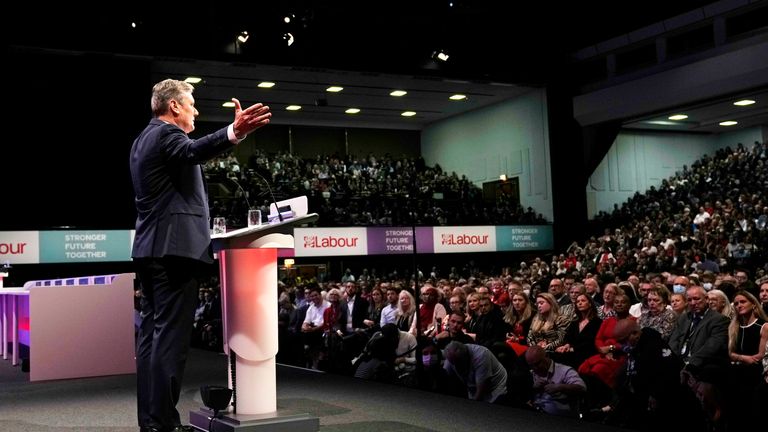
Sir Keir was cheered as he set himself apart from the Tories
He promised Labour will “always fund the NHS properly” and would shift the priority of the NHS away from emergency care to prevention, including funding mental health as much as physical health.
“Labour will guarantee that support will be available in less than a month,” he said.
That would include recruiting 8,500 more mental health professionals and ensuring every school has specialist support and communities have mental health hubs.
Another of the Labour leaders key promises is on education and Sir Keir used a famous Tony Blair slogan (“education, education, education”) as he said: “Education is so important I am tempted to say it three times.”
He said Labour will launch the most ambitious school improvement plan, including ensuring children leave school with good qualifications and who are ready to work.
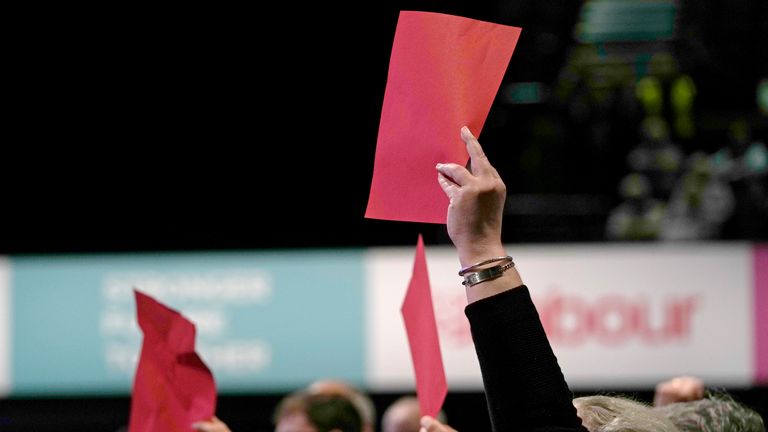
Delegates hold up a red cards as a group of hecklers attempt to interrupt the keynote speech of leader of the British Labour Party Keir Starmer at the annual party conference in Brighton, England, Wednesday, Sept. 29, 2021. (AP Photo/Alastair Grant)
Theatre, drama and music will not be allowed to collapse, he said as he mentioned he had music lessons with Fat Boy Slim at school.
On the economy, Sir Keir said Labour would support small businesses and invest a minimum of 3% of GDP in science and research and development.
He said the finances inherited from the Conservatives “will need serious repair work” but the approach to taxation will be governed by taxpayers getting the best value for money.
Sir Keir’s shadow cabinet ministers have announced a raft of new policies this week and he added to that by saying climate change – which got a big clap – would be tackled by retrofitting 19 million homes over a decade to save families more than £400 a year on energy bills, with a £6bn a year investment.
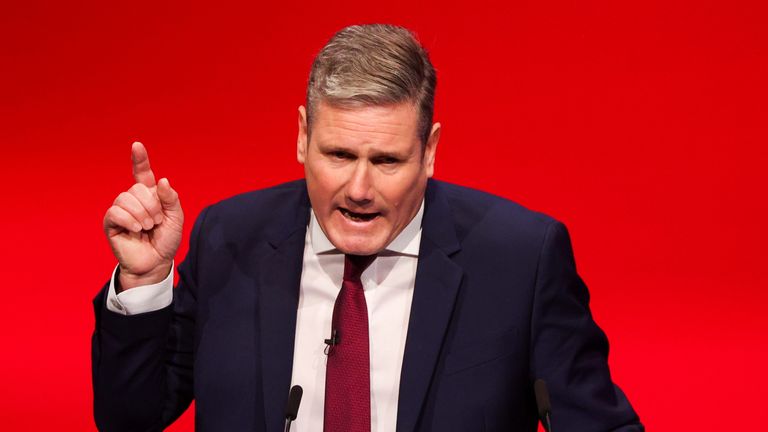
Starmer wants ‘serious’ plan for government from his party
And he hit out at Scottish First Minister Nicola Sturgeon, saying the SNP and the Tories “exploit the constitutional divide” so he was worried about the future of Wales within the Union.
After his speech, the Labour leader was joined by his wife, Victoria, on stage and they left the conference hall to the Fat Boy Slim song “Right here, right now” – plus a standing ovation.


Crypto industry executives have urged the US Securities and Exchange Commission to shift its thinking on blockchain privacy tools, pitching that there are legitimate applications for them outside of criminal use.
The SEC hosted crypto and finance executives for a discussion and panel on financial surveillance and privacy on Monday, the agency’s sixth crypto-focused roundtable this year, as it seeks to overhaul its approach to crypto.
StarkWare general counsel Katherine Kirkpatrick Bos, who participated in a panel discussion, told Cointelegraph after the event that a major takeaway was that there shouldn’t be an assumption that those using and creating privacy tools are “overwhelmed by wrongdoers.”
“Why is the assumption that an individual needs to affirmatively prove that they are compliant or they’re using the tool for good?”
“As opposed to it being the other way around, where the assumption is that this individual is using the tool for good until there is some sort of indication that they’re using it for bad,” she said.
Kirkpatrick Bos added that “of course, wrongdoers were using, or are using those tools, but there needs to be a balance.”
During the roundtable, Wayne Chang, the founder and CEO of the credential management company SpruceID, said some percentage of users of stablecoins, a crypto tool that is slowly becoming mainstream, will want privacy.
“There are a ton of stablecoins that aren’t onchain yet that would come onchain if there is privacy,” he said. “We’re going to see an increase in demand for privacy-preserving blockchains.”
“My hope is that regulators continue to engage industry, and we can have those discussions on how to keep privacy for folks while also having tools that are useful,” Chang said.
Customer checks are becoming outdated
Kirkpatrick Bos said a discussion on Know Your Customer (KYC) and Anti-Money Laundering (AML) measures focused on whether current rules are sufficient in the age of artificial intelligence.
“The question arose and was debated on the panel, well, what is necessary for Anti-Money Laundering?” she said. “Now we have AI. It’s made manual, AML and KYC antiquated. How do we solve for that?”
“There was a sense that the current system of AML and KYC is antiquated, it’s problematic, it’s ineffective,” she added. “But there needs to be some sort of check when it’s a centralized entity facilitating flows of money to ensure that they’re not helping wrongdoers.”
Many financial institutions request a picture of a user’s driver’s license for its KYC checks, which Kirkpatrick Bos said was “absurd, because an individual can go on the internet and develop a fake driver’s license in a matter of seconds.”
“So the question is, can cryptography-based tools improve that and make it harder for bad guys to do that? But can they also do that and make it harder for bad guys while preserving an individual’s privacy and not revealing data like an address, where it is not necessary to vet the legality of the funds?” she added.
Some projects have begun to test crypto-based solutions for proving identity while claiming to preserve privacy, such as Sam Altman’s World, which gives users a cryptographic key they can use to prove they’re human.
SEC’s Atkins warns of potential for crypto mass surveillance
SEC chair Paul Atkins had given opening remarks at the roundtable, warning that if “pushed in the wrong direction, crypto could become the most powerful financial surveillance architecture ever invented.”
“If the instinct of the government is to treat every wallet like a broker, every piece of software as an exchange, every transaction as a reportable event, and every protocol as a convenient surveillance node, then the government will transform this ecosystem into a financial panopticon,” he added.
Related: SEC ’eased up on’ 60% of crypto enforcement cases under Trump: Report
Atkins said that crypto allows for “privacy-preserving tools that the analog world could not provide,” which some institutions depend on to build positions or test strategies without “instantly telegraphing that activity to competitors.”
He added that some of the technology could balance the government’s interest in deterring security threats and the public’s privacy.
“But to best strike this balance, we must make certain that Americans can use these tools without immediately falling under suspicion.”
Magazine: 2026 is the year of pragmatic privacy in crypto — Canton, Zcash and more



US President Donald Trump says he will review the case of convicted Samourai Wallet developer Keonne Rodriguez, hinting he will explore the possibility of a pardon.
Samourai Wallet co-founders Rodriguez and William Lonergan Hill were sentenced on Nov. 19 to five and four years in prison on charges stemming from their involvement in the crypto mixing protocol.
“I’ve heard about it, I’ll look at it,” Trump said when asked about the case at a press conference about the Mexican border at the White House on Monday.
“Okay, let’s take a look at it. You know, you’ll have to tell me. I don’t know anything about it, but we’ll take a look,” he added.
Privacy advocates and crypto users have long been advocating for Rodriguez and Hill, along with Tornado Cash co-founder Roman Storm, arguing they shouldn’t be held responsible for the actions of third parties using their software.
Samourai co-founder says “noise is working”
Rodriguez, who is due to start his time behind bars this week, said in an X post on Monday that the “continued noise” from supporters is working. “Thank you to everyone pushing Donald Trump to pardon Bill and me. Let’s get this over the line.”
In an interview with Bitcoin educator Natalie Brunell on Friday, Rodriguez said he thought there was a chance of receiving a pardon if the case were presented to Trump and the top officials in the administration.
I appreciate @keonne taking some tough questions on the Samourai Wallet case. No topic was off limits.
Keonne is getting ready to report to prison on December 19th but there is an active movement to #PardonSamourai, and Keonne hopes President Trump hears his story.
If you care… pic.twitter.com/iXg3BXr8iq
— Natalie Brunell ⚡️ (@natbrunell) December 12, 2025
“Because President Trump has been touched by a DOJ that was weaponized against him, I think when he sees the facts laid out on the table, he will know exactly what’s going on,” Rodriguez said.
Conventional appeal is unlikely
Rodriguez also said it’s his understanding he waived his right to appeal the sentence when he took the plea deal, adding that he’s not “100% on that, but my understanding is appeal is pretty unlikely.”
Rodriguez and Hill initially pleaded not guilty but then agreed to plead guilty to one charge of operating an illegal money transmitter in July.
They faced at least 25 years in prison on charges of conspiracy to commit money laundering, which carries a maximum prison sentence of 20 years, and operating an unlicensed money-transmitting business, which carries a sentence of up to five years.
Up until the sentencing hearing, Rodriguez said he regretted pleading guilty but feared the judge wouldn’t allow key evidence to be used in his defense, such as receiving legal advice before launching Samourai Wallet.
Related: After Samourai, DOJ’s money-transmitter theory now looms over crypto mixers
After crunching the numbers, he also found a “conviction means 25 years, even if you appeal, that you’re sitting in prison for five years waiting for your appeal, your appeal is going to cost you another $7 million on top of the four and a half million you’ve already spent to get to this point. So the numbers just didn’t make any sense.”
Trump pardoned Changpeng Zhao, Ross Ulbricht
Since taking office, Trump pardoned Binance founder Changpeng “CZ” Zhao in October, after he pleaded guilty in November 2023 to failing to maintain an effective Anti–Money Laundering program at Binance, in violation of the Bank Secrecy Act.
Ross Ulbricht, the founder of the defunct darknet marketplace the Silk Road, was also granted a presidential pardon on his life sentence in January.
Magazine: Do Kwon sentenced to 15 years, Bitcoin’s ‘choppy dance’: Hodler’s Digest, Dec. 7 – 13
-
 Sports2 years ago
Story injured on diving stop, exits Red Sox game
-
 Sports3 years ago
‘Storybook stuff’: Inside the night Bryce Harper sent the Phillies to the World Series
-
 Sports2 years ago
Game 1 of WS least-watched in recorded history
-
 Sports3 years ago
Button battles heat exhaustion in NASCAR debut
-
 Sports3 years ago
MLB Rank 2023: Ranking baseball’s top 100 players
-
Sports4 years ago
Team Europe easily wins 4th straight Laver Cup
-
 Environment3 years ago
Japan and South Korea have a lot at stake in a free and open South China Sea
-
 Environment1 year ago
Here are the best electric bikes you can buy at every price level in October 2024