
Sudan prime minister and wife at home “under heavy security” after military coup – as ministers reject takeover

Sudan’s prime minister Abdalla Hamdock and his wife are at home “under heavy security” after the military seized control in a violent coup.
The premier was allowed to return to his house in Kafouri, in the state of Khartoum on Tuesday, according to an official who asked to remain anonymous.
But it has yet to be confirmed whether the Hamdocks are free to move or make calls.
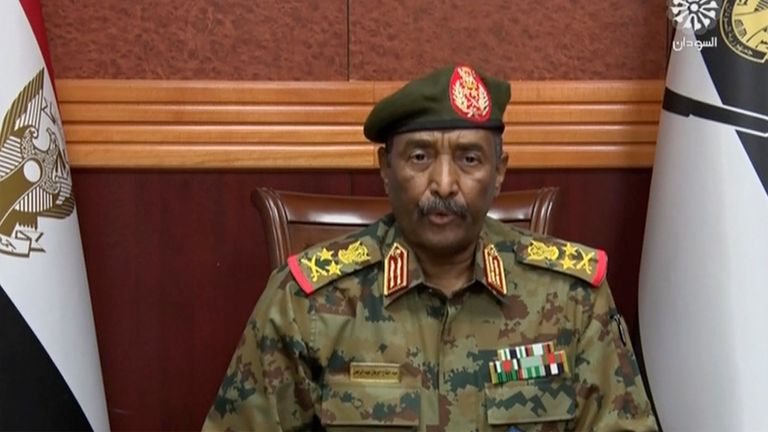
Gen. Abdel-Fattah al-Burhan announced in a televised address that he was dissolving the country’s ruling Sovereign Council
It comes after the country’s ruling general, Abdel Fattah al-Burhan, claimed on Tuesday that Mr Hamdock was being held “for his own safety” and would be released “today or tomorrow”.
The prime minister’s office earlier issued a statement voicing concerns about him and other officials who are believed to be detained.
General al-Burhan warned how members of the dissolved government could face trial.
At least seven people have been killed and 140 hurt in the wake of the coup on Monday, which saw Sudan declare a state of emergency.
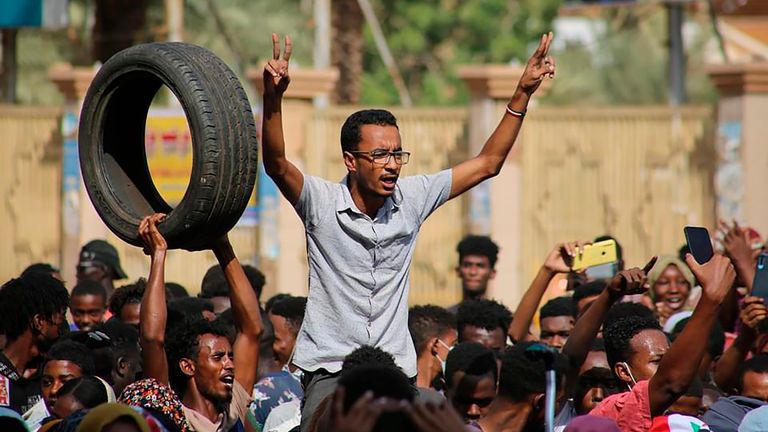
Thousands of protesters have descended on the Sudanese capital Khartoum after the military arrested government ministers.
Thousands of pro-democracy demonstrators responded by blockading roads in Khartoum.
The coup has been widely denounced by the international community, with UN Security Council members due to meet for private talks on how to deal with the crisis on Tuesday.
UN Secretary-General, Antonio Guterres, urged world powers to act decisively at the council, insisting unity was necessary to confront an “epidemic of coups d’état” recently.
Meanwhile US President Joe Biden’s administration announced the suspension of $700million in emergency assistance to Sudan in a bid to send a strong message to military leaders.
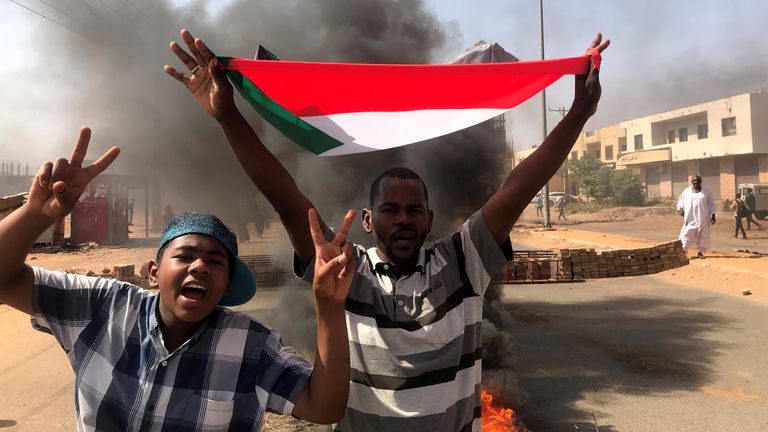
A protester waves a flag during the military takeover which left at least seven dead
“They should first and foremost cease any violence against innocent civilians, and… they should release those who have been detained and they should get back on a democratic path,” said National Security adviser Jake Sullivan.
The coup follows weeks of simmering tensions between military and civilian leaders over Sudan’s transition to democracy, following a failed coup in September.
Now the bloodshed threatens to derail progress made since autocrat Omar al-Bashir lost power after a popular uprising two years ago.
Speaking on Tuesday, Gen Burhan said the military was forced to step in to resolve a growing political crisis which he alleged could have resulted in civil war.
“The whole country was deadlocked due to political rivalries,” he told a televised news conference.
He warned senior officials who allegedly tried to incite a rebellion within the armed forces would face trial – but vowed others who are found innocent would be freed.
But despite the prime minister being toppled, foreign minister Mariam al-Mahdi remained defiant, declaring she and members of Mr Hamdock’s administration remained the legitimate authority in Sudan.
“We are still in our positions. We reject such coup and such unconstitutional measures,” she said.
“We will continue our peaceful disobedience and resistance.”
Protestors are set to attend a mass march on Saturday to demand a return to civilian rule – as union leaders urged workers to go on strike and engage in civil disobedience.
It comes as Sudan’s Civil Aviation Authority announced on Tuesday it has suspended all flights to and from from the Khartoum International Airport until October 30.
World
‘If someone took Trump’s land, how would he feel?’ – Ukrainians view peace talks with suspicion
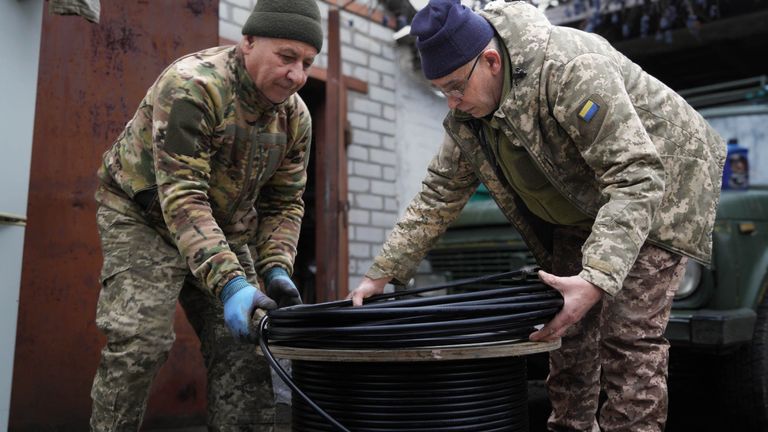
A Ukrainian farmer-turned-soldier in the Donbas has a message for Donald Trump as the US president attempts to broker a peace deal between Kyiv and Moscow.
Anatolii, 59, said: “If someone took a piece of his territory, what would he say to that? The same goes for us.”
Like many Ukrainians, the serviceman volunteered to join a territorial defence unit when Russia launched its full-scale war almost four years ago.
He has been fighting ever since, but will have the option to quit next year once he turns 60.
Anatolii and a colleague
Unable to wear body armour anymore because of its weight, Anatolii now operates further back from the frontline in a small workshop on the outskirts of the city of Kramatorsk where he helps to fix and improve the performance of drones – a crucial weapon on the battlefield.
“I want this war to finally end,” he said. “I want to go home, to my family, to my land.”
But not at any price.
He and other soldiers in 107 Brigade of Ukraine’s Territorial Defence Force view Mr Trump’s efforts to negotiate a peace agreement with suspicion.
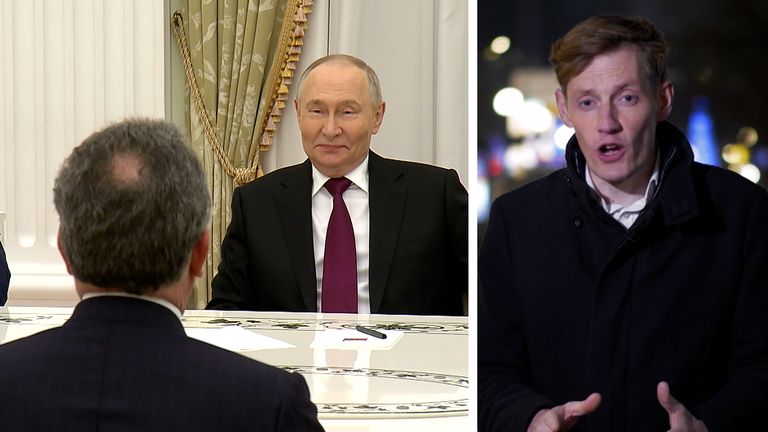
Peace deal: Russia ‘in no mood to compromise’.
An initial proposal envisaged the Ukrainian government giving up Donetsk and Luhansk, the two regions that make up the Donbas, to Russia.
This includes large swathes of land that are still under Ukraine’s control, and that thousands of Ukrainian soldiers have lost their lives fighting to defend.
“I feel negative about it,” Anatolii said, referring to the proposal.
“So many people already fell for this land … How can we give away our land? It would be like someone comes to my house and says: ‘Give me a piece of your home.'”
However, he added: “I understand, we have nothing to take it back with. Maybe through some political means…
“I do not want more people to fall, more people to die. I want politicians to somehow come to terms.”
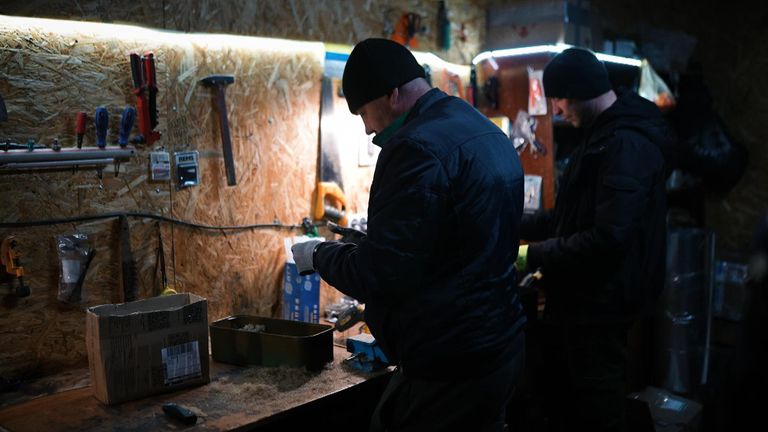
A short drive away from the workshop is a hidden bomb factory where other soldiers from the same unit are focused on a different kind of war effort.
Surrounded by 3D printed gadgets, metal ball bearings and plastic explosives, they make improvised bombs, including anti-personnel mines and devices that can be fitted onto one-way attack drones and exploded onto targets.
Vadym, 41, is in charge of the production line.
He has been fighting since Russian President Vladimir Putin first attacked eastern Ukraine in 2014.
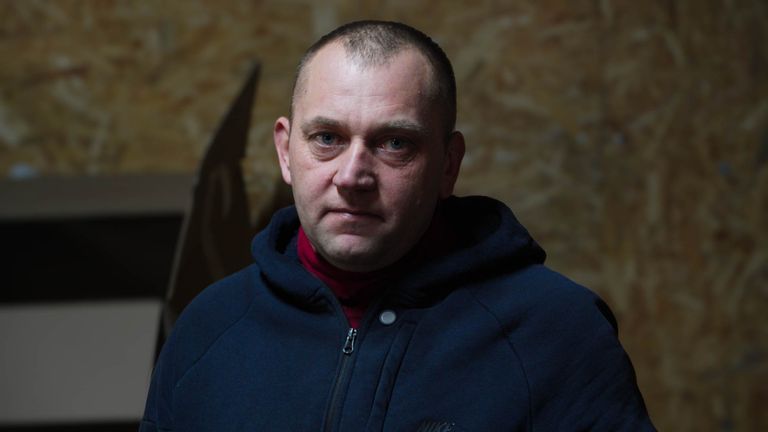
Vadym
Asked whether he felt tired, he said: “We are always tired, we have no motivation as such, but there is the understanding that the enemy will keep coming as long as we do not stop him. If we stop fighting, our children and grandchildren will fight. That keeps us going.”
Vadym is also against simply handing over Ukrainian land to Russia.
“If we now give away borders, give away Donbas, then what?” he said.
“Any country can come to any other country and say: This is our land. Let’s coordinate, do business, and keep living as before. That is not normal in my view.”

The Ukrainian president says ‘everyone must be on this side of peace’
The city of Kramatorsk stands testament to Ukraine’s will to fight, remaining firmly in Ukrainian hands, though Russia’s war is inching closer.
Nets stretched like a tunnel line a main road leading into the city to protect vehicles from the threat of small, killer drones.
Coils of barbed wire are also strung across fields around the outskirts of Kramatorsk along with other fortifications such as mounds of dirt and triangular lumps of concrete.
Many civilians have remained here as well as the nearby city of Slovyansk, even as other landmark sites such as Mariupol, Bakhmut and Avdiivka have fallen.
Yet the toll of living in a warzone is clear.
Stallholders swept away rubble and broken glass on Sunday after a Russian missile smashed into a central market in Kramatorsk on Saturday night.
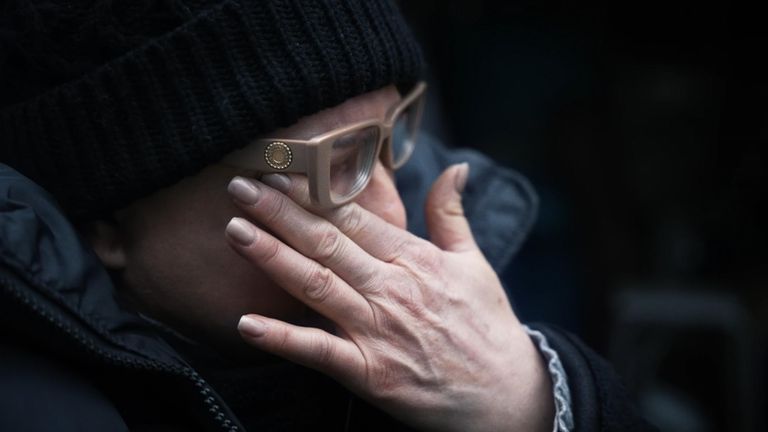
Some, like Ella, 60, even chose to reopen despite the carnage.
“It’s frightening. We need to earn a living. I have my mother, I need to look after her, help my children. So we do what we have to do,” she said.
Her adult children live in Kyiv and want her to leave, but Kramatorsk is her home.
“We’ve been living like this for four years now. We’re so used to it. A drone flies overhead and we keep working,” she said.
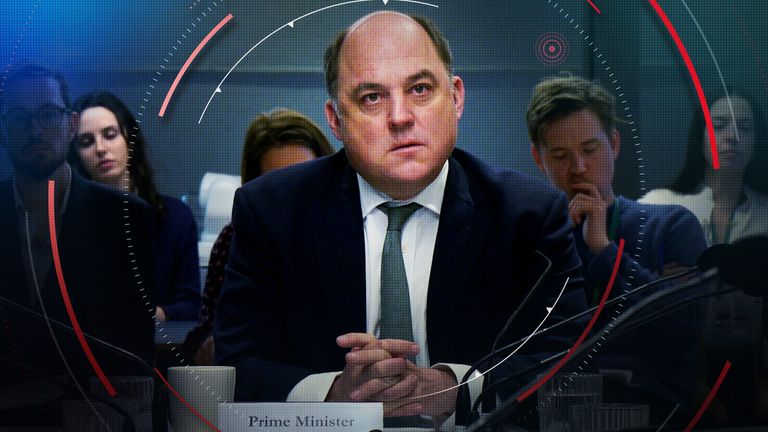
Is the UK prepared to fight a war?
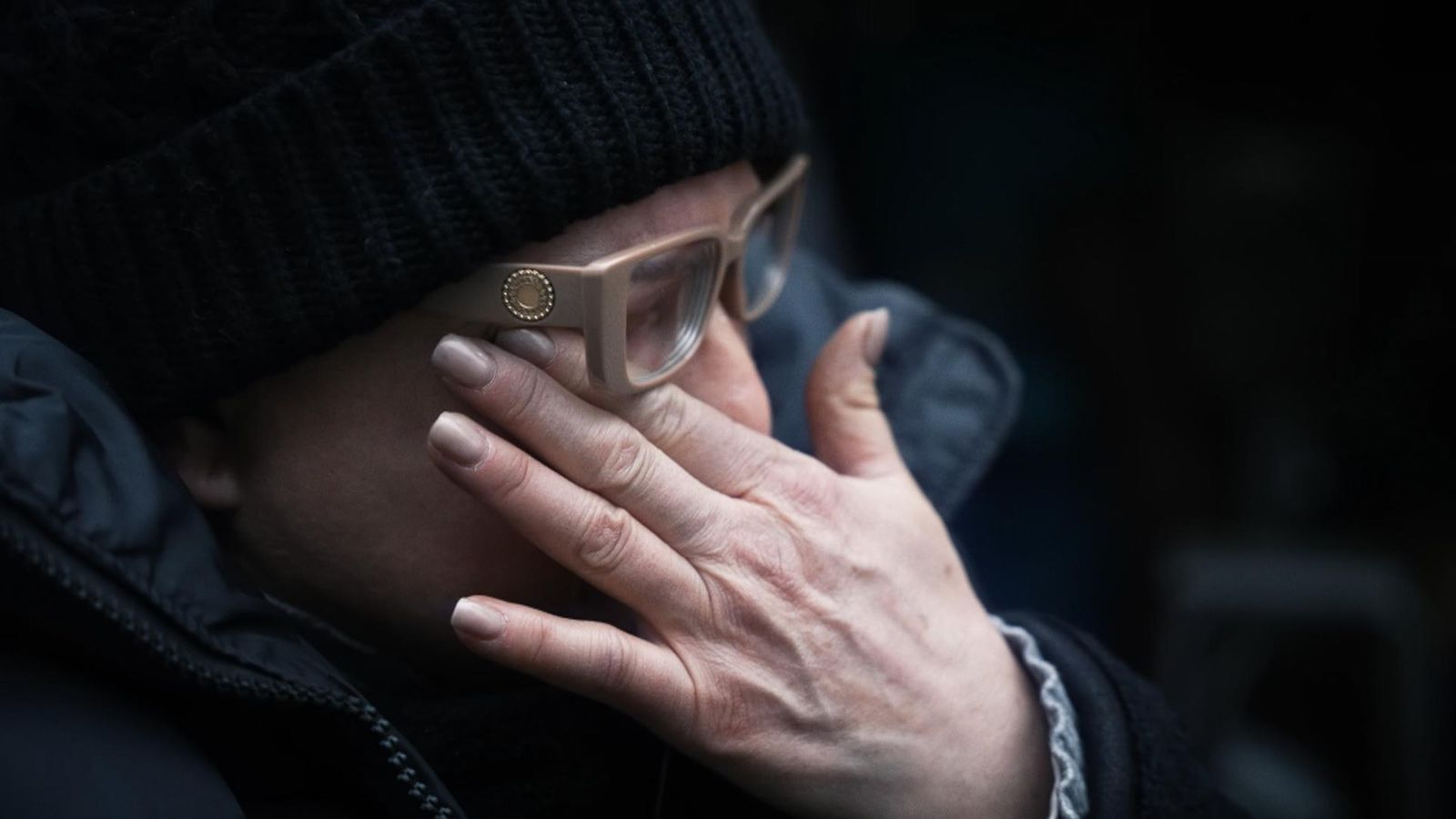
Asked how she felt about what the war had done to her city, Ella’s voice wobbled and she wiped tears from her eyes.
“We keep it all inside, but it still hurts. It’s frightening and painful. I just want things as they used to be. We don’t want anything here to change,” she said.
As for what she would do if a future peace deal forced Ukraine to surrender the area, Ella said: “That’s a hard question … I wouldn’t stay. I’d leave.”
Production by security and defence producer Katy Scholes, Ukraine producer Azad Safarov, camera operator Mostyn Pryce
This community in Sri Lanka’s Kandy District is a mass of mud and loss.
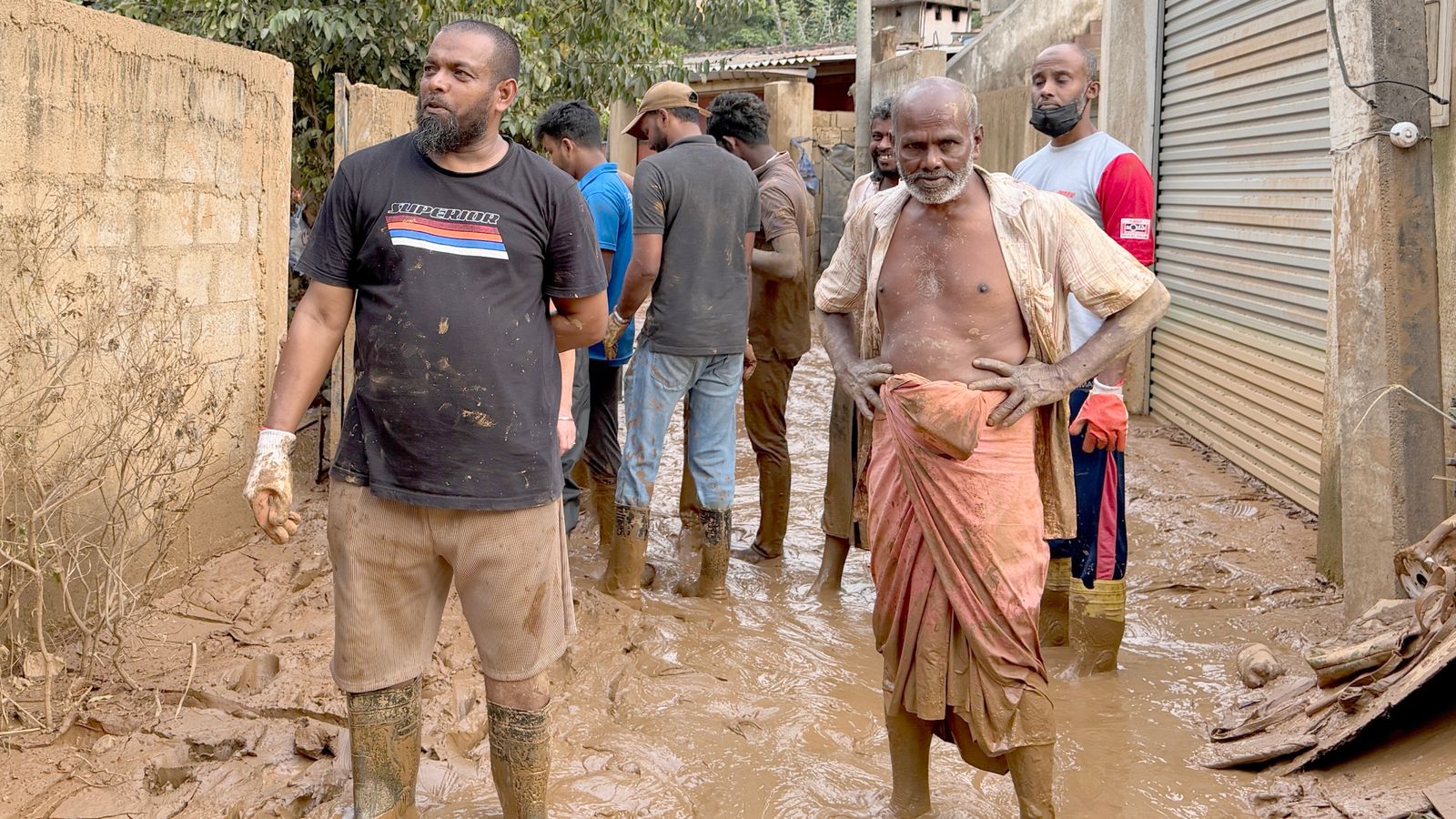
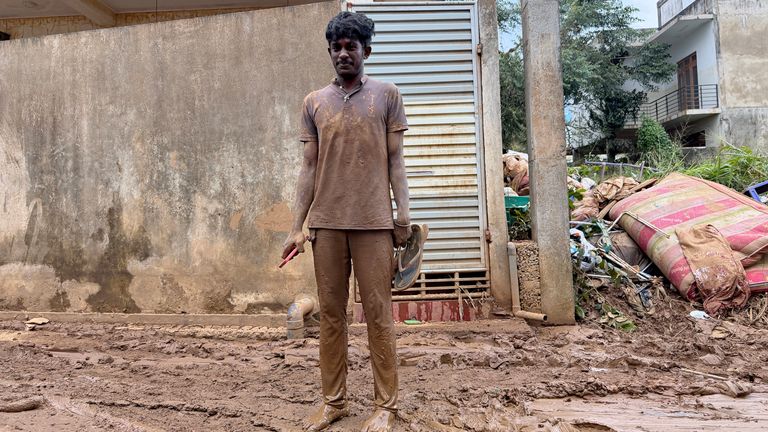
The narrow, filthy streets in Gampola are filled with broken furniture, sodden toys and soiled mattresses. A torrent of floodwater ripped through this neighbourhood and many people had no time to escape.
Trying to reach their now destroyed homes is like wading through treacle – the mud knee-deep.
Many locals say they were not warned about the threat Cyclone Ditwah posed here before it struck last Friday, and weren’t told to evacuate. They say they’ve received very little help since.
Resourceful neighbours were left to try to help rescue survivors. But some had to carry the bodies of the dead, too. Mohamed Fairoos was one of them.
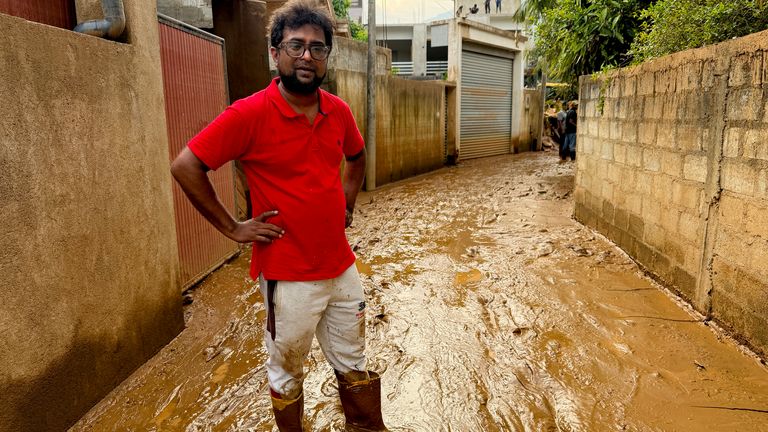
Fairoos Mohamed
“We took five bodies from here,” he says, gesturing to a house full of debris, where mattresses hang drying over the balcony.
“We took nine bodies in total and handed them over to the hospital.” He appears both shocked and exasperated at the lack of support this community received.
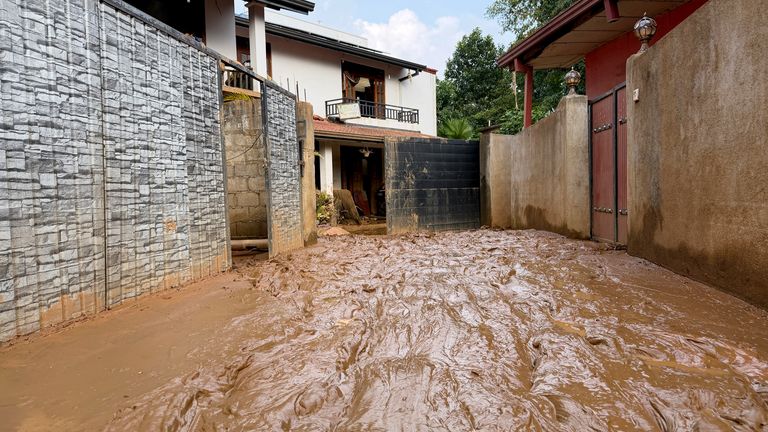
The house where Fairoos pulled the bodies from
“When I took the bodies, the police, the navy, no one sent for us.” He tells me he even posted a video online appealing for boats, hoping it might help.
I ask him if he thinks the government has done enough. “No,” he says forcefully. “No one called for us. No one helped us. No one gave us any boats.”
Read more: Families count the cost of devastating floods
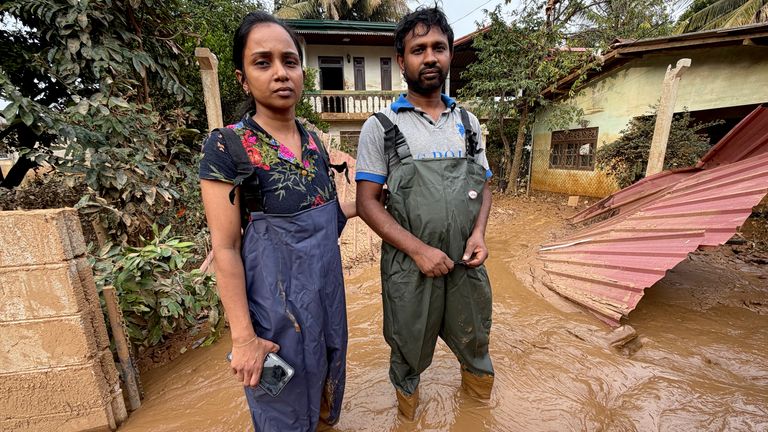
Kumudu Wijekon and her husband Kumar Premachandra
‘Five people were killed here’
Just a few doors down, a group of volunteers have come to clear another home filled with floodwater. “Five people were killed here,” one of them tells me.
Five of them came from one family: a mother, father, their two daughters and son. Kumudu Wijekon tells me she was friends with them and they’d fled here to a friend’s house, hoping to escape the threat.
“There was heavy rain, but they didn’t think there would be flooding. They left their own home to save themselves from landslides. If they had stayed, they would have survived.”

Chamilaka Dilrukshi
‘We don’t have a single rupee’
A short drive away, Chamilaka Dilrukshi is sobbing inside the photography studio she shares with her husband Ananda. They have two children aged four and 11.
Chamilaka is clutching a bag of rice – she says it’s been donated by a friend and it’s all they have to eat.
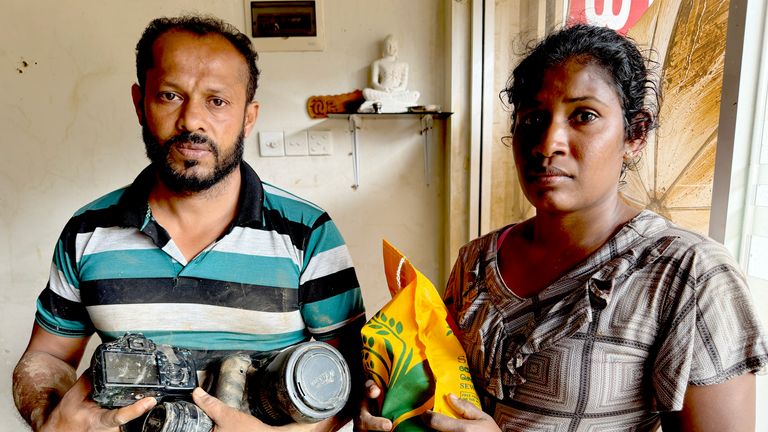
Ananda Wijebandara and his wife Chamilaka Dilrukshi
Everything in the shop is wrecked – expensive cameras and lighting equipment covered in thick layers of mud, and outside, rows of broken frames and ripped pictures.
They think they’ve lost nearly £2,500 and their home is severely damaged. She weeps as she tells us: “We don’t have a single rupee to start our business again. We spent all of our savings on trying to build our house.”
Like Mohamed, she believed they should have been warned. “We didn’t know anything. If we did, we would have taken our cameras and our computers out. We just didn’t know it was coming.”
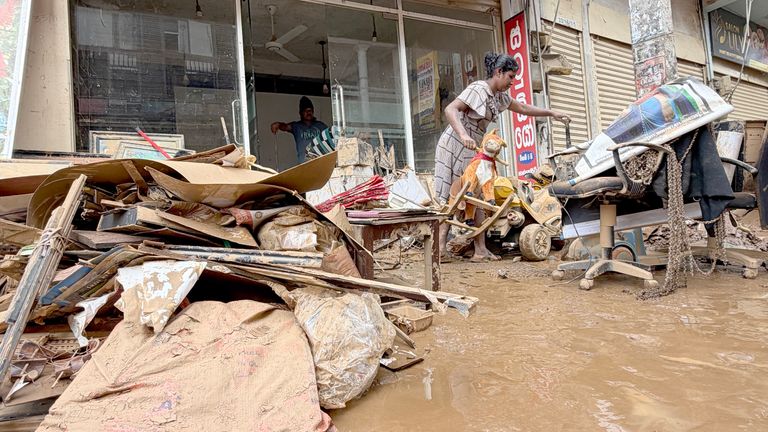
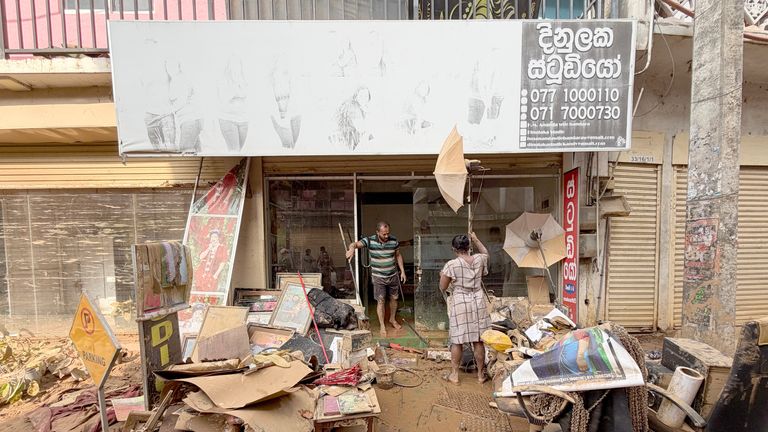
The studio was caked in mud
Anger at government’s perceived failings
Sri Lankan president Anura Kumara Dissanayake has declared a state of emergency to deal with the aftermath of the cyclone, and international aid has arrived.
But many people are angry at the government’s perceived failings. It’s been criticised for not taking the warnings from meteorologists seriously two weeks before the cyclone made landfall, as well as for not communicating enough messages in the Tamil language.
It is going to take places like Gampola a long time to rebuild, repair and restore trust. And in a country still recovering from an economic collapse, nothing is guaranteed.
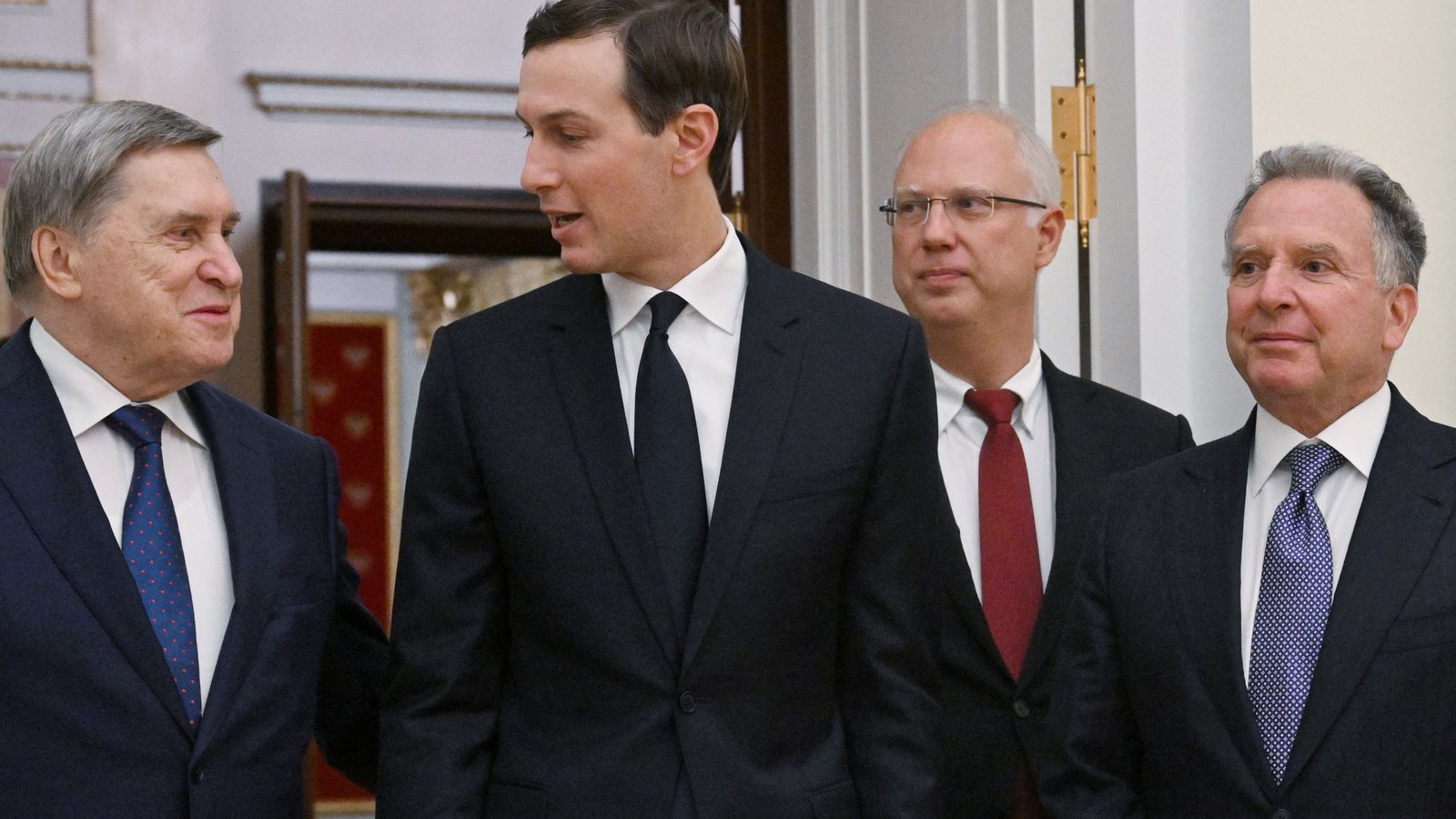
The Americans were given the full VIP treatment on their visit to Moscow.
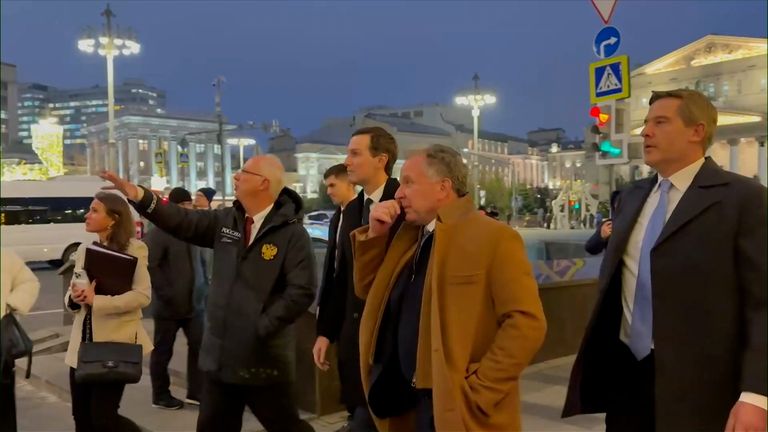
There was a motorcade from the airport, lunch at a Michelin-starred restaurant, and even a stroll around Red Square.
It felt like Steve Witkoff and Jared Kushner were on more of a tourist trail than the path to peace.
Trump’s envoys walk around Moscow
They finally got down to business in the Kremlin more than six hours after arriving in Russia. And by that point, it was already clear that the one thing they had come to Moscow for wasn’t on offer: Russia’s agreement to their latest peace plan.
According to Vladimir Putin, it’s all Europe’s fault. While his guests were having lunch, he was busy accusing Ukraine’s allies of blocking the peace process by imposing demands that are unacceptable to Russia.
The Europeans, of course, would say it’s the other way round.
But where there was hostility to Europe, only hospitality to the Americans – part of Russia’s strategy to distance the US from its NATO allies, and bring them back to Moscow’s side.
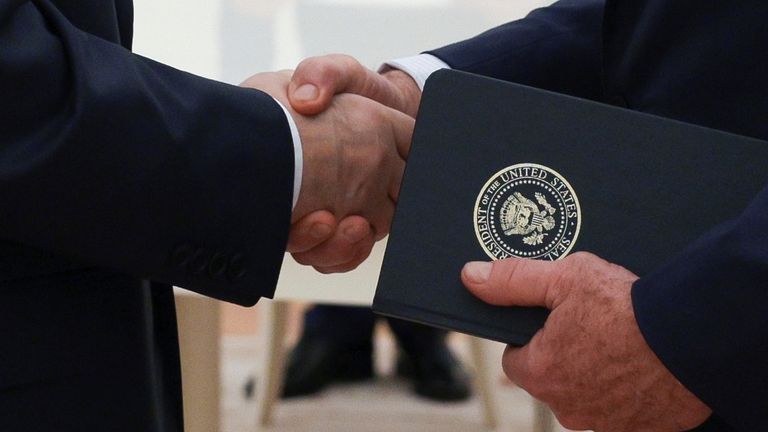
Vladimir Putin and Steve Witkoff shaking hands in August. AP file pic
Putin thinks he’s winning…
Russia wants to return to the 28-point plan that caved in to its demands. And it believes it has the right to because of what’s happening on the battlefield.
It’s no coincidence that on the eve of the US delegation’s visit to Moscow, Russia announced the apparent capture of Pokrovsk, a key strategic target in the Donetsk region.
It was a message designed to assert Russian dominance, and by extension, reinforce its demands rather than dilute them.
Read more:
Michael Clarke answers your Ukraine war questions
‘Thousands’ of Westerners applying to live in Russia
‘Everyone must be on this side of peace’
…and believes US-Russian interests are aligned
The other reason I think Vladimir Putin doesn’t feel the need to compromise is because he believes Moscow and Washington want the same thing: closer US-Russia relations, which can only come after the war is over.
It’s easy to see why. Time and again in this process, the US has defaulted to a position that favours Moscow. The way these negotiations are being conducted is merely the latest example.
With Kyiv, the Americans force the Ukrainians to come to them – first in Geneva, then Florida.
As for Moscow, it’s the other way around. Witkoff is happy to make the long overnight journey, and then endure the long wait ahead of any audience with Putin.
It all gives the impression that when it comes to Russia, the US prefers to placate rather than pressure.
According to the Kremlin, both Russia and the US have agreed not to disclose the details of yesterday’s talks in Moscow.
I doubt Volodymyr Zelenskyy is filled with hope.
-
 Sports2 years ago
Story injured on diving stop, exits Red Sox game
-
 Sports3 years ago
‘Storybook stuff’: Inside the night Bryce Harper sent the Phillies to the World Series
-
 Sports2 years ago
Game 1 of WS least-watched in recorded history
-
 Sports3 years ago
Button battles heat exhaustion in NASCAR debut
-
 Sports3 years ago
MLB Rank 2023: Ranking baseball’s top 100 players
-
Sports4 years ago
Team Europe easily wins 4th straight Laver Cup
-
 Environment3 years ago
Japan and South Korea have a lot at stake in a free and open South China Sea
-
 Environment1 year ago
Here are the best electric bikes you can buy at every price level in October 2024