Brooks vs. Bryson: The full history of the feud
More Videos
Published
4 years agoon
By
adminIn 2004, when Ryder Cup captain Hal Sutton paired Phil Mickelson and Tiger Woods together at Oakland Hills, it was considered bold.
Not because it was the No. 2- and No. 4-ranked players in the world playing together in one group, but because Mickelson and Woods had a rivalry that was considered unfriendly. The two didn’t say as much publicly, but it was known that they weren’t sharing bottles of wine or comparing calves off the course.
They were partners in two sessions and came away with zero points.
In hindsight, that rivalry now seems benign compared to what current Ryder Cup captain Steve Stricker is dealing with when it comes to the feud between Bryson DeChambeau and Brooks Koepka.
The fact that Mickelson and Woods were paired together at all shows how much more animosity there is between DeChambeau and Koepka, who have said we shouldn’t expect the two to play together at Whistling Straits. Koepka went as far to say that they won’t be hanging out at night or high-fiving after any victories, either.
They both agreed to put the feud aside for the week for the good of the team to try to help the United States to victory over Europe. But even that required a conversation with Stricker and the latter having to act like a parent warning their young children that if they act up in front of company, they’ll be grounded.
Whether we’ll actually see them put the beef aside, or if we’ll see two kids sent to their rooms yelling “He started it,” isn’t the point. It’s that it has gotten to a level that it needs to be addressed and the two will be forced to be civil in what is supposed to be the game’s greatest team event.
Even outside of the Ryder Cup, the clash has taken on such a wave of momentum that PGA Tour commissioner Jay Monahan announced a new rule geared toward fans yelling, “Brooksy” at DeChambeau during tournaments. Violations could get fans tossed from events.
How did it get to this point? What started this back-and-forth and why has it escalated to the point that the adults in the room had to step in to stop it?
It started with slow play
Before this all moved to social media, Koepka made a comment in January 2019 about slow play at the Dubai Desert Classic.
He didn’t mention DeChambeau by name, but at the time, DeChambeau was at the center of conversation for his methodical approach to each shot.
“I just don’t understand how it takes a minute and 20 seconds, a minute and 15 to hit a golf ball; it’s not that hard,” Koepka said at the time. “It’s always between two clubs. There’s a miss short, there’s a miss long. It really drives me nuts especially when it’s a long hitter because you know you’ve got two other guys or at least one guy that’s hitting before you, so you can do all your calculations, you should have your numbers.”
DeChambeau was asked about it, but responded subtly that a lot goes into a shot and there’s a lot of calculating he’s doing in 45 seconds.
Fast forward to August at the Northern Trust, when a video of DeChambeau taking more than three minutes to hit a 70-yard shot went viral.
anyone need a nap?
here’s DeChambeau pacing off a 70-yard shot which took over 3 minutes to hit (couldn’t post the entire video it took so long) pic.twitter.com/7A3Azeftyu
— Eric Patterson (@EPatGolf) August 9, 2019
Another video went viral that week, showing DeChambeau taking more than two minutes to read an 8-foot putt on the eighth hole. The video showed playing partners Justin Thomas and Tommy Fleetwood visibly bored by the amount of time it was taking to read the putt, only to watch DeChambeau miss the birdie try and tap in for par.
It was hard to! ⏰
— Justin Thomas (@JustinThomas34) August 10, 2019
Other players, including Luke Donald, Rich Beem, Joel Dahmen, Eddie Pepperell and Ian Poulter, criticized the video on social media and were vocal that the tour needed to step in and do something about the pace of play.
And after all that miss read it by 2 cups 🤦🏼♂️
— Luke Donald (@LukeDonald) August 10, 2019
Just look at Tommy and Justin, both looking completely bored. Slow players do this to their playing partners making the game less enjoyable. Problem is, the unaffected single minded twit in this instance, doesn’t care much for others.
— Eddie Pepperell (@PepperellEddie) August 10, 2019
That, of course, caused DeChambeau to go on the defensive and talk about the criticism he has received. He believed it was unfair and pointed to different factors throughout a round that can contribute to slow play.
DeChambeau also noted that there were other players who were also habitually slow and that when people start talking about his slow play and how he is killing the game, it was unfounded criticism.
“Sure, Eddie Pepperell, not fair to say. I would love to speak to him personally and talk about it, because I played with him, actually, at WGC-Mexico. We can talk about that time that we played it in,” DeChambeau said at the time. “When you start personally attacking people on Twitter, it’s like, come on, dude. Let’s have some more, I was going to say something else, but let’s have some more balls and speak to me to my face about that.”
Koepka didn’t say anything more publicly about DeChambeau at the time, so whether or not there was something said behind the scenes or that made its way to DeChambeau through other channels, it’s unknown.
Something caused DeChambeau to confront Koepka’s caddie, Ricky Elliott, on the practice green. He told Elliott that if Koepka has something to say about his slow play, he should say it to his face.
Was standing on the putting green with Koepka’s caddie earlier when an irritated Bryson DeChambeau walked up & told him to tell his boss to make any comment about slow play “to my face”. Brooks arrived soon after, got the message & ambled over for a chat with the scientist.
— Eamon Lynch (@eamonlynch) August 11, 2019
Koepka said he found that ironic that DeChambeau didn’t go to his face to say it, but rather through his caddie, but he did not immediately go on the offensive. The two seemed to have worked something out at the time and had a private conversation on Sunday of the tournament about the brewing feud.
DeChambeau felt as though he was singled out by Koepka in his comments earlier in the year and that had snowballed into heavier criticism from multiple angles.
“It’s not just him. I know he feels singled out, especially when I’m speaking about it,” Koepka said at the time. “But it’s like I told him, I’ve mentioned his name once, and that’s it. There’s so many guys out here where it’s become an issue, and obviously him being probably the best player that’s relatively slow right now, he’s going to be on TV a lot more, so you’re going to catch a lot more of those type of instances.”
DeChambeau acknowledged the conversation and said it was productive. That the two talked about what Koepka had said and it was explained that it was a generalized comment, not meant to just single out DeChambeau or one person.
That conversation led to both golfers agreeing they should keep their comments internal, that they shouldn’t go public with criticism and should try to keep any disagreements or verbal spats in house.
“It was great. I said, ‘I think we got to start internally so we don’t have these issues come out in public and it creates a bad image for the PGA Tour,” DeChambeau said. “We never want that. So, it was great. We had a great conversation, and have a new level of respect for him.”
That conversation seemed to squash any potential issues that could move forward and they both even appeared on SiriusXM radio together with Pat Perez and Michael Collins, where DeChambeau admitted to his slow play on the greens. There was even some jovial banter between the two with DeChambeau saying Koepka would win in a fight and that, “He’d kick my ass.”
Problem solved, right? Nope.
It’s all about The Body
In January 2020, Koepka appeared in ESPN The Magazine’s The Body Issue with other athletes showing off their physique.
DeChambeau either didn’t know how livestreaming works or didn’t care, because he criticized Koepka’s body while livestreaming himself playing a video game on Twitch.
“I don’t know if his genetics even make him look good, to be honest,” DeChambeau said on video. “That Body Issue, he didn’t have any abs, I can tell you that. I got some abs.”
Bryson goes after Brooks’ physique!! pic.twitter.com/NSugaoCs1h
— Eric Patterson (@EPatGolf) January 15, 2020
That went against what Koepka and DeChambeau had agreed upon previously, to keep any issues in-house and not make any statements public, so the choice of words was strange, to say the least. Especially given that on the platform, a video can be recorded and shared on social media.
Koepka responded.
You were right @b_dechambeau I am 2 short of a 6 pack! pic.twitter.com/aCJ1jimId6
— Brooks Koepka (@BKoepka) January 16, 2020
That seemed like a light-hearted jab back at DeChambeau. Maybe DeChambeau’s criticism was made in jest, as well, but either way, we didn’t see much public bickering until July 2020, at the Rocket Mortgage Classic in Detroit.
The tour had just returned from its pandemic shutdown and DeChambeau was featuring his new, bulked-up body and distance off the tee. He had everyone noticing how far he was hitting the ball, but some questioning how he gained so much weight so quickly.
DeChambeau had a confrontation with a cameraman during the tournament after hitting the sand in anger in a bunker. He felt the cameraman was focusing too much on him for too long to capture his outburst. The two had a conversation.
Koepka, who was not playing in the tournament, took notice.
— Brooks Koepka (@BKoepka) July 7, 2020
Later in the month, at the WGC-FedEx St. Jude Invitational, DeChambeau hit an errant tee shot near a tree and on top of a stick on the seventh hole. He called over a rules official to see if he could get relief because he believed his ball was resting on an anthill.
He was hoping for relief under the dangerous animal condition, by saying his ball was on a fire ant nest and the fire ants were potentially dangerous. Dangerous to what or whom, who knows.
He was not given relief.
During the second round of the tournament, Koepka hit a tee shot out to the left, in the rough near some trees, and joked to his caddie that he saw an ant. The discussion was picked up by cameras and microphones and, of course, went viral.
No matter how @BKoepka plays this weekend, we’ll always have this. pic.twitter.com/uxGKT9Xr2Y
— Skratch (@Skratch) July 31, 2020
Koepka didn’t mention DeChambeau by name in the steroid tweet or his ant remark, but it can be surmised they were aimed at DeChambeau. Similar to his comment at the PGA Championship about his successful play.
He told a reporter in an interview that there’s no reason to be scientific with the numbers, that he’ll just go out and play. That might not have been targeted, but DeChambeau’s nickname is the Mad Scientist.
“I am playing so good…”
Brooks Koepka is one shot off the clubhouse lead after another impressive PGA Championship round
📺 Watch the #PGAChamp now on Sky Sports Golf or follow here: https://t.co/lCwOOLXYf1 pic.twitter.com/H4XI9yJTOt
— Sky Sports Golf (@SkySportsGolf) August 6, 2020
Things seemed to cool down for a while. Koepka complimented DeChambeau before the Masters in November 2020. DeChambeau was contemplating using a 48-inch driver for the tournament and Koepka said that length is always an advantage and that DeChambeau has done a good job working to hit the ball as far as he does.
One eye roll changes everything
The feud fizzled for a few months then went straight to a rolling boil in May when Koepka was being interviewed by Golf Channel’s Todd Lewis after his second round at the PGA Championship.
Koepka answered a question as the sound of DeChambeau’s spikes clanking against the cement get within Koepka’s earshot. He lost his train of thought, rolled his eyes and cussed on camera, saying, “I lost my train of thought, yeah, hearing that bulls—.”
Lewis tells Koepka they’re going to have fun with that blooper and Koepka said he wouldn’t care if it was released. Naturally, it was leaked by someone and went viral in no time.
DeChambeau saw the video and commented on an Instagram account that posted the incident, saying, “You know you can fix spike marks now.” He was seemingly referring to the metal spikes he was wearing while walking through the video.
What came next was a flurry of shots on social media as DeChambeau prepared to play in The Match, partnering with Green Bay Packers quarterback Aaron Rodgers against Tom Brady and Phil Mickelson.
When the teams and event were announced, Koepka first tweeted at Rodgers about playing with DeChambeau.
Sorry bro @AaronRodgers12
— Brooks Koepka (@BKoepka) May 26, 2021
Of course, DeChambeau had something to say.
@BKoepka It’s nice to be living rent free in your head!
— Bryson DeChambeau (@b_dechambeau) May 26, 2021
Koepka then replied again with a video of DeChambeau hitting a tee shot while a fan calls him “Brooksy.” In the video, DeChambeau is seen saying, “Whoever is calling me Brooksy needs to get out of here.” Koepka noticed.
— Brooks Koepka (@BKoepka) May 26, 2021
The initial tweet from Koepka has more than 110,000 likes. DeChambeau’s reply back has more than 28,000. Koepka’s video reply has more 46,000 likes, showing the reach of the feud online.
Trying to offer some levity, Justin Thomas replied with a GIF of Bill Hader eating popcorn while nodding his head yes. Thomas was all of us that day.
— Justin Thomas (@JustinThomas34) May 26, 2021
Mickelson tweeted at DeChambeau and Koepka, saying he felt like he was in the middle of something and should step aside. But with Phil being Phil, he added more fuel to the fire on his way out.
The fans have their say
That video tweeted by Koepka escalated the number of fans yelling “Brooksy” at DeChambeau.
It got to the point where three fans were tossed from the Memorial Tournament in June for shouting “Brooksy.” At the time, DeChambeau tried to play it off as best he could and said the chants weren’t impacting him and that the yells were flattering.
He tried his best to make it seem like it wasn’t a bother, but it didn’t stop the fans from doing it.
What probably made it even worse was that Koepka, who wasn’t playing in The Memorial, partnered with Michelob Ultra to give free beer to any fan removed from the tournament.
He started the video by saying, “What’s up guys, it’s Brooksy,” then went on to thank the fans for showing their support by yelling his name.
Capping off a long day with @MichelobULTRA! Thanks for all the support today. Also, we’ve got something for you… pic.twitter.com/kwtwXg3Kqb
— Brooks Koepka (@BKoepka) June 4, 2021
DeChambeau acknowledged that he saw the video giving away free beer and tried to turn it into a positive.
“I’m happy that there’s more conversation about me, because of the PIP fund,” he said at the time.
The PIP fund is the player impact program that will split a $40 million pot between the 10 golfers that receive the highest-impact score based on social media presence and engagements. So, more mentions equals a bigger opportunity for DeChambeau to get some of that $40 million.
As the feud continued to grow, more yells of “Brooksy” happened at events. Reporters started asking if it had gotten out of hand and if it was actually bad for the game.
Koepka was asked about the feud and the leaked video from his Golf Channel interview. He responded by saying he doesn’t regret anything and that he is OK with everything that he had done up to that point.
“I think it’s good for the game. I really do,” Koepka said. “The fact that golf’s on pretty much every news outlet for about two weeks pretty consistently, I think that’s a good thing. It’s growing the game.”
Growing the game or not, it was becoming bigger than it ever had been. With the Ryder Cup approaching and the idea of the two playing on a team together, Steve Stricker went from an observer to a captain who needed to ensure his players wouldn’t let it be a distraction during the event.
“Yeah, it’s not making my job any easier, you know,” Stricker said in June. “I haven’t talked to either one of them. I will have to at some point. We’ll see where it goes from there. Hopefully, they can put their differences aside for the week, be big boys and come together as a team.”
That month, at the Palmetto Championship, Koepka addressed the idea that it could negatively impact the team.
“I mean, there’s only eight guys that are playing, four guys are sitting, whatever,” He said. “I mean, I play with one other guy. I don’t understand, if let’s say I don’t play with Bryson or Bryson doesn’t play with me, he takes care of his match, and I would take care of my match, and I don’t know how that has any effect. What you do off the golf course doesn’t have any effect on the golf course.”
No regret here
A week later, at the U.S. Open on June 17, DeChambeau saw an opportunity as Koepka was once again being interviewed by Golf Channel. The interview was set up higher than the walkway where players were going by.
DeChambeau saw the cameras and jumped in the air, waving his arms, to video-bomb Koepka’s interview in more of a quiet fashion.
This is so great…check it out @NoLayingUp #golf #brooksie #golfpodcast pic.twitter.com/yv6xsmmoED
— The Divot Room (@DivotRoom) June 18, 2021
Koepka didn’t notice it live and didn’t acknowledge whether he saw it afterward, either.
But Koepka was asked about the genesis of the feud. He went back to the time DeChambeau approached Elliott and told him if DeChambeau has something to say, that he should say it to his face.
“We both agreed we’d leave each other out of it and wouldn’t mention each other, just kind of let it die off, wouldn’t mention each other’s names, just go about it,” Koepka said. “So, then he decided, I guess he was going on that little, whatever, playing video games online or whatever, and brought my name up and said a few things, so now it’s fair game.”
He was referencing the fact that DeChambeau took a shot at him on his livestream and made it as public as can be, rather than keeping it in-house. Oddly enough, DeChambeau said in July that he didn’t remember what was said in the conversation.
“We just had a conversation that I really don’t know what happened, because we haven’t really bantered back and forth until now,” DeChambeau said. “So, it’s like, why is this happening now?”
At the time of the conversation, DeChambeau had praised Koepka for talking and working things out. He might not remember the context of the conversation, but previously acknowledging that it took place and what the conversation was about made it seem as though he was on the same page as Koepka at the time.
Regardless of whether he remembered the conversation, the feud had gone full-tilt and was as public as it has ever been.
Koepka digs in on social media
In the beginning of July, DeChambeau parted ways with caddie Tim Tucker before the Rocket Mortgage Classic in Detroit. Koepka took the opportunity to again throw shade and tweeted out his support for his own caddie the same day.
Couldn’t do it without my guy Rick! Best friend and greatest caddie to do it💯 @RickyElliott appreciation day! pic.twitter.com/cNvD2VX8Nh
— Brooks Koepka (@BKoepka) July 1, 2021
DeChambeau was introspective in a media session, telling reporters that he never wanted to be famous growing up. He just wanted to be a golfer. He said he’s human, so naturally he is impacted by things that are said and situations he has been in.
He acknowledged that he hasn’t approached certain situations in the past the best way and that he didn’t set out for this feud to grow into what it is.
“I’m somebody that doesn’t necessarily like controversy. I just like doing my own thing,” he said. “Do I like showcasing something unique and different? Yeah, but I guess what comes with that is controversy, and I guess that’s something that I don’t necessarily deal the best with sometimes.”
That didn’t stop Koepka, though.
On Thursday at The Open, DeChambeau said his driver sucked in an interview after having a poor performance off the tee. He blamed it on the build of the club itself and the physics in how companies create driver heads, instead of his swing.
Koepka pounced on another opportunity.
Brooks Koepka: “I love my driver” 😂 This is content, folks.
Please, we need Brooks vs. Bryson Dechambeau for The Match 5.#TheOpen pic.twitter.com/EzGjQSEdTt
— Cam Rogers (@MrRogers99) July 16, 2021
It’s not just the fact the Koepka says it. It’s the fact that he says it with a smile that shows you how much he’s enjoying taking shots, whether on television or on social media.
Driving into the weekend! pic.twitter.com/poSQG0mrvC
— Brooks Koepka (@BKoepka) July 16, 2021
At that point, the clash had become somewhat one-sided in the public eye, with Koepka encouraging fans yelling his name at tournaments, tweeting jabs and saying whatever he wanted in interviews.
The captain steps in
Despite the fact that there hadn’t been much back and forth for a while, the Ryder Cup became a bigger point of emphasis in August. Would the two be able to be on the same team? Would they bicker the week of the Ryder Cup? Would it hurt the team chemistry?
Stricker had a conversation with both players and came away assured that the two would be able to quash the beef for the week and that it wouldn’t be a distraction.
“They said it’s not going to be an issue, and I believe them,” Stricker said. “I trust them. As far as I’m concerned, it’s been put to bed.”
Koepka acknowledged the conversation and said he’s willing to put it aside. DeChambeau has refused post-round interviews since before the Olympics, so he hasn’t given his perspective on the feud and the Ryder Cup. But Stricker has said both are on board.
All was well until three days later at the BMW Championship. After a 6-hole playoff, in which DeChambeau lost to Patrick Cantlay, a fan said “Great job, Brooksy,” as DeChambeau was walking toward the clubhouse.
According to ESPN’s Kevin Van Valkenburg, who witnessed the incident, DeChambeau spun around and yelled, “You know what? Get the f— out,” at the fan.
Van Valkenburg said DeChambeau had been dealing with the taunts all week and weathered the storm until that moment.
While Koepka may have agreed to pause the feud, his fans had not.
That moment caused the PGA Tour to get involved, creating a rule that will expel fans for yelling “Brooksy” at DeChambeau.
Now comes the actual Ryder Cup, with the two on the same team as the U.S. tries to bounce back from a rout three years ago in Paris at the hands of the European team. Will these two players on the same team hurt the team? Will fans at Whistling Straits be divided — not by U.S. vs. Europe but by Koepka vs. DeChambeau? Stricker believes he has the players on the same page.
It’s time see if the rivalry takes a break or another chapter of the feud is required.
You may like
Sports
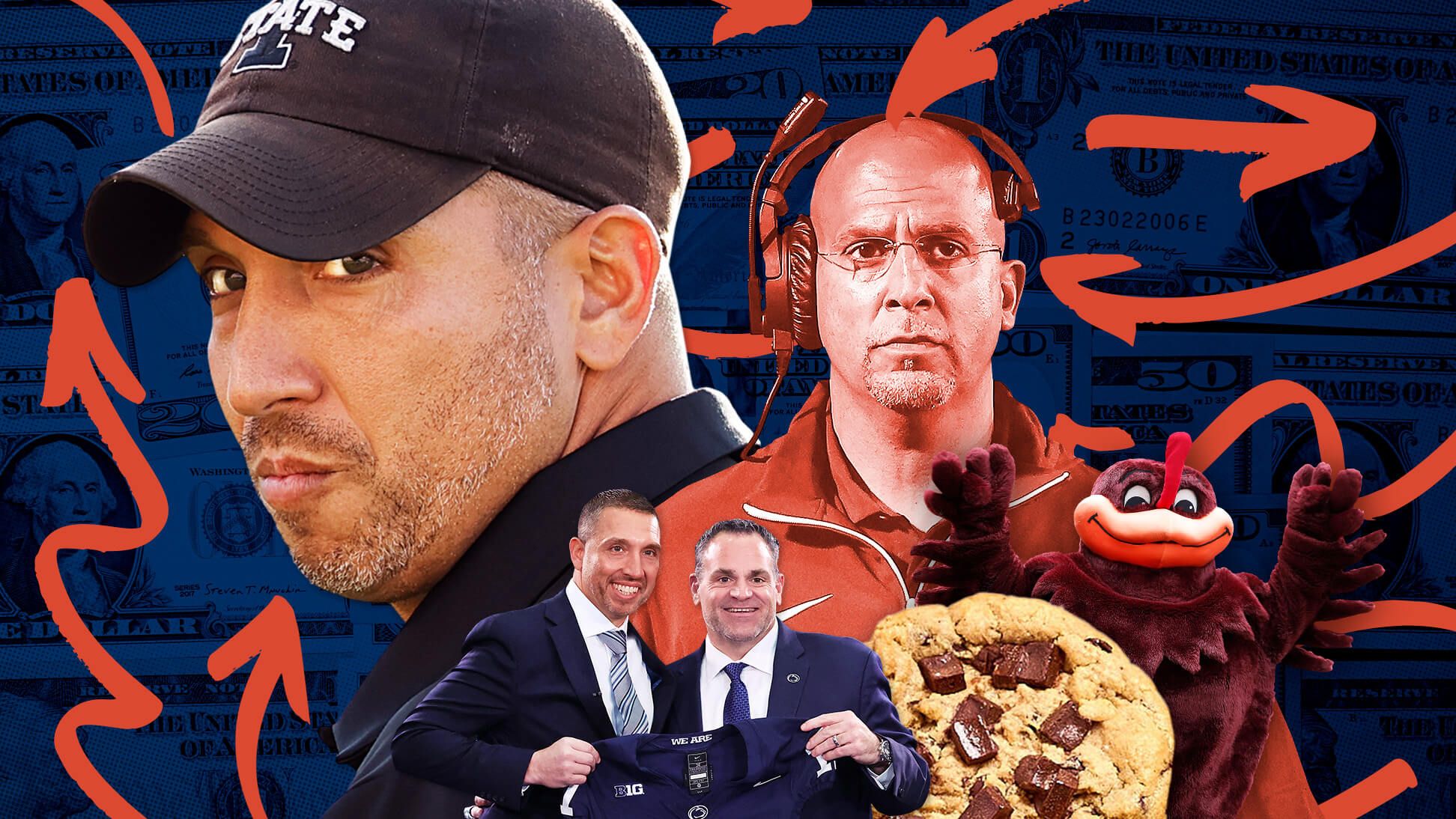
‘Probably will be a Netflix documentary’: Inside the twists and turns of Penn State’s 58-day coaching search
Published
3 hours agoon
December 24, 2025By
admin

EQUAL PARTS HAPPY and relieved, Penn State athletic director Pat Kraft sat at the interview table inside the media room at Beaver Stadium with new coach Matt Campbell to his right.
After 58 days, Penn State had completed its coaching search with a selection who was both exciting and sensible, someone who seemingly could have been sitting with Kraft a lot sooner.
Campbell, only 46 years old, had become Iowa State’s all-time coaching wins leader and elevated the ISU program to historic consistency. Plus, he needed no introduction to Penn State and its tradition, having spent much of his childhood following Nittany Lions football while visiting his grandparents in Carmichaels, Pennsylvania.
Campbell’s hiring drew instant praise. But everyone wondered the same thing: What took so long?
“We didn’t really have a timeline, I mean that,” Kraft said. “We were focused on finding the right person, and at all costs.”
He paused.
“There probably will be a Netflix documentary at some point.”
Penn State’s was the first top-tier coaching job to open during a cycle that included 15 Power 4 hirings, but, until the Sherrone Moore scandal broke at Michigan, it was the very last to be filled. The search lasted so long that James Franklin, the coach Penn State abruptly fired after 12-plus seasons and 104 wins, found his next job at Virginia Tech three full weeks before Campbell was introduced in State College.
The 58-day saga included tens of millions in contract extension money for potential external candidates, a recruiting class that in large part followed Franklin to Blacksburg, the leaking of a secret audio recording of Kraft airing grievances, and the CEO of Crumbl cookies taking an interest.
ESPN spoke with sources in and around the Penn State search to assess what happened behind the scenes and why two sides seemingly meant for one another took so long to come together.
PENN STATE’S DECISION to fire Franklin on Oct. 12 rattled the college football world. Only 277 days earlier, Franklin had coached Penn State in the College Football Playoff semifinal at the Orange Bowl, which the Nittany Lions led midway through the fourth quarter before falling 27-24 to Notre Dame.
Quarterback Drew Allar and many of Penn State’s top players had returned. The team made significant investments in the roster and the coaching staff, where Franklin plucked defensive coordinator Jim Knowles from national champion Ohio State. Penn State debuted at No. 2 in the AP Top 25, its highest preseason ranking in 28 years. But the team looked sluggish in nonconference play against non-Power 4 opponents Nevada, Florida International and Villanova.
After a heartbreaking overtime loss to Oregon at home, losses to winless UCLA and unranked Northwestern followed.
“Things really progressed poorly this year,” a source familiar with the search said. “Didn’t feel like they were going to get better within this year, and then didn’t feel great about the future.”
Franklin went 4-21 at Penn State against AP top-10 opponents, including 1-18 against Big Ten teams in the top 10. At a news conference on the day after firing Franklin, Kraft made it clear that Penn State needed to start winning the biggest games more often, including the ones that would secure the school’s first national championship since 1986.
“Football is our backbone,” Kraft said. “We have invested at the highest level. With that comes high expectations. Ultimately, I believe a new leader can help us win a national championship, and now is the right time for this change.”
In a meeting between Kraft and a group of Penn State team leaders after the firing, the contents of which later leaked in the final days of the search, the fourth-year athletic director acknowledged the stakes he was staring down.
“If I don’t get this right, my career is over,” Kraft said. “Understand that: If I don’t hire the right person, my career is over. So it’s very serious to me. This isn’t, like, what people just think. You all are going to graduate and move on. If I don’t find the right person, in two years, they will fire my ass and I don’t get another AD job.
“‘How could you f— up Penn State?'” he added rhetorically.
Kraft entered a market that wasn’t overflowing with obtainable candidates. Although Penn State was the first top-tier program to fire its coach, Florida fired Billy Napier the following week and LSU capped off the month by dumping Brian Kelly. This created competition among the blue bloods for top coaches.
“They figured, ‘Hey, we’ll get a good one, even though the market sucks and everybody else is in,'” an industry source said. “I don’t think they anticipated Missouri, Vandy, Indiana, Nebraska, SMU — everybody ponied up to keep their coaches, and that they couldn’t get one of these guys. It was always going to be a bad market to hire a football coach this year.
“There’s just not that many out there that are movable, and there’s too many open jobs.”
Penn State led its own search but contracted a firm to help handle elements such as candidate communication and background checks.
The initial speculation around Penn State centered on two coaches: Nebraska’s Matt Rhule and Indiana’s Curt Cignetti. Rhule played at Penn State and grew up in State College. He and Kraft were close from their time together at Temple, where Kraft served as deputy athletic director and then AD during Rhule’s tenure as Owls head coach. Cignetti had no direct connection to Penn State but was born in Pittsburgh, later worked at Temple and Pitt, and secured his first head coaching job at Indiana University of Pennsylvania.
Barely 96 hours after Penn State fired Franklin, Cignetti and Indiana agreed to a new eight-year contract that would pay him $11.6 million annually. His would be the first of several new and enhanced contracts secured by coaches connected to the Penn State search.
Rhule’s deal arrived at the end of October, and by then Penn State’s focus had already shifted. Although Rhule was evaluated by Penn State, sources connected to Penn State said his candidacy became amplified more in the media than in reality.
Penn State entered the search intending to take some big swings, while recognizing that the chances of landing certain coaches weren’t high. Alabama’s Kalen DeBoer, Notre Dame’s Marcus Freeman and Texas A&M’s Mike Elko all surfaced as potential candidates.
Of the three, Elko seemed like the most realistic. He grew up in New Jersey and played college ball at Penn, before beginning his coaching career in the Northeast.
“The whole time, we thought Elko was going to be the guy,” an SEC coach said. “Then he came off the board.”
Elko kept winning at Texas A&M, a program that, despite no CFP appearances or recent league titles, had the financial clout to ensure it wouldn’t lose a coach over money. By late October, Texas A&M was 8-0 and Elko seemed all but set for an enhanced contract to remain with the Aggies, which he received Nov. 15.
In early December, DeBoer denied having any interest or contact with Penn State about its vacancy.
Penn State “never spent a ton of time on those guys knowing their current situations,” a source with knowledge of the search said.
The school wanted head coaches whose success couldn’t be tied to one quarterback or a single stretch of success. Penn State prioritized those who had shown a sustained ability to recruit and develop talent.
The lengthy search sparked weeks of speculation, as the public focus drifted from DeBoer to Elko to Vanderbilt’s Clark Lea to Louisville’s Jeff Brohm and even to James Madison’s Bob Chesney, the Pennsylvania native in his very first FBS job.
The truth, according to sources familiar with the search, is that two coaches appeared high on Penn State’s wish list from early on: BYU’s Kalani Sitake and Campbell, the Iowa State coach. But initially, Penn State pursued only one.
AT FIRST BLUSH, Sitake and Campbell seem like an odd pairing as contenders for the same A-list job.
Sitake is from Tonga and played fullback at BYU. Other than the 2015 season at Oregon State, he had spent his entire coaching career in the state of Utah at three different programs.
Campbell also had deep roots in a single state, Ohio, where he grew up, finished college at Division III power Mount Union and spent the decade-plus of his coaching career, culminating with his first head coaching opportunity at Toledo. But he also had family in Pennsylvania and had spent most of his life in the same region as Penn State.
Both coaches had led major programs for a decade, and had proved an ability to win across multiple quarterbacks and recruiting classes. Both oversaw balanced teams, built around the line of scrimmage, and were known for outstanding player development. BYU and Iowa State typically don’t sign nationally celebrated recruiting classes, but the teams have combined for 23 NFL draft picks since 2021.
Sitake is one of the most popular coaches in the sport, and Penn State loved his character-driven approach. Although Sitake had no connection to Happy Valley, Penn State felt he could adapt and compile a staff featuring some trusted BYU aides and others with more links to the PSU program and region.
By the end of October and into November, Sitake became Penn State’s focus, while he continued to lead a BYU team in contention for the Big 12 title and a CFP berth. Penn State had conversations with candidates such as Georgia Tech coach Brent Key and Pat Fitzgerald, the longtime Northwestern coach looking to return to the sideline. The school also interviewed interim coach Terry Smith, an assistant throughout Franklin’s tenure and a former PSU player under Joe Paterno.
Smith quickly gained support from current and former players, especially as the team improved under his watch with three straight wins to end the regular season. He was a legitimate candidate, sources close to the search said, and went through the same process as others, but ultimately lacked the FBS head coaching experience Penn State desired.
By late November, the school was locked in on Sitake, whose name had, to that point, not been widely connected to the Penn State job. University president Neeli Bendapudi had involvement in the effort to bring Sitake to Penn State, sources familiar with the search said.
Campbell, meanwhile, had not gained much traction. Despite Penn State’s initial interest, the school had received “some intel that was not accurate” about the ISU coach, a source familiar with the search said. Essentially, Campbell was portrayed as a coach who would struggle with the magnitude of the Penn State job, especially the recruiting and roster-construction elements when targeting higher-profile players who would demand serious money.
An industry insider “basically bad-mouthed Matt, told Pat that he didn’t work the portal well,” said a source familiar with the search. “It dampened Pat’s interest. He got a bad read about Matt from that [person]. That’s why I think he steered in a different direction.”
As the regular season concluded, Sitake was seemingly in line to become the next Nittany Lions coach. The hope was that his name wouldn’t get out publicly, and an agreement could be consummated after the Big 12 championship game.
But Sitake’s name began to leak during the final weekend of the regular season. By Dec. 1, a Monday, reports labeled Sitake as the focus of Penn State’s drawn-out search. BYU’s financial machine, which had activated to obtain top basketball recruit AJ Dybantsa and others, quickly kicked into gear to keep Sitake at his alma mater.
Several prominent BYU donors stepped up, including Jason McGowan, CEO and co-founder of Crumbl, the national cookie bakery chain, who lives in Provo, Utah, near BYU’s stadium. McGowan posted on X, “Some people are not replaceable. Sounds like it is time for me to get off the sidelines and get to work.”
Within 24 hours, BYU announced a new, enhanced long-term contract for Sitake, designed to keep him in Provo for good and compete regularly for the CFP. Penn State seemingly was back to square one.
In an attempt to rub sugar in the wound, a BYU fan sent Kraft a box of Crumbl cookies through DoorDash, while Virginia Tech just happened to serve Crumbl cookies at its first signing day event under Franklin.
JACKSON FORD SIGNED his letter of intent around lunchtime Dec. 3. Then reality set in.
A four-star defensive end at Malvern Prep, a private school 25 miles west of Philadelphia, Ford grew up watching the Nittany Lions. When he sprouted into a Power 4 recruit, Penn State was among the earliest programs to offer. “Dream school — I always wanted to play there,” Ford said.
He committed to the Nittany Lions in June. And while Franklin’s October dismissal came as a surprise, Ford never wavered on his pledge to the program this fall. But, as Ford walked out of his signing ceremony inside the Malvern Prep gymnasium, a flurry of news washed over him.
For at least a few minutes, Ford was officially the last man standing in Penn State’s 2026 class.
“It was kind of nerve-racking,” he told ESPN. “Like, ‘Dang, it’s really just me.'”
As the coaching search dragged on in the weeks before the 2026 early signing period, a once-promising Nittany Lions recruiting class crumbled almost entirely.
Penn State held pledges from 25 recruits within the nation’s 17th-ranked recruiting class in the 2026 cycle at the time of Franklin’s Oct. 12 firing. Among that group were six members of the 2026 ESPN 300, including coveted in-state recruits Kevin Brown (No. 78 overall), Messiah Mickens (No. 141) and Matt Sieg (No. 162). Four-star quarterback Troy Huhn, a polished, pro-style passer from San Marcos, California, had been committed for more than a year.
By the end of the early signing period on Dec. 5, only Ford remained with the Nittany Lions.
Florida and LSU each retained and signed the majority of their 2026 commits earlier this month despite the respective October firings of coaches Billy Napier and Brian Kelly. At Penn State, where sources familiar with the program described a hushed, old-school approach to financials and a recruiting operation centered firmly on Franklin himself, the infrastructure, or a lack thereof, caved in.
In the immediate aftermath, multiple former Penn State commits told ESPN that members of the Penn State staff said their previously agreed revenue share contracts were “null and void,” at least until the Nittany Lions hired a new coach. Others stopped hearing from the program altogether.
“Once Franklin got fired, they stopped contacting us completely,” the parent of another Penn State decommit said. “It’s like they didn’t have a recruiting department once he stepped away.”
The Penn State job had been vacant for more than a month when Franklin landed at Virginia Tech on Nov. 17 and immediately began targeting his former Penn State commits. “I’m pretty sure he called all of us that night,” eventual Hokies signee Benjamin Eziuka said.
Over the next two weeks, Franklin landed pledges from 11 ex-Nittany Lions commits, including Huhn, Mickens and eight others who had been part of the program’s incoming class on Oct. 12.
Brown and Sieg — two of Pennsylvania’s top five prospects in 2026 — landed together at West Virginia. North Carolina poached four former Penn State pledges. All told, 24 members of the Nittany Lions’ incoming class found new homes across 11 schools during the 58 days between Franklin’s firing and Campbell’s hiring.
But, in the background of the program’s recruiting collapse, interim coach Terry Smith and quarterbacks coach Trace McSorley spent the first 48 hours of December working on a signing day surprise.
The pair of Nittany Lions assistants had kept in touch with four-star quarterback Peyton Falzone after he flipped his pledge from Penn State to Auburn in the summer. When Falzone left the Tigers’ 2026 class on Dec. 1 following the arrival of former South Florida coach Alex Golesh at Auburn, the Nittany Lions were prepared to pounce. Smith sealed his commitment over the phone on the eve of the early signing period. Falzone put pen to paper in a signing ceremony the next day.
Afterward, one of his first phone calls was to Ford. Penn State’s lonely pair of early signing period additions will room together when Falzone and Ford land on campus in January.
“We’re fired up to get up there early and just work our tails off,” Ford said. “We have a lot to prove.”
“WHY ISN’T PENN State calling us?”
This was a popular question among Iowa State staffers close to Campbell in November. As they watched coach after coach re-up with their current school, they were baffled that Kraft had still expressed zero interest in the three-time Big 12 Coach of the Year.
That angst never reached Campbell, whose standard operating procedure was to have zero discussion about other jobs until the end of the regular season.
He’d turned down plenty of big-time opportunities over his decade in Ames, often needing only one phone call with an athletic director to sniff out which jobs were bad fits. Given his Midwest roots as a native of Massillon, Ohio, Penn State was always on the short list alongside Ohio State, Notre Dame and Michigan as jobs that staffers believed he privately coveted if the opportunity ever arose.
“I think honestly this was always one of the four schools that he would really, really, really want to go to,” a source close to Campbell said. “It didn’t matter how he got to it — he was going to get to it.”
Extracting him from Iowa State still wasn’t going to be easy. For Campbell, there was an extremely high bar to clear if he was going to put his family, staff and players through one of these transitions. Campbell has said he has already made more money than he ever dreamed of in coaching.
“The hard thing for me ever wanting to leave Iowa State at times — and getting close but saying, you know what, it’s just not the right time — is I never wanted to be that coach that was going to jump from job to job,” Campbell said.
Winning him over required pitching strong alignment with university leadership and a shared vision. He loved what he’d constructed in Ames, a successful and sustainable program that did things the right way with player-led teams and staff continuity, winning with modest roster budgets and an internal culture strong enough to withstand the NIL era and achieve the most successful period in Iowa State history.
Iowa State is not an easy place to win — because of the donor base and a historical lack of success — and isn’t getting easier. Campbell often described the job as going up the rough side of the mountain. Yet the more college football has evolved, the more entrenched he became about staying where he is and, as he likes to say, “standing for something.”
He was offered the Detroit Lions job in January 2021, and sources close to him believed he planned to accept. Campbell slept on it and declined the next day.
He’d promised Cyclones quarterback Brock Purdy he’d be there all four years of his college career. So he stuck by his word. Everything ended up working out fine for the Lions. Dan Campbell joked at his introductory news conference that he’d told his agent, “Make sure they think I’m Matt Campbell.”
Since then, it has been tough to line up perfect timing with perfect destination. And it seemed like 2025 might not be the year, either. Soon after the big jobs started opening, the Cyclones endured a four-game losing streak that knocked them out of the Big 12 title race. They managed to rally back in November and pull off an 8-4 finish.
The morning after Sitake re-upped with BYU, an associate with ties to both Kraft and Campbell reached out to the Penn State AD and brought up Campbell. Kraft was pitched on why Campbell could succeed at PSU: a proven culture, a detailed and disciplined approach and natural regional ties.
“If I were you,” the associate told Kraft, “I would turn my attention to Campbell quickly.”
Kraft agreed and asked to connect with Campbell. The associate thought Penn State would be an ideal spot for the Campbells with their extended family less than three hours away in Ohio. Kraft also suspected what their response might be to Penn State belatedly reaching out.
“What the f— took you guys so long?”
Penn State had an explanation, of course — that it was told Campbell could struggle with certain elements of the Penn State job — but Kraft would need to relay it himself. Late that night, the AD spoke with Campbell over the phone, and came away convinced that Penn State finally had its guy.
“I was banging my head against the wall like, ‘Why did it take so long for us to find each other?'” Kraft said. “He was perfect, and we connected on so many levels. I woke my wife, Betsy, up and said, ‘Oh my god, he’s the guy.'”
Kraft needed to meet Campbell in person and cleared out his remaining schedule for the following day. Campbell had a full slate of end-of-season meetings scheduled with Iowa State players and wasn’t going to think about the job until he completed those. Kraft and others involved in Penn State’s search flew to Ames on Thursday night, Dec. 4, for their own in-person meeting with their new No. 1 target. The Penn State contingent arrived at Campbell’s home with a term sheet in hand, determined to get a deal done. Campbell was joined by several top aides, including general manager Derek Hoodjer and chief of staff Skip Brabenec, sources said.
Iowa State staffers were left in suspense for most of Friday and were nervous that, just like with the Detroit job, this could still somehow fall through. They received radio silence from Campbell while his representative negotiated an eight-year, $70.5 million deal. Finally, Campbell called a 6:30 p.m. staff meeting.
Campbell held a team meeting a half hour later and ended up talking with Iowa State players until 2 a.m. He describes that night as “one of the hardest moments of my life.” Team leaders assured their head coach they understood and supported his decision.
Iowa State athletic director Jamie Pollard was prepared for his coach’s expected departure and immediately hired Washington State coach Jimmy Rogers that same night as Campbell’s replacement. Pollard went with Rogers over promoting longtime Campbell protégé Taylor Mouser, which made for a cleaner split for both sides and the end of an era.
After a fast and furious 48-hour pursuit to close out the marathon search, Penn State had found its next head coach.
“We got the guy we want,” Kraft said. “We really got the guy, the guy who’s going to lead us to a national championship and bring us back to the best program in the country.”
Sports
Gamecocks LB to be among highest-paid in 2026
Published
4 hours agoon
December 24, 2025By
admin

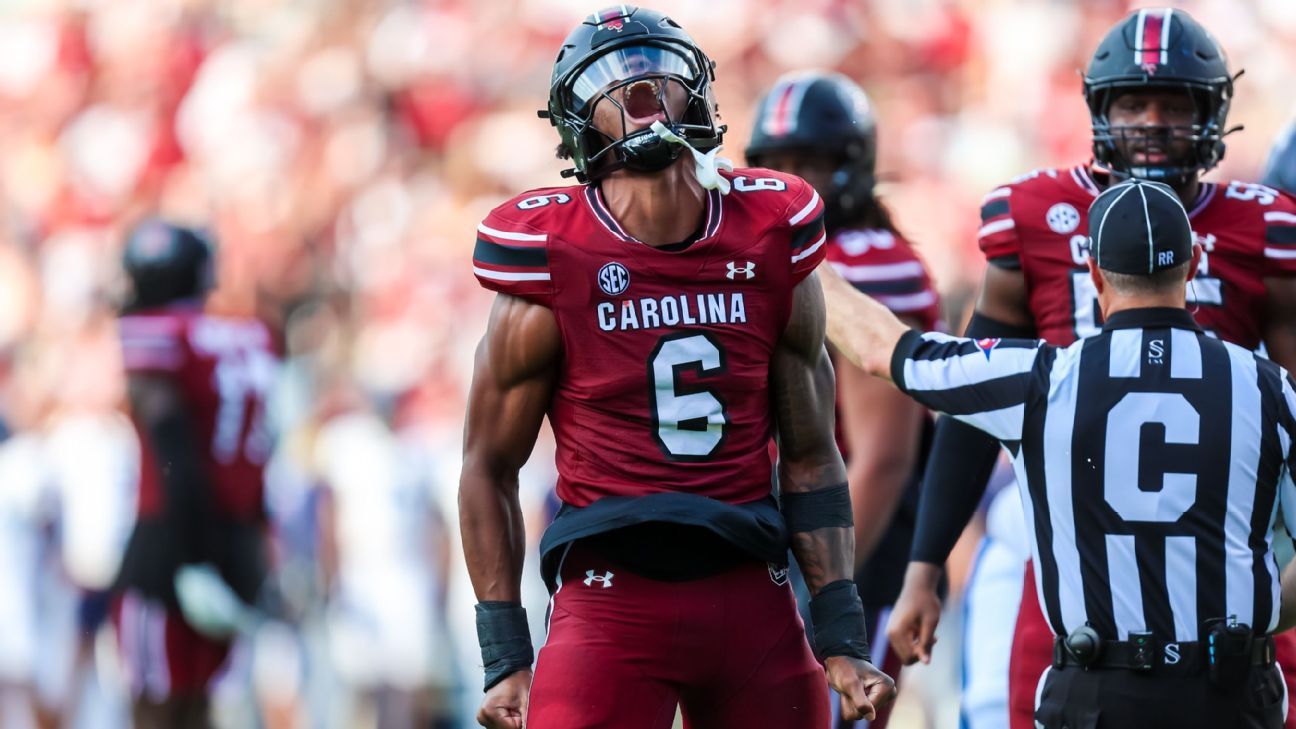
South Carolina star edge rusher Dylan Stewart announced his return to the Gamecocks for his true junior season in 2026.
The All-SEC linebacker is expected to be among the country’s highest-paid players after signing his deal with South Carolina, sources told ESPN’s Pete Thamel.
Stewart has 56 tackles, 11 sacks and 6 forced fumbles in 24 career games with South Carolina. He was the No. 24 overall prospect in the 2024 class out of Washington, D.C., according to the ESPN 300.
The Stewart news follows Monday’s announcement that quarterback LaNorris Sellers will also be returning.
The Gamecocks finished 4-8 (1-7) last season.
Sports
Canadiens handle Bruins in Original 6 fight fest
Published
13 hours agoon
December 24, 2025By
admin
-
Associated Press
Dec 23, 2025, 10:03 PM ET
BOSTON — The Boston Bruins put up a pretty good fight against the rival Montreal Canadiens — for one period.
Boston’s Tanner Jeannot and Montreal’s Josh Anderson dropped the gloves at the opening faceoff of Tuesday night’s game. Another first-period fight helped set the tone for the Bruins, who had beaten Montreal in eight of the previous 10 meetings.
But after falling behind 2-1, the Canadiens scored five straight goals — four of them in a five-minute span in the third period — to win 6-2 and put some distance between the two Original Six teams who are jockeying for position in the Eastern Conference standings.
The Bruins lost the past four games on their homestand after winning five of their previous six. They have three days off before heading to a five-game road trip.
“We all recognized it was the last game before break — against the Habs, at the Garden,”Bruins forward Alex Steeves said. “We were down early, but we bounced back. Energy was good. And then it just got away from us.”
Five weeks after starting a fight from the opening faceoff in Montreal, the teams did it again. Jeannot, who has 53 goals and 435 penalty minutes in his career, and Anderson, who has 154 goals and 582 penalty minutes, fought for about a minute while teammates on both benches banged their sticks against the boards in approval.
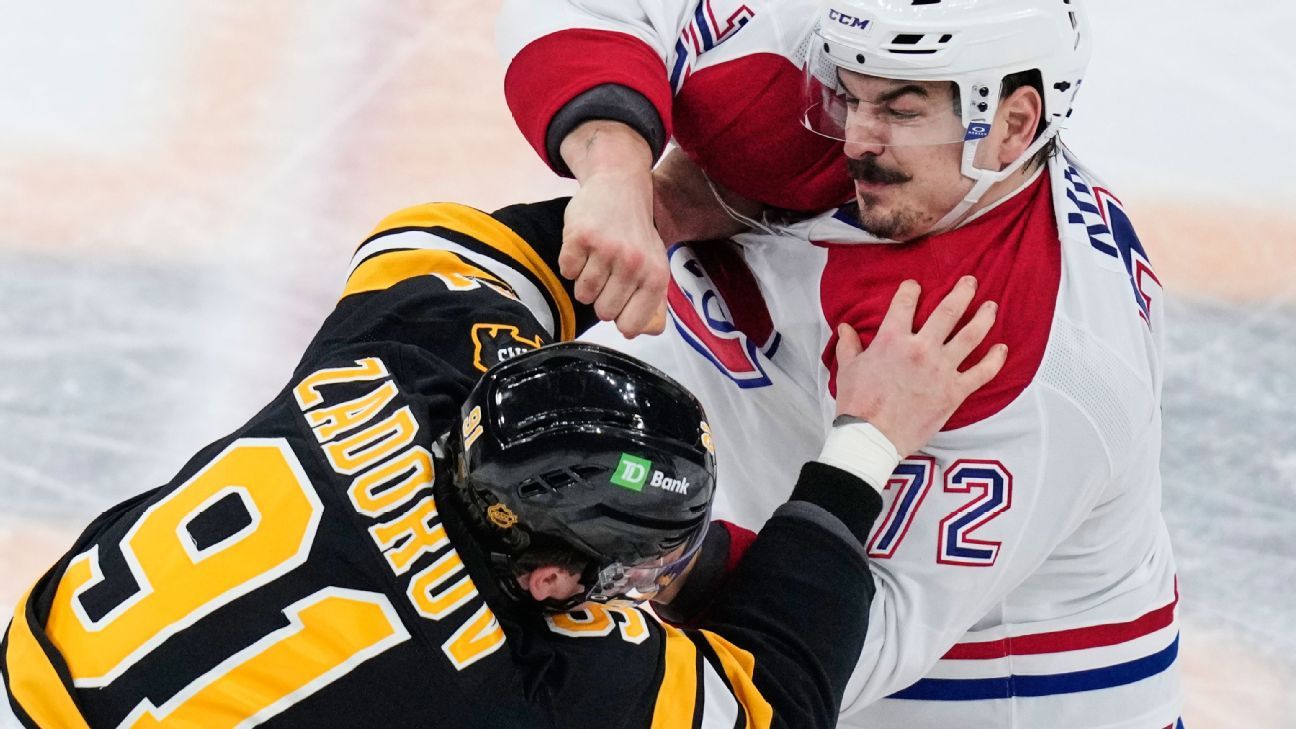
The Bruins forward landed several blows before his Canadiens counterpart went to the ice, drawing a big roar and a chant of “U-S-A!” from the TD Garden crowd. Midway through the first period, it happened again, with Boston’s Nikita Zadorov and Montreal’s Arber Xhekaj dropping their gloves off a faceoff in the Bruins’ end.
“It had everything to me: Guys winning fights; guys laying their body on the [line],” Bruins forward David Pastrnak said. “It’s easy to get into the game when you have guys like this.”
In all, there were nine penalties for 30 minutes in the first, with Boston taking a 2-1 lead on Steeves’ power-play goal with 18 seconds left in the period.
“It gives the whole building energy — not just us players,” Steeves said. “Some guys on the bench just said it was the loudest we’ve heard the building. So it’s awesome. Those guys lay their bodies on the line every night. It’s up to us as a team to galvanize around that and really use that.”
But the penalties in the third were costly, with the Canadiens twice capitalizing on 5-on-3 advantages to pull away. Montreal ended the night with 45 points, four more than Boston and good for third in the Eastern Conference. The Bruins are currently out of playoff position.
“I still can’t believe that the game actually ended 2-6,” Bruins coach Marco Sturm said. “Even after the first period, guys came ready to play today. They were very excited.”
The Bruins had won eight of the past 10 matchups between the teams, including a 3-2 win in Montreal on Nov. 15. That game also featured several scuffles, including a fight at the opening faceoff. But the bigger problem for the Bruins had nothing to do with the fisticuffs: Star defenseman Charlie McAvoy was hit in the face by a slap shot, which could make him miss almost a month.
Trending
-
Sports2 years agoStory injured on diving stop, exits Red Sox game
-

Sports3 years ago‘Storybook stuff’: Inside the night Bryce Harper sent the Phillies to the World Series
-

Sports2 years agoGame 1 of WS least-watched in recorded history
-

Sports3 years agoButton battles heat exhaustion in NASCAR debut
-

Sports3 years agoMLB Rank 2023: Ranking baseball’s top 100 players
-
Sports4 years ago
Team Europe easily wins 4th straight Laver Cup
-

Environment3 years agoJapan and South Korea have a lot at stake in a free and open South China Sea
-
Environment1 year agoHere are the best electric bikes you can buy at every price level in October 2024