

Honda’s first electric moped design revealed in patent filings, giving us an early look

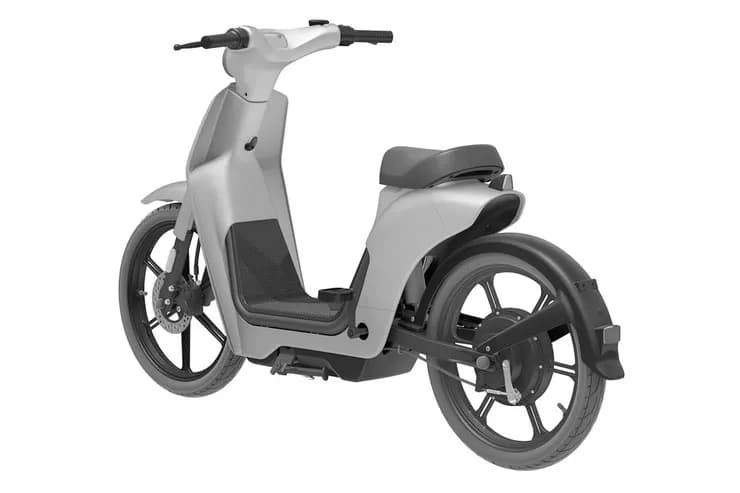
Like most Japanese motorcycle manufacturers, Honda has been late to the electrification game. But don’t count the storied motorbike brand out just yet, as the company’s upcoming electric moped looks to be shaping up nicely based on recent IP filings.
Honda recently announced that it planned to rollout 10 different electric motorcycle models by 2025, though most of those are expected to be light electric motorcycles or electric mopeds.
Zero and Harley-Davidson likely don’t have anything to be worried about for several more years.
Light electric motorcycles and electric mopeds are much easier to produce, are subject to significantly fewer regulations, and can carry much lower price tags than are likely to entice a wider range of riders.
And now we’re getting our first look at an upcoming Honda electric moped thanks to filings the company submitted to the European Union Intellectual Property Office, according to Bennetts.
The model shown looks to borrow much of the frame and componentry seen on a previous Honda and MUJI collaboration, resulting in a classically styled electric moped.
In fact, fans of the original Honda Cub motorcycle might recognize the design as Cub-like. The Honda Cub, sold under multiple model names and several variants, is the most produced motor vehicle in the world. It was a staple of 1960s and ’70s motorcycle culture, offering young riders a low-cost and low-power two-wheeler that was perfect for urban and suburban exploration.
This upcoming Honda electric moped appears to share much of the same design ethos, yet with updated styling and a pair of pedals that should help classify it as an electric bike or moped in many regions.
The single-seater electric moped sports built-in lighting, a broad front shield to protect the rider’s legs from splashing water or road debris, a wide foot platform, and of course those stubby pedals that help exempt it from motorcycle classification.
The wheels feature a six-spoke cast design with a small hydraulic brake in the front and a rear drum brake.
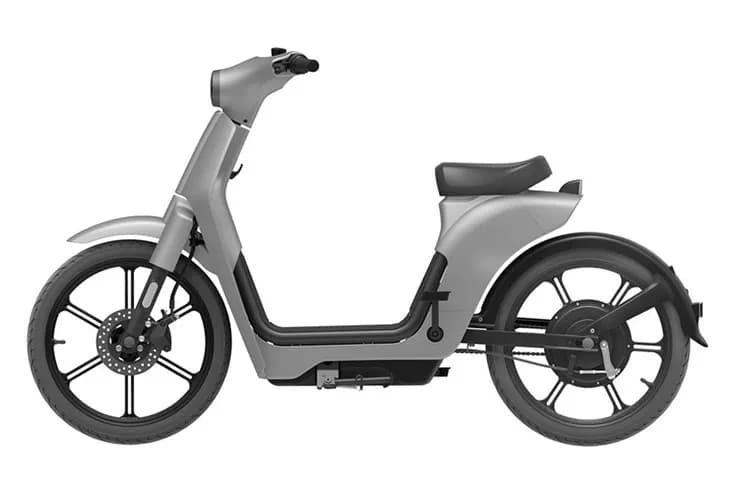
The design appears to offer both front and rear suspension, and a small chain can be seen running along the rear swingarm. That chain is purely for the pedal drivetrain, as the rear wheel seems to hold a large hub motor at its center. If produced, it is likely that the pedals would go unused by most riders, and some may even choose to remove them altogether.
It is unclear what type of battery the bike will use or where it would be mounted. The seat may lift up to allow access to a rear battery compartment, but it is more likely that we’ll eventually find just a small storage compartment back there.
The underfoot area is the most likely future home for the battery, which could prove to be one of Honda’s 48V swappable battery packs that follow Gogoro’s battery design.
It’s unclear what the top speed of Honda’s first electric moped will be, but a 28 mph (45 km/h) limit seems likely. That’s the maximum allowable speed for e-bikes in the US and for Speed Pedelecs in much of Europe.
Perhaps Asia’s market is a better bellwether though, as Asia accounts for many more times the sales of electric bikes and e-mopeds than Europe and North America combined.
The inclusion of a license plate holder on the rear fender could indicate that Honda is aiming at more than just electric bicycle-class designation, and instead targeting full moped status for the upcoming two-wheeler. In many jurisdictions across North America, Europe, and Asia, mopeds have more lax license requirements but can sometimes still be required to bare a number plate for identification.
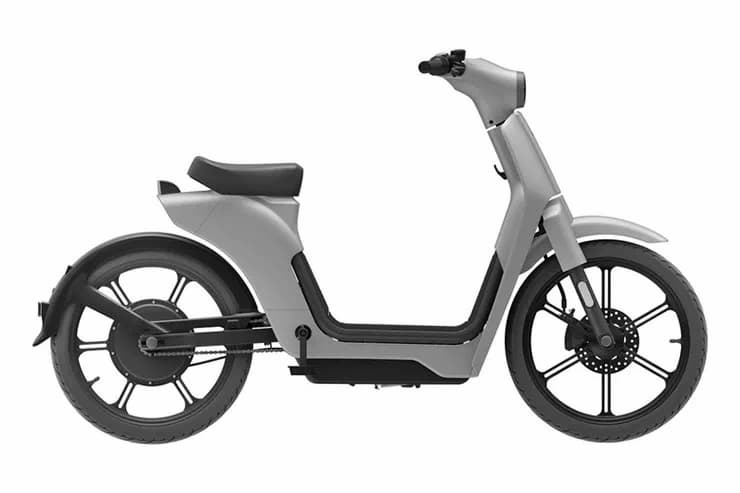
Do you think a lightweight electric moped like this could help Honda get some skin in the game when it comes to electric two-wheelers? Could you see yourself cruising your town on a modern day electric Honda Cub moped?
Let’s hear your thoughts in the comments section below!
FTC: We use income earning auto affiliate links. More.

Subscribe to Electrek on YouTube for exclusive videos and subscribe to the podcast.

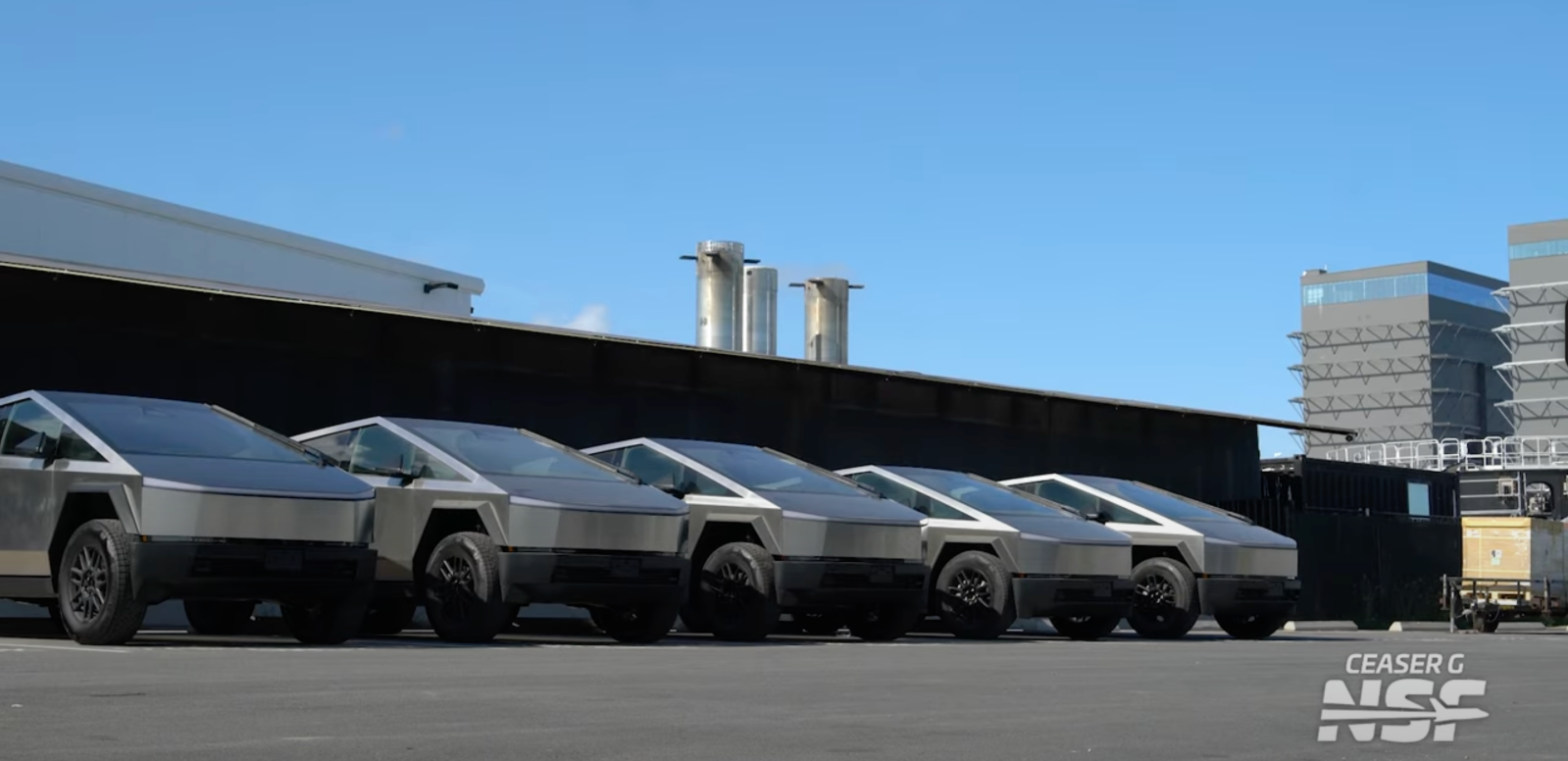
As demand for the Cybertruck can’t reach more than about 10% of Tesla’s planned production capacity, Elon Musk used his privately owned company to try to boost demand.
We now learn that SpaceX has bought tens of millions of dollars’ worth of Cybertrucks – potentially over a hundred million.
Elon Musk said that he expects Tesla to sell as many as 500,000 Cybertrucks per year.
Tesla actually planned to produce up to 250,000 Cybertrucks annually at the Gigafactory Texas. It never came even close to that.
The automaker is extremely opaque about its sales data, bundling Model S, Model X, and Cybertruck sales together.
However, based on registration data and historical split of Model S/X sales, we can estimate that Tesla is having issues selling even 20,000 Cybertrucks per year – less than 10% of its planned capacity.
By definition, the Cybertruck is a commercial flop.
Tesla boasted over 1 million reservations for the vehicle ahead of production, but it is estimated to have converted only about 60,000 of those reservations into orders since production began more than 2 years ago.
There are many reasons for this, but it is primarily because the Cybertruck costs much more than initially announced at the unveiling in 2019 and has less range and fewer cool features than the prototype.
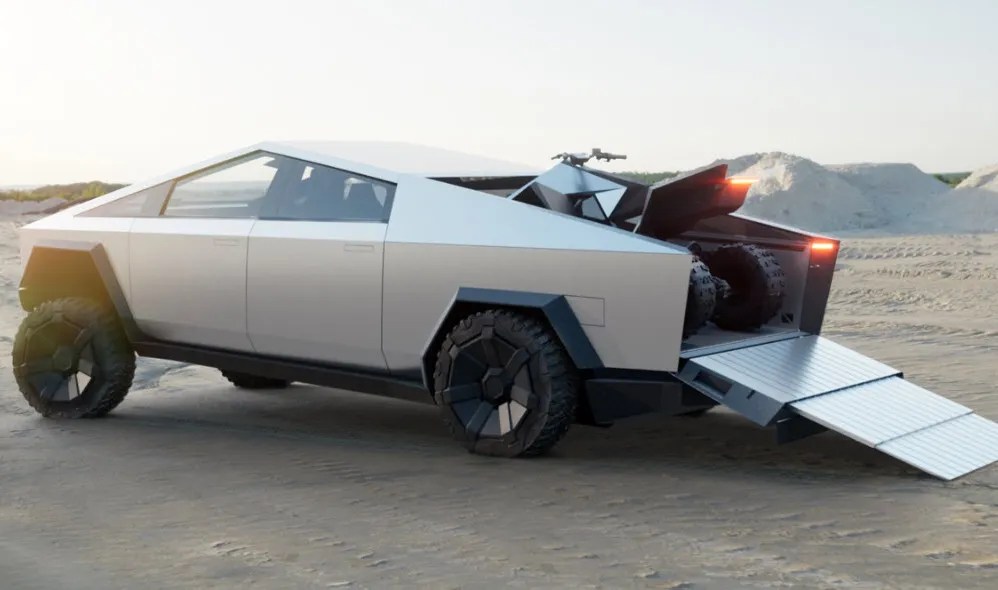
SpaceX to the rescue
Earlier this year, we reported that Tesla started delivering truckloads of Cybertrucks to SpaceX and xAI, Elon Musk’s privately owned companies.
Now, a source familiar with the matter told Electrek that SpaceX bought over 1,000 Cybertrucks from Tesla and that it could ramp up to about 2,000 over time.
Hundreds of Cybertrucks can currently be seen parked in SpaceX’s lots in Southern Texas:
With a base price of $80,000, it would represent between $80 million and $160 million in sales.
It would be a significant help to Tesla’s performance in the fourth quarter, as the automaker is suffering from EV incentives ending in the US at the end of the third quarter, which remains Tesla’s most important market.
Electrek’s Take
SpaceX has been helping out Elon’s other companies quite a bit lately. It has reportedly committed to invest $2 billion into xAI, which is burning cash at an insane rate. Now, they are buying tens of millions to over a hundred million worth of Cybertruck, which are sitting in Tesla’s inventory, making its 4th quarter look even worse than it already is.
Can’t blame him here. This is legal. Although SpaceX investors might have concerns about how smart a purchase this is and what the utilization rate of those trucks looks like.


FTC: We use income earning auto affiliate links. More.

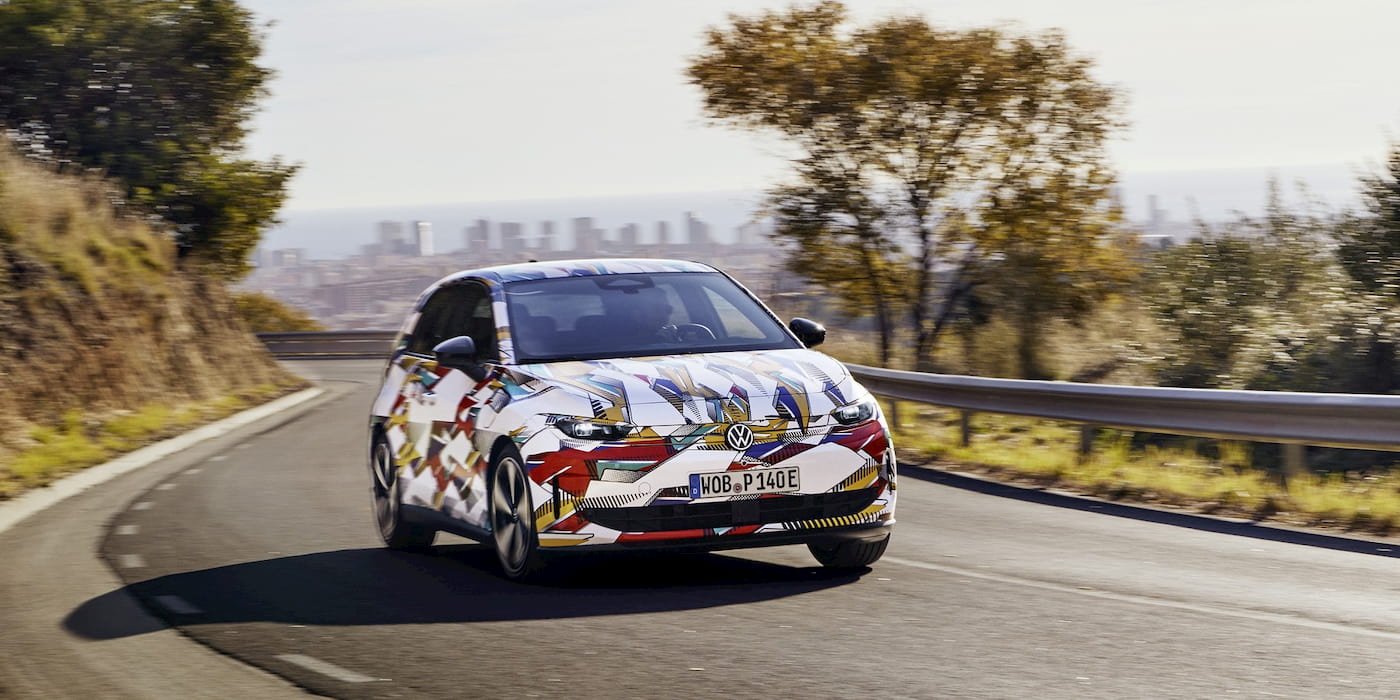
Volkswagen’s upcoming family of smaller, more affordable EVs will not be offered with a gas-powered engine. Volkswagen brand boss Thomas Schäfer said small gas cars make no sense, urging “the future in this segment is electric.”
Volkswagen shifts from small gas cars to EVs
During an interview with Auto Motor und Sport (via Ecomento), Schäfer explained that “Offering new gasoline-powered models in the Polo class and below makes no sense in light of future emissions regulations.”
The comments come as the German auto giant prepares to launch its new family of mass-market electric cars, starting with the ID.Polo in Spring 2026.
“The future in this segment is electric,” Schäfer urged, adding that new gas cars would be “too expensive,” and wouldn’t make any sense.
With the Polo-sized electric car due out next year, the report suggests Volkswagen’s upcoming entry-level EVs will not get any sister models with a gas engine. Although the VW brand CEO didn’t say exactly how long it plans to continue selling ICE versions of the Polo and T-Cross, local reports suggest it could still be until 2030.
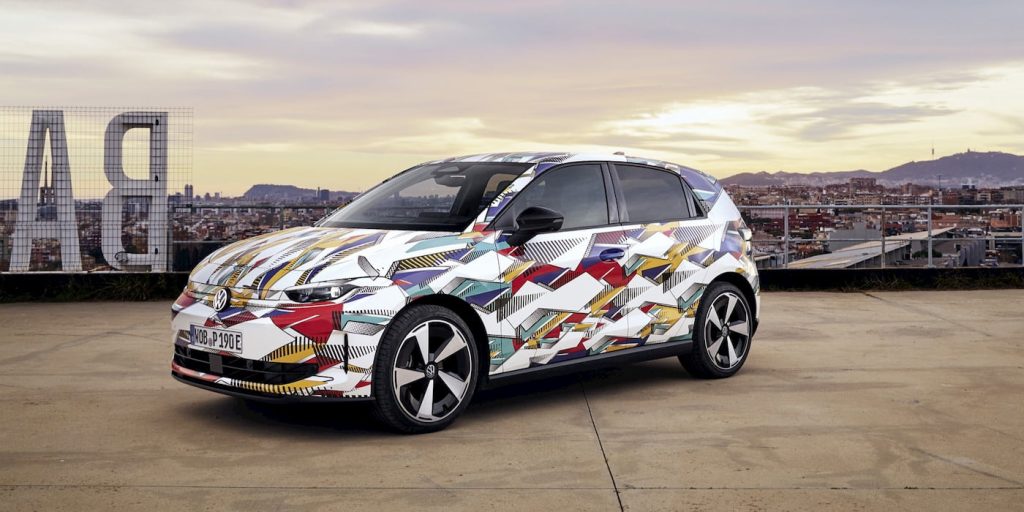
As for hydrogen-powered cars, Schäfer called them “a sham discussion” for the volume segment. “There simply isn’t enough green hydrogen, the fuel cell is far too expensive, and the technology isn’t efficient either,” he said.
“The only way to quickly decarbonize mass-market cars is through electric drive,” according to Schäfer. The ID.Polo is kicking off a new generation of Volkswagen as its first EV to bear an established brand name.
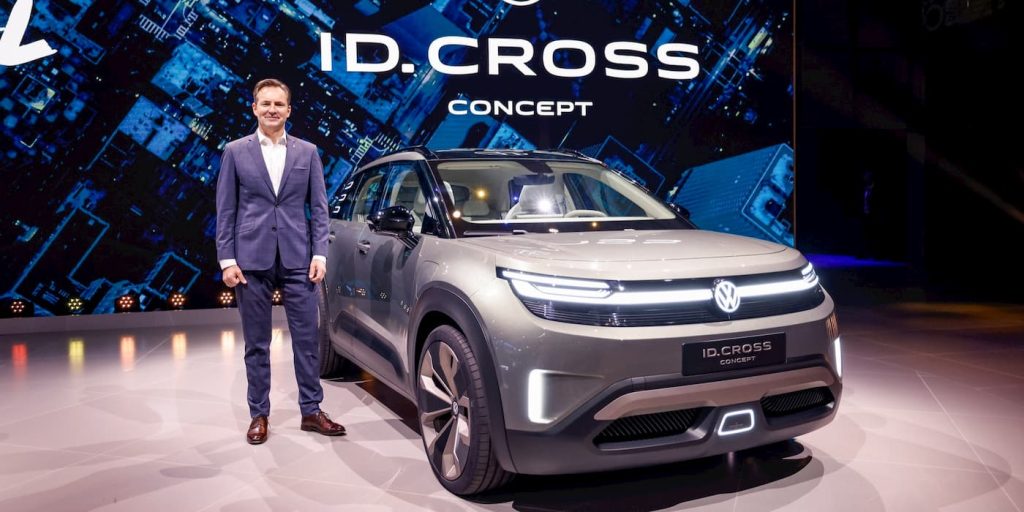
Volkswagen is set to launch the Polo EV in Europe next Spring, starting at around €25,000 ($30,000). The electric version of the T-Cross, the ID.Cross will follow it in mid-2026. Volkswagen has yet to reveal prices, but the ID.Cross is slated to sit below the ID.4, which starts at around €35,000 ($41,000).

Both will be based on VW’s new MEB+ platform, set to underpin Volkswagen’s upcoming entry-level EV series. An even smaller, lower-priced ID.1 is due out in 2027, which will serve as a replacement for the e-UP!.
Electrek’s Take
Finally, a global OEM has the right idea. Volkswagen appears to be finally on the right path with its new entry-level EV lineup.
Schäfer is correct. Small gas-powered cars don’t have a future, but it’s not just because of stricter emissions rules. Buyers are looking for smaller, more efficient electric vehicles.
Through the first 10 months of the year, electric vehicles accounted for 16.4% of vehicle registrations in Europe, up from 13.2% in October 2024.
According to data from the European Automobile Manufacturers’ Association, the market share of gas and diesel-powered cars fell to 36.6% from 46.3% during the same period.
Chinese and Korean brands, such as BYD, Kia, and Hyundai, are seeing early success in Europe with mass-market EVs like the Dolphin Surf, EV3, and Hyundai Inster EV. Volkswagen looks to grab its share with the ID.Polo and ID.Cross arriving in 2026.
FTC: We use income earning auto affiliate links. More.
Environment
Rivian rolls out software update 2025.46, including Universal Hands-Free driving and digital key for Apple and Android users


Rivian has just shared details of its latest over-the-air software update 2025.46, which includes some of the new features announced during its recent AI and Autonomy event last week. The update features a new digital key function for Gen 2 R1 owners, “flavorful” drive styles, kick turns, tuning, and, of course, Rivian’s new Universal Hands-Free driving capabilities.
There’s a lot to unfold with the 2025.46 software update, so we’ll provide a quick recap of our visit to Rivian’s Palo Alto facilities last week for its inaugural AI and Autonomy Day. During the exclusive event, Rivian executives, like founder and CEO RJ Scaringe, unveiled the company’s new in-house designed silicon chip, which will help power its new dedicated autonomy platform.
In addition to adding LiDAR to the upcoming R2 models, Rivian shared plans to expand its Enhanced Highway Assist ADAS to support Universal Hands-Free driving. That includes expanded availability of the feature from 135,000 miles to over 3.5 million miles of roads across the US and Canada.
According to Rivian, this availability is expected to start rolling out in early 2026. However, it appears the process is now underway with its latest software update, which includes a slew of other noteworthy upgrades.

2025.46 includes Rivian’s Universal Hands-Free driving
According to a blog post from Rivian this morning, a key rollout in its end-of-the-year software update is Universal Hands-Free driving, which significantly expands the number of roads on which R1 owners can engage the driving assist feature.
With update 2025.46, Gen 2 drivers can engage Universal Hands-Free on virtually any road where lane lines are clearly marked. Note that this is not a full autonomy feature (yet), so Hand-Free cannot slow or stop at lights or stop signs.
Speaking of autonomy, Rivian is introducing three new Drive Styles for its assisted driving features, including Universal Hands-Free, Highway Assist, Adaptive Cruise Control, and Lane Change on Command. After the update, R1 owners will be able to choose their “spice level” of autonomous functions:
- Mild: A relaxed style with more gap distance and more gradual lane changes.
- Medium: A balanced style to manage cut-ins and accelerate with traffic flow.
- Spicy: A more dynamic style with a tighter gap distance and quicker steering during lane changes.
Another significant bonus, in addition to Universal Hands-Free, is Rivian’s new Digital Key feature for Gen 2 R1 owners. Following the 2025.46 update, owners will now be able to add their R1S or R1T key to their digital wallet on iPhone, Apple Watch, Google Pixel, or Samsung devices. Digital Key provides an additional means of easy access to your EV, as well as the ability to share keys with family and friends.
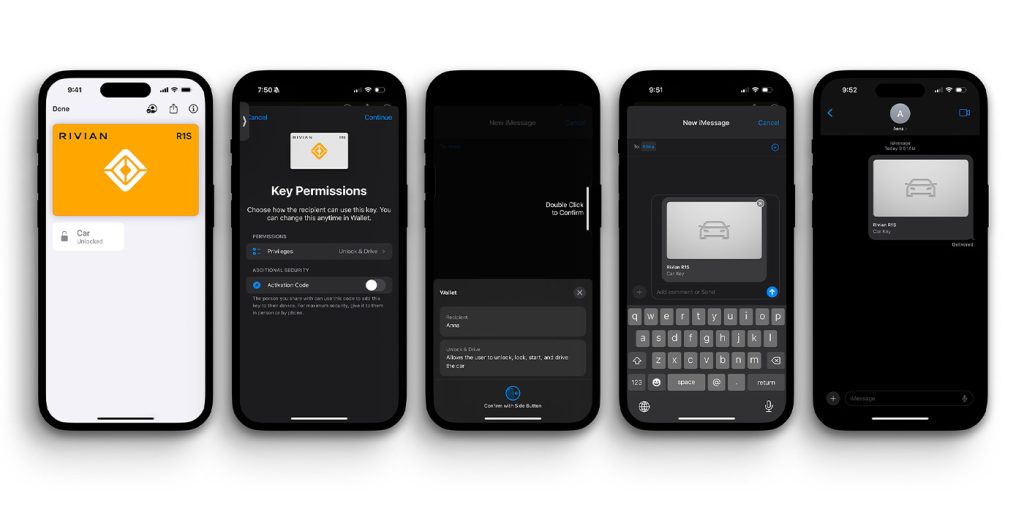
Other features in software update 2025.46 include a new way to view the Driver Display for both Gen 1 and Gen 2 R1 owners. Per Rivian:
Gen 2 drivers can now switch between the Autonomy view, which shows surrounding lanes and vehicles, and the Maps and Navigation view on the driver display. Gen 1 drivers can switch between the Driver Assistance view, which shows vehicles and objects up ahead, and the Maps and Navigation view on the driver display. Press the right thumbwheel on the steering wheel to swap.
Here’s an example:
Last but not least, Rivian is introducing some exciting new features for R1 Quad owners. Software update 2025.46 includes a new tuner screen from the Rivian Adventure Department (RAD) – “a team of engineers, software developers, and designers who create and test features that push the boundaries of our vehicles.”
The RAD Tuner (seen below) was initially used by teams at Rebelle Rally and Pikes Peak, but is now available to Gen 2 Quad owners. Those drivers will be able to tune beyond Rivian’s factory presets and customize the vehicle’s behavior to their preferences and/or the terrain. Touch sliders control custom, savable drive modes that include factors such as acceleration, torque balance, and stability.
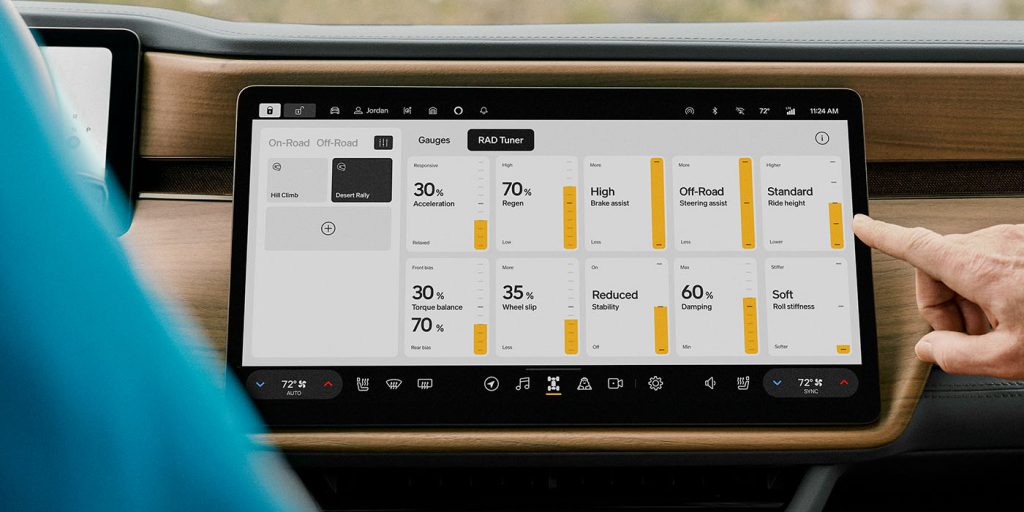
In addition to RAD Tuning, Rivian’s latest software update also includes the ability for Gen 2 Quad drivers to perform Kick Turns. Per the blog post:
Turn makes it easier to steer in tight off-road conditions while moving at speeds under 15 mph (24 km/h). It works by controlling the power and tire grip, letting the vehicle spin about its center, even when it’s moving. You can now make tighter turns with just a simple button press. When you engage Kick Turn, your R1 Quad smartly adjusts the power to the inside wheels, slowing them down or even reversing them. This precise control over wheel slip ensures your vehicle turns exactly as quickly and smoothly as you intend.
Electrek‘s Seth Weintraub tested it out in Lake Tahoe earlier this year, and it’s absolutely incredible. Check it out:
I have a Gen 2 R1S, so I’m looking forward to Universal Hands-Free rolling out so I can test it and report back. Stay tuned. If you haven’t test-driven a Rivian yet, I highly recommend doing so. You can schedule a demo drive at your nearest Rivian Space here.
FTC: We use income earning auto affiliate links. More.
-
 Sports2 years ago
Story injured on diving stop, exits Red Sox game
-
 Sports3 years ago
‘Storybook stuff’: Inside the night Bryce Harper sent the Phillies to the World Series
-
 Sports2 years ago
Game 1 of WS least-watched in recorded history
-
 Sports3 years ago
Button battles heat exhaustion in NASCAR debut
-
 Sports3 years ago
MLB Rank 2023: Ranking baseball’s top 100 players
-
Sports4 years ago
Team Europe easily wins 4th straight Laver Cup
-
 Environment3 years ago
Japan and South Korea have a lot at stake in a free and open South China Sea
-
 Environment1 year ago
Here are the best electric bikes you can buy at every price level in October 2024