
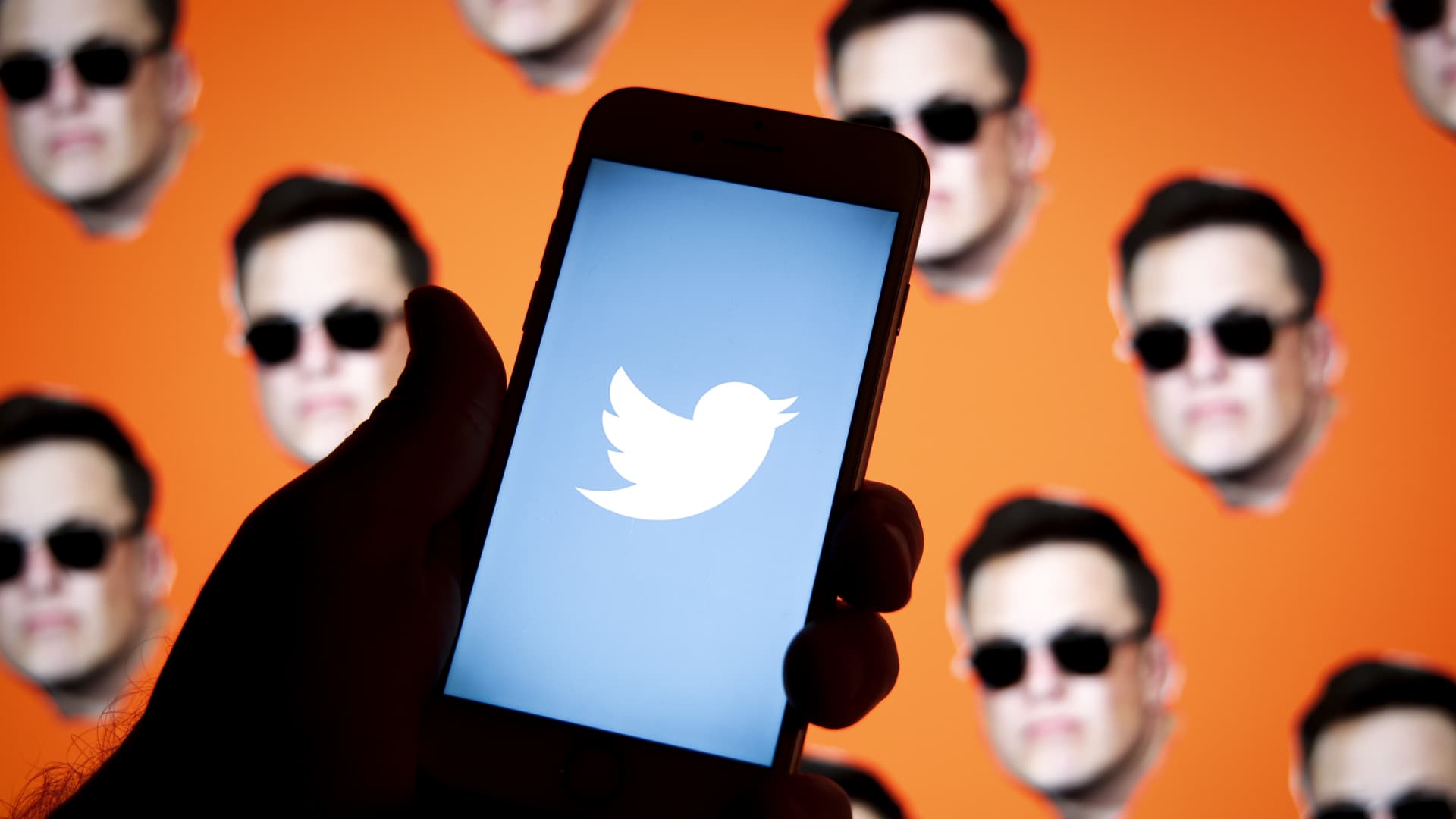
The Twitter logo is seen on a mobile device in ths illustration photo in Warsaw, Poland on 30 October, 2022. Twitter is losing its most active users according to research done by Reuters. Despite the most impactful tweeters making up only 10 percent of the monthly users they are together responsible for 90 percent of all tweets and around half of the company’s revenue.
STR | Nurphoto | Getty Images
Advertising giant Interpublic Group has recommended that clients of its IPG Media Brands agencies suspend all paid advertising on Twitter for at least a week following Elon Musk’s $44 billion acquisition of the social media network.
According to a person familiar with the matter, the firm is telling its clients — who may independently choose to keep advertising on Twitter — to wait for clarity on the social network’s plans for trust and safety, and to see whether Musk will be able to prevent Twitter from becoming, as he called it, a “free-for-all hellscape.”
Some of the agencies’ clients include CVS Pharmacy,Nintendo and Unilever. These companies did not immediately respond to requests for comment on the recommendation.
Morning Brew contributor Ryan Barwick first reported on the ad giant’s recommendation to IPG Media Brands clients, citing an e-mail sent by MAGNA, a media intelligence business that is part of the group.
MAGNA reportedly advised clients in that email that Twitter had not been in direct, clear communications with each marketing agency yet, and that “the current situation is unpredictable and chaotic, and bad actors and unsafe behaviors thrive in such an environment.”
On Friday, automaker GMtold CNBC it had temporarily suspended advertising on the service “to understand the direction of the platform under their new ownership.”
The user experience on Twitter is already undergoing significant changes mere days after Musk’s takeover.
By the time Musk closed the deal on Oct. 28, racist and other hateful tweets had begun to plague the social network at much higher levels than usual, according to research by the Network Contagion Research Institute and Dataminr, as reported by NPR. Bad actors on some other platforms, notably 4Chan, have encouraged fellow users to post and amplify racist epithets and other derogatory slurs on Twitter, and the change has driven away several celebrity users and inspired a call-out by NBA star LeBron James.
Yoel Roth, head of safety at Twitter, has posted several threads to Twitter discussing how the company is combating this. On Monday, Roth wrote on Twitter, “We’ve made measurable progress, removing more than 1,500 accounts and reducing impressions on this content to nearly zero.”
Last week, Musk wrote that Twitter would be “forming a content moderation council with widely diverse viewpoints” and promised he would make “no major content decisions or account reinstatements” before the council convenes.
While he has not yet revealed whether such a council has been established, Twitter recently restored all functionality to the account of a previously restricted user, Mark Finchem, who is the Republican candidate for secretary of state in Arizona.
Finchem called upon Musk personally for help in a tweet, and Musk said in a reply on Twitter that he was “looking into” the matter. Finchem has been a prominent 2020 election denier and an Arizona state legislator. The politician has been roundly criticized for sharing anti-Semitic tropes and memes on Twitter.
Traders work on the floor at the New York Stock Exchange in New York City, U.S., Dec. 15, 2025.
Brendan McDermid | Reuters
U.S. stocks of late have been shaky as investors turn away from artificial intelligence shares, especially those related to AI infrastructure, such as Oracle, Broadcom and CoreWeave.
The worry is that those companies are running into high levels of debt to finance their multibillion-dollar deals.
The stock lost 2.7% on Monday, while shares of CoreWeave, its fellow player in the AI data center trade dropped around 8%. Broadcom also retreated over concerns over margin compression, sliding about 5.6%.
That said, the broader market was not affected too adversely as investors continued rotating into sectors such as consumer discretionary and industrials. The S&P 500 slipped 0.16%, the Dow Jones Industrial Average ticked down just 0.09% and the Nasdaq Composite, comprising more tech firms, fell 0.59%.
The broader market performance suggests that the fears are mostly contained within the AI infrastructure space.
“It definitely requires the ROI [return on investment] to be there to keep funding this AI investment,” Matt Witheiler, head of late-stage growth at Wellington Management, told CNBC’s “Money Movers” on Monday. “From what we’ve seen so far that ROI is there.”
Witheiler said the bullish side of the story is that, “every single AI company on the planet is saying if you give me more compute I can make more revenue.”
The ready availability of clients, according to that argument, means those companies that provide the compute — Oracle and CoreWeave — just need to make sure their finances are in order.
Tesla testing driverless Robotaxis in Austin, Texas. “Testing is underway with no occupants in the car,” CEO Elon Musk wrote in a post on his social network X over the weekend. Shares of Tesla rose 3.6% on Monday to close at their highest this year.
U.S. collects $200 billion in tariffs. The country’s Customs and Border Protection agency said Monday that the tally comprises only new tariffs, including “reciprocal” and “fentanyl” levies, imposed by U.S. President Trump in his second term.
Ukraine-Russia peace deal is nearly complete. That’s according to U.S. officials, who held talks with Ukraine President Volodymyr Zelenskyy beginning Sunday. Ukraine has offered to give up its NATO bid, while Russia is open to Ukraine joining the EU, officials said.
[PRO] Wall Street’s favorite stocks for 2026. These S&P 500 stocks have a consensus buy rating and an upside to average price target of at least 35%, based on CNBC Pro’s screening of data from LSEG.
And finally…
Customers walk in the parking lot outside a Costco store on December 02, 2025 in Chicago, Illinois.
The logos of Google Gemini, ChatGPT, Microsoft Copilot, Claude by Anthropic, Perplexity, and Bing apps are displayed on the screen of a smartphone in Reno, United States, on November 21, 2024.
Jaque Silva | Nurphoto | Getty Images
Merriam-Webster declared “slop” its 2025 word of the year on Monday, a sign of growing wariness around artificial intelligence.
Slop is now defined as “digital content of low quality that is produced usually in quantity by means of artificial intelligence,” according to Merriam-Webster’s dictionary. The word has previously been used primarily to connote a “product of little value” or “food waste fed to animals”
Mainstream social networks saw a flood of AI-generated content, including what 404 Media described as a “video of a bizarre creature turning into a spider, turning into a nightmare giraffe inside of a busy mall,” that the publication reported had been viewed more than 362 million times on Meta apps.
In September, Meta launched Vibes, a separate feed for AI-generated videos. Days later, OpenAI released its Sora app. Those services, along with TikTok, YouTube and others, are increasingly rife with AI slop, which can often generate revenue with enough engagement.
Spotify said in September that it had to remove over 75 million AI-generated, “spammy tracks” from its service, and roll out formal policies to protect artists from AI impersonation and deception. The streaming company faced widespread criticism after The Velvet Sundown racked up 1 million monthly listeners on without initially making it clear they produced their songs with generative AI. The artist later clarified on its bio page that it’s a “synthetic music project.”
According to CNBC’s latest All-America Economic Survey, published Dec. 15, fewer respondents have been using AI platforms, such as ChatGPT, Microsoft Copilot and Google Gemini, in the last two to three months compared to the summer months.
Just 48% of those surveyed said they had used AI platforms recently, down from 53% in August.
PayPal CEO Alex Chriss speaks at the Global Fintech Fest in Mumbai, India, on Oct. 7, 2025.
Indranil Aditya | Nurphoto | Getty Images
PayPal said Monday that it has applied for approval to form PayPal Bank, which would be able to offer loans to small businesses.
“Establishing PayPal Bank will strengthen our business and improve our efficiency, enabling us to better support small business growth and economic opportunities across the U.S.,” PayPal CEO Alex Chriss said in a statement.
The U.S. Federal Deposit Insurance Corporation will review an application proposing the establishment of PayPal Bank, along with Utah’s Department of Financial Institutions, PayPal said.
The company, which owns popular payment app Venmo, hopes to also offer interest-bearing savings accounts to its customers, the statement said. PayPal already makes credit lines available to consumers and has been trying to expand its roster of banking-like services as it competes with a growing number of fintech companies that are aiming to take business from traditional brick-and-mortar banks.
Shares of PayPal rose 1.5% in extended trading following the announcement.
In October, PayPal said quarterly revenue increased 7% year over year to $8.42 billion, more than analysts had expected. But in 2025 the stock has slumped about 29%, while the S&P 500 index has gained almost 16% in the same period.





