
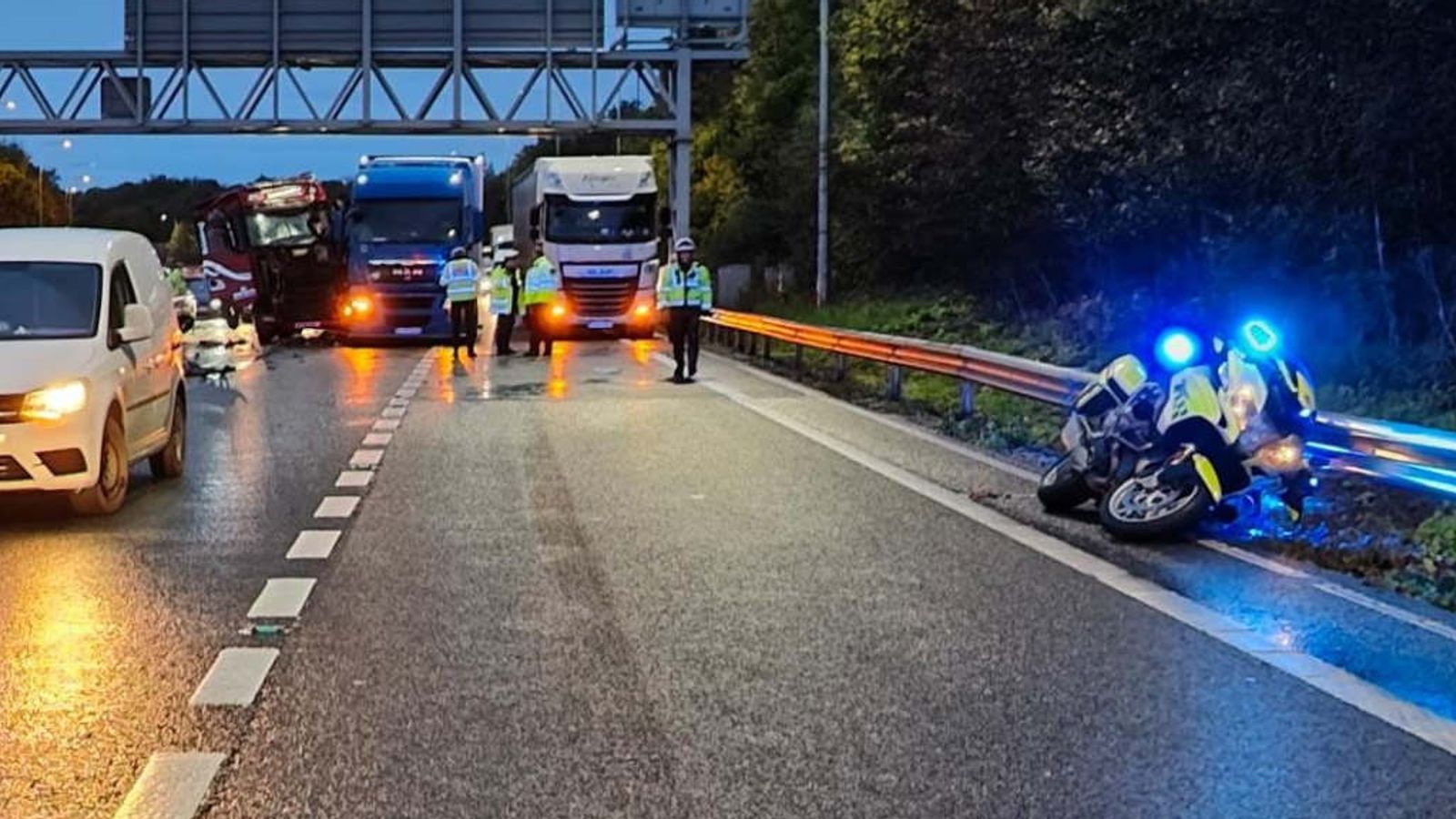
Essex Police officer injured while responding to a Just Stop Oil protest on M25

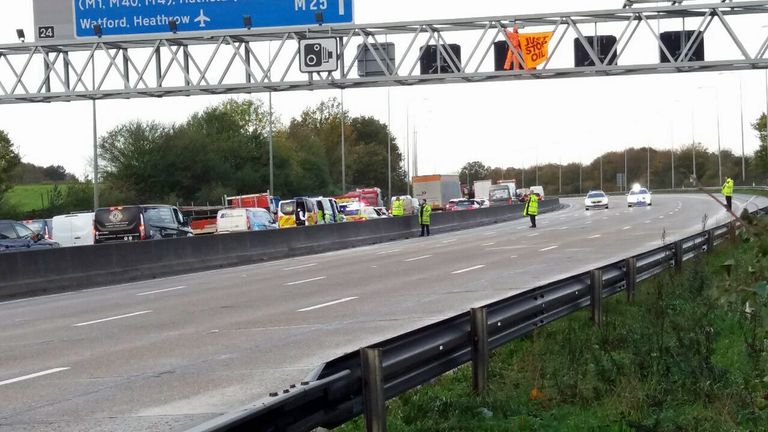
A police officer has been injured in a collision involving two lorries while responding to Just Stop Oil protests taking place on the M25.
Essex Police said one person has been arrested for causing a public nuisance for protesting on the motorway, though the cause of the accident is unclear.
The force said a police officer was struck and injured by a vehicle after a rolling roadblock was put in place due to a person being on the road.
It added the incident has led to road closures between Junction 26 and Junction 27 clockwise.
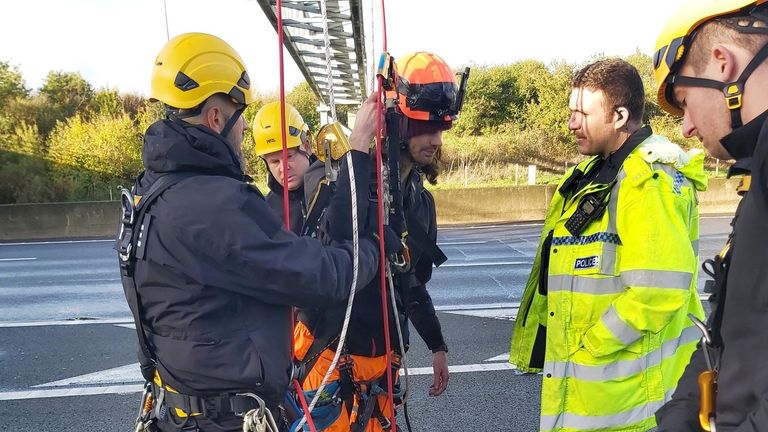
There have been further reports of people on gantries near Junctions 29 and 30, with Essex Police bringing down and arresting one protester who was scaling a gantry on Junction 30.
Motorists have been urged to avoid the area and seek alternative routes while several police forces deal with the demonstrations.
Chief Superintendent Simon Anslow said: “Officers have again responded quickly to minimise disruption and two people have already been arrested.
“One of our officers has been injured as they worked to help resolve this situation.”
It comes after Just Stop Oil said around 10 of its supporters had climbed onto overhead gantries in “multiple locations” on the M25 from 6.30am on Wednesday – the third consecutive day of protests on the UK’s busiest motorway.
A protester who was on J30 has been brought down and arrested. Pic: Essex Police
The protesters have also been joined by Animal Rebellion activists – who are campaigning for “a plant-based food system”.
Officers are warning the ongoing action would cause disruption to traffic in the area.
Elsewhere, Surrey Police confirmed one protester was on a gantry near Junction 8 on the motorway.
The force said: “Officers are proactively patrolling the rest of the M25, as they have been all week.”
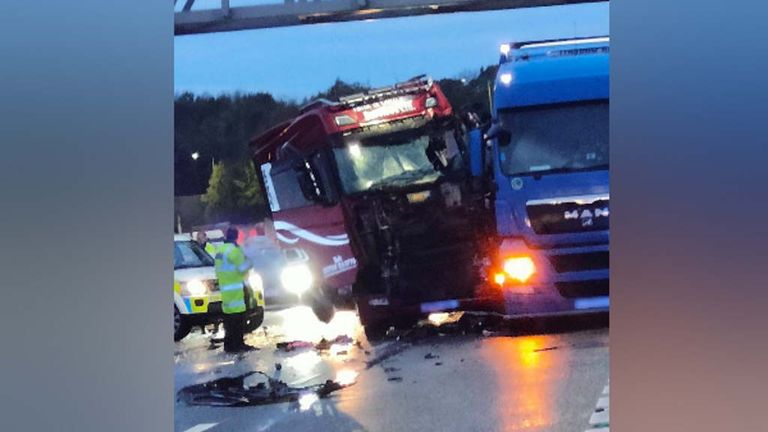
The collision involved two lorries. Pic: Essex Police
The M25 was closed between Junctions 7 and 8 clockwise.
Kent Police said officers have been responding to a report of protesters close to Junction 4.
The Metropolitan Police said on Twitter: “We’re ready to respond to any protest activity on M25 with partner forces again today.
“We know this disruption is incredibly frustrating for the public.”
The force added that officers are currently on scene at Junctions 24 and 25, where a protester “has locked themself on to a gantry”.
It added that locks add “more complexity for our removal teams” so officers have had to bring in specialist equipment for the removal, including a JCB.
Just Stop Oil said in a statement: “This is not a one-day event, expect us every day and anywhere.
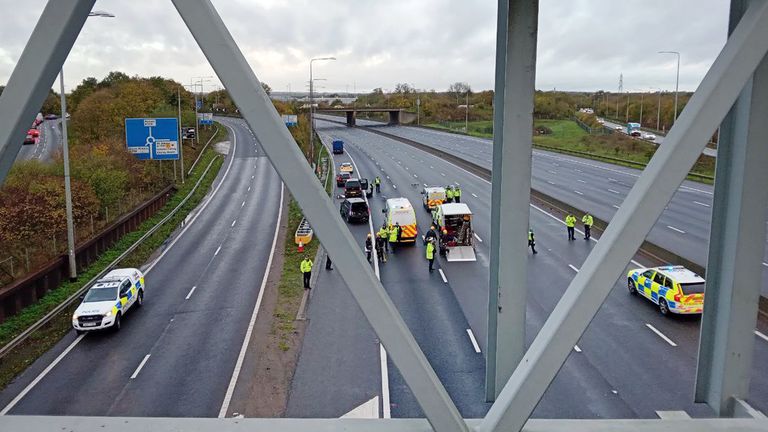
The M25 was closed by police due to ongoing protests from Just Stop Oil activists
“This is an act of resistance against a criminal government and their genocidal death project.
“Our supporters will be returning today, tomorrow and the next day, and the next day after that, and every day until our demand is met: no new oil and gas in the UK.”
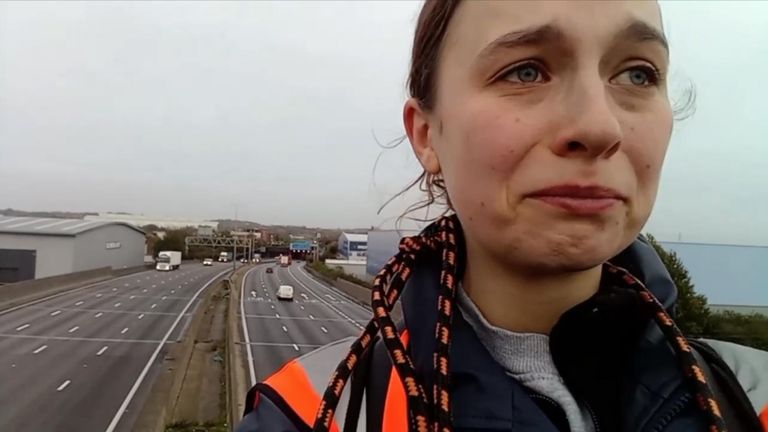
Tearful protester: ‘I don’t have future’
National Highways has secured a High Court injunction to prevent Just Stop Oil protesters from disrupting England’s busiest motorway.
The court has granted a further injunction that aims to stop unlawful demonstrations on the M25, which encircles Greater London, in an attempt to end the disruption to the busy road by the environmental group.
Just Stop Oil staged 32 days of disruption from the end of September and throughout October, resulting in 677 arrests and 111 people charged, with Met Police officers working a total of 9,438 additional shifts.
UK
Specialist teams and online investigators deployed across England and Wales to tackle ‘national emergency’ of violence against women and girls
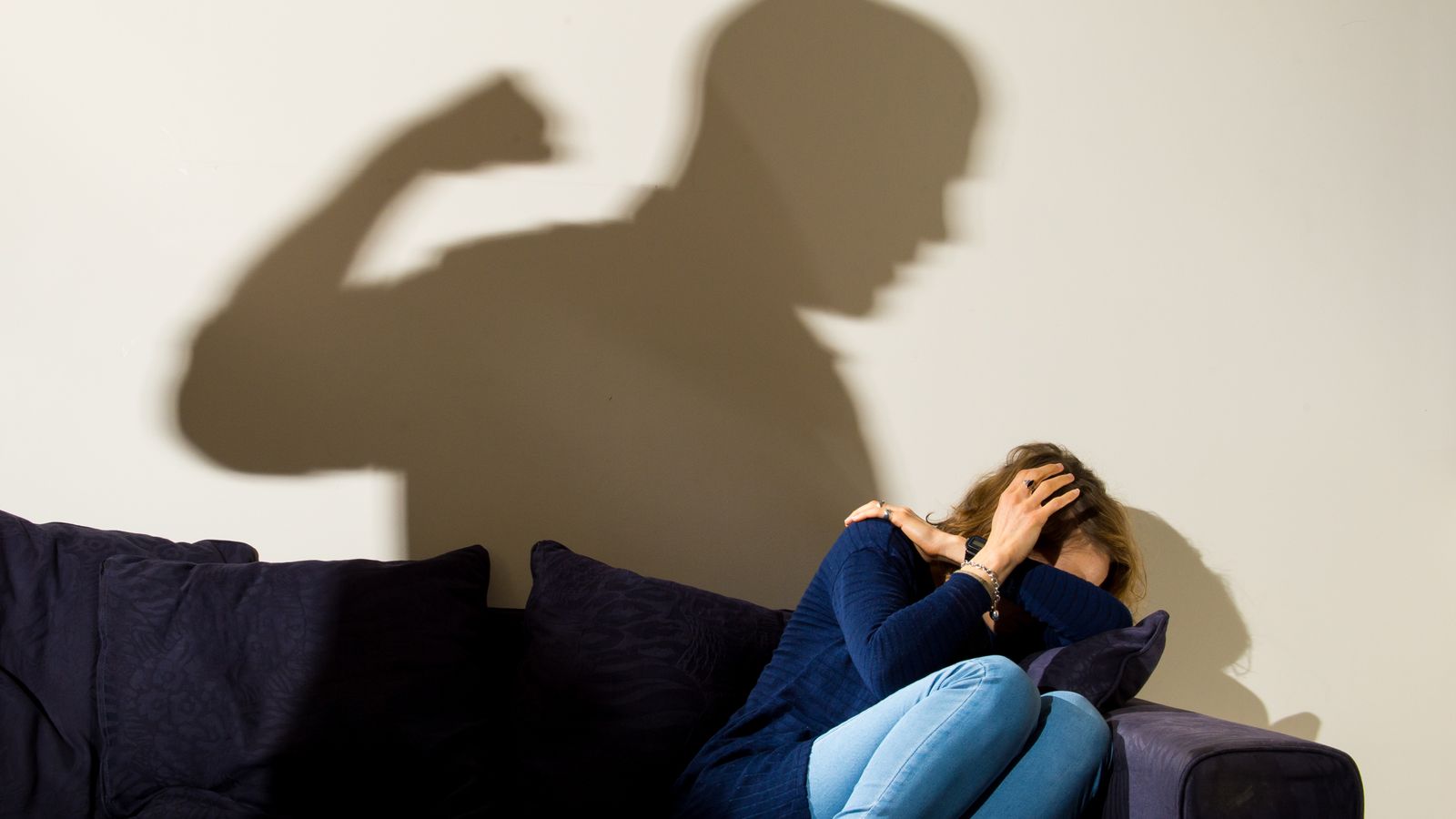
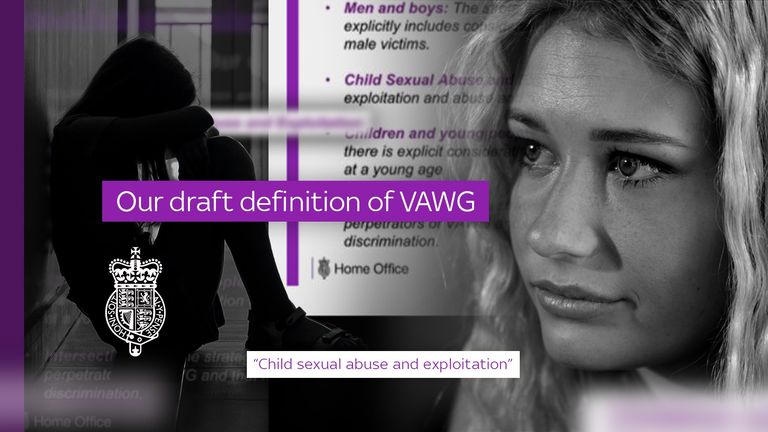
Specialist investigation teams for rape and sexual offences are to be created across England and Wales as the Home Secretary declares violence against women and girls a “national emergency”.
Shabana Mahmood said the dedicated units will be in place across every force by 2029 as part of Labour’s violence against women and girls (VAWG) strategy due to be launched later this week.
The use of Domestic Abuse Protection Orders (DAPOs), which had been trialled in several areas, will also be rolled out across England and Wales. They are designed to target abusers by imposing curfews, electronic tags and exclusion zones.
The orders cover all forms of domestic abuse, including economic abuse, coercive and controlling behaviour, stalking and ‘honour’-based abuse. Breaching the terms can carry a prison term of up to 5 years.
Govt ‘thinking again’ on abuse strategy
Nearly £2m will also be spent funding a network of officers to target offenders operating within the online space.
Teams will use covert and intelligence techniques to tackle violence against women and girls via apps and websites.
A similar undercover network funded by the Home Office to examine child sexual abuse has arrested over 1,700 perpetrators.
Abuse is ‘national emergency’
Home Secretary Shabana Mahmood said in a statement: “This government has declared violence against women and girls a national emergency.
“For too long, these crimes have been considered a fact of life. That’s not good enough. We will halve it in a decade.
“Today we announce a range of measures to bear down on abusers, stopping them in their tracks. Rapists, sex offenders and abusers will have nowhere to hide.”
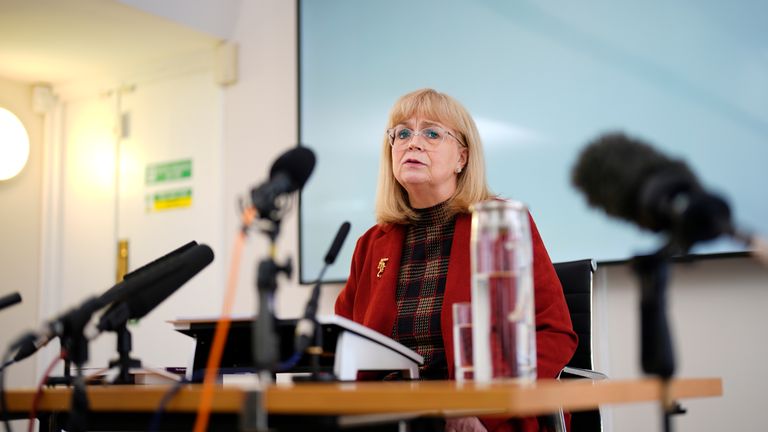
Angiolini Inquiry: Recommendations are ‘not difficult’
The target to halve violence against women and girls in a decade is a Labour manifesto pledge.
The government said the measures build on existing policy, including facial recognition technology to identify offenders, improving protections for stalking victims, making strangulation a criminal offence and establishing domestic abuse specialists in 999 control rooms.
Read more from Sky News:
Demands for violence and abuse reforms
Women still feel unsafe on streets
Minister ‘clarifies’ violence strategy
Labour has ‘failed women’
But the Conservatives said Labour had “failed women” and “broken its promises” by delaying the publication of the violence against women and girls strategy.
Shadow Home Secretary, Chris Philp, said that Labour “shrinks from uncomfortable truths, voting against tougher sentences and presiding over falling sex-offender convictions. At every turn, Labour has failed women.”
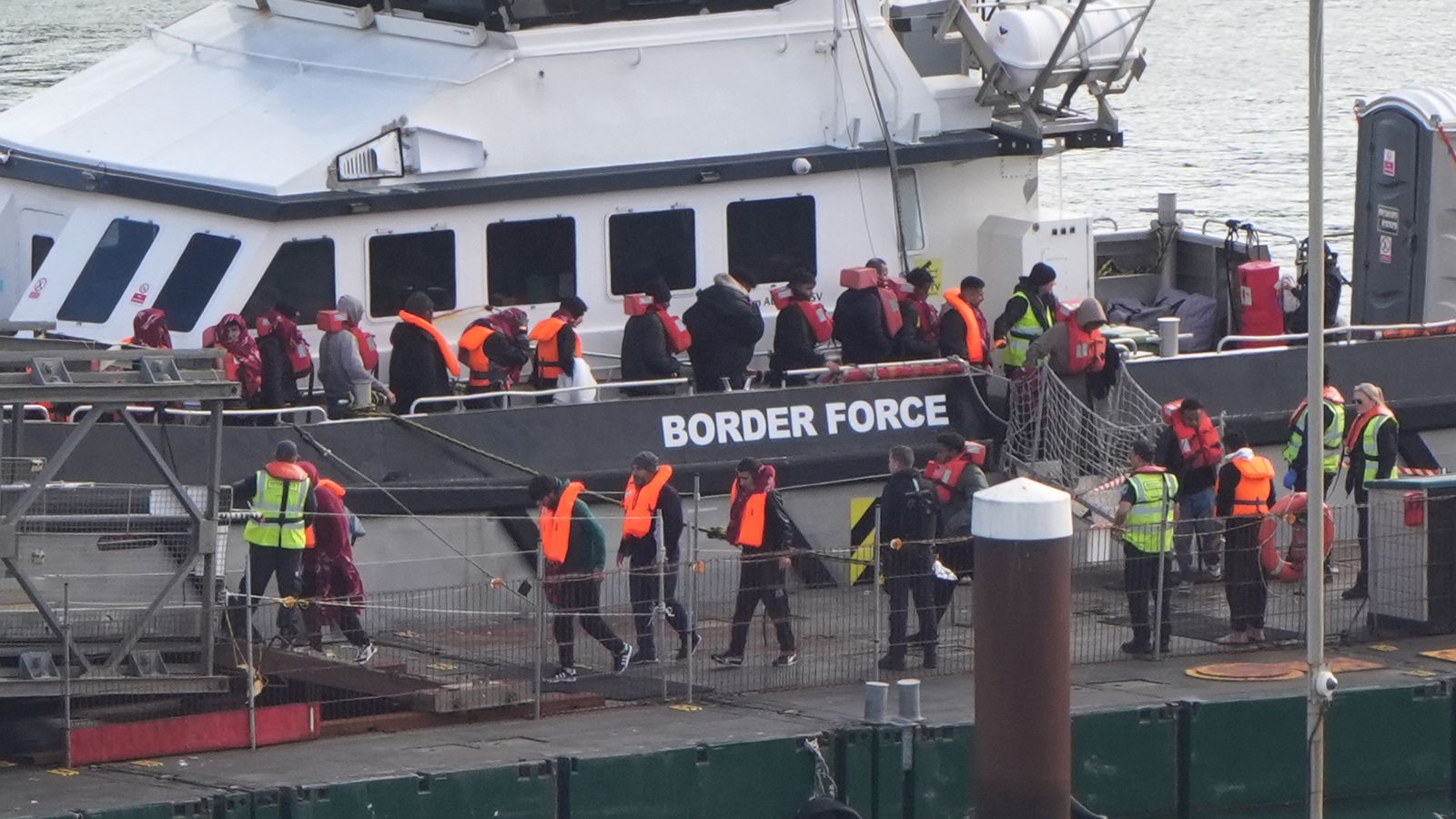
There have been no migrant arrivals in small boats crossing the Channel for 28 days, according to Home Office figures.
The last recorded arrivals were on 14 November, making it the longest uninterrupted run since autumn 2018 after no reported arrivals on Friday.
However, a number of Border Force vessels were active in the English Channel on Saturday morning, indicating that there may be arrivals today.
So far, 39,292 people have crossed to the UK aboard small boats this year – already more than any other year except 2022.
The record that year was set at 45,774 arrivals.
It comes as the government has stepped up efforts in recent months to deter people from risking their lives crossing the Channel – but measures are not expected to have an impact until next year.
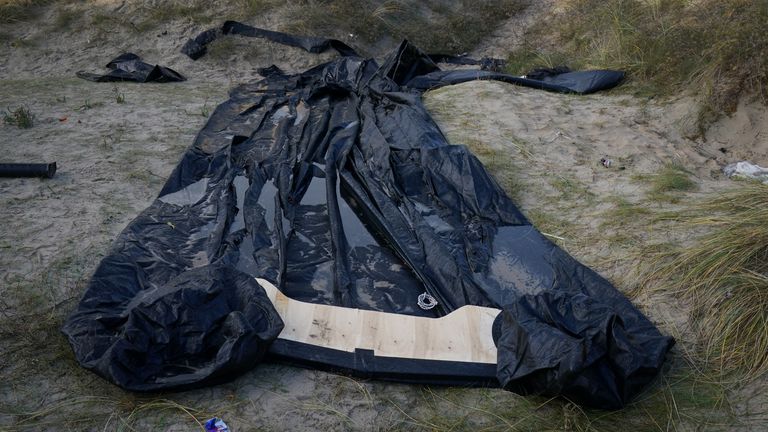
Debris of a small boat used by people thought to be migrants to cross the Channel lays amongst the sand dunes in Gravelines, France. Pic: PA
December is normally one of the quietest for Channel crossings, with a combination of poor visibility, low temperatures, less daylight and stormy weather making the perilous journey more difficult.
The most arrivals recorded in the month of December is 3,254, in 2024.
Deputy Prime Minister David Lammy met with ministers from other European countries this week as discussions over possible reform to the European Convention on Human Rights (ECHR) continue.
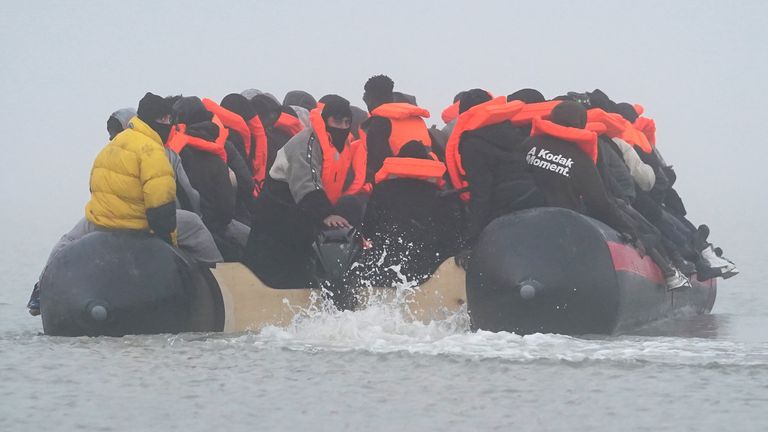
France agrees to start intercepting small boats
The issue of small boat arrivals – a very small percentage of overall UK immigration – has become a salient issue in British politics in recent years.
Last month, French maritime police announced they would soon be able to intercept boats in the English Channel.
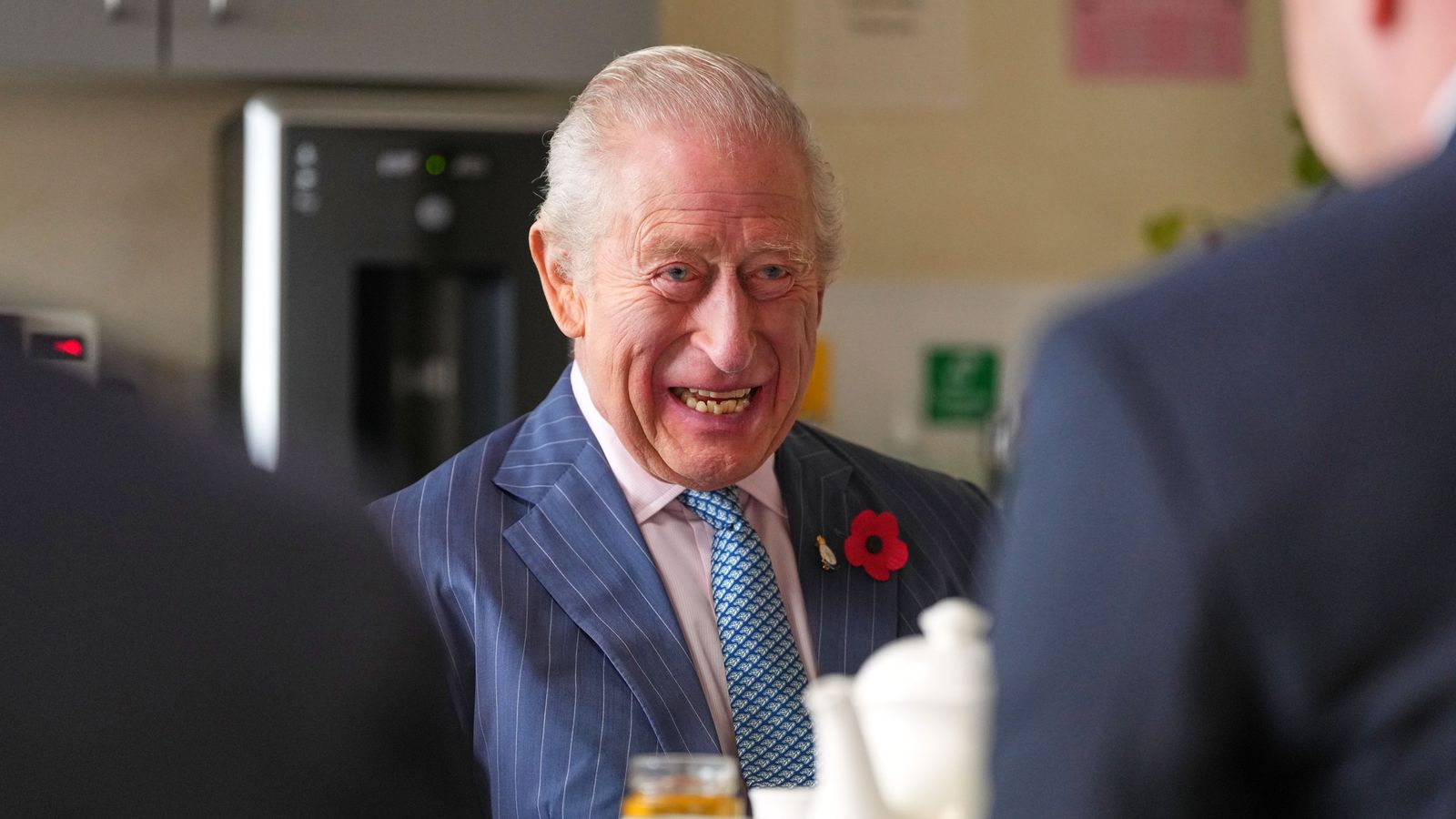
The King has shared in a television address that, thanks to early diagnosis, his cancer treatment can be reduced in the new year.
In a televised address, Charles said his “good news” was “thanks to early diagnosis, effective intervention and adherence to doctors’ orders”.
“This milestone is both a personal blessing and a testimony to the remarkable advances that have been made in cancer care in recent years,” he added.
“Testimony that I hope may give encouragement to the 50% of us who will be diagnosed with the illness at some point in our lives.”
The King announced in February 2024 that he had been diagnosed with cancer and was beginning treatment.
The monarch postponed all public-facing engagements, but continued with his duties as head of state behind palace walls, conducting audiences and Privy Council meetings.
He returned to public duties in April last year and visited University College Hospital Macmillan Cancer Centre in central London with the Queen and discussed his “shock” at being diagnosed when he spoke to a fellow cancer patient.
Sources suggested last December his treatment would continue in 2025 and was “moving in a positive direction”.
The King began returning to public duties in April last year. File pic: PA
The King has chosen not to reveal what kind of cancer he has been treated for. Palace sources have partly put that down to the fact that he doesn’t want one type of cancer to appear more significant or attract more attention than others.
In a statement after the speech aired, a Buckingham Palace spokesperson said: “His Majesty has responded exceptionally well to treatment and his doctors advise that ongoing measures will now move into a precautionary phase.”
Sir Keir Starmer praised the video message as “a powerful message,” and said: “I know I speak for the entire country when I say how glad I am that his cancer treatment will be reduced in the new year.
“Early cancer screening saves lives.”
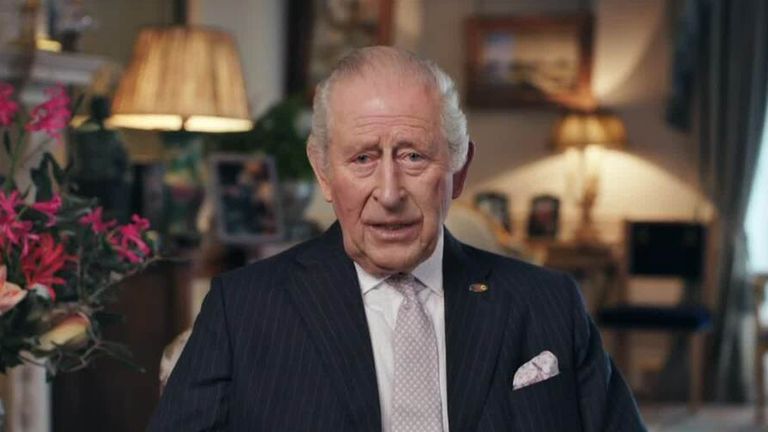
Watch: King Charles gives update on treatment
Early detection can give ‘the precious gift of hope’
His message on Friday was broadcast at 8pm in support of Stand Up To Cancer, a joint campaign by Cancer Research UK and Channel 4.
In an appeal to people to get screened for the disease early, the King said: “I know from my own experience that a cancer diagnosis can feel overwhelming.
“Yet I also know that early detection is the key that can transform treatment journeys, giving invaluable time to medical teams – and, to their patients, the precious gift of hope. These are gifts we can all help deliver.”
Charles noted that “at least nine million people in our country are not up to date with the cancer screenings available to them,” adding: “That is at least nine million opportunities for early diagnosis being missed.
“The statistics speak with stark clarity. To take just one example: When bowel cancer is caught at the earliest stage, around nine in ten people survive for at least five years.
“When diagnosed late, that falls to just one in ten. Early diagnosis quite simply saves lives.”
Minor inconvenience of screening ‘a small price to pay’
The King acknowledged that people often avoid screening “because they imagine it may be frightening, embarrassing or uncomfortable”. But, he added: “If and when they do finally take up their invitation, they are glad they took part.
“A few moments of minor inconvenience are a small price to pay for the reassurance that comes for most people when they are either told either they don’t need further tests, or, for some, are given the chance to enable early detection, with the life-saving intervention that can follow.”
Read more from Sky News:
Christmas tree chopped down hours after lights switch-on
More photos from Epstein’s estate released
Taylor Swift breaks down in tears over Southport attacks
Giving his “most heartfelt thanks” to doctors, nurses, researchers and charity workers, the King added: “As I have observed before, the darkest moments of illness can be illuminated by the greatest compassion. But compassion must be paired with action.
“This December, as we gather to reflect on the year past, I pray that we can each pledge, as part of our resolutions for the year ahead, to play our part in helping to catch cancer early.
“Your life – or the life of someone you love – may depend upon it.”
-
 Sports2 years ago
Story injured on diving stop, exits Red Sox game
-
 Sports3 years ago
‘Storybook stuff’: Inside the night Bryce Harper sent the Phillies to the World Series
-
 Sports2 years ago
Game 1 of WS least-watched in recorded history
-
 Sports3 years ago
Button battles heat exhaustion in NASCAR debut
-
 Sports3 years ago
MLB Rank 2023: Ranking baseball’s top 100 players
-
Sports4 years ago
Team Europe easily wins 4th straight Laver Cup
-
 Environment3 years ago
Japan and South Korea have a lot at stake in a free and open South China Sea
-
 Environment1 year ago
Here are the best electric bikes you can buy at every price level in October 2024