

Amazon starts cutting jobs, with layoffs hitting Alexa unit and cloud gaming division

Andy Jassy, chief executive officer of Amazon.Com Inc., speaks during the GeekWire Summit in Seattle, Washington, U.S., on Tuesday, Oct. 5, 2021.
David Ryder | Bloomberg | Getty Images
Amazon on Tuesday began laying off employees in its corporate and tech workforce as CEO Andy Jassy steps up efforts to rein in costs.
The company notified workers in several divisions, including Alexa and the Luna cloud gaming unit, that they were being let go, according to LinkedIn posts from Amazon employees who said they had been impacted.
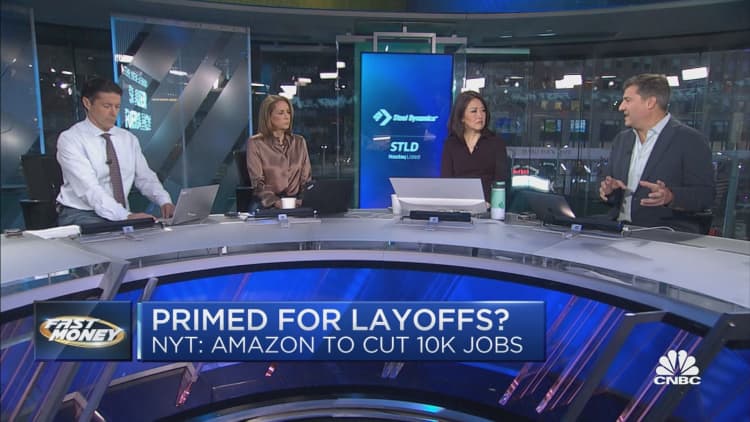
Amazon is aiming to eliminate about 10,000 jobs, mostly in retail, devices and human resources, The New York Times reported Monday. The number remains fluid because the cuts are being implemented by individual teams, according to the Times.
By midday Tuesday, Amazon had not sent out any companywide communication about the planned layoffs, which sparked frustration among employees, according to a person familiar with the matter who asked not to be named because of confidentiality.
Representatives from Amazon declined to comment.
In recent weeks, Amazon also began laying off some contracted employees who worked in recruiting roles for its advertising, internal operations, and Fire TV divisions, according to people with knowledge of the cuts.
One employee, who asked to remain anonymous, said Amazon informed her earlier this month that it wouldn’t be renewing her contract. Last month, she was in talks to pursue a full-time role in Amazon’s consumer division, but her interview was abruptly canceled due to ongoing restructuring, she was told.
The Amazon Spheres, part of the Amazon headquarters campus, right, in the South Lake Union neighborhood of Seattle, Washington, U.S., on Sunday, Oct. 24, 2021.
Chona Kasinger | Bloomberg | Getty Images
Jassy has aggressively curtailed expenses across the company in recent months as it stares down a weakening economy and slowing growth in its retail business. Previously, the company said it would pause hiring among its corporate workforce, and it has halted some experimental projects, as well as opted to close, delay or cancel new warehouse locations.
Until now, it had managed to avoid mass layoffs by offering employees impacted by project closures the opportunity to transfer to other divisions within the company.
The job cuts represent a stark reversal for Amazon, which less than a year ago couldn’t find enough workers to keep its warehouses staffed in a hot labor market and was still in the midst of a pandemic-fueled hiring spree. It nearly doubled its workforce between the end of 2019 and the end of 2021 from 798,000 employees globally to 1.6 million.
Since then, it has moved to slow headcount growth as consumers have returned to physical stores, and its retail business is no longer growing at a rapid clip as it has in recent years. Amazon CFO Brian Olsavsky last month said the company is seeing signs consumers are feeling the sting of inflation.
“We are preparing for what could be a slower growth period,” Olsavsky said on a call with reporters following the company’s third-quarter earnings results, which included weaker-than-expected guidance for the current period.
The company still plans to bring on 150,000 employees for the holiday shopping period, the same number of workers it said it would add last year.
Job cuts are hitting the tech sector hard after years of unbridled growth. Facebook parent Meta last week laid off 13% of its staff, while Twitter, Shopify, Salesforce and Stripe have also announced cuts.
The expected layoffs would represent the biggest cut in the company’s 28-year history. In 2001, Amazon slashed 1,300 jobs, or 15% of its workforce, after the dot-com bubble burst.
Technology
Disney making $1 billion investment in OpenAI, will allow characters on Sora AI video generator


The Walt Disney Company on Thursday announced it will make a $1 billion equity investment in OpenAI and will allow users to make videos with its copyrighted characters on its Sora app.
OpenAI launched Sora in September, and it allows users to create short videos by simply typing in a prompt.
As part of the startup’s new three-year licensing agreement with Disney, Sora users will be able make content with more than 200 characters across Disney, Marvel, Pixar and Star Wars starting next year.
“The rapid advancement of artificial intelligence marks an important moment for our industry, and through this collaboration with OpenAI we will thoughtfully and responsibly extend the reach of our storytelling through generative AI, while respecting and protecting creators and their works,” Disney CEO Bob Iger said in a statement.
Tune in at 10:30 a.m. ET as Disney CEO Bob Iger and OpenAI CEO Sam Altman joins CNBC TV to discuss the media giant’s investment. Watch in real time on CNBC+ or the CNBC Pro stream.
As part of the agreement, Disney said it will receive warrants to purchase additional equity and will become a major OpenAI customer.
Disney is deploying OpenAI’s chatbot ChatGPT to its employees and will work with its technology to build new tools and experiences, according to a release.
When Sora launched this fall, the app rocketed to the top of Apple’s App Store and generated a storm of controversy as users flooded the platform with videos of popular brands and characters.
The Motion Picture Association said in October that OpenAI needed to take “immediate and decisive action” to prevent copyright infringement on Sora.
OpenAI CEO Sam Altman said more “granular control” over character generation was coming, according to a blog post following the launch.
As AI startups have rapidly changed the way that people can interact with content online, media companies, including Disney, have kicked off a series of fresh legal battles to try and protect their intellectual property.
Disney sent a cease and desist letter to Google late on Wednesday alleging the company infringed its copyrights on a “massive scale.” In the letter, which was viewed by CNBC, Disney said Google has been using its copyrighted works to train models and distributing copies of its protected content without authorization.
Universal and Disney have sued the AI image creator Midjourney, alleging that the company improperly used and distributed AI-generated characters from their movies. Disney also sent a cease and desist letter to Character.AI in September, warning the startup to stop using its copyrighted characters without authorization.
Disney’s deal with OpenAI suggests the company isn’t ruling out AI platforms entirely.
The companies said they have affirmed a commitment to the use of AI that “protects user safety and the rights of creators” and “respects the creative industries,” according to the release.
OpenAI has also agreed to maintain “robust controls” to prevent illegal or harmful content from being generated on its platforms.
Some of the characters available through the deal include Mickey Mouse, Ariel, Cinderella, Iron Man and Darth Vader. Disney and OpenAI said the agreement does not include any talent likeness or voices.
Users will also be able to draw from the same intellectual property while using ChatGPT Images, where they can use natural language prompts to create images.
“Disney is the global gold standard for storytelling, and we’re excited to partner to allow Sora and ChatGPT Images to expand the way people create and experience great content,” Altman said in a statement.
Curated selections of Sora videos will also be available to watch on Disney’s streaming platform Disney+.
WATCH: We tested OpenAI’s Sora 2 AI-video app to find out why Hollywood is worried

Technology
Goldman Sachs leads investment in software delivery startup Harness at $5.5 billion valuation


Jyoti Bansal, co-founder and CEO of Harness, speaks at the company’s Unscripted conference in London on Sept. 25, 2025.
Harness
Almost nine years ago, Jyoti Bansal sold AppDynamics to Cisco for $3.7 billion just as the software startup was set to go public.
Bansal’s latest venture, Harness, is now worth substantially more than that, after raking in $200 million in fresh capital at a $5.5 billion valuation in a funding round led by Goldman Sachs.
Harness’ technology helps companies manage and monitor code that’s produced with the help of artificial intelligence, making sure it doesn’t break, create security vulnerabilities or trigger cost overruns. It’s a compliment to the so-called vibe coding trend that’s taken off with the boom in generative AI.
In recent months, venture capitalists have poured money into startups such as Cursor, Lovable and most recently Kilo Code that sell subscriptions for tools for directing AI models to write and update software. Harness’ software draws on models from Anthropic and OpenAI.
Earlier this year, Bansal bolstered Harness’ cybersecurity chops by merging the startup with Traceable, another company he co-founded. The combined company, based in San Francisco, has a total of about 1,300 employees.
Harness is on track to exceed its goal of more than $250 million in annualized revenue, growing more than 50% year over year, Bansal said. That makes it larger than AppDynamics at the time it was acquired by Cisco.
Bansal is aiming for a different outcome this time.
“I’m a believer that at the right market timing, we want to operate as a public company, so we can build for the long term,” Bansal said.
In addition to the funding round, Harness is also planning a $40 million tender offer to provide some liquidity to long-standing employees.
WATCH: ‘Vibe-coding’s’ evil twin? How AI ‘vibe-hacking’ is upending cyber security
Technology
Esusu, platform for renters to build credit scores, valued at $1.2 billion in new funding round


Esusu, a fintech platform that helps renters build credit scores, has raised $50 million in a Series C funding round at a $1.2 billion valuation.
Renters have remained largely excluded from the traditional credit system, with an estimated $1.4 trillion paid to landlords every year in the U.S., but only 20% of those landlords choosing to report the rent paid. As a result, millions of reliable renters remain in a category referred to as the “credit invisible.”
“110 million people in America rent … and less than 10% of that data shows up on their credit score,” said Esusu co-founder and CEO Wemimo Abbey in an interview on CNBC’s “Worldwide Exchange” on Thursday. “When people pay rent, we make sure it shows up in their credit score,” he said.
While on-time mortgage payments are known to increase one’s credit score, many renters don’t have any history of credit. Esusu reports on time rent payments to credit bureaus so renters can build their scores. Over 50 million Americans lack a credit history with the three major credit bureaus: Experian, Equifax and TransUnion.
The company says $30 billion in mortgages has already been accessed by renters who use its system.
“Esusu is fundamentally reshaping how the financial system can work for everyone,” Sean Mendy, partner at Westbound Equity Partners and a lead investor in the deal, said in a statement. “When people are given the tools to rise, they do.”
Esusu was ranked No. 49 on CNBC’s 2025 Disruptor 50 list.
Esusu partners with 65% of the largest commercial real estate owners and property managers in the U.S., as well as with banks. Since its launch in 2016, its platform has grown to support more than five million rental units nationwide, reaching about 12 million renters and processing nearly $100 billion in annual lease volume. Landlords that use its technology include Bell Partners, BH Management, Blackstone, Cortland, Invitation Homes, Jonathan Rose Companies, Kayne Anderson, Morgan Properties, Nuveen Real Estate, Pretium, Related Companies, TruAmerica, and WinnCompanies.
The fintech company plans to use the new funding to expand three initiatives. It will broaden distribution of its rent reporting API through what it calls “rent reporting as a service.” Among recent partners for this initiative, Esusu technology now reaches 228 million monthly active users through real estate platform Zillow. The company also plans to launch Esusu Pay in 2026, which will allow renters to split monthly rent into installments.
Esusu will also focus on the opportunity to make rental data a more prominent feature in mortgage underwriting. The Federal Housing Finance Agency has formalized the inclusion of rental data in mortgage underwriting, which will required verified rental and identity data. Esusu acquired identity verification firm Celeri early this year. Esusu already has partnerships with Fannie Mae and Freddie Mac to increase the number of units nationally that report rent as part of credit.
Esusu founders Abbey and Samir Goel grew up watching their families struggle financially as immigrants from Lagos, Nigeria, and New Delhi, India, respectively, which was a founding motivation for Esusu. “When we came here, we didn’t have a credit score. We went to one of the biggest financial institutions to borrow money; we were turned away and had to go borrow from a predatory lender who wanted to lend at over 400% interest rate,” Abbey told CNBC in a June 2025 interview. “My mother sold my dad’s wedding ring. We borrowed money from church members and that’s how we got started.”
-
 Sports2 years ago
Story injured on diving stop, exits Red Sox game
-
 Sports3 years ago
‘Storybook stuff’: Inside the night Bryce Harper sent the Phillies to the World Series
-
 Sports2 years ago
Game 1 of WS least-watched in recorded history
-
 Sports3 years ago
Button battles heat exhaustion in NASCAR debut
-
 Sports3 years ago
MLB Rank 2023: Ranking baseball’s top 100 players
-
Sports4 years ago
Team Europe easily wins 4th straight Laver Cup
-
 Environment3 years ago
Japan and South Korea have a lot at stake in a free and open South China Sea
-
 Environment1 year ago
Here are the best electric bikes you can buy at every price level in October 2024