Connect with us

Published

on

Nearly all of the new NHS funding announced by the chancellor will be eaten up by the costs of inflation and growing demand, with just £800m left over for the improvement of services.

In his autumn statement, Jeremy Hunt promised an additional £3.3bn in funding for the NHS for each of the next two years.

Analysis by the Nuffield Trust, shared exclusively with Sky News, suggests that rising prices and growing demand will use up three quarters of next year’s increase, and the entirety of the increase scheduled for 2024/25.

Half of the total funding boost is likely to be eaten up by inflation, as the UK endures a second year of rising prices. A Sky News analysis found that energy price increases added £121m to the running cost of NHS buildings in the year to March.

Inflation is expected to cost the health service £3.2bn over the next two years, while increased demand from a growing and ageing population is expected to cost the NHS a further £852m next year and £1.7bn the year after.

That leaves just £795m left over for improving services next year, a quarter of the £3.3bn headline funding boost.

The increase scheduled for 2024/25, meanwhile, is set to be entirely taken up in dealing with the pressures of inflation and growing demand.

More on Autumn Statement 2022

John Appleby, chief economist at the Nuffield Trust, said that the final amount “could be higher or lower”, depending on whether trusts overspend and whether certain key costs, like nurses’ pay, increase faster than expected.

Nurses are set to go on strike next month over the government’s decision not to raise their pay in line with inflation.

Rising energy costs are already putting NHS England’s finances under strain. Sky News analysis of data from NHS Digital found that an 18% rise in fuel prices added £121m to the running costs of the health service’s buildings in the year to March.

Many NHS trusts expect costs to rise further. A recent report by the British Medical Journal found that some trusts were budgeting for an additional £2m per month in fuel costs next year.

Nottingham University Hospitals NHS Trust confirmed to Sky News that it expects its annual energy bills to more than triple in 2023, adding £24m to its running costs.

It’s not just energy prices that are rising. The increased costs of hiring cleaners, for instance, has added £76m to the health service’s expenses over the past year, while higher costs for providing inpatient meals has added a further £38m.

Matthew Taylor, chief executive of NHS Providers, told Sky News that the new money promised by the chancellor would allow the NHS to “just about keep the show on the road”.

“It will enable us to continue to manage a very difficult situation, and hopefully make further progress in areas like waiting lists.

“What it won’t do is address the fundamental issues and get the NHS to where the public would like it to be.”

More than 7 million people in England are currently waiting for treatment. That’s nearly one in eight of the population, and the number has been rising for 28 consecutive months.

NHS tracker postcode search: See how your local trust is performing through the year

The number of people waiting more than four hours at A&E is also at record levels, while ambulance response times are far above target.

David Maguire, senior analyst at the King’s Fund, told Sky News that local NHS trusts were likely to face “really, really tough decisions” about where to focus their resources in the coming years.

“You always have to prioritise emergency and urgent care. That might mean less focus on goals like improving productivity or investing in preventative care. We’re already seeing a pull back at the NHS England-level on some of the funding for transformation efforts, for example around digital technology and data usage.”

This wouldn’t be the first time the NHS has cut back on long-term investments in order to free up resources for frontline services.

Between 2014 and 2019, £4.3bn earmarked for capital investment was instead used to fund day-to-day spending.

That decision has left the NHS with a backlog of maintenance work worth £10.2bn – equivalent to 92% of the entire annual cost of running the NHS estates.

Nearly a fifth of that backlog (£1.8bn worth) is classified as “high risk”, meaning it could result in “catastrophic failure, major disruption to clinical services or deficiencies in safety liable to cause serious injury or prosecution”.

“We’ve got some hospitals which are currently being held up by struts,” said Mr Taylor.

“That’s not what you want people to be doing – lying in a hospital bed looking at a temporary strut holding up the roof. These hospitals aren’t currently dangerous, but in time they will become dangerous and this needs to be addressed.”

Dealing with the maintenance backlog is increasingly hampering the ability of trusts to invest in improving services. Last year, the NHS spent £1.4bn dealing with the maintenance backlog, 16% of its entire capital budget.

And that capital budget is already low by international standards. In the decade before the pandemic, OECD data shows, the UK’s long-term investments in the healthcare sector amounted to just 0.25% of GDP – compared to 0.38% in France and 0.69% in the US.

Reducing the waiting list

In order to reduce the number of patients waiting for treatment, NHS England set a target in February of returning NHS activity to pre-pandemic levels by early 2022-23, and increasing activity a further 29% within two years.

Thousands of additional staff have been hired in recent years, but the impact of COVID-19 and the demand of the target means that the NHS is still short of staff.

Trusts are increasingly hiring expensive agency workers to fill the gaps, adding further pressure to the budget.

Spending on agency workers reached £3bn in the year to March, up from £2.4bn two years earlier.

Hours before the chancellor’s statement on Thursday, the National Audit Office said the NHS was unlikely to meet its activity targets, pointing to the impact of inflation, staff shortages and productivity issues.

Despite a 13% increase in the number of clinical staff since 2018, the number of people being removed from the NHS waiting list each month has risen by just 2%.

NHS chief executive Amanda Pritchard said the chancellor’s decision to increase funding for the health service showed that “the government has been serious about its commitment to prioritise the NHS”.

“While I am under no illusions that NHS staff face very testing times ahead, particularly over winter, this settlement should provide sufficient funding for the NHS to fulfil its key priorities,” she said.

Continue Reading

UK

Royal Navy chief gives stark warning: Fund defence or risk losing Atlantic to Russia

Published

on

By

Royal Navy chief gives stark warning: Fund defence or risk losing Atlantic to Russia

The head of the Royal Navy has warned the government to “step up” and fund defence or risk losing the UK’s superiority in the Atlantic to Russia.

Should that happen, General Sir Gwyn Jenkins said it would be the first time since the end of the Second World War that Britain’s warships and submarines were not the dominant force in their most vital sea lanes alongside their allies.

“We are holding on, but not by much,” he told a conference in London on Monday.

“There is no room for complacency. Our would-be opponents are investing billions. We have to step up, or we will lose that advantage.”

As a senior, serving military officer speaking publicly, he did not make any direct criticism of the speed of plans by Sir Keir Starmer’s government to increase defence spending.

But Sky News has reported that he and his fellow chiefs held a “very difficult meeting” last month over how to fund plans to rebuild the armed forces amid fears of further cuts.

Please use Chrome browser for a more accessible video player

Budget: what about defence spending?

Defence sources said there was growing concern at the very top of the armed forces about a gap between the promises being made by the prime minister to fix the UK’s hollowed-out defences and the reality of the size of the defence budget, which is currently not seen as growing fast enough.

That means either billions of additional pounds must be found more quickly, or ambitions to modernise and transform the armed forces might need to be curbed, despite warnings of mounting threats from Russia and China, and pressure from Donald Trump on allies to spend more on their own defences.

A Sky News and Tortoise podcast series called The Wargame tracks the hollowing out of the UK’s military since the end of the Cold War and the risk that has created.

👉Search for The Wargame on your podcast app👈

General Jenkins, the first Royal Marine to serve as First Sea Lord, used a speech at the Sea Power Conference to say that Russia is still investing billions in its naval capabilities – in particular the Northern Fleet that operates in the Atlantic – even as it wages war against Ukraine.

There has been a 30% increase in Russian incursions in the North Atlantic in the past two years, he said.

That included the Yantar spy ship, which last month was spotted off the coast of Scotland and even shone a laser at the pilots of a Royal Air Force reconnaissance plane that was tracking the vessel.

The Russian spy ship Yantar. Pic: MOD/PA
Image:
The Russian spy ship Yantar. Pic: MOD/PA

Yet General Jenkins said what Russia is doing beneath the surface of the waves, where the UK and its allies store vital communications cables as well as critical oil and gas pipelines, was even more concerning.

“I can also tell you today that the advantage that we have enjoyed in the Atlantic since the end of the Second World War is at risk,” he said.

Read more:
UK unveils undersea tech
Does Britain’s threat to Russia ring hollow?
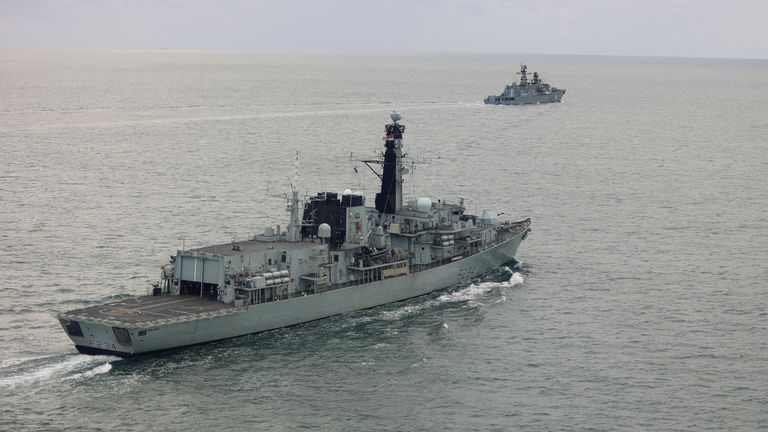
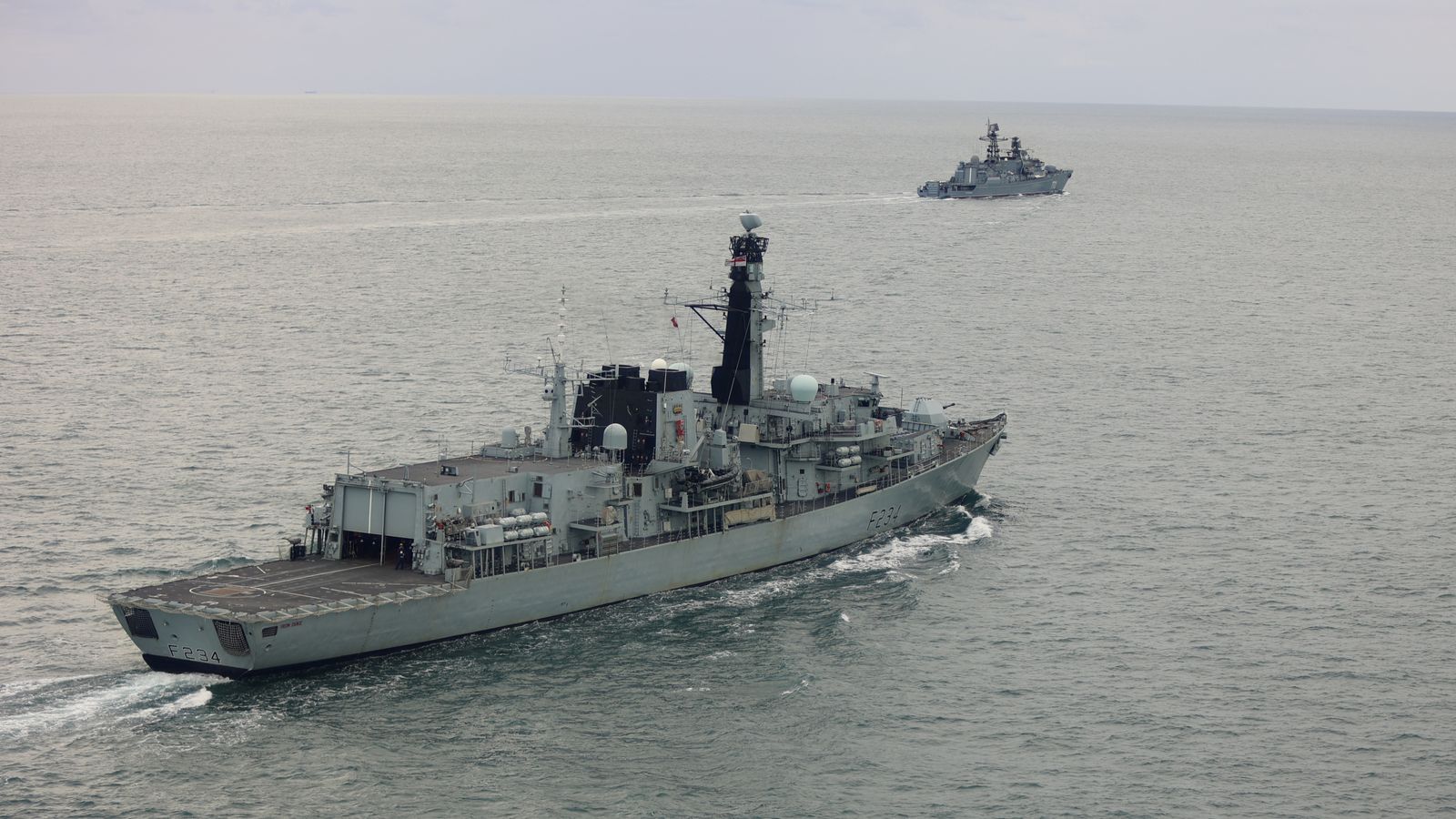
HMS Iron Duke shadowing the Russian Frigate Neustrashimy through UK waters in September. Pic: PA
Image:
HMS Iron Duke shadowing the Russian Frigate Neustrashimy through UK waters in September. Pic: PA

Navy facing huge challenges

It is a particularly tough time for the navy, which has more ships and submarines alongside and unable to operate than at sea or at least ready to sail.

The service is also suffering from a shortage of sailors and in particular submariners, which again is impacting the availability of the fleet.

The crisis follows decades of funding cuts since the end of the Cold War, compounded by a litany of botched procurement programmes that has all too often seen vessels coming into service years late, at an inflated price and in too few numbers.

Vision of ‘hybrid navy’

Despite the sombre tone, the First Sea Lord set out how he wants to transform his service and make it ready to fight a war – though not until 2029, a timeline that could be too slow if some predictions about the threat posed by Russia to NATO are correct.
Please use Chrome browser for a more accessible video player

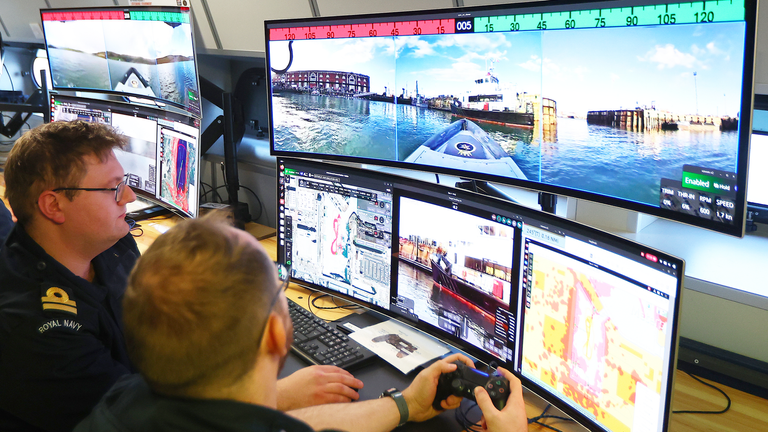
New UK military technology unveiled

His vision – working with industry and other allies – is about developing a blend of manned ships and submarines as well as unmanned ones – a “hybrid navy”.

He is also stripping back what he called the navy’s own bureaucracies to enable the service to move much faster – crucially at the pace of the threat and the pace of rapid and growing technological change.

“We will face headwinds, we will face rough seas, but together, we can solve these problems if we have the appetite, if we have the determination, and if we have the mindset.”

Continue Reading

UK

Teen Afghan asylum seekers locked up for raping girl

Published

on

By

Teen Afghan asylum seekers locked up for raping girl

Two teenage asylum seekers from Afghanistan face possible deportation after being detained for abducting and raping a 15-year-old girl.

Jan Jahanzeb and Israr Niazal, both 17, led the “highly-distressed” victim away from friends near Leamington town centre to a secluded “den-type” area in parkland, where they pushed her to the ground and attacked her.

Sentencing the pair at Warwick Crown Court on Monday, Judge Sylvia de Bertodano said they ignored the victim’s “vigorous protests” and told them what they did “changed her life forever”.

“No child should have to suffer the ordeal that she suffered. It’s clear from the footage we have seen that no one can seriously entertain the thought that you believed she was consenting,” she said.

“You both knew perfectly well that what you were doing was criminal and wrong,” the judge added.

‘Highly distressing’

After lifting reporting restrictions protecting the identities of the defendants, the judge told them they had “betrayed” those who come to Britain seeking sanctuary and who observed the law.

Both defendants were unaccompanied child asylum seekers who arrived in the UK last year, prosecutor Shawn Williams said.

The incident happened in May of this year.

“Highly distressing” phone video found by police showed the victim screamed for help, but Jahanzeb placed his hand over her mouth.

CCTV footage showed that after being led away against her will, the terrified victim was “moved to a bushy den-type area – a really secluded location” before, according to her, she was “pushed to her knees before being raped”.

“The prosecution case is that it was probably Jahanzeb that did that, but what is certain is that Israr Niazal was present and participating,” Mr Williams said.

The victim had made “explicit verbal protests” during what Mr Williams described as an abduction.

What are their sentences?

Jahanzeb, who has already been served with deportation notification papers, was given 10 years, eight months’ youth detention.

Niazal, who may also be deported, was sentenced to nine years and 10 months.

They will start their sentences in a young offenders’ institution and move to prison at a later date, police said.

Both pleaded guilty to rape at an earlier hearing.

Read more from Sky News:
Storm brings ‘danger to life’
Rapper admits dangerous driving
My ‘traumatic’ maternity experience

Detective Chief Inspector Richard Hobbs said the offenders “went out of their way to befriend the victim with the intention of raping her”.

“The length of their sentence reflects the severity of their crime and the need to protect the public from them,” he added.

After sentence was passed, Judge de Bertodano said the victim had been “beyond brave” in attending court at a previous stage, when the defendants had intended to plead not guilty.

They were both ordered to register as sex offenders.

Continue Reading

UK

‘Striking’ new artwork for UK trains revealed – as MPs debate rail nationalisation

Published

on

By

'Striking' new artwork for UK trains revealed - as MPs debate rail nationalisation

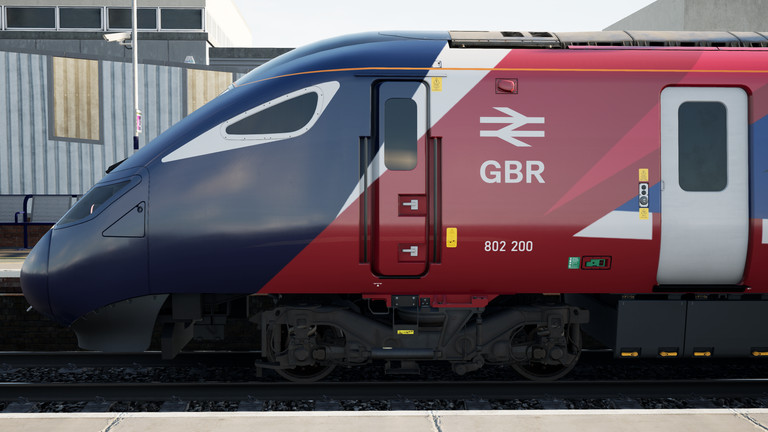
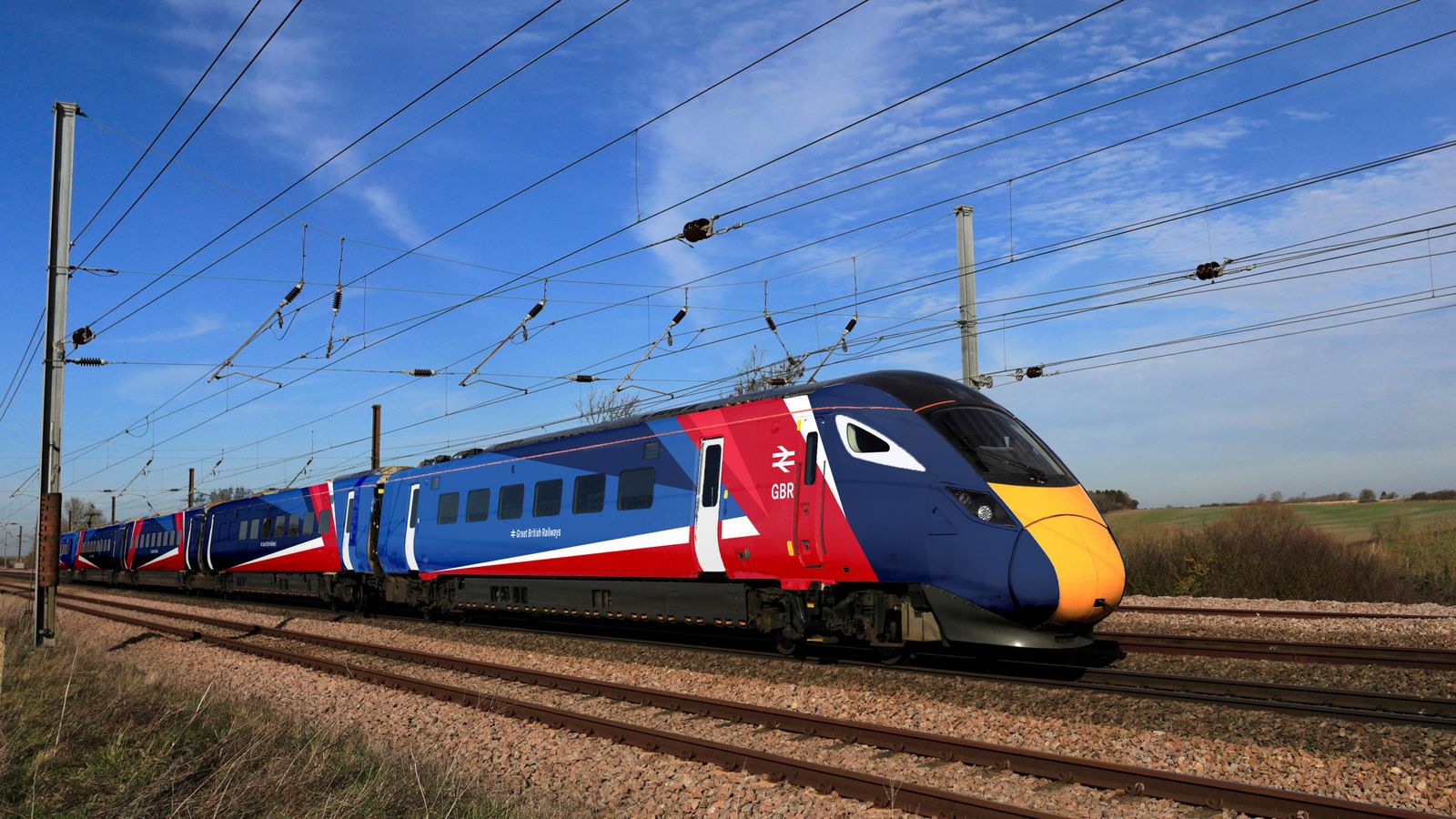
A “striking” new design for UK trains has been revealed by the transport secretary – but you may well think it looks familiar.

Train services already in public ownership will begin to adopt a Union flag-inspired design from this spring, Heidi Alexander has confirmed.

It’s part of the government’s efforts to nationalise most passenger rail services in the UK and run them under the new Great British Railways (GBR) brand – with its logo to be unveiled later today.

Ms Alexander will be speaking more about GBR – which is due to be formally established in 2027 – on Mornings With Ridge And Frost from around 7.10am.

The new Great British Railways logo has drawn on the original logo of British Rail from 1965.
Pic: Dovetail Games.
Image:
The new Great British Railways logo has drawn on the original logo of British Rail from 1965.
Pic: Dovetail Games.

Haven’t I seen this somewhere before?

The branding features the familiar double arrow symbol used by British Rail when the country’s trains were last state-owned.

A spokesperson for the Department for Transport (DfT) said the “iconic” symbol has been incorporated into the new GBR logo to reflect “Britain’s proud railway heritage”.

Ms Alexander has insisted it “isn’t just a paint job”, saying: “It represents a new railway, casting off the frustrations of the past and focused entirely on delivering a proper public service for passengers.”

Special one-day public exhibition launched

People in the capital will be able to see the new train livery for themselves today, with a special one-day exhibit being held at London Bridge station, where a GBR-branded Hornby model train will be on display.

The government has also partnered with a gaming company to create mock-ups of the new design, and those at the station will be able to see a digital demonstration of the new artwork in Train Sim World 6.

The new designs will also be beamed on to digital display boards over the coming days at Manchester Piccadilly, Birmingham New Street, Glasgow Central, and Leeds City.
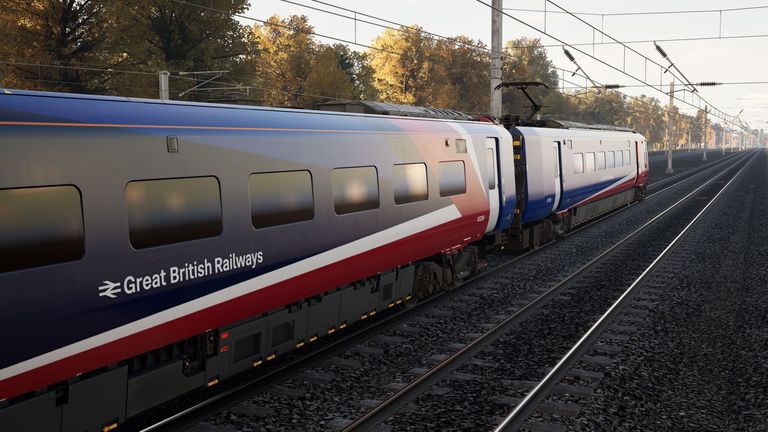
People in the capital will be able to see a mock-up of a train in the new livery in a Train Sim World 6 game.
Pic: Dovetail Games.
Image:
People in the capital will be able to see a mock-up of a train in the new livery in a Train Sim World 6 game.
Pic: Dovetail Games.

It comes as MPs prepare to debate the government’s Railways Bill in the Commons.

The government has taken control of seven major operators so far, but has pledged to return all passenger services to public ownership as contracts with existing operators expire or are broken through a failure to deliver.

Read more:
What is Labour’s rail nationalisation plan?

Rail fares frozen for first time in 30 years

What will nationalisation actually involve?

The government has said its Railways Bill will bring 17 different organisations together and will also lead to greater accountability, better services and an easier way to buy tickets.

Among the measures is the creation of a GBR app, where passengers will be able to check train times and buy tickets without booking fees, while those with disabilities will be able to also request assistance.

A new 'one-stop shop' app will be launched as part of the scheme.
Pic: Department for Transport
Image:
A new ‘one-stop shop’ app will be launched as part of the scheme.
Pic: Department for Transport

The draft law would also beef up accountability by creating a strengthened Passenger Watchdog, while GBR would operate both services and maintain the railways themselves.

Ministers have pointed to improvements to existing services since they have been nationalised, such as South Western Railway boosting capacity by almost 10% by quadrupling its number of Arterio trains in service.

A new East Coast Main Line timetable will also come into effect this month, which the government says will lead to 10,000 extra LNER services every year, or roughly 60,000 extra seats a week.

Continue Reading

Trending