
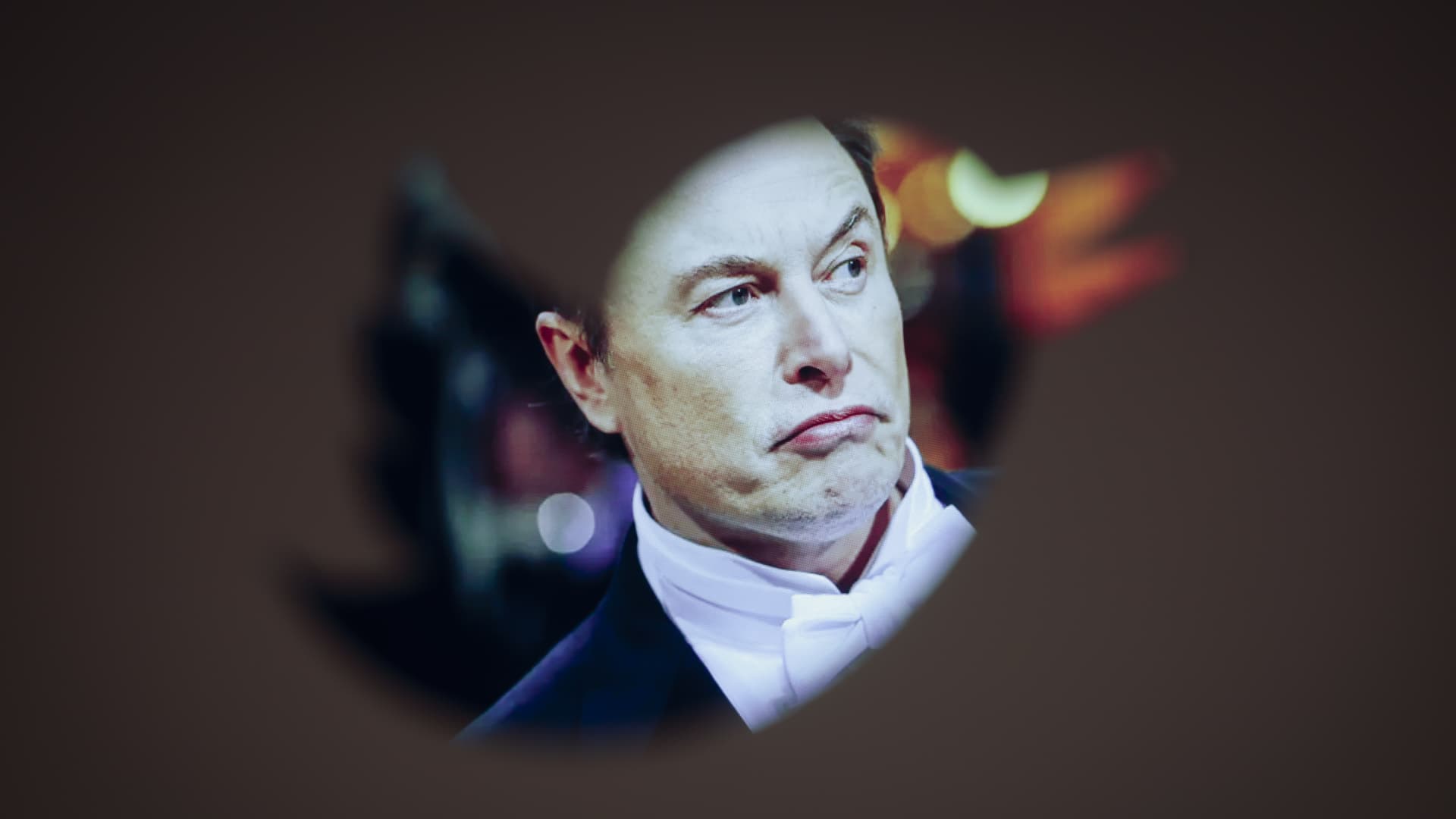
EU threatens Elon Musk with sanctions after Twitter’s suspension of journalists

STR | Nurphoto | Getty Images
The European Union on Friday threatened tech billionaire Elon Musk with sanctions after Twitter removed several journalists that report on him and the social media company.
Vera Jourova, the European Commission’s vice president for values and transparency, said in a tweet that news of the “arbitrary suspension of journalists on Twitter is worrying.”
Late Thursday, Twitter abruptly suspended several high-profile journalists who cover him, including CNN correspondent Donie O’Sullivan and Ryan Mac, a reporter at The New York Times.
He suggested these journalists violated Twitter’s policy on “doxxing,” or exposing a person’s identifiable information.
It comes after the account @ElonJet, which tracked the location of Musk’s private jet using publicly available flight data, was suspended by Twitter.
Musk now faces possible sanctions from the EU.
“EU’s Digital Services Act requires respect of media freedom and fundamental rights,” said Jourova. “This is reinforced under our #MediaFreedomAct. @elonmusk should be aware of that.”
“There are red lines. And sanctions, soon,” she added.
Jourova didn’t add any further details on the sanctions. Under the EU’s Digital Services Act, companies can be fined up to 6% of their global annual revenues for breaches.
The DSA, which entered into force on Nov. 16, requires large platforms to reduce harms online, implement protections for users’ rights and issue transparency reports.
Big Tech platforms are required to report the number of active end users they have to the Commission by February 2023. They then have until four months after the bloc completes reviews of the numbers to comply with the rules.
Musk has served as Twitter’s CEO since October after buying the company for $44 billion.
The Tesla and SpaceX boss, a self-described “free speech absolutist,” has troubled politicians and civil liberties activists with steps to restore the accounts of banned users, including former U.S. President Donald Trump, and the laying off of thousands of Twitter’s employees.


Palantir Technologies CEO Alex Karp attends the Pennsylvania Energy and Innovation Summit on the campus of Carnegie Mellon University in Pittsburgh, Pennsylvania, July 15, 2025.
Andrew Caballero-reynolds | Afp | Getty Images
Palantir expanded its lawsuit against two former employees on Thursday to include the CEO of their new artificial intelligence startup, Percepta AI.
In the suit, Palantir alleged that Percepta CEO and co-founder Hirsh Jain, co-founder Radha Jain, and a third employee, Joanna Cohen, violated their non-solicitation agreements, hiring top talent to create a competitive business.
Palantir and Percepta didn’t immediately respond to CNBC’s request for comment.
The three defendants are accused of attempting to “poach” executives and developers from their former company and “plunder Palantir’s valuable intellectual property.”
Cohen and Radha Jain, who were named in the original lawsuit filed in October, were previously senior engineers at Palantir. Hirsh Jain, an executive responsible for the company’s healthcare portfolio, was added as another defendant in the latest complaint.
Palantir said the defendants were “entrusted” with the company’s “crown jewels,” including source code, customer workflows and proprietary customer engagement strategies.
The former employees “brazenly disregarded their contractual and legal commitments to Palantir and instead chose a path of deception and unjust competition,” the plaintiffs said in the document, which was filed in the U.S. District Court for the Southern District of New York.
Cohen and Radha Jain denied the initial allegations in a November filing, and agreed to stop working for Percepta during the proceedings.
The suit accused Hirsh Jain, who resigned from Palantir in August 2024, of an “aggressive campaign” to recruit other employees to join Percepta, and said the startup has already hired at least 10 former Palantir employees.
An alleged message written by Hirsh Jain in November 2024 read, “I’m down to pillage the best devs at palantir when they’re at their maximum richness.”
The complaint says Rhada Jain wrote another message saying, “God thinking about poaching is so fun.”
Palantir, which was co-founded by Peter Thiel, CEO Alex Karp and others, builds analytics software for companies and government agencies, including the U.S. military. The company’s stock price has soared more than tenfold since the end of 2023, lifting its market cap close to $450 billion.
Palantir also accused Cohen of sending herself highly confidential documents shortly after announcing her resignation from the company in March. Cohen allegedly took photos of sensitive information, the suit said, and downloaded the files onto her personal phone.
“At Percepta, they seek to succeed not through old-fashioned ingenuity and competition, but through outright theft and deceit,” Palantir said in the filing.
Among other things, Palantir is asking for the defendants to be forced to return any confidential information in their possession, and to avoid working at Percepta or venture backer General Catalyst for 12 months from the time of an order.
Technology
Trump ‘sells out’ U.S. national security with Nvidia chip sales to China, Sen. Warren says


Sen. Elizabeth Warren, D-Mass., speaks during a Senate Banking, Housing and Urban Affairs Committee confirmation hearing on President Donald Trump’s nominees to lead the National Economic Council, Consumer Financial Protection Bureau and Federal Housing Finance Agency, on Capitol Hill in Washington, Feb. 27, 2025.
Annabelle Gordon | Reuters
President Donald Trump‘s decision to let Nvidia sell its advanced H200 artificial intelligence chips to China “sells out American national security,” Sen. Elizabeth Warren, D-Mass., said Thursday.
Warren also reiterated her call for Nvidia CEO Jensen Huang to testify before Congress about the agreement, along with Commerce Secretary Howard Lutnick.
The senator’s fiery remarks on the Senate floor came three days after Trump announced on social media that the U.S. semiconductor giant Nvidia could sell the chips to “approved customers” in China, so long as the U.S. gets a 25% cut of the revenues.
The announcement drew concerns both from Democrats and some of Trump’s Republican allies, who have been vocal about protecting America’s hardware advantage over China in the race to AI superiority.
Warren, in Thursday’s remarks, urged Congress to pass bipartisan legislation that “reins in this administration” by imposing new chip export restrictions. Critics of the bill say it could undermine U.S. chipmakers’ competitiveness.
The Trump administration knows that China gaining access to the chips, which have previously been subject to export restrictions, “poses a serious threat to our technological leadership and national security,” Warren said on the Senate floor.
She noted that shortly before Trump announced his decision on the H200 chips on Monday, the Department of Justice touted a crackdown touted a crackdown on a “major China-linked AI tech smuggling network.”
“So why did the President make this bad deal that sells out the American economy and sells out American national security?” she asked. “It’s simple: In the Trump administration, money talks.”
“Mr. Huang understands that in this administration, being able to cozy up to Donald Trump might be the most important corporate CEO skill of all,” Warren said.
She pointed to Huang attending a $1 million-per-plate dinner at Trump’s Florida home Mar-a-Lago, and Nvidia’s later donations to the president’s under-construction White House ballroom.
“Those are just the most obvious possible reasons to cut this deal,” Warren said, “and who knows what else Mr. Huang might have done behind closed doors to persuade President Trump and Secretary Lutnick into making this dangerous concession.”
CNBC has reached out to Nvidia for comment on the senator’s remarks.


The Axiom-4 mission, with a SpaceX Dragon spacecraft and Falcon 9 rocket, lifts off from Launch Complex 39A at NASA’s Kennedy Space Center in Cape Canaveral, Florida, June 25, 2025.
Giorgio Viera | AFP | Getty Images
Elon Musk responded to the latest report that SpaceX is going public in 2026, calling it “accurate.”
The article from Ars Technica’s Eric Berger examined why this is the right time for Musk’s space venture to IPO, and said the rise of artificial intelligence and opportunities for data centers in space play an important role in the move.
“As usual, Eric is accurate,” Musk wrote on his social media platform X in response to Berger’s article.
Musk’s comment comes after multiple news outlets said that SpaceX was looking to go public in 2026, with The Information and Wall Street Journal both reporting last week on the likeliness of an IPO, as well as a new share sale valuing the company at about $800 billion.
Bloomberg said this week that the company was pursuing an IPO in 2026 and is looking to raise more than $30 billion.
Over the weekend, Musk said on X that reports of the $800 billion valuation were “not accurate” and addressed the amount his company gets from NASA.
“While I have great fondness for @NASA, they will constitute less than 5% of our revenue next year,” Musk wrote. “Commercial Starlink is by far our largest contributor to revenue. Some people have claimed that SpaceX gets ‘subsidized’ by NASA. This is absolutely false.”
SpaceX didn’t immediately respond to a request for comment.
Heading into 2026, SpaceX and Tesla CEO Musk look set to gain a powerful ally in the government’s space program.
Jared Isaacman, who paid millions to lead two private spaceflights with SpaceX in 2021 and 2024, is likely to become the next NASA administrator and was voted through committee on Monday.
He now heads to a full Senate vote for confirmation.
SpaceX is a key contractor for NASA, but acting administrator Sean Duffy has criticized Musk’s space operation for being behind on the Artemis moon trip, which has seen several delays.
Musk lashed out at Duffy, accusing him on X of “trying to kill NASA!”
Duffy, who is the secretary of transportation, was handed the reins of the space program this summer by President Donald Trump, after he pulled Isaacman’s nomination following a clash with Musk.
Trump said at the time that Isaacman’s relationship with Musk represented a conflict of interest.
The renomination of Isaacman at the beginning of November signaled that the relationship between Trump and Musk was on the mend, and the Tesla CEO’s attendance at a White House dinner later that month solidified the return to camaraderie.
— CNBC’s Lora Kolodny contributed to this report.
-
 Sports2 years ago
Story injured on diving stop, exits Red Sox game
-
 Sports3 years ago
‘Storybook stuff’: Inside the night Bryce Harper sent the Phillies to the World Series
-
 Sports2 years ago
Game 1 of WS least-watched in recorded history
-
 Sports3 years ago
Button battles heat exhaustion in NASCAR debut
-
 Sports3 years ago
MLB Rank 2023: Ranking baseball’s top 100 players
-
Sports4 years ago
Team Europe easily wins 4th straight Laver Cup
-
 Environment3 years ago
Japan and South Korea have a lot at stake in a free and open South China Sea
-
 Environment1 year ago
Here are the best electric bikes you can buy at every price level in October 2024