
Intel shares drop on weak quarterly results and expectations for another quarter of losses

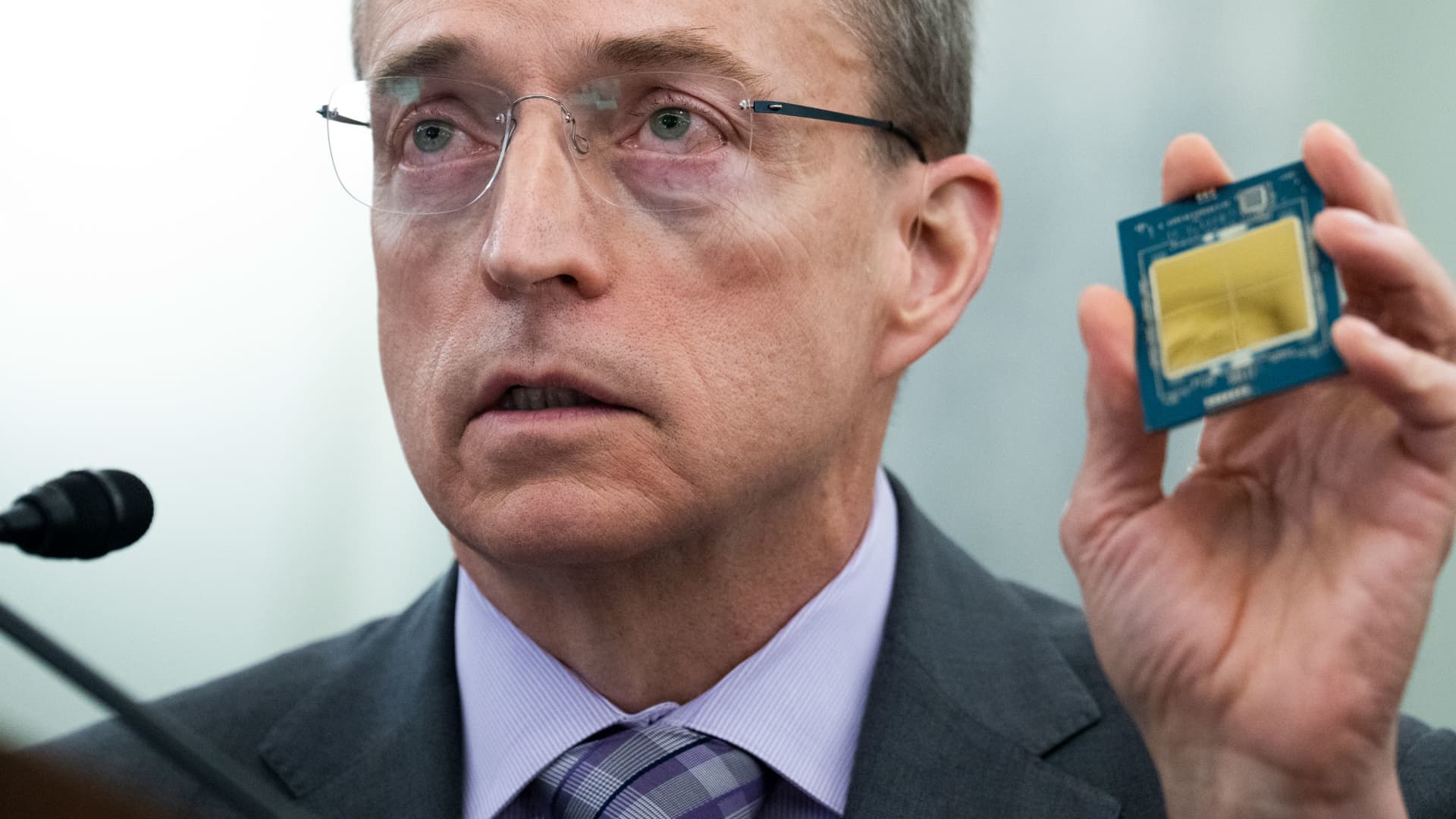
Pat Gelsinger, CEO, of Intel Corporation, testifies during the Senate Commerce, Science, and Transportation hearing on semiconductors titled Developing Next Generation Technology for Innovation, in Russell Senate Office Building on Wednesday, March 23, 2022.
Tom Williams | CQ-Roll Call, Inc. | Getty Images
Intel shares slid by as much as 9% in extended trading on Thursday after the chipmaker issued fourth-quarter results that failed to meet analysts’ estimates and gave a weaker-than-expected forecast.
Here’s how the company did:
- Earnings: 10 cents per share, adjusted, vs. 20 cents per share as expected by analysts, according to Refinitiv.
- Revenue: $14.04 billion, vs. $14.45 billion as expected by analysts, according to Refinitiv.
Intel’s revenue declined 32% year over year in the quarter that ended Dec. 31, according to a statement. It’s the fourth consecutive quarter of falling sales as the market for personal computers retreats from the Covid boom.
The company recorded a $664 net loss, compared with a profit of $4.62 billion in the year-ago quarter.
Investors can expect more pain in the first quarter. Intel called for adjusted net loss of 15 cents per share on $10.5 billion to $11.5 billion in revenue. Analysts polled by Refinitiv had expected earnings of 24 cents per share and $13.93 billion in revenue.
Intel declined to provide a full-year forecast because of “the uncertainty in the current environment,” CEO Pat Gelsinger said on a conference call with analysts. For at least the first half of the year, Intel will deal with “persistent economic headwinds,” the company said in a presentation on its results.
In the fourth quarter, Intel’s Client Computing Group, which includes PC chips, contributed $6.63 billion in revenue, down 36% and below the $7.68 billion consensus among analysts polled by StreetAccount. Demand fell mainly in consumer and education markets, and customers lowered their inventory, Intel said. Gartner said the PC market shrank more sharply than any quarter since it began following the industry in the 1990s.
On January 12, Intel saw a total addressable market for 270 million to 295 million PCs in 2023. On Thursday the company said it now expects the market to be on the low end of that range.
The Data Center and AI segment, consisting of server chips, memory and field-programmable gate arrays, recorded $4.30 billion in revenue, down 33% but still more than the $4.17 billion consensus from StreetAccount. Intel said it encountered competitive pressure and a decline in market size.
Intel’s Network and Edge segment, containing networking products, posted $2.06 billion in revenue. That’s 1% less than in the year-ago quarter, and lower than the $2.26 billion StreetAccount consensus.
Business conditions are now “driving near-term under-loading in our factory network,” Gelsinger said.
Under-load charges, which accrue when factories are underutilized, narrowed Intel’s gross margin in the fourth quarter by 220 basis points (2.2%), David Zinsner, Intel’s finance chief, said on the call. In the first quarter loading issue will hurt gross margin by 400 basis points, Zinsner said.
“We would expect loadings to improve once we get past the inventory correction we’re currently experiencing,” Zinsner said.
During the quarter, Mobileye, an autonomous driving hardware and software supplier that Intel acquired for $15.3 billion in 2017, debuted on the Nasdaq. Intel still controls most of the voting power of Mobileye’s common stock.
Intel said that in January it lengthened the useful life of some equipment from five years to eight years, which will boost 2023 gross profit by $2.6 billion. That move is separate from the $3 billion cost-savings plan for 2023 Intel announced in its earnings statement in October. Amazon and Microsoft have made similar accounting adjustments for their server and networking equipment in recent years, and IBM on Wednesday followed suit.
Intel stock has slid about 42% in the past year, while the S&P 500 index is off by 7% over the same period.
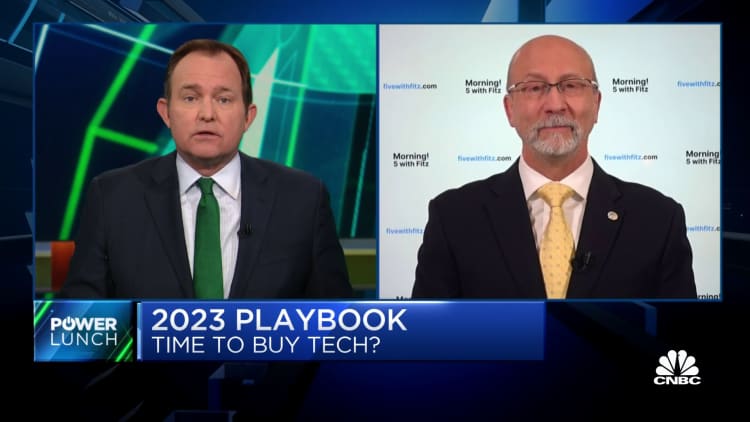
WATCH: AMD and Intel are priced like they’re going out of business, says Keith Fitz-Gerald


Oracle CEO Clay Magouyrk appears on a media tour of the Stargate AI data center in Abilene, Texas, on Sept. 23, 2025.
Kyle Grillot | Bloomberg | Getty Images
Oracle on Friday pushed back against a report that said the company will complete data centers for OpenAI, one of its major customers, in 2028, rather than 2027.
The delay is due to a shortage of labor and materials, according to the Friday report from Bloomberg, which cited unnamed people. Oracle shares fell to a session low of $185.98, down 6.5% from Thursday’s close.
“Site selection and delivery timelines were established in close coordination with OpenAI following execution of the agreement and were jointly agreed,” an Oracle spokesperson said in an email to CNBC. “There have been no delays to any sites required to meet our contractual commitments, and all milestones remain on track.”
The Oracle spokesperson did not specify a timeline for turning on cloud computing infrastructure for OpenAI. In September, OpenAI said it had a partnership with Oracle worth more than $300 billion over the next five years.
“We have a good relationship with OpenAI,” Clay Magouyrk, one of Oracle’s two newly appointed CEOs, said at an October analyst meeting.
Doing business with OpenAI is relatively new to 48-year-old Oracle. Historically, Oracle grew through sales of its database software and business applications. Its cloud infrastructure business now contributes over one-fourth of revenue, although Oracle remains a smaller hyperscaler than Amazon, Microsoft and Google.
OpenAI has also made commitments to other companies as it looks to meet expected capacity needs.
In September, Nvidia said it had signed a letter of intent with OpenAI to deploy at least 10 gigawatts of Nvidia equipment for the San Francisco artificial intelligence startup. The first phase of that project is expected in the second half of 2026.
Nvidia and OpenAI said in a September statement that they “look forward to finalizing the details of this new phase of strategic partnership in the coming weeks.”
But no announcement has come yet.
In a November filing, Nvidia said “there is no assurance that we will enter into definitive agreements with respect to the OpenAI opportunity.”
OpenAI has historically relied on Nvidia graphics processing units to operate ChatGPT and other products, and now it’s also looking at designing custom chips in a collaboration with Broadcom.
On Thursday, Broadcom CEO Hock Tan laid out a timeline for the OpenAI work, which was announced in October. Broadcom and OpenAI said they had signed a term sheet.
“It’s more like 2027, 2028, 2029, 10 gigawatts, that was the OpenAI discussion,” Tan said on Broadcom’s earnings call. “And that’s, I call it, an agreement, an alignment of where we’re headed with respect to a very respected and valued customer, OpenAI. But we do not expect much in 2026.”
OpenAI declined to comment.
WATCH: Oracle says there have been ‘no delays’ in OpenAI arrangement after stock slide

-
 Sports2 years ago
Story injured on diving stop, exits Red Sox game
-
 Sports3 years ago
‘Storybook stuff’: Inside the night Bryce Harper sent the Phillies to the World Series
-
 Sports2 years ago
Game 1 of WS least-watched in recorded history
-
 Sports3 years ago
Button battles heat exhaustion in NASCAR debut
-
 Sports3 years ago
MLB Rank 2023: Ranking baseball’s top 100 players
-
Sports4 years ago
Team Europe easily wins 4th straight Laver Cup
-
 Environment3 years ago
Japan and South Korea have a lot at stake in a free and open South China Sea
-
 Environment1 year ago
Here are the best electric bikes you can buy at every price level in October 2024