
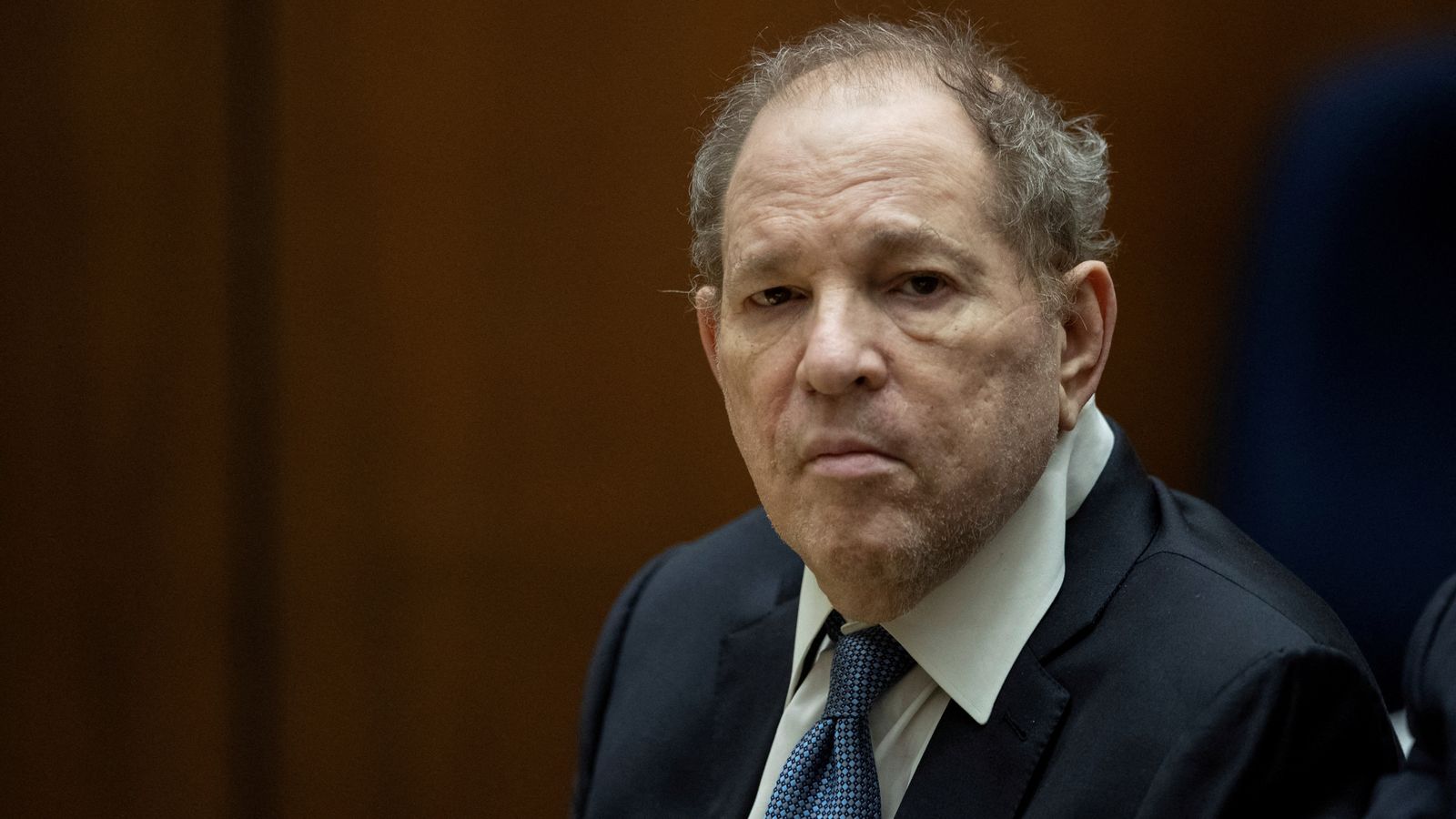
Harvey Weinstein begs for mercy as he is jailed for another 16 years

Disgraced Hollywood producer Harvey Weinstein begged “please don’t sentence me to life in prison, I don’t deserve it” as he was jailed for another 16 years for rape and sexual assault.
Weinstein, 70, will serve the jail term after completing his 23-year-sentence for a sexual misconduct conviction in New York in 2020.
It is therefore highly possible he will spend the rest of his life in prison.
Weinstein begged for leniency as he was handed the latest sentence in a Los Angeles court today.
He was sentenced for the rape of an actress, named only in court as Jane Doe 1, at a hotel in Los Angeles in 2013.
A jury found him guilty in December of rape, forcible oral copulation and sexual penetration by a foreign object.
Weinstein said: “This is a made up story. Jane Doe 1 is an actress. She can turn the tears on.
“Please don’t sentence me to life in prison. I don’t deserve it. There are so many things wrong with this case.
“There are too many loopholes. Too many things wrong with this case.
“This is a set-up. This is not the way to act in this situation.”
He finally added: “I beg your mercy.”
Dave Ring, a lawyer for Jane Doe 1, said after the verdict: “The sentencing today provides Jane Doe 1 with closure and relief, knowing Weinstein will spend the rest of his life in prison where he belongs.
“It took tremendous courage for Jane Doe 1 and the other victims to come forward and testify… Weinstein is out of options.”
Weinstein spokesperson slams ‘cruel sentence’
A lawyer for another of Weinstein’s victims said afterwards that the disgraced producer will now spend the rest of his life in prison “where he belongs”.
Weinstein, once one of the most powerful figures in Hollywood, has said all of his sexual encounters had been consensual and pleaded not guilty in the Los Angeles case.
Prosecutors called for a “high-term” penalty of 24 years because of the prior conviction, rather than a “mid-term” sentence of 18 years that California law would otherwise prescribe.
Louisette Geiss, one of Weinstein’s accusers, said after the verdict: “While I am disappointed that Judge Lench did not sentence Harvey Weinstein to the maximum of 18 years, no amount of time in jail will erase the damage Weinstein has caused to the lives and careers of his survivors, including me.”
Weinstein’s team opposed the district attorney’s recommendation for a high-term, consecutive sentence, given Weinstein’s “advanced age and deteriorating health”.
A spokesperson for Weinstein said after the verdict: “It’s a cruel sentence, given his age, his health and the conditions of his conviction in Los Angeles, when the sole charge was from a person who lied, with the judge and prosecutor well aware of it and permitting it, about critical elements of her own claim. It’s not justice, but a pile on for a man many people just decided should be cast off and discarded regardless of facts.”
Read more:
The women who fought Harvey Weinstein in court
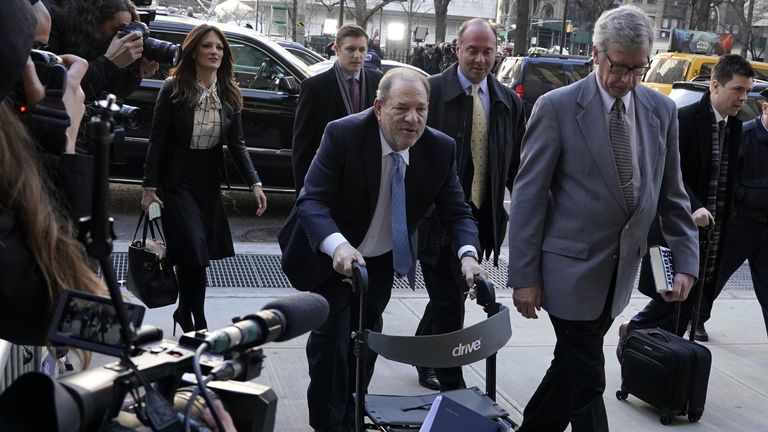
Harvey Weinstein arrives at Manhattan Criminal Court in 2020
The jury acquitted Weinstein of charges relating to a second alleged victim and failed to reach a unanimous verdict on charges arising from two other accusers.
One of them, documentary filmmaker Jennifer Siebel Newsom, now the wife of California Governor Gavin Newsom, had disclosed she was the alleged rape victim referred to in court records as Jane Doe 4.
Weinstein appealing New York conviction
Los Angeles Superior Court Judge Lisa Lench declared a mistrial on the deadlocked charges.
Defence attorneys argued that the women willingly had sex with Weinstein because they believed he would advance their careers, part of what they said was a widespread “casting couch” culture in the film industry.
In two of the cases, they said the alleged sexual contact was fabricated.
Weinstein was convicted of sexual misconduct in New York in February 2020.
He was extradited from New York to Los Angeles prison in July 2021.
Weinstein is appealing the New York conviction and prison sentence.
Allegations against Weinstein helped fuel the #MeToo movement, which has encouraged women to speak out about sexual harassment and abuse by powerful men in certain industries.
The movement, which went viral on social media in 2017, seeks to break a culture of silence that has long allowed such conduct to go unchallenged.


Paramount has launched a £108.4bn hostile bid for Warner Bros, challenging Netflix, which had reached a $72bn takeover deal with the company.
Paramount said on Monday that it was going straight to Warner Bros Discovery (WBD) shareholders with a $30 per share in cash offer for the entirety of the company, including its Global Networks segment, asking them to reject the deal with Netflix.
On Friday Netflix struck a deal to buy WBD, the Hollywood giant behind “Harry Potter” and HBO Max
The agreement means Warner Bros Discovery’s library of film and TV successes including Harry Potter and Game Of Thrones will come under the same roof as Stranger Things and Squid Game.
The cash and stock deal is valued at $27.75 per Warner share, giving it a total enterprise value of $82.7 billion, including debt.
But Paramount says its deal will pay $30 cash per share, representing $18 billion more in cash than its rivals are offering.
In a statement, Paramount said it was making a “strategically and financially compelling offer to WBD shareholders” and a “superior alternative to the Netflix transaction”.
File pic: iStock
David Ellison, chairman and CEO of Paramount, said: “WBD shareholders deserve an opportunity to consider our superior all-cash offer for their shares in the entire company.
“Our public offer, which is on the same terms we provided to the Warner Bros. Discovery Board of Directors in private, provides superior value, and a more certain and quicker path to completion.
“We believe the WBD Board of Directors is pursuing an inferior proposal which exposes shareholders to a mix of cash and stock, an uncertain future trading value of the Global Networks linear cable business and a challenging regulatory approval process.
“We are taking our offer directly to shareholders to give them the opportunity to act in their own best interests and maximize the value of their shares.”
Paramount said it had submitted six proposals to WBD in the course of 12 weeks, but that they were never “meaningfully” engaged with.
This breaking news story is being updated and more details will be published shortly.
Please refresh the page for the latest version.
You can receive breaking news alerts on a smartphone or tablet via the Sky News app. You can also follow us on WhatsApp and subscribe to our YouTube channel to keep up with the latest news.
Donald Trump’s eldest son has said his father may walk away from the Ukraine peace process, claiming the issue is not a priority for Americans, and signalling Europe needs a better plan.
In a wide-ranging discussion with Sky’s lead world news presenter Yalda Hakim at Doha Forum 2025, Donald Trump Jr addressed issues including the US administration’s recent diplomatic efforts around the world.
He was speaking in his capacity as a business leader, setting out his agenda for “America first” investments in defence technology and artificial intelligence (AI), drawing a direct line between global stability and economic prosperity.
Ukraine war latest – follow live updates
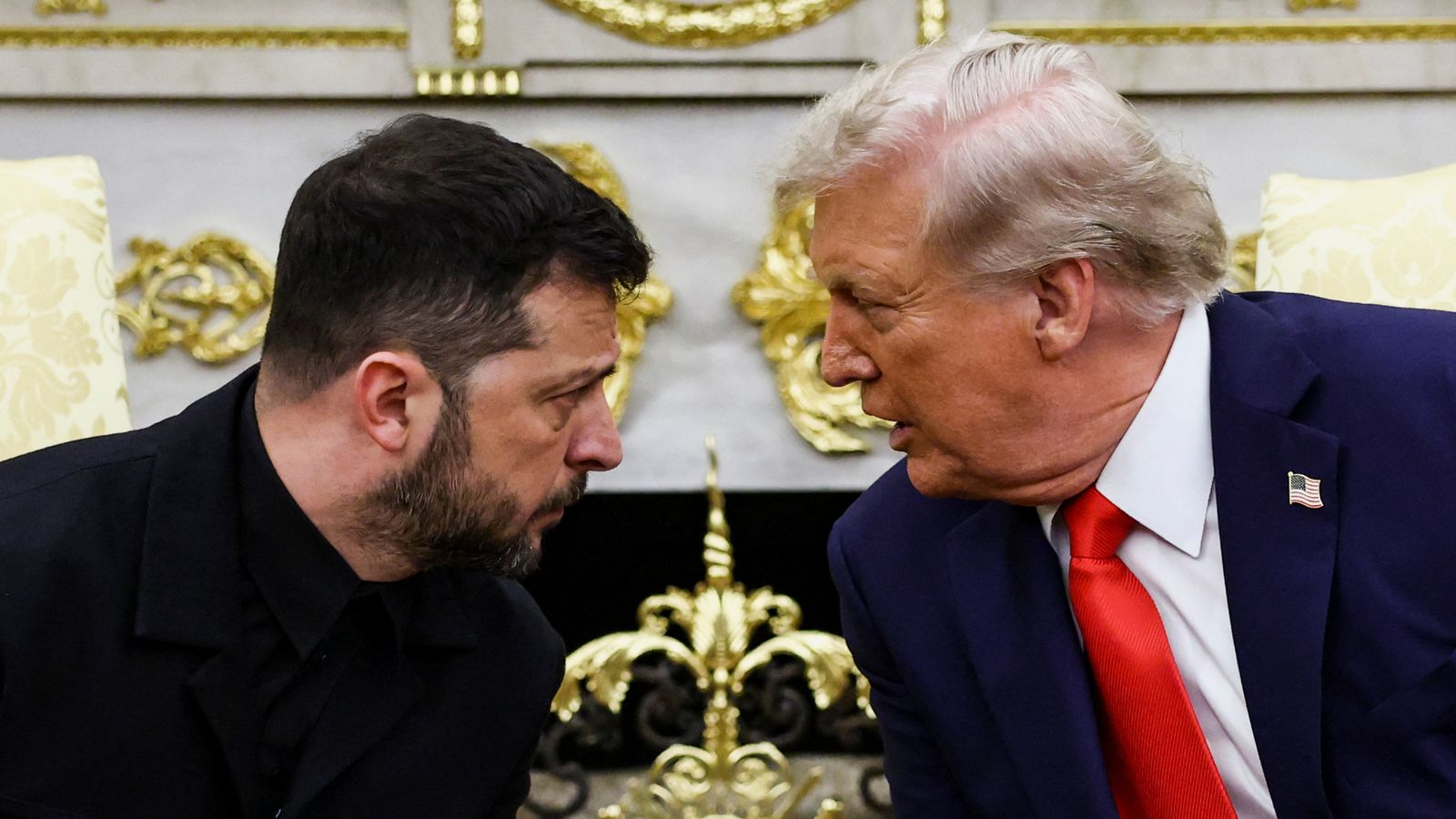
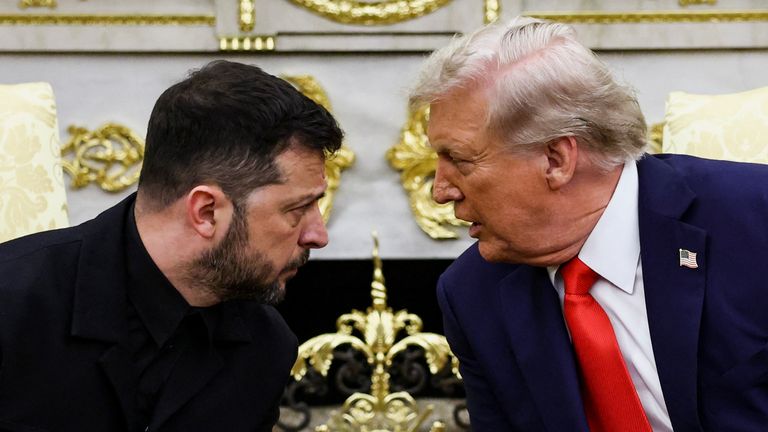
Donald Trump meeting Volodymyr Zelenskyy in Washington earlier this year. Pic: Reuters
When asked directly if he believed the US president would walk away from Ukraine, he answered: “I think he may, what’s good about my father and what’s unique about my father is you don’t know what he’s going to do. He’s unpredictable.”
President Trump has led renewed efforts for a ceasefire deal with Russia in recent months.
Drawing a parallel with his father’s current “war” on drug cartels, Donald Trump Jr described gangs bringing illegal drugs into America as a “far greater clear and present danger to the US than anything [going on] in the Ukraine or Russia”.
While he said he did not believe Ukraine would be “abandoned”, he said: “The American public doesn’t have the appetite [for endless wars and further funding of Ukraine’s military efforts].”
Describing Ukraine as “a far more corrupt country than Russia”, he characterised Ukrainian President Zelenskyy as “one of the great marketeers of all time”, who he said had become “a borderline deity, especially to the left”.
He went on to describe President Trump’s approach as “common sense”.
China rivalry was the focus, but Musk got a mention

In a country and at a conference which is friendly, even admiring of the Trump administration, Don Jr was in his element.
He’s here in his capacity as a business leader, promoting his venture, 1789 Capital which claims to be focused on “America First” investments.
But he wasn’t shy about discussing his father’s foreign policy achievements, boasting that Donald Trump had resolved seven or eight wars – conflicts that most ordinary Americans were unaware of.
His pitch is bullish and direct – the current US administration is projecting strength globally, stopping wars and creating investment opportunities which serves the American economy. It’s the MAGA mentality for the global audience.
It’s clear that the rivalry with China is their biggest focus, especially finding ways to combat their dominance over critical minerals.
“America can no longer just sit there and hope that China is going to be a good actor… I think the rest of the world understands that they want America to be at the forefront of all of that.”
When I asked him about recent efforts by President Trump to bring the war in Ukraine to an end, he responded forcefully. “We want peace, we want to stop the death.”
But he went on to say that Europe needed to shoulder the burden and currently they have no plan.
As he sat on the stage in Qatar, the country which has been at the centre of the ceasefire efforts for Gaza, he expressed hope that peace would prevail, but balanced expectations America would fund its re-construction. This would have to be a global effort.
“If there’s one thing my father is, it’s a builder… I think he can be the greatest construction manager in the history of the world, but no one in America wants to bear the entire responsibility of that.”
And, away from international diplomatic efforts, he was happy to announce a breakthrough closer to home.
The “bromance” with Elon Musk and President Trump is back on – calling the entrepreneur a “generational talent, a generational level of genius”.
‘Bromance’ back on
He also confirmed that Tesla billionaire Elon Musk was “100% back in the fold”, after previously appearing to fall out with the president.
Earlier this year, Donald Trump Jr’s investment company, 1789 Capital, heavily invested in some of Musk’s companies, including SpaceX.

Elon Musk and Donald Trump in the Oval Office at the White House in May. Pic: AP
Directly comparing President Trump with Musk, he said: “Imagine dealing with one Donald Trump – now I have to deal with two.
“They’re very similar that way, so it created some headaches… but the reality is they’re both very much aligned, they’re on message with what we want to do with our country. What we want to do with freedom of speech.”
He went on: “Elon did incredible things for Twitter, really allowed the democratisation of truth and freedom and free speech to occur. That’s something that is a true threat in America right now.”
He also praised Musk as “changing the face of free speech, science and technology”, adding, “we have to protect our geniuses”.
When asked whether Mr Trump would stand for a third term, he joked that he could be “just trolling” those on the left.
He went on, “He’s the most unpredictable person, probably in the history of politics. Which is why he’s able to get something done. We’ll see.”
-
 Sports2 years ago
Story injured on diving stop, exits Red Sox game
-
 Sports3 years ago
‘Storybook stuff’: Inside the night Bryce Harper sent the Phillies to the World Series
-
 Sports2 years ago
Game 1 of WS least-watched in recorded history
-
 Sports3 years ago
Button battles heat exhaustion in NASCAR debut
-
 Sports3 years ago
MLB Rank 2023: Ranking baseball’s top 100 players
-
Sports4 years ago
Team Europe easily wins 4th straight Laver Cup
-
 Environment3 years ago
Japan and South Korea have a lot at stake in a free and open South China Sea
-
 Environment1 year ago
Here are the best electric bikes you can buy at every price level in October 2024