
Budget 2023: UK economy will avoid recession in 2023 and inflation set to plummet, says chancellor

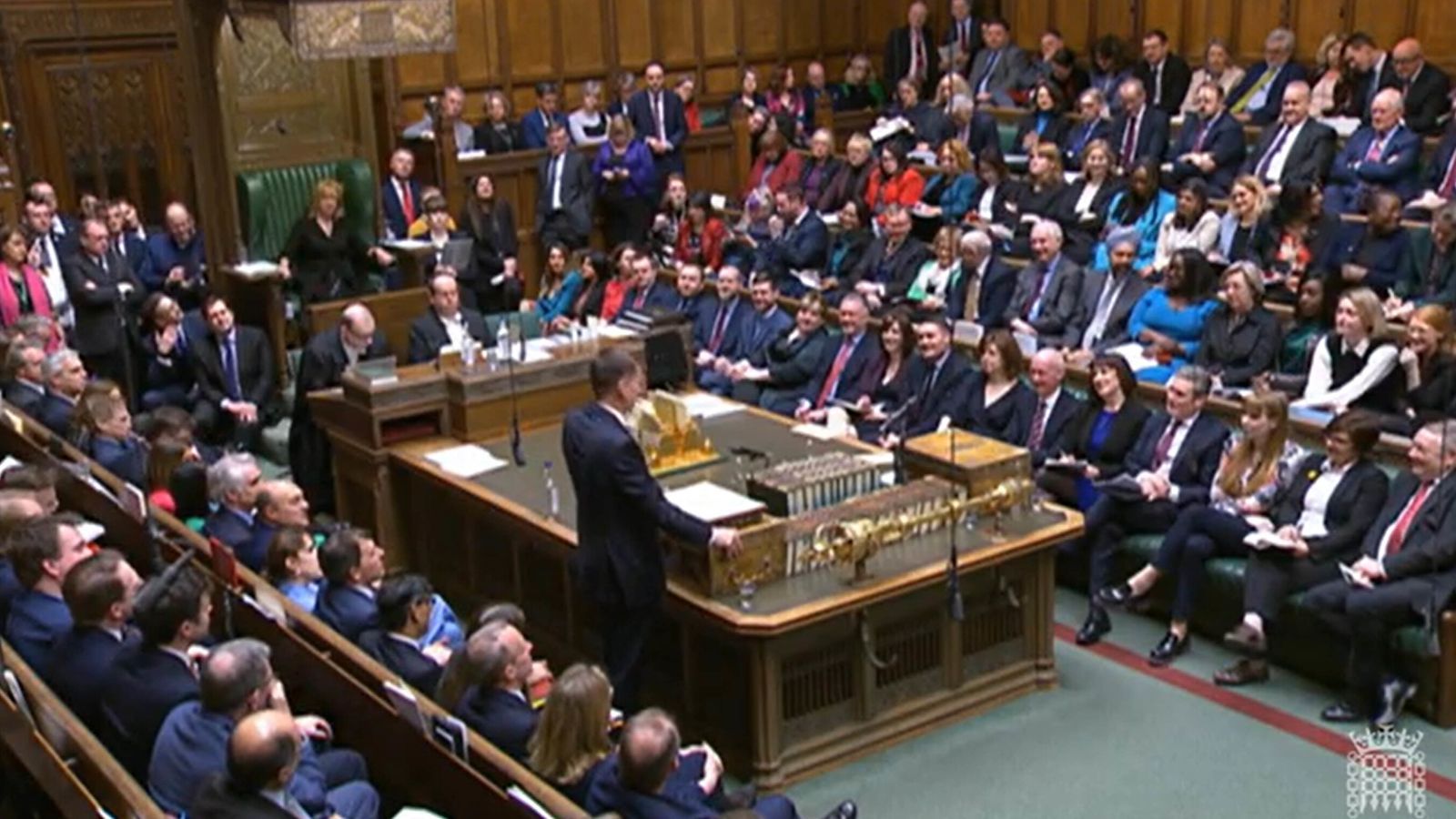
Jeremy Hunt said the British economy is “proving the doubters wrong” and will avoid recession, as he delivered his first full budget speech to Parliament.
The chancellor said the government’s plan for the economy was “working” as he announced what he called a “budget for growth”.
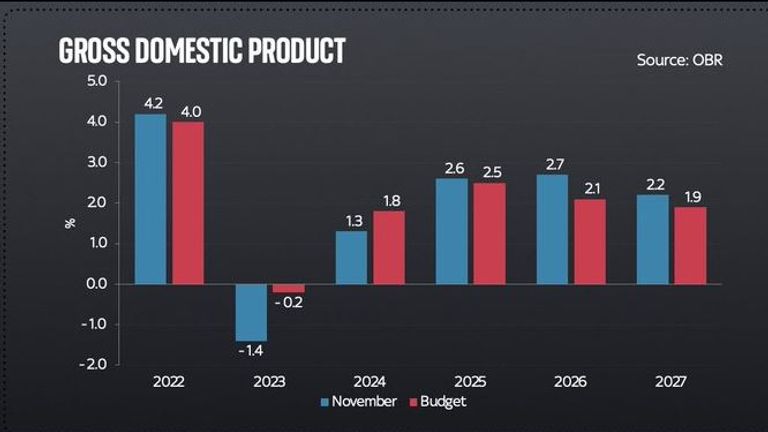
He said forecasts from the Office for Budget Responsibility (OBR) showed the UK would avoid recession – two-quarters of negative growth – in 2023, despite previous predictions.
But the economy will still contract overall this year by 0.2%, and the OBR has warned living standards are still expected to fall by the largest amount since records began – although the decline is not as bad as had been forecast in November.
Budget 2023 – read more:
Politics live: The budget as it happened and reaction
The key points of the budget at a glance
The OBR forecasts also said inflation in the UK would fall from 10.7% in the final quarter of last year to 2.9% by the end of 2023.
Mr Hunt said it showed Rishi Sunak’s goal of halving inflation this year would be met, but he added: “We remain vigilant and will not hesitate to take whatever steps are necessary for economic stability”.
However, Labour leader Sir Keir Starmer said the chancellor’s “boasts” about lower inflation were “ridiculous”, adding: “The idea that it’s a tax cut, British people can see through that.
“They see their tax burden at its highest level for 70 years and they know it’s not the government that’s lowering inflation.
“It’s working people, earning less, enjoying less. It’s their sacrifice that is helping to bring inflation down and they deserve better than another cheap trick from the government of gimmicks, making them pay whilst trying to claim the credit.”
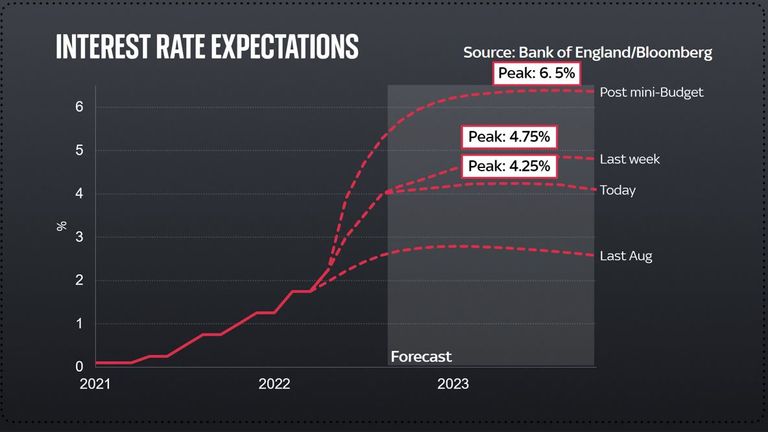
Interest Rate Expectations
A number of other plans were unveiled by Mr Hunt, including:
• Bringing charges for prepayment meters in line with direct debit charges, impacting over four million households and saving them an average of £45 per year
• Making duty on draught products in pubs up to 11p lower than supermarkets
• Maintaining the freeze in fuel duty
The chancellor also said £11bn will be added to the defence budget over the next five years – following an announcement earlier this week – saying it would be nearly 2.25% of GDP by 2025. The government’s ambition is for it to reach 2.5%, he added.
And after reports he would increase the pensions lifetime allowance to £1.8m in an attempt to encourage doctors and other high earners back to work, Mr Hunt decided to scrap the limit entirely, as well as increasing the pensions annual tax-free allowance from £40,000 to £60,000.
He told the Commons: “In the face of enormous challenges I report today on a British economy which is proving the doubters wrong.
“In the autumn we took difficult decisions to deliver stability and sound money. Since mid-October, 10-year gilt rates have fallen, debt servicing costs are down, mortgage rates are lower and inflation has peaked.
“The International Monetary Fund says our approach means the UK economy is on the right track.”
But Sir Keir said the only permanent tax cut in the budget was for “the richest 1%”, adding: “How can that possibly be a priority for this government?”
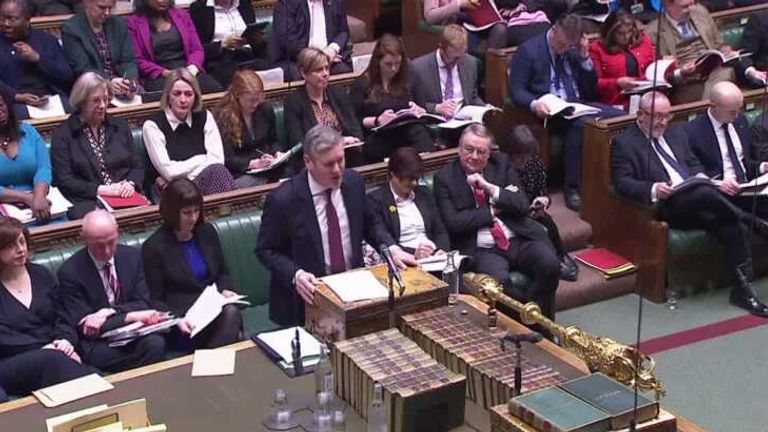
‘This a failure you can measure not just in the figures but in the empty pockets of working people,’ says the Labour leader.
The Labour leader continued: “Again we see a failure to grip the long-term challenges. No determination to create growth that unlocks the potential of the many – working people being made to pay for Tory choices and Tory mistakes.”
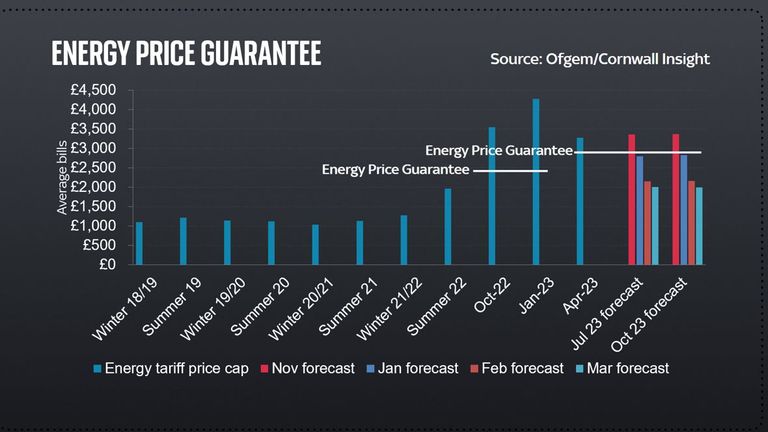
Some policies were revealed ahead of the chancellor’s speech, including keeping the cap on energy prices at £2,500 for a further three months, despite a planned rise to £3,000 in April, and 12 new investment zones.
Sky News also reported last night his promise to provide 30 hours of childcare a week to parents of one and two-year-olds, and to give a further cash injection to the sector to increase the availability of existing free childcare for three to four-year-olds.
But Mr Hunt went further on this measure, saying the care would be available from September 2024 when a child reaches nine months, as well as promising to increase funding for nurseries and pay those on Universal Credit upfront for the childcare they need to get.
However, he also confirmed the ratio for how many children each staff member looks after can be raised from one per four to one per five – though he said it was optional for both providers and parents.
There were more announcements to fit with Mr Hunt’s “three E’s” philosophy – enterprise, employment and education.
They included:
• Incentive payments of up to £1,200 for childminders who sign up to the profession
• Enhanced credit for small and medium businesses, and creative firms
• An extension to relief for theatres, orchestras and museums
• Tax relief on energy efficient measures in firms
• £900m investment into supercomputing
The chancellor also confirmed widely reported plans to abolish the Work Capability Assessment for disabled people to “separate benefit entitlement from an individual’s ability to work”.
Mr Hunt promised a new programme called Universal Support, describing it as “a new, voluntary employment scheme for disabled people where the government will spend up to £4,000 per person to help them find appropriate jobs and put in place the support they need”.
And he said there would be a £400m fund to help those who are forced to leave work because of a health condition to get support in the workplace.
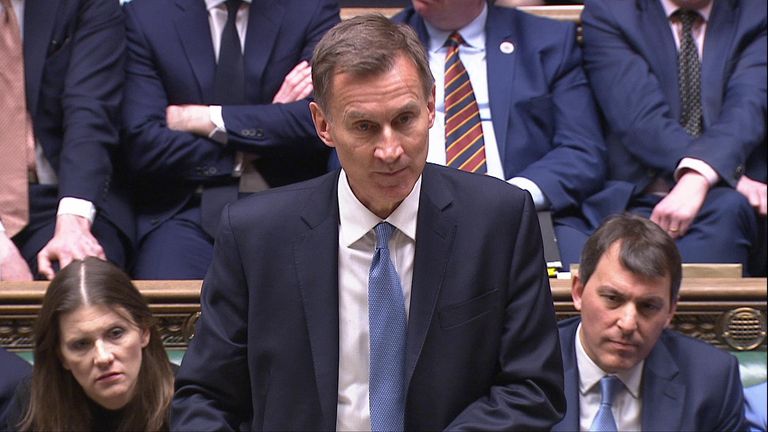
Chancellor Jeremy Hunt MP has announced that the energy price guarantee will remain at £2,500 until the end of June.
Mr Hunt confirmed he would keep the incoming rise in corporation tax – from 19% to 25% – despite anger from some of his own backbenchers.
But in a bid to keep businesses happy, he introduced a new benefit where every pound a company invests in equipment can be deducted in full and immediately from taxable profits – “a corporation tax cut worth an average of £9bn a year for every year it is in place”.
In what appeared to echo recent Labour policy, the chancellor announced continued state-financed investment in nuclear power and the launch of Great British Nuclear, saying the public body will “bring down costs and provide opportunities across the nuclear supply chain to help provide up to one quarter of our electricity by 2050”.
And he said nuclear energy would be reclassified as “environmentally sustainable” to give it the same access to investment incentives as renewables.
Today’s statement was Mr Hunt’s first full budget as chancellor – having been brought in by Liz Truss to reverse a number of measures from her disastrous mini-budget last October and kept on by Rishi Sunak after he took over as prime minister.
It came against a backdrop of mass industrial action, with hundreds of thousands of workers today staging what is believed to be the biggest walkout since the current wave of unrest began.
Teachers, university lecturers, civil servants, junior doctors, London Underground drivers and BBC journalists are among those taking to picket lines around the country amid widespread anger over pay, job security, pensions and conditions.
Labour’s shadow chancellor, Rachel Reeves, said ahead of the budget that it was “an opportunity for the government to get us off their path of managed decline”.
She added, if her party were in power, their focus would be on securing the highest growth in the G7.
“Our plan will help us lead the pack again, by creating good jobs and productivity growth across every part of our country, so everyone, not just a few, feel better off,” she added.
Our politics, business and finance reporters will be hosting a Q&A after the budget statement. To submit a question, click here.

-
 Sports2 years ago
Story injured on diving stop, exits Red Sox game
-
 Sports3 years ago
‘Storybook stuff’: Inside the night Bryce Harper sent the Phillies to the World Series
-
 Sports2 years ago
Game 1 of WS least-watched in recorded history
-
 Sports3 years ago
Button battles heat exhaustion in NASCAR debut
-
 Sports3 years ago
MLB Rank 2023: Ranking baseball’s top 100 players
-
Sports4 years ago
Team Europe easily wins 4th straight Laver Cup
-
 Environment3 years ago
Japan and South Korea have a lot at stake in a free and open South China Sea
-
 Environment1 year ago
Here are the best electric bikes you can buy at every price level in October 2024