
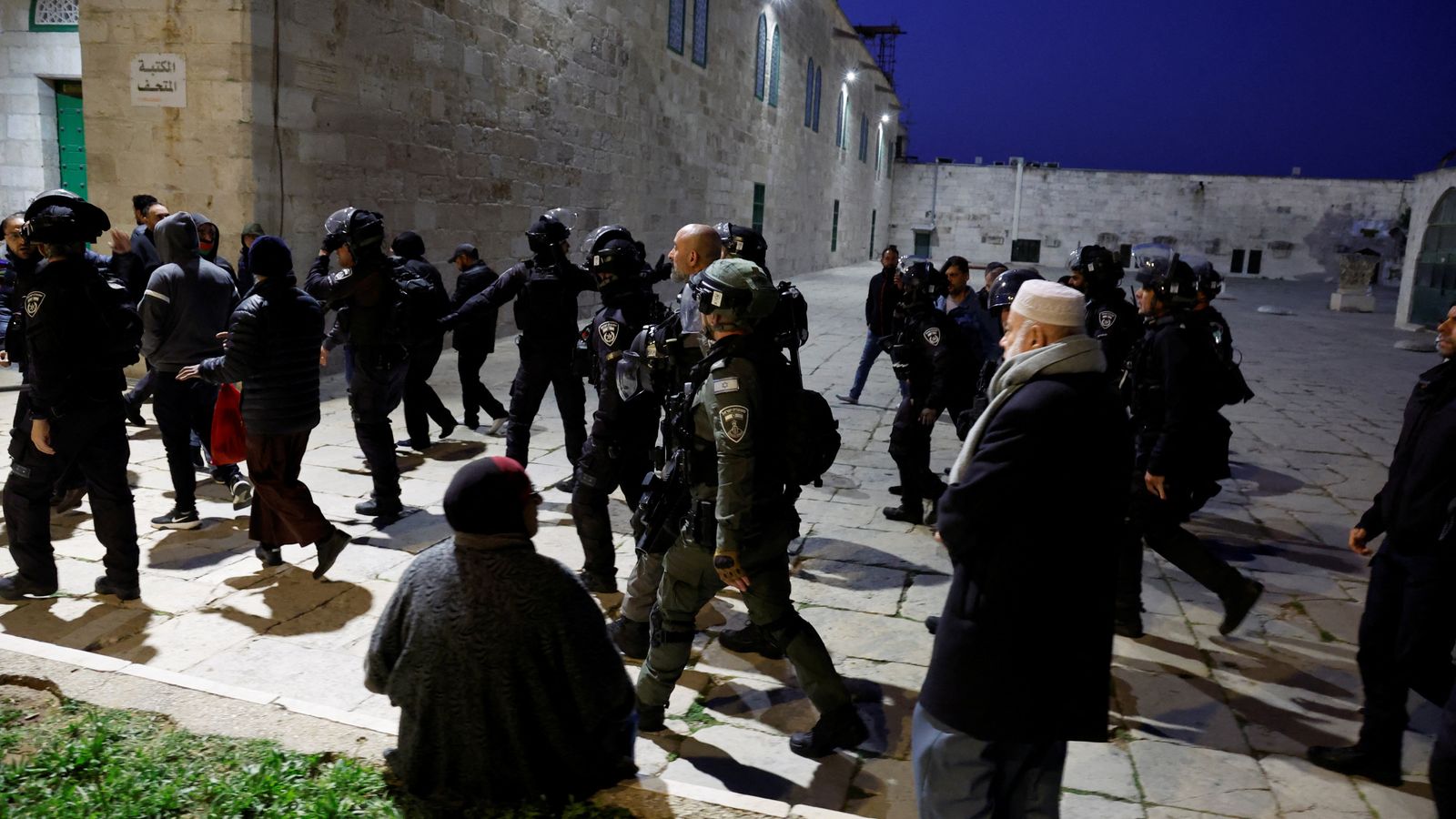
Israeli riot police fire stun grenades and tear gas inside Al Aqsa mosque in clashes with Palestinian worshippers

Israeli riot police have fired stun grenades and tear gas inside al Aqsa mosque in clashes with Palestinian worshippers in the early hours of Wednesday morning.
Twelve Palestinians were reportedly injured according to the Palestinian Red Crescent and dozens were arrested. Video footage from inside the mosque shows police beating Palestinians.
The incident occurred after several hundred Palestinians remained in the mosque after Ramadan prayers on Tuesday night.
Israeli police say they tried to clear them peacefully but a small group refused to leave and they were armed with fireworks and rocks.
Israeli police said they moved in after “several law-breaking youths and masked agitators” brought fireworks, sticks and stones and barricaded themselves into the mosque.
Police said the youths chanted violent slogans and locked the front doors.
“After many and prolonged attempts to get them out by talking to no avail, police forces were forced to enter the compound in order to get them out,” police said.
Footage released by police showed the repeated explosions of fireworks inside the mosque.
One officer was injured in the leg, while dozens of people were arrested.
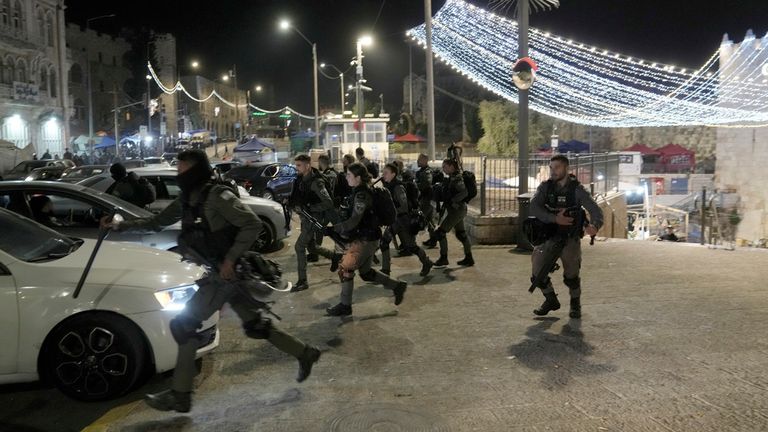
Israeli border police were deployed near the Damascus Gate to the Old City of Jerusalem during the raid
Jordan and Egypt, who have both been involved in peace talks to keep the calm during Ramadan, issued strong statements condemning the actions of Israeli police.
In response, nine rockets were fired from the Hamas-controlled Gaza Strip setting off air raid sirens in Israeli towns nearby.
A number of the missiles were intercepted by Israel’s Iron Dome defence system, but some fell in open areas. The local council in the town of Sderot said a factory was hit, but there were no reports of injuries.
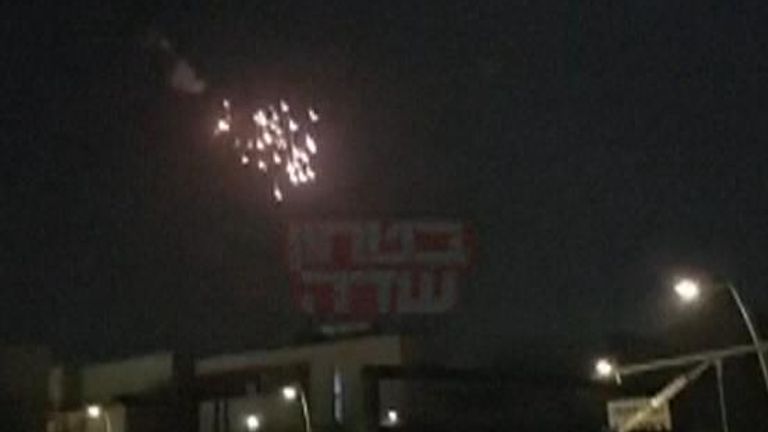
Israel intercepts rockets
In a separate incident, a Palestinian teenager was injured after police opened fire on a group in the east Jerusalem district of Silwan.
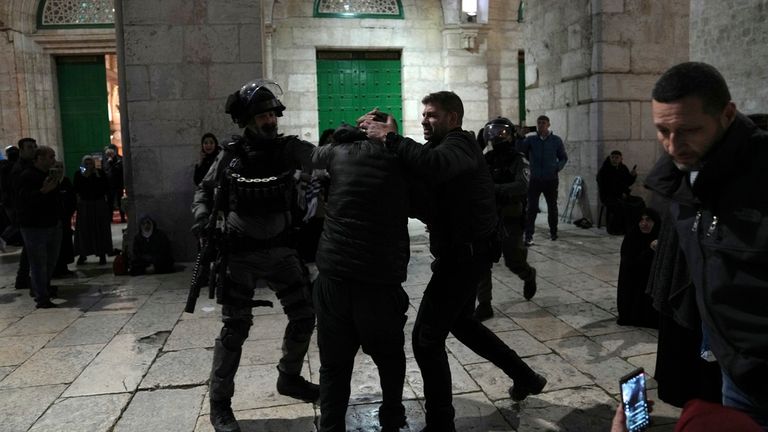
Israeli police detain a Palestinian worshipper at the al Aqsa Mosque compound in the Old City of Jerusalem
Police say he tried to open the door of a security vehicle and throw a Molotov cocktail inside. The teenager is reportedly in a stable condition.
The clashes in al Aqsa compound in Jerusalem’s old city, came at the start of the Jewish festival of Passover. Every year, a small group of Jewish activists try to slaughter a goat in the area known as Haram al Sharif to Muslims and also known as the Temple Mount, the holiest site in Judaism.
Read more on Sky News:
Islamic State leader ‘who planned attacks on Europe’ killed in Syria by US strike
Finland officially joins NATO, as Russia threatens ‘counter measures’
Although Israeli police stop the slaughter from taking place, it heightens tensions amongst Palestinians fearful it will undermine the fragile status quo that allows Jews to visit the site but not pray there.
Israel and the occupied Palestinian West Bank are experiencing one of the deadliest years in decades, however, despite fears that the violence could spiral out of control, the Muslim holy month of Ramadan had been relatively quiet until now.
The coincidence of Ramadan and Passover, for a second year running, has meant tensions have been high in Jerusalem and will remain so over the coming days.
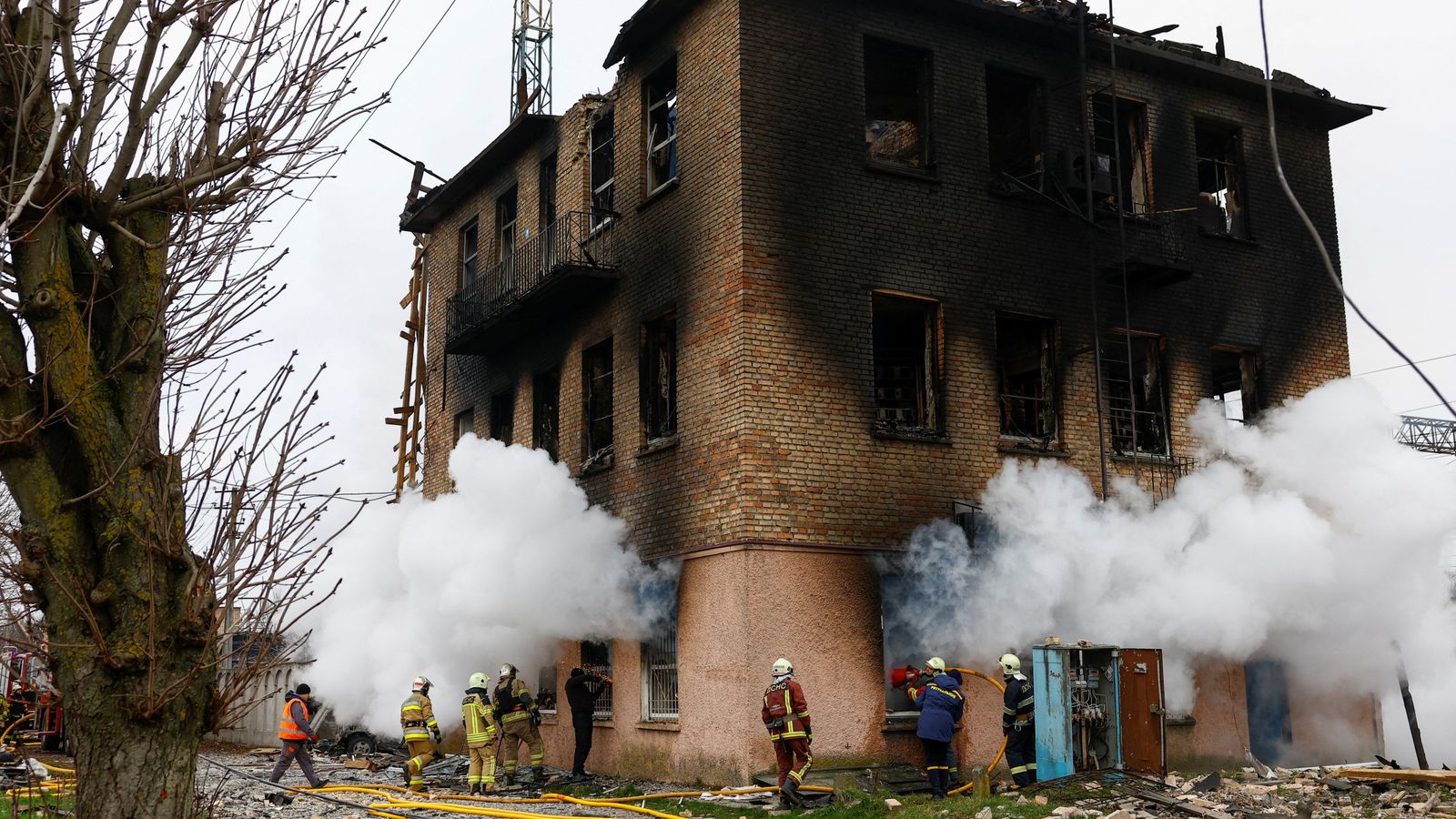
Russia launched a massive missile and drone attack on Ukraine overnight, after US and Ukrainian officials said they would meet for a third day of talks aimed at bringing the war to an end.
The two sides said they had made progress on a security framework for post-war Ukraine, but that any “real progress toward any agreement” will depend “on Russia’s readiness to show serious commitment to long-term peace.”
Russia launched 653 drones and 51 missiles in its attack on Ukraine, triggering air raid alerts across the country, Ukraine’s air force said.
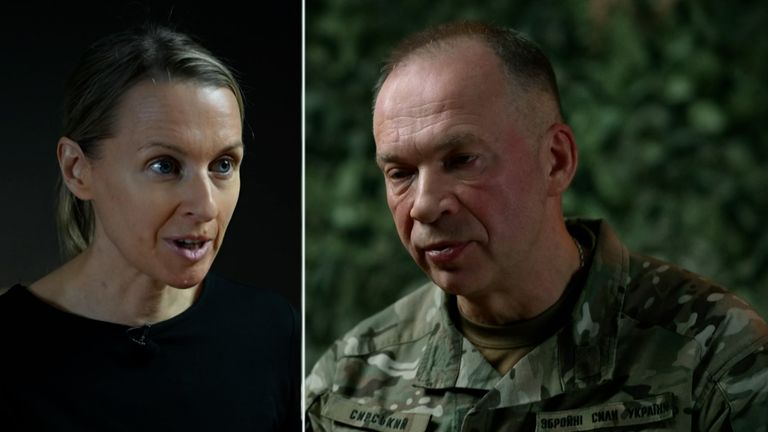
Giving up territory ‘unacceptable’ – Ukraine’s military chief
Ukrainian forces shot down and neutralised 585 drones and 30 missiles, the air force said, adding that 29 locations were struck.
At least eight people were wounded in the attacks, Ukraine’s minister of internal affairs Ihor Klymenko said.
Russia conducted a “massive missile-drone attack” on power stations and other energy infrastructure in several regions, Ukraine’s national energy operator Ukrenergo said on Instagram.
Ukraine’s Zaporizhzhia nuclear power plant temporarily lost all off-site power overnight, the International Atomic Energy Agency said.
The plant is in an area that has been under Russian control since early in Moscow’s invasion of Ukraine. It is not in service, but needs reliable power to cool its six shutdown reactors and spent fuel in order to avoid any catastrophic nuclear incidents.
Read more from Sky News:
Young Germans fear return to conscription
Giving up territory would be ‘unjust’, says Kyiv armed forces chief

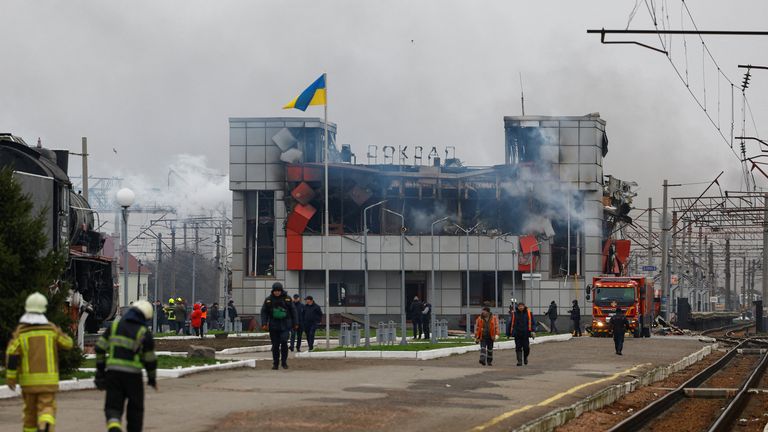
Russia struke a train station in the city of Fastiv. Pics: Reuters
Zelenskyy condemns ‘meaningless’ strikes
Ukrainian President Volodymyr Zelenskyy condemned the strikes as “meaningless” from a military point of view.
He said energy facilities were the main targets, but a drone strike had “burned down” a train station in the city of Fastiv, in the Kyiv region.
“The Russians’ goal is to hurt millions of Ukrainians, and they have sunk so low that they are launching missiles at peaceful cities on St. Nicholas Day,” he said.
“That is why additional pressure is needed. Sanctions must work, and so must our air defence, which means we must continue to support those who defend our lives.”
Ukraine strikes oil refinery
Meanwhile, Russia’s defence ministry said its air defences had shot down 116 Ukrainian drones over Russian territory overnight.
The General Staff of the Ukrainian Armed Forces said Ukrainian forces had struck Russia’s Ryazan Oil Refinery, while Russian Telegram news channel Astra shared footage appearing to show a fire breaking out and plumes of smoke rising above the refinery.
Over the last few months, Ukraine has used long-range drones to target Russian refineries in an attempt to deprive Moscow of the oil export revenue it needs to continue the war.
Meanwhile, Kyiv and its Western allies say Russia is trying to cripple Ukraine’s power grid and deny civilians access to heat, light and running water in winter, which Ukrainian officials call “weaponising” the cold.
On Monday, Mr Zelenskyy will meet Sir Keir Starmer in London to discuss the ongoing negotiations mediated by the US, along with French President Emmanuel Macron and German Chancellor Friedrich Merz.
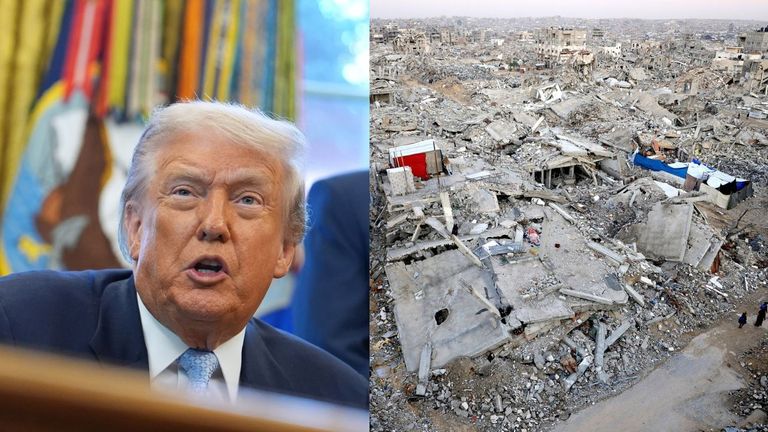
Negotiations on a lasting ceasefire deal for Gaza are at a “critical moment”, the prime minister of Qatar, which has played a key role in brokering the deal, has said.
Sheikh Mohammed bin Abdulrahman said a definitive ceasefire could only happen with a full withdrawal of Israeli troops from the besieged enclave.
The first stage of a ceasefire deal was agreed in October, but violence in Gaza has not stopped. On Saturday alone, seven people were reportedly killed.
Palestinian local health authorities said the victims were from Beit Lahiya, Jabalia and Zeitoun in northern Gaza and included a 70-year-old woman who was killed by a drone strike.
What is the UN-approved Trump peace plan for Gaza?
The Israeli military said that in two separate incidents on Saturday, forces deployed in northern Gaza behind the so-called yellow line of withdrawal agreed in the ceasefire had fired on Palestinian militants who crossed the line, killing three.
The military was unaware of any drone strike, a spokesperson said.
The long-sought ceasefire – and the second one after a first deal fell apart earlier this year – began on 11 October after Israel and Hamas agreed to the first phase of Donald Trump’s 20-point peace plan.
Despite accusations by both sides of violations, talks on the next phase of the ceasefire deal began almost two weeks ago, with Turkish, Qatari and Egyptian officials meeting in Cairo to discuss the second part of the agreement, including deploying a stabilisation force and body to govern Gaza and oversee reconstruction.
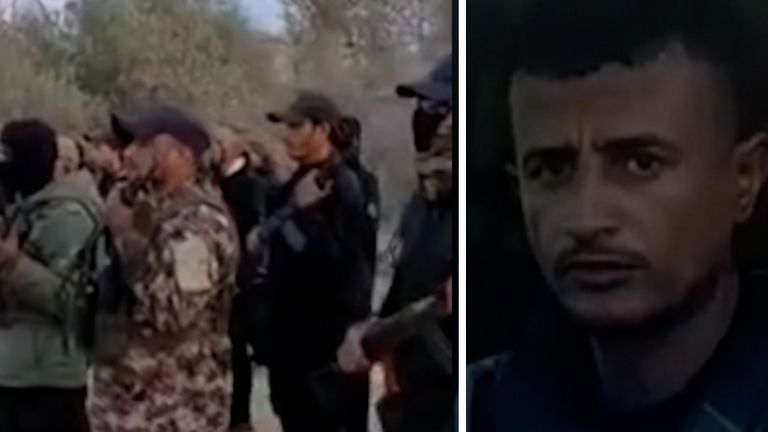
Fragile Gaza ceasefire persists as anti-Hamas leader killed
Read more:
Two brothers killed in Israeli drone strike on Gaza
Gaza child has vital operation
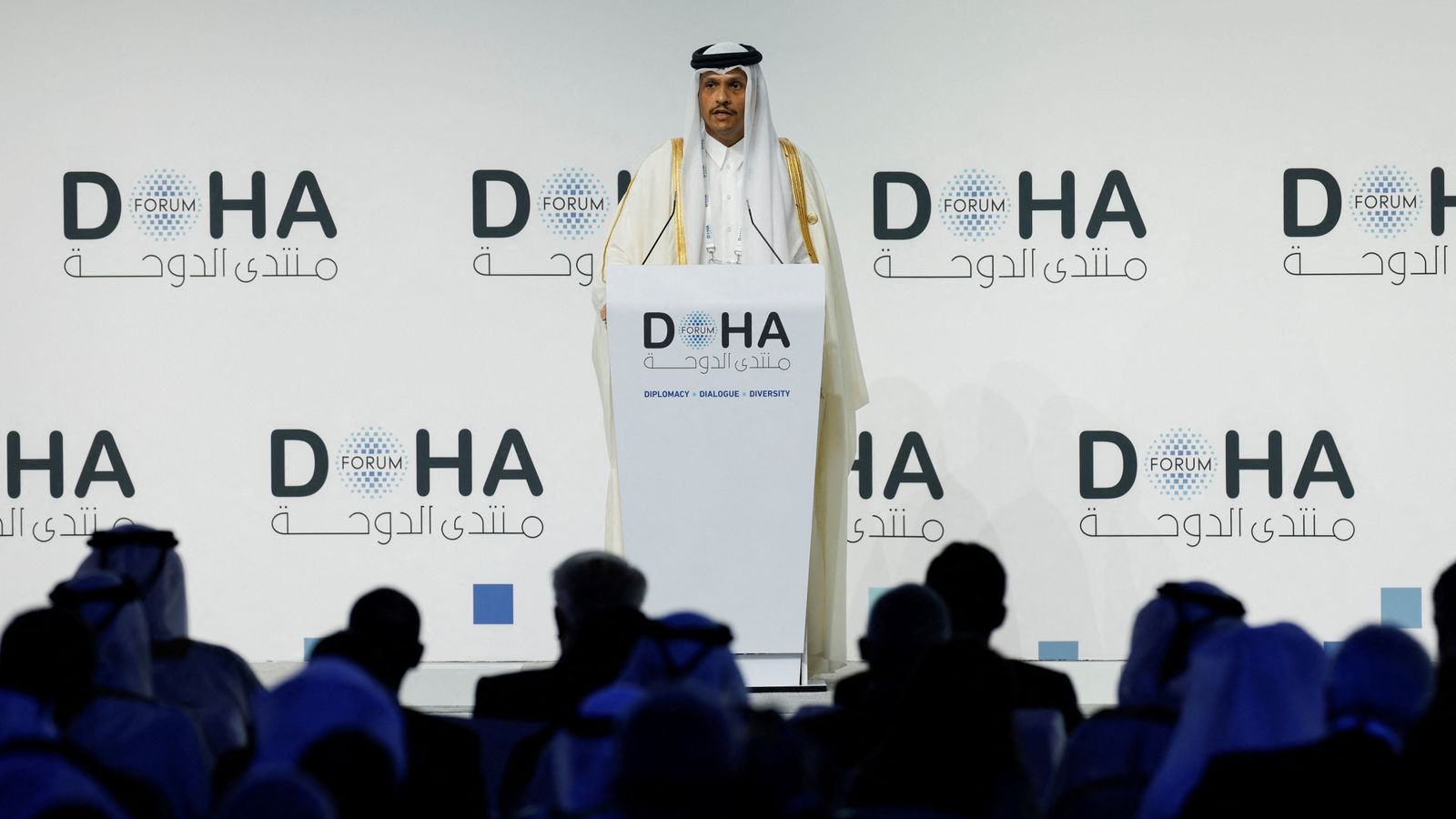
“We are at a critical moment. It’s not yet there. So what we have just done is a pause,” PM al-Thani said during a panel discussion at the Doha Forum conference in Qatar.
“We cannot consider it yet a ceasefire. A ceasefire cannot be completed unless there is a full withdrawal of the Israeli forces – (until) there is stability back in Gaza, people can go in and out – which is not the case today.”
On Thursday, an Israeli delegation held talks in Cairo with mediators on the return of the body of the last hostage held in Gaza, which would complete an initial part of Mr Trump’s plan to bring an end to the two-year war.
Since the truce started, Hamas has returned all 20 living hostages and 27 bodies in exchange for around 2,000 Palestinian detainees and convicted prisoners.


At least 50 people, including 33 children, have been killed in southern Sudan after a drone attack by paramilitary forces hit a nursery in South Kordofan state.
Sudan Doctors’ Network says paramedics on the scene in the town of Kalogi were also targeted by the Rapid Support Forces (RSF) in a “second unexpected attack”.
Rights group Emergency Lawyers reported a “third civilian site” near the previous two attacks was also targeted.
The death toll is expected to be higher, but communication blackouts have made it difficult to confirm the full number of casualties.
Emergency Lawyers says the strikes are a “flagrant violation of international humanitarian law, including the protection of civilians, especially children, and vital civilian infrastructure.”
UNICEF has urged both parties to stop the attacks immediately and allow safe access for humanitarian aid.
“Killing children in their school is a horrific violation of children’s rights,” said UNICEF representative for Sudan Sheldon Yett.
“Children should never pay the price of conflict.”
Read more from Sky News
RSF says it has captured Babanusa in West Kordofan
Sudan ‘epicentre of suffering in the world’
Sudan’s paramilitary forces agree to US-led humanitarian ceasefire proposal
The attack on the nursery is among the latest in the two-year conflict between the RSF and Sudan’s military, where the focus has recently shifted to the oil-rich Kordofan states.
A photo released by UNICEF shows displaced children and families from al-Fashir. (Mohammed Jammal/UNICEF via AP)
Hundreds of civilians have been killed in the last few weeks as fighting shifted from Darfur, following the RSF’s violent takeover of the city of Al Fashir, which was marked with civilians being executed, rapes, sexual assaults and other atrocities.
Thousands managed to escape the violence, but thousands more are trapped or feared killed.
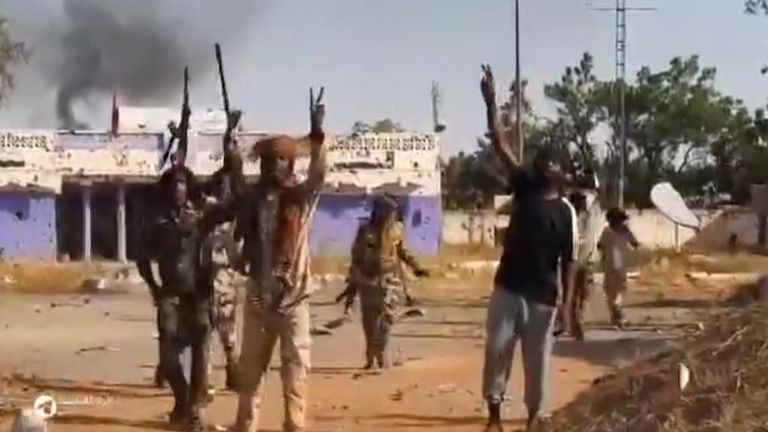
Grab from RSF social media channels in Al Fashir, Sudan
Meanwhile, Sudanese military aerial strikes last weekend killed at least 48 people, mostly civilians, in South Kordofan.
The RSF has also accused the military of carrying out a drone strike on the border with Chad, posting a video showing billowing black smoke.
The Associated Press has been unable to verify the video or whether there were any casualties, while Sudan’s military also hasn’t commented.
The RSF and the Sudanese military have been fighting for power over the country since 2023, which has seen more than 40,000 people killed, according to the World Health Organisation, although the real death toll is expected to be higher. 12 million people have been displaced.
-
 Sports2 years ago
Story injured on diving stop, exits Red Sox game
-
 Sports3 years ago
‘Storybook stuff’: Inside the night Bryce Harper sent the Phillies to the World Series
-
 Sports2 years ago
Game 1 of WS least-watched in recorded history
-
 Sports3 years ago
Button battles heat exhaustion in NASCAR debut
-
 Sports3 years ago
MLB Rank 2023: Ranking baseball’s top 100 players
-
Sports4 years ago
Team Europe easily wins 4th straight Laver Cup
-
 Environment3 years ago
Japan and South Korea have a lot at stake in a free and open South China Sea
-
 Environment1 year ago
Here are the best electric bikes you can buy at every price level in October 2024