

MLB’s strict clock oversight ‘frustrating’ Scherzer


-
Joon Lee, ESPN
NEW YORK — Mets pitcher Max Scherzer is not happy with the strict enforcement of the pitch clock.
Before the fifth inning of Thursday’s 4-2 victory over the Phillies at Citi Field, Scherzer got into an intense conversation with plate umpire Tripp Gibson over enforcement of the pitch clock. MLB rules state there is two minutes between innings for local broadcasts, with pitchers allowed eight warmup pitches. But with Mets catcher Francisco Alvarez making the last out of the bottom of the fourth, delaying his arrival behind home plate as he needed time to put on catching gear, Scherzer could not finish his warmup pitches before Gibson signaled for the start of the inning, prompting the discussion between pitcher and umpire.
“Why can’t the umpires have discretion in that situation to allow eight normal warmup pitches?” Scherzer said. “Why do we have to be so anal about this to have the clock shoved in everybody’s face and try to step out every little second that’s going into the game?”
According to Scherzer, when he asked Gibson why he couldn’t finish his warmup pitches, the umpire said the league would “get mad at him” if he did not strictly enforce the clock. While MLB previously implemented a clock to measure break times between innings in 2015, they were not strictly enforced, giving umpires leeway to let pitchers warm up longer even if the time on the clock expired.
That has changed in 2023, according to Scherzer.
“It’s situations like this that really are frustrating not only for pitchers, players, but even umpires,” Scherzer said. “That’s what Tripp says. Tripp is handcuffed. Why is Tripp handcuffed to not allow something normal, a normal routine. Why can’t Tripp make that call?”
Scherzer said Gibson wanted him to speak out about the issue publicly because the umpires want discretion to give players more time in situations like Thursday, when Alvarez came out later than usual after making the final out of an inning.
“They want to allow the game to be normal,” Scherzer said. “The umpires are frustrated that the game is not normal, that we’re living and dying by the clock. I said I would speak for him. We’re way too far thinking about the clock in every single situation instead of letting players have their normal routines.”
Throughout the season, Scherzer has had a love-hate relationship with the pitch clock. In February, he described it as a “cat-and-mouse” game that gave pitchers power to dictate pace.
“Really, the power the pitcher has now — I can totally dictate pace,” Scherzer said at the time. “The rule change of the hitter having only one timeout changes the complete dynamic of the hitter-and-pitcher dynamic. I love it.”
The future Hall of Famer tested the boundaries of the rules during spring training, getting called for a balk in his second preseason start in March after he started throwing a pitch to Washington Nationals outfielder Victor Robles the moment umpire Jeremy Riggs reset the clock.
“We have to figure out where the limit is,” Scherzer said in March.
In Thursday’s start, Scherzer went seven innings, allowing just one run on five hits while striking out nine and walking one. The outing marked the third straight quality start for Scherzer, who has a 3.21 ERA, 1.09 WHIP and a 5-2 record in nine starts this season, good for 0.8 bWAR.


-
Dave Wilson
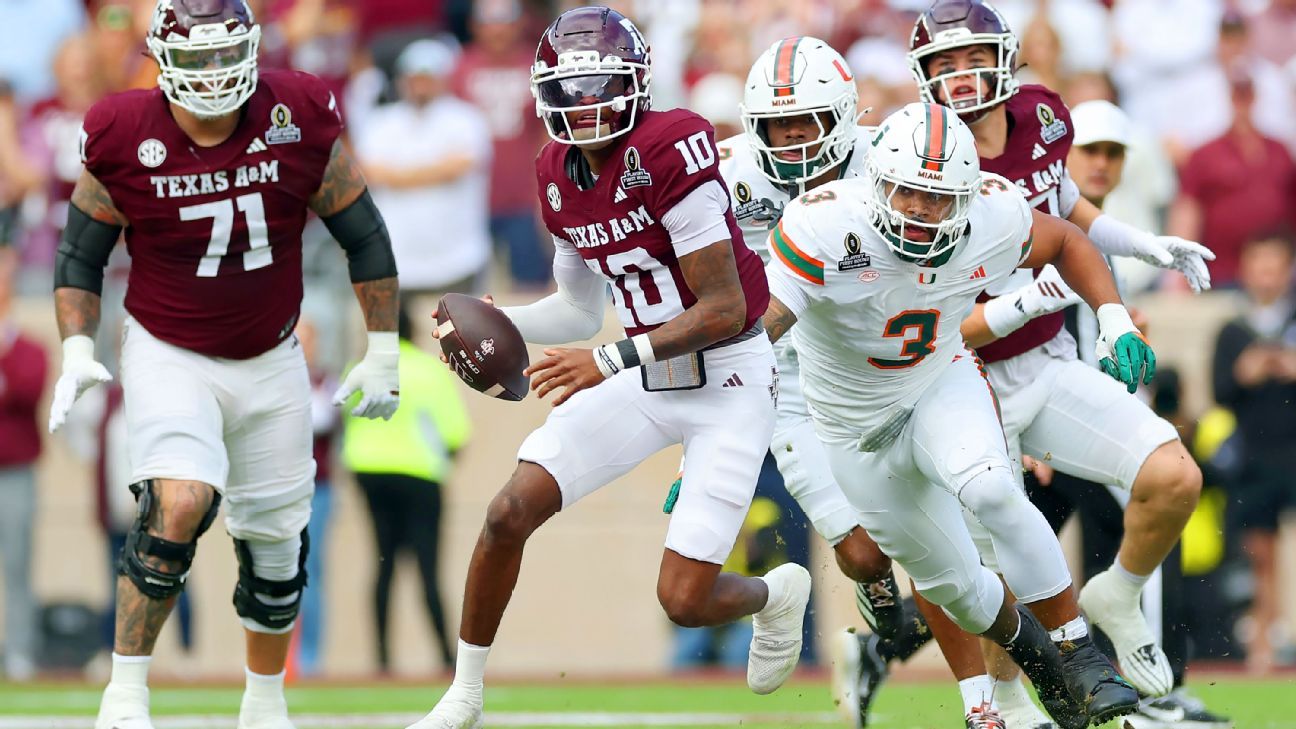
COLLEGE STATION, Texas — Texas A&M‘s historic season ended with a gut punch, as quarterback Marcel Reed, who had driven the Aggies to the Miami 5-yard line with 27 seconds left, threw an interception in the back of the end zone in a 10-3 loss at Kyle Field.
The loss Saturday in front of 104,122, the second-biggest crowd in CFP history, ended the Aggies’ season at 11-2, tying A&M’s 1939, 1998 and 2012 teams for the second-most wins in program history, behind the 1992 squad that finished 12-1.
Mike Elko, the Aggies’ second-year head coach, said that the loss will sting but that it shouldn’t discount what the team accomplished. When he took over before last season, he said that this was not an elite program ready to compete for a national championship. In his first season, the Aggies finished 8-5 after a 7-1 start and went into the offseason vowing to put an emphasis on finishing games. They did that all year and started 11-0 but lost their final two games: to Texas in Austin and then to the Hurricanes, their first defeat at home this season.
“We weren’t able to tilt the margins in our favor the last two games,” Elko said. “That’s going to be a killer. One to not go to Atlanta [to the SEC championship], one to not go to the quarterfinals. So that’s a killer, but you’ve got to swallow it and you’ve got to move forward just like we did last year.”
Elko said he and his staff believed this team had “fairly small margins” to be successful in each game, and that’s exactly how the season played out. He said that as a grown man he can handle the disappointment but that he is hurting for his players. Still, he emphasized that he didn’t want to discount what his players had done to help turn the tide for the Aggies.
“I said to the seniors who just played their last game, they left a mark on elevating this program that will never go away. From where this program was two years ago to where it is now, I don’t think that can be lost on people,” Elko said. “I said to the guys coming back, there’s still another major step we have to take as a program to finish. I think the last two games showed that.”
Elko said his offense had become one-dimensional, and he credited Miami’s defense for preventing the Aggies from being able to run the ball, enabling the Canes to tee off on Reed.
“Marcel Reed can’t be our leading rusher,” Elko said of his sophomore quarterback who had 15 carries for 27 yards, 6 more than running back Rueben Owens II. “He can’t have the most carries. It just can’t happen that way.”
Reed sat devastated on the bench as the game ended following the interception, a towel draped over his head. Reed’s offensive coordinator, Collin Klein, is headed to Kansas State, his alma mater, as the Wildcats’ new coach. The two spoke about how close their relationship is after the game, with Reed saying Klein is like a father figure for him.
“It didn’t really feel real,” Reed said. “I don’t want the season to end. A lot of changes are going to be made after the season, so I really didn’t want it to end. It sucked.”
Taurean York, the Aggies’ all-SEC linebacker, said he’s proud of the steps the team took and called the season a “foundation-setter,” saying A&M finally got to the big stage and has plans to keep building.
“We’re really just scratching the surface of who we’re going to become in the future,” he said.
The Aggies traded defensive blows with Miami all day, but Carson Beck‘s shovel pass to Malachi Toney with 1:44 left broke the game open. The Aggies’ offense responded, driving with a chance to tie the game before Bryce Fitzgerald‘s second interception of Reed on the day ended A&M’s season and crushed the Kyle Field faithful.
“We came up 5 yards short and that’s something we’ll have to live with throughout the off season,” Elko said. “But [I’m] still proud of this team, proud of what they accomplished, proud of what they did.”

-
David Hale
COLLEGE STATION, Texas — Rueben Bain rolled his eyes, smiled, then held up his cell phone, the lock screen glowing with a photo of Texas A&M offensive lineman Trey Zuhn III. Bain had anticipated the question. He was looking forward to it.
In the run-up to Saturday’s College Football Playoff game between Miami and Texas A&M, Zuhn had delivered the bulletin-board material, when he told reporters he didn’t think Bain “would be a threat that we need to worry about too much.”
Big mistake.
“We don’t take kindly to disrespect,” Bain said. “Some people said some things they shouldn’t have said.”
Bain and the Miami defense were dominant in a 10-3 win over the Aggies, ending a once-promising Texas A&M season and sending the Hurricanes on to the Goodyear Cotton Bowl, where they’ll face off against Ohio State.
Bain finished with five tackles — four for a loss — and three sacks, while also blocking a field goal in the first half.
The rest of the defense followed his lead, racking up nine tackles for loss and creating three takeaways, including a game-sealing interception in the back of the end zone with 24 seconds to play by freshman Bryce Fitzgerald.
In the aftermath, defensive end Akheem Mesidor was running through his rolodex of players who’d stepped up against the Aggies — defensive line, defensive backs, linebackers — then mentioned Fitzgerald.
“Bryce!” Bain and cornerback Keionte Scott both shouted in unison, laughing.
Fitzgerald arrived on campus in June, but quickly made his presence felt, and his role on Miami’s defense has grown as the season progressed. On Saturday, he was a star, intercepting Aggies quarterback Marcel Reed twice. The latter came on a third-and-goal at the 5 after the Aggies had marched down the field in an effort to tie it, but Fitzgerald stepped in front of a pass intended for Melin Ohrstrom and the celebration began.
“He’s a quick study,” Miami coach Mario Cristobal said. “He’s never flinched. He spends every waking minute studying, but when the lights come on, some guys just kind of have ‘it.’ He’s that guy. He just knows what to do and how to do it.”
A year ago, this Miami defense was the fly in the ointment that kept the Hurricanes from the playoff. With future No. 1 NFL draft pick Cam Ward working magic on offense, Miami’s battered secondary created a chain reaction that led to a complete defensive meltdown in the season’s stretch run. Miami lost two of its final three games to fall from No. 4 in the rankings to out of the playoff.
Cristobal responded by making a change at coordinator, bringing in Corey Hetherman — now a Broyles Award finalist — and putting a focus on rebuilding the back end of the defense. Fitzgerald and Scott, along with transfer Xavier Lucas, were keys to the turnaround. With the secondary secure, the defensive front was free to wreak havoc, and Mesidor and Bain did exactly that against the Aggies.
“We sat in the locker room for like 15 minutes [after the game],” Bain said, “just saying how crazy it was for us to win this game in this kind of way.”
Hetherman said the focus for Miami’s defense was actually more about patience and keeping Reed inside the pocket. The A&M quarterback did have a handful of scrambles that extended plays to find open receivers or picked up yards on the ground. But Hetherman said he prioritized showing Reed a host of different coverage schemes to keep him off balance, and eventually that allowed the Miami defensive front to get home.
Miami’s seven sacks against Texas A&M tied for the most by a ‘Canes defense in the last six seasons. And while there’d been concern about how Miami’s offensive line would handle the crowd noise at Kyle Field, where more than 104,000 fans provided a stifling soundtrack, it was actually the Aggies O-line that was flagged for multiple penalties.
“We lost the game of the line of scrimmage, and I think it got worse in the second half,” Aggies coach Mike Elko said. “We just couldn’t keep them off of us. We couldn’t get the run game established. We became one-dimensional. Once we became one-dimensional, they were able to tee off.”
Overall, Miami held the Aggies to just 326 yards of offense and just 89 on the ground — just 50 from A&M’s trio of tailbacks, Le’Veon Moss, Rueben Owens and EJ Smith.
And when Miami’s back was against the wall, the defense was at its best. A&M’s three red-zone trips amounted to just three total points, and when Miami receiver Malachi Toney fumbled near midfield late in the game, the Hurricanes defense followed with a quick three-and-out.
“A year ago, we had a tough time stopping people on defense,” Cristobal said. “This was one of those games where we felt like we were holding good and knocking them back. The confidence that [the defense] brings is off the charts, and they were the difference today.”

-
 Sports2 years ago
Story injured on diving stop, exits Red Sox game
-
 Sports3 years ago
‘Storybook stuff’: Inside the night Bryce Harper sent the Phillies to the World Series
-
 Sports2 years ago
Game 1 of WS least-watched in recorded history
-
 Sports3 years ago
Button battles heat exhaustion in NASCAR debut
-
 Sports3 years ago
MLB Rank 2023: Ranking baseball’s top 100 players
-
Sports4 years ago
Team Europe easily wins 4th straight Laver Cup
-
 Environment3 years ago
Japan and South Korea have a lot at stake in a free and open South China Sea
-
 Environment1 year ago
Here are the best electric bikes you can buy at every price level in October 2024