
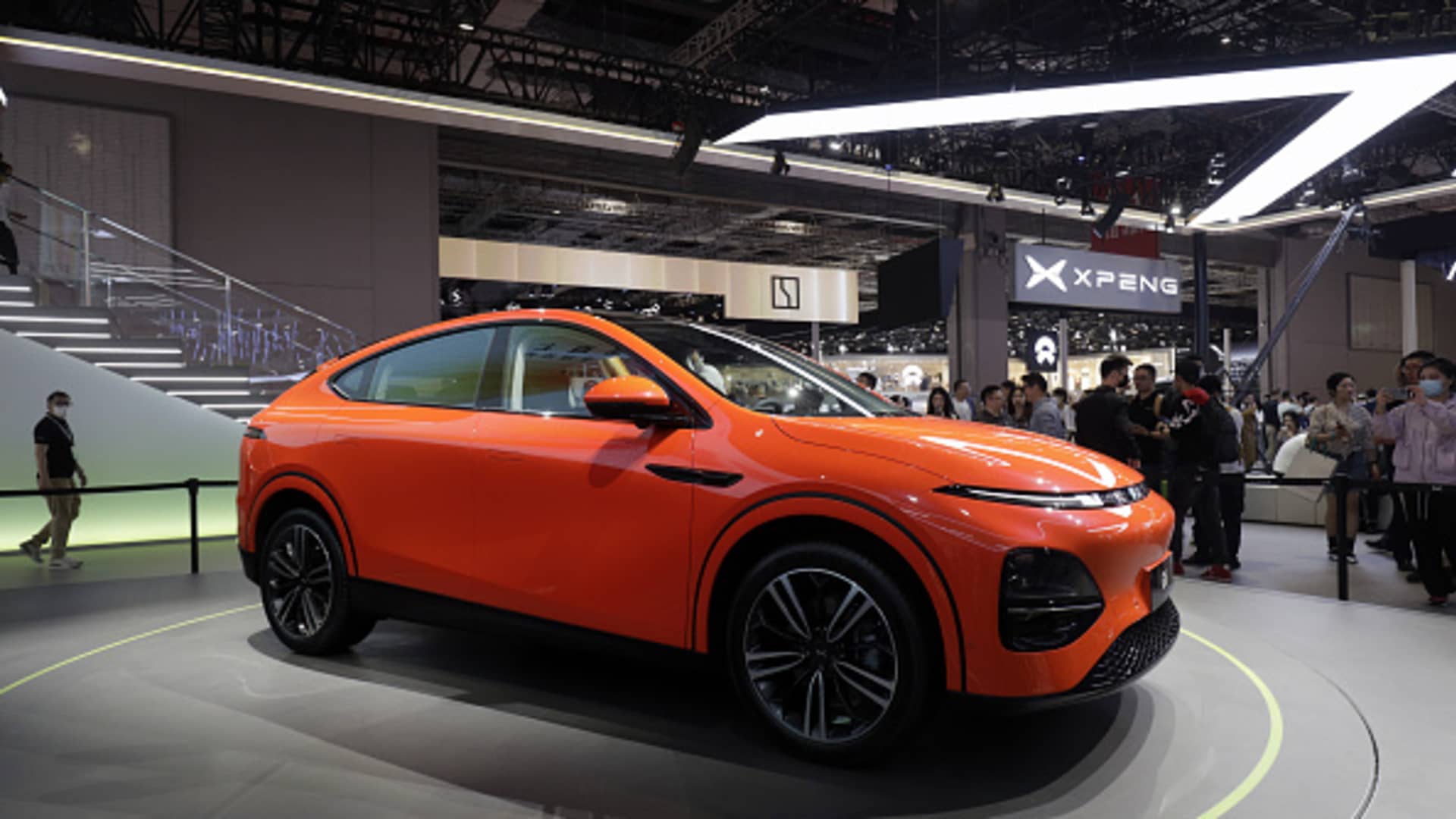
A XPeng Inc. G6 electric sport utility vehicle (SUV). The company is hoping the release of the new car will boost sales which plunged in the first quarter.
Qilai Shen | Bloomberg | Getty Images
Shares of Xpeng were higher Monday in the U.S. after the Chinese electric vehicle maker reported a quarterly return to growth for car deliveries, following more than a year of declines.
Xpeng on Saturday said it delivered 23,205 cars in the second quarter of 2023, logging a 27% quarter-on-quarter rise. This surpassed the company’s own delivery forecast of between 21,000 and 22,000 units. That was still lower than the 34,422 cars delivered in the second quarter of last year.
U.S.-listed shares of Xpeng added about 0.7%.
Deliveries have been declining each quarter since the first quarter of 2022 for Xpeng, as it struggled with a tough macroeconomic environment in China and heightened competition from domestic rivals and from Tesla, which has been cutting prices in China to spur demand. That has also hurt Xpeng’s competitiveness.
Tesla’s strategy seems to be working with the company reporting global vehicles deliveries of 466,140 in the second quarter, beating analysts expectations.
Xpeng said deliveries in June alone totalled 8,620 cars, marking a 15% increase over May and the highest monthly delivery figure this year.
The Guangzhou, China-headquartered company said deliveries of its flagship P7 sedan rose 17% in June from May, but did not give a specific unit figure.
Xpeng’s latest car — the G6 Ultra Smart Coupe SUV — was launched at the end of the second quarter, with deliveries beginning this month. Xpeng is hoping this will boost sales in the coming quarters.
Xpeng’s losses continue to widen and competition is getting fiercer. Last month, Chinese EV start-up Nio made big price cuts to its cars.
Xpeng has been reorganizing its management structure and overhauling the company over the past few months in the hope of unlocking growth.
Some of the company’s rivals have fared better. Li Auto delivered 32,575 vehicles in June while its second quarter figures totaled 86,533. Nio meanwhile delivered 10,707 vehicles in June and 23,520 cars in the second quarter, not far ahead of Xpeng.
Meanwhile, Warren Buffett-backed automaker BYD delivered 253,046 new energy vehicles — which includes battery and plug-in hybrids — in June alone, representing a 96% year-on-year rise.
Jim Cramer implores Amazon not to engage in “sham-like” circular AI deals that remind him of the kind of speculation that fueled the 1990s dotcom bubble that burst more than two decades ago. According to multiple reports on Wednesday, Amazon is in talks about a potential $10 billion investment in OpenAI in exchange for the ChatGPT creator agreeing to use the cloud giant’s custom AI chips. “They really need Trainium chips sold so badly that they give somebody $10 billion to buy them,” Jim said during the Club’s Morning Meeting on Wednesday . “I would love to see them not play this game.” “I really respect Amazon, and this shocks me that they’re willing to put up with this,” Jim said on “Squawk on the Street” earlier Wednesday. “You can’t do these deals. These deals are not real.” Over the past several years, many investors have been sounding the alarm over the growing levels of AI-related spending from megacap hyperscalers to compete in the so-called AI arms race. The push for AI requires the buildout of data centers and high-performance chips to run the systems. Jim said the current spate of interconnected investment activity is similar to deals in the lead-up to the year 2000. “The market is not going to let this happen,” Jim predicted, calling the stock market a “cruel task master,” in a stark warning about excess that drove the tech-heavy Nasdaq to a then-record high in March 2000 and the 78% crash over 2½ years that followed. OpenAI has been on a deal spree in 2025, securing massive amounts of computing power from firms including Nvidia , Advanced Micro Devices , Oracle , and Amazon’s cloud unit. That has amounted to the AI startup making $1.4 trillion in infrastructure commitments in recent months. Jim recently referred to OpenAI’s deal activity as “2000 in a nutshell,” as it continues to make aggressive, leveraged bets, raising concerns about an AI bubble. (Jim Cramer’s Charitable Trust is long AMZN, NVDA. See here for a full list of the stocks.) As a subscriber to the CNBC Investing Club with Jim Cramer, you will receive a trade alert before Jim makes a trade. Jim waits 45 minutes after sending a trade alert before buying or selling a stock in his charitable trust’s portfolio. If Jim has talked about a stock on CNBC TV, he waits 72 hours after issuing the trade alert before executing the trade. THE ABOVE INVESTING CLUB INFORMATION IS SUBJECT TO OUR TERMS AND CONDITIONS AND PRIVACY POLICY , TOGETHER WITH OUR DISCLAIMER . NO FIDUCIARY OBLIGATION OR DUTY EXISTS, OR IS CREATED, BY VIRTUE OF YOUR RECEIPT OF ANY INFORMATION PROVIDED IN CONNECTION WITH THE INVESTING CLUB. NO SPECIFIC OUTCOME OR PROFIT IS GUARANTEED.
Rohit Prasad, Senior VP & Head Scientist for Alexa, Amazon, on Centre Stage during day one of Web Summit 2022 at the Altice Arena in Lisbon, Portugal.
Ben McShane | Sportsfile | Getty Images
Rohit Prasad, a top Amazon executive overseeing its artificial general intelligence unit, is leaving the company at the end of this year, the company confirmed Wednesday.
As part of the move, Amazon CEO Andy Jassy said the company is reorganizing the AGI unit under a more expansive division that will also include its silicon development and quantum computing teams. The new division will be led by Peter DeSantis, a 27-year veteran of Amazon who currently serves as a senior vice president in its cloud unit.
This is breaking news. Please refresh for updates.
Oracle stock dipped about 5% on Wednesday following a report that discussions with Blue Owl Capital on backing a $10 billion data center in Michigan had stalled, although the cloud company later disputed the report.
Blue Owl had been in talks with Oracle about funding a 1-gigawatt facility for OpenAI in Saline Township, Michigan, according to the Financial Times.
However, the plans fell through due to concerns about Oracle’s rising debt levels and extensive artificial intelligence spending, the FT reported, citing people familiar with the matter.
This comes as some investors raise red flags about the funding behind the rush to build ever more data centers.
The concern is that some hyperscalers are turning to private equity markets rather than funding the buildings themselves, and entering into lease agreements that could prove risky.
Blue Owl did look into the project, but pulled out due to unfavorable debt terms and the structure of repayments, according to a person familiar with the company’s plans who asked not to be named in order to discuss a confidential matter.
Blue Owl is still involved in two other Oracle sites, the person said.
The person added that Blue Owl was also concerned that local politics in Michigan would cause construction delays.
Oracle later responded to the FT report, saying the project was moving forward and that Blue Owl was not part of equity talks.
“Our development partner, Related Digital, selected the best equity partner from a competitive group of options, which in this instance was not Blue Owl. Final negotiations for their equity deal are moving forward on schedule and according to plan,” Oracle spokesperson Michael Egbert said in a statement.
The cloud company did not name the firm involved in current equity talks for the project.
Read more CNBC tech news
CNBC has reached out to the FT for comment.
The FT said that Blackstone is in discussions to potentially replace Blue Owl Capital as a financial partner for the data center, although no deal has been signed yet.
Blue Owl Capital has been the primary investor in Oracle’s data center projects in the U.S., including a $15 billion center in Abilene, Texas, and an $18 billion site in New Mexico, the FT said.
“This appears to be a case where the deal simply wasn’t the right one, and seasoned investors understand that success does not require winning every transaction,” Evercore ISI analysts wrote in a note on Wednesday.
The bank added that digital infrastructure remains a “core growth vertical” for the Blue Owl, noting an upcoming digital infrastructure fund in 2026 that would add to its $7 billion fund announced in May.
Oracle has $248 billion in lease commitments for data centers and cloud capacity commitments over the next 15 to 19 years as of Nov. 30, the company said in its latest quarterly filing. That is up almost 148% from August.
In September, the cloud computing giant raised $18 billion in new debt, according to an SEC filing. That same month, OpenAI announced a $300 billion partnership with Oracle over the next five years.
By the end of November, the company owed over $124 billion, including operating lease liabilities, according to the filing.
Oracle shares are down about 50% from the high of $345.72 reached in September.





