
Connect with us

Published

on

An inflation index that is closely monitored by the Federal Reserve tumbled last month to its lowest level since April 2021, pulled down by lower gas prices and slower-rising food costs.

At the same time, consumers barely increased their spending last month, boosting it just 0.1%, after a solid 0.6% gain in April.

The inflation index showed that prices rose 3.8% in May from 12 months earlier, down sharply from a 4.4% year-over-year surge in April.

And from April to May, prices ticked up just 0.1%.

Still, last months progress in easing overall inflation was tempered by an elevated reading of core prices, a category that excludes volatile food and energy costs.

The increase underscored theFeds beliefthat it will need to keep raising interest rates to conquer high inflation.

Core prices rose 4.6% in May from a year earlier, down slightly from the annual increase of 4.7% in April.

It was the fifth straight month that the core figure was either 4.6% or 4.7% a sign that the Feds streak of 10 rate hikes over the past 15 months hasnt subdued all categories of prices.

From April to May, core prices increased 0.3%, a pace that, if it lasts, would keep inflation well above the Feds 2% target.

Fridays report from the government suggested that consumer spending is slowing under pressure from high prices and interest rates, a trend that is also likely cooling inflation.

As a result, many economists think growth in the current April-June quarter will slow from the 2% annual pace in the first three months of the year.

That cooldown could lead the Fed to decide to skip a rate hike when it meets in September, after a widely expected increase at its next meeting in late July.

The stickiness of core inflation continues to be the proverbial bee in the bonnet of policymakers at the Fed, said Shernette McLeod, an economist at TD, a bank. Consumers continue to be a pillar of support for the US economy. Nevertheless, they are coming under increasing pressures, with high prices, tightening credit and other indicators pointing to a slowdown on the way.

Grocery prices edged up just 0.1% from April to May, providing some relief to consumers, though food costs are still 5.8% higher than they were a year ago.

Gas prices, which sank 5.6% just from April to May, have plunged 22% over the past year.

Used cars soared 4.7% from April to May, though theyre still 2.2% cheaper than they were a year ago. Economists expect used car prices to fall soon because measures of wholesale used car costs are declining.

Housing costs keep rising and fueling overall inflation, with rents increasing 0.5% from April to May and 8.7% over the past year.

Fridays report also showed that Americans incomes rose a solid 0.4% from April to May, outpacing inflation and providing more fuel for future spending.

The report arrives two days afterChair Jerome Powell said the Fedwas prepared to keep interest rates at their peak for an extended period to tame the still-rising prices that have shrunk Americans inflation-adjusted paychecks and disrupted businesses.

The Feds policymakers, as a group, envision two additional rate hikes this year.

The bottom line is that (interest rate) policy hasnt been restrictive enough for long enough, Powell said in his remarks at an international forum in Sintra, Portugal. He reiterated his view that prices for services, such as restaurant meals, hotel rooms and health care, are still rising too fast, driven in part by the need of many companies to raise pay to attract and keep workers.

Inflation has also eased in the 20 countries that use the euro, according toa separate report released Friday. Prices rose 5.5% in June compared with a year ago, down from 6.1% in May.

But as in the United States, core inflation has proved more stubborn: It ticked up from 5.3% to 5.4%.

The inflation gauge that was issued Friday, called the personal consumption expenditures price index, is separate from the governments better-known consumer price index.

The government reported earlier this month that theCPI rose 4% in Mayfrom 12 months earlier.

The Fed prefers the PCE index because it accounts for changes in how people shop when inflation jumps when, for example, consumers shift away from pricey national brands in favor of cheaper store brands.

And rents, which are among the biggest inflation drivers but many economists think arent well-measured, carry about half the weight in the PCE than the CPI.

Beginning with its first hike in March 2022, the Fed has lifted its benchmark interest rate to about 5.1%, its highest level in 16 years, before forgoing a hike at its most recent meeting earlier this month.

The economy has shown surprising resilience despite the Feds rate hikes, defyinglong-standing forecasts of a recession.

A measure of the economys growth in the first three months of the year was sharply upgraded Thursday to asolid annual pace of 2%, from a previous estimate of 1.3%.

Still, the economys durability could prove a mixed blessing.

The Fed is raising rates to try to cool borrowing and spending by businesses and consumers.

It hopes employers will then reduce their demand for workers, which, in turn, could slow wage increases and inflation pressures.

Yet if the economy continues to expand at a solid pace, the Fed would likely feel compelled to send rates even higher to achieve its goal of bringing inflation back down to 2%.

Continue Reading

Business

Bank of England warns of heightened risks but trims banks’ reserve requirements

Published

on

By

Bank of England warns of heightened risks but trims banks' reserve requirements

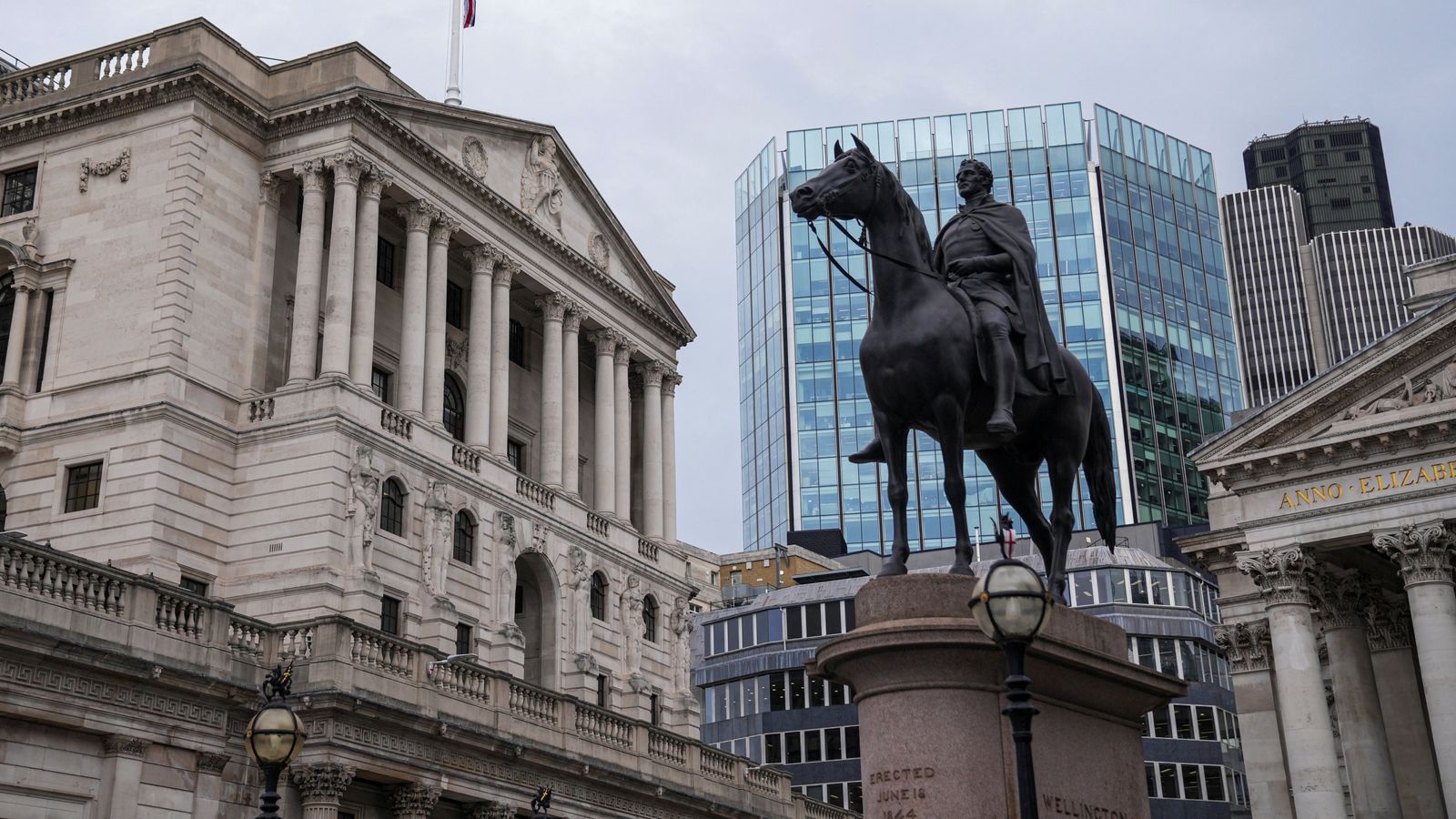
The Bank of England has warned of heightened risks to the UK’s financial system but cut the amount of money that banks need to hold in reserve in case of shock.

The twice-yearly financial stability report highlights a series of pressures, from higher government borrowing costs to risks around lending to major tech firms and record stock market valuations – particularly in areas exposed to artificial intelligence (AI).

“Risks to financial stability have increased during 2025,” the Bank‘s financial policy committee (FPC) said.

“Global risks remain elevated and material uncertainty in the global macroeconomic outlook persists. Key sources of risk include geopolitical tensions, fragmentation of trade and financial markets, and pressures on sovereign debt markets.

Money latest: My supermarket delivery row

“Elevated geopolitical tensions increase the likelihood of cyberattacks and other operational disruptions.

“In the FPC’s judgement, many risky asset valuations remain materially stretched, particularly for technology companies focused on AI.

More from Money

“Equity valuations in the US are close to the most stretched they have been since the dot-com bubble, and in the UK since the global financial crisis (GFC). This heightens the risk of a sharp correction.”

Its concern extended to the growing trend of tech firms using debt finance to fund investment.

Please use Chrome browser for a more accessible video player

Could the AI bubble burst?

The Bank, which joined the International Monetary Fund in warning over an AI-led bubble in October, delivered its verdict at a time when UK regulators are under pressure from the government to place a greater focus on supporting economic growth.

It is understood, for example, the UK’s ringfencing regime – that sees retail banking separated from more risky investment banking operations within major lenders – is the subject of a review between the Bank and government.

Efforts by the chancellor to grow the economy will be potentially helped by the Bank’s decision today to lower capital requirements – the reserves banks must hold to help them withstand shocks in the financial system such as the global crisis of 2008/9.

The sector’s main capital requirement was cut by the Bank from 14% to 13%.

The Bank said that almost four million households face higher mortgage costs as fixed-term deals end. Pic: iStock
Image:
The Bank said that almost four million households face higher mortgage costs as fixed-term deals end. Pic: iStock

Such a move was urged, not only by the government, but by businesses to bolster UK lending and competitiveness.

The relaxation of the buffer does not take effect until 2027.

It was announced alongside confirmation that the country’s biggest lenders – Barclays, HSBC, Lloyds, NatWest, Santander UK, Standard Chartered and Nationwide building society – had passed the Bank’s latest stress tests.

The shocks each was exposed to included a 5% contraction in UK economic output, a 28% drop in house prices and Bank rate at 8%.

Despite the growing risks identified by the FPC, the Bank said that each was strong enough to support households and businesses even in the event of such scenarios, given the healthy state of their reserves.

It is widely expected that the gradual reduction in Bank rate will continue next year, assuming the outlook for inflation remains on a downwards trajectory, helping wider borrowing costs – a source of record bank profitability – decline.

The Bank said that three million households were expected to see their mortgage payments decrease in the next three years but that 3.9 million were forecast to refinance onto higher rates.

As such, it projected a £64 (8%) rise in costs for a typical owner-occupier mortgage customer rolling off a fixed rate deal in the next two years.

Banking stocks, which have enjoyed strong gains this year, were up when the FTSE 100 opened for business despite wider market caution globally which is aligned with the risks spoken of in the financial stability report.

Matt Britzman, senior equity analyst at Hargreaves Lansdown, said: “UK banks are offering a dose of optimism this morning in what’s turning out to be a good couple of weeks for the major lenders.

“The UK’s seven biggest banks sailed through the latest stress test, reaffirming their resilience and earning a regulatory nod to ease capital buffers.

“Most banks already hold capital well above the minimum by choice, so any shift in strategy may take time – but in theory, it frees up extra capital for lending or capital returns.

“However they use the new freedom, this is another clear signal that the UK banking sector is in robust health. This was largely expected, but the confirmation should still be taken well, especially after dodging tax hikes in last week’s budget.”

Continue Reading

World

More than 800,000 young children seeing social media content ‘designed to hook adults’, figures show


Published

on

By

More than 800,000 young children seeing social media content 'designed to hook adults', figures show

Children as young as three are “being fed content and algorithms designed to hook adults” on social media, a former education minister has warned.

Lord John Nash said analysis by the Centre for Social Justice (CSJ) suggesting more than 800,000 UK children aged between three and five were already engaging with social media was “deeply alarming”.

The peer, who served as minister for the school system between 2013 and 2017, said that “children who haven’t yet learned to read [are] being fed content and algorithms designed to hook adults”, which, he said, “should concern us all”.

He called for “a major public health campaign so parents better understand the damage being done, and legislation that raises the age limit for social media to 16 whilst holding tech giants to account when they fail to keep children off their platforms”.

The CSJ reached the figure by applying the latest population data to previous research by Ofcom.

The internet and communications watchdog found that almost four in 10 parents of a three to five year-old reported that their child uses at least one social media app or site.

With roughly 2.2 million children in this age group as of 2024, the CSJ said this suggests there could be 814,000 users of social media between three and five years old, a rise of around 220,000 users from the year before.

More on Australia

Lord Nash is among those who have demanded the Children’s Wellbeing and Schools Bill ban under-16s from having access to social media, something that will become law in Australia next month.

From 10 December, social media platforms will have to take reasonable steps to prevent under-16s from having a social media account, in effect blocking them from platforms such as Meta’s Instagram, TikTok and Snap’s Snapchat.

Ministers hope it will protect children from harmful content and online predators.

But one teenager who is against the idea is suing the Australian government as, he says, the measure would make the internet more dangerous for young people, many of whom would ignore the ban.

Read more on Sky News:
Call to trial four-day week for teachers
Primary school tests ‘devastating’
AI to tackle truancy

Noah Jones, 15, co-plaintiff in a High Court case said a better plan would be “cutting off the bad things about social media”, adding, “I most likely will get around the ban. I know a lot of my mates will”.

UK campaigners have called for stronger policies to stop students using phones in schools, which already have the power to ban phones.

The CSJ wants to see smartphones banned in all schools “to break the 24-hour cycle of phone use”, and said a public health campaign is needed “to highlight the harms of social media”.

Last week Health Secretary Wes Streeting said he worries “about the mind-numbing impact of doomscrolling on social media on young minds and our neurodevelopment”.

Continue Reading

World

Sudan’s RSF says it has captured Babanusa in West Kordofan

Published

on

By

Sudan's RSF says it has captured Babanusa in West Kordofan

Sudan’s paramilitary Rapid Support Forces says it has captured Babanusa, a transport junction in the south of the country, just a month after the fall of Al Fashir to the same group.

The RSF said in a statement the seizure of the city in West Kordofan state came as it repelled “a surprise attack” by the Sudanese army in what it called “a clear violation of the humanitarian truce”.

The paramilitary group added it had “liberated” the city in the state, which has become the latest frontline in the war in Sudan.

Please use Chrome browser for a more accessible video player

Sky’s Yousra Elbagir explains the unfolding humanitarian crisis

It comes just over a month after the Sudanese Armed Forces (SAF) withdrew from military positions in the heart of Al Fashir, the capital of North Darfur, and the symbolic site was captured by the RSF with no resistance.

The RSF claimed at the time it had taken over the city and completed its military control of the Darfur region, where the administration of former US president Joe Biden has accused the group of committing genocide.

Please use Chrome browser for a more accessible video player

Sky’s Africa correspondent Yousra Elbagir on why evidence suggests there is a genocide in Sudan.

The war between the Sudanese army and the RSF – who were once allies – started in Khartoum in April 2023 but has spread across the country.

About 12 million people are believed to have been displaced and at least 40,000 killed in the civil war, according to the World Health Organization (WHO) – but aid groups say the true death toll could be far greater.

More on Sudan

Tom Fletcher, the UN’s under-secretary-general for humanitarian affairs, recently told Sky’s The World With Yalda Hakim the situation was “horrifying”.

“It’s utterly grim right now – it’s the epicentre of suffering in the world,” he said of Sudan.

Read more:
Tens of thousands killed in two days in Sudan city

Sudan’s war: Is it a genocide?

The United States, the United Arab Emirates, Egypt and Saudi Arabia – known as the Quad – earlier in November proposed a plan for a three-month truce followed by peace talks.

The RSF responded by saying it had accepted the plan, but soon after attacked army territory with a barrage of drone strikes.

Continue Reading

Trending