
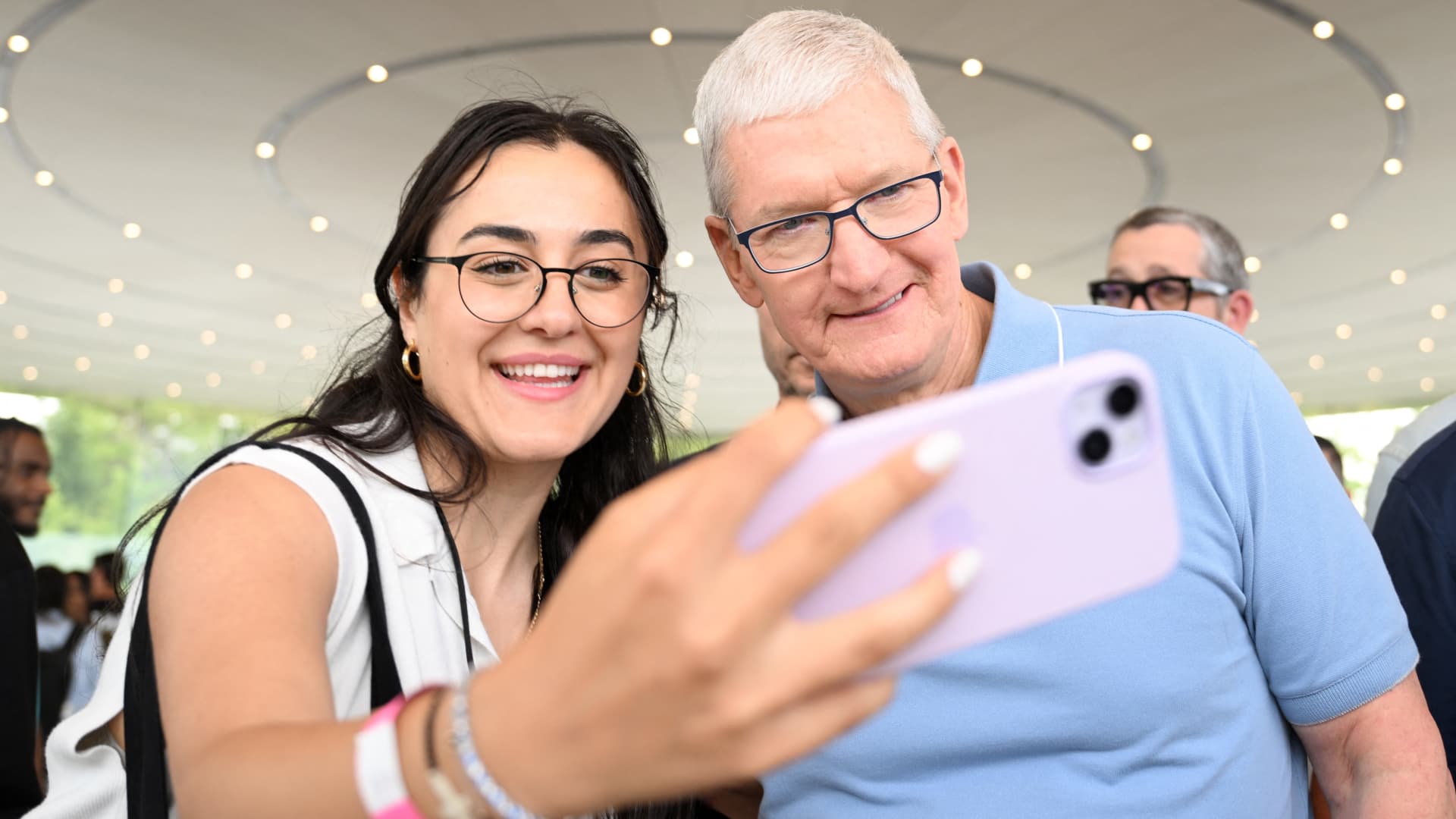
Here are the biggest changes coming to your iPhone this fall


Colin Angle, co-founder and chief executive officer of iRobot Corp., speaks during a Prime Air delivery drone reveal event in Las Vegas, Nevada, U.S., on Wednesday, June 5, 2019.
Joe Buglewicz | Bloomberg | Getty Images
Colin Angle, co-founder and former CEO of iRobot, on Monday said the company’s move to declare bankruptcy was “profoundly disappointing” and “nothing short of a tragedy for consumers.”
The robotic vacuum pioneer announced Sunday that it filed for bankruptcy and will be taken private by Shenzhen Picea Robotics, a lender and key supplier, following years of financial struggles.
“Today’s outcome is profoundly disappointing — and it was avoidable,” Angle told CNBC in a statement. “This is nothing short of a tragedy for consumers, the robotics industry, and America’s innovation economy.”
In a Sunday court filing, iRobot said it had between $100 million and $500 million of assets and liabilities. The company said it owes almost $100 million to its new owner Picea, more than $5.8 million to GXO Logistics and roughly $3.4 million to U.S. Customs and Border Protection for unpaid tariffs, among other liabilities.
Shares of iRobot plunged more than 72% on Monday.
Founded in 1990 by Angle and two other researchers at the Massachusetts Institute of Technology, iRobot got its start making military and defense tech for the government before launching its flagship Roomba product in 2002 that cemented it as an early leader in the vacuum cleaner market.
The company’s future has remained uncertain after Amazon abandoned its planned $1.7 billion acquisition of the company in January 2024, citing regulatory scrutiny from the European Union and the U.S. Federal Trade Commission. Afterward, iRobot laid off 31% of staff and Angle announced he would step down as CEO and board chair.
Amazon CEO Andy Jassy called regulators’ efforts to block the deal a “sad story” and said it would’ve given iRobot a competitive boost against rivals.
The Amazon acquisition was “the most viable path” for iRobot to compete globally, Angle said Monday. He added that iRobot’s bankruptcy serves as a “warning” for competition watchdogs.
Helen Greiner, one of iRobot’s cofounders, said in a Monday LinkedIn post that the company’s restructuring plan under a Chinese owner isn’t good for “consumers, employees, stockholders, Massachusetts or the USA.”
The company had been facing growing competition from cheaper, rapidly growing rivals, such as China-based Anker, Ecovacs and Roborock. Supply chain constraints in recent years added further strain to iRobot’s business, as it struggled to navigate shipping and inventory delays, which dented its revenue.
Its financial outlook darkened significantly after the Amazon deal fell apart, and in October, iRobot said it would be forced to seek bankruptcy protection if it failed to secure more capital or find a buyer.
Gary Cohen, iRobot CEO, said in a statement Monday that the restructuring plan would help secure the company’s “long-term future.” The bankruptcy proceedings aren’t expected to disrupt its products’ functionality or customer support, iRobot said.
The company’s third-quarter sales came in at $145.8 million, down almost 25% from $193.4 million one year earlier, and iRobot has about $190 million in debt.


Broadcom CEO Hock Tan.
Lucas Jackson | Reuters
In at least one corner of the artificial intelligence market, sentiment has turned decidedly negative.
Broadcom, CoreWeave and Oracle, three companies intimately tied to the AI infrastructure buildout, all had another rough day on Wall Street on Monday after selling off sharply last week.
While the three stocks are all still solidly up for the year — CoreWeave held its market debut in March — the most recent trend suggests that investors are concerned about whether the returns on investment will ever justify the level of spending taking place.
“It definitely requires the ROI to be there to keep funding this AI investment,” Matt Witheiler, head of late-stage growth at Wellington Management, told CNBC’s “Money Movers” on Monday. “From what we’ve seen so far that ROI is there.”
Witheiler said the bullish side of the story is that, “every single AI company on the planet is saying if you give me more compute I can make more revenue.”
Still, the market was displeased last week with quarterly earnings reports from chipmaker Broadcom and cloud infrastructure supplier Oracle, even though both companies beat on revenue and issued forecasts showing that AI demand is soaring.
Oracle, which is now heavily reliant on the debt markets to fund its data center development, provided scant details about how it will continue to finance its commitments. The company said it would ramp up capital expenditures in the current fiscal year to $50 billion from an earlier forecast of $35 billion because of new contracts from the likes of Meta and Nvidia.
It’s also ratcheting up leases. As of Nov. 30, Oracle had $248 billion in lease commitments for data centers and cloud capacity commitments that will run for 15 to 19 years. That’s up 148% from the end of August.
Meanwhile, Broadcom CEO Hock Tan said he expects AI chip sales this quarter to double from a year earlier to $8.2 billion, driven by both custom chips as well as semiconductors for AI networking.
However, as the company spends heavily on more parts to produce server racks, investors are going to have to stomach a hit to profits. CFO Kirsten Spears said on Broadcom’s earnings call that “gross margins will be lower” for some of the company’s AI chip systems.
Broadcom shares fell about 5% on Monday following an 11% slump on Friday, leaving them 17% below their record high reached on Wednesday.
Oracle dropped about 2.5% on Monday and is now down 17% in the past three trading days. The company has lost 46% of its value since Sept. 10, when the stock had its best day since 1992 following disclosure of a massive AI backlog.
Venture capitalist Tomasz Tunguz, who focuses on enterprise software and AI, wrote in a Monday blog that Oracle’s recent fundraising binge has left it with a debt-to-equity ratio of 500%, “dwarfing its cloud computing peers.” Amazon, Microsoft, Meta and Google all have ratios between 7% and 23%, he wrote.
Tunguz, founder of Theory Ventures, said the other company with a notably high ratio, at 120%, is CoreWeave, which provides cloud computing services built largely around Nvidia’s graphics processing units.
CoreWeave shares fell about 6% on Monday after dropping 11% last week. The company has lost 60% of its value from its high in June.
WATCH: Oracle financing in question


Samuel Boivin | Nurphoto | Getty Images
OpenAI has hired Google’s Albert Lee to lead corporate development, a spokesperson for the artificial intelligence startup confirmed to CNBC.
Lee previously led corporate development for Google Cloud and Google DeepMind. He worked on several of Google’s high-profile acquisitions, including its $32 billion purchase of the cloud security startup Wiz, which the company announced in March.
In his new role, Lee will have broad visibility across OpenAI as the company focuses on strategic investments and M&A in its next phase of growth, the spokesperson said. His hiring signals that OpenAI will continue to hunt for targets that can help it gain an edge over rivals like Google and Anthropic.
OpenAI was founded as a nonprofit research lab in 2015, but its valuation has ballooned to $500 billion since the launch of ChatGPT in 2022.
The AI lab has made multiple acquisitions this year. Most recently, OpenAI earlier this month announced a definitive agreement to acquire Neptune, a startup that helps with AI model training. The companies did not disclose the terms.
OpenAI also bought a small company called Software Applications Incorporated for an undisclosed sum in October, the product development startup Statsig for $1.1 billion in September and former Apple designer Jony Ive’s AI devices startup io for more than $6 billion in May.
Lee is the latest of several executives to join OpenAI as the company looks to fill out its leadership bench.
Earlier this month, OpenAI announced Slack CEO Denise Dresser will serve as its chief revenue officer. In May, the company announced it hired Fidji Simo, who was then CEO of Instacart, as the head of the AI lab’s applications business.
The Information was first to report Lee’s departure from Google.
WATCH: OpenAI unveils GPT-5.2, its strongest AI model for professional use
-
 Sports2 years ago
Story injured on diving stop, exits Red Sox game
-
 Sports3 years ago
‘Storybook stuff’: Inside the night Bryce Harper sent the Phillies to the World Series
-
 Sports2 years ago
Game 1 of WS least-watched in recorded history
-
 Sports3 years ago
Button battles heat exhaustion in NASCAR debut
-
 Sports3 years ago
MLB Rank 2023: Ranking baseball’s top 100 players
-
Sports4 years ago
Team Europe easily wins 4th straight Laver Cup
-
 Environment3 years ago
Japan and South Korea have a lot at stake in a free and open South China Sea
-
 Environment1 year ago
Here are the best electric bikes you can buy at every price level in October 2024