

Channel crossings: Facebook and TikTok team up with police to crack down on people smugglers


Facebook, TikTok and Twitter will team up with UK law enforcement to crack down on posts by people smugglers encouraging migrants to cross the English Channel, the government says.
Rishi Sunak, who has made cutting the number of small boats arriving on UK shores one of his “five pledges”, said the new partnerships with various social media companies will tackle attempts to “lure” people into paying to make the perilous journey.
Group discounts, free spaces for children and offers of false documents are among the posts the prime minister wants removed to help achieve his promise to “stop the boats”.
Nearly 15,000 people have made the dangerous trip across the Dover Strait in small boats so far this year, according to official data compiled and analysed by Sky News.
This is around 15% less than the same time last year, the data suggests.
The voluntary partnership between social media firms and the National Crime Agency will seek to redirect people away from such content in the same way as is used to tackle content promoting extremism or eating disorders.
Plans to house asylum seekers in tents
Meta, which owns Facebook and Instagram, as well as TikTok and X, formally known as Twitter, have all signed up to the plans, Downing Street said.
It comes as controversy over plans to house asylum seekers on the Bibby Stockholm barge continues.
Mr Sunak said: “To stop the boats, we have to tackle the business model of vile people smugglers at source.
“That means clamping down on their attempts to lure people into making these illegal crossings and profit from putting lives at risk.
“This new commitment from tech firms will see us redouble our efforts to fight back against these criminals, working together to shut down their vile trade.”
Read more:
Lords back down over government plans to stop small boats
Nearly 300 children have died or disappeared in Mediterranean crossings
Labour said the action was “too little, too late” and the Liberal Democrats said it amounted to “tinkering around the edges”.
Kicking off a “small boats week” of linked announcements, Number 10 said the “legacy” backlog of asylum applications made before the end of June 2022 has been reduced by a third since December.
But Labour claimed it will take until 2036 to clear the existing backlog for removals of failed asylum seekers, with nearly 40,000 people awaiting removal in the latest figures.
Shadow home secretary Yvette Cooper said it was “just deluded” for the Conservatives to “boast about progress on tackling the Tories’ asylum chaos”.


Homelessness charities have warned that ministers are “falling short of what is desperately needed to end Britain’s homelessness crisis”.
It comes as the government published its new plan to tackle rough sleeping in Britain, which pledges £3.5bn of funding to crackdown on the issue.
But charities have said Labour’s National Plan to End Homelessness “falls short” and contains “important gaps”, meaning the party will not be able to achieve their stated goal of halving the number of homeless people by 2029/30.
Crisis, an organisation that supports the homeless, also argues that only £100m of the funding announced in the strategy is new.
Meanwhile, Labour MP Paula Barker, who co-chairs the All-Party Parliamentary Group (APPG) for ending homelessness, has told Sky News that the strategy has a “depressing lack of meat on the bone”, looks like it has been “rushed out”, and has left her “disappointed”.
It comes as Shelter warns that 382,618 people in England – including a record 175,025 children – will be homeless this Christmas, equivalent to one in every 153 people.
Working but homeless: Daniel’s story
What does the government’s plan to reduce rough sleeping involve?
The government has made three key pledges in its new plan, unveiled on Wednesday evening.
It says that it is aiming to halve the number of long-term rough sleepers by the end of the parliament, reduce the time families spend living in bed and breakfasts (B&Bs), and prevent more people from becoming homeless in the first place.
To achieve this, the party has set out numerous new measures, schemes and extra funding.
A new £124m supported housing scheme is also being established, and the government hopes that it will help get 2,500 people in England off the streets.
Housing Secretary Steve Reed said homelessness is “one of the most profound challenges we face”, and suggested that the strategy will build “a future where homelessness is rare, brief, and not repeated”.
How has the plan been received?
Ms Barker told Sky News she welcomes “the scale of investment”, but is “disappointed by what I have seen”.
The Labour MP explained: “From what I have seen so far, it leaves more questions than it answers – where are the clear measures around prevention? Where is the accommodation for people sleeping rough coming from – has it already been built? What about specialised provision for those fleeing domestic abuse?
“We needed this strategy to be bold.”
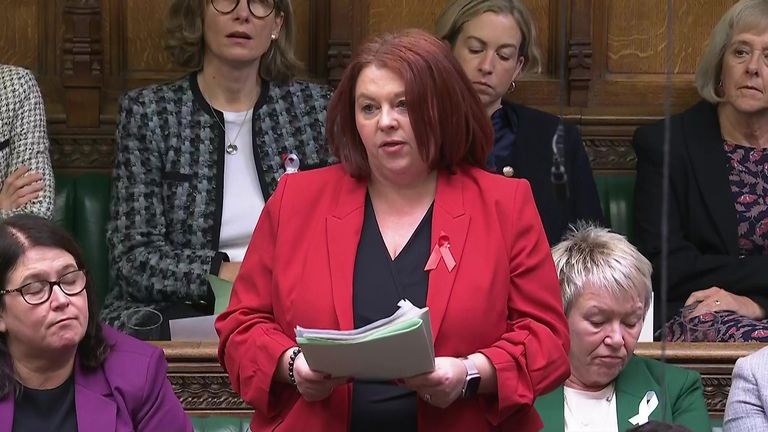
MP Paula Barker is ‘disappointed’ by what she has seen
Meanwhile, organisations working to support those on the streets have welcomed the plan for its focus on the issue, but warn it leaves it “almost impossible” for many families to avoid homelessness.
Matt Downie, the chief executive of Crisis, said: “Housing benefit remains frozen until at least 2030; there is no coherent approach for supporting refugees and stopping them becoming homeless; and we hear no assurances that the new homes government has pledged to build will be allocated to households experiencing homelessness at the scale required.
“There is a long way to go. Ministers are taking steps in the right direction, but falling short of what’s desperately needed to end Britain’s homelessness crisis.”

An exhibit organised to highlight the contrast between the Christmas period and an estimated 23,500 young people who will homeless. Pic: PA
Sarah Elliott, head of Shelter, also warned the proposals do not go far enough, saying: “Until a lot more of these social homes are built, one of the only ways to escape homelessness is if you can afford to pay a private rent.
“We know from our frontline services this is almost impossible to do when housing benefit remains frozen, and that is where the homelessness strategy falls short.”
Centrepoint, a charity that supports young people facing homelessness, said that the strategy is “an important step”, and could be “transformative”. But it added that “gaps in the government’s approach remain”, and said increases in funding “don’t face up to the scale of homelessness”.
The Conservatives have said that the strategy means Labour “has completely failed on homelessness”.
Paul Holmes, shadow housing minister, said the number of households and children in temporary accommodation has risen to “record levels”, and pointed to the government’s “abysmal record on house-building” and tackling immigration.

Australia’s securities regulator has finalized exemptions that will make it easier for businesses to distribute stablecoins and wrapped tokens.
The Australian Securities and Investments Commission (ASIC) on Tuesday announced the new measures, aimed at fostering innovation and growth in the digital assets and payment sectors.
It stated that it was “granting class relief” for intermediaries engaging in the secondary distribution of certain stablecoins and wrapped tokens.
This means that companies no longer need separate, and often expensive, licenses to act as intermediaries in these markets, and they can now use “omnibus accounts” with proper record-keeping.
The new exemptions extend the earlier stablecoin relief by removing the requirement for intermediaries to hold separate Australian Financial Services (AFS) licenses when providing services related to stablecoins or wrapped tokens.
Leveling the playing field for stablecoin issuers
The regulator stated that these omnibus structures were widely used in the industry, offering efficiencies in speed and transaction costs, and helping some entities manage risk and cybersecurity.
“ASIC’s announcement helps level the playing field for stablecoin innovation in Australia,” said Drew Bradford, CEO of Australian stablecoin issuer Macropod.
“By giving both new and established players a clearer, more flexible framework, particularly around reserve and asset-management requirements, it removes friction and gives the sector confidence to build,” he continued.
Related: Australia risks ‘missed opportunity’ by shirking tokenization: top regulator
The old licensing requirements were costly and created compliance headaches, particularly for an industry awaiting broader digital asset reforms.
“This kind of measured clarity is essential for scaling real-world use cases, payments, treasury management, cross-border flows, and onchain settlement,” added Bradford.
“It signals that Australia intends to be competitive globally, while still maintaining the regulatory guardrails that institutions and consumers expect.”
Angela Ang, head of policy and strategic partnerships at TRM Labs, also welcomed the development, stating, “Things are looking up for Australia, and we look forward to digital assets regulation crystallizing further in the coming year — bringing greater clarity to the sector and driving growth and innovation.”
Global stablecoin growth surges
Total stablecoin market capitalization is at a record high of just over $300 billion, according to RWA.xyz.
It has grown by 48% since the beginning of this year, and Tether remains the dominant issuer with a 63% market share.

Magazine: XRP’s ‘now or never’ moment, Kalshi taps Solana: Hodler’s Digest

A group of Republicans has called foul after the US House passed a massive defense spending bill on Wednesday that omitted a ban on central bank digital currencies despite promises it would be included.
“Conservatives were promised — explicitly — that strong anti-Central Bank Digital Currency (CBDC) language would be included in the National Defense Authorization Act (NDAA). That promise was broken,” GOP Representative Keith Self wrote to X on Wednesday.
The House voted 312-112 to pass the NDAA on Wednesday, sending the $900 billion annual military funding bill to the Senate in a bid to have it passed before the end of the year.
Self had filed an amendment on Tuesday to include a CBDC ban, which had been removed from the bill, but it failed to advance and did not see a vote on the House floor.
Self said a group of Republicans was “assured that anti-CBDC language would be included. Instead, we have been forced into a take-it-or-leave-it bill that breaks that promise. Without that language, I’m inclined to leave it.”

The more than 3,000-page bill is considered must-pass legislation and typically sees non-defense-related amendments that could otherwise be stalled or heavily revised if passed as standalone bills.
In July, House Republican leaders cut a deal with a group of party hardliners to put a CBDC ban in the defense spending bill after the group refused to move forward with three crypto bills unless a CBDC ban was guaranteed.
The bills had been held up in a record-long nine-hour procedural vote and included the stablecoin-regulating GENIUS Act, which President Donald Trump had pressured the GOP to quickly pass.
Related: Does GENIUS turn stablecoin issuers into stealth buyers of US debt?
GOP Representative Marjorie Taylor Greene slammed Speaker Mike Johnson on Monday for not keeping his promise of a CBDC ban, adding she supports crypto but “will never support giving the government the ability to turn off your ability to have full control of your money and to buy and sell.”
An early House version of the bill shared in August had included a CBDC ban, before it was subjected to amendments via multiple markups and committees.
The language of the provision banned the Federal Reserve from testing, studying, developing or issuing any digital currency or asset. It would have also stopped the central bank from offering financial products or services directly to individuals.
In July, the House passed a bill banning CBDCs, the Anti-CBDC Surveillance State Act, with a slim vote of 219-210, which has stalled in the Senate.
Self said he would “fight on in the next must-pass bill to ensure a CBDC never sees the light of day. Financial freedom isn’t negotiable.”
Legal Panel: Crypto wanted to overthrow banks, now it’s becoming them in stablecoin fight
-
 Sports2 years ago
Story injured on diving stop, exits Red Sox game
-
 Sports3 years ago
‘Storybook stuff’: Inside the night Bryce Harper sent the Phillies to the World Series
-
 Sports2 years ago
Game 1 of WS least-watched in recorded history
-
 Sports3 years ago
Button battles heat exhaustion in NASCAR debut
-
 Sports3 years ago
MLB Rank 2023: Ranking baseball’s top 100 players
-
Sports4 years ago
Team Europe easily wins 4th straight Laver Cup
-
 Environment3 years ago
Japan and South Korea have a lot at stake in a free and open South China Sea
-
 Environment1 year ago
Here are the best electric bikes you can buy at every price level in October 2024