
The scientist behind IBM Watson has raised $60 million for his AI startup in New York

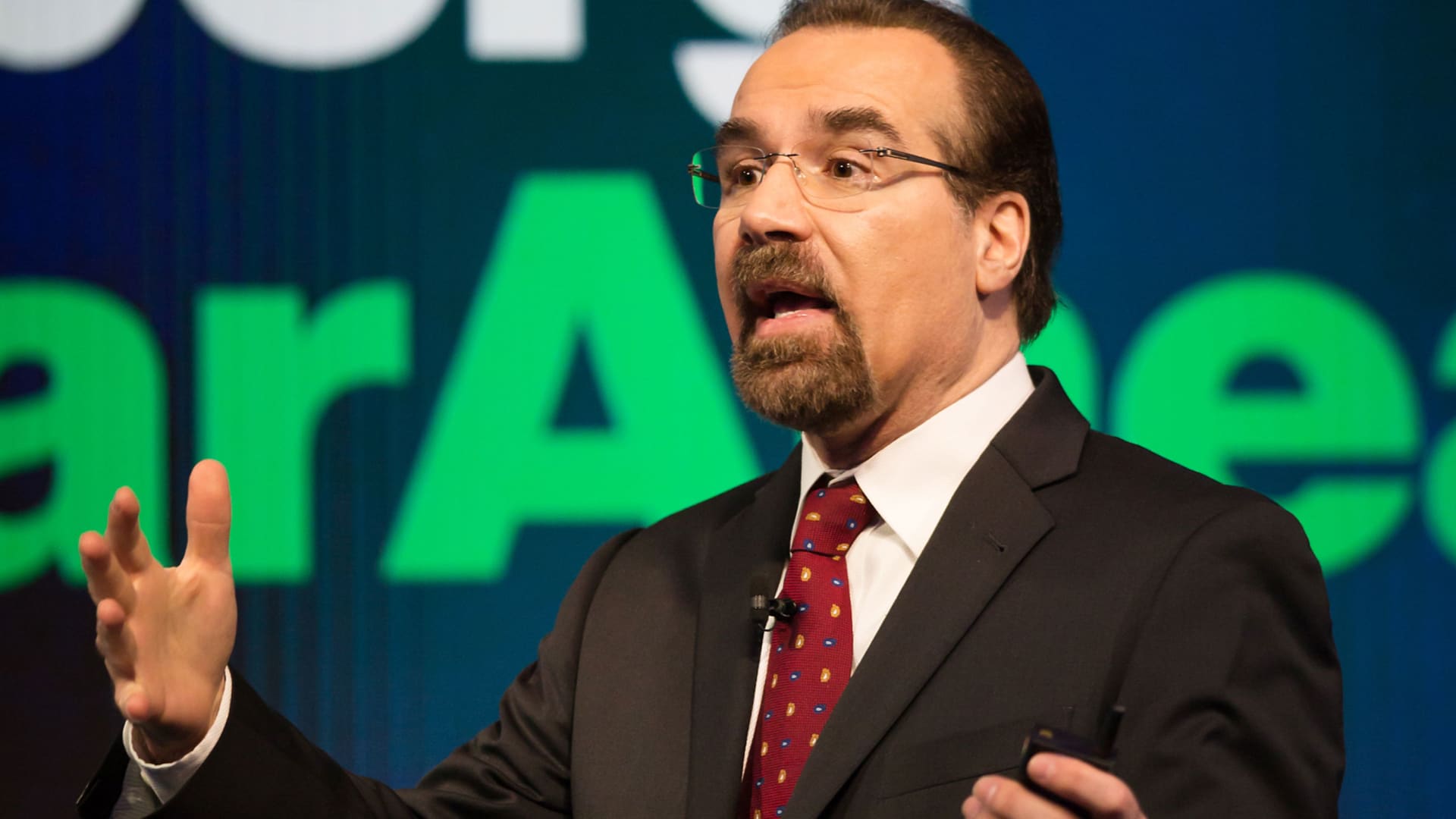
David Ferrucci, chief executive officer and founder of Elemental Cognition, speaks during a conference in New York, Nov. 8, 2017.
Alex Flynn | Bloomberg | Getty Images
David Ferrucci, a prominent artificial intelligence researcher who led the team that created IBM Watson, has raised nearly $60 million for his AI startup called Elemental Cognition, according to a regulatory filing.
The filing on Thursday says the company sold $59.95 million worth of equity to 17 investors and plans to raise another $5.75 million.
Headquartered in New York’s historic Helmsley Building, Elemental says on its website that the company seeks to develop AI that “thinks before it talks.” It offers two enterprise products, Cogent and Cora, which are essentially chatbots designed for different scenarios. They can be used in financial services, interactive travel planning and for automating research discovery in life sciences.
Ferrucci led IBM Watson from 2006 until the end of 2012, during which time the computer system famously won “Jeopardy!” He then ran AI research for Bridgewater Associates, one of the world’s largest hedge funds. Ferrucci has a Phd in computer science from Rensselaer Polytechnic Institute.
Elemental’s operating chief is David Shepler, another former top Bridgewater executive who also worked at IBM. Other members of Elemental’s leadership team with IBM on their resumes include Eric Brown and Mike Barborak, who are both vice presidents.
Jim Breyer, founder and CEO of Breyer Capital and one of the first investors in Facebook, is named on Elemental’s investors and advisors page, as is former IBM CEO Sam Palmisano. Greg Jensen, Bridgewater’s co-chief investment officer, and Geoff Yang of Redpoint Ventures are also in that group.
Elemental didn’t respond to requests for comment.
Investors have been swarming to AI startups this year following the release in late 2022 of OpenAI’s ChatGPT, which gave the public a clear look at the power of AI chatbots. While Elemental’s website doesn’t emphasize generative AI, the broad category that’s been red hot, its LinkedIn page says the company “provides a revolutionary Generative AI platform with superior natural language understanding that powers expert problem-solving intelligence and research & discovery applications.”
Elemental touts its hybrid AI platform as its standout offering. Instead of solely relying on large language models (LLMs) as is the case with ChatGPT, Elemental says it combines LLMs with an AI-powered reasoning engine to help responses better stay within guardrails.
Watson, which marked IBM’s early splash in artificial intelligence, never amounted to a profitable endeavor. In January of last year, the company sold its Watson Health unit for an undisclosed amount to private equity firm Francisco Partners. Three months ago, IBM announced WatsonX, which it’s billing it as a development studio for companies to “train, tune and deploy” machine-learning models.
WATCH: Most of the world will follow China on many aspects of AI rules


Chuck Robbins, chief executive officer of Cisco, participates in a Bloomberg interview at the World Economic Forum in Davos, Switzerland, on Jan. 17, 2024.
Stefan Wermuth | Bloomberg | Getty Images
Few companies were as hot in early 2000 as Cisco, whose networking equipment served as the backbone of the internet boom.
On Wednesday, Cisco’s stock surpassed its dot-com peak for the first time. The shares rose almost 1% to $80.25, topping their prior split-adjusted record or $80.06 reached on March 27, 2000. That’s the same day that Cisco passed Microsoft to become the most valuable publicly traded company in the world.
Back then, investors saw Cisco as a way to bet on the growth of the web, as companies that wanted to get online relied upon the hardware maker’s switches and routers. But following a half-decade boom, the dot-com bubble burst just after Cisco reached its zenith, a collapse that wiped out more than three-quarters of the Nasdaq’s value by October 2002.
While the market swoon eliminated scores of internet highflyers, Cisco survived the upheaval. Eventually it started to grow and expand, diversifying through a series of acquisitions like set-top box maker Scientific- Atlanta in 2006, followed by software companies including Webex, AppDynamics, Duo and Splunk.
With its gains on Wednesday, Cisco’s market cap sits at $317 billion, making it only the 13th most valuable U.S. tech company. In recent years, the stock has badly trailed tech’s megacaps, which have been at the center of the new boom surrounding artificial intelligence.
The AI market has reached a level of euphoria that many analysts have compared to the dot-com era. Instead of Cisco, the modern infrastructure winner is Nvidia, whose AI chips are at the heart of model development and are relied up by the other major tech companies that are all building out AI-focused data centers. Nvidia has a market cap of $4.5 trillion, roughly 14 times Cisco’s current value.
But Cisco is angling to benefit from the AI craze, with CEO Chuck Robbins in November touting $1.3 billion in quarterly AI infrastructure orders from large web companies. Total revenue approached $15 billion, which was up 7.5% year over year, compared with 66% growth in 2000.
Shares of Cisco are up about 36% so far in 2025, outperforming the Nasdaq, which has gained about 22% over the same period.
WATCH: Cisco CEO on latest quarter: AI demand from hyperscalers is accelerating


Larry Ellison, Oracle’s co-founder and chief technology officer, appears at the Formula One British Grand Prix in Towcester, U.K., on July 6, 2025.
Jay Hirano | Sopa Images | Lightrocket | Getty Images
Oracle is scheduled to report fiscal second-quarter results after market close on Wednesday.
Here’s what analysts are expecting, according to LSEG:
- Earnings per share: $1.64 adjusted
- Revenue: $16.21 billion
Wall Street expects revenue to increase 15% in the quarter that ended Nov. 30, from $14.1 billion a year earlier. Analysts polled by StreetAccount are looking for $7.92 billion in cloud revenue and $6.06 billion from software.
The report lands at a critical moment for Oracle, which has tried to position itself at the center of the artificial intelligence boom by committing to massive build-outs. While the move has been a boon for Oracle’s revenue and its backlog, investors have grown concerned about the amount of debt the company is raising and the risks it faces should the AI market slow.
The stock plummeted 23% in November, its worst monthly performance since 2001 and, as of Tuesday’s close, is 33% below its record reached in September. Still, the shares are up 33% for the year, outperforming the Nasdaq, which has gained 22% over that stretch.
Over the past decade, Oracle has diversified its business beyond databases and enterprise software and into cloud infrastructure, where it competes with Amazon, Microsoft and Google. Those companies are all vying for big AI contracts and are investing heavily in data centers and hardware necessary to meet expected demand.
OpenAI, which sparked the generative AI rush with the launch of ChatGPT three years ago, has committed to spending more than $300 billion on Oracle’s infrastructure services over five years.
“Oracle’s job is not to imagine gigawatt-scale data centers. Oracle’s job is to build them,” Larry Ellison, the company’s co-founder and chairman, told investors in September.
Oracle raised $18 billion during the period, one of the biggest issuances on record for a tech company. Skeptical investors have been buying five-year credit default swaps, driving them to multiyear highs. Credit default swaps are like insurance for investors, with buyers paying for protection in case the borrower can’t repay its debt.
“Customer concentration is a major issue here, but I think the bigger thing is, How are they going to pay for this?” said RBC analyst Rishi Jaluria, who has the equivalent of a hold rating on Oracle’s stock.
During the quarter, Oracle named executives Clay Magouyrk and Mike Sicilia as the company’s new CEOs, succeeding Safra Catz. Oracle also introduced AI agents for automating various facets of finance, human resources and sales.
Executives will discuss the results and issue guidance on a conference call starting at 5 p.m. ET.
WATCH: Oracle’s debt concerns loom large ahead of quarterly earnings
-
 Sports2 years ago
Story injured on diving stop, exits Red Sox game
-
 Sports3 years ago
‘Storybook stuff’: Inside the night Bryce Harper sent the Phillies to the World Series
-
 Sports2 years ago
Game 1 of WS least-watched in recorded history
-
 Sports3 years ago
Button battles heat exhaustion in NASCAR debut
-
 Sports3 years ago
MLB Rank 2023: Ranking baseball’s top 100 players
-
Sports4 years ago
Team Europe easily wins 4th straight Laver Cup
-
 Environment3 years ago
Japan and South Korea have a lot at stake in a free and open South China Sea
-
 Environment1 year ago
Here are the best electric bikes you can buy at every price level in October 2024