

PayPal’s new PYUSD stablecoin faces legal headwinds and ‘less functionality’

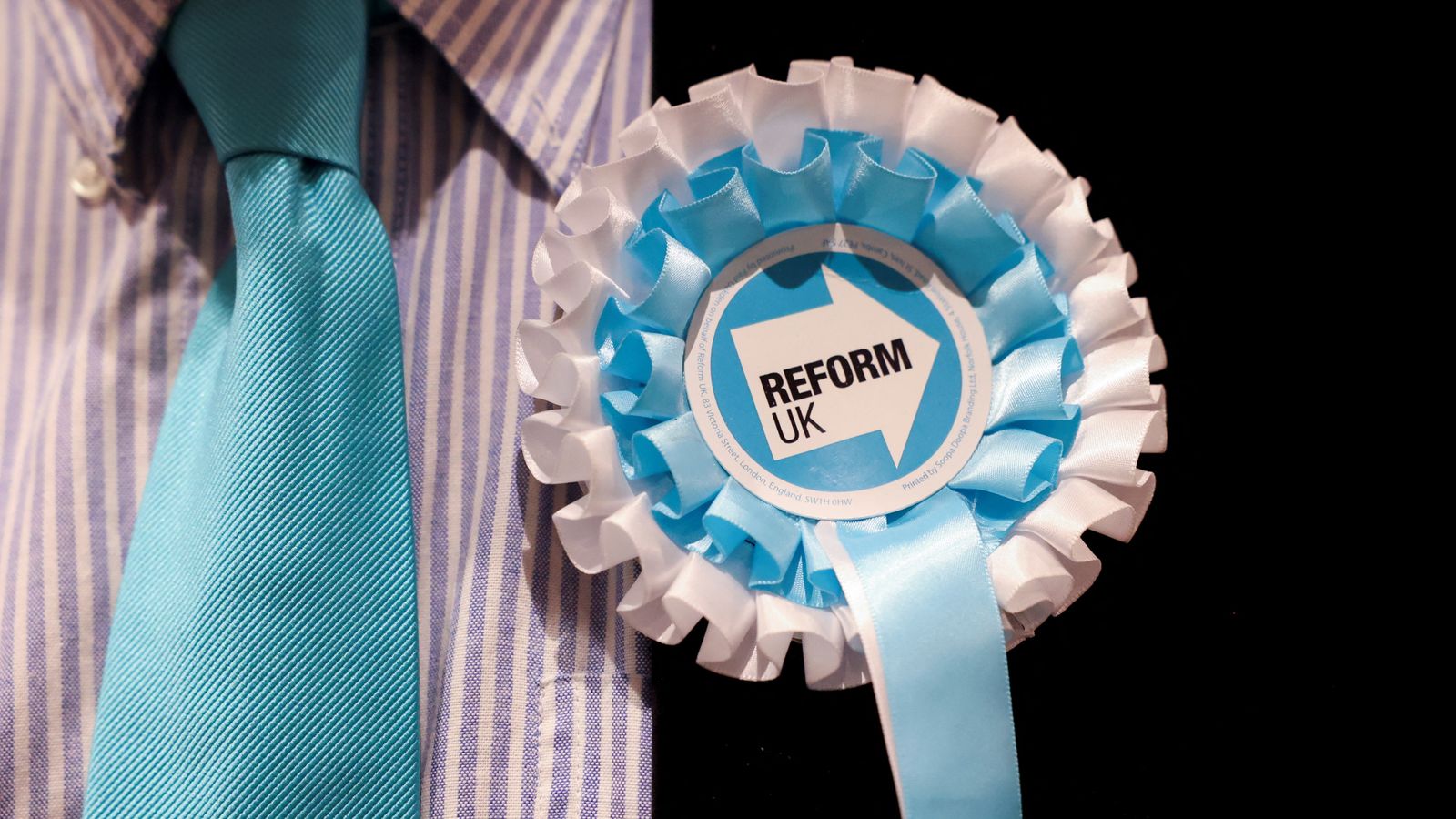
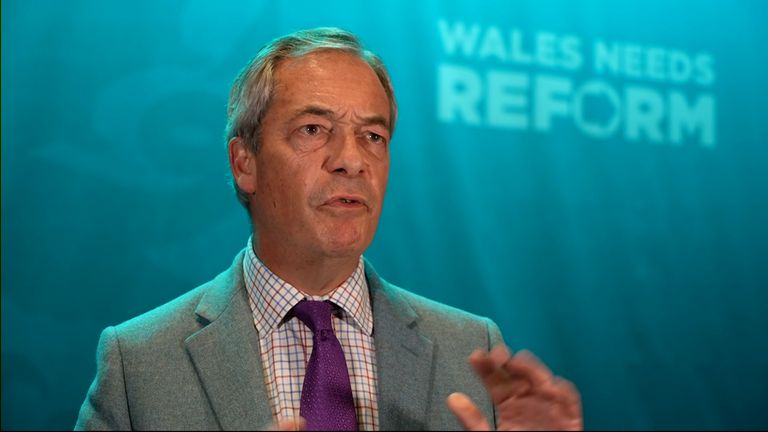
Who is the man behind the record-breaking multi-million pound donation to Reform UK?
Christopher Harborne gave Nigel Farage‘s party £9m in August, according to new data published by the Electoral Commission. The contribution ranks as the largest ever single donation from a living person in UK political history.
Born in Britain, Mr Harborne is a businessman who owns several companies, employing more than 600 people worldwide, according to a court filing dated last year.
Reform UK leader Nigel Farage
Yet he’s not resident in the UK, and is also a citizen of Thailand, where he is known as Chakrit Sakunkrit, and has lived and worked there for 20 years.
Follow live: Politics latest
Nonetheless, he has a long history of political donations to British parties.
Electoral Commission data shows he has previously donated to the Conservatives, gifting them £10,000 in May 2001, and continuing to support them with close to £2m in donations by October 2022.
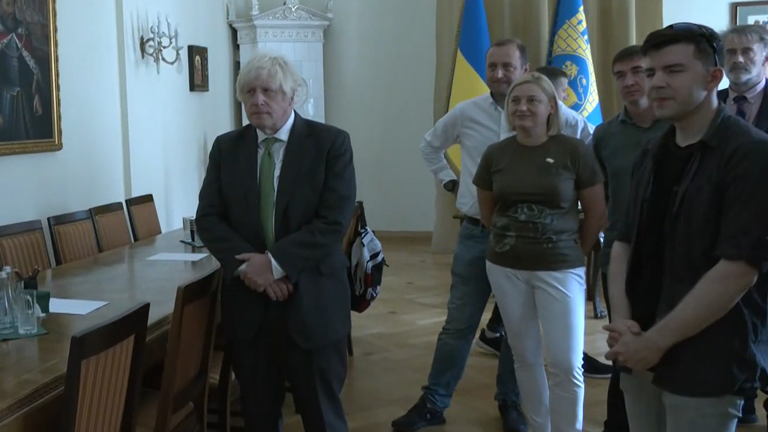
Christopher Harborne, furthest right, joins Boris Johnson, left, during his visit to Lviv, Ukraine. Pic: City of Lviv
But there was been some overlap with his backing of Reform, which first received a donation from him in April 2019, for £200,000.
He’s also donated to Mr Farage personally, giving £27,616.76 in January so the Reform leader could attend the second inauguration of Donald Trump.
He paid another £32,836 for the Reform and a member of staff to fly to the US following the attempted assassination of Trump in July last year.
And he gave one of the biggest donations ever made to an individual UK politician when he backed Boris Johnson to the tune of £1m in 2022.
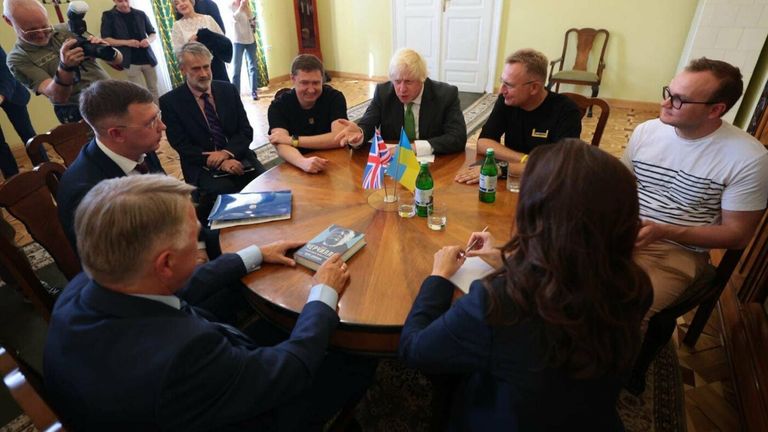
Christopher Harborne sits second left from Boris Johnson, centre, during his visit to Lviv, Ukraine. Pic: City of Lviv
He served as an advisor to Mr Johnson during the former PM’s trip to Kyiv in 2023.
His latest cash injection to Reform UK breaks the previous record for a donation from a living person, which was £8m from supermarket tycoon Lord David Sainsbury to the Liberal Democrats in 2019.
The largest ever single donation to a UK political party was from his cousin, Lord John Sainsbury, who left more than £10.2m to the Conservatives in 2022 in his will.
Read more:
Labour accused of ‘scandalous attempt to subvert democracy’
Tory-Reform pact talks ‘not happening at any level’
Electoral Commission records show Mr Harborne has made at least £24.5m in UK political donations since 2001.
But where is his money from?
Several of his businesses come under the banner of AML Global, including one registered in the UK, which has a London address listed with Companies House.
AML Global is described in a court filing as an international jet fuel broker that works with oil companies, and which has been awarded $39m (£29m) worth of contracts by the US Department of Defense.
Harborne was also an early investor in Bitcoin and other cryptocurrencies.
On his LinkedIn page, the businessman further describes himself as chair of Sherriff Global Group.
His profile shows he was educated at INSEAD business school, Cambridge University, and Westminster School.
Figures from the Electoral Commission released this week show Reform UK reported the most donations of any party in the third quarter of 2025, a total of £10,526,846.
By contrast, the Conservatives reported £7,038,861 in the same period, Labour £2,564,786, and the Liberal Democrats £2,174,712.
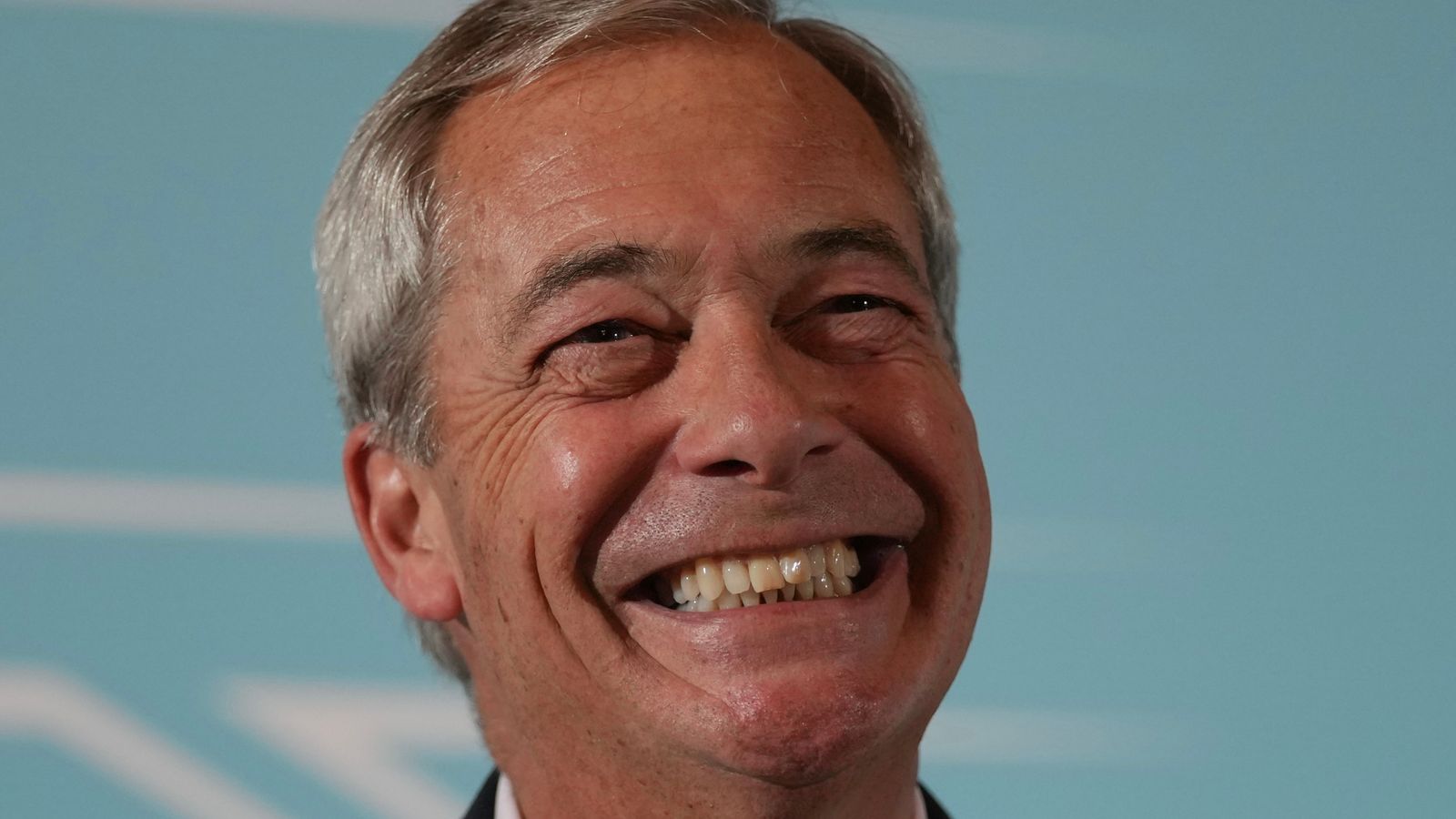
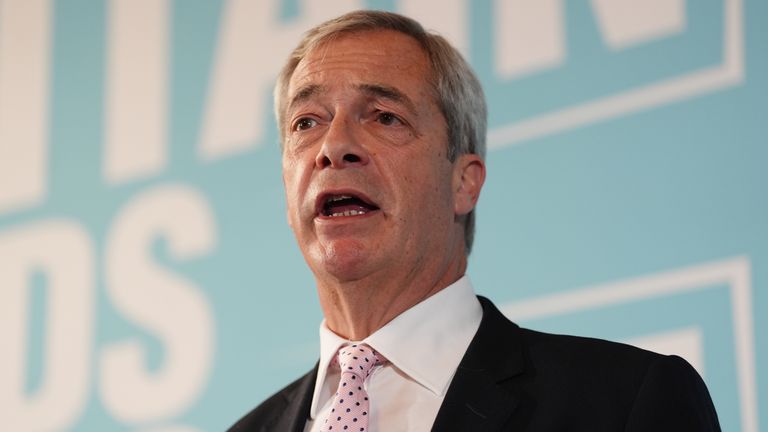
Nigel Farage’s Reform UK have received its largest ever donation, with former Conservative donor Christopher Harborne handing the party £9m.
The donation – one of the largest in British political history – was made in August this year, according to filings from the Electoral Commission.
Mr Harborne, a British businessman based in Thailand, previously donated millions to Reform in 2019, when it was known as the Brexit Party, and has continued to give the party and Mr Farage cash.
Politics latest: Reform gets its largest ever donation
Between 2001 and 2022, he donated close to £2m to the Conservatives, according to Companies House.
The £9m handed to Reform UK on 1 August this year is the largest political donation on record from a living person, after Lord Sainsbury left £10m to the Conservatives in his will in 2023.
Educated in the UK, Mr Harbone is now based in Thailand, where he chairs the investment company Sherriff Global Group.
He also paid around £28,000 for Mr Farage to travel to the US for Donald Trump’s inauguration this year, and roughly £33,000 for the Reform leader to visit the president after the failed assassination attempt in the run-up to the election.
Responding to a question at a news conference from Sky News deputy political editor Sam Coates, Mr Farage said Mr Harborne has business interests all around the world, but his “natural home” was the UK.
Mr Farage says no promises were made in exchange for the money. Pic: PA
He says the donation is “nothing out of the blue”, pointing to Mr Harbone donating significant sums to the Brexit Party.
“I think what he wants to do, really, is to try and help us get onto a level playing field with the trade union funded Labour Party, and a Conservative Party where there seems to be a remarkable correlation, I can’t think why, between donations and membership of the House of Lords,” Mr Farage said.
He added that “hand on heart” he has not promised anything to Mr Harborne in exchange for the money, adding that speaks to the Bangkok-based businessman “maybe once a month, maybe once every six weeks”.
Professor Justin Fisher of Brunel University, an expert in political donations, told Sky News: “It exposes the fact that this is a person who is a British citizen but is able to influence British politics without being subject to the laws that any Reform government might bring in, any tax arrangements that a Reform might bring in.
“This is foreign money by any other name.”
The professor pointed to the fact that in the 2022 Election Act under the Conservatives, the law was changed so that British citizens could live abroad their whole lives and stay on the electoral roll, allowing them to donate.
Previously, the cap had been set at 15 years of living overseas.
He added that it was not surprising to see a person with an interest in a particular policy area – like cryptocurrencies – give money to a political advocating for this cause.
Read more:
Tice denies Tory-Reform pact talks
New rules may stop unlimited donations to Reform UK
Will Tories and Reform unite?
According to the Electoral Commission, political parties raised £24m in the third quarter of this year – up from £10m over the same time period last year, and £11m last quarter.
With the local and national assembly elections coming up in May next year, parties are building their war chests for the campaign.
Reform reported taking a total of £10,526,846, more than the Tories (£7,038,861), Labour (£2,564,786), and the Lib Dems (£2,174,712).
This means Mr Farage’s party raised almost as much as the three main parties combined (£11,778,359).
While the Green Party has reported an increase in donations since Zack Polanski became leader, these figures mostly cover the time before he took office, with the party only accepting £371,753.
Professor Jonathan Hopkin of the London School of Economics told Sky News the donation “shows the power of money in politics if one individual can make such a big difference to the resources available to a political party”.
He added that big donors giving to Reform who also have links to the Tories could separately “pressurise the Conservatives to step aside their candidates in seats that Reform are better placed to win”.
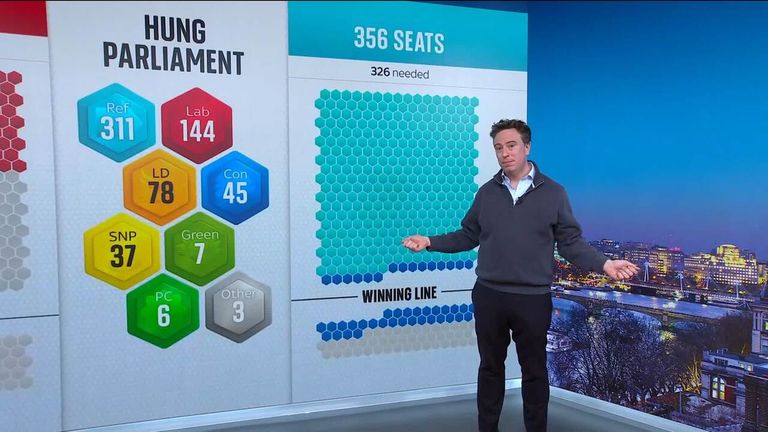
The fact that Reform has received large volumes of cash from a former Tory donor will do nothing to extinguish reports that the two parties are considering an electoral pact in time for the next general election.
The Financial Times reported that such an agreement was spoken about by Mr Farage in a discussion with party donors.
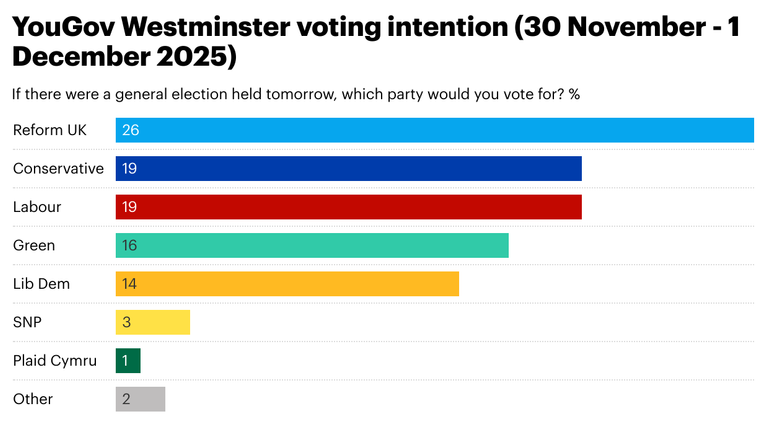
YouGov graphic of voter intention from 30 November to 1 December 2025. Pic: YouGov
👉Listen to Politics at Sam and Anne’s on your podcast app👈
Both the Conservatives and Reform have denied they will do a deal.
Reform currently lead voting intention polls, with the Conservatives and Labour together in joint second place, followed by the Greens.
A spokesperson for the Reform Party said: “This quarter’s figures show the incredible progress Reform UK is making. This is further evidence that we have all the momentum in British politics.”
-
 Sports2 years ago
Story injured on diving stop, exits Red Sox game
-
 Sports3 years ago
‘Storybook stuff’: Inside the night Bryce Harper sent the Phillies to the World Series
-
 Sports2 years ago
Game 1 of WS least-watched in recorded history
-
 Sports3 years ago
Button battles heat exhaustion in NASCAR debut
-
 Sports3 years ago
MLB Rank 2023: Ranking baseball’s top 100 players
-
Sports4 years ago
Team Europe easily wins 4th straight Laver Cup
-
 Environment3 years ago
Japan and South Korea have a lot at stake in a free and open South China Sea
-
 Environment1 year ago
Here are the best electric bikes you can buy at every price level in October 2024