
Tesla shares close down 5% after price cuts, Model 3 refresh

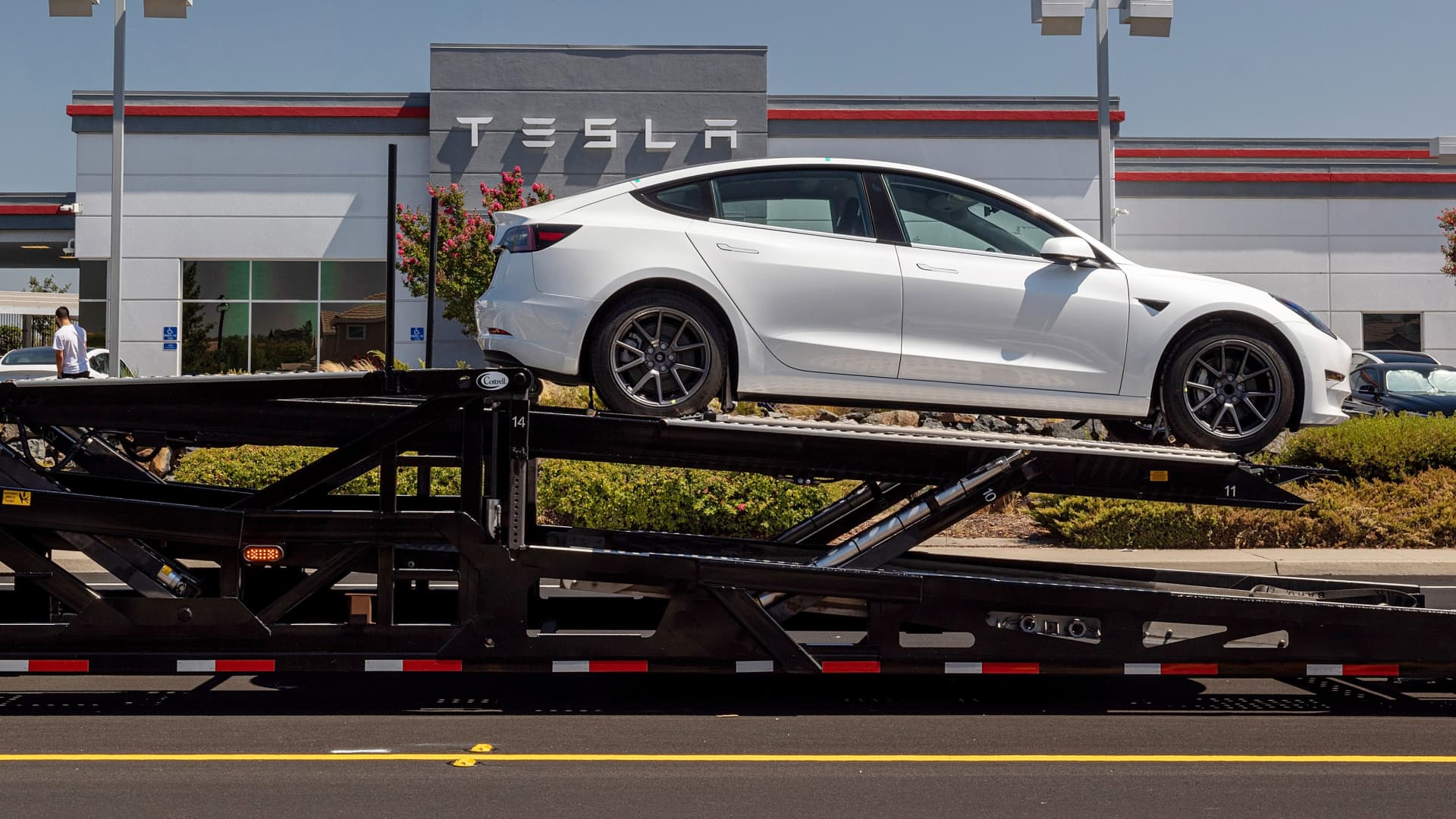
A Tesla Model 3 vehicle on an auto carrier in front of a store in Rocklin, California, July 21, 2021.
David Paul Morris | Bloomberg | Getty Images
Tesla shares dropped 5% Friday after the electric car company cut prices on some models in the U.S. and reduced the price for its premium driver assistance software.
The stock closed at $245.01. It’s still up almost 100% this year after gaining 2.7% for the week.
While Tesla CEO Elon Musk has said in the past that the price of Tesla’s premium driver assistance option, marketed as Full Self-Driving software, would only ever go up, the company cut the price by $3,000 from $15,000 in the U.S. for customers who purchase it upfront rather than through a monthly subscription. Subscribers pay between $99 and $199 per month, depending on whether they’re upgrading from a standard or other premium version.
Tesla is also cutting prices for inventory vehicles in the U.S., including its entry-level Model 3 sedan, luxury Model S sedan and the Model X SUV. In China, Tesla is reducing the price of the Model S and Model X about 7%.
The FSD discount follows reports that the National Highway Traffic Safety Administration is nearing completion of a years-long investigation into possible safety defects of Tesla’s driver assistance systems. The investigation began after a string of crashes into stationary first responder vehicles by Tesla drivers who were thought to be using driver assistance features.
The price cut for some Model X cars in the U.S. makes the SUV eligible for a $7,500 tax break for qualified buyers. However, the price cuts on Model S and X upset some prior customers in the U.S. and in China, who took to social media to complain that the lower price hurts the resale value of their cars and that they’re paying higher insurance costs because their car was more expensive.
Meanwhile, Tesla’s Model 3 refresh, officially revealed Friday, included controversial changes, such as a “stalkless” turn signal. Drivers of the redesigned Model 3 in China and the EU will need to touch a button on the steering wheel to indicate they’re about to change lanes or turn, and can use park, reverse, neutral and drive controls on the touchscreen in lieu of the left-side stalk. The base Model 3 refresh comes with an approximately 12% higher price tag in China compared to its predecessor.
Also known as the “highland,” the Model 3 refresh includes a longer-range battery. The Tesla China website says the higher-end version of the Model 3 refresh can travel up to 713 km (443 miles) on a single charge and the base model can travel 606 km (377 miles). The new Model 3 variant also features several design changes, including a touchscreen that allows passengers in the back to adjust comfort settings and entertainment, along with tweaks to the vehicle’s exterior design, with new colors available.
Due to its pricing, analysts at Bank of America wrote in a note, “We think the impact of the new Model 3 debut on Chinese EV peers should be manageable considering the sedan’s entry price is much high than consumers’ expectation.”
The analysts said the Model 3’s peers in China include XPeng’s P7, BYD’s Han and Seal and Leapmotor’s C01 electric cars.
Considering the increased starting price, initial sales volume for the Model 3 refresh in China may not be as high as previously expected, they said. Still, the analysts remain positive on the outlook for the vehicle’s sales this quarter as consumers have been waiting for the upgrade.
Also this week, Tesla faced reports of new federal probes into the company by the U.S. Securities and Exchange Commission and a Manhattan federal prosecutor about whether it had deliberately misled consumers with its prior EV battery range claims, and improperly used resources to benefit Musk personally.
Regarding the use of company resources, Musk on Friday denied reports that Tesla had plans to build him a “glass house” near Austin, Texas.
Correction: The Model 3 refresh has a haptic turn signal button on the “stalkless” steering wheel and other controls on the touchscreen.


Dado Ruvic | Reuters
Elon Musk’s SpaceX, is initiating a secondary share sale that would give the company a valuation of up to $800 billion, The Wall Street Journal reported Friday.
SpaceX is also telling some investors it will consider going public possibly around the end of next year, the report said.
At the elevated price, Musk’s aerospace and defense contractor would be valued above ChatGPT maker OpenAI, which wrapped up a share sale at a $500 billion valuation in October.
SpaceX has been investing heavily in reusable rockets, launch facilities and satellites, while competing for government contracts with newer space players, including Jeff Bezos‘ Blue Origin. SpaceX is far ahead, and operates the world’s largest network of satellites in low earth orbit through Starlink, which powers satellite internet services under the same brand name.
A SpaceX IPO would include its Starlink business, which the company previously considered spinning out.
Musk recently discussed whether SpaceX would go public during Tesla‘s annual shareholders meeting last month. Musk, who is the CEO of both companies, said he doesn’t love running publicly traded businesses, in part because they draw “spurious lawsuits,” and can “make it very difficult to operate effectively.”
However, Musk said during the meeting that he wanted to “try to figure out some way for Tesla shareholders to participate in SpaceX,” adding, “maybe at some point, SpaceX should become a public company despite all the downsides.”
WATCH: What retail investors should know about OpenAI and SpaceX


The logo for Google LLC is seen at the Google Store Chelsea in Manhattan, New York City, U.S., November 17, 2021.
Andrew Kelly | Reuters
A U.S. judge on Friday finalized his decision for the consequences Google will face for its search monopoly ruling, adding new details to the decided remedies.
Last year, Google was found to hold an illegal monopoly in its core market of internet search, and in September, U.S. District Judge Amit Mehta ruled against the most severe consequences that were proposed by the Department of Justice.
That included the proposal of a forced sale of Google’s Chrome browser, which provides data that helps the company’s advertising business deliver targeted ads. Alphabet shares popped 8% in extended trading as investors celebrated what they viewed as minimal consequences from a historic defeat last year in the landmark antitrust case.
Investors largely shrugged off the ruling as non-impactful to Google. However some told CNBC it’s still a bite that could “sting.”
Mehta on Friday issued additional details for his ruling in new filings.
“The age-old saying ‘the devil is in the details’ may not have been devised with the drafting of an antitrust remedies judgment in mind, but it sure does fit,” Mehta wrote in one of the Friday filings.
Google did not immediately respond to a request for comment. The company has previously said it will appeal the remedies.
In August 2024, Mehta ruled that Google violated Section 2 of the Sherman Act and held a monopoly in search and related advertising. The antitrust trial started in September 2023.
In his September decision, Mehta said the company would be able to make payments to preload products, but it could not have exclusive contracts that condition payments or licensing. Google was also ordered to loosen its hold on search data. Mehta in September also ruled that Google would have to make available certain search index data and user interaction data, though “not ads data.”
The DOJ had asked Google to stop the practice of “compelled syndication,” which refers to the practice of making certain deals with companies to ensure its search engine remains the default choice in browsers and smartphones.
The judge’s September ruling didn’t end the practice entirely — Mehta ruled out that Google couldn’t enter into exclusive deals, which was a win for the company. Google pays Apple billions of dollars per year to be the default search engine on iPhones. It’s lucrative for Apple and a valuable way for Google to get more search volume and users.
Mehta’s new details
In the Friday filings, Mehta wrote that Google cannot enter into any deal like the one it’s had with Apple “unless the agreement terminates no more than one year after the date it is entered.”
This includes deals involving generative artificial intelligence products, including any “application, software, service, feature, tool, functionality, or product” that involve or use genAI or large-language models, Mehta wrote.
GenAI “plays a significant role in these remedies,” Mehta wrote.
The judge also reiterated the web index data it will require Google to share with certain competitors.
Google has to share some of the raw search interaction data it uses to train its ranking and AI systems, but it does not have to share the actual algorithms — just the data that feeds them.” In September, Mehta said those data sets represent a “small fraction” of Google’s overall traffic, but argued the company’s models are trained on data that contributed to Google’s edge over competitors.
The company must make this data available to qualified competitors at least twice, one of the Friday filing states. Google must share that data in a “syndication license” model whose term will be five years from the date the license is signed, the filing states.
Mehta on Friday also included requirements on the makeup of a technical committee that will determine the firms Google must share its data with.
Committee “members shall be experts in some combination of software engineering, information retrieval, artificial intelligence, economics, behavioral science, and data privacy and data security,” the filing states.
The judge went on to say that no committee member can have a conflict of interest, such as having worked for Google or any of its competitors in the six months prior to or one year after serving in the role.
Google is also required to appoint an internal compliance officer that will be responsible “for administering Google’s antitrust compliance program and helping to ensure compliance with this Final Judgment,” per one of the filings. The company must also appoint a senior business executive “whom Google shall make available to update the Court on Google’s compliance at regular status conferences or as otherwise ordered.”
This is breaking news. Check back for updates.

-
 Sports2 years ago
Story injured on diving stop, exits Red Sox game
-
 Sports3 years ago
‘Storybook stuff’: Inside the night Bryce Harper sent the Phillies to the World Series
-
 Sports2 years ago
Game 1 of WS least-watched in recorded history
-
 Sports3 years ago
Button battles heat exhaustion in NASCAR debut
-
 Sports3 years ago
MLB Rank 2023: Ranking baseball’s top 100 players
-
Sports4 years ago
Team Europe easily wins 4th straight Laver Cup
-
 Environment3 years ago
Japan and South Korea have a lot at stake in a free and open South China Sea
-
 Environment1 year ago
Here are the best electric bikes you can buy at every price level in October 2024