

Appellate judge denies Sam Bankman-Fried’s request for immediate release from jail


Former FTX CEO Sam Bankman-Fried, also known as SBF, lost an initial appeal to return to being free on bail prior to his criminal trial.
In a Sept. 6 filing in the United States Court of Appeals for the Second Circuit, Clerk of the Court Catherine O’Hagan Wolfe said a circuit judge had denied a motion from SBF’s legal team requesting his immediate release from the Metropolitan Detention Center in Brooklyn. The former FTX CEO’s lawyers had petitioned the court for temporary release, claiming the current measures aimed at allowing SBF to help prepare for his defense at trial were inadequate due in part to limited internet access.
“The motion for pretrial release is referred to the next available three-judge panel,” said Wolfe. “To the extent Appellant requests his immediate release pending decision by the three-judge panel, that request is denied.”
Following his extradition from the Bahamas and arraignment in the U.S. in December 2022, Bankman-Fried had been free on a $250 million bond and largely confined to his parents’ California home. However, a federal judge revoked his bail on Aug. 11 following allegations of witness intimidation toward former Alameda Research CEO Caroline Ellison, with whom SBF shared a personal and professional relationship.
Related: Sam Bankman-Fried appeal against bail revocation ‘meritless’: Prosecutors
Bankman-Fried’s lawyers have made several filings following the judge’s decision on bail, requesting SBF have more time to review evidence in the visitor’s room at the Brooklyn jail as well as the New York courthouse cell block attorney room, where he can be allowed access given sufficient notice to the court. The former FTX CEO has roughly four weeks before his Oct. 3 trial is scheduled to begin.
Magazine: Can you trust crypto exchanges after the collapse of FTX?

Sir Keir Starmer has declared it his “moral mission” to “turn the tide on the lost decade of young kids left as collateral damage”.
The government launches its 10-year youth plan today, which has pledged £500m to reviving youth services.
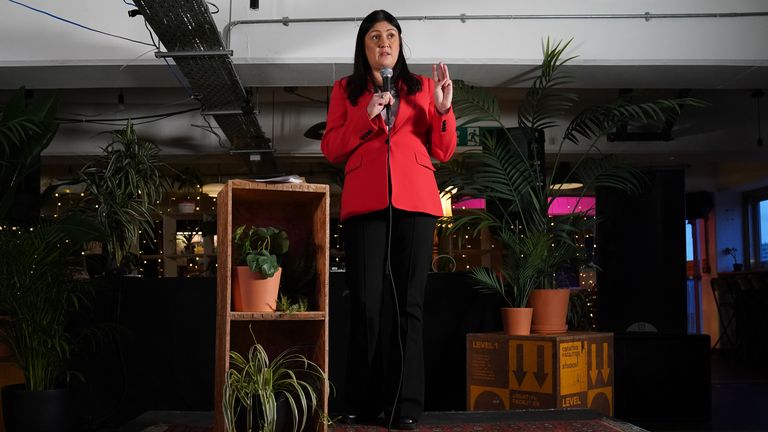
Culture Secretary Lisa Nandy has also warned that young people are now “the most isolated in generations” and face challenges that are “urgent and demand a major change in direction”.
But despite the strong language, the Conservatives have warned that “under Labour, the outlook for the next generation is increasingly bleak”.
Lisa Nandy is on Sky News from 7am – follow live
Launching the 10-year strategy, Sir Keir said: “As a dad and as prime minister, I believe it is our generation’s greatest responsibility to turn the tide on the lost decade of young kids left as collateral damage. It is our moral mission.
“Today, my government sets out a clear, ambitious and deliverable plan – investing in the next generation so that every child has the chance to see their talents take them as far as their ability can.”
What’s in the government’s strategy?
Under the plans, the government will seek to give 500,000 more young people across England access to a trusted adult outside their homes – who are assigned through a formal programme – and online resources about staying safe.
The prime minister said the plans will also “ensure” that those who choose to do apprenticeships rather than go to university “will have the same respect and opportunity as everyone else”.
The plan comes following a so-called “state of the nation” survey commissioned by Ms Nandy, which heard from more than 14,000 young people across England.
Launching the strategy, she said: “Young people have been crystal clear in speaking up in our consultation: they need support for their mental health, spaces to meet with people in their communities and real opportunities to thrive. We will give them what they want.”
Read more:
Child poverty strategy launched
Young people may lose benefits
Lisa Nandy will speak about the plan on Sky News on Wednesday morning. Pic: PA
But the Conservatives have criticised the government for scrapping the National Citizen Service (NCS), which ended in March this year.
Shadow culture secretary Nigel Huddlestone said “any renewed investment in youth services is of course welcome”, but said Labour’s “economic mismanagement and tax hikes are forcing businesses to close, shrinking opportunities while inflation continues to climb”.

The US Office of the Comptroller of the Currency has affirmed that national banks can intermediate cryptocurrency trades as riskless principals without holding the assets on their balance sheets, a move that brings traditional banks a step closer to offering regulated crypto brokerage services.
In an interpretive letter released on Tuesday, the regulator said banks may act as principals in a crypto trade with one customer while simultaneously entering an offsetting trade with another, a structure that mirrors riskless principal activity in traditional markets.
“Several applicants have discussed how conducting riskless principal crypto-asset transactions would benefit their proposed bank’s customers and business, including by offering additional services in a growing market,” notes the document.
According to the OCC, the move would allow customers “to transact crypto-assets through a regulated bank, as compared to non-regulated or less regulated options.”

The letter also reiterates that banks must confirm the legal permissibility of any crypto activity and ensure it aligns with their chartered powers. Institutions are expected to maintain procedures for monitoring operational, compliance and market risks.
“The main risk in riskless principal transactions is counterparty credit risk (in particular, settlement risk),” reads the letter, adding that “managing counterparty credit risk is integral to the business of banking, and banks are experienced in managing this risk.”
The agency’s guidance cites 12 U.S.C. § 24, which permits national banks to conduct riskless principal transactions as part of the “business of banking.” The letter also draws a distinction between crypto assets that qualify as securities, noting that riskless principal transactions involving securities were already clearly permissible under existing law.
The OCC’s interpretive letter — a nonbinding guidance that outlines the agency’s view of which activities national banks may conduct under existing law — was issued a day after the head of the OCC, Jonathan Gould, said crypto firms seeking a federal bank charter should be treated the same as traditional financial institutions.
According to Gould, the banking system has the “capacity to evolve,” and there is “no justification for considering digital assets differently” than traditional banks, which have offered custody services “electronically for decades.”
Related: Trump’s national security strategy is silent on crypto, blockchain
From ‘Choke Point 2.0’ to pro-crypto policy
Under the Biden administration, some industry groups and lawmakers accused US regulators of pursuing an “Operation Choke Point 2.0” approach that increased supervisory pressure on banks and firms interacting with crypto.
Since President Trump took office in January after pledging to support the sector, the federal government has moved in the opposite direction, adopting a more permissive posture toward digital asset activity.
Magazine: Quantum attacking Bitcoin would be a waste of time: Kevin O’Leary

CryptoUK, a UK-based cryptocurrency trade association, has announced that it will join The Digital Chamber, a US crypto policy advocacy group, potentially marking a significant cross-collaboration on digital asset regulation between the two countries.
In a Tuesday notice, CryptoUK said its team would fall under The Digital Chamber’s umbrella as part of a “unified, cross-border advocacy platform.” Both groups have worked in their respective countries to promote policies favoring the cryptocurrency and blockchain industry, starting with The Digital Chamber in 2014 and CryptoUK in 2018.
“CryptoUK has always aspired to ensure we are driven by policy-led issues, member collaboration, and regulatory engagement,” said Su Carpenter, CryptoUK’s executive director.

The partnership between the two advocacy groups comes as US lawmakers move forward on negotiations to pass a digital asset market structure bill, aiming to establish regulatory clarity for the industry. In the UK, policymakers announced plans to collaborate with their counterparts in the US to explore crypto laws and regulations.
Related: Digital Chamber seeks to guide crypto policy across US states
US-based crypto advocacy organizations, such as The Digital Chamber, have garnered support from former regulators and members of Congress as the Trump White House directs policies toward the industry. Among these groups are the Solana Policy Institute, the Blockchain Association, the Crypto Council for Innovation, and the American Innovation Project.
UK central bank moves forward on stablecoins
On Nov. 10, the Bank of England released a consultation paper to propose a framework for “sterling-denominated systemic stablecoins.” The move by the country’s central bank marked a step toward the UK seeming to play catch-up to the US, where the government passed a law regulating payment stablecoins in July.
Bank of England Deputy Governor Sarah Breeden signaled before the publication of the paper that the central bank’s actions were in response to the US advancing stablecoin policies, and it was “really important” to be synchronized on rules.
Magazine: When privacy and AML laws conflict: Crypto projects’ impossible choice
-
 Sports2 years ago
Story injured on diving stop, exits Red Sox game
-
 Sports3 years ago
‘Storybook stuff’: Inside the night Bryce Harper sent the Phillies to the World Series
-
 Sports2 years ago
Game 1 of WS least-watched in recorded history
-
 Sports3 years ago
Button battles heat exhaustion in NASCAR debut
-
 Sports3 years ago
MLB Rank 2023: Ranking baseball’s top 100 players
-
Sports4 years ago
Team Europe easily wins 4th straight Laver Cup
-
 Environment3 years ago
Japan and South Korea have a lot at stake in a free and open South China Sea
-
 Environment1 year ago
Here are the best electric bikes you can buy at every price level in October 2024